Awesome Growth Hacking
Turn this article into takeaways for your work.


Each assistant summarizes the article only for you and suggests best practices for your work.
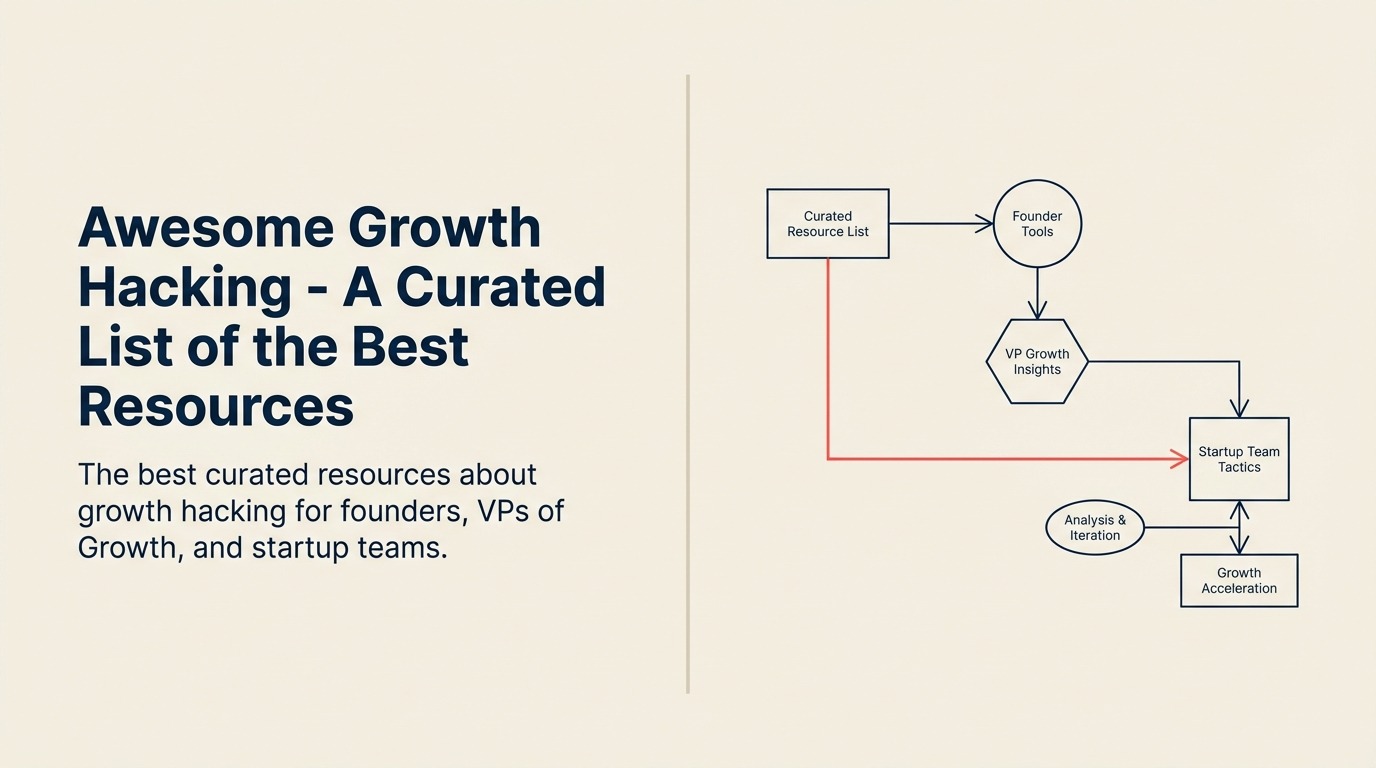
This page collects the best business resources for growth hacking in one curated list: the essays, books, tools, templates, case studies, and communities that growth teams actually use. Everything below is hand-picked for lasting value over trend-chasing, so founders and growth leads can skip the noise and go straight to what works.
A curated list of the best resources about growth hacking, experimentation-driven growth, and sustainable acquisition for founders and growth teams.
Inspired by awesome lists. Maintained by Rework.
Contents
- Articles
- Books
- Videos & Talks
- Tools & Software
- Templates & Frameworks
- Case Studies & Real-World Examples
- Communities & Newsletters
- Rework Resources
Articles
Growth hacking has evolved well past its "hack everything" origins. The best writing now focuses on building sustainable growth systems, not short-term tricks. These are the essays and articles worth reading more than once.
- Growth Hacker is the New VP Marketing by Andrew Chen - The essay that started the growth hacking movement, with Airbnb/Craigslist case study.
- 10 Years After "Growth Hacking" by Andrew Chen - A candid retrospective on what worked and what the term got wrong.
- The State of Growth Hacking at andrewchen.com - A guest essay reviewing how growth practice has matured across the industry.
- Andrew Chen and the State of Growth Hacking via Mixpanel - A conversation on modern growth strategy and product analytics.
- GrowthHackers Blog by Sean Ellis - The largest curated database of growth experiments, case studies, and AMA sessions.
- The Reforge Growth Series - Strategy-level content from practitioners who have run growth at Airbnb, HubSpot, and Duolingo.
- Sean Ellis on Finding Product-Market Fit via First Round Review - The Sean Ellis PMF survey methodology explained in depth.
- How Dropbox Got Its First 10 Million Users via TechCrunch - The original Dropbox referral loop case study and viral coefficient breakdown.
- Slack's Growth Story at First Round Review - How Slack grew through word-of-mouth before any traditional marketing.
- The Evolution of Growth Hacking in 2025 - Where the discipline stands today and what "sustainable growth" looks like.
Books
These are the titles that have shaped how growth teams think and operate. They are ranked from foundational to advanced.
- Hacking Growth by Sean Ellis & Morgan Brown - The definitive playbook for building a cross-functional growth team and running experiments at scale.
- Traction by Gabriel Weinberg & Justin Mares - A framework for testing 19 customer acquisition channels to find what works for your specific startup.
- The Lean Startup by Eric Ries - Build-measure-learn cycles that underpin the experimental mindset every growth team needs.
- Hooked by Nir Eyal - How to design habit loops that drive retention and organic word-of-mouth growth.
- Obviously Awesome by April Dunford - Product positioning as a growth lever: how framing drives conversion and reduces churn.
Videos & Talks
- How to Get Your First 1,000 Users - Y Combinator lecture on early-stage growth tactics from founders who have done it.
- Growth for Startups - Y Combinator's How to Start a Startup series covering distribution and growth loops.
- Andrew Chen at Stanford on Network Effects - A deep look at how network effects compound growth in marketplace and social products.
- Brian Balfour on Building a Growth Machine - Reforge founder on why most growth efforts fail and how to build a system that doesn't.
- Sean Ellis on the GrowthHackers Methodology - How to run a high-tempo growth process inside any company.
Tools & Software
These tools form the core growth stack for most early-stage and mid-market companies. The right combination depends on your team's maturity and the channels you're testing.

- Amplitude - Product analytics platform for measuring activation, retention, and feature impact.
- Mixpanel - Event-based analytics for tracking user behavior across web and mobile products.
- PostHog - Open-source product analytics with session recording, feature flags, and A/B testing.
- GrowthBook - Open-source A/B testing and feature flagging platform built for engineering teams.
- Optimizely - Enterprise-grade experimentation platform for web, mobile, and full-stack testing.
- LaunchDarkly - Feature flag management for controlled rollouts and targeted experiments.
- Heap - Autocapture analytics that retroactively lets you analyze any user action without pre-tagging.
- ReferralHero - Build and manage referral programs that drive viral growth loops.
Templates & Frameworks
Together, these frameworks help teams diagnose a funnel, choose a North Star, structure tests, and prioritize the next experiment.
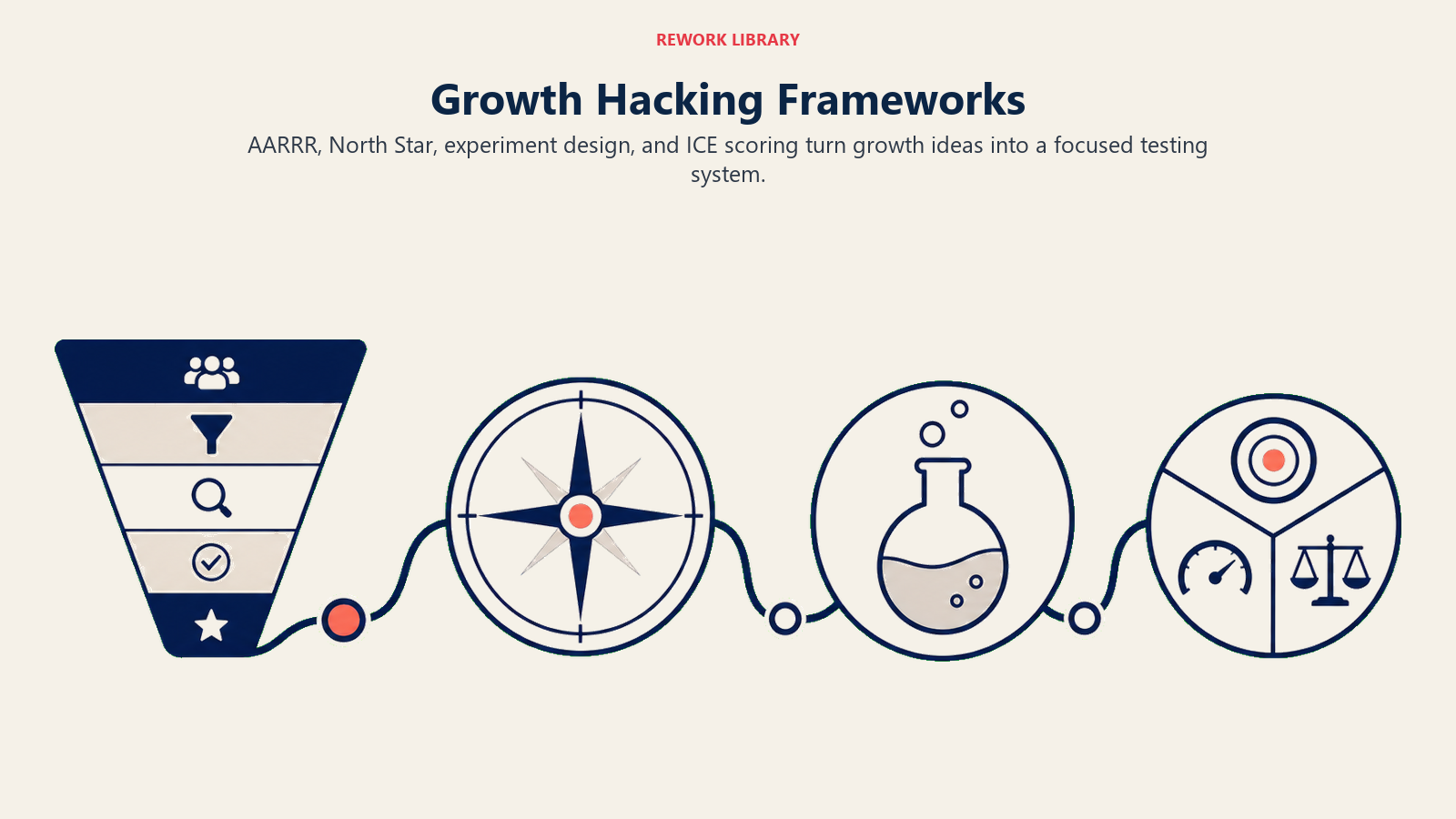
- AARRR Pirate Metrics Framework - Dave McClure's Acquisition, Activation, Retention, Revenue, Referral funnel template for identifying growth bottlenecks.
- ICE Scoring Framework - Impact, Confidence, Effort prioritization model for ranking growth experiments quickly.
- Aha Moment Optimization via Rework - How to identify and systematically accelerate the moment new users first experience your product's core value - the single highest-leverage activation experiment most growth teams run.
Case Studies & Real-World Examples
These are real examples of growth hacking in practice - showing what the tactics look like when they work, and why context determines whether they translate to other businesses.
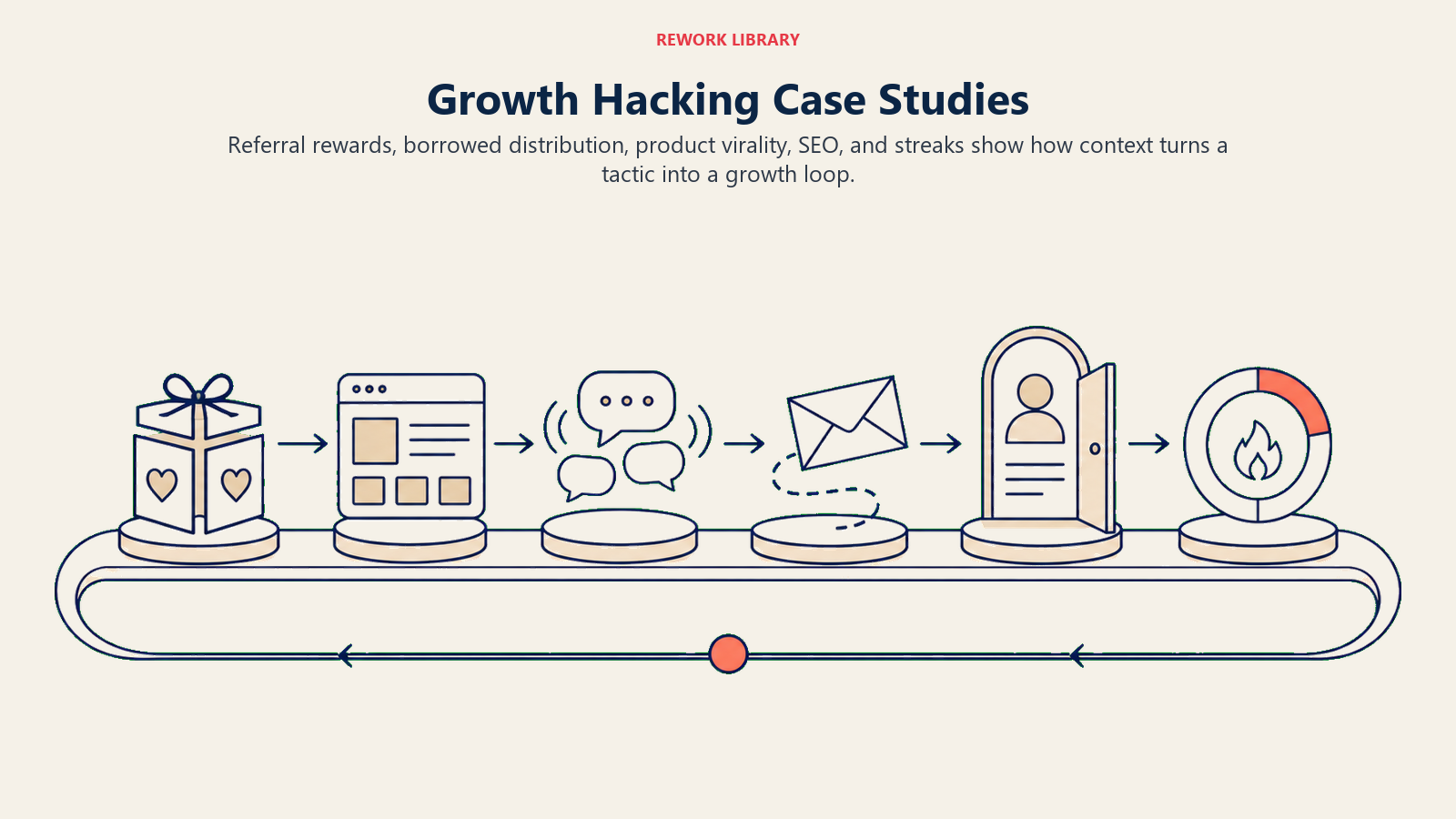
Dropbox - Launched a double-sided referral program in 2008 that gave both referrer and new user 500MB of free storage per successful signup. The program drove 60% of all new signups within the first year and grew the user base from 100,000 to 4 million in 15 months - without paid advertising. The lesson: referral works when the product itself is the reward. Source
Airbnb - Integrated with Craigslist in 2010 to auto-post Airbnb listings to the much larger platform, capturing high-intent housing searchers at zero acquisition cost. The tactic required reverse-engineering a platform that had no official API - technically complex but strategically decisive in Airbnb's early growth phase. It demonstrates how growth hacking often means finding distribution channels others haven't claimed yet. Source
Slack - Signed up about 8,000 companies in the first 24 hours after its August 2013 preview-launch announcement, driven by word-of-mouth and press coverage rather than paid acquisition. Stewart Butterfield deliberately targeted early adopters at tech companies, knowing they would spread it internally. After the February 2014 public launch, Slack reached 500,000 daily active users across 60,000 teams by its first anniversary in February 2015, and 8 million by May 2018. First 24 hours | 500K DAU | Launch strategy
Duolingo - Used streak mechanics and loss aversion (you'll lose your streak if you don't practice today) to drive daily active usage above 50% of registered users - exceptional for an app in the education category. Retention, not acquisition, became Duolingo's growth engine, with 70%+ of new users coming from word-of-mouth by 2023. The case shows how product design can replace paid acquisition at scale. Source
Communities & Newsletters
- GrowthHackers - The original growth hacking community founded by Sean Ellis, with case studies, AMAs, and discussion threads.
- Reforge Network - Premium cohort-based programs and a practitioner network for experienced growth professionals.
- Lenny's Newsletter - Weekly research and benchmarks on product growth, retention, and GTM strategy for product leaders.
Rework Resources
Explore more content on the Rework blog:
- Aha Moment Optimization - How to identify and accelerate the moment new users first experience your product's core value.
- Growth Strategy Frameworks - A practical overview of growth frameworks used by leading SaaS and consumer companies.
- Awesome Growth Frameworks - A companion list of vetted frameworks for structuring growth strategy.
- Awesome SaaS Growth - Curated resources on scaling SaaS revenue, activation, and retention.
- Awesome Customer Retention - The retention reading list that pairs with experimentation-driven growth.
- Awesome Content Marketing - Distribution and content resources for sustainable acquisition.
Frequently Asked Questions
What is growth hacking? Growth hacking is a discipline that uses rapid experimentation across marketing, product, and engineering to find the most efficient ways to grow a business. Modern practice focuses on building repeatable growth systems and improving retention, not one-off tricks.
What are the best resources to learn growth hacking? Start with Sean Ellis and Morgan Brown's book Hacking Growth, Andrew Chen's essays, and Brian Balfour's work at Reforge. For tools, product analytics platforms like Amplitude, Mixpanel, and PostHog form the core of most growth stacks. All of these are linked above with context.
Are growth hacking tactics still effective in 2026? The flashy one-off tactics matter less now, but the underlying method (test fast, measure, double down on what works) is more relevant than ever. The strongest results today come from retention, activation, and product-led loops rather than acquisition gimmicks.
Which tools belong in a growth stack? Most early and mid-market teams run a product analytics tool (Amplitude, Mixpanel, or PostHog), an experimentation or feature-flag platform (GrowthBook, Optimizely, or LaunchDarkly), and a referral tool. The right combination depends on your team's maturity and the channels you're testing.
Contributing
Know a great resource that belongs on this list? Let us know.
Links verified. Focused on resources with lasting value beyond any single trend cycle.