Awesome Project Management
Turn this article into takeaways for your work.


Each assistant summarizes the article only for you and suggests best practices for your work.
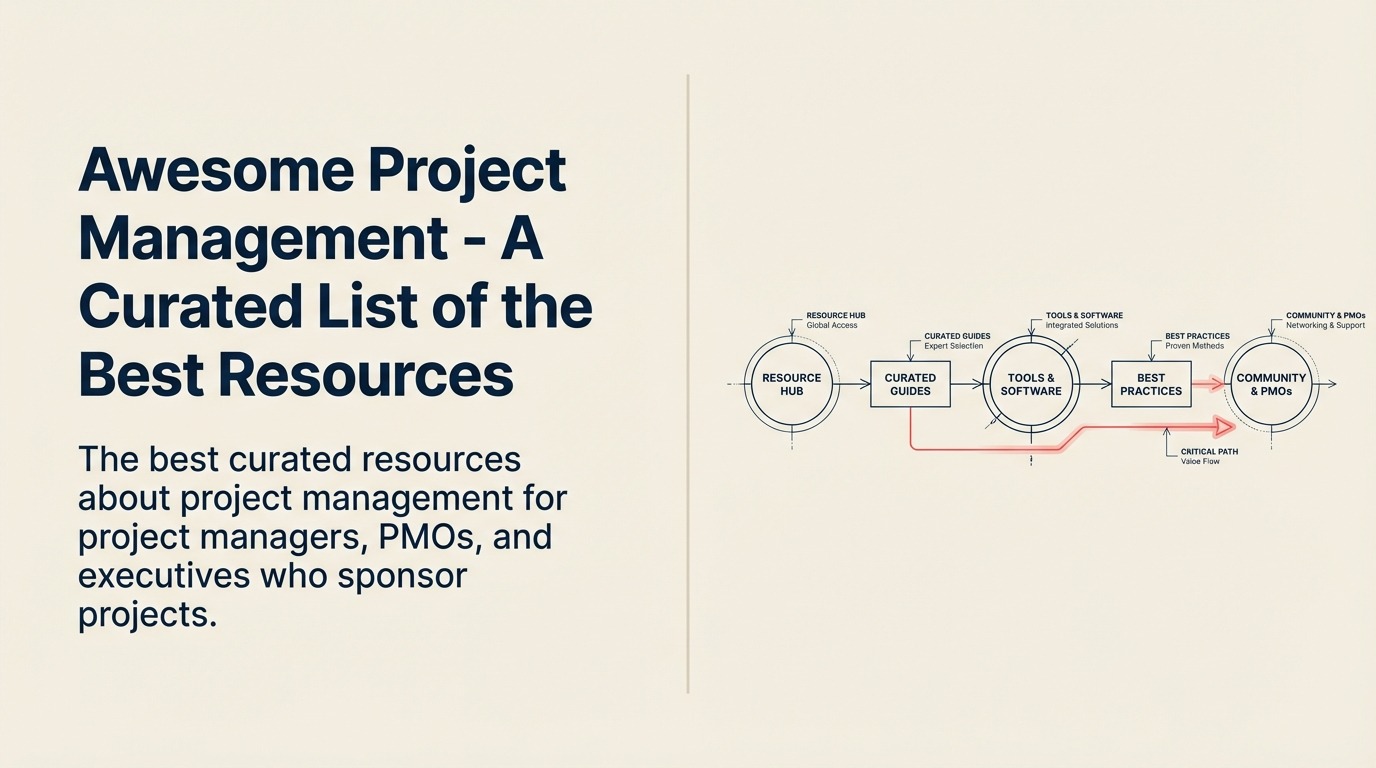
A curated list of the best resources about project management - covering Waterfall, Agile, Scrum, Kanban, and hybrid approaches - for project managers, PMOs, and business leaders.
Inspired by awesome lists. Maintained by Rework.
Contents
- Articles
- Books
- Videos & Talks
- Tools & Software
- Templates & Frameworks
- Case Studies & Real-World Examples
- Communities & Newsletters
- Rework Resources
Articles
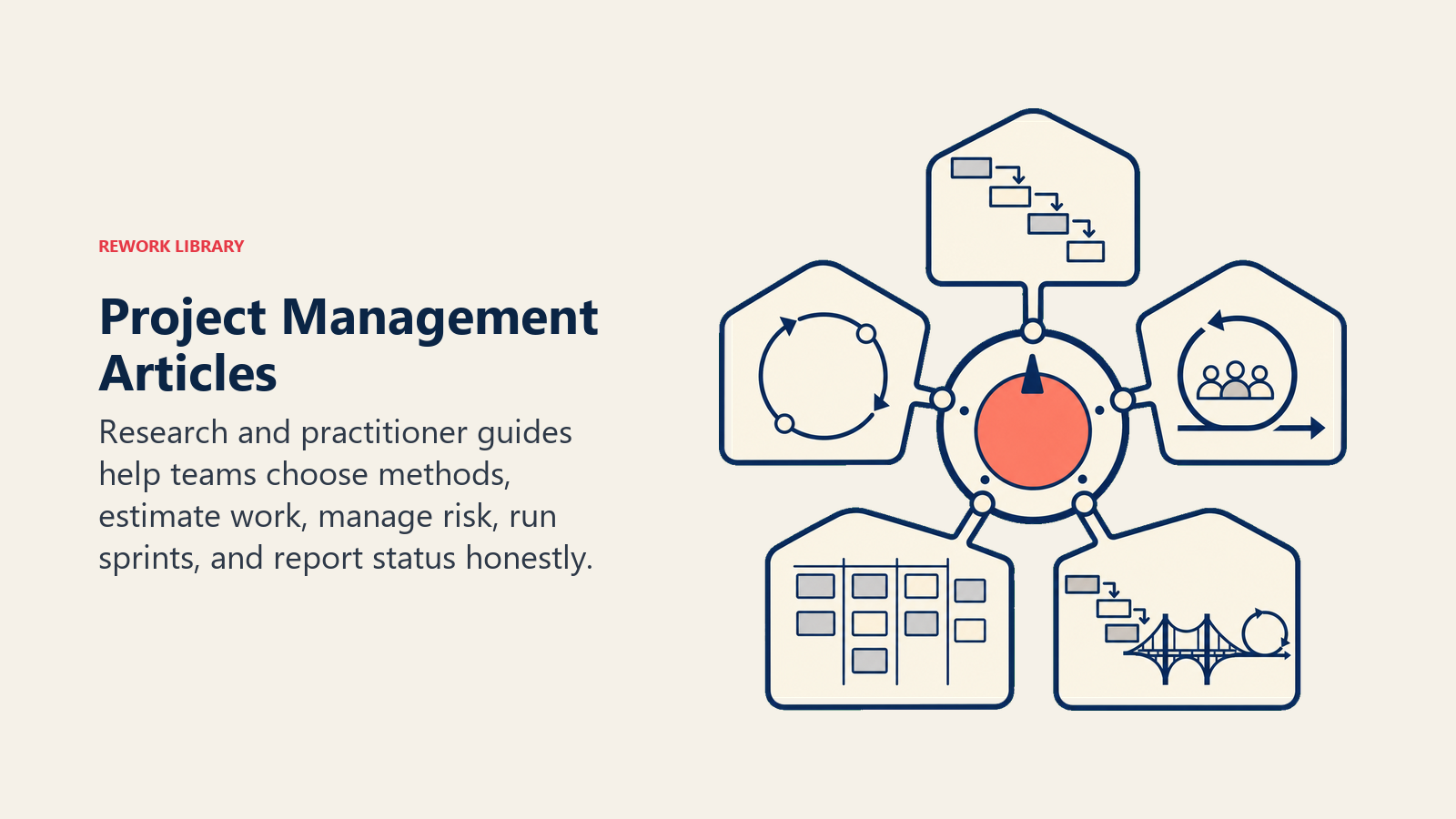
Most projects don't fail because of bad tools or wrong methodologies. They fail because of unclear scope, poor stakeholder alignment, and absence of honest status reporting. These articles address the real causes.
- Agile Resources for Project Management by PMI - PMI's official learning hub for Agile methods including Scrum, Kanban, SAFe, and hybrid approaches.
- Agile Practice Guide by PMI - Created with the Agile Alliance, this guide bridges traditional PM thinking and Agile practice for PMs in transition.
- Agile Alliance Joins PMI - The January 2025 merger that unified the world's two largest PM bodies under one roof.
- Project Management Jobs Are Growing by Scrum Alliance - BLS data showing 6% projected PM job growth through 2034, faster than average occupations.
- How to Choose Between Waterfall, Agile, and Hybrid by Atlassian - A decision framework for matching your methodology choice to project type and team context.
- Why Projects Fail at Harvard Business Review - Research on why large projects consistently overrun budgets and timelines - and what to do differently.
- The Art of the Sprint by Atlassian - How to run effective sprints, including planning, daily standups, review, and retrospective.
- Mike Cohn on Estimating with Story Points at Mountain Goat Software - The definitive explanation of story points and why they work better than time estimates.
- PMI's Pulse of the Profession - Annual research on project success rates, talent trends, and what high-performing organizations do differently.
- Essential Tools for Project Management Professionals in 2025 by Agile Seekers - A curated breakdown of the PM tools that experienced practitioners actually recommend.
- Scrum vs Kanban: Which One Does Your Team Need? by Atlassian - A clear comparison of when to use each framework based on team type and work pattern.
Books
- Scrum: The Art of Doing Twice the Work in Half the Time by Jeff Sutherland - The Scrum co-creator's accessible guide to the framework, with real examples from military, finance, and tech.
- Project Management for the Unofficial Project Manager by Kory Kogon - For business professionals who run projects without a PM title or formal training.
- Making Things Happen by Scott Berkun - A candid, experienced-practitioner take on what actually determines project success in real organizations.
- The Lean Startup by Eric Ries - Build-measure-learn thinking that applies directly to iterative project delivery and scope management.
- Drive by Daniel Pink - What motivates project teams and why traditional management approaches undermine performance.
Videos & Talks
- Jeff Sutherland: Scrum at Scale - The Scrum co-creator on applying Scrum principles beyond individual teams to entire organizations.
- PMI: How to Use the PMBOK Guide - PMI's official walkthrough of the Project Management Body of Knowledge for certification candidates and practitioners.
- Atlassian: Running Effective Retrospectives - A practical guide to making sprint retrospectives genuinely useful rather than a formality.
- How to Build a WBS (Work Breakdown Structure) - Step-by-step creation of a work breakdown structure for any project type.
- Agile vs Waterfall: Making the Right Choice - A practitioner's guide to choosing methodology based on project characteristics and stakeholder needs.
Tools & Software
The right PM tool depends on team size, methodology, and how technical your stakeholders are. These are the platforms with the strongest track records.
- Asana - Work management platform for cross-functional teams managing projects, campaigns, and operations.
- Jira - The industry standard for Agile software development teams tracking epics, stories, and sprints.
- Linear - Fast, opinionated project tracker loved by product and engineering teams for its speed and simplicity.
- Monday.com - Visual work OS for non-technical teams managing projects across marketing, HR, and operations.
- ClickUp - All-in-one project management platform combining tasks, docs, goals, and time tracking.
- Notion - Flexible workspace used for project documentation, wikis, and lightweight task tracking.
- Smartsheet - Spreadsheet-style project management for teams comfortable with Excel but needing collaboration.
- Microsoft Project - Enterprise project planning with Gantt charts, resource management, and portfolio-level reporting.
Templates & Frameworks
Together, these artifacts turn project governance into repeatable decisions about scope, ownership, risk, cadence, and learning.
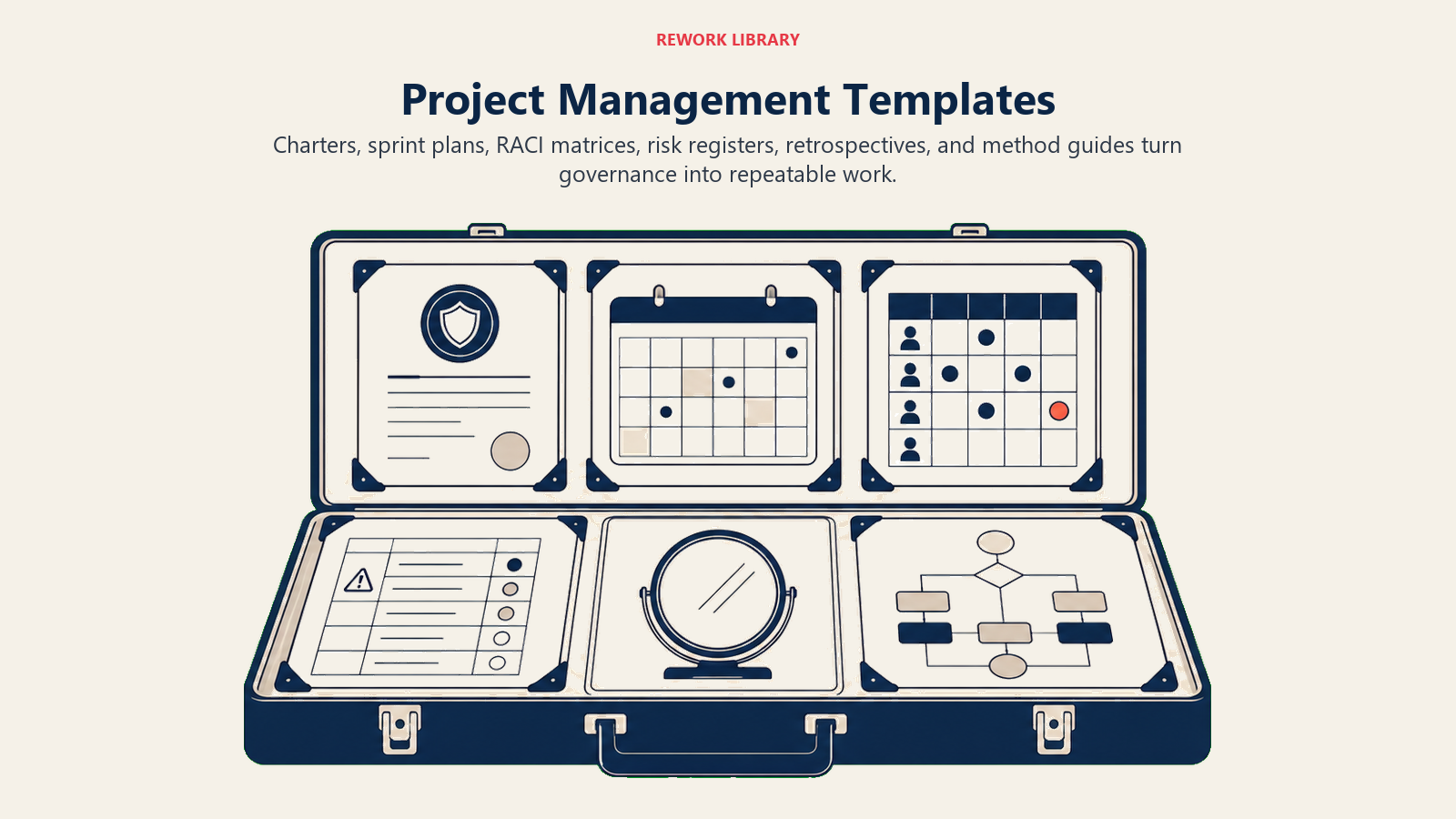
- Project Charter Template by PMI - A structured one-pager that defines project purpose, scope, stakeholders, and success criteria before work begins.
- Sprint Planning Template by Miro - A visual template for sprint planning meetings that keeps teams aligned on goals and capacity.
- RACI Matrix Template by Lucidchart - A responsibility assignment matrix that eliminates ambiguity about who decides, does, is consulted, and informed.
- Project Retrospective Template by Miro - A facilitated template for capturing what went well, what didn't, and what to do differently next sprint.
- Project Management Frameworks via Rework - A side-by-side comparison of Waterfall, Scrum, Kanban, PRINCE2, and hybrid approaches - with specific guidance on which one fits each type of project and team context, including the construction vs. software distinction explored in the case studies below.
Case Studies & Real-World Examples
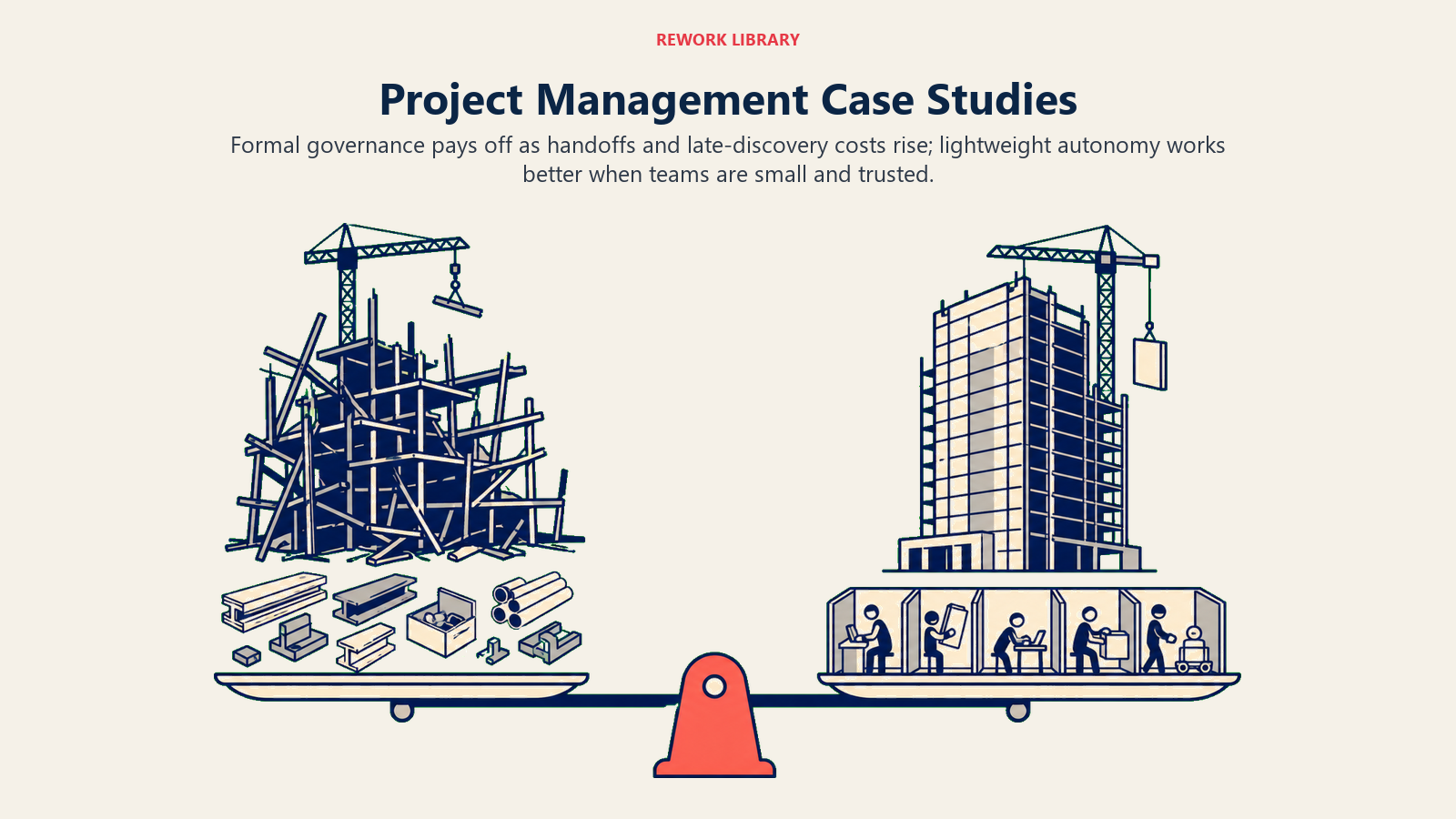
One of the most useful questions an executive can ask before investing in formal project management is: does this situation actually need it? These examples span five industries - including one cautionary failure - to help you answer that question for your own context. The pattern that emerges is straightforward: the higher the cost of late discovery and the more handoffs between teams, the more formal PM pays for itself.
Construction (Sydney Opera House) - PM failure turned cautionary classic - The Sydney Opera House, completed in 1973, was budgeted at AUD $7 million and was expected to take 4 years. It took 16 years and cost AUD $102 million - 1,400% over budget. The project lacked formal scope control, had no change management process, and the architect and construction teams operated without a unified project governance structure. The consequence was that design changes cascaded into structural rework, which cascaded into cost overruns, which cascaded into political crisis. Today it's the standard example cited in engineering PM courses for why large physical infrastructure projects with interdependent phases need rigorous change control before a single concrete pour. Source
Manufacturing (Boeing 787 Dreamliner) - PM prevents costly delays, until it doesn't - Boeing's 787 program, launched in 2004, used an unprecedented outsourced supply chain model across 50+ global suppliers. The initial PM framework assumed components would arrive ready-to-assemble. Instead, suppliers delivered parts that didn't fit, lacked proper documentation, and required Boeing to reverse-integrate work it had outsourced. The result was a 3-year delivery delay and $32 billion in cost overruns. The lesson: PM frameworks need to govern not just your team's work but every interdependency in the delivery chain. When you outsource execution, you can't outsource accountability. Source
Software startup (Spotify) - Lightweight PM at scale - Spotify replaced traditional project management with "Squads, Tribes, Chapters, and Guilds" - a model published in 2012 that gave small autonomous teams end-to-end ownership of product areas. There were no centralized PMs coordinating between teams; instead, each squad owned its backlog and release cycle. By 2015, Spotify was shipping product updates hundreds of times per week. The tradeoff was real: inter-squad coordination became harder as the company grew, and Spotify itself later evolved the model. But the case established that small, high-trust engineering teams often deliver faster under lightweight PM than under heavy process overhead. Source
Healthcare IT (NHS patient records) - Large project failure from under-governance - The UK National Health Service's National Programme for IT, launched in 2003, was one of the largest public IT programs ever attempted - a centralized patient records system across all NHS hospitals. It was cancelled in 2011 after spending £10 billion (of a planned £12 billion) with almost none of its original scope delivered. The failure's root cause, per the official parliamentary review, was inadequate project governance: no mechanism to surface and escalate scope creep, no structured process for vendor accountability, and no single accountable PM role with authority to make decisions. The program had governance theatre - meetings and reports - without governance substance. Source
Construction (Burj Khalifa) - PM where it's genuinely essential - The Burj Khalifa, completed in 2010 as the world's tallest building, involved 12,000 workers on site daily, over 60 contracting firms, and a project timeline measured in 24-hour shifts across 6 years. Samsung C&T, the main contractor, used critical path method scheduling, daily earned value reporting, and a dedicated PMO to coordinate the interdependencies between structural, mechanical, electrical, and facade teams. The project finished 8 months ahead of the revised schedule. This is the opposite end of the spectrum from a startup Sprint cycle: when you have 60 contractors and a $1.5 billion budget, formal PM is not overhead - it's the mechanism by which anything gets built at all. Source
Communities & Newsletters
- PMI Community - Local chapters and a global network of 700,000+ project management professionals.
- Scrum Alliance - Certification body and community for Scrum practitioners, with forums, user groups, and annual gatherings.
- ProjectManagement.com - A practitioner community with articles, forums, templates, and career resources for PMs at all levels.
Rework Resources
- Agile Methodology - How Agile works in practice: sprints, standups, backlogs, and retrospectives for business teams.
- Project Management Frameworks - A comparison of Waterfall, Scrum, Kanban, PRINCE2, and hybrid frameworks to help you choose the right one.
Contributing
Know a great resource that belongs on this list? Let us know.
Links verified. Covers traditional Waterfall, Agile, Scrum, Kanban, and hybrid project management for both technical and non-technical teams.