Awesome Data-Driven Decision Making
Turn this article into takeaways for your work.


Each assistant summarizes the article only for you and suggests best practices for your work.
A curated list of the best resources about data-driven decision making, behavioral strategy, and analytical thinking for business leaders.
Inspired by awesome lists. Maintained by Rework.
Data doesn't make decisions. People do. And people are predictably irrational in ways that data can either expose or reinforce, depending on how it's used. The best decision-making resources acknowledge both sides: the power of data to cut through bias, and the limits of data when the questions are fundamentally about values, strategy, or incomplete information.
Contents
- Articles
- Books
- Videos & Talks
- Tools & Software
- Templates & Frameworks
- Case Studies & Real-World Examples
- Communities & Newsletters
- Rework Resources
Articles
- The Case for Behavioral Strategy - McKinsey's seminal piece on integrating behavioral economics into strategic decision-making processes.
- Three Keys to Building a Data-Driven Strategy - McKinsey on the data, models, and muscle required to make analytics actually drive decisions.
- The Advantages of Data-Driven Decision-Making - Harvard Business School Online on how data-driven companies are 23x more likely to acquire customers.
- What I Learned from Daniel Kahneman - McKinsey's tribute to Kahneman and how his insights on bias apply to organizational decisions.
- How to Leverage Analytics for Data-Driven Decision-Making as CEO - The CEO Project's practical guide on building a data-informed leadership practice.
- Data-Driven Decision-Making: How to Use Quantitative Insights - DigitalOcean's accessible breakdown of quantitative methods for business decision-making.
- Pre-Mortems: A Simple Technique for Better Decisions - HBR's guide to the pre-mortem, one of the most underused decision quality tools available.
- Jeff Bezos on Two Types of Decisions - Bezos's framework for reversible vs. irreversible decisions and why speed matters for one but not the other.
- Building a Decision Log Culture - Farnam Street on the decision journal practice and why tracking your decisions improves them over time.
- From Intuitive to Data-Driven Decision-Making - Research framework for understanding how organizations move from gut-feel to analytical decision cultures.
Books
- Thinking, Fast and Slow by Daniel Kahneman - The foundational text on cognitive biases and the two systems that govern human judgment.
- Thinking in Bets: Making Smarter Decisions When You Don't Have All the Facts by Annie Duke - A poker champion's framework for making decisions under uncertainty, applicable to every business context.
- How to Measure Anything: Finding the Value of Intangibles in Business by Douglas W. Hubbard - The book that proves almost any business question can be quantified if you know how to ask it.
- Superforecasting: The Art and Science of Prediction by Philip E. Tetlock - Research-backed methods for making more accurate predictions and building organizational forecasting capability.
- The Intelligence Trap: Why Smart People Make Dumb Mistakes by David Robson - Why high-IQ leaders make predictable errors and how structured decision processes counteract them.
Videos & Talks
- Daniel Kahneman: The Riddle of Experience vs. Memory - Kahneman's TED Talk on how we misremember experiences and what it means for how we evaluate outcomes.
- Annie Duke: How to Make Better Decisions Under Uncertainty - Annie Duke on poker-style thinking applied to business strategy and risk management.
- Jeff Bezos on Decision-Making - Bezos explains his two-pizza rule, reversible vs. irreversible decisions, and why speed matters.
- Philip Tetlock: A Short Course in Good Judgment - Tetlock on what separates good forecasters from bad ones, and what organizations can learn from it.
- Shane Parrish on Mental Models and Decision-Making - Farnam Street founder on building the mental models that improve decision quality over time.
Tools & Software
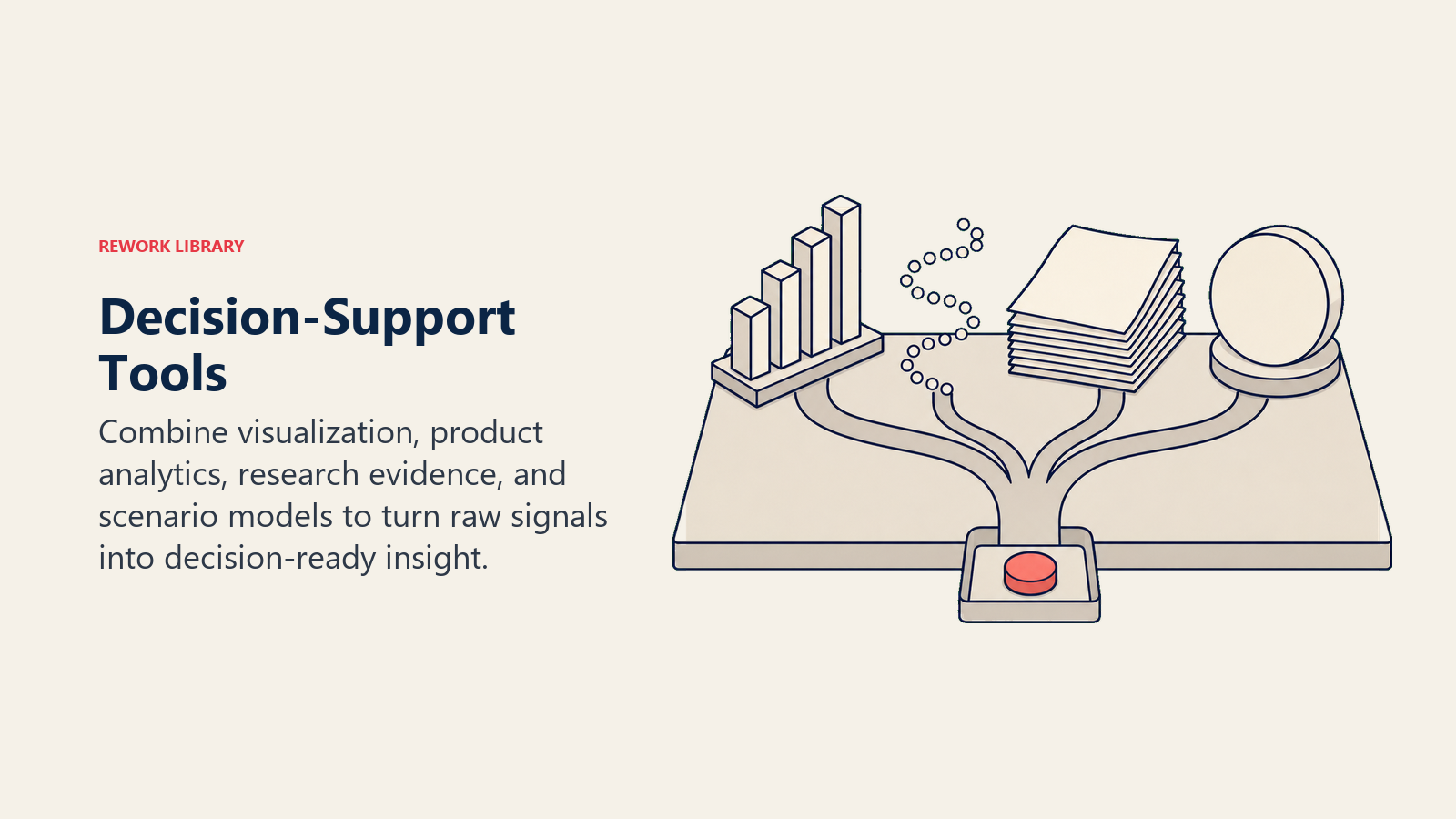
The strongest decision-support stack combines quantitative performance signals, behavioral evidence, qualitative research, and scenario modeling rather than forcing every question into one dashboard.
- Tableau - Data visualization platform for turning raw data into decision-relevant dashboards and reports.
- Microsoft Power BI - BI and analytics platform deeply integrated with Microsoft 365 and enterprise data sources.
- Amplitude - Product analytics platform for making product and growth decisions from behavioral data.
- Mixpanel - Event-based analytics for understanding user behavior and validating product decisions.
- Streamlit - Open-source tool for building data apps and decision-support tools from Python scripts.
- Observable - Browser-based data notebook for collaborative data analysis and visualization.
- Dovetail - Research repository and analysis tool for turning qualitative research into structured insight.
- Causal - Financial modeling and scenario planning tool built for data-driven business decisions.
Templates & Frameworks
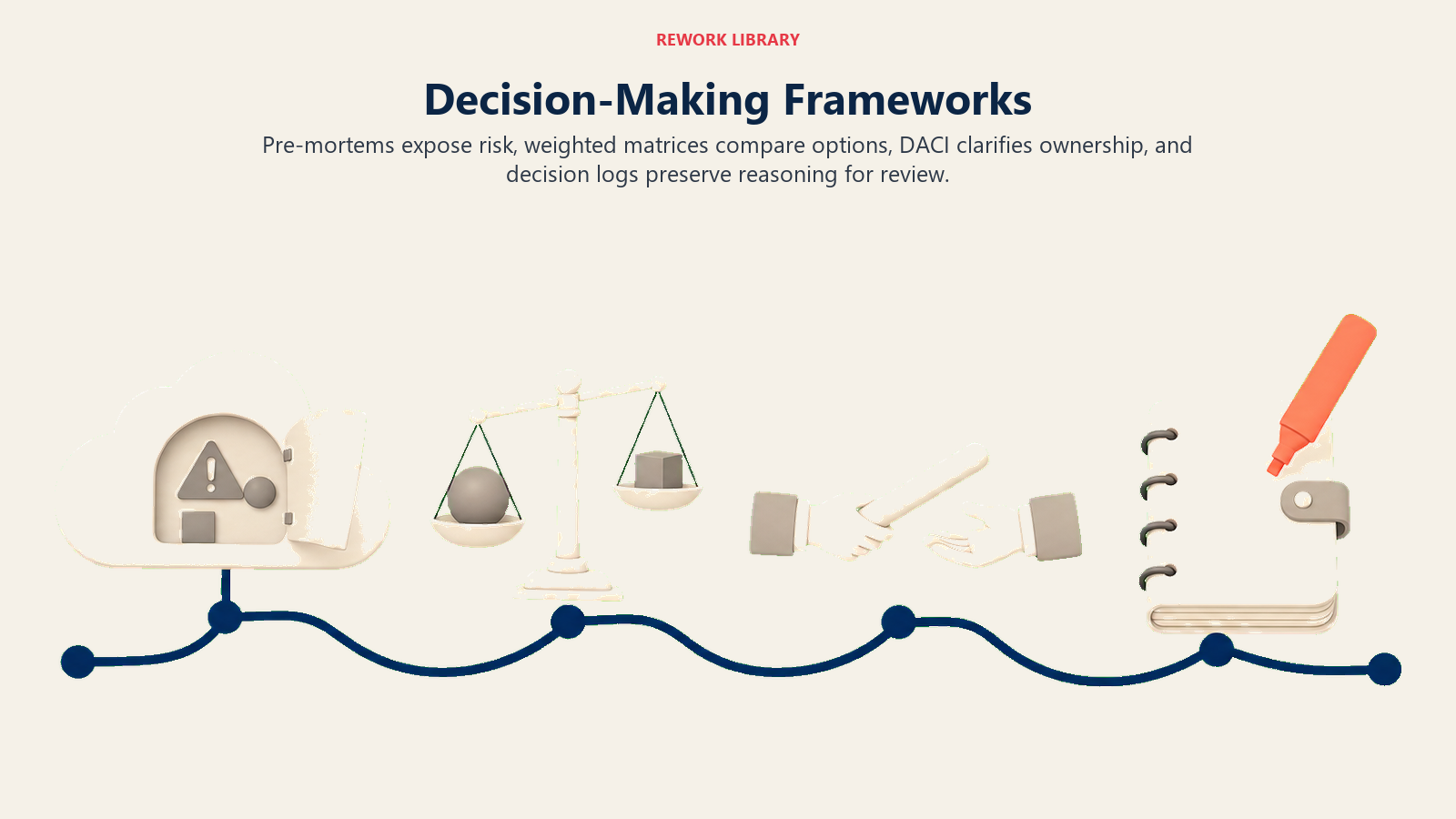
Each framework strengthens a different part of the decision: exposing risk, comparing options, assigning ownership, or preserving the reasoning for later review.
- Decision Log Template - Farnam Street's structured format for recording decisions, rationale, and outcomes for later review.
- Pre-Mortem Workshop Guide - HBR's step-by-step format for running a pre-mortem to expose hidden risks before committing.
- DACI Decision-Making Framework - Atlassian's Driver-Approver-Contributor-Informed model for clarifying who decides what.
- Choosing Tools for Productivity - A framework for evaluating and selecting tools that support better team and individual decision-making.
Case Studies & Real-World Examples
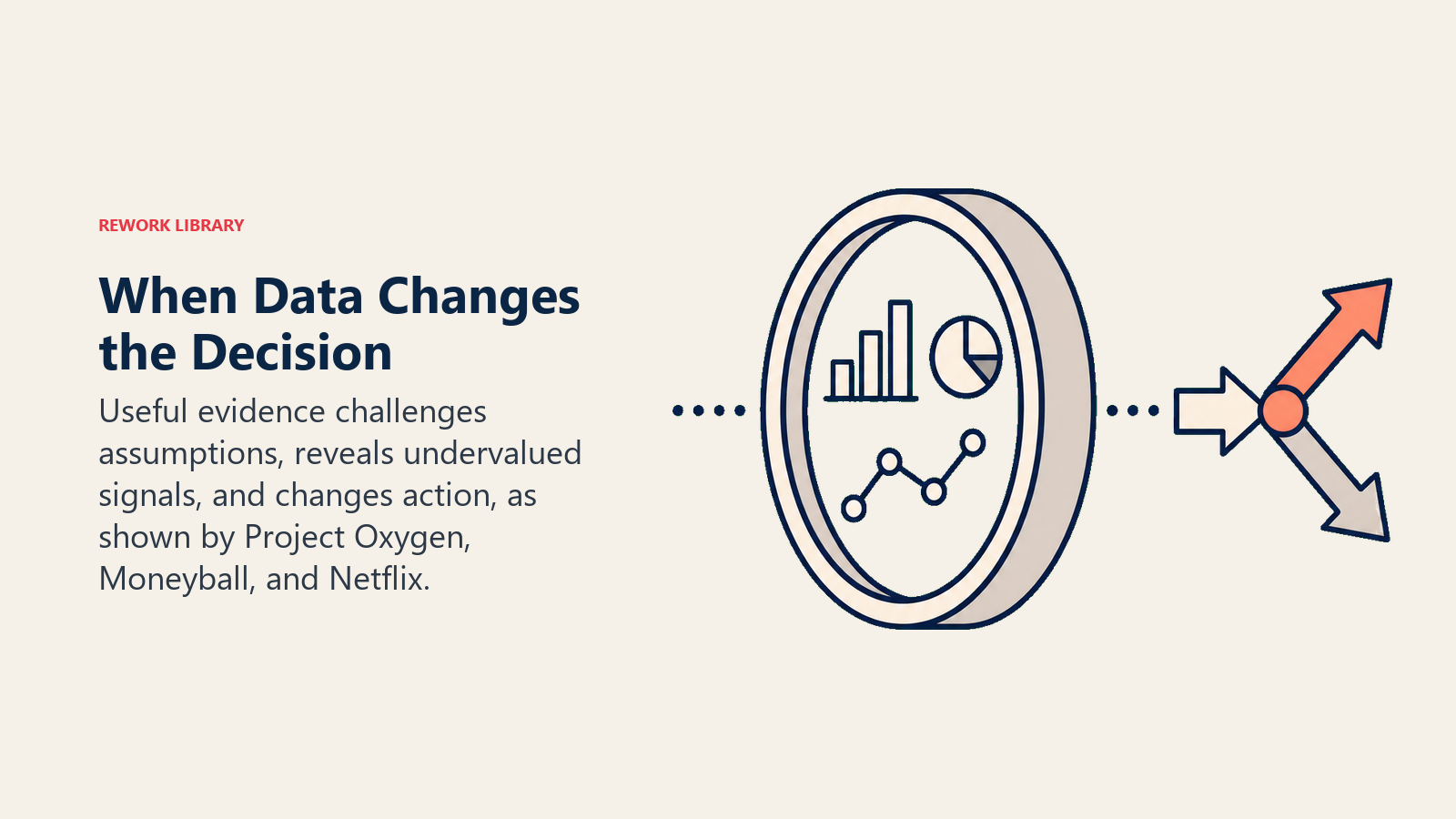
These cases matter because the evidence changed the operating decision, not just the report. Assumptions were overturned, overlooked signals gained value, and leaders committed to a different course.
Google's Project Oxygen - In 2008, Google's People Analytics team set out to prove that managers didn't matter, and discovered the opposite. Using performance reviews, employee surveys, and exit interview data, they identified eight behaviors that distinguished the company's best managers from its worst. The project became a model for how data can overturn institutional assumptions and directly reshape people management practice. Source
Oakland A's and Moneyball - Billy Beane's use of sabermetrics to build a competitive MLB team on a fraction of the New York Yankees' payroll in the early 2000s is the most famous demonstration that data-driven decision-making can systematically outperform expert intuition. The A's identified undervalued statistics (on-base percentage over batting average) that the market mispriced, and won 20 consecutive games in 2002, a record at the time. Source
Capital One - Founded in 1994 with the explicit premise that banking could be run as an information-based business, Capital One's founders applied mass customization and statistical modeling to credit card marketing at a time when most banks used uniform pricing. Their data-driven approach to credit risk and customer acquisition helped Capital One grow from a spinout of Signet Bank to one of the top-10 U.S. banks by assets, built almost entirely on the analytical edge they maintained over traditional competitors. Source
Communities & Newsletters
- Farnam Street (Brain Food Newsletter) - Shane Parrish's weekly newsletter on mental models, decision-making, and clear thinking for leaders.
- Decision Education Foundation - Non-profit focused on teaching structured decision-making skills, with research and practitioner resources.
- Data & Society - Research institute exploring the social and ethical dimensions of data-driven decision-making.
Rework Resources
- AI Business Intelligence Platforms - How AI-powered BI platforms are changing the speed and quality of business decisions.
Contributing
Know a great data-driven decision making resource we've missed? Let us know.
Links verified. Balances quantitative methods with behavioral strategy and the limits of data in real decisions.
