Awesome Process Management
Turn this article into takeaways for your work.


Each assistant summarizes the article only for you and suggests best practices for your work.
A curated list of the best resources about business process management, Lean, Six Sigma, and continuous improvement for operations leaders and business executives.
Inspired by awesome lists. Maintained by Rework.
Contents
- Articles
- Books
- Videos & Talks
- Tools & Software
- Templates & Frameworks
- Case Studies & Real-World Examples
- Communities & Newsletters
- Rework Resources
Articles
Good process management is not about bureaucracy. It's about making quality, speed, and consistency reproducible without relying on heroics from specific people. These are the articles that capture that distinction.
- 2025 Top Challenges and Solutions: Process Management by APQC - The annual survey of what process and performance management practitioners are actually struggling with.
- 2025 Process and Performance Management Priorities by APQC - Data on what COOs and operations teams are prioritizing heading into the next planning cycle.
- Business Process Management Maturity Benchmarks by APQC - Where your organization's BPM maturity sits relative to peers across industries.
- What to Expect in Process and Performance Management in 2024 by APQC - A look at the trends shaping process management practice going into the mid-2020s.
- Process Classification Framework (PCF) by APQC - The most recognized cross-industry framework for categorizing and benchmarking business processes.
- BPTrends: Frameworks and End-to-End Processes - How leading frameworks like SCOR, PCF, and APQC connect to end-to-end process design.
- Lean Enterprise Institute: What Is Lean? - The foundational definition of Lean thinking and how it differs from traditional efficiency programs.
- The Toyota Production System Explained at Harvard Business Review - The original 1999 HBR article decoding TPS that remains the clearest explanation of its principles.
- Process Automation: Where to Start by McKinsey - How to identify high-ROI automation candidates before spending on tools or implementation.
Books
- The Goal by Eliyahu Goldratt - A novel that teaches the Theory of Constraints through a factory manager's fight to save his plant.
- Lean Thinking by James Womack & Daniel Jones - The foundational text for applying Toyota's production philosophy outside manufacturing.
- The Toyota Way by Jeffrey Liker - A deep study of the 14 management principles behind Toyota's sustained operational excellence.
- Work the System by Sam Carpenter - How a struggling business owner documented his processes and reclaimed control of his company.
- The Checklist Manifesto by Atul Gawande - Why the simplest process tool - a checklist - prevents catastrophic failures in surgery, aviation, and business.
Videos & Talks
- Toyota Production System Documentary - A visual walkthrough of the actual TPS principles in practice on the factory floor.
- Lean Enterprise Institute: Introduction to Lean Thinking - LEI's primer on value streams, waste elimination, and continuous flow for non-manufacturing contexts.
- Six Sigma DMAIC Explained - A clear walkthrough of Define, Measure, Analyze, Improve, and Control for process improvement projects.
- Kaizen in Practice - How Kaizen events work in real organizations and what the before-and-after looks like.
- BPMN 2.0: How to Map Business Processes - A practical tutorial on using Business Process Model and Notation to document complex workflows.
Tools & Software
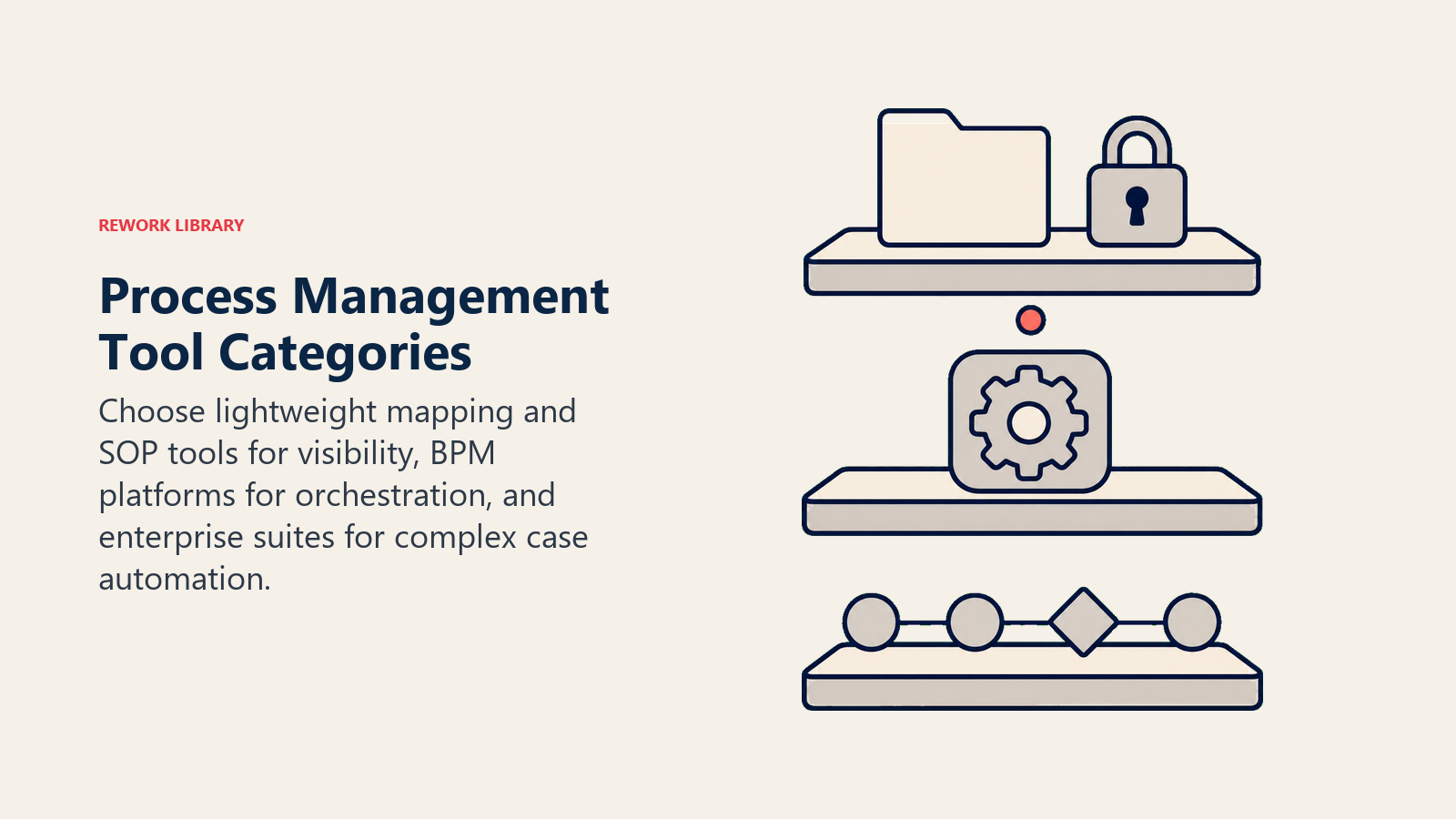
These platforms cover the range from lightweight process documentation to full BPM automation suites used at enterprise scale.
- Lucidchart - Diagramming tool for process maps, swimlane diagrams, and BPMN notation with collaboration features.
- Miro - Visual collaboration platform widely used for process mapping workshops and value stream mapping.
- Bizagi - BPM platform for modeling, automating, and monitoring business processes with BPMN support.
- Camunda - Open-source BPMN-based workflow automation for technical teams embedding process orchestration in software.
- Nintex - Process management and automation platform for organizations standardizing on Microsoft 365.
- Pega - Enterprise low-code platform for automating complex business processes and case management.
- Process Street - Lightweight SOP and checklist management tool for teams running recurring processes without code.
- Creately - Visual workspace for process documentation, org charts, and collaborative process design.
Templates & Frameworks
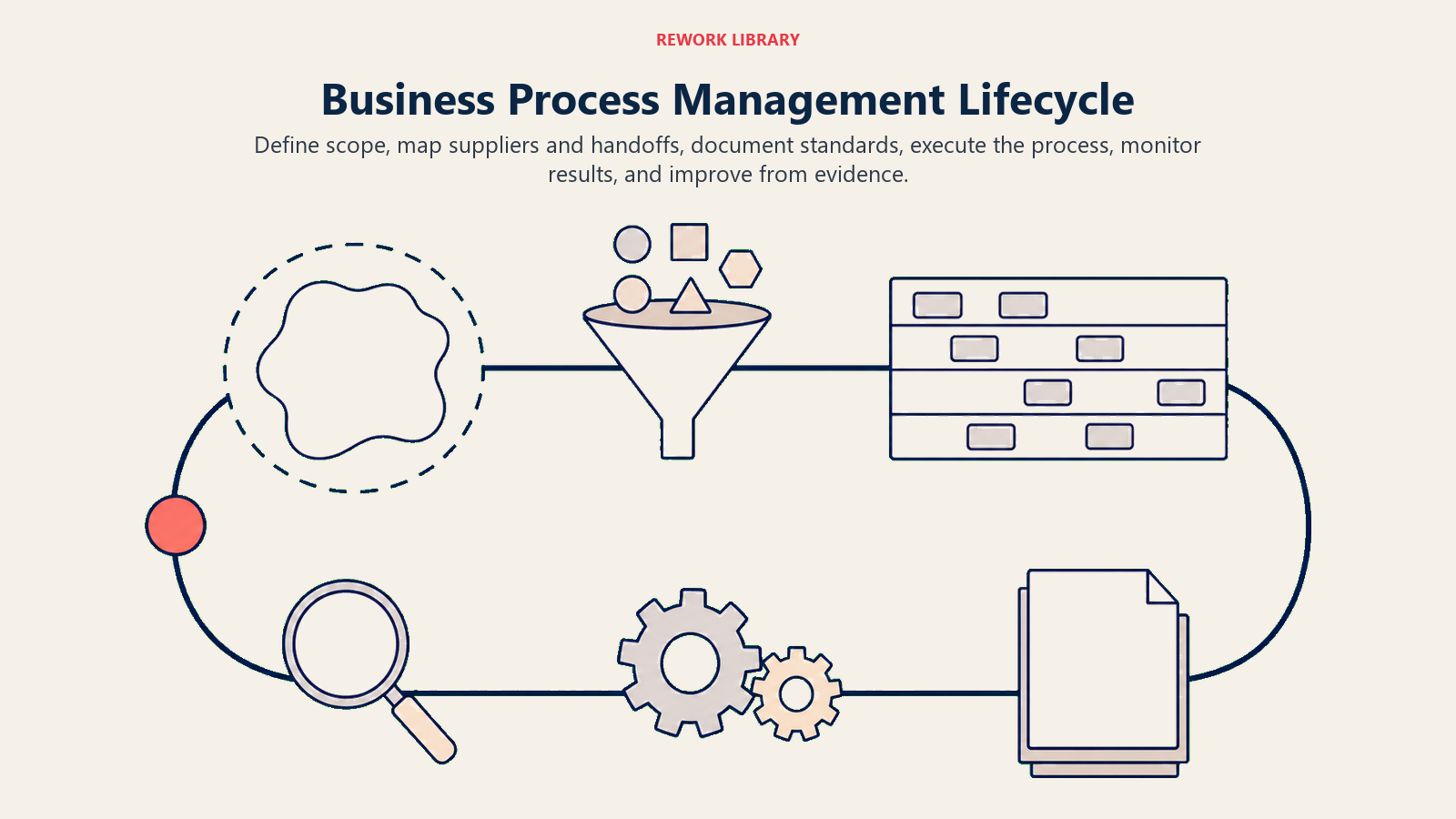
Together, these artifacts support the full process lifecycle: define the scope, map inputs and handoffs, document the standard, execute the work, monitor results, and improve it.
- Process Mapping Template (Swimlane) by Lucidchart - A ready-to-use swimlane diagram template for mapping cross-functional process flows and handoffs.
- Process Improvement Charter by iSixSigma - A one-page document to define scope, goals, team, and timeline before starting any improvement project.
- Business Process Management via Rework - A practical walkthrough of the full BPM lifecycle - design, model, execute, monitor, and optimize - with guidance on which phase most organizations are actually failing at.
Case Studies & Real-World Examples
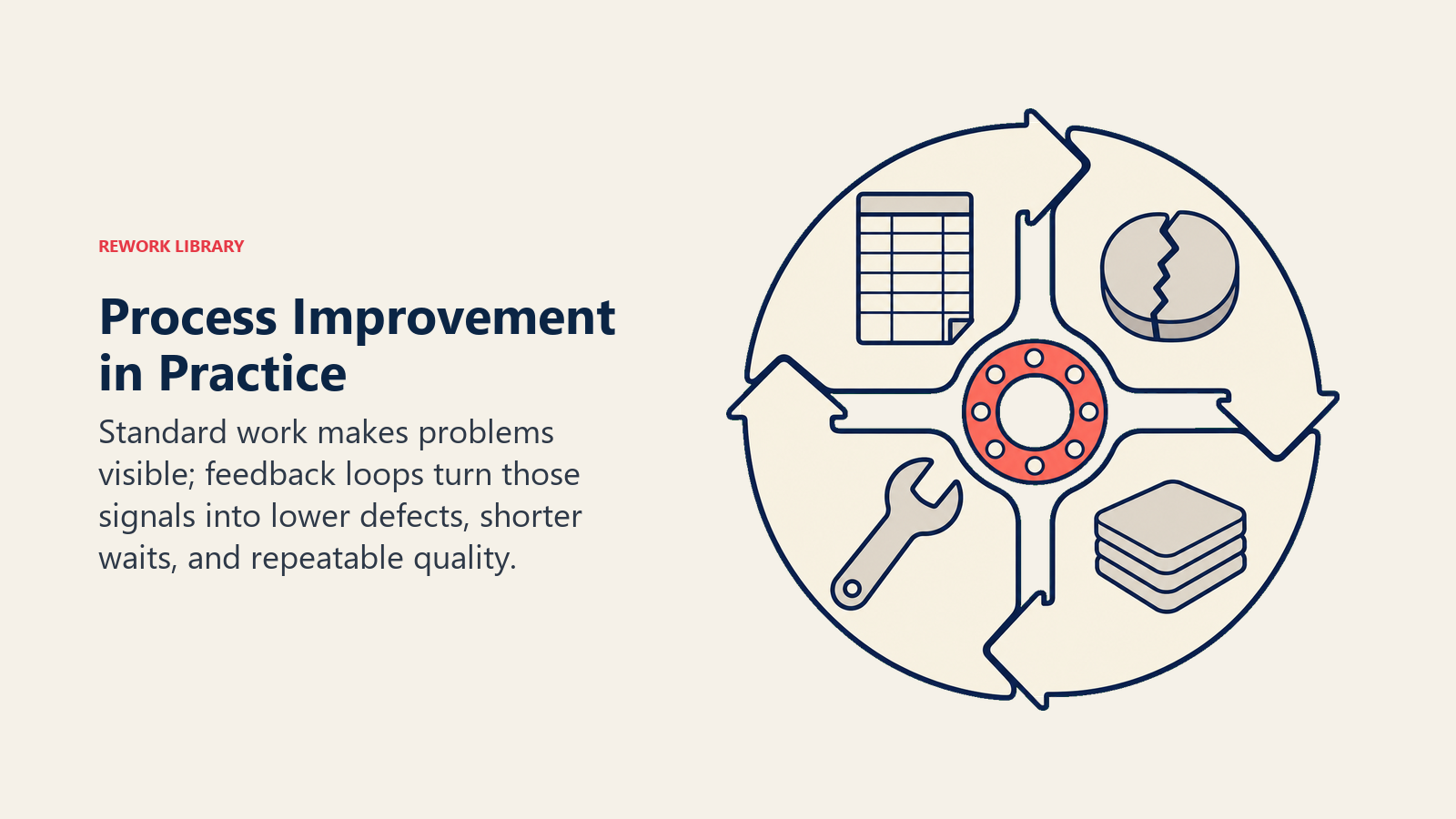
Process improvement doesn't always require consultants or new software. These examples show what the work actually looks like - and why the results are often surprisingly large relative to the intervention.
Toyota - The Toyota Production System, refined over decades from the 1950s through the 1980s, eliminated seven categories of waste (muda) across its manufacturing lines and is credited with enabling Toyota to achieve defect rates 100x lower than US competitors at the time of the 1984 NUMMI joint venture with GM. When NUMMI applied TPS principles to GM's worst-performing plant in Fremont, California, quality improved from the bottom to the top of GM's network within two years using the same workers. The case established that process, not workforce, determines output quality. Source
Virginia Mason Medical Center - Applied Toyota's Lean principles to healthcare operations beginning in 2002, reducing medication errors by 74% and cutting surgical instrument inventory costs by $1 million in the first year. The hospital systematically mapped patient care as a "production" process and used Kaizen events to eliminate steps that added waiting time without clinical value. It became one of the first hospitals to win quality awards typically reserved for manufacturers. Source
Amazon Fulfillment Centers - Built their warehouse operations on continuous process improvement cycles, using real-time data dashboards to identify bottlenecks in picking, packing, and shipping within hours rather than days. Amazon's fulfillment cost per unit dropped by roughly 40% between 2006 and 2015 while processing volume grew by over 1,000%. The efficiency came from standardized processes with built-in feedback loops, not from worker speed alone. Source
Communities & Newsletters
- APQC Community - A network of 250,000+ process and performance management practitioners sharing benchmarks and best practices.
- Lean Enterprise Institute - The hub for Lean thinking education, including articles, workshops, and a global practitioner network.
- Process Excellence Network - PEX Network covers Lean, Six Sigma, BPM, and digital transformation through articles, webinars, and events.
Rework Resources
- Business Process Management - A practical guide to the BPM lifecycle: design, model, execute, monitor, and optimize.
- 5S Methodology at Work - How to apply Sort, Set in Order, Shine, Standardize, and Sustain to any business environment.
Contributing
Know a great resource that belongs on this list? Let us know.
Links verified. Bridges formal BPM methodology with practical everyday process improvement.