Voz do Cliente (VoC): Métodos e Exemplos
Turn this article into takeaways for your work.


Each assistant summarizes the article only for you and suggests best practices for your work.
A voz do cliente (VoC) é a disciplina estruturada de capturar o que os clientes precisam, esperam e valorizam, e depois transformar essas entradas em requisitos que suas equipes podem executar. Sem ela, as decisões de processo e produto se apoiam em suposições internas que frequentemente erram o alvo. Bem feita, a VoC se torna o motor que mantém as melhorias de qualidade voltadas para os resultados que os clientes realmente valorizam.
O que é a voz do cliente?
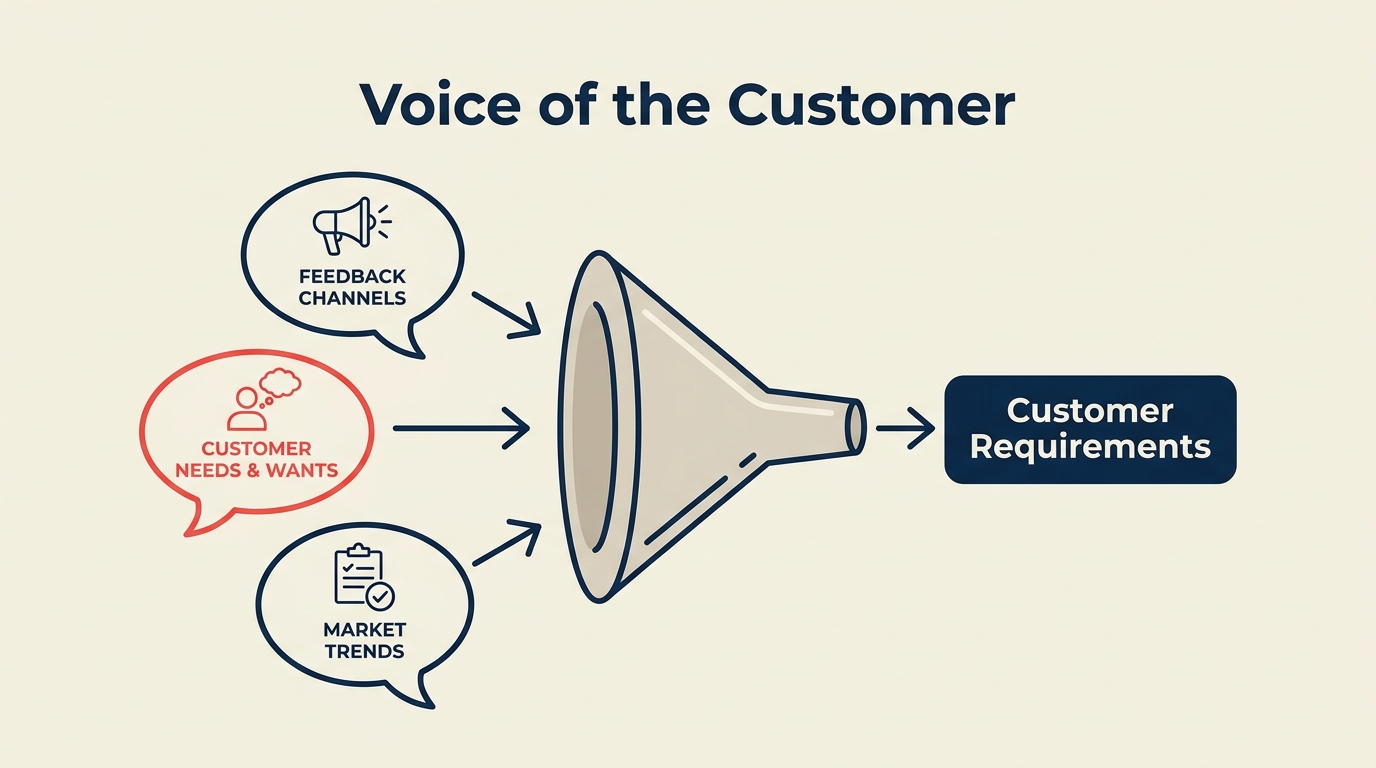
Voz do cliente (VoC) é uma prática de pesquisa e análise que coleta as necessidades declaradas, as expectativas não declaradas e as preferências emocionais dos clientes, e depois as traduz em requisitos específicos e mensuráveis para produtos, serviços ou processos.
O termo surgiu na gestão da qualidade, aparecendo na literatura acadêmica nos anos 1990 ao lado do Seis Sigma e do Desdobramento da Função Qualidade. É central para a fase Definir do ciclo de melhoria DMAIC, na qual as equipes estabelecem o que os clientes consideram "crítico para a qualidade" antes de medir ou analisar qualquer processo.
A VoC captura duas categorias de entrada:
- Necessidades declaradas: o que os clientes dizem que querem quando perguntados diretamente ("checkout mais rápido", "menos erros nas faturas").
- Necessidades não declaradas: expectativas tão óbvias para o cliente que ele nem as articula ("o produto deveria funcionar", "a entrega deveria chegar sem avarias").
Ambas as categorias alimentam a Árvore CTQ, que decompõe os desejos do cliente em características de qualidade específicas e mensuráveis. Essas características, por sua vez, direcionam o Desdobramento da Função Qualidade (QFD), que as mapeia para decisões de engenharia ou design de processo.
Principais fatos
- Empresas com programas robustos de VoC alcançam um crescimento de receita 10 vezes maior ano a ano em comparação com aquelas sem programas estruturados de feedback, segundo pesquisa da Aberdeen Group.
- A Bain & Company constatou que 80% das empresas acreditam entregar uma experiência de cliente superior, enquanto apenas 8% dos clientes delas concordam, uma lacuna que os programas de VoC são projetados para fechar.
- A Forrester relata que empresas que priorizam o feedback do cliente veem as taxas de retenção de clientes aumentarem em média 55%.
Métodos de coleta de VoC
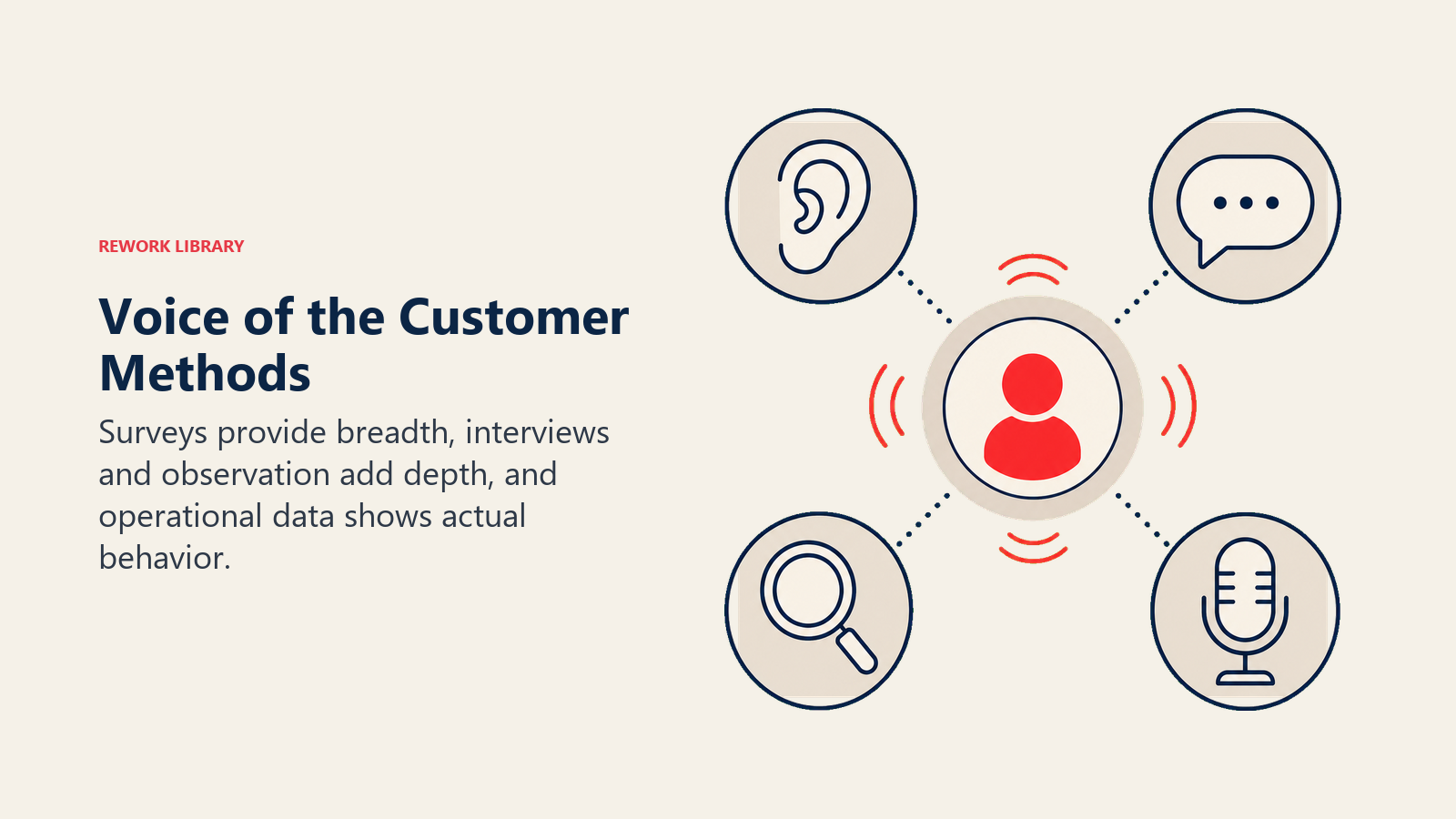
Nenhum canal isolado captura o quadro completo. A maioria das equipes combina pelo menos três métodos para obter abrangência e profundidade.
| Método | O que captura | Melhor para | Principal limitação |
|---|---|---|---|
| Pesquisas (online/e-mail) | Satisfação e preferência quantificadas em grandes amostras | Benchmarking ao longo do tempo, acompanhamento de NPS/CSAT | Viés de autorrelato; pouca profundidade em respostas abertas |
| Entrevistas com clientes | Motivações, soluções alternativas, contexto do job-to-be-done | Descobrir necessidades não declaradas; design em estágio inicial | Consome muito tempo; amostra pequena |
| Grupos focais | Reações a conceitos, dinâmica de grupo em torno do uso | Novos conceitos de produto, testes de mensagens | Risco de pensamento de grupo; não representativo |
| Avaliações online e monitoramento social | Sentimento espontâneo e não filtrado, em volume | Identificar pontos de dor recorrentes e lacunas da concorrência | Falta contexto; dados ruidosos |
| Tickets de suporte e logs de chat | A linguagem exata que os clientes usam quando algo dá errado | Identificar os principais modos de falha; entradas para CTQ | Enviesado para experiências negativas |
| Pontuações de NPS e CSAT | Lealdade e satisfação transacional quantificadas | Acompanhar tendências de satisfação; alertar sobre quedas | Os números sozinhos não explicam a causa raiz |
| Dados comportamentais e de uso | O que os clientes realmente fazem, versus o que dizem | Produtos digitais, gravações de sessão, análise de funil | Não explica o "porquê" sem combinar com dados qualitativos |
A combinação que você escolhe depende da maturidade do seu processo e do prazo. Uma equipe enxuta rodando um projeto rápido de DMAIC pode depender da análise de tickets de suporte e de 10 entrevistas com clientes. Uma função de qualidade madura, rodando a Gestão da Qualidade Total, vai operar escuta contínua em todos os canais simultaneamente.
Por que a voz do cliente importa
A resposta curta: suposições internas são caras.
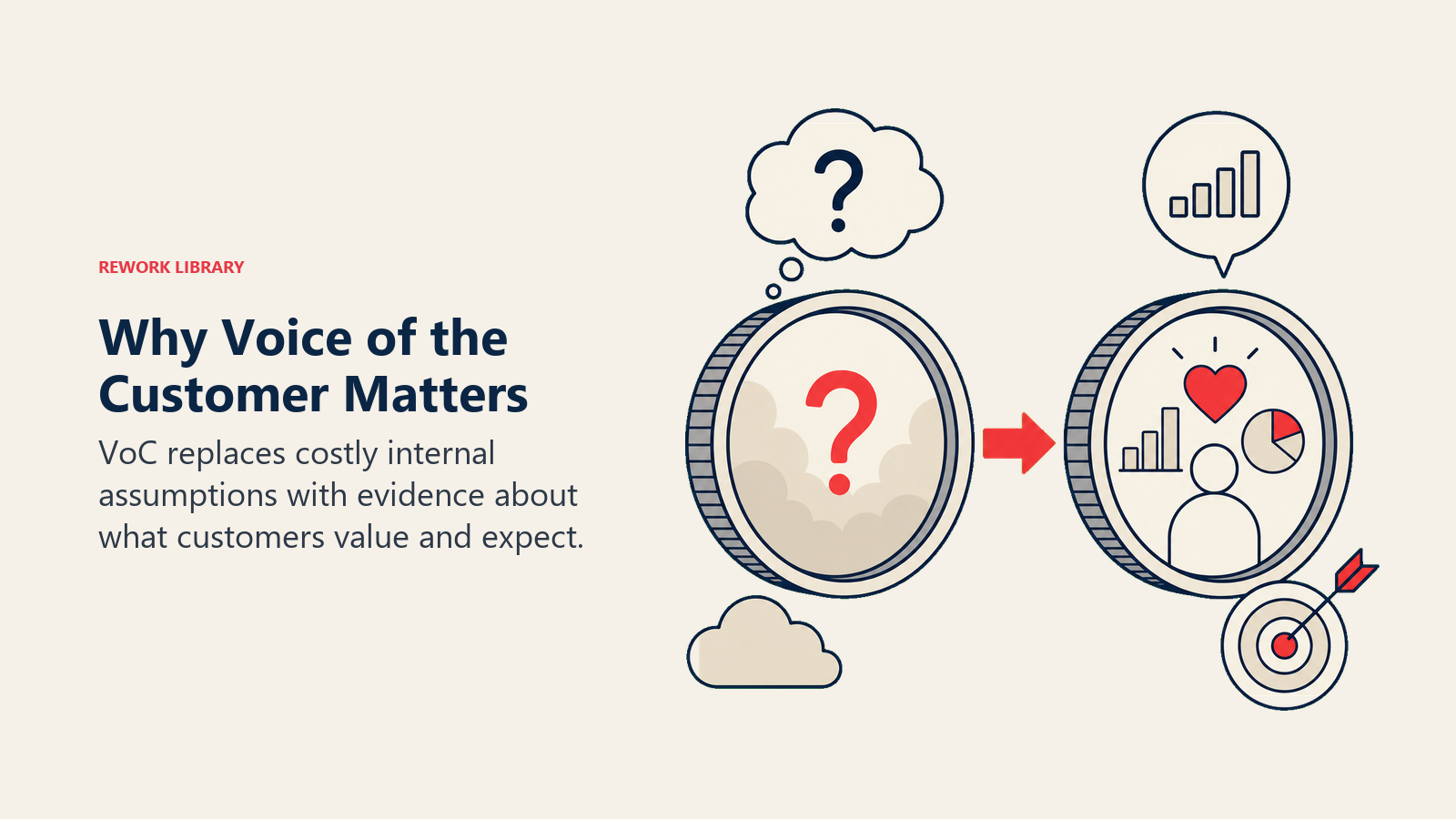
Quando as equipes projetam processos ou produtos com base no que acham que os clientes querem, frequentemente otimizam as coisas erradas. O resultado são projetos de melhoria que consomem recursos, mas não mudam a satisfação, a receita ou a retenção.
A VoC corrige isso ancorando cada decisão de melhoria em um sinal externo. No Seis Sigma, os dados de VoC fluem diretamente para o diagrama SIPOC para definir quem é o cliente e o que ele precisa da saída do processo. Também alimentam a árvore CTQ que define o que "qualidade" significa em termos mensuráveis.
Além da gestão da qualidade, a VoC importa porque:
- Reduz o retrabalho. Quando os requisitos são definidos a partir da linguagem do cliente, e não do jargão interno, as equipes constroem a coisa certa da primeira vez.
- Revela sinais de priorização. Nem toda reclamação tem a mesma importância. A análise de VoC revela quais pontos de dor são generalizados e de alto impacto.
- Cria hábitos de retenção. Equipes que fecham sistematicamente o ciclo com os clientes ("ouvimos você, veja o que mudou") criam uma lealdade que nenhum programa de desconto consegue replicar.
Erros comuns
Equipes que coletam feedback mas não o utilizam estão fazendo algo mais prejudicial do que simplesmente não coletar: estão ensinando os clientes a parar de responder.
Coletar uma vez, não continuamente. As expectativas dos clientes mudam. Uma pesquisa feita no lançamento do produto não diz nada sobre o que importa 18 meses depois. A VoC precisa ser uma cadência, não um projeto.
Fazer perguntas tendenciosas. "O quanto você gostou do nosso novo fluxo de checkout?" não vai revelar o atrito real. Perguntas neutras e abertas, como "Descreva o que aconteceu na última vez em que você concluiu uma compra", revelam muito mais.
Pular a etapa de tradução. O feedback bruto não é acionável. "Demora muito" é uma reclamação, não um requisito. O processo de VoC existe para traduzir isso em um CTQ específico e mensurável: "95% dos pedidos confirmados em até 2 segundos após o envio."
Isolar os dados em silos. As equipes de suporte ouvem sobre falhas. As equipes de vendas ouvem sobre pontos de comparação. As equipes de produto ouvem solicitações de funcionalidades. Quando essas fontes não se fundem em uma única visão, você obtém requisitos fragmentados e às vezes contraditórios.
Nunca fechar o ciclo. Clientes que dão feedback e nunca recebem um retorno presumem que nada mudou. Um reconhecimento breve, mesmo em escala via e-mail, mantém o relacionamento e as taxas de resposta para pesquisas futuras.
Como executar um processo de voz do cliente
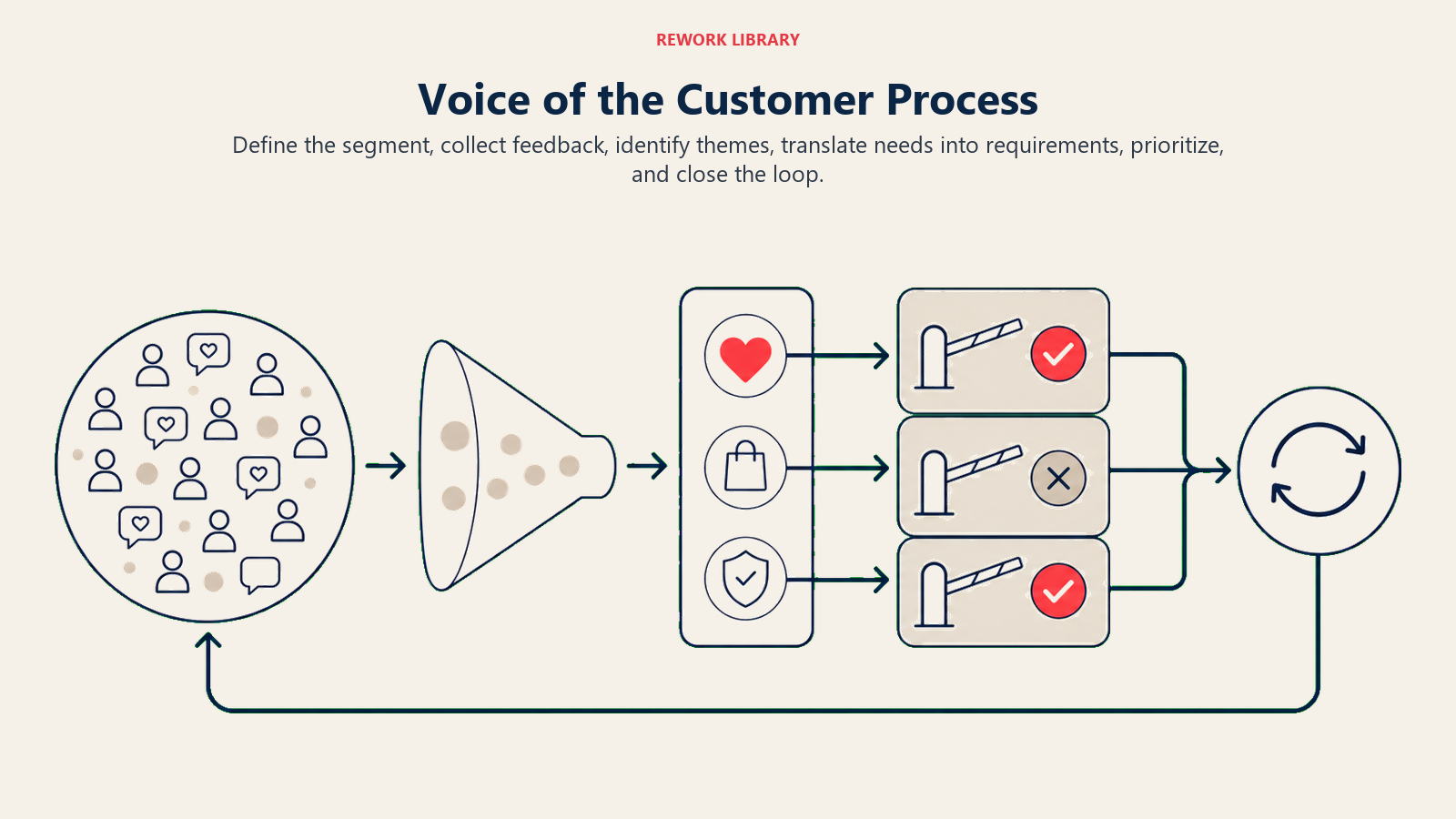
Defina o segmento, colete feedback, identifique temas, traduza necessidades em requisitos, priorize e feche o ciclo.
Passo 1: Defina o escopo e o segmento de clientes
Comece esclarecendo qual processo, produto ou decisão você está melhorando, e de qual segmento de clientes você precisa da voz. Um projeto de DMAIC voltado para a precisão de faturas precisa de contribuições de contatos financeiros em contas enterprise, não de usuários finais em geral. Segmentos desalinhados produzem requisitos irrelevantes.
Passo 2: Escolha e execute métodos de coleta
Selecione dois a três métodos complementares da tabela acima. Uma combinação inicial comum: 10-15 entrevistas com clientes para profundidade, uma pesquisa com 200 respostas para abrangência, e uma extração dos últimos 90 dias de tickets de suporte. Execute-os em paralelo sempre que possível para reduzir o tempo até o insight.
Passo 3: Organize e agrupe o feedback por afinidade
Consolide todas as entradas brutas em uma única planilha ou ferramenta. Agrupe declarações semelhantes em temas usando mapeamento de afinidade: reúna comentários como "a resposta demorou dias," "ninguém deu retorno" e "ainda estou esperando uma resposta" sob um tema como "prontidão de resposta." Isso revela padrões que citações isoladas escondem.
Passo 4: Traduza necessidades em requisitos usando uma árvore CTQ
Para cada tema principal, construa um ramo da Árvore CTQ. A necessidade do cliente ("respostas rápidas") se torna um direcionador de qualidade ("tempo de resposta"), que se torna um requisito CTQ mensurável ("primeira resposta em até 4 horas úteis, em 98% dos tickets"). Essa tradução é a etapa mais crítica: ela converte linguagem subjetiva em algo que engenheiros e donos de processo podem projetar e medir.
Passo 5: Priorize os requisitos
Nem todos os CTQs são igualmente urgentes ou viáveis. Use uma matriz de impacto/esforço ou uma análise do modelo Kano para classificar os requisitos. Priorize CTQs que aparecem em múltiplos segmentos de clientes, estão ligados a sinais de retenção ou receita, ou tratam de uma falha de processo atual capturada no seu diagrama SIPOC.
Passo 6: Aja e atualize o processo
Encaminhe os CTQs priorizados para as equipes adequadas. Para mudanças de processo, eles se tornam a linha de base "Definir" de um projeto de DMAIC ou uma entrada de design para o DMADV, caso você esteja construindo algo novo. Para mudanças de produto, eles alimentam as matrizes de Desdobramento da Função Qualidade (QFD).
Passo 7: Feche o ciclo com os clientes
Conte aos clientes o que mudou como resultado da contribuição deles. Mesmo um e-mail segmentado ("com base no seu feedback, reduzimos as etapas de checkout de 6 para 3") reforça que o mecanismo de feedback funciona. Isso também melhora as taxas de resposta futuras e constrói confiança.
Exemplos de voz do cliente
Manufatura, saúde, software e serviços traduzem a linguagem do cliente em requisitos mensuráveis diferentes.
Manufatura: reduzindo reclamações de defeitos
Um fabricante de eletrônicos de médio porte realizava pesquisas trimestrais de NPS, mas não via melhora nas pontuações apesar de três ciclos consecutivos de DMAIC. Depois de trocar para entrevistas com compradores B2B, descobriram que o problema não eram defeitos de produto: era a documentação inconsistente incluída nos envios. Os compradores falhavam durante a instalação, não por falhas de hardware, mas porque o manual não correspondia à revisão do produto. O CTQ se tornou "100% da documentação corresponde à versão de hardware enviada." A correção custou menos de US$ 12.000, e o NPS subiu 18 pontos em dois trimestres.
SaaS: priorizando o desenvolvimento de funcionalidades
Uma empresa de software de gestão de projetos analisou 6 meses de tickets de suporte e gravações de sessões no aplicativo, junto com 50 entrevistas com clientes. O ponto de dor mais citado não era a lista de funcionalidades: era o tempo para integrar um novo membro da equipe. A saída da VoC se traduziu em dois CTQs: "o novo usuário conclui a primeira tarefa em até 10 minutos" e "o administrador adiciona um novo membro e atribui permissões em menos de 3 minutos." Ambos direcionaram os dois sprints de produto seguintes, resultando em uma redução de 34% no churn da primeira semana.
Saúde: melhorando o cadastro de pacientes
Um sistema hospitalar regional usou pesquisas pós-consulta e entrevistas com a equipe de linha de frente para levantar dados de VoC sobre o processo de cadastro de pacientes. O tema dominante: os pacientes não sabiam o que levar para as consultas. O CTQ traduzido foi "100% das confirmações de consulta incluem uma lista de verificação de documentos completa e personalizada." Depois do lançamento da atualização de confirmação automatizada, as taxas de documentos faltantes caíram de 31% para 6%, reduzindo os atrasos nas consultas.
| Setor | Reclamação bruta do cliente | Requisito CTQ traduzido |
|---|---|---|
| Manufatura | "A documentação é confusa" | 100% dos documentos correspondem à revisão do produto enviado |
| SaaS | "A integração demora demais" | O novo usuário conclui a primeira tarefa em até 10 min |
| Saúde | "Eu não sabia o que levar" | 100% das confirmações incluem lista de verificação de documentos |
| Varejo | "Os reembolsos demoram uma eternidade" | 95% dos reembolsos processados em até 3 dias úteis |
Melhores práticas
Envolva a equipe de linha de frente na coleta. Agentes de suporte, representantes de vendas e técnicos de serviço ouvem a linguagem do cliente todos os dias. Incluí-los na análise de VoC adiciona nuances que as pesquisas isoladamente não captam.
Use falas literais dos clientes em apresentações. Ao levar dados de VoC para a liderança, inclua citações exatas de clientes junto com o resumo quantitativo. Números convencem; citações mobilizam as pessoas.
Revisite os CTQs após cada ciclo de melhoria. Depois de agir sobre um CTQ e o processo mudar, execute a VoC novamente naquele ponto de contato. As expectativas dos clientes tendem a subir depois de melhorias, então o CTQ do ano passado pode já estar obsoleto.
Vincule a VoC ao mapeamento de processos. Sobreponha as descobertas da VoC ao seu diagrama SIPOC ou mapa de fluxo de valor para ver exatamente em que ponto do processo a experiência do cliente é criada ou quebrada.
Construa um calendário de VoC. Programe entrevistas anuais em profundidade, pesquisas trimestrais de pulso e análise contínua de tickets de suporte como compromissos permanentes, não projetos pontuais. Sinais de rotina são muito mais úteis do que fotografias únicas.
As expectativas dos clientes não são estáticas, e seus processos também não deveriam ser. Equipes que incorporam a VoC ao ritmo operacional regular, não apenas aos pontapés iniciais de projetos, criam um ciclo de feedback que mantém o trabalho de melhoria voltado para o que realmente movimenta a satisfação. O resultado é melhor retenção, menos ciclos de retrabalho e uma cultura de processo fundamentada em evidências, não em suposições.
Leitura relacionada

Customer Success Operations Manager
On this page
- O que é a voz do cliente?
- Métodos de coleta de VoC
- Por que a voz do cliente importa
- Erros comuns
- Como executar um processo de voz do cliente
- Passo 1: Defina o escopo e o segmento de clientes
- Passo 2: Escolha e execute métodos de coleta
- Passo 3: Organize e agrupe o feedback por afinidade
- Passo 4: Traduza necessidades em requisitos usando uma árvore CTQ
- Passo 5: Priorize os requisitos
- Passo 6: Aja e atualize o processo
- Passo 7: Feche o ciclo com os clientes
- Exemplos de voz do cliente
- Manufatura: reduzindo reclamações de defeitos
- SaaS: priorizando o desenvolvimento de funcionalidades
- Saúde: melhorando o cadastro de pacientes
- Melhores práticas
- Leitura relacionada