What Is a Seed-Stage Startup?
Turn this article into takeaways for your work.


Each assistant summarizes the article only for you and suggests best practices for your work.
A seed-stage startup is a young company that has moved past the idea and is now building a real product, getting it into the hands of early users, and trying to prove that people want it enough to keep using it and paying for it. It usually has a small team, a tiny amount of revenue (often none), and a lot of unanswered questions. The "seed" in the name is the point: the company is planted, but nobody knows yet whether it will grow.
This article is about the stage itself: what the company looks like, what it is trying to achieve, who works there, and what can go wrong. It isn't a deep dive on the financing round that often pays for the stage. Stage labels are informal, and different founders and investors draw the lines in slightly different places, so treat everything here as a working definition, not a rulebook. For the full sequence, start with the stages of a startup.
What "seed stage" actually means
Nobody certifies a company as seed stage. There's no legal definition, no regulator that assigns the label, and no revenue number that flips the switch. People use the word in two overlapping ways.
- As a company stage. The company has an early product, some users or pilot customers, and it's searching for a business model that works. That's the meaning this article uses.
- As a financing label. The first significant round of outside money is often called a "seed round." Early-stage lawyers use similar language: Cooley, a law firm that focuses on startups, notes that issuing convertible notes is one of the most popular ways for startups to raise initial seed funding.
The two meanings usually travel together, but not always. A company can be seed stage without ever raising a seed round (it might be funded by its founders or by early revenue), and a company can raise money labeled "seed" while its product is still half-built.
A useful way to think about it comes from Paul Graham of Y Combinator. He argues that a startup is a company designed to grow fast, and that growth rate is the one measure of a startup. At the seed stage, the company is trying to find out whether it has the kind of growth worth designing around.
Where seed sits in the startup journey
The stages blur into each other, but most founders recognize this order.
| Stage | Core question | Typical state of the company |
|---|---|---|
| Idea | Is this problem real? | A concept, research and conversations, maybe a prototype |
| Pre-seed | Can we build something people want? | Founders, a prototype or first version, first user conversations |
| Seed | Do people use it and come back? Can we find a repeatable way to reach them? | A working product, early users or customers, a first small team |
| Series A | Can we scale something that already works? | Evidence of product-market fit and a repeatable way to sell |
| Growth | Can we expand efficiently? | Established revenue, larger team, defined processes |
The boundary between pre-seed and seed is especially fuzzy. If you want that comparison in detail, read about the pre-seed startup. And the line between "early" and "growth" is its own topic, covered in early-stage vs growth-stage.
What a seed-stage company is trying to do
The goals at this stage are narrower than founders sometimes expect. A seed-stage company isn't trying to scale. It's trying to learn, fast, and to turn the learning into a product people value.
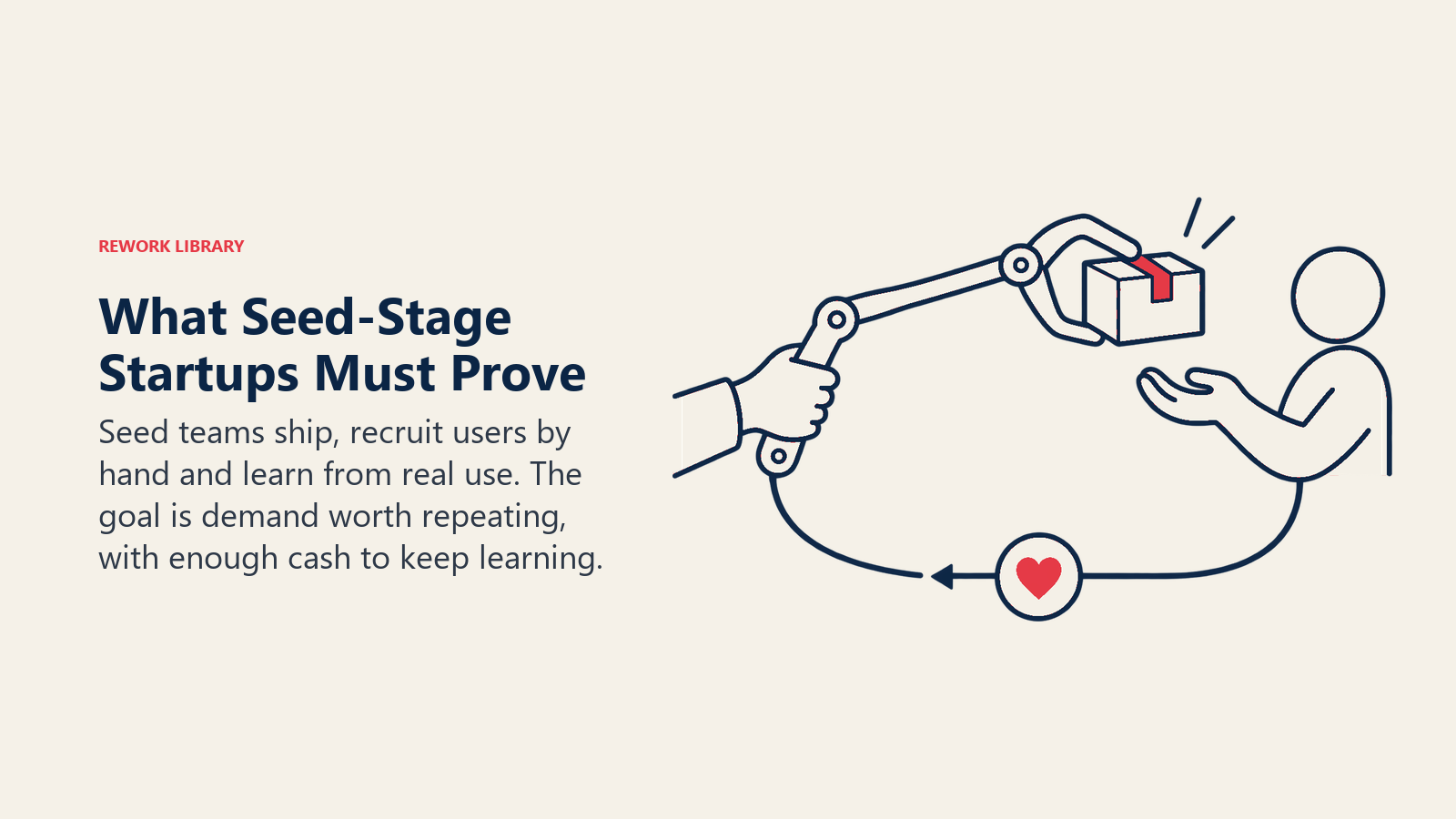
Build and ship a real product
At the idea stage the product may exist only as a plan. By seed, a version has to be in use. It doesn't need to be polished. It needs to solve one problem well enough that someone returns to it.
Get the first users, by hand
Early users rarely arrive on their own. Paul Graham's essay on this says that the most common unscalable thing founders have to do at the start is recruit users manually, and he gives Airbnb's early door-to-door work in New York as a classic example. At seed stage, founder-led outreach, personal onboarding and doing support by hand are normal and healthy, not signs of failure.
Look for product-market fit
The central task is finding out whether there's real demand. Product-market fit means a product that a defined group of customers uses, values and would miss. It's hard to pin to a single number, which is why seed-stage teams watch behavior: do users come back, do they recommend it, do pilots turn into paid contracts? For software companies specifically, the product-market fit for SaaS guide goes into the signals in detail.
Learn the economics early
A seed-stage company doesn't need perfect financial models, but it needs a rough sense of what it costs to win a customer and what that customer is worth. Even rough unit economics help a team notice early when growth would be too expensive to sustain.
Stay alive long enough to learn
Cash is the clock. Everything above takes time, and time costs money. That's why runway, the number of months the company can operate before cash runs out, is the number seed-stage founders check most often.
The team at seed stage
Seed-stage teams are small, and roles overlap heavily. A typical shape looks like this, although it varies by company and market.
- Founders do most things: building, selling, recruiting, support and fundraising. The CEO usually spends a lot of time talking to customers and investors.
- A few early hires tend to be generalists who can build or sell and who are comfortable with unclear job descriptions.
- Advisors and angel investors supply introductions and judgment without being on payroll.
- Contractors and part-timers fill gaps without adding fixed cost.
Specialists such as dedicated finance, HR or operations managers usually come later. Early on, founders handle those jobs with simple tools and outside accountants or lawyers. The point isn't to be lean for its own sake. It's that every hire raises the monthly cost and shortens the runway, so early hires need to move the learning forward.
How seed-stage companies get funded
There's no single path. Seed-stage companies commonly draw on a mix of these sources:
| Source | What it is | Notes |
|---|---|---|
| Founder savings | The founders' own money | Keeps full control, limits the amount available |
| Revenue | Early customers paying | Rare at the very start, ideal when it happens |
| Friends and family | Personal network | Warm, but personal relationships are at stake |
| Angel investors | Wealthy individuals investing their own money | Often the first outside checks |
| Seed funds and accelerators | Firms that invest small amounts early as a business | Paul Graham describes seed firms as like angels in that they invest small amounts early, but like VCs in being companies |
| Grants and non-dilutive funding | Money that doesn't take equity | Availability depends heavily on the country and sector |
Many seed rounds use instruments that avoid setting a price. Y Combinator's SAFE is a short contract an investor signs to fund a startup now for the right to shares later, converting automatically when the startup raises a priced round. A convertible note does something similar, but as debt with interest and a maturity date.
This article deliberately skips the mechanics of valuation caps, round sizes and dilution, because those belong to the financing side. What matters for the stage is that outside money buys time, and the time needs to buy a specific milestone.
Milestones that define a successful seed stage
A seed round without a clear milestone is just a delay. Strong seed-stage companies pick two or three checkpoints and organize the work around them.
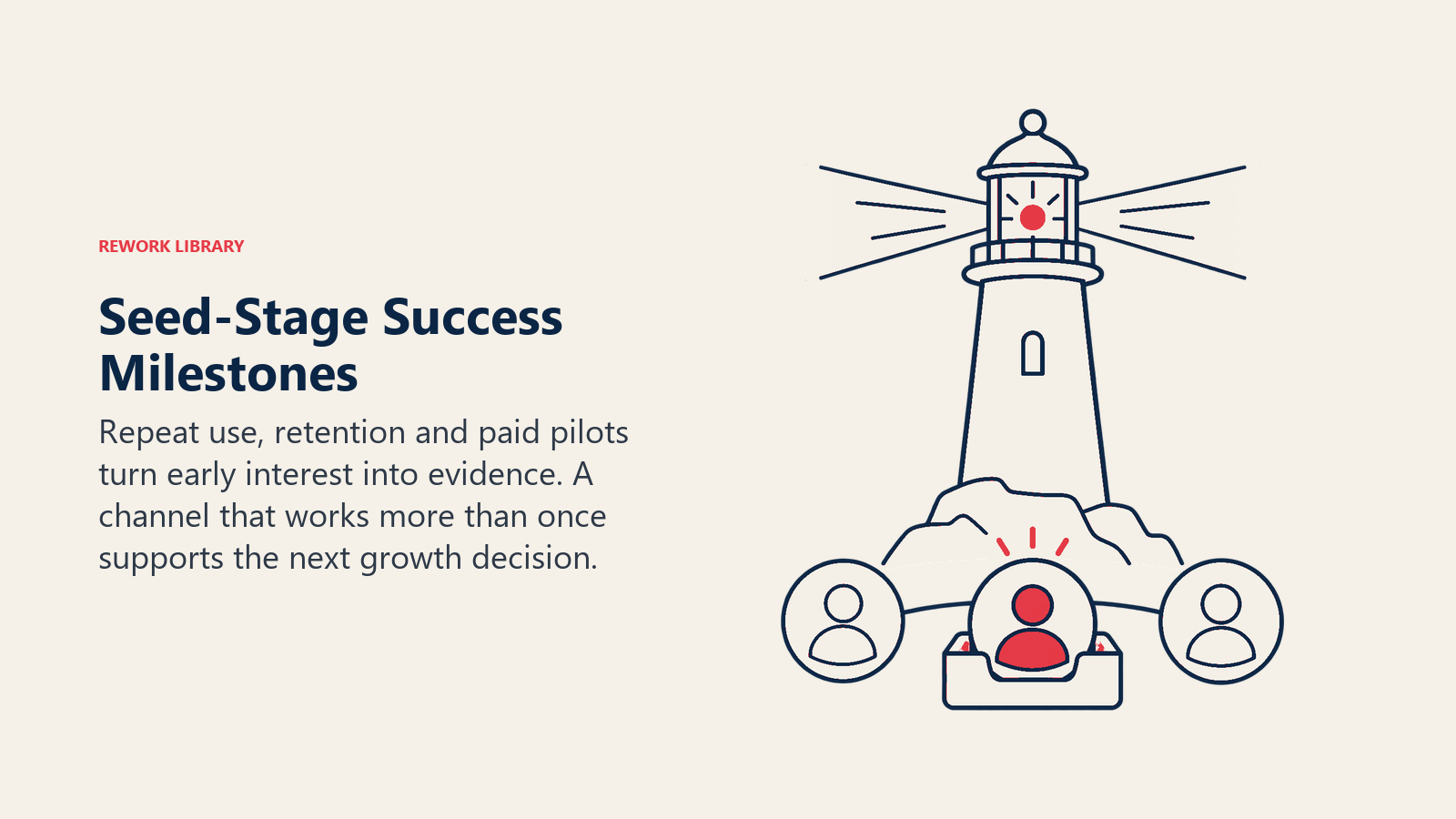
- A product people actually use. Not downloads or sign-ups, but repeat use.
- Retention that holds. Early users stay instead of dropping off after the first week or month.
- Revenue or paid pilots. Customers pay, even in small amounts. Willingness to pay is stronger evidence than praise.
- A repeatable acquisition channel. At least one way of finding customers that works more than once, even if it's still manual. The early-stage growth model shows how teams structure that search.
- A growth rate worth defending. Paul Graham's example is useful here: a company making $1,000 a month and growing 1% a week reaches about $7,900 a month four years later, while one growing 5% a week reaches about $25 million a month. It's his own illustration of compounding, not a benchmark for what any seed company should hit. Its lesson is that small differences in weekly growth become huge differences over time.
- A story for the next investors. A clear account of what was learned, what worked and what the next funding will accomplish.
If you track one number weekly, make it the growth rate of the metric that matters most to your business, whether that's active users, revenue or paid pilots.
Seed stage vs the stages around it
| Pre-seed | Seed | Series A | |
|---|---|---|---|
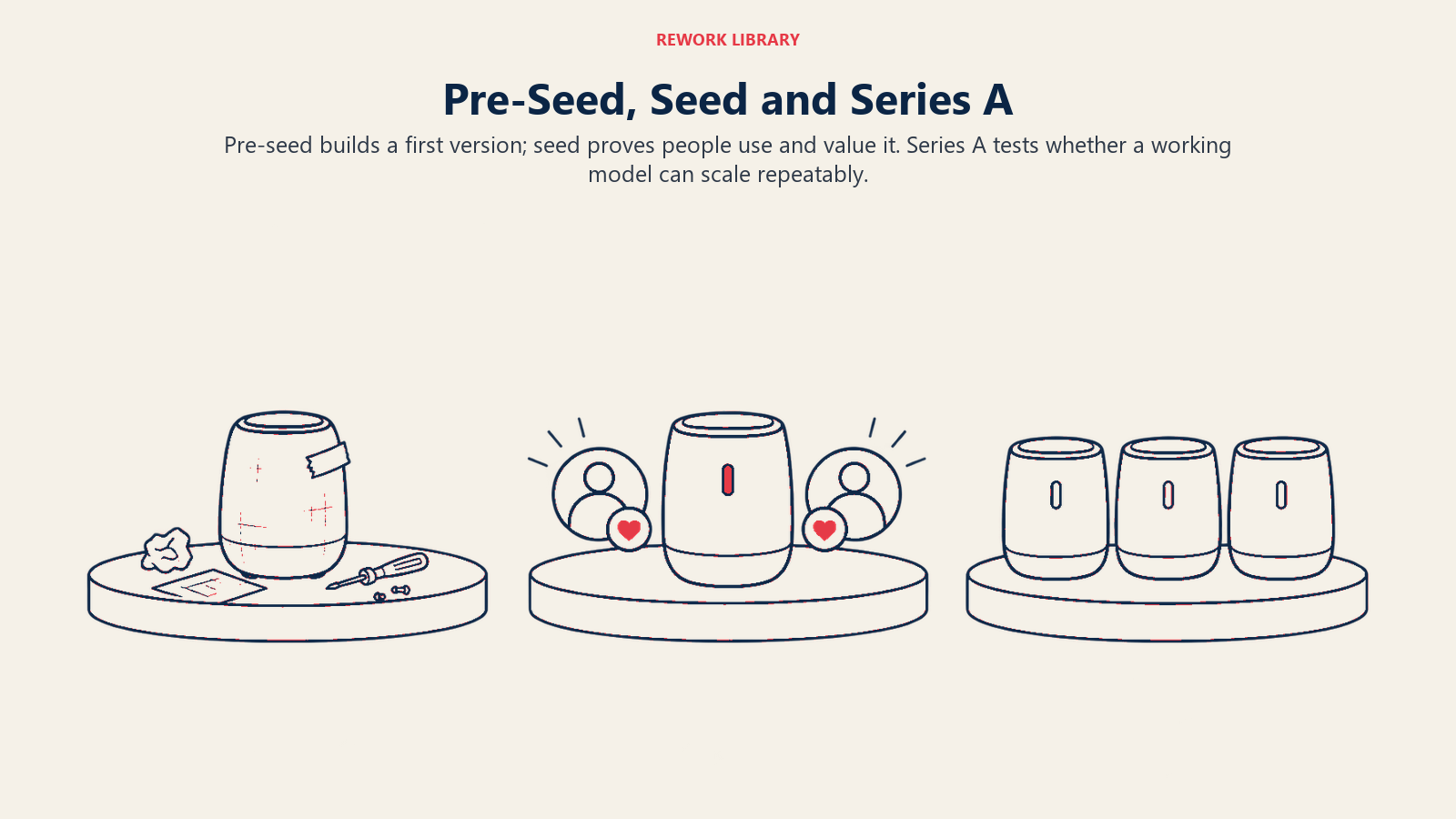
| Main goal | Build a first version, test the idea | Prove people use and value it | Prove it can scale repeatably |
| Product | Prototype or early version | Working product in real use | Mature enough to sell broadly |
| Customers | Conversations, a handful of testers | Early users and pilot customers | A repeatable customer base |
| Team | Founders, maybe one or two others | Small team of generalists | Growing, with some specialists |
| Biggest risk | Building something nobody wants | Never finding repeatable demand | Scaling before the model works |
These are tendencies, not thresholds. A B2B enterprise product may take far longer to reach paying customers than a consumer app, and a seed-stage company in one industry can look very different from one in another.
Common risks and mistakes at seed stage
- Mistaking early praise for demand. Friends and advisors are polite. Look for use, repeat behavior and payment.
- Scaling too early. Hiring a sales team before there's a repeatable pitch burns cash on an unproven process.
- Building without talking to users. Teams that disappear for months to build in isolation often come back to the wrong product.
- Raising too little to reach a milestone. If the money runs out before the proof point, the company is forced into a hasty bridge round or a shutdown.
- Ignoring the default outcome. Paul Graham frames the question as whether a company is default alive or default dead: if expenses stay constant and growth continues as it has, does the company reach profitability before the money runs out? He notes that half the founders he talks to don't know.
- Poor founder alignment. Disagreements between founders about role, equity or direction cause problems that no amount of capital fixes.
- Treating investor interest as a guarantee. Investors can change their minds, so Graham advises that fundraising is never more than a plan A, and you should always have a plan B.
How seed-stage practices vary by market
Seed-stage expectations differ by country, industry and investor base. Company types also matter: a software company can often get early users with a small team, while hardware, health or deep-technology ventures may need much more time and capital before they have anything to test. Investor norms, legal structures and the availability of seed funding also vary between markets. We haven't found a reliable comparative source for Southeast Asia or other specific regions, so founders there should talk to local investors, accelerators and lawyers about what's typical before assuming US norms apply.
Key Facts
- "Seed stage" has no legal definition. It describes a company that has moved past the idea and is testing a real product with early users.
- Paul Graham of Y Combinator defines a startup as a company designed to grow fast and calls growth rate the measure of a startup.
- Founders typically recruit their first users manually, a point Graham makes in "Do Things That Don't Scale."
- Cooley notes that convertible notes are one of the most popular ways to raise initial seed funding.
- Y Combinator describes a SAFE as a contract that funds a startup now for shares later, converting when a priced round happens.
- Graham's default alive or default dead test asks whether a company reaches profitability on its current trajectory before cash runs out.
- Seed practices differ by country and industry, so check local norms.
Related Reading

On this page
- What "seed stage" actually means
- Where seed sits in the startup journey
- What a seed-stage company is trying to do
- Build and ship a real product
- Get the first users, by hand
- Look for product-market fit
- Learn the economics early
- Stay alive long enough to learn
- The team at seed stage
- How seed-stage companies get funded
- Milestones that define a successful seed stage
- Seed stage vs the stages around it
- Common risks and mistakes at seed stage
- How seed-stage practices vary by market
- Key Facts
- Related Reading