Internet Timeline: From ARPANET to the Cloud
Turn this article into takeaways for your work.


Each assistant summarizes the article only for you and suggests best practices for your work.
A message was only as fast as the person or the horse carrying it. The Roman Empire needed to move orders and reports across its provinces. So it built a relay post. For a very long time after that, speed in long-distance messaging meant better relays.
The Internet timeline starts in 1961 with the first paper on packet switching. It reaches its first four connected computers in 1969. It turns into one network on 1 January 1983, when ARPANET switched to TCP/IP. The web arrived between 1989 and 1993, and the backbone went commercial in 1995. The cloud and the smartphone made the network constant after 2006. The throughline is theory first, practice later: most of the key ideas sat in papers for years before anyone could use them.
Everything below is the story of how that limit was removed, one layer at a time. This page is the dated reference. For the story of who gets credit, read Who Invented the Internet?, and for the manager's view, read The History of the Internet.
Two questions get their own pages. The difference between the Internet and the web is covered in Internet vs World Wide Web: A History, so here the two are kept apart only where the dates differ.
Timeline at a Glance
| Year | Milestone | Why It Mattered |
|---|---|---|
| 1794 | Claude Chappe completes a fifteen-station optical telegraph line from Paris to Lille | A message crossed a country faster than a rider could carry it. |
| 1844 | Samuel Morse sends "What hath God wrought" from the US Capitol to Baltimore on 24 May | Electric signals over a wire became a working public service. |
| 1858-1866 | A transatlantic cable fails after three weeks in 1858, then works in 1866 | News between continents dropped from days of steamer travel to minutes. |
| 1961 | Leonard Kleinrock publishes the first paper on packet switching theory in July | The core idea of the Internet existed on paper eight years before the network. |
| 1969 | ARPANET installs its first node at UCLA and links four hosts by year end | Packet switching worked between real institutions. |
| 1971-1972 | Ray Tomlinson chooses the "@" sign (1971) and writes basic email software (1972) | The network found its first mass use: people writing to people. |
| 1973-1974 | Vint Cerf and Bob Kahn sketch (1973) and publish (1974) the protocol design | Different networks gained a common language. |
| 1983 | ARPANET switches to TCP/IP on 1 January, the date set in RFC 801 | One protocol suite became the standard. |
| 1985-1987 | NSFNET makes TCP/IP mandatory (1985); RFC 1034 defines the Domain Name System (November 1987) | Universities connected at scale, and names replaced numbers. |
| 1990-1993 | The first web server goes online in November 1990; CERN frees the technology on 30 April 1993 | Anyone could build a server or a browser without fees. |
| 1995 | NSF defunds the NSFNET backbone in April; the Federal Networking Council defines "Internet" on 24 October | Commercial providers took over the backbone. |
| 1998 | Google is incorporated in August | Search organized a web nobody could navigate. |
| 2006-2007 | AWS launches S3 on 14 March 2006; Apple announces the iPhone on 9 January 2007 | Infrastructure and access both became on-demand. |
| 2024-2025 | Anthropic announces the Model Context Protocol on 25 November 2024; the ITU reports almost three-quarters of the world online | The network now connects software agents to business data as well as people to pages. |
The Courier and the Wire (Roman Empire-1866)
Better relays, then wires, shrink the distance
Picture a rider arriving at a Roman roadside station, handing over a sealed dispatch and taking a fresh animal for the next stage. Britannica describes the empire's cursus publicus as relay stages set along the major roads, with rest stops and overnight lodging at regular intervals, and calls it "the most highly developed postal system of the ancient world." It served the state's military and administrative needs. It was not the Internet, and nobody confused the two. But it solved the same problem in the same shape: a message too important to trust to chance, moved from node to node along a fixed route.
The next real jump in speed came in 1794. Claude Chappe and two of his brothers completed a line of fifteen stations between Paris and Lille in July 1794, and the first message went out in August, reporting the recapture of Le Quesnoy. The ETHW (IEEE) account says each station was a mast with a rotating bar and two indicator arms, staffed by two operators about 10 to 15 km from the next, and that the code gave 92 usable positions. Operators did not read a letter. They read the shape of the arms through a telescope and passed it on. A Paris-Strasbourg line followed in 1798, Napoleon ordered the network expanded, and France began replacing it with electrical telegraphy in 1846.
Electricity removed the towers. On 24 May 1844, Samuel Morse sent "What hath God wrought" from the US Capitol to his partner Alfred Vail in Baltimore. The Senate Historical Office notes Morse had first demonstrated his equipment in the Capitol in February 1838, and that he spent years seeking congressional money before the 1844 line existed. That gap, a working idea waiting years for funding, will reappear.
Then came the ocean. The Met's description of Robert Dudley's cable watercolors says a transatlantic telegraph cable, led by Cyrus W. Field and financed by the Atlantic Telegraph Company, meant messages could cross in minutes instead of the ten or twelve days a steamer needed. An initially successful 1858 attempt failed after three weeks. Queen Victoria's congratulatory message to President Buchanan went over it on 16 August 1858. After repeated efforts, two working cables followed in July and September 1866.
All of this is precursor, not Internet. These systems carried messages on dedicated lines, one conversation at a time, and nobody could join them without permission. What they proved was that long-distance messaging could be organized as a network of relay points, and that people would pay for speed.
For teams today: the technology changes, but the question stays the same: how many hand-offs sit between a message and its reader? Count them in your own approvals and reporting chains before you buy anything.
The Packet Years (1961-1972)
A paper idea becomes four connected computers
In July 1961, Leonard Kleinrock at MIT published the first paper on packet switching theory, according to the Internet Society's history. A year later, in August 1962, J.C.R. Licklider described a "Galactic Network" in memos, and in October he became the first head of DARPA's computer research program. In 1964, Paul Baran and others at RAND wrote about packet switching networks for secure military voice communication, and Kleinrock published the first book on the subject. The idea was in several places at once.
The first working steps were small. In 1965, Lawrence Roberts and Thomas Merrill linked a computer in Massachusetts to one in California over a low-speed dial-up line. In 1967, Roberts published his ARPANET plan, and at the same conference Donald Davies and Roger Scantlebury presented work from Britain's National Physical Laboratory. The Internet Society adds that the word "packet" came from that British group.
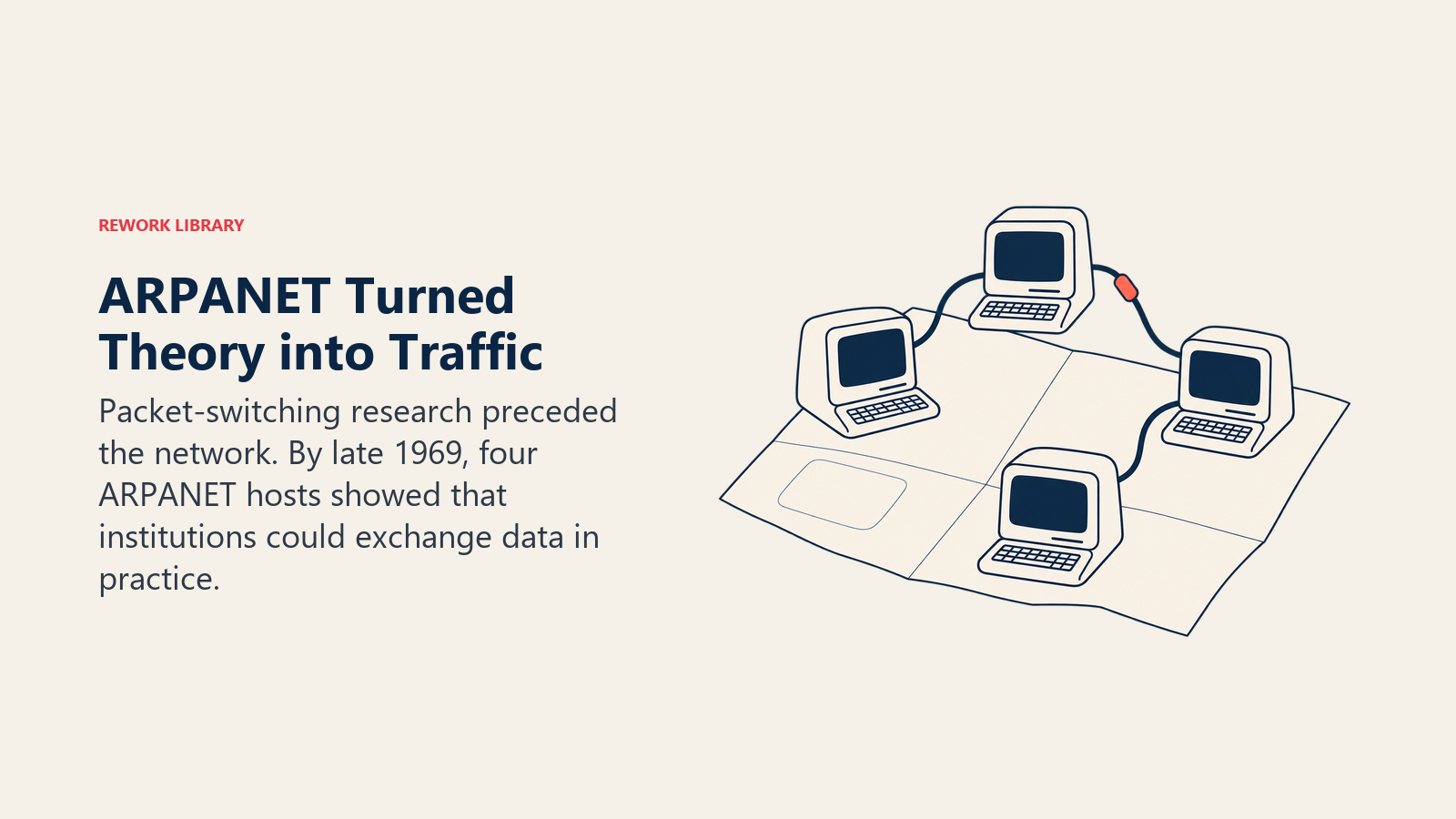
Then the machines went in. In September 1969, the first interface message processor was installed at UCLA, and the first host connected to it. A month later SRI joined, and the first host-to-host message went from Kleinrock's lab to SRI. By the end of 1969 there were four hosts. The Computer History Museum dates ARPANET's switch-on to late October 1969, so "first connected" and "first message" are different dates. Email followed. The Museum records Ray Tomlinson choosing the "@" sign in 1971, while the Internet Society dates his basic send-and-read software to March 1972. By 1973, the Museum adds, email was well over half of the network's traffic. In October 1972, Bob Kahn organized a public ARPANET demonstration at the International Computer Communication Conference.
The problem this era left was isolation. ARPANET was one network with one protocol. The satellite and radio networks being built at the same time each spoke something else.
For teams today: the best early signal on a new technology is a working demo between two real organizations, not a promise. Ask for a pilot with a partner, not a slide.
After Flag Day (1973-1991)
One protocol suite replaces every dialect
This era overlaps with the next one, because the web was proposed in 1989 while the old backbone was still being retired. The turning point is a calendar date. In spring 1973, Bob Kahn asked Vint Cerf to help design a way for networks to interconnect. The first written version, INWG#39, circulated at a meeting at Sussex University that September, and Cerf and Kahn published a refined design in 1974. The Computer History Museum dates their sketch to 1973 as well.
Jon Postel's RFC 801, "NCP/TCP Transition Plan," dated November 1981, set 1 January 1983 as the target for completing the switch from the old ARPANET protocol to IP/TCP. It laid out who had to do what, with relay hosts bridging old and new until then. On 1 January 1983, the Internet Society records, ARPANET made a single "flag-day" cutover, and participants later made buttons celebrating that they survived it.
The network then spread beyond the defense world. The UK's JANET (1984) and the US NSFNET (1985) were built for higher education, and NSFNET made TCP/IP mandatory. The Computer History Museum notes NSFNET linked five supercomputer centers, which helped Internet protocols beat rival standards. The National Science Foundation says NSFNET connected about 2,000 computers in 1986, that its backbone in 1991 became the first national 45-megabit-per-second network, and that it linked more than 2 million computers by 1993. The Internet Society puts the program's funding at about $200 million from 1986 to 1995.
Growth broke the old address book. RFC 1034, by Paul Mockapetris and dated November 1987, introduced domain-style names because the single HOSTS.TXT file could not keep up with the network. Its answer was a distributed system with local caching. In September 1988, the first Interop trade show drew 50 companies, an early sign that vendors saw a market. ARPANET itself was decommissioned in 1990, by which point TCP/IP had largely displaced other wide-area protocols.
The problem this era created was the interface. Using the network meant command lines, file transfer and knowing which server held what.
For teams today: a hard cutover with a published date and a named owner is how the Internet itself migrated. If your own migration has no date, it has no owner.
The Web Opens the Door (1989-1995)
A proposal, a free license and a browser
In March 1989, Tim Berners-Lee circulated "Information Management: A Proposal" at CERN. The W3C's history page lists what followed. In October 1990, he began a browser and editor on a NeXT computer and named the program "WorldWideWeb." In November 1990, the first web server went online at CERN along with the first web page. A line-mode browser reached a limited audience in March 1991, and web files became available by FTP in August 1991. The Computer History Museum records that by Christmas 1990 he had prototyped a server, HTML, URLs and the first browser.
Two decisions in 1993 mattered more than any code. In February, NCSA released the first alpha of Mosaic for X. On 30 April, CERN's directors declared that WWW technology could be used freely by anyone, with no fees payable to CERN. By October 1993 there were over 200 known HTTP servers. The NSF, which funded the NCSA work, calls Mosaic the world's first freely available web browser, and the Computer History Museum calls it the first browser supported by a major institution.
The institutions followed. The World Wide Web Consortium was founded on 1 October 1994, and its first meeting was at MIT on 14 December. In April 1995, NSF defunded the NSFNET backbone and redistributed the money to regional networks so they could buy private connectivity. By then the Internet had grown to over 50,000 networks, about 29,000 of them in the United States. On 24 October 1995, the Federal Networking Council defined the term "Internet."
The problem this created was discovery. Pages multiplied faster than anyone's ability to find them. The wider question of where the web ends and the Internet begins is handled in Internet vs World Wide Web: A History.
For teams today: adoption followed the interface and the license, not the infrastructure. When you choose a platform, check who is allowed to build on it and on what terms. API architecture is the modern version of that question.
The Cloud and the Phone (1998-2020)
Search, rented servers and a pocket browser
Search came first. Google's own account says Larry Page and Sergey Brin met at Stanford in 1995, built a search engine that ranked pages by analyzing the links between them, and that Google was officially incorporated in August 1998 after Andy Bechtolsheim wrote a $100,000 check.
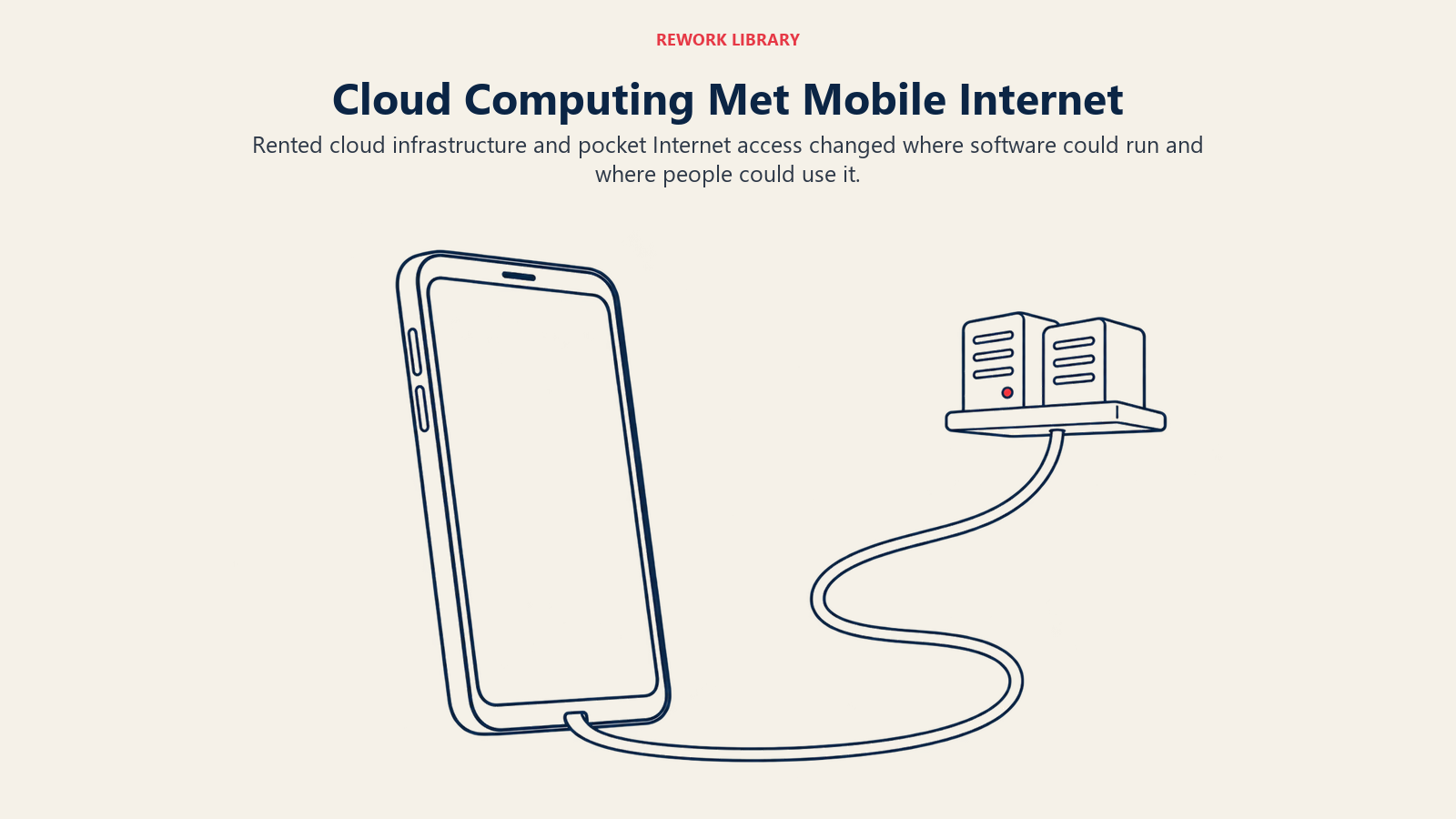
Then servers became a utility. On 14 March 2006, AWS launched publicly. Amazon's account says it launched with one service, S3 for storage, and that EC2 followed a few months later. A founder with a laptop could rent what only large companies had owned. The same logic moved software itself into the browser, which is why a plan for your SaaS tech stack now starts with integrations and exit terms and not with installation.
Access went with it. On 9 January 2007, Apple announced the iPhone, and its press release described it as a mobile phone, a widescreen iPod and "a breakthrough Internet communications device" in one. The US launch was slated for June 2007. The numbers show how fast the base grew. The Pew Research Center reports that 52% of US adults used the Internet in 2000 and 96% in 2025, and that home broadband went from 1% in a March 2000 survey to 78% in its latest figure, June 2026.
By the time remote work became a mass policy, most knowledge-work tools already ran in a browser. That is why remote work productivity is a management question more than a technical one. The new problems were sprawl, attention and security: when everything is reachable from anywhere, every login is a door.
For teams today: the Internet stopped being a channel and became the place work is stored and run. Budget for it like an operating environment, and keep a current list of what connects to what. Digital transformation strategy covers that planning.
The Age of Agents (2020s-present)
Software, not only people, starts using the network
The network the earlier eras built is now mostly assumed. The ITU's 2025 edition of Facts and Figures says almost three-quarters of the world's population is now online, with roughly 2.2 billion people still offline, most of them in low- and middle-income countries. The next layer is about what the connected software can do.
AI assistants only help with work when they can reach the tools and records where work lives. On 25 November 2024, Anthropic announced the Model Context Protocol, which it describes as "an open standard that enables developers to build secure, two-way connections" between data sources and AI-powered tools. The Model Context Protocol explainer covers how it works. The pattern is old: a shared protocol lets new kinds of software join the network. For the parallel story of the technology on top, see the AI timeline.
The problem this era creates is control. The network was built to move data, not to tell humans from software, so identity, permissions and audit trails matter more than they did.
For teams today: before connecting an AI tool to company systems, decide what it may read, what it may change and where that is logged. Clean integrations are the precondition for useful automation.
Key People
| Name | Role | Contribution | Year |
|---|---|---|---|
| Claude Chappe | French inventor | Completed the Paris-Lille optical telegraph line with two brothers | 1794 |
| Samuel Morse and Alfred Vail | Telegraph inventor and partner | Sent and received the first Washington-Baltimore message | 1844 |
| Cyrus W. Field | Financier and promoter | Led the transatlantic cable effort through the 1858 failure and 1866 success | 1858-1866 |
| Leonard Kleinrock | MIT researcher | Published the first paper on packet switching theory; his lab sent the first host-to-host message | 1961, 1969 |
| J.C.R. Licklider | DARPA computer research head | Described the "Galactic Network" and led DARPA's computer program | 1962 |
| Paul Baran | RAND researcher | Wrote on packet switching networks for secure military voice; his 1964 paper is cited by the Internet Society | 1964 |
| Donald Davies and Roger Scantlebury | NPL (UK) | Presented packet network work; the word "packet" came from NPL | 1967 |
| Lawrence Roberts | ARPA | Published the ARPANET plan | 1967 |
| Ray Tomlinson | BBN engineer | Chose "@" for networked email and wrote basic email software | 1971-1972 |
| Vint Cerf and Bob Kahn | Protocol designers | Designed and published the TCP/IP approach | 1973-1974 |
| Jon Postel | ISI | Wrote the NCP/TCP Transition Plan | 1981 |
| Paul Mockapetris | ISI | Authored RFC 1034 on domain names | 1987 |
| Tim Berners-Lee | CERN | Proposed and built the first web server and browser | 1989-1990 |
Key Facts
Key Facts: Internet Timeline
- ARPANET had four connected host computers by the end of 1969, and ARPANET switched to TCP/IP in one cutover on 1 January 1983, per the Internet Society.
- The plan for that cutover is RFC 801, dated November 1981, which set 1 January 1983 as the target date.
- NSFNET connected about 2,000 computers in 1986 and more than 2 million by 1993, according to the National Science Foundation.
- CERN declared on 30 April 1993 that WWW technology could be used freely by anyone, and over 200 known HTTP servers existed by October 1993, per the W3C.
- 52% of US adults used the Internet in 2000, versus 96% in 2025, according to the Pew Research Center.
- Almost three-quarters of the world's population is online, while about 2.2 billion people remain offline, per the ITU.
The Pattern Behind the History
Across two centuries of dated milestones, the story repeats four moves. This is our own synthesis of the timeline above, not a published study.
- Idea before infrastructure. Packet switching sat in papers from 1961 and Morse waited years for funding. The wait is normal.
- Common rules beat better machines. The 1983 cutover to one protocol suite did more than any single network.
- Open access sets the adoption date. CERN's fee waiver in 1993 and NSF's rule that campus connections serve all qualified users made growth possible.
- Each layer hides the one below. Browsers hid protocols, the cloud hid servers, and agents now hide interfaces.
What It Teaches Teams Today
The dates give a working checklist. Put a date and an owner on every migration, as RFC 801 did. Prefer tools that sit on open standards, because those are the ones that stayed useful across eras. Judge a new technology by which layer it sits in: a standard is worth betting on early, an interface once it removes a skill barrier, and a platform with care. And expect the next layer to depend on the previous ones, so keep your integrations and data clean. For the longer view of the hardware under all of this, see the computer timeline.
The Internet timeline is a long argument that the dates matter less than the order. Every layer was proposed on paper, built by a small group, opened to everyone and then hidden by the next. The layer after agents is probably being drafted now.

Co-Founder, Rework.com