More in
B2B SaaS Industry News
Salesforce Just Solved CRM's Oldest Data Problem, At a Cost
Apr 7, 2026
When Your SaaS Vendor Cuts Its R&D Team: What Enterprise Buyers Need to Watch
Mar 19, 2026
The 171% Agentic AI ROI Number: What the Data Actually Says
Mar 2, 2026
Drift Is Being Phased Out: The RevOps Checklist Before Your Conversational Workflows Go Dark
Feb 11, 2026 · Currently reading
The $99-Per-Seat Decision: How to Evaluate Microsoft's New AI Bundle
Feb 9, 2026
The SaaS Growth Model That No Longer Requires More Engineers
Feb 4, 2026
Meeting Notes Just Hit a $1.5B Valuation: What That Signals About the Enterprise AI Context Race
Feb 3, 2026
A $1.2B CRM-Killer at $8M ARR: What Every Sales Leader Needs to Decide Before the Next Board Meeting
Feb 2, 2026
Record AI Funding in Q1 2026: What It Means for Your Sales Stack and Your Competitors
Jan 8, 2026
The Agentic Sales Stack Is Attracting Unicorn Capital: What CEOs Need to Decide About Their Revenue Infrastructure
Jan 7, 2026
Drift Is Being Phased Out: The RevOps Checklist Before Your Conversational Workflows Go Dark
Turn this article into takeaways for your work.


Each assistant summarizes the article only for you and suggests best practices for your work.
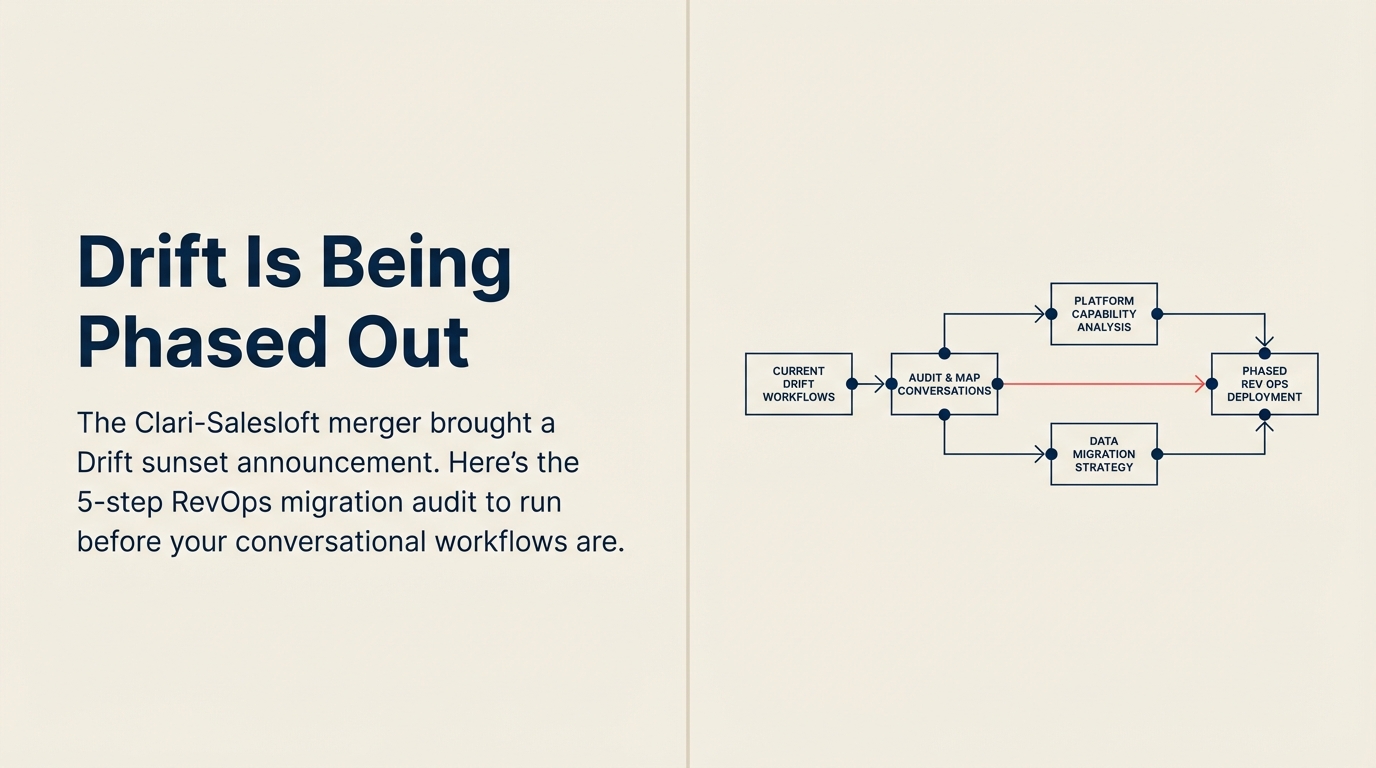
When two major revenue platforms merge and then announce the gradual sunset of a product thousands of teams depend on, RevOps can't wait for a formal end-of-life notice. The migration audit starts now.
The Clari-Salesloft merger closed on December 3, 2025, with Steve Cox appointed as CEO of the combined entity. According to the Salesloft company newsroom, the combined organization immediately doubled R&D investment toward what it's calling a "Predictive Revenue System," a unified platform that brings engagement, forecasting, and pipeline intelligence under one roof. By March 2026, the company had partnered with 1mind, an AI digital teammate platform, to extend that capability through the full revenue cycle from pipeline generation to close.
The 1mind partnership came with an announcement that should put every Drift customer on alert: Drift is being gradually phased out. As reported by Demand Gen Report, the conversational marketing product that Salesloft acquired in February 2024 is being wound down as the combined organization consolidates its product bets.
If your conversational workflows, chatbot sequences, or lead routing logic runs through Drift, you now have an active vendor risk. Here's how to get ahead of it.
Why This Pattern Matters Beyond Drift
Before the checklist, it's worth understanding why this keeps happening, because Drift won't be the last product to go through this cycle.
Post-M&A product rationalization is predictable. When two platforms with overlapping functionality merge, engineering resources consolidate around the combined roadmap. Products that don't fit the new narrative get sunset. The survivor benefits from focused investment; the deprecated product gets feature-frozen and eventually end-of-lifed.
Drift's acquisition by Salesloft in 2024 was the first flag. Once a product changes hands, especially to a larger platform with its own roadmap priorities, the timeline on its independence shortens. When that platform then merges with another major player (in this case Clari) the denominator of competing priorities expands. Drift, which was already Salesloft's acquisition, is now several layers removed from the surviving entity's core thesis.
For RevOps teams, the lesson isn't just about Drift. It's about any vendor in your stack that has changed hands in the last 18 to 24 months. The migration risk profile of those products is elevated, and they deserve a higher frequency of review in your vendor governance process. The true cost of software sprawl at mid-market companies shows why this category of risk adds up faster than most finance teams realize.
The 5-Step Migration Audit
Run this audit before your next vendor review, not after you receive a formal deprecation notice.
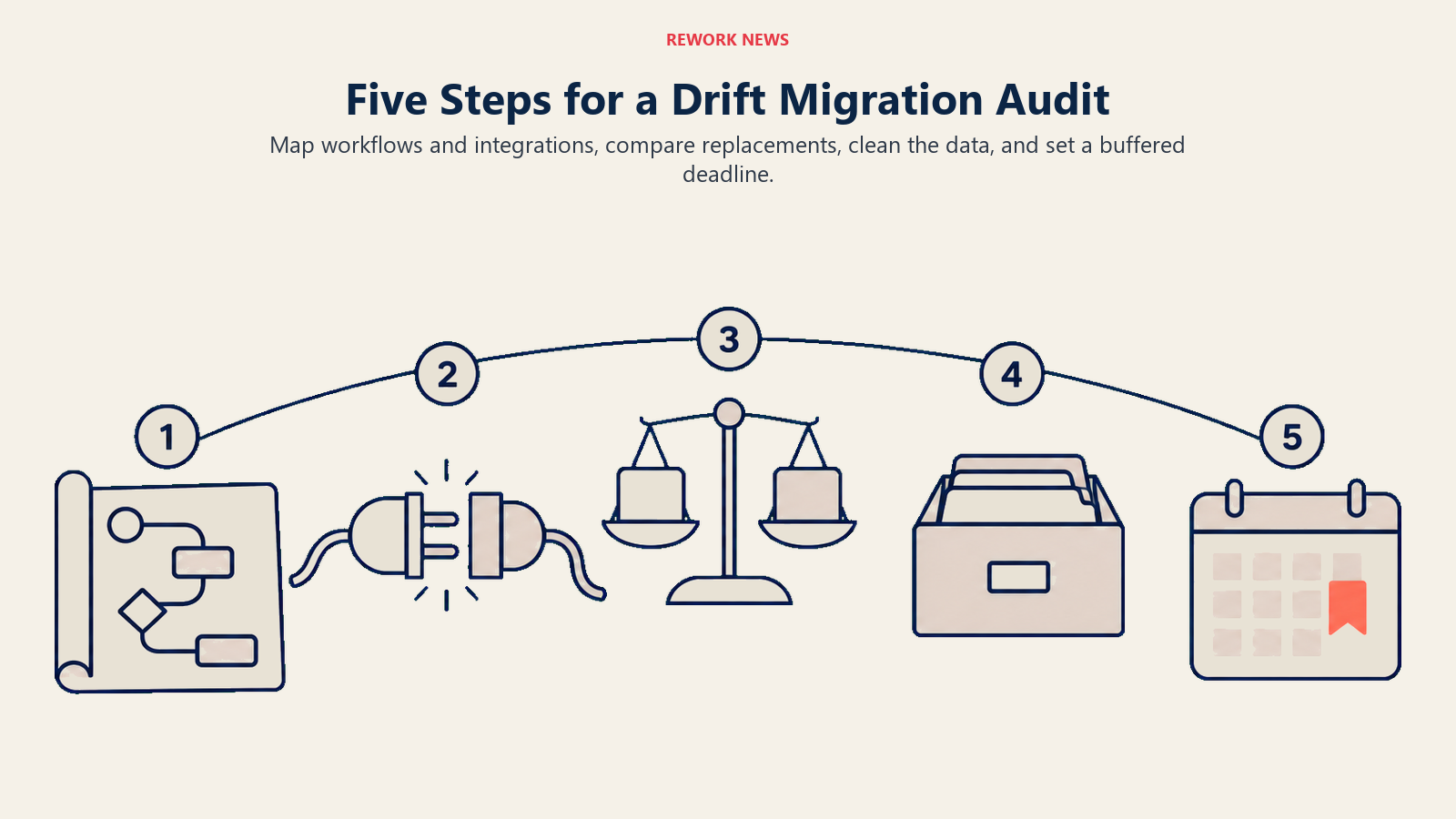
Step 1: Map every workflow that touches Drift. This sounds obvious, but most teams discover the full scope of Drift dependencies only after they start planning a migration. Pull every bot sequence, routing rule, playbook, and integration. Document which workflows are revenue-critical (inbound lead qualification, trial signup flows, renewal-risk routing) and which are lower stakes (FAQ bots, informational pages). The revenue-critical ones need migration plans with tight timelines; the others can be deprioritized.
Step 2: Identify every system Drift talks to. Drift integrations typically span CRM (Salesforce or HubSpot), marketing automation (Marketo, HubSpot, Pardot), meeting scheduling (Calendly, Chili Piper), and Slack or email for internal routing. Each integration is a migration risk. Pull the integration list now, before you're under deadline pressure, and map which systems you'd need to reconfigure for any replacement platform.
Step 3: Evaluate the combined Clari-Salesloft roadmap as an option, but not the only option. The combined entity is positioning its platform as the natural replacement for Drift's conversational use cases. That may be true for some workflows, especially if you're already a Salesloft customer. But the evaluation should be objective. Alternatives worth scoping include Qualified, Intercom, HubSpot's native chat (if you're already HubSpot-first), and 6sense's conversational intelligence features. The vendor that's sunsetting Drift is not automatically the best replacement for Drift's use cases.
Step 4: Audit your revenue data readiness against the AI governance problem. This step is less about Drift specifically and more about a broader vulnerability the Clari-Salesloft merger has surfaced. Research released by Clari Labs in early 2026 found that 87% of enterprises missed 2025 revenue targets despite record AI spend. More usefully: 48% said their revenue data is not AI-ready, and 42% lack formal AI governance frameworks.
Those numbers describe a structural problem that vendor migrations often expose. If your Drift data (conversation histories, lead routing outcomes, qualification signals) isn't structured in a way that your AI systems can actually use, then migrating to a new platform without fixing the data architecture will reproduce the same problem in a different tool. The migration is an opportunity to clean the data model, not just swap the interface. Preparing your data before you migrate anything is the step most teams skip, and the one that causes the most post-migration fires.
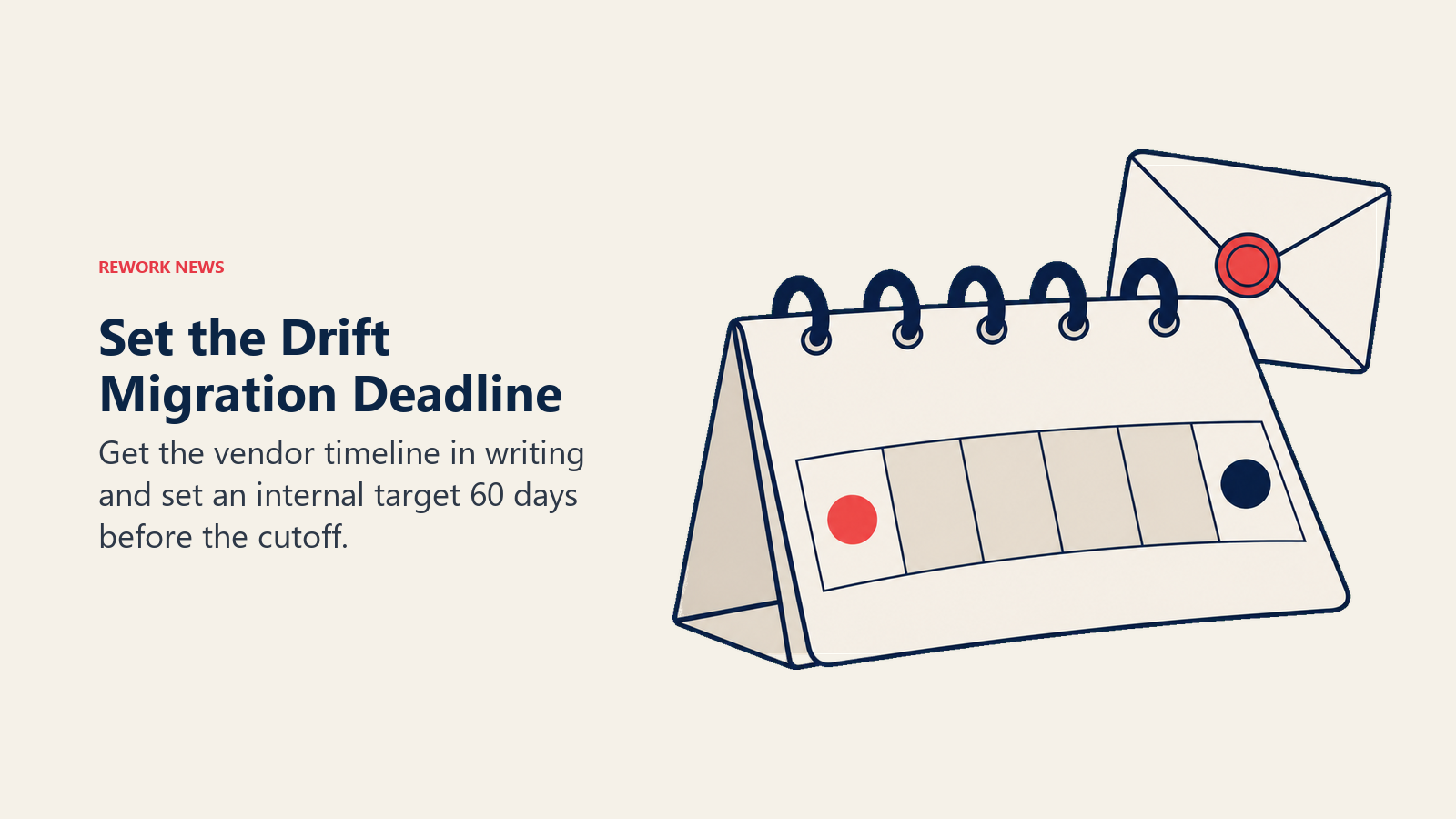
Step 5: Set a migration deadline before the vendor sets one for you. Every vendor sunset has a formal end-of-life date, and there's typically a gap between the announcement and the actual cutoff. But migration timelines in RevOps are always longer than initially estimated. Integration reconfiguration, playbook rebuilding, rep retraining, and pipeline impact during the transition all add up. Set your own internal deadline that gives you a 60-day buffer before the formal cutoff. If you don't know when the formal cutoff is, that's step one: get it in writing from your account team. Once you have the timeline, cutover day preparation is where migrations either hold together or fall apart.
The AI Governance Signal You Shouldn't Ignore
The 87%-missed-revenue-targets figure from Clari Labs deserves its own read, separate from the Drift migration conversation. It's a data point about the gap between AI investment and AI effectiveness, and it's relevant to every RevOps team, not just Drift users.
The specific breakdown matters: nearly half of enterprises say their revenue data isn't AI-ready, and more than 40% have no formal framework governing how AI tools make decisions about their pipeline. Those aren't small operational gaps. They're structural vulnerabilities that compound over time, especially as AI agents take on more of the decision-making in lead routing, forecast calls, and risk scoring. A RevOps maturity model maps out what "having a governance framework" actually looks like at each stage, and why most teams that think they're at stage three are operating at stage two.
If your team is migrating off Drift and rebuilding conversational workflows on a new platform, the governance questions should be part of the scoping conversation. Who owns the routing logic? Who reviews the AI's decisions on high-value leads? What data goes into the model, and is that data clean enough to produce reliable outputs?
The companies that came through 2025 hitting their revenue targets despite the AI spend environment (the 13% that succeeded) almost certainly have answers to those questions. The migration audit is a good forcing function to get your team to those answers too.
What to Decide This Quarter
Drift's gradual sunset doesn't come with a hard off date in the public announcement. That ambiguity is the risk. "Gradual" usually means "sooner than you think once the engineering resources move."
Three decisions to make before end of quarter:
Lock down the scope. Run the workflow and integration audit now. You need the full map before you can estimate the migration effort. This is a RevOps task, not an IT task. The people who built the workflows need to document them.
Choose an evaluation owner. If Drift replacement isn't already in someone's quarterly OKRs, it needs to be. This can't be a background project. Assign it a named owner and a delivery date for the vendor shortlist.
Get timeline clarity from Salesloft. If you're a current Drift customer, your account team owes you a clear migration timeline. Get it in writing. That date is your backstop. Your internal deadline should be 60 days ahead of it.
Post-M&A vendor consolidation is a feature of the current market, not an exception. The teams that build durable RevOps infrastructure are the ones that treat vendor risk as an ongoing process, not a fire drill. Drift is the reminder. The checklist is the response.
Learn More
- Drift Is Being Sunset: 5-Step Migration Playbook for Sales Ops: Detailed workflow audit and migration steps for the operational team
- The B2B Chat Tool Market Is Consolidating: CMO Vendor Stability Guide: What CMOs need to know about the same Drift sunset from a marketing perspective
- RevOps Maturity Model: How durable RevOps infrastructure handles vendor consolidation without fire drills
