More in
B2B SaaS Industry News
Salesforce Just Solved CRM's Oldest Data Problem, At a Cost
Apr 7, 2026 · Currently reading
When Your SaaS Vendor Cuts Its R&D Team: What Enterprise Buyers Need to Watch
Mar 19, 2026
The 171% Agentic AI ROI Number: What the Data Actually Says
Mar 2, 2026
Drift Is Being Phased Out: The RevOps Checklist Before Your Conversational Workflows Go Dark
Feb 11, 2026
The $99-Per-Seat Decision: How to Evaluate Microsoft's New AI Bundle
Feb 9, 2026
The SaaS Growth Model That No Longer Requires More Engineers
Feb 4, 2026
Meeting Notes Just Hit a $1.5B Valuation: What That Signals About the Enterprise AI Context Race
Feb 3, 2026
A $1.2B CRM-Killer at $8M ARR: What Every Sales Leader Needs to Decide Before the Next Board Meeting
Feb 2, 2026
Record AI Funding in Q1 2026: What It Means for Your Sales Stack and Your Competitors
Jan 8, 2026
The Agentic Sales Stack Is Attracting Unicorn Capital: What CEOs Need to Decide About Their Revenue Infrastructure
Jan 7, 2026
Salesforce Just Solved CRM's Oldest Data Problem: At a Cost
Turn this article into takeaways for your work.


Each assistant summarizes the article only for you and suggests best practices for your work.
Ask any RevOps leader about their biggest CRM data quality problem and the answer comes back quickly: what a sales rep actually said on a call and what ended up in Salesforce are two different things. It's one of the core reasons CRM data quality is treated as a leading indicator of revenue risk in mature RevOps functions. The call had context, nuance, objections, commitments. The CRM record has a stage update and a one-line note if you're lucky.
Salesforce's acquisition of Momentum, announced via the Salesforce Newsroom on February 23, 2026, with the deal closing March 2, is a direct attempt to close that gap. Momentum captures conversational data from Zoom, Google Meet, and other video call platforms, structures it, and feeds it into CRM workflows automatically. The promise is a CRM record that reflects what actually happened in the conversation, without relying on rep discipline to log it.
For RevOps, this is genuinely interesting technology. It's also another layer of Salesforce platform dependency, and that dependency calculation is worth understanding clearly before the integration ships.
What Momentum Actually Does
Momentum's core function is converting unstructured audio and video data from sales calls into structured information that can flow into CRM fields, Slack notifications, and workflow triggers. Where a typical conversation intelligence tool stops at transcription and sentiment scoring, Momentum goes further into orchestration: automatically updating deal records, triggering follow-up tasks, and surfacing deal risk signals based on what was discussed.
According to Salesforce Ben's analysis of the acquisition, the technology integrates directly with Agentforce 360 and Slack to ingest third-party video call data and connect it to agentic workflows. The practical effect: an Agentforce agent can read what happened on a call and act on it (update an opportunity stage, send a recap, flag a risk) without a rep doing any manual entry.
This matters for RevOps because the data quality problem it addresses isn't peripheral. Pipeline forecast accuracy depends on CRM data reflecting reality. When reps don't log calls accurately (and most don't, consistently), every downstream model built on that data inherits the noise. Accurate call capture, automatically structured and pushed to the CRM, is the kind of input quality improvement that compounds across forecasting, coaching, and territory planning.
The Salesforce Acquisition Pace Context
One fact worth holding alongside the Momentum announcement: this was Salesforce's tenth acquisition in a six-month window. The previous deal, closed earlier in 2026, was for Cimulate, an agentic commerce company. CIO coverage of the Momentum acquisition noted the pace of dealmaking as context for Salesforce's broader Agentforce strategy.
Ten acquisitions in six months is not a coincidence. It's a platform build. Salesforce is assembling components for what appears to be an end-to-end agentic sales operating system: call capture (Momentum), commerce agents (Cimulate), voice workflows (Agentforce Voice for Financial Services), and agent management infrastructure (Agentforce Builder). The platform ARR from Agentforce reached $800M, up 169% year-on-year, with over 29,000 Agentforce deals closed in Q4.
For RevOps teams already running Salesforce as their primary CRM, this context is important. Salesforce isn't just adding features; it's building a vertical integration play. Every acquisition deepens the ecosystem and makes the total Salesforce footprint (and switching cost) more substantial.
The Dependency Calculation
Here's where RevOps leaders need to think carefully. The Momentum integration may genuinely improve CRM data quality. But it does so by adding another layer of infrastructure that runs inside the Salesforce ecosystem.
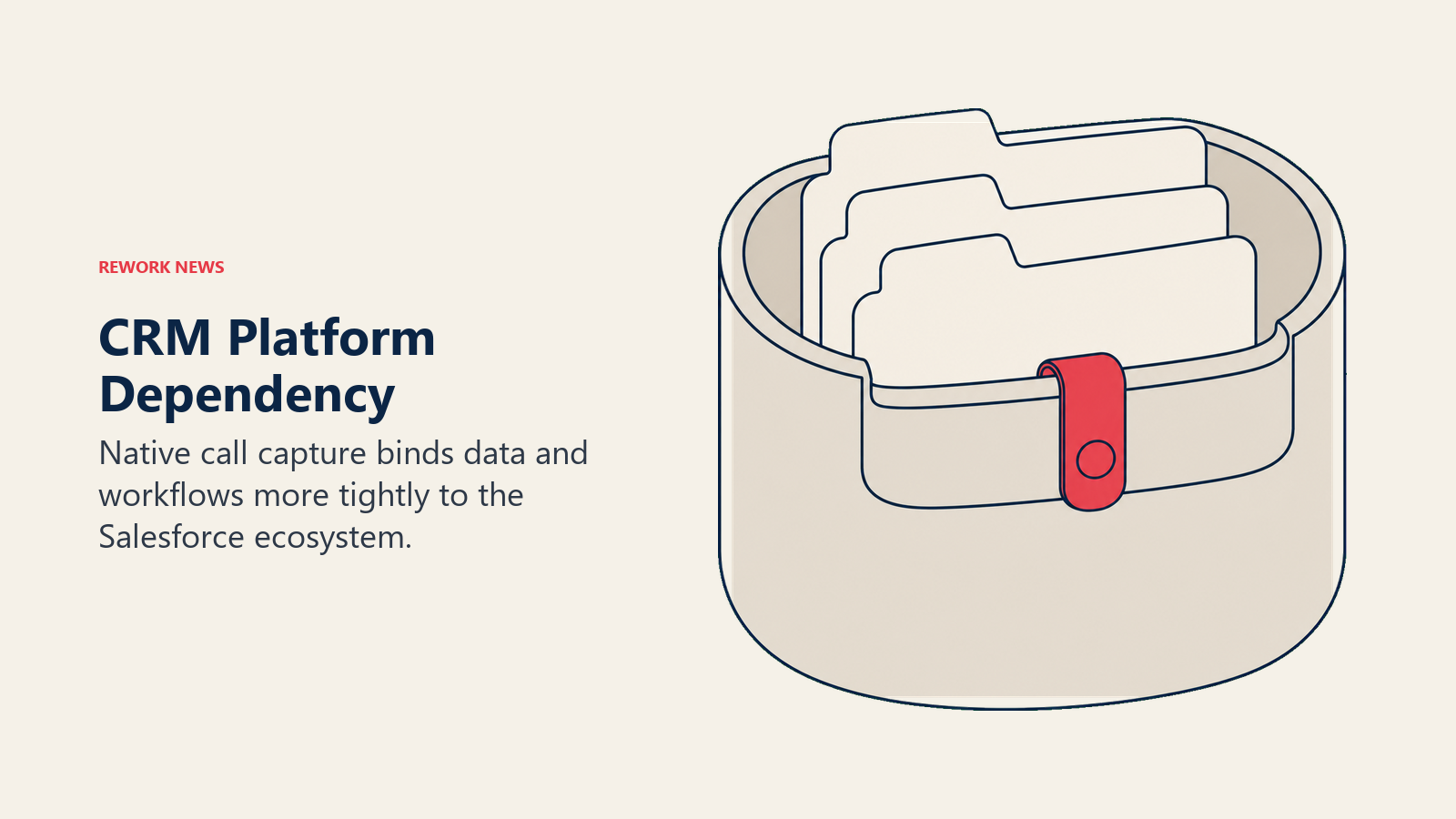
Today, your conversation intelligence might be handled by a standalone vendor like Gong, Chorus, or a similar platform. Those platforms integrate with Salesforce but operate independently. You can switch CRMs and retain your conversation data in a separate system. You can renegotiate your call intelligence contract independently of your CRM contract.
Once call capture is native to Salesforce via Momentum, that modular structure collapses. Your call data lives inside Agentforce workflows, Slack channels managed through Salesforce, and CRM fields populated by Salesforce-owned tooling. The data is more tightly integrated (which is the product benefit), but it's also more deeply bound to the Salesforce platform, which is the commercial risk. If your org is evaluating whether the Salesforce ecosystem is the right long-term anchor, the CRM comparison overview covers the key trade-offs against alternative platforms.
This isn't an argument against using the Momentum integration. It may be the right choice for your organization. But it should be an explicit, deliberate choice rather than one you drift into because a new feature appeared in your license.
Understanding the CRM Data Flow You Have Now
Before the Momentum integration ships, RevOps teams have a window to map their current state clearly. That map is the baseline for evaluating what changes.
Right now, your sales call data probably flows something like this: rep completes a call on Zoom or Google Meet, a third-party tool (Gong, Chorus, or similar) captures and transcribes it, rep reviews and edits notes and manually updates the CRM, then a manager reviews CRM data for pipeline calls. The quality of that process depends entirely on rep discipline in the middle step.
Momentum, integrated with Agentforce, would change that flow to: rep completes a call, Momentum captures it, Agentforce agents structure it, CRM fields update automatically, Slack notifications fire, then rep reviews the automated record rather than creating it. The human-in-the-loop moves from creation to review.
That's a meaningful shift. And it means your existing conversation intelligence vendor's role changes substantially. If Salesforce is capturing and structuring call data natively, the standalone call intelligence platform either gets displaced or needs to serve a different function (deep coaching analytics, cross-rep pattern analysis, competitive intelligence) rather than basic capture and CRM sync.
A Decision Framework for RevOps Teams
Audit your current call data pipeline. Before the Momentum integration is available, document how call data currently flows into your CRM. What tools are involved? Where does data quality break down? This documentation serves two purposes: it tells you what Momentum solves and what it doesn't, and it gives you a baseline to measure the integration against. A companion piece focused on the audit steps specifically, what RevOps needs to check before the call data changes, is worth reading in parallel.
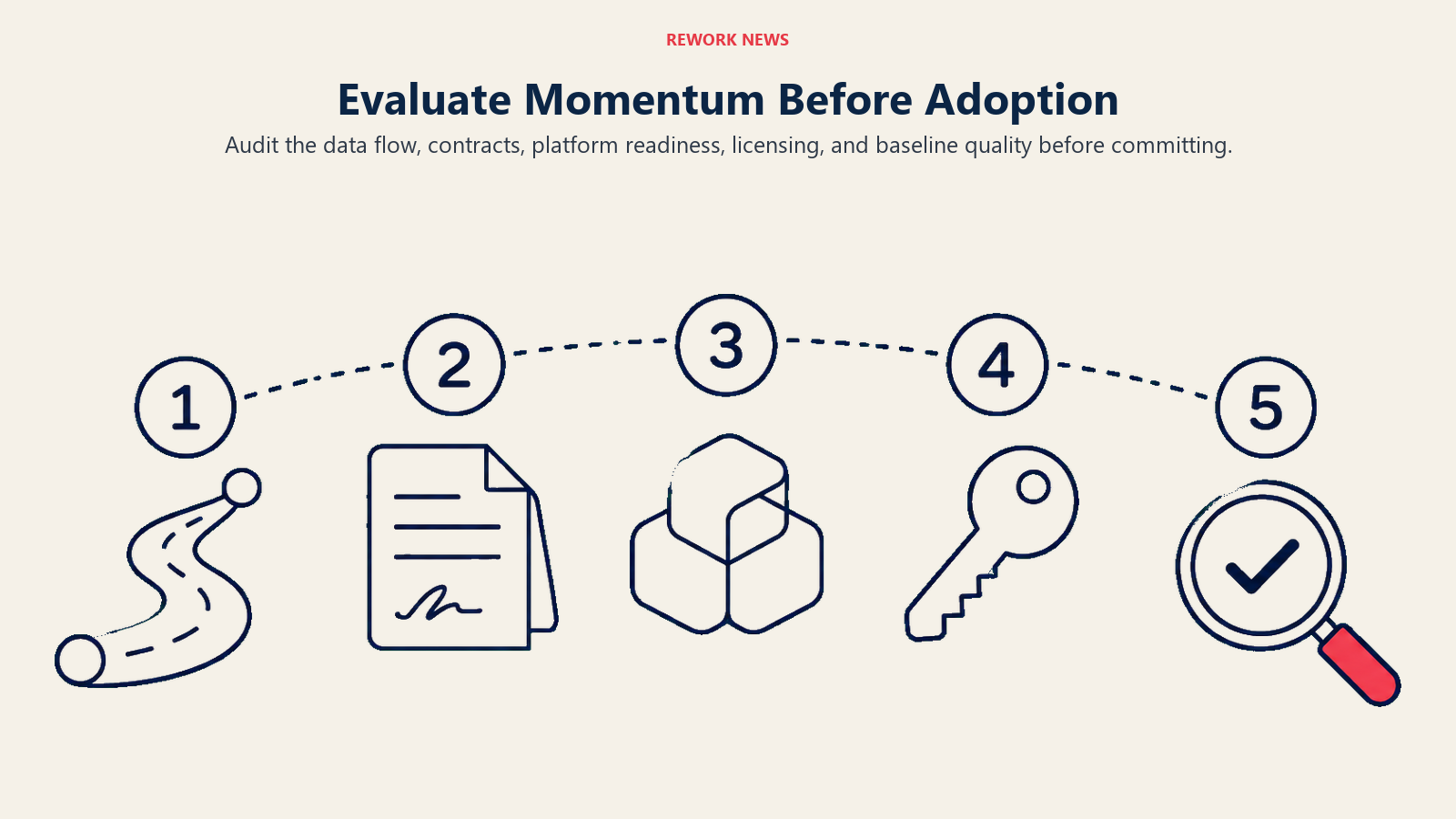
Review your existing conversation intelligence contract. If you're paying for a standalone tool that primarily captures calls and syncs to Salesforce, understand when that contract renews and what overlap with Momentum looks like. You may have a timing decision to make, and knowing your current contract terms before you need to make it is significantly better than discovering them during a renewal meeting.
Assess your Agentforce footprint. The Momentum integration runs through Agentforce. If your organization hasn't meaningfully adopted Agentforce, the call capture benefit depends on that adoption happening first. Map your current Agentforce use cases and whether they're mature enough for Momentum's output to be actionable.
Check your Salesforce licensing tier. Depending on how Salesforce packages the Momentum integration, access may require a specific license tier. Get clarity on this before budgeting, either to confirm it's included in your current agreement or to understand what an upgrade would cost.
Plan a data quality baseline measurement. Run a snapshot of your current CRM data quality: what percentage of opportunities have complete call activity logs? What percentage of call notes contain specific next steps? That baseline (measured now) is what you'll compare against after the integration ships to evaluate whether it actually delivered the data quality improvement it promises.
What to Do This Week
Start with the call-to-CRM data flow, renewal timing, and rollout questions so the sales team can prepare for the change.
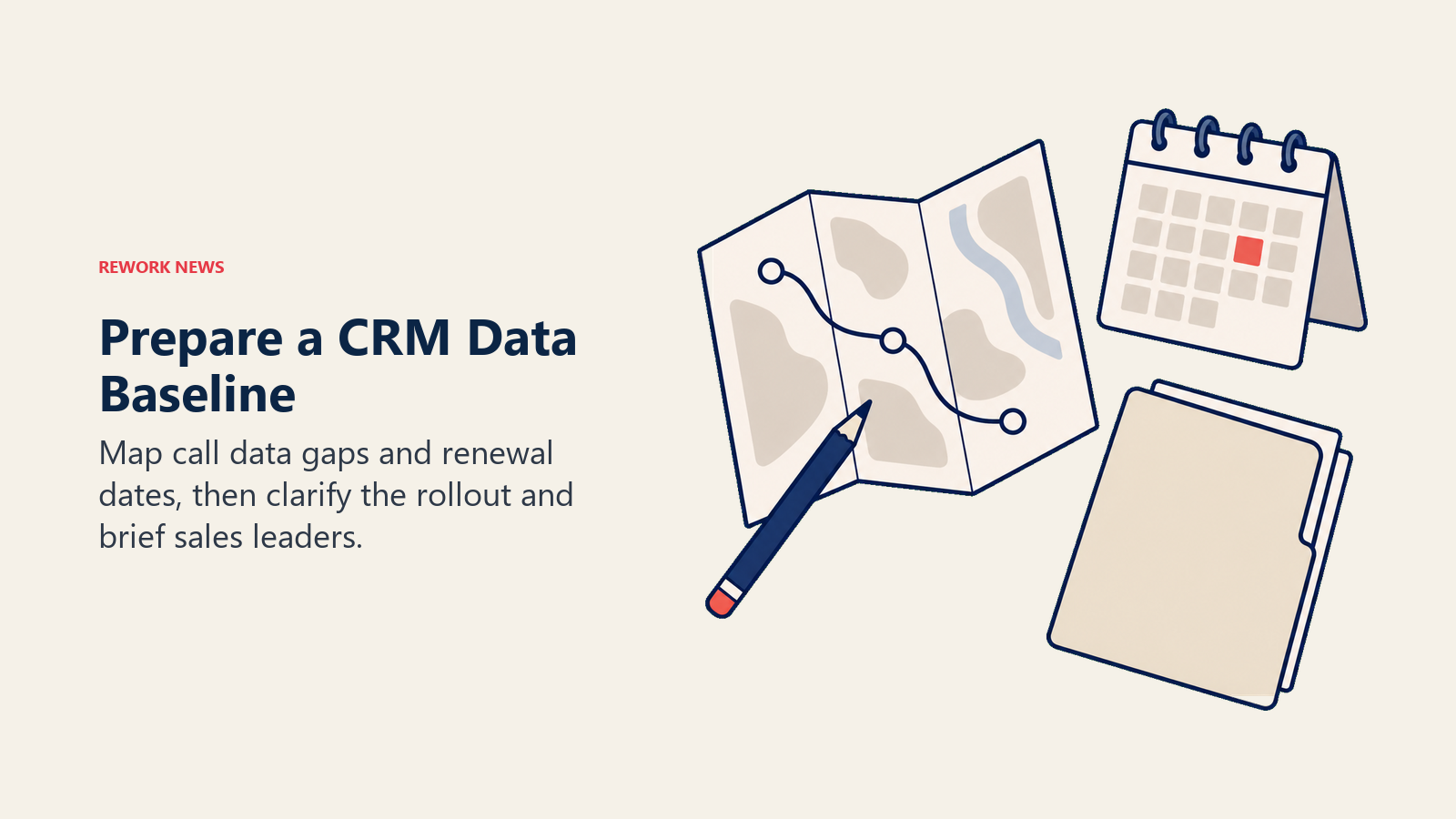
- Map your current call-to-CRM data flow on a whiteboard or simple doc. Identify the three biggest points where data quality degrades. This is the foundation for any Momentum integration evaluation.
- Check which of your current conversation intelligence licenses come up for renewal in the next 12 months. Flag any that overlap substantially with what Momentum is described as doing.
- Ask your Salesforce account team for the Momentum integration roadmap, specifically when it will be available at your license tier and what the rollout process looks like for existing customers.
- Brief your VP of Sales on the change in data entry expectations. If reps currently expect to log calls manually, the shift to automated capture changes their workflow. Getting ahead of that change is easier than managing the confusion after it ships.
- Review your current Salesforce contract renewal terms. Ten acquisitions in six months means Salesforce is building infrastructure at a pace that will create renewal conversations. Know your terms before you need to negotiate them.
The gap between what happens on a sales call and what ends up in the CRM has been a persistent RevOps problem for the entire history of CRM software. Salesforce's acquisition of Momentum is a real attempt to close it. Whether it's the right solution for your organization depends on factors that are worth evaluating now, not after the integration is already running in your environment.
Learn More
- Salesforce Can Now Pull Your Zoom Calls Into the CRM: RevOps Audit: The technical RevOps preparation checklist before Agentforce gets call data
- Your Meetings Are Now a Programmable Data Source: How meeting intelligence infrastructure connects to the broader CRM context problem
- CRM Data Model Design: Structuring your CRM to receive and use AI-generated call intelligence properly
- Rework vs. Salesforce: CRM comparison for teams evaluating whether Salesforce's expanding footprint still fits their needs
