More in
B2B SaaS Industry News
Salesforce Just Solved CRM's Oldest Data Problem, At a Cost
Apr 7, 2026
When Your SaaS Vendor Cuts Its R&D Team: What Enterprise Buyers Need to Watch
Mar 19, 2026
The 171% Agentic AI ROI Number: What the Data Actually Says
Mar 2, 2026
Drift Is Being Phased Out: The RevOps Checklist Before Your Conversational Workflows Go Dark
Feb 11, 2026
The $99-Per-Seat Decision: How to Evaluate Microsoft's New AI Bundle
Feb 9, 2026
The SaaS Growth Model That No Longer Requires More Engineers
Feb 4, 2026
Meeting Notes Just Hit a $1.5B Valuation: What That Signals About the Enterprise AI Context Race
Feb 3, 2026
A $1.2B CRM-Killer at $8M ARR: What Every Sales Leader Needs to Decide Before the Next Board Meeting
Feb 2, 2026
Record AI Funding in Q1 2026: What It Means for Your Sales Stack and Your Competitors
Jan 8, 2026
The Agentic Sales Stack Is Attracting Unicorn Capital: What CEOs Need to Decide About Their Revenue Infrastructure
Jan 7, 2026 · Currently reading
The Agentic Sales Stack Is Attracting Unicorn Capital: What CEOs Need to Decide About Their Revenue Infrastructure
Turn this article into takeaways for your work.


Each assistant summarizes the article only for you and suggests best practices for your work.
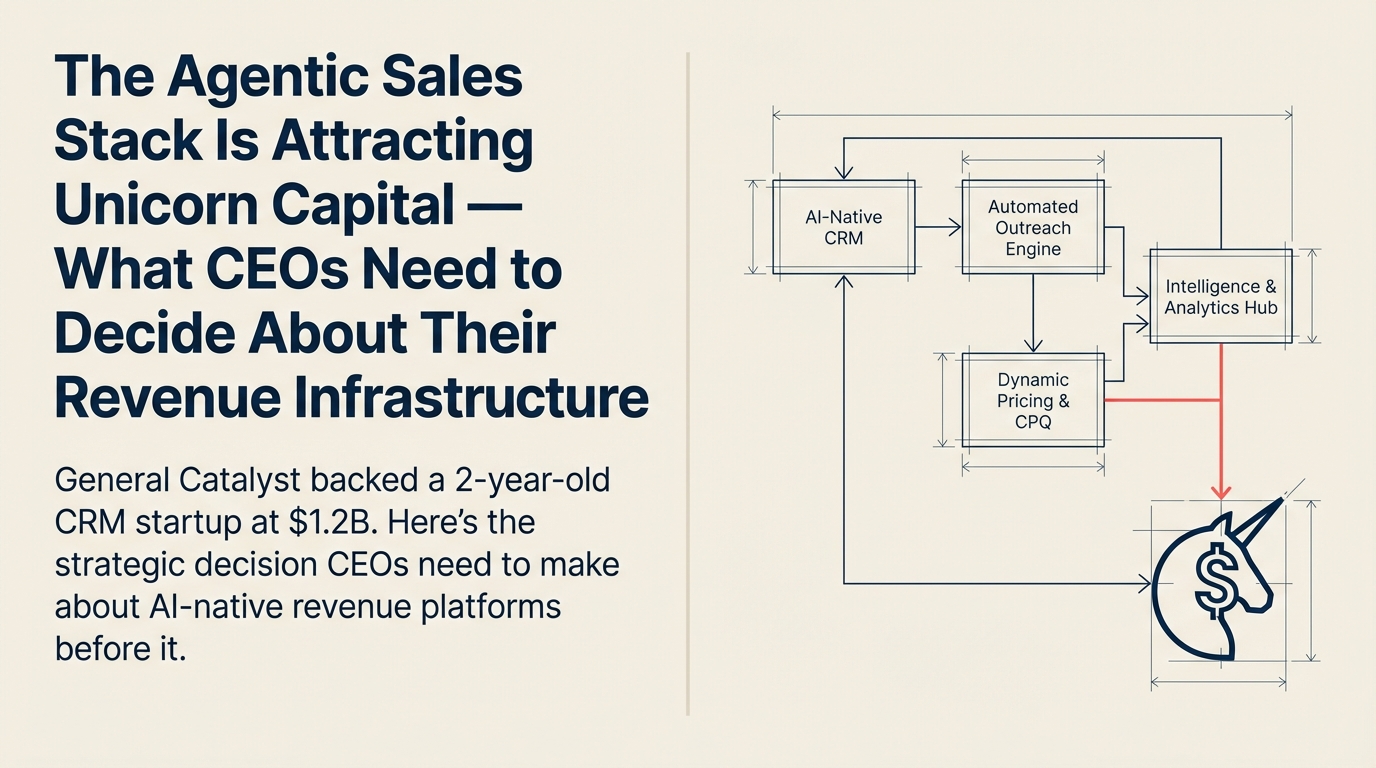
When General Catalyst leads a round that values a two-year-old CRM startup at $1.2 billion, the statement isn't about the startup. It's about the category.
According to TechCrunch, Rox, founded in 2024 by Ishan Mukherjee (formerly chief growth officer at New Relic), closed a General Catalyst-led round in March 2026 that put its valuation at $1.2B. The company had raised $50M total in a prior seed and Series A. It had roughly $8M in ARR at close. The capital flowing into this category says one thing clearly: the CRM replacement cycle is underway, and investors believe AI-native platforms will define the next generation of revenue infrastructure.
This is now a CEO-level question. Not because you should immediately migrate your GTM stack, but because your board will ask, your CRO will ask, and the companies in your market that move early will have a different cost structure and pipeline velocity than those that wait for the incumbents to catch up.
What the Agentic Model Means for Revenue Teams
Rox doesn't look like a traditional CRM. It doesn't ask your team to live in a new interface or migrate your data on day one. It plugs into Salesforce, Zendesk, email, and calendar, and then deploys AI agents that run autonomously across those systems.
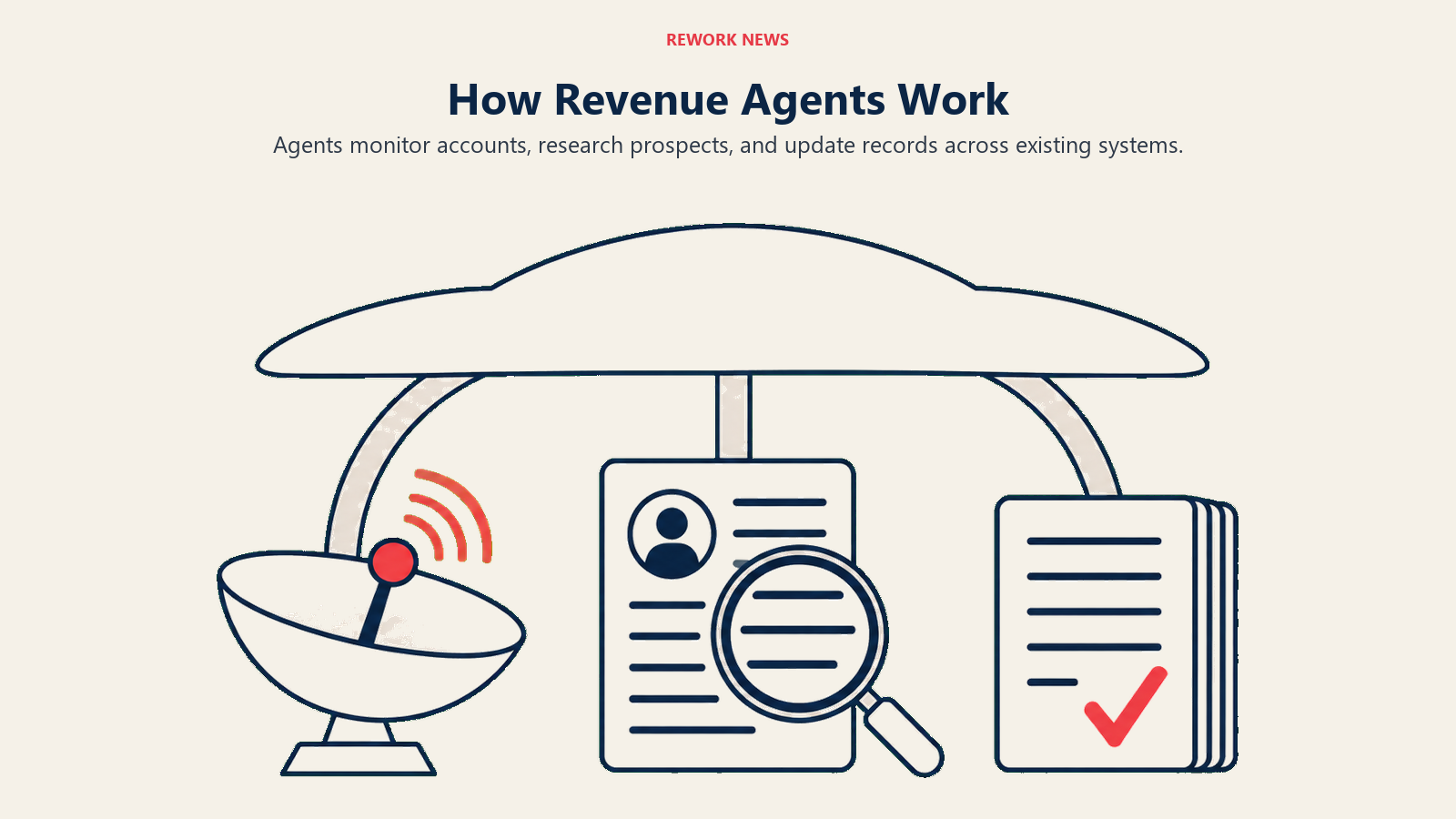
Those agents monitor accounts for signals that matter (stakeholder changes, engagement drops, renewal risk), research prospects before outbound calls, and update CRM records based on what actually happened rather than what reps chose to log. The result is cleaner data, better context, and administrative overhead that shifts from human to machine.
The companies using it now, Ramp, MongoDB, and others, aren't running experiments. They're building it into how their revenue teams operate.
The model is significant for a non-obvious reason: it's designed to add agent-layer value without requiring a rip-and-replace migration. That lowers the barrier to adoption dramatically. You're not betting your Salesforce implementation on a startup. You're adding a workflow layer on top and measuring the results. The true cost of software sprawl is a useful lens here. Adding a workflow layer to an already crowded stack needs to justify its real cost, not just its license fee.
The Platform Shift Is Already Priced In
General Catalyst, Sequoia, and Index Ventures don't move at $1.2B on a product bet. They move on a category bet. The category they're betting on is AI-native revenue infrastructure: platforms built from the ground up for agents, not retrofitted from systems designed for human users.
That framing matters for strategic planning. Salesforce Agentforce is real, HubSpot's Breeze AI is real, and Microsoft Copilot for Sales is real. All of them are trying to get to the same end state. But they're starting from architectures built for the workflows of 2010, and every product decision they make has to balance new capability against the needs of existing enterprise customers.
AI-native startups don't have that constraint. They build for how agents work, not how humans worked. And that architectural difference is what $1.2B valuations at $8M ARR are essentially saying: the incumbents may not be able to close the gap fast enough to prevent a real market shift.
As a CEO, you don't need to take a position on which company wins. You need to take a position on whether your revenue infrastructure strategy accounts for this shift at all.
A Three-Point Framework: Monitor, Pilot, or Commit
Most CEOs are somewhere between "aware of the hype" and "ready to evaluate seriously." Here's a structured way to figure out where you actually are:
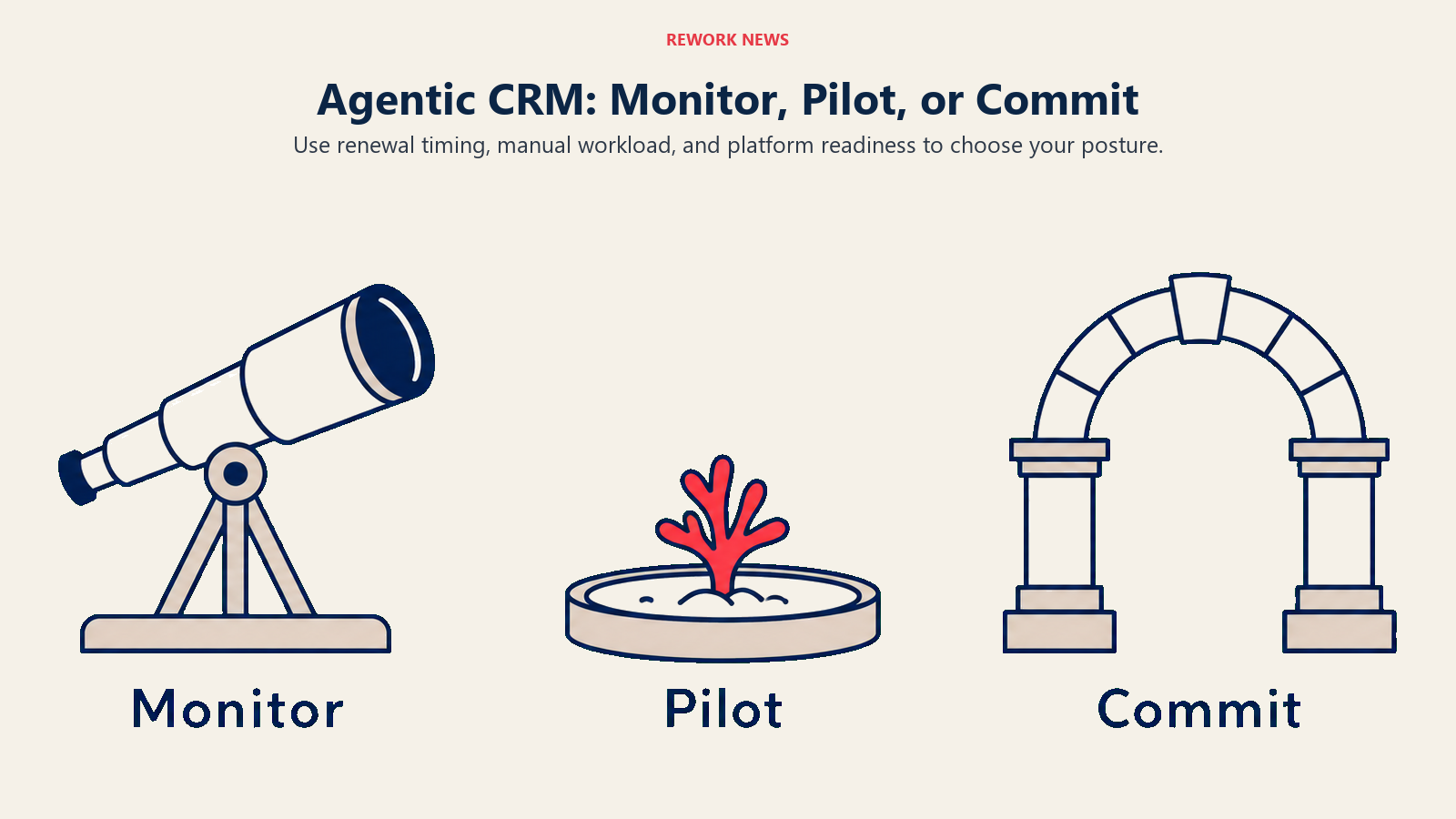
Monitor: Your Salesforce or HubSpot contract is locked for 18+ months, your CRO isn't reporting an acute problem with CRM adoption, and your board hasn't raised the topic. You should be tracking the category, reading the funding news, and asking your CRO to include agentic CRM in the next annual planning review. Not urgent, but not ignorable. A RevOps maturity model helps you benchmark where your organization actually sits before deciding how aggressively to move.
Pilot: Your renewal is within 12 months, your reps are spending significant time on manual CRM work, or your pipeline data quality is a recurring issue in forecasting conversations. This is the right posture for a structured 90-day pilot with one account segment. Define the metrics upfront (time savings, CRM hygiene score, pipeline visibility) and let the data inform the renewal decision.
Commit: You're a growth-stage company without deep technical debt in an incumbent CRM, or you're already deploying AI agents in other parts of the business and need a revenue data layer that was built for agents. This is the scenario where evaluating an AI-native platform from the ground up makes sense, not as a replacement for everything tomorrow, but as the foundation for how your revenue team operates in two to three years. How to pick a CRM in 2026 gives you the structured criteria to run that evaluation without spending six weeks in demos.
Most mid-market B2B companies with annual contracts and structured sales motions are currently in the "monitor to pilot" transition. The question is whether your renewal timing forces the pilot conversation sooner than later.
What Incumbents Will Ship, and What They Won't
Salesforce will accelerate Agentforce. HubSpot will deepen Breeze. Microsoft will keep pushing Copilot integration into its enterprise installed base. All of this is real, and all of it will improve materially over the next 12–18 months.
But here's the honest assessment of what they will and won't solve:
They will solve the surface-level workflow problems: call summaries, deal stage suggestions, and email drafts. These are high-visibility features with measurable adoption metrics, and their product teams will prioritize them.
They may not solve the architectural problem quickly enough. An AI agent that needs to route through Salesforce's permission model, API rate limits, and multi-object data architecture to surface a relevant insight in real time is slower than an agent designed around that task from day one. Whether that performance gap matters for your team depends on deal velocity, account complexity, and how many concurrent agents you'd need running.
The safest assumption for strategic planning is this: the incumbents will catch up eventually, but the gap will be largest over the next 12–24 months. Companies that build real operational fluency with agentic revenue tools during this window will have a compounding advantage (cleaner data, faster ramp times for new reps, and better forecasting) that doesn't disappear when the incumbents ship their own version.
What to Add to Your Next Leadership Agenda
You don't need to make a vendor decision this quarter. But you do need to close the knowledge gap and ensure the right conversation is happening at the right level of the organization.
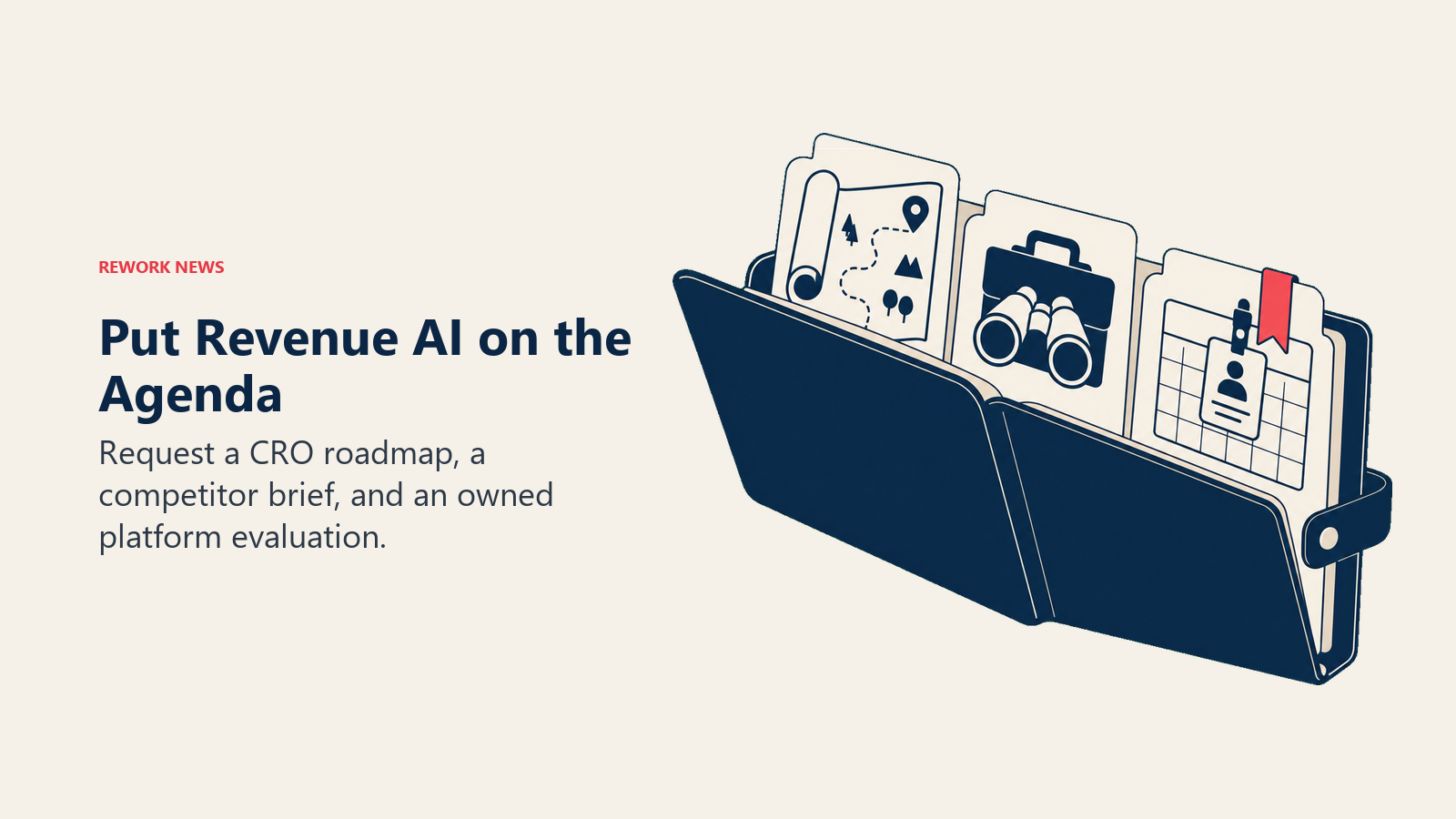
Three agenda items worth adding:
First: Ask your CRO for a 30-minute briefing on where agentic AI fits their 2026 and 2027 technology roadmap. Not a budget request, just a point of view. If they don't have one, that's useful information in itself.
Second: Request a competitive intelligence brief on what your top two or three competitors are doing with AI in their GTM motion. Ramp, MongoDB, and New Relic aren't small companies. The fact that they're early Rox customers is a signal about where talent-dense, growth-oriented companies are moving their revenue infrastructure. If your competitors are in that cohort, the timeline shortens. And the Drift sunset and what it means for vendor-dependent RevOps workflows is a useful parallel case study in what happens when you're caught without a contingency plan.
Third: Put "AI-native revenue platform evaluation" on next quarter's technology stack review agenda. You don't need to run the evaluation yourself. But it needs to be a named priority with an owner, not a topic that floats in the background until someone reads a vendor blog post and asks why you haven't evaluated it.
The agentic sales stack isn't a future category anymore. General Catalyst's check made it official. The question now is whether your company is ahead of that inflection point, behind it, or in the process of figuring that out.
Learn More
- A $1.2B CRM-Killer at $8M ARR: Sales Leader Decision Guide: The CRO's 90-day pilot framework for evaluating agentic CRM alongside your incumbent
- The AI Workforce Transformation Roadmap: How revenue infrastructure and workforce planning need to move together
- Measuring AI Adoption ROI: Frameworks for setting up the measurement that justifies agentic CRM investment to a board
- Board-Level AI Governance: The governance infrastructure CEOs need before agentic revenue platforms take autonomous action
