More in
B2B SaaS Industry News
Salesforce Just Solved CRM's Oldest Data Problem, At a Cost
Apr 7, 2026
When Your SaaS Vendor Cuts Its R&D Team: What Enterprise Buyers Need to Watch
Mar 19, 2026
The 171% Agentic AI ROI Number: What the Data Actually Says
Mar 2, 2026
Drift Is Being Phased Out: The RevOps Checklist Before Your Conversational Workflows Go Dark
Feb 11, 2026
The $99-Per-Seat Decision: How to Evaluate Microsoft's New AI Bundle
Feb 9, 2026
The SaaS Growth Model That No Longer Requires More Engineers
Feb 4, 2026
Meeting Notes Just Hit a $1.5B Valuation: What That Signals About the Enterprise AI Context Race
Feb 3, 2026 · Currently reading
A $1.2B CRM-Killer at $8M ARR: What Every Sales Leader Needs to Decide Before the Next Board Meeting
Feb 2, 2026
Record AI Funding in Q1 2026: What It Means for Your Sales Stack and Your Competitors
Jan 8, 2026
The Agentic Sales Stack Is Attracting Unicorn Capital: What CEOs Need to Decide About Their Revenue Infrastructure
Jan 7, 2026
Meeting Notes Just Hit a $1.5B Valuation: What That Signals About the Enterprise AI Context Race
Turn this article into takeaways for your work.


Each assistant summarizes the article only for you and suggests best practices for your work.
When a meeting-transcription app crosses a $1.5B valuation, you're no longer reading a product news story. You're reading a market signal, and it's one that CEOs of B2B SaaS companies should be paying attention to.
According to TechCrunch, Granola closed a $125M Series C in late March 2026, led by Index Ventures, with participation from Kleiner Perkins, Lightspeed, Spark, and NFDG. That round pushed the company's valuation from $250M to $1.5B (a 6x jump). And that gap, between what Granola does on the surface and what investors think it's worth, is where the real story lives.
This isn't about note-taking. It's about who controls enterprise AI context: what your teams said, decided, and committed to, across every meeting, stored in a way that AI systems can actually use.
From Laptop App to Enterprise Knowledge Layer
Granola started as a laptop-resident transcription tool. You ran it locally, it captured your meetings, and it organized the notes. Useful, but narrow. The round signals something much bigger.
The company used the funding to launch Spaces, a team workspace layer that adds folder structures and access controls. Alongside that, they opened two APIs: a personal API giving individuals access to their meeting history, and an enterprise API giving administrators programmatic access to team-level context at scale.
They also launched an MCP server (a Model Context Protocol integration) in February 2026. That's the technical detail that changes everything. MCP means Granola's data layer can now connect directly to LLMs and AI agents, making meeting context available as structured input, not just a searchable archive.
The customer list at close included Vanta, Gusto, Asana, MongoDB-adjacent teams, and several AI-native companies like Cursor and Mistral AI. These aren't early adopters testing a novel toy. They're companies where AI agents are already embedded in workflows, and they're choosing Granola as the memory layer.
Why This Is a CEO-Level Signal, Not an IT Decision
Most CEOs still categorize meeting transcription tools under "productivity software," somewhere between Notion and expense management on the priority list. That framing is now outdated.
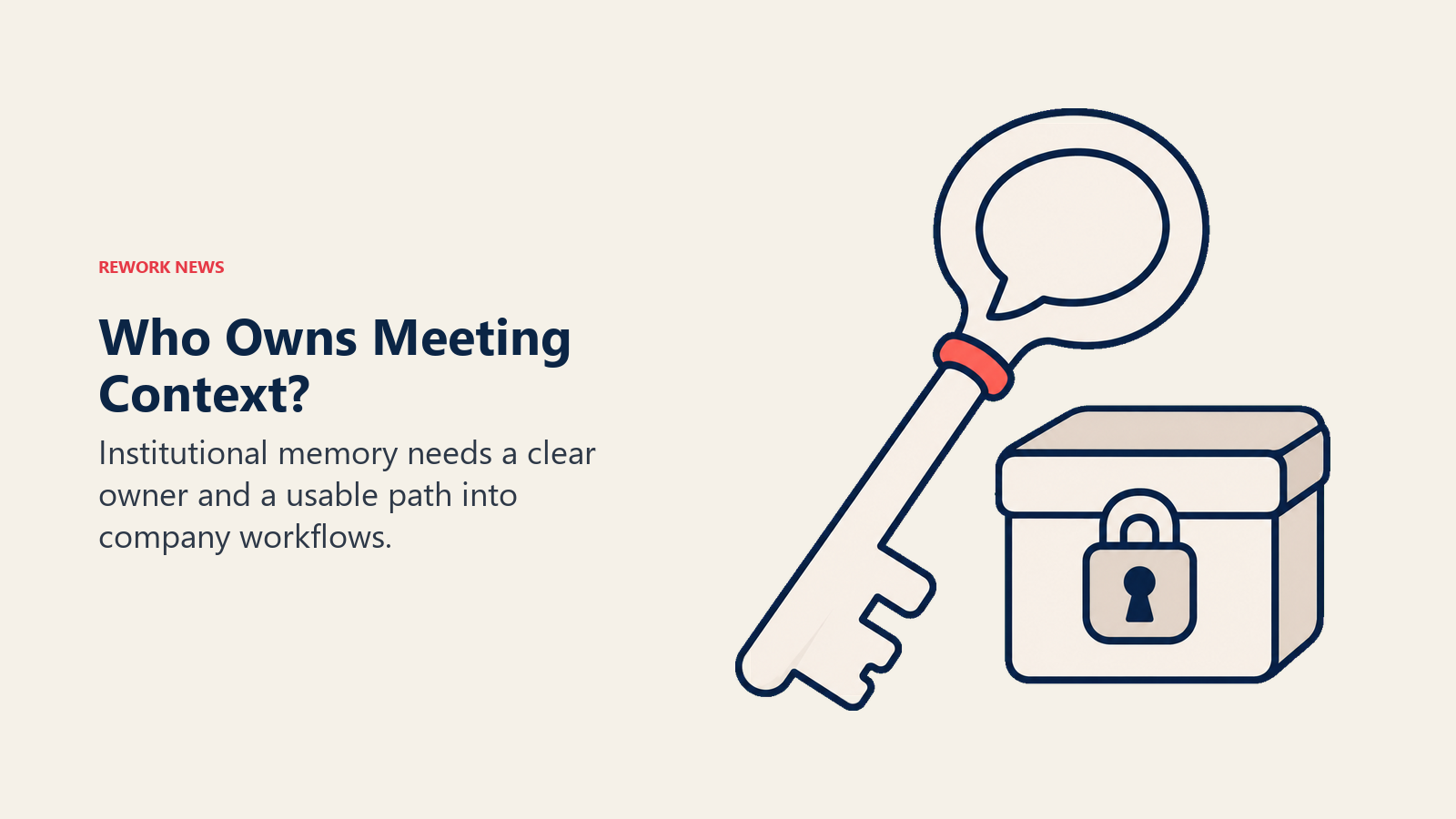
The question isn't whether to have a note-taker. The question is: who owns the institutional memory of your company's decisions, and can your AI systems read it?
Consider what AI agents increasingly need to do well: understand account history before a customer call, surface what was promised to a prospect in Q3, cross-reference what the product team committed to in the last sprint review. Right now, most of that context lives in meeting recordings and notes that are formatted for humans, not machines. Granola's enterprise API changes that.
This puts Granola on a direct collision course with platforms you probably already pay for: Notion, Confluence, and Salesforce. They all claim to be the source of truth for institutional knowledge. But none of them have deep, native integration with the moment decisions are actually made, which is the meeting. The true cost of software sprawl at mid-market companies is already high. Adding a meeting-context layer to an already crowded stack deserves a deliberate evaluation, not a default renewal.
The Competitive Stakes: Knowledge Graph as Moat
Index Ventures and Kleiner Perkins don't lead a $125M round on a transcription app. They lead it on a belief that whoever builds the dominant enterprise AI context layer will have a defensible moat for the next decade.
Think about it from a switching-cost perspective. Once an organization's meeting history (two or three years of decisions, context, and commitments) is indexed in a system with API access and AI integration, migration becomes painful. The data gravity compounds over time. That's the same reason Salesforce's CRM is sticky even when sales teams hate using it: the historical data is too valuable to walk away from. How to pick a CRM in 2026 covers the criteria that still apply when evaluating any system where data lock-in is part of the value proposition.
The difference with Granola's model is that context is being captured passively. There's no data entry required from reps or managers. Every meeting becomes a structured asset automatically.
That passive capture model is what makes the valuation make sense. And it's what should make CEOs pay attention.
A Decision Framework for Evaluating Meeting Context Infrastructure
Not every company needs to act on this immediately. But every CEO should have a point of view. Here's a four-question framework for deciding where this falls on your priority list:
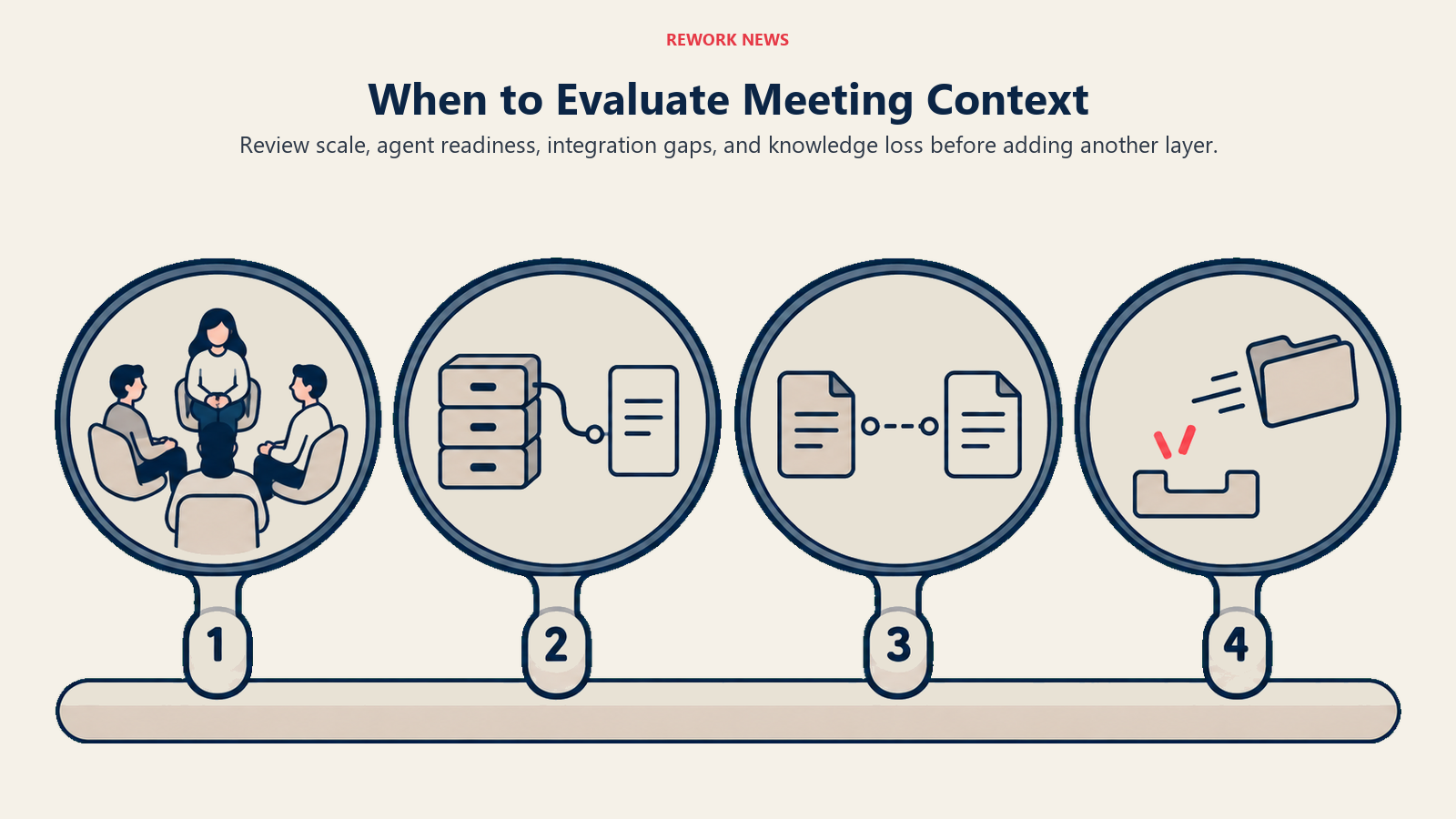
1. Do you have more than 50 people in customer-facing or cross-functional roles? If yes, you already have a meeting context problem. You just may not have named it yet. Onboarding takes longer than it should, account handoffs lose nuance, and tribal knowledge exits with every employee departure. Meeting AI context infrastructure directly addresses this.
2. Are you deploying AI agents in your GTM or product workflows? If yes, your agents are only as good as the context they can access. A call recording in a folder is not usable context. A structured API output is. If agents are in your near-term roadmap, the data architecture question belongs in front of you now. The agentic sales stack and what CEOs need to decide about revenue infrastructure covers the parallel question playing out in CRM.
3. Are you paying for tools that claim to be your "source of truth" but don't integrate with your meeting workflow? Notion, Confluence, and Salesforce all have AI features now. But they're working backward, trying to add meeting context to knowledge bases that were designed for documents. Platforms built meeting-first may close that integration gap faster.
4. Is employee turnover a recurring problem for institutional knowledge retention? If you're in an industry or growth stage where turnover is high, meeting context becomes an explicit retention and continuity mechanism. What's decided stays in the system, regardless of who's still at the company.
If you answered yes to two or more of those, this category deserves a proper evaluation this quarter, not a note for next year's planning cycle.
What Incumbents Will Do Next
Salesforce, Notion, and Atlassian will respond. They already have meeting integrations in various stages of maturity, and they have distribution advantages Granola doesn't. But the $1.5B valuation is a signal that investors don't think the incumbents will move fast enough.
That's an important subtext for platform decisions you're making now. If you're evaluating Salesforce's roadmap on meeting intelligence, or waiting for Notion to build deeper AI context tools, you're betting on enterprise velocity from companies that also have to maintain legacy products for millions of users. That's a different bet than backing a company that's been meeting-native from day one.
The pattern here echoes what happened with CRM in the early 2010s. Point solutions with deep workflow integration grew faster than expected because incumbents were managing too many competing priorities to respond at startup speed.
What to Decide This Quarter
Meeting context infrastructure isn't urgent in the same way a broken integration is urgent. But the decisions you make now about who owns your institutional memory will shape your AI agent effectiveness two to three years from now.
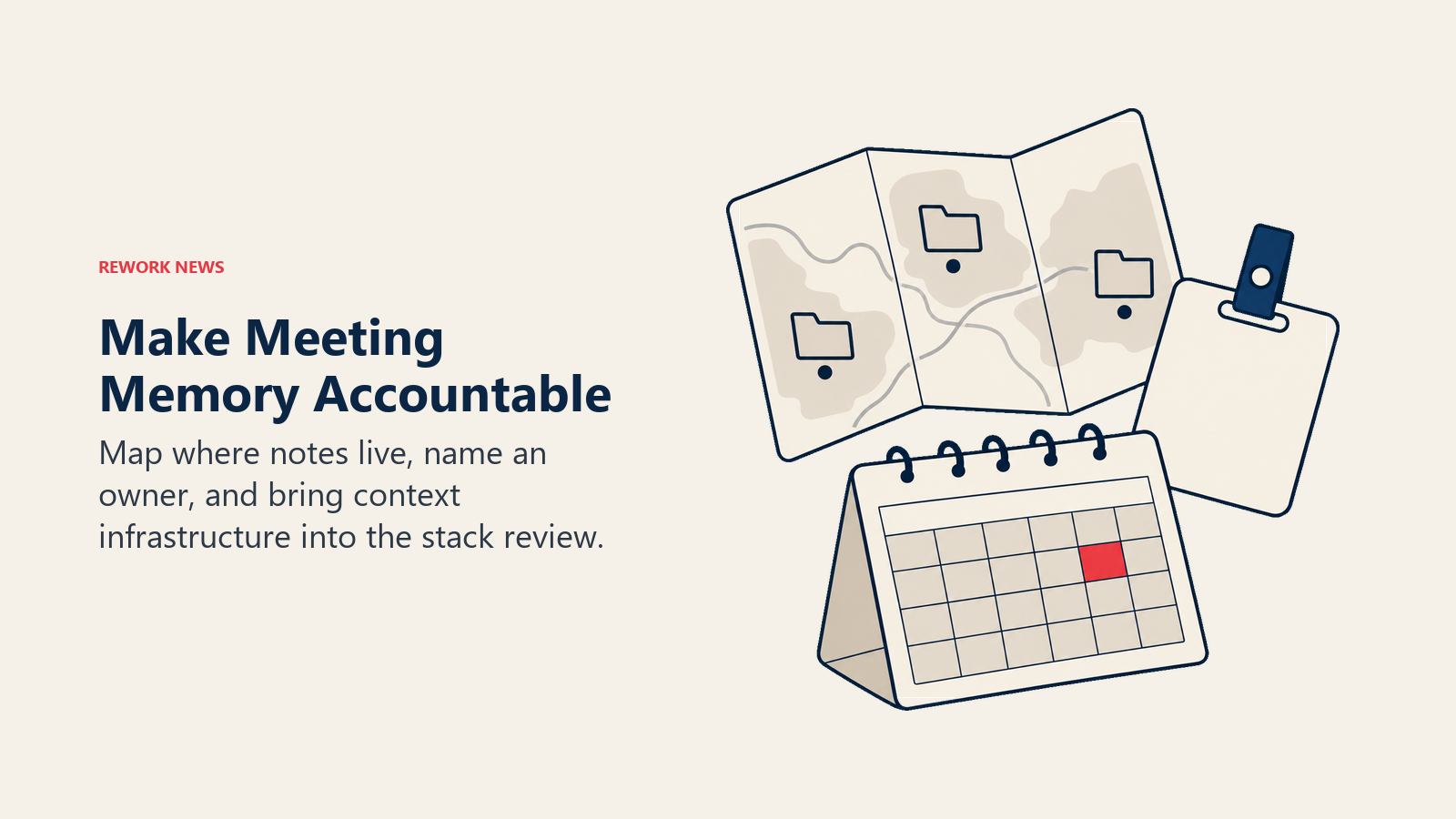
Three decisions worth making before the end of this quarter:
Audit your current meeting data posture. Where do meeting recordings, notes, and action items currently live? Are they in a format your AI systems can query? If the honest answer is "a mix of Otter.ai exports, Zoom recordings, and somebody's Notion page," you have a context architecture problem.
Define who owns the knowledge-management layer in your organization. Is it IT? RevOps? Engineering? If no one has a clear mandate to evaluate tools like Granola, the decision will get made by individual contributors choosing what they personally prefer. That's fine for personal tools, but not for infrastructure. A RevOps maturity model that assigns clear ownership of the tech stack review is exactly the structural piece that separates reactive from strategic operations.
Put enterprise AI context on next quarter's technology stack review. You don't need to decide now whether to deploy Granola or any specific tool. But you do need to have the category conversation before your competitors do. The $1.5B valuation means there's serious capital and serious velocity here. Companies that wait until the market has consolidated will be making migration decisions under competitive pressure.
The meeting-notes app story ended with this round. The enterprise AI context infrastructure story is just beginning.
Learn More
- Your Meetings Are Now a Programmable Data Source: MCP and Meeting-Context APIs: The CTO architecture implications of Granola's MCP server and enterprise API
- AI Meeting Context vs. Your Notion Workspace: How team leads should evaluate meeting intelligence alongside existing knowledge tools
- Record AI Funding in Q1 2026: Sales Stack Implications: The broader funding context that Granola's $1.5B valuation sits within
- RevOps Maturity Model: Why owning the knowledge-management layer is now a RevOps maturity dimension

Co-Founder, Rework.com