More in
B2B SaaS Industry News
Salesforce Just Solved CRM's Oldest Data Problem, At a Cost
Apr 7, 2026
When Your SaaS Vendor Cuts Its R&D Team: What Enterprise Buyers Need to Watch
Mar 19, 2026
The 171% Agentic AI ROI Number: What the Data Actually Says
Mar 2, 2026
Drift Is Being Phased Out: The RevOps Checklist Before Your Conversational Workflows Go Dark
Feb 11, 2026
The $99-Per-Seat Decision: How to Evaluate Microsoft's New AI Bundle
Feb 9, 2026
The SaaS Growth Model That No Longer Requires More Engineers
Feb 4, 2026
Meeting Notes Just Hit a $1.5B Valuation: What That Signals About the Enterprise AI Context Race
Feb 3, 2026
A $1.2B CRM-Killer at $8M ARR: What Every Sales Leader Needs to Decide Before the Next Board Meeting
Feb 2, 2026 · Currently reading
Record AI Funding in Q1 2026: What It Means for Your Sales Stack and Your Competitors
Jan 8, 2026
The Agentic Sales Stack Is Attracting Unicorn Capital: What CEOs Need to Decide About Their Revenue Infrastructure
Jan 7, 2026
A $1.2B CRM-Killer at $8M ARR: What Every Sales Leader Needs to Decide Before the Next Board Meeting
Turn this article into takeaways for your work.


Each assistant summarizes the article only for you and suggests best practices for your work.
Rox is an AI-native sales-automation SaaS startup, founded in 2024, that reached a $1.2 billion valuation on roughly $8M in annual recurring revenue after a March 2026 round led by General Catalyst. It runs AI agents over your existing stack (Salesforce, Zendesk, email, calendar) to handle account monitoring, prospect research, and CRM hygiene, which is why investors are pricing it as a bet on the agentic-CRM platform shift.
A two-year-old startup just got handed a $1.2 billion valuation with roughly $8 million in annual recurring revenue. That math doesn't add up unless you believe the entire CRM category is about to be rebuilt.
According to TechCrunch, Rox, an AI-native sales automation platform founded in 2024, closed a new round in March 2026 led by returning investor General Catalyst, pushing its valuation to $1.2B. The company had already raised $50M across a Sequoia-led seed and an earlier General Catalyst-led Series A in late 2024. The new money arrived fast. And the gap between $8M ARR and $1.2B valuation is essentially a $1.19B bet on velocity.
For CROs and VP Sales leaders currently running Salesforce or HubSpot, this is not a product you need to buy today. But it is a signal you need to have a point of view on, before your board asks you in Q2 what you think about "agentic CRM."
What Rox Actually Does
Rox positions itself as an intelligent revenue operating system. But unlike traditional CRMs, it doesn't ask your team to live in it. It plugs into the tools you already use (Salesforce, Zendesk, email, calendar) and deploys AI agents that run in the background.
Those agents do three things that sales teams have historically done manually and badly: account monitoring (flagging changes in customer health, engagement, and buying signals), prospect research (surfacing relevant context before calls and emails), and CRM hygiene (updating records based on what actually happened, rather than what reps remembered to log).
The model matters. Rox isn't trying to replace Salesforce's data layer immediately. It's trying to become the workflow layer on top, and then, over time, to own enough of the workflow that the underlying data layer becomes interchangeable. It's worth reading how to pick a CRM in 2026 before assuming your current data layer is too sticky to revisit.
Customers at the time of the raise included Ramp, MongoDB, and New Relic. The founder, Ishan Mukherjee, previously served as chief growth officer at New Relic. That's both a credibility signal and a distribution advantage: he knows exactly who the buyer is and what they're frustrated by.
The Valuation Gap Is the Actual Story
Investors don't price companies at 150x ARR because they believe in the product. They price them at 150x because they believe the market is in the first inning of a platform shift, and that whoever establishes the agent layer over revenue workflows will be worth multiples of $1.2B inside of five years.
That belief isn't unique to Rox. Salesforce Agentforce, HubSpot's AI features, and Microsoft's Copilot for Sales are all chasing the same end state: AI that does the work, not just assists with the work. But incumbents are building on top of data models and UX patterns that were designed for human users. Rox was designed from the start for agents.
That architectural difference is real. But whether it matters in practice, whether being "agentic by design" beats "agentic by retrofit" at enterprise scale, is exactly what the next 24 months will answer.
Four Signals That Tell You Whether to Pilot or Wait
Not every CRO should be calling Rox for a demo today. Here's how to think about your own situation:
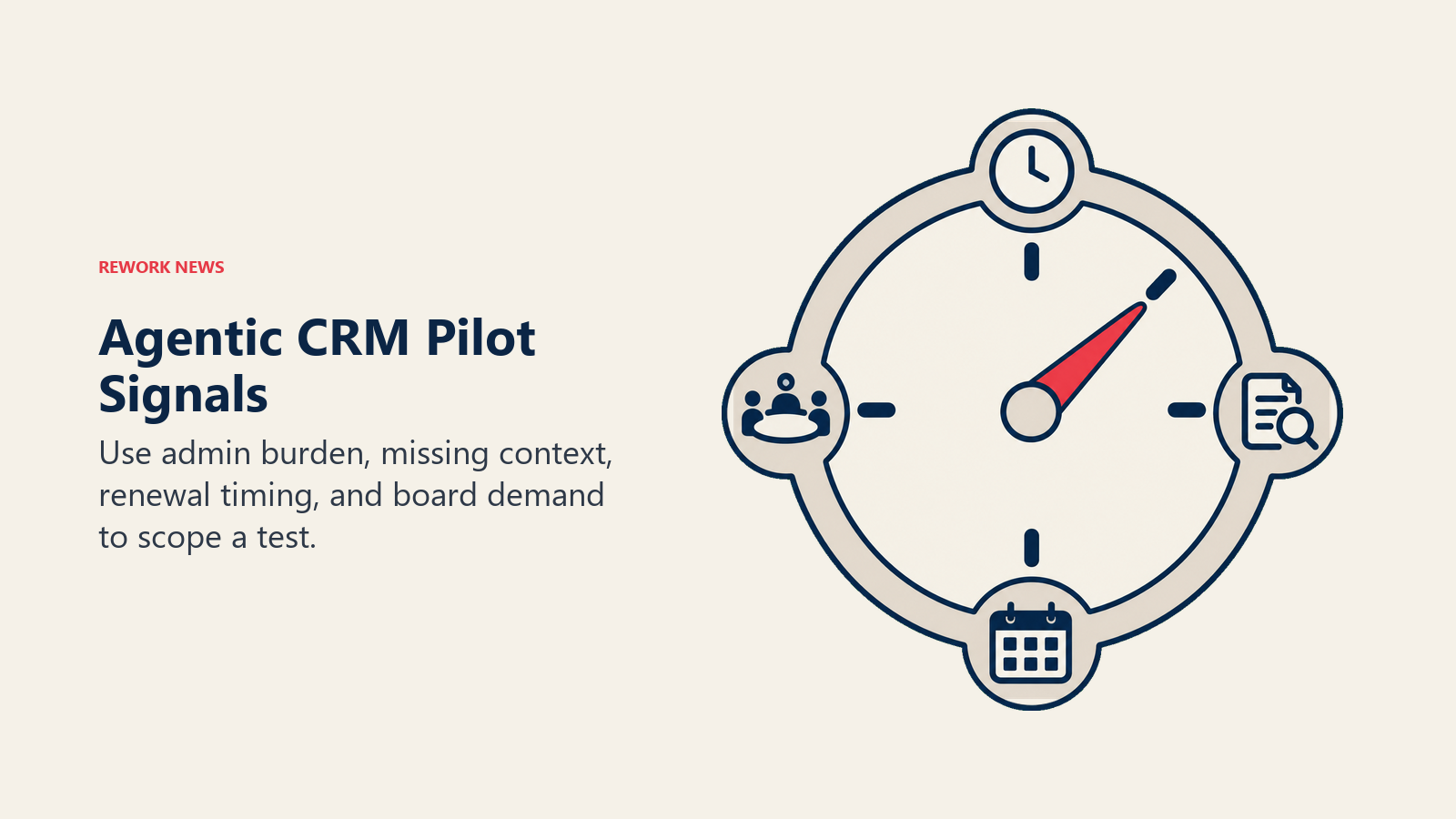
Signal 1: Your reps spend more than 30 minutes per day on CRM hygiene. If your team is manually updating pipeline stages, logging calls, or reconciling contact records, the ROI case for an agent layer closes itself. Rox and platforms like it were built for this problem first. If you can get even 20 minutes per rep per day back on selling, the math justifies a pilot conversation. The 10 CRM automations every team should have on day one is a useful baseline for understanding what's already automatable before adding an agent layer on top.
Signal 2: You're losing deals because your reps don't have the right context going into calls. Account research is the second major use case. If reps are walking into renewal calls without knowing that a stakeholder changed three months ago, or that a support ticket went unresolved, you have a context problem an AI agent can address. Incumbent vendors are much slower to solve this than startups.
Signal 3: Your Salesforce or HubSpot renewal is 12–18 months out. If you're two years into a contract, you don't need to make a decision now. But if renewal is coming up, this is exactly the right time to run a structured pilot with an agentic layer and benchmark the results. You'll have data for the "build vs. buy" conversation with your CFO and you'll have leverage with your incumbent vendor.
Signal 4: Your board is already asking about AI in the sales stack. If someone brought up "agentic AI" or "AI-native CRM" in the last board meeting, you need a prepared answer. "We're monitoring it" is not an answer anymore when General Catalyst is putting $1.2B valuations on the category. A structured evaluation, even if the conclusion is to wait, is the right posture.
What the Incumbents Will Do
Salesforce won't sit still. Agentforce is a direct response to exactly the threat Rox represents, and Salesforce has distribution, data gravity, and a CFO relationship that Rox will spend years trying to build. HubSpot's Breeze AI is moving in the same direction.
But here's the uncomfortable truth for incumbent defenders: large platform companies have to serve their existing customer base while building new capabilities. Every design choice in Agentforce has to be backward-compatible with customers who have been using Salesforce since 2008. Rox has no such constraint.
The question isn't whether Salesforce will ship agentic features. They will. The question is whether the features they ship, constrained by legacy architecture and enterprise customer requirements, will close the gap quickly enough to prevent defection from companies that are growing into CRM for the first time.
Mid-market companies on their first or second CRM contract are the most exposed. They don't have the sunk costs of a decade of Salesforce customization, which makes the switch calculus genuinely different.
Real Use Cases Worth Evaluating
Before the board meeting, you want concrete examples, not category abstractions. Here's what the agentic CRM use case actually looks like in practice:
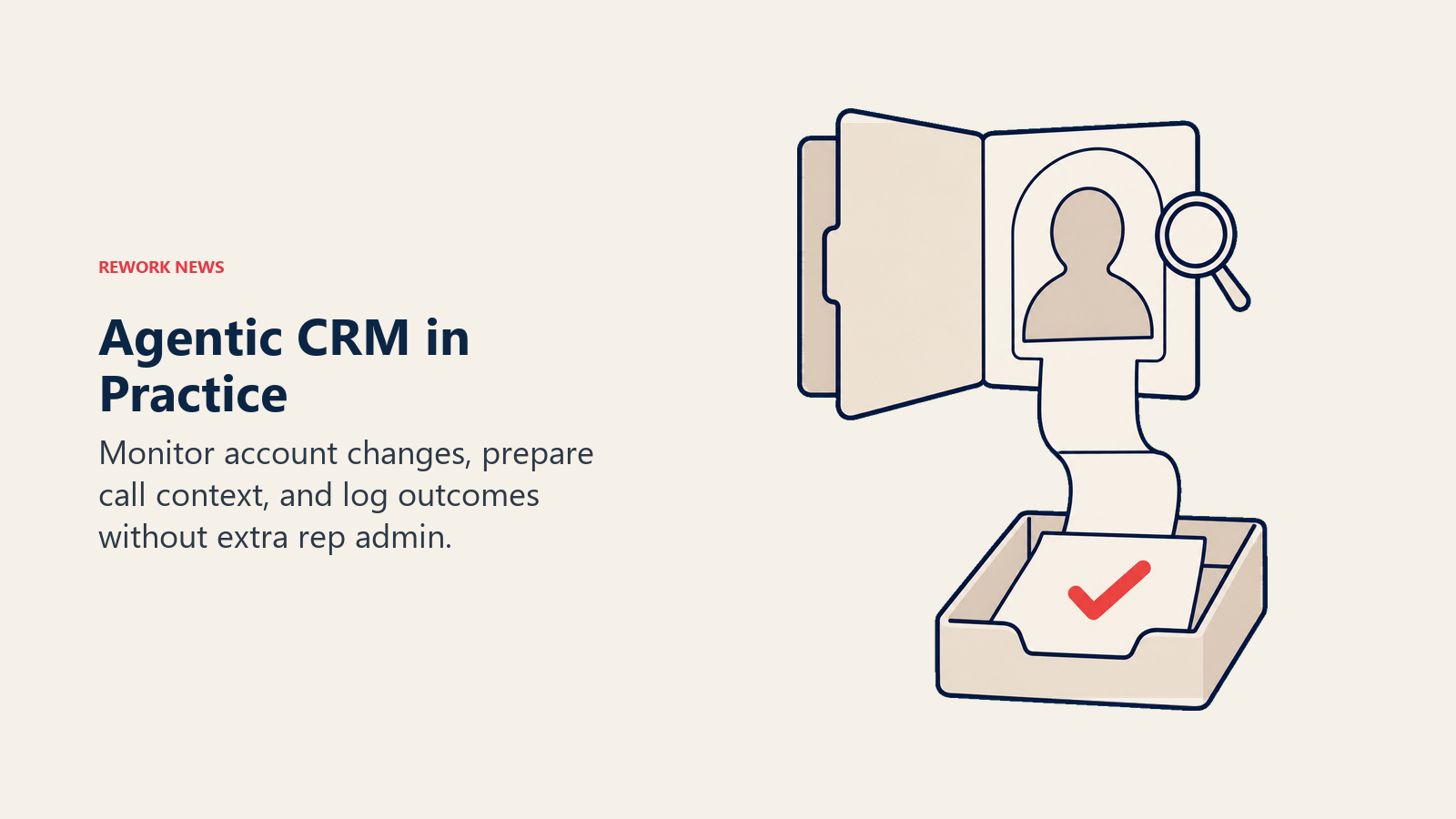
Account monitoring: An AI agent flags when a decision-maker at a key account changes roles, posts about budget challenges, or hasn't engaged with your team in 45 days. The CRM record is updated automatically. The AE gets a Slack notification with context. Right now, most teams find out about these signals weeks later, if at all.
Prospect research: Before an outbound call, an agent pulls recent news about the prospect's company, maps the buying committee from LinkedIn and email signals, and surfaces prior interactions from the CRM. The rep enters the call with two minutes of briefing, not 20 minutes of research.
CRM hygiene at scale: After every call or email, the agent logs the outcome, updates the deal stage, and flags any commitments that need follow-up tasks. Adoption rates for CRM logging go up when reps don't have to do the logging themselves. Your pipeline data gets cleaner. Your forecasting improves. And building pipeline hygiene as a cultural practice is what makes those gains hold after the novelty of the new tool wears off.
These aren't visions for 2027. They're what early Rox customers are describing now.
What to Do This Quarter
You don't need to make a platform decision before the end of Q2. But you do need to close the information gap before someone else closes it for you.
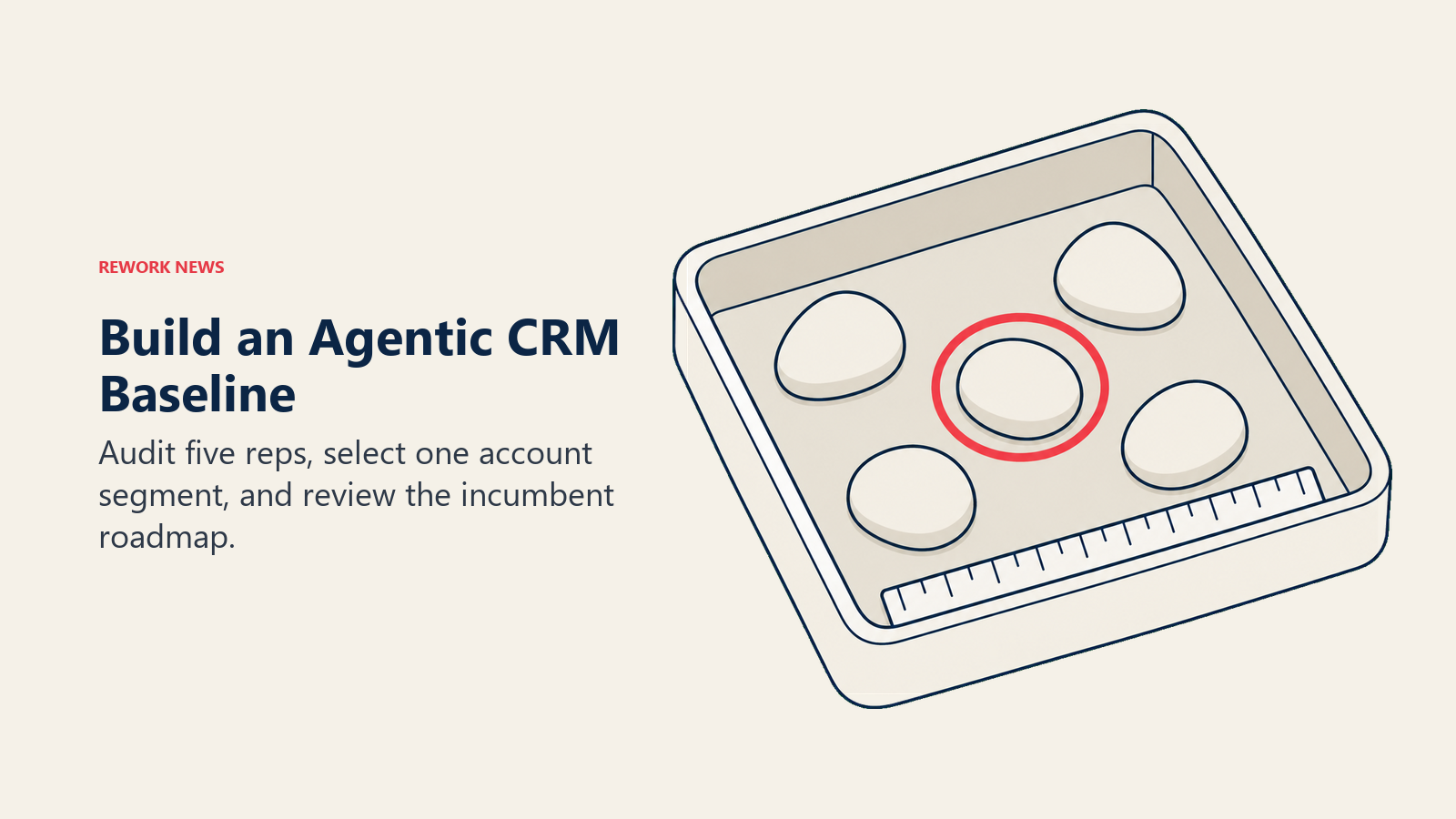
Step 1: Run a time audit on your sales team's administrative burden. Survey five reps on how much time per week goes to CRM updates, research, and email logging. That number is your baseline. Any pilot needs to show a reduction of at least 25% to be worth the switching friction.
Step 2: Identify one account segment where the agentic use case is highest-value. Mid-market renewals are usually the best test bed: the stakes are high enough to matter, and the accounts are structured enough to see measurable impact in 90 days.
Step 3: Get a briefing from your incumbent vendors on their agent roadmap. Salesforce and HubSpot both have published timelines. If their plans address your top-three use cases within the next 12 months, you have reason to wait. If they don't, you have reason to pilot. Forecasting discipline: what separates 90% callers from 50% callers is worth assigning to your team before the evaluation, because better forecast accuracy is often the most measurable near-term output of cleaner pipeline data.
The $1.2B valuation at $8M ARR is a statement. Investors are saying the CRM replacement cycle is already happening, it's just not evenly distributed yet. Your job this quarter is to figure out which side of that distribution your company is on.
Frequently Asked Questions
What is Rox? Rox is an AI-native sales-automation SaaS company founded in 2024 by Ishan Mukherjee, the former chief growth officer at New Relic. It deploys AI agents over your existing tools (Salesforce, Zendesk, email, calendar) to run account monitoring, prospect research, and CRM hygiene in the background, rather than asking reps to live inside another system.
Why is Rox valued at $1.2B on only $8M in ARR? That works out to roughly 150x ARR. Investors price companies that high when they believe a platform shift is in its first inning. The bet is that whoever owns the agent layer over revenue workflows will be worth multiples of $1.2B within five years, so the round funds velocity, not current revenue.
How is Rox different from Salesforce Agentforce or HubSpot Breeze? Salesforce and HubSpot are retrofitting agents onto data models and interfaces designed for human users. Rox was architected for agents from the start. Whether "agentic by design" beats "agentic by retrofit" at enterprise scale is the open question the next 24 months will answer.
Should a CRO buy Rox right now? For most teams, no. It is a signal to form a point of view on, not a product you must adopt today. Run a structured pilot if your reps spend more than 30 minutes a day on CRM hygiene, you lose deals to missing call context, or your CRM renewal is 12 to 18 months out.
Who are Rox's customers? At the time of the raise, named customers included Ramp, MongoDB, and New Relic. Mukherjee's New Relic background gives Rox both a credibility signal and a distribution advantage with the mid-market and enterprise revenue buyers it targets.
Learn More
- The Agentic Sales Stack Is Attracting Unicorn Capital: CEO Strategy: The CEO's board-level framing of the same agentic CRM investment signal
- Layer or Replace? AI-Native CRM Evaluation: A structured framework for evaluating the layer-vs-replace decision with real numbers
- Rework vs. Salesforce: CRM comparison for teams evaluating their options as agentic alternatives emerge
- Pipeline Hygiene as a Culture Problem: Why agentic CRM only compounds pipeline gains if the underlying culture is already there
