More in
B2B SaaS Industry News
Salesforce Just Solved CRM's Oldest Data Problem, At a Cost
Apr 7, 2026
When Your SaaS Vendor Cuts Its R&D Team: What Enterprise Buyers Need to Watch
Mar 19, 2026
The 171% Agentic AI ROI Number: What the Data Actually Says
Mar 2, 2026
Drift Is Being Phased Out: The RevOps Checklist Before Your Conversational Workflows Go Dark
Feb 11, 2026
The $99-Per-Seat Decision: How to Evaluate Microsoft's New AI Bundle
Feb 9, 2026
The SaaS Growth Model That No Longer Requires More Engineers
Feb 4, 2026 · Currently reading
Meeting Notes Just Hit a $1.5B Valuation: What That Signals About the Enterprise AI Context Race
Feb 3, 2026
A $1.2B CRM-Killer at $8M ARR: What Every Sales Leader Needs to Decide Before the Next Board Meeting
Feb 2, 2026
Record AI Funding in Q1 2026: What It Means for Your Sales Stack and Your Competitors
Jan 8, 2026
The Agentic Sales Stack Is Attracting Unicorn Capital: What CEOs Need to Decide About Their Revenue Infrastructure
Jan 7, 2026
The SaaS Growth Model That No Longer Requires More Engineers
Turn this article into takeaways for your work.


Each assistant summarizes the article only for you and suggests best practices for your work.
For two decades, the SaaS growth model had a reliable shape: more customers meant more product investment, which meant more engineers. Headcount and revenue scaled together. That equation is breaking. If you want a deeper frame on how the underlying SaaS growth model works before AI changed the math, that context is worth having.
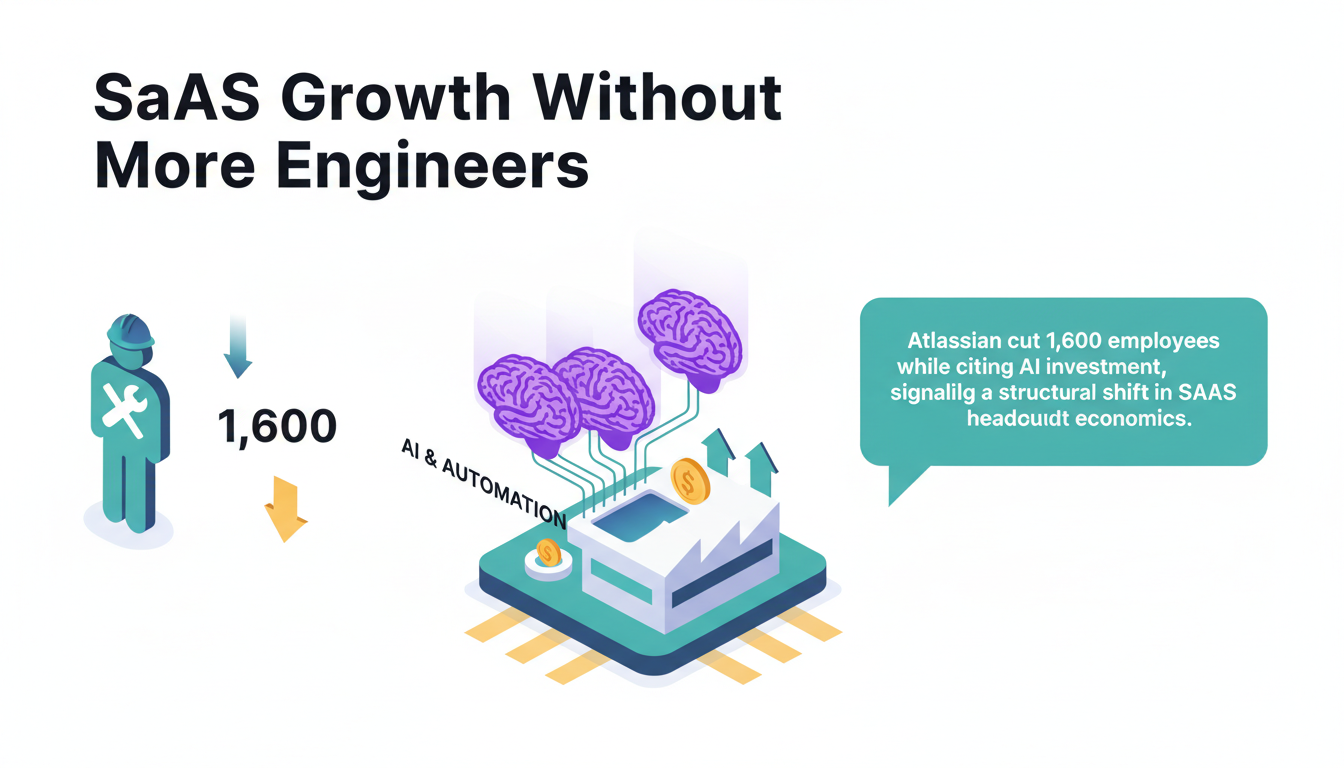
According to TechCrunch's reporting on the Atlassian restructuring, the company cut approximately 1,600 positions (roughly one in ten employees) with the explicit rationale of funding deeper AI investment. More than half of those roles came from software research and development. The company's CEO described the restructuring as a way to "self-fund" AI and enterprise sales expansion. Within weeks, Workday and Salesforce announced their own headcount reductions, each citing similar logic.
When three of the largest names in enterprise SaaS cut engineering staff in the same quarter while accelerating product investment, it's worth asking what they're seeing and what it means for you as a buyer.
What Actually Changed in the Math
The conventional assumption was that software complexity grew linearly with product scope. More features required more engineers to build and maintain them. AI tooling is disrupting that ratio (not eliminating it, but compressing it substantially).
Atlassian's CTO stepped down effective the end of March, and the company split the role between two existing executives. That leadership restructuring alongside the R&D headcount reduction tells a specific story: the org structure built for one era of software development is being replaced by something flatter and more AI-augmented.
The numbers behind this particular restructuring were significant. CNBC reported that the expected restructuring charges fall between $225M and $236M, hitting Atlassian's books in its Q3 fiscal quarter. That's real capital being reallocated from human productivity to AI capability. The geographic spread of cuts (roughly 40% in North America, 30% in Australia, 16% in India) suggests this wasn't a single market correction but a deliberate global reshape of how the company expects to build software going forward.
What's particularly notable is the timeline. Five months before the announcement, Atlassian's CEO had stated publicly that the company expected to employ more engineers in five years, not fewer. That position reversed quickly, which tells you something about how fast the AI productivity calculus shifted even at senior levels.
The Dual Lens Every CEO Needs Right Now
There are two directions from which CEOs should be reading this news, and most commentary focuses on only one.
The vendor lens: Atlassian builds tools that tens of thousands of companies rely on (Jira for project tracking, Confluence for documentation). When more than 900 of its R&D roles disappear in a single quarter, that has implications for roadmap velocity, support quality, and the continuity of features your teams depend on. This isn't hypothetical; it's the practical consequence of a vendor restructuring aggressively while still promising product improvements.
The mirror lens: The same AI productivity logic that allowed Atlassian to cut engineering headcount applies to your company too. If you build software, or if software is a significant part of your operations, the headcount-to-output ratio you've been using to plan hiring may already be obsolete. Q1 2026 tech layoffs crossed 52,000 globally by end of March, and the pattern isn't random. It's concentrated in companies that have the capital to invest in AI tooling and the scale to absorb the restructuring cost. The companion piece on what these layoffs mean for your own workforce strategy covers the broader pattern in more depth.
A Framework for CEOs Evaluating Restructuring SaaS Vendors
When a core vendor cuts its engineering team and pivots to AI, you need a way to assess whether you're exposed. Here's what to look at:
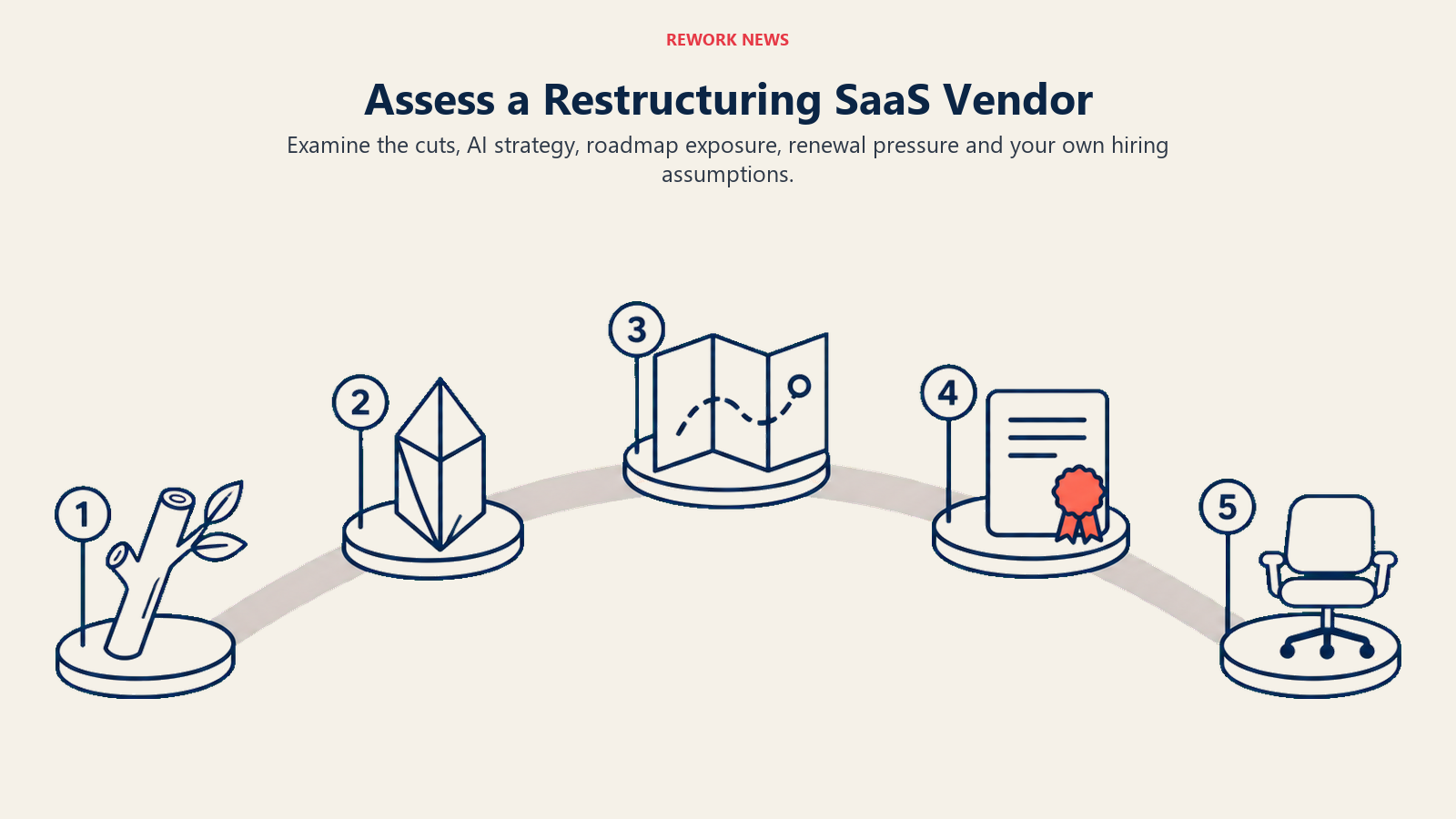
1. What percentage of cuts came from R&D vs. sales and G&A? Atlassian's R&D-heavy reduction is a different signal than cutting sales support. R&D cuts affect future capability; sales and G&A cuts affect cost structure. Know which category your vendor's restructuring falls into before drawing conclusions about roadmap risk.
2. Is the vendor's AI investment replacing human output or expanding it? "Investing in AI" means different things. Some vendors are using AI to automate internal processes and reduce headcount. Others are building net-new AI features. The Atlassian case appears to be both, but the mix matters for how you model their future product trajectory.
3. How dependent are you on roadmap promises the vendor made before the restructuring? If your team's workflow was built on a feature roadmap that was constructed with a larger R&D team, that roadmap needs reassessment. Don't assume commitments made in a prior headcount era carry through unchanged.
4. Does the vendor's enterprise sales expansion affect your commercial relationship? Atlassian specifically cited enterprise sales investment alongside the AI rationale. That combination often translates to more aggressive upsell motions and renewal pressure on existing customers. Know what's coming before it arrives.
5. What does the same logic mean for your own hiring plan? This is the hardest question and the most important one. If your software vendors are discovering that AI tools allow them to grow product capability without growing engineering headcount proportionally, the same leverage may exist in your business. The companies that figure this out early will have a structural cost advantage over competitors who don't. The SaaS unit economics behind headcount-to-output ratios are a useful reference for that internal conversation.
The Strategic Shift You Can't Ignore
What's happening across SaaS in Q1 2026 isn't simply a cost-cutting wave. It's a re-rating of the relationship between human labor and software output. The assumption that more growth requires more people is being tested at scale by companies with the resources and incentive to run the experiment publicly.
For CEOs, the implication isn't to panic or immediately announce your own restructuring. It's to update your mental model. The vendors you rely on are building with smaller teams. The competitors you face may be doing the same. And the hiring plans you approved six months ago may have been drafted with assumptions about productivity ratios that are already changing.
The Atlassian restructuring is a data point, not a mandate. But when three major SaaS companies report the same rationale in the same quarter, the data is pointing in a direction worth taking seriously.
What to Do This Week
- Identify your top five SaaS vendors by spend and check whether any announced headcount reductions in Q1 2026. If so, request an updated product roadmap briefing from your account team before your next renewal. See also the COO-angle piece on what operations leaders need to assess before Atlassian renewal.
- Pull your own headcount-to-output ratios from the past two years in engineering, product, and operations. Ask your leadership team to estimate what the same output would require if AI tools were applied aggressively to each function.
- Schedule a 30-minute conversation with your CFO on the assumption set behind this year's hiring plan. Not to change it, but to verify it still holds given what's happening at your vendor base.
- Review any multi-year contracts with vendors that have announced significant R&D restructuring. Understand your exit terms and SLA commitments before the next renewal conversation.
The SaaS growth model is changing. The CEOs who update their assumptions now will be better positioned than those who wait for the change to arrive at their doorstep.
Learn More
- The Q1 2026 Tech Layoff Pattern: CEO Workforce Strategy: The broader AI-driven restructuring pattern across tech and what it means for your own headcount planning
- When Your SaaS Vendor Cuts Its R&D Team: The enterprise buyer's evaluation checklist when a core vendor restructures
- AI Workforce Transformation in Professional Services: How leading firms are recalibrating the human-AI output ratio
- The Hidden Cost of Delaying AI Upskilling: The financial case for moving quickly on your own AI investment
