More in
Revenue Operations Insights
Should You Trust the AI Forecast Over Your Reps' Commit?
Oct 12, 2026
Should RevOps Own AI in the Revenue Engine?
Oct 12, 2026
How Much Should a Growing Company Invest in Revenue Operations?
Oct 11, 2026
Is Pipeline Coverage the Most Misleading Number in Your Forecast?
Oct 11, 2026
Shared Revenue Targets: Do They Align Teams or Blur Accountability?
Oct 11, 2026
Why Buying Tools Before Fixing Process Is the Most Expensive RevOps Mistake
Oct 11, 2026
Should RevOps Report to the CRO, the CFO, or the CEO?
Oct 11, 2026
The True Cost of Software Sprawl (It's Not the Licenses)
Jun 12, 2026
Pipeline Hygiene as a Cultural Practice, Not a Data Problem
Apr 7, 2026
The RevOps Maturity Model: From Reactive to Strategic
Apr 6, 2026 · Currently reading
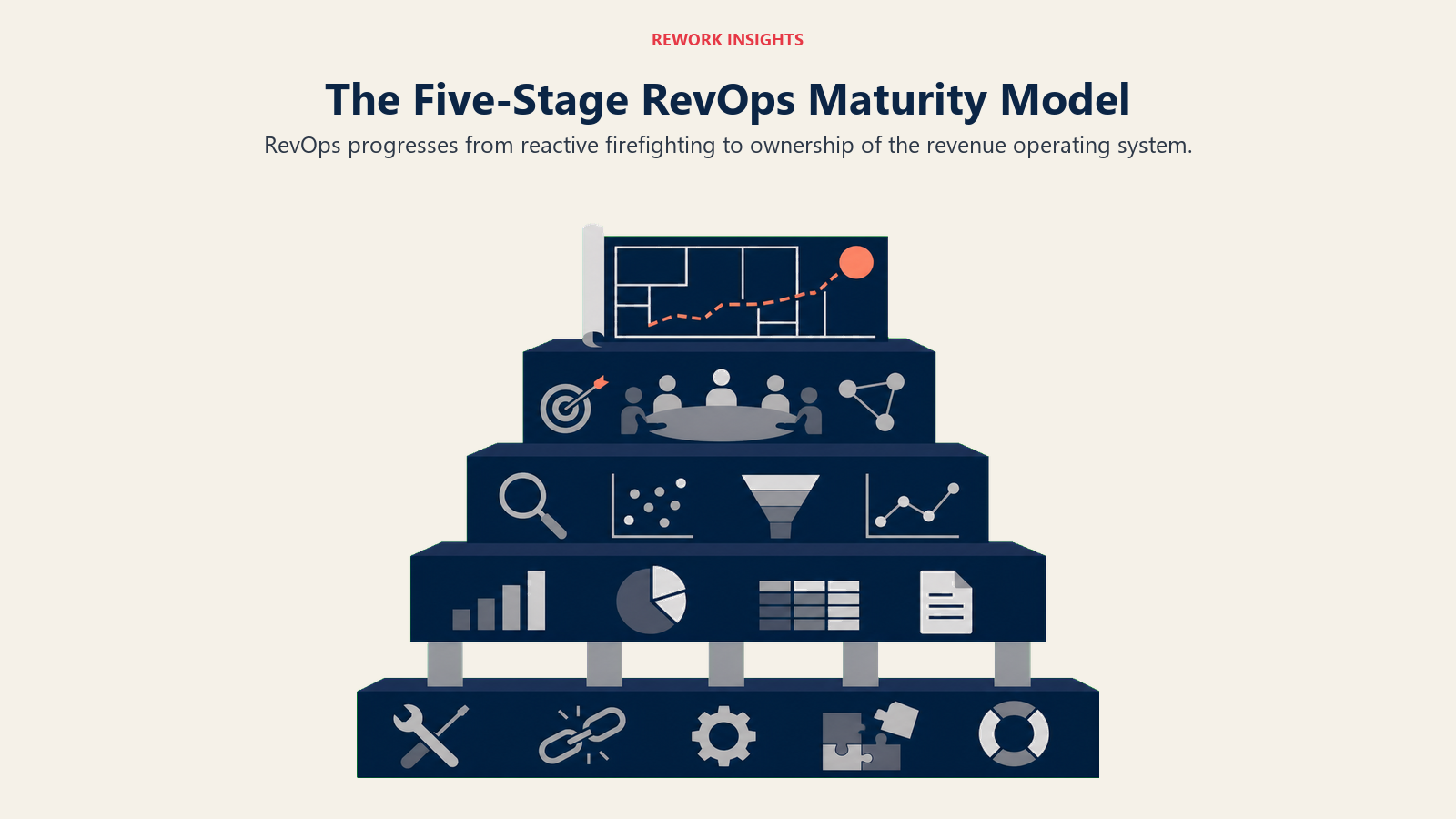
The RevOps Maturity Model: From Reactive to Strategic
Turn this article into takeaways for your work.


Each assistant summarizes the article only for you and suggests best practices for your work.
Most RevOps functions spend their first two years in the same state: perpetually reactive. Broken Salesforce integrations before a board call. Missing pipeline data the day before QBR. A VP of Sales who needs a report "by end of day" that requires three hours of manual extraction. The team gets faster at these requests. They build better processes. They become reliably excellent at reactive work.
And then they plateau.
The ceiling isn't skill, it's posture. Reactive work is visible and immediately rewarded. The CRO sees that RevOps fixed the integration in two hours and thinks "these guys are good." Strategic work is invisible until something breaks or until it produces an outcome that happened to align with a decision RevOps influenced six months ago. The incentive structure keeps talented RevOps leaders doing Level 2 work when they have the capacity for Level 4. McKinsey's analysis of B2B operations functions identifies this reactive trap as one of the primary reasons revenue operations fails to convert analytical capability into business influence.
Getting unstuck requires deliberately understanding where you are on the maturity curve and what the next level actually looks like in practice. Not in a job description, but in the specific behaviors and outputs that signal you've moved.
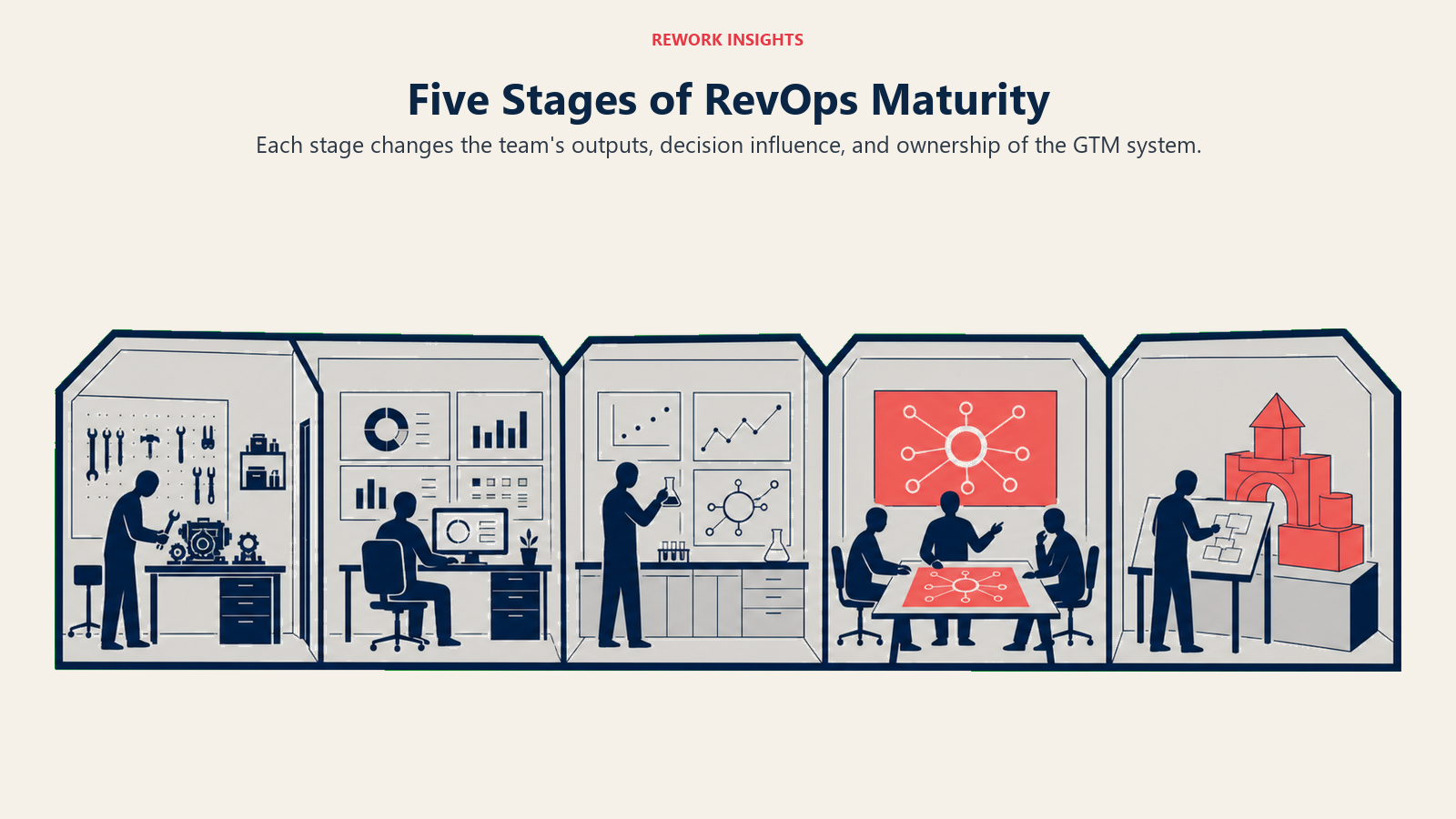
The Five Stages of RevOps Maturity
Level 1: Firefighter
What it looks like: The RevOps team exists to fix things that are broken. CRM cleanup, integration troubleshooting, ad-hoc report requests, onboarding new reps into tech stack tools. Every day starts with a queue of tickets. The team is reactive by default because there's no space to be anything else.
Output: Things that used to be broken now work. Requests get fulfilled. Technical debt gets serviced.
What's missing: Any forward-looking function. RevOps at Level 1 has no recurring deliverable that isn't triggered by someone else's request.
Tech stack signal: The CRM configuration is inconsistent. Fields were added when someone needed them without a governing logic. Integration errors are common. Data in the CRM reflects what happened, not what was planned.
How you know you're here: Your team has no standing agenda items on any exec meeting. All your work is pull-based: someone asks, you do it. You haven't said "no" to a request in three months.
Level 2: Reporter
What it looks like: RevOps owns dashboards and recurring reporting. The QBR deck is theirs. Pipeline reports go to the CRO every Friday. Sales performance metrics are tracked and published on cadence. The team has standing deliverables, but they're reporting on what happened rather than shaping what will happen.
Output: Leadership has visibility into what happened last week, last month, last quarter. Dashboards exist and are maintained. RevOps is seen as the team that "knows the numbers."
What's missing: Interpretation. Level 2 RevOps reports what happened without providing a view on why it happened or what should happen next. They're a data delivery service, not an analytical function.
Tech stack signal: CRM fields are clean enough to support the core reports. Attribution is tracked but not analyzed critically. Dashboards are built but often unused. They serve reporting rituals rather than daily decision-making. A SaaS metrics dashboard built around decision-making rather than reporting rituals is the Level 3 signal that dashboards can actually influence behavior.
How you know you're here: When you present a report and the CRO asks "so what does this mean?" and you have to schedule a follow-up to answer that question.
Level 3: Analyst
What it looks like: RevOps not only tracks what happened but builds models that explain it. Forecasting models are owned by RevOps and updated with commentary. Win rate trends are analyzed by segment, by rep cohort, by deal size. GTM experiments get post-mortems with a clear hypothesis about what worked and why.
Output: Leadership gets a point of view from RevOps, not just data. The team surfaces anomalies before they become crises. When CAC payback ticks up, RevOps has an explanation before the board meeting.
What's missing: Influence on decisions before they're made. Level 3 RevOps is still explaining past events, just more skillfully. They're not in the room when the CRO decides where to hire next quarter.
Tech stack signal: CRM configuration reflects the analytical framework RevOps uses internally. If RevOps is tracking win rates by deal source, there's a field for deal source that's consistently populated. The tech stack serves the analytical work.
How you know you're here: Leadership calls you before they publish a decision to ask if you have data to support it. You're a check, not an input.
Level 4: Strategic Partner
What it looks like: RevOps is consulted before significant GTM decisions, not after. When the CRO is considering a new comp structure, RevOps models the expected behavior change before rollout. When Sales wants to enter a new vertical, RevOps builds the pipeline coverage model and capacity analysis. The team has influence over hiring plans, commission structures, territory design, and product roadmap prioritization.
Output: RevOps work shapes decisions that shape the business. The function has recurring agenda time in exec meetings, not to report, but to recommend.
What's missing: Ownership of the full GTM system. Level 4 RevOps is a strategic advisor. They inform decisions. But the operating model itself (the rules that govern how the revenue machine runs) still sits with the CRO or CEO.
Tech stack signal: The CRM is configured around RevOps's operating model, not just sales convenience. Stage definitions reflect buyer behavior, not rep activity. Forecasting is automated from CRM data that RevOps governs. A structured forecast cadence owned by RevOps, not pulled ad-hoc by the CRO, is the most visible external signal that you've reached Level 4.
How you know you're here: The CRO asks for your recommendation before making a decision. You occasionally say "we'd recommend against that" and your recommendation is taken seriously.
Level 5: Revenue Architect
What it looks like: RevOps owns the GTM operating system. That means the governance framework for how revenue is planned, measured, and optimized lives with RevOps. Headcount models, capacity planning, territory design, comp philosophy, tech stack selection; these aren't approved by RevOps, they're designed by RevOps and adopted by the business.
Output: A revenue machine that runs on principles RevOps defined. The CRO leads the sales team. RevOps runs the system the sales team operates within.
Tech stack signal: RevOps selected the CRM and owns the contract. They have a multi-year tech stack roadmap. Integrations are designed and governed by RevOps rather than assembled reactively, which is how mature teams avoid the true cost of software sprawl.
How you know you're here: When you leave the company, the operating system you built is a competitive asset that the next RevOps leader inherits rather than rebuilds.
Why Most RevOps Teams Stay Stuck at Level 2
The incentive trap is real. Reactive work gets immediate positive feedback. Fix a broken integration: CRO sends a thank-you Slack. Build a QBR deck that impresses the board: VP of Sales calls you out by name in the all-hands. Strategic work produces invisible feedback, delayed by months, and often absorbed by the leader who made the decision you influenced. Harvard Business Review's research on operations function influence identifies this delayed-feedback dynamic as a core reason high-capability operations teams fail to build organizational influence despite strong technical output.
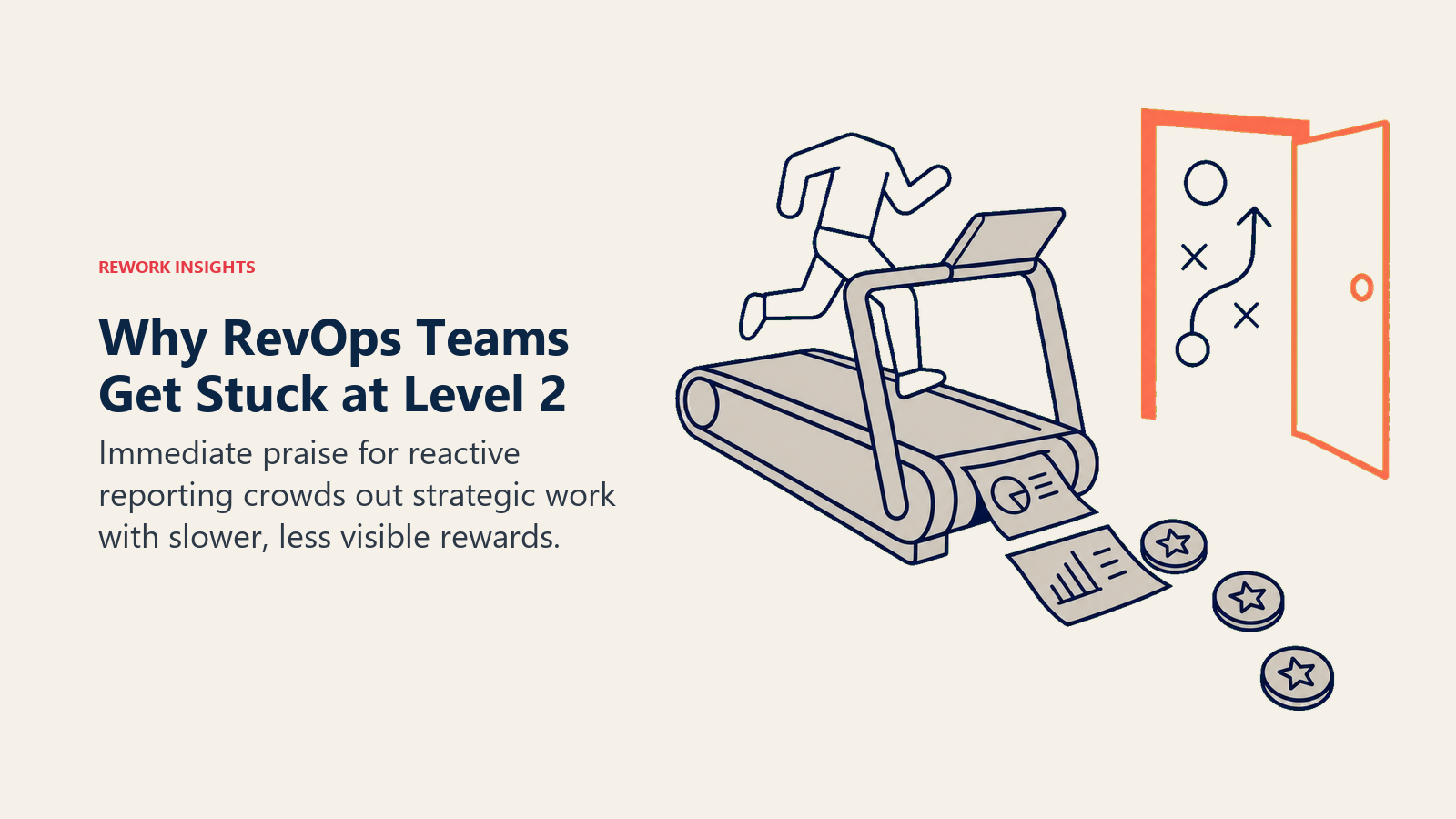
But there's a second mechanism that keeps teams at Level 2: the absence of a mandate for strategic work. Nobody hired the first RevOps person and said "build a model that optimizes our GTM motion for the next three years." They said "fix our CRM and help us close out Q4." The team built its identity around execution, and execution kept demanding their full attention.
Moving up the maturity curve doesn't happen organically. It requires deliberately choosing to do strategic work even when reactive work is always available. That means sometimes saying "this report request isn't a RevOps function, here's how you can get this yourself" and protecting time for analytical work that won't pay off for two quarters.
Tech Stack as a Maturity Signal
Your CRM configuration is a mirror of where you are on the maturity curve.
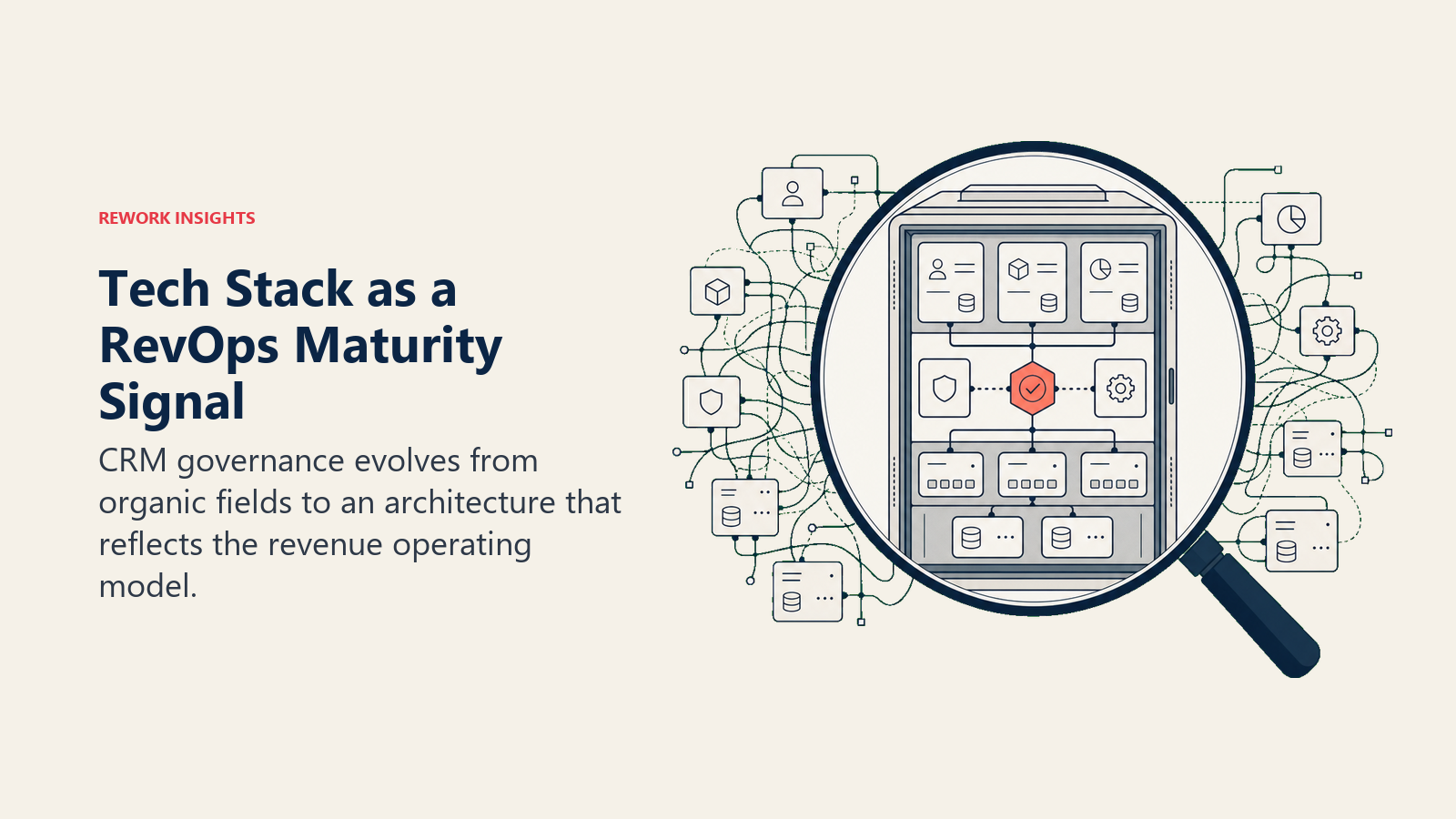
Level 1 companies have CRM fields that grew organically as people needed them. There's no governing logic. Required fields were added during a hygiene sprint and then abandoned when adoption dropped. The pipeline stages were set up during implementation and haven't been revisited since.
Level 3 companies have CRM fields that map to their analytical framework. If RevOps tracks win rates by deal source, there's a "deal source" field that's required, clearly defined, and maintained. Stage definitions reflect buyer behavior evidence, not rep activity. Reports are built to serve recurring analytical questions, not one-off requests. CRM rollout and adoption practices determine whether those field standards actually hold, definition without adoption produces the same dirty data as no definition at all.
Level 4 and 5 companies have a CRM that is owned by RevOps the way an engineering team owns their architecture. Changes require a review process. New fields have a business case. The configuration reflects a point of view about how the GTM motion works.
When a Salesforce or HubSpot instance is configured messily, it tells you RevOps is at Level 1 or 2. When it's clean but static, Level 2 or 3. When it actively reflects the analytical framework that drives executive decisions, Level 3 or 4. That's not a rule. It's a signal. But it's a reliable one.
The RevOps Influence Test
Four questions that reveal whether RevOps is informing or just reporting:
Were you consulted before the last major GTM decision? Not informed after the fact. Consulted before, with time to provide a recommendation that could change the outcome.
Do you have a standing agenda item on the leadership team's recurring meeting? Not a guest slot. A standing item where RevOps presents a view, not just answers questions.
Has a decision gone differently because of something RevOps recommended in the last 90 days? You should be able to name it.
Does the CRO's view of the revenue machine align with RevOps's view? If they'd describe how the GTM motion works differently than you would, you're not yet aligned on the operating model.
If you can answer yes to all four, you're operating at Level 4 or above. Two or fewer yeses means you're at Level 2 or 3 regardless of what your job title says.
The One Deliverable That Earns Level 4
RevOps leaders who move from Level 3 to Level 4 almost always do it through one deliverable: an unsolicited analysis that changed a decision.
Not a report someone asked for. Not a QBR dashboard. An analysis you ran because you noticed something in the data that looked like a problem. You built a model, formed a recommendation, and brought it to the CRO before they knew the problem existed.
That might look like: noticing that win rates in your 201–500 employee segment have declined 8 points over three quarters, building a hypothesis about why (new competitor entering that space, a pricing change that hurt competitiveness at that deal size, a rep mix change), and bringing a recommendation to the CRO before the QBR.
The CRO didn't ask for it. You saw it. You analyzed it. You recommended something. That's Level 4 behavior. Do it once and you'll get invited into conversations you weren't in before.
30-Day Plan for the Level 2 Leader
If you're solidly at Level 2 and want to start moving toward Level 3, here's a concrete starting point.
Week 1: Pick one metric your CRO cares about that you currently report on but don't explain. Win rate, pipeline coverage, CAC. Doesn't matter which. Spend three hours doing actual analysis: what's driving the trend, what's the right benchmark, what does it predict about next quarter? Forrester's research on high-performing revenue operations found that RevOps leaders who present at least one unsolicited analytical insight per month are measurably more likely to be included in strategic planning cycles, the act of bringing analysis unprompted signals strategic intent more than any title change. A good starting point is the RevOps framework for connecting sales motions to SaaS unit economics; it gives you the vocabulary to move from "here are the numbers" to "here is what they mean for our growth model."
Week 2: Write a one-page narrative (not a slide deck) that explains what you found. Include a recommendation. Send it to your CRO with a note: "I've been thinking about our win rate trends and have a hypothesis about what's driving it. I'd welcome 20 minutes to walk through it if useful."
Week 3: Whether or not you got the 20 minutes, run the same analysis on a second metric. Build the habit, not just the deliverable.
Week 4: Request a standing 30-minute slot in the weekly leadership meeting. Not to report, but to share one analytical observation per week. Offer to start with a 30-day trial.
None of this requires additional headcount, new software, or permission from anyone above your CRO. It requires protecting time for analytical work when operational work is always available. That's the practice that builds Level 3.
Learn More
- CAC Payback: The Metric That Actually Predicts SaaS Survival, The kind of analytical depth that earns RevOps a seat at the strategy table
- Attribution Is Broken. Here's What to Measure Instead, Building investment views that executives trust is core Level 4 RevOps work
- Pipeline Hygiene as a Cultural Practice, Not a Data Problem, How mature RevOps teams handle the behavioral foundation that makes all other analysis trustworthy

Co-Founder, Rework.com
On this page
- The Five Stages of RevOps Maturity
- Level 1: Firefighter
- Level 2: Reporter
- Level 3: Analyst
- Level 4: Strategic Partner
- Level 5: Revenue Architect
- Why Most RevOps Teams Stay Stuck at Level 2
- Tech Stack as a Maturity Signal
- The RevOps Influence Test
- The One Deliverable That Earns Level 4
- 30-Day Plan for the Level 2 Leader
- Learn More