More in
AI at Work News
OpenAI Opened ChatGPT Advertising to Small Businesses at Any Budget
Jun 6, 2026
AI Is Everywhere at Work. Only 1 in 10 Say It Transformed the Job
Jun 6, 2026
Vibe Coding's $10.5B Moment: AI Now Starts Most New Software Builds
Jun 6, 2026
AI Agents Now Have More System Access Than Your Employees. Few Are Secured
Jun 5, 2026
Should You Build Your AI or Buy It? Watch What the Giants Bought.
Jun 5, 2026
Uber Caps Employee AI Spending at $1,500 Per Seat After a Budget Blowout
Jun 5, 2026
Trump's AI Executive Order Is Deregulatory. Your Compliance Risk Didn't Move
Jun 4, 2026
AI Pushed 220 Unicorns Below $1B. Pre-ChatGPT Companies Face a Reckoning
Jun 4, 2026
Token Prices Fell 67% This Year. Your AI Bill Is Going Up Anyway
Jun 3, 2026
Small Businesses Using AI Report Higher Revenue and Shorter Workdays
Jun 3, 2026
The Q1 2026 Tech Layoff Pattern and What It Means for Your Own Workforce Strategy
Turn this article into takeaways for your work.


Each assistant summarizes the article only for you and suggests best practices for your work.
The 2026 AI layoffs are different from the 2023 to 2024 cuts: companies like Atlassian, Workday, and Salesforce eliminated 52,000-plus Q1 roles explicitly to self-fund AI investment, not to correct over-hiring. For CEOs, the move is to build a specific, honest internal position on what AI is and isn't replacing before employees and the board ask.
Something structurally different happened in the first quarter of 2026. Major enterprise software companies cut staff not to fix an over-hiring mistake, but to fund an AI investment thesis. And they said so publicly, by name, to shareholders and employees. That's a new kind of signal. Every CEO should be paying attention.
According to a roundup published by Technext, approximately 52,000 tech sector jobs were eliminated in Q1 2026, with AI cited as a direct rationale by multiple major companies in the same reporting period. By early April, the year-to-date total had already crossed 90,000. That's not a blip. It's a directional statement.
The companies involved aren't startups scrambling for runway. Atlassian cut roughly 1,600 roles (about 10% of its workforce) with leadership describing the decision as a way to "self-fund AI investment." Workday reduced its headcount by approximately 1,750, framing it as a pivot toward AI systems and global expansion. Salesforce eliminated several hundred roles spread across marketing, data analytics, and AI product teams. These are the companies that built the software stack most B2B enterprises run on. The fact that they're restructuring their own workforces around AI should inform how you think about yours.
Why This Cycle Is Different From the Last One
The 2023-2024 tech layoff wave looks superficially similar but was actually a different phenomenon. Those cuts were corrections: companies that hired aggressively during COVID-era growth reversed over-staffing when growth slowed. The rationale was financial discipline, not structural transformation.
The Q1 2026 cuts have a different underlying logic. If you're thinking about the broader AI experimentation to execution shift inside your own organization, the timing of these announcements is relevant context. Atlassian's announcement is the clearest example: over 900 of its 1,600 eliminated roles came from R&D. That's not trimming fat. That's a deliberate bet that AI tooling can replace a portion of human engineering capacity while maintaining or improving output. Workday's public messaging from its CEO reinforced this directly, describing a world where companies everywhere are reconsidering how work gets done at a fundamental level.
The distinction matters for how you interpret these events. The 2024 corrections told you the business cycle was normalizing. The 2026 restructurings tell you that leading technology companies have crossed a threshold. They're confident enough in AI's productivity gains to stake headcount decisions on that confidence. That's different. And it's contagious.
The Roles Being Cut vs. The Roles Being Added
If you look past the headline numbers, there's a pattern in which roles are disappearing and which ones companies claim they're adding. R&D engineers, data analysts, and mid-tier marketing functions appear repeatedly across Q1 announcements. These are roles where AI tooling (code generation, data pipelines, content workflows) has reached a threshold of reliability that lets companies reduce human involvement.
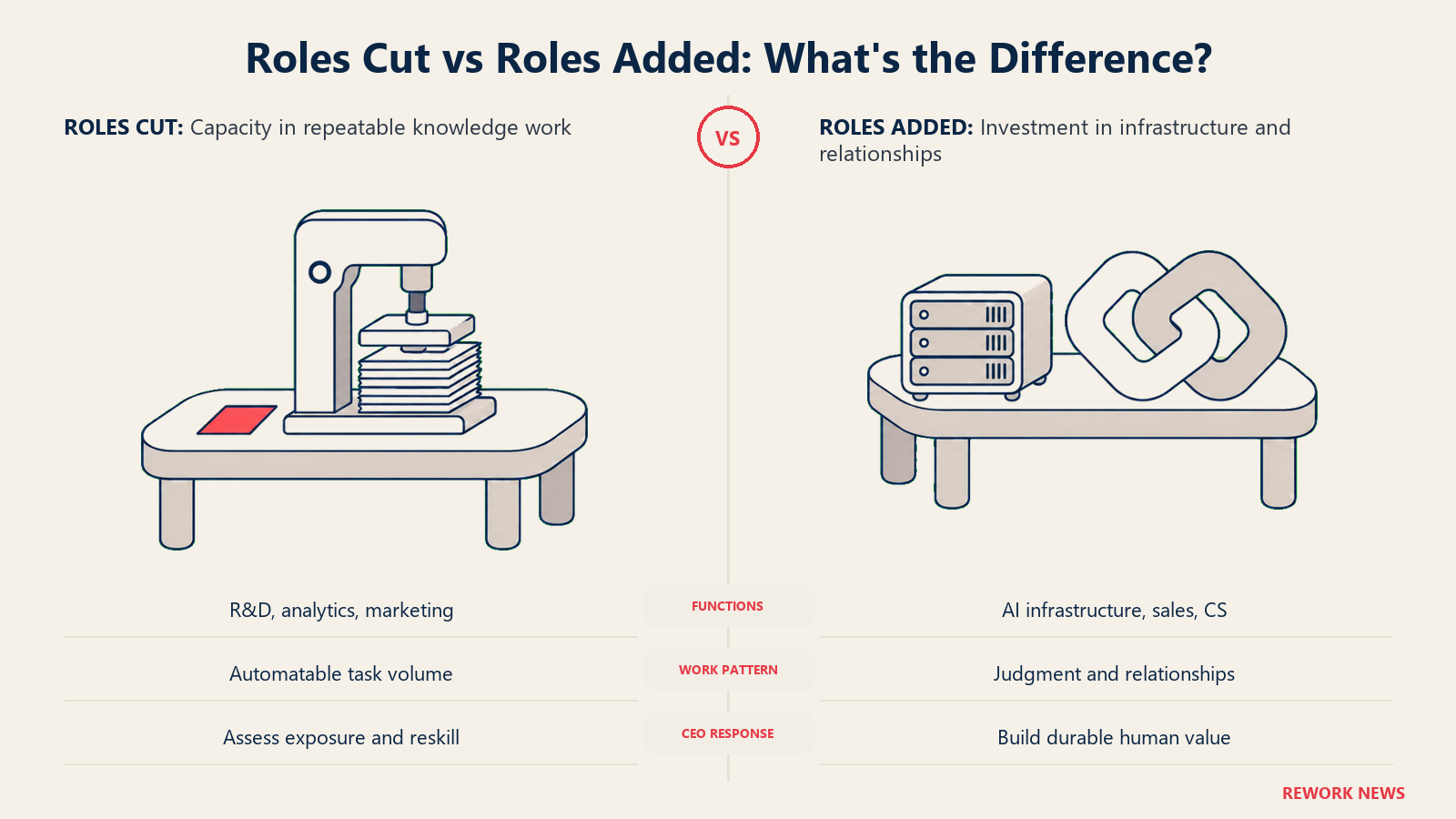
What companies say they're investing in looks different: AI infrastructure, enterprise sales, and customer success. Workday specifically framed its reductions as a reallocation toward AI development capabilities and international commercial expansion. Atlassian has signaled a similar direction. So the story isn't "AI replaces everyone." It's "AI reduces the marginal cost of certain knowledge work, and that creates room to grow revenue without growing those specific teams."
That's a useful frame for your own workforce planning. Not everything is at the same risk of displacement. The question worth asking in your context is where AI tooling can genuinely absorb task volume versus where human judgment, relationship management, and contextual expertise create durable value that AI currently can't replicate reliably. The internal mobility strategy decisions you make now will define which roles you're hiring for versus retraining into.
The Communication Problem Most CEOs Are Underestimating
Here's the issue that's quieter but more immediately pressing: you're probably going to be asked about this by employees, board members, or press. The companies that look bad in AI workforce conversations are usually the ones caught without a prepared, honest position.
There are two failure modes. The first is over-promising: telling employees AI won't affect jobs when you haven't actually done the analysis and you don't know that to be true. The second is sanitizing: using language like "resource optimization" or "strategic realignment" when what you mean is that AI is replacing some human capacity. Neither builds trust. Both create a credibility gap that's hard to close once it opens.
The executives who've handled this best in Q1 2026 are the ones who gave employees two things simultaneously: an honest acknowledgment that AI is changing what certain roles do and how many of them exist, and a concrete articulation of where human work creates value that AI doesn't. That's a harder message to give, but it's more durable.
A Framework for Your AI Workforce Position
You don't need a press release. You need a coherent internal position that holds together when employees, managers, and board members ask questions. Here's a five-part structure that reflects what the most credible CEOs are using right now:
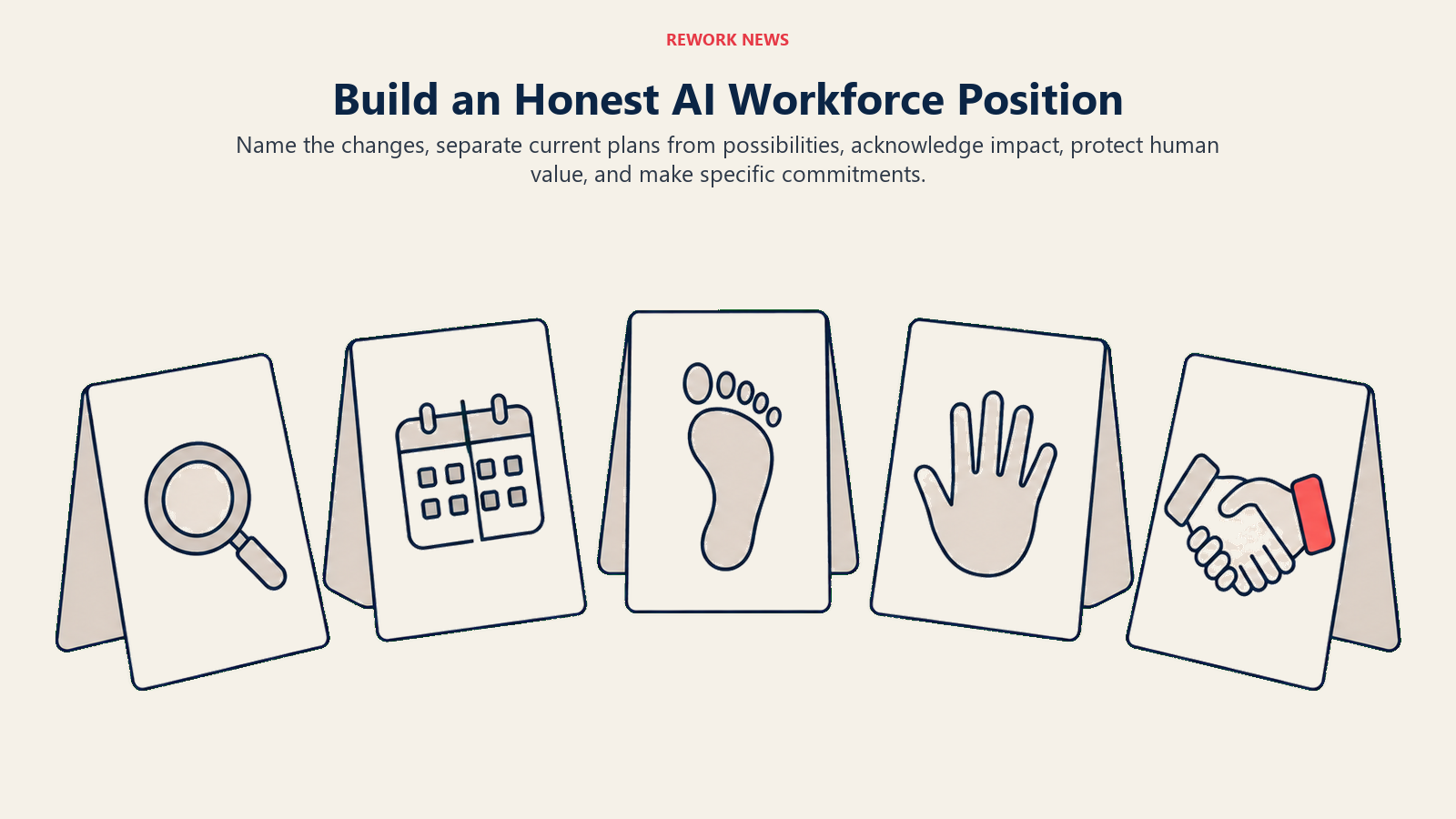
1. Be specific about what AI is and isn't replacing in your business. Generic statements don't hold up. "AI will change how we work" means nothing to the person wondering if their job is at risk. Which functions are being augmented? Which processes are you automating? Being specific, even if the answer is incomplete, signals honesty.
2. Separate the "what's changing now" from "what we're watching." Some AI-driven changes in your organization are already underway. Others are plausible but not decided. Conflating them creates anxiety without purpose. Distinguish between current realities and future possibilities you're monitoring.
3. Acknowledge the human impact without moralizing. If AI tooling eliminates or significantly changes some roles at your company, say so. The cost of pretending otherwise isn't just reputational, it's operational. Employees planning careers and teams planning capacity need accurate information to make good decisions.
4. Name the areas where human judgment is explicitly irreplaceable. This is where the conversation usually gets vague, but it shouldn't. Client relationships, ethical judgment under uncertainty, complex problem-solving in novel contexts, institutional knowledge: there are specific areas in every business where AI's current limitations make human involvement genuinely necessary. Identify yours. The skills-based hiring shift underway at many organizations reflects exactly this kind of recalibration.
5. Make commitments you can actually keep. Vague promises about "supporting impacted employees" or "investing in retraining" land poorly if they're not backed by specifics. If you're offering reskilling programs, name them. If you're building internal mobility pathways, describe how they work. Specificity signals seriousness.
What's Actually at Stake for B2B Leaders
There's a downstream consequence that doesn't get enough attention in these conversations: what happens to the software tools you rely on when the companies that build them restructure their engineering teams around AI.
Atlassian cut more than 900 engineers. That's a significant portion of the people who built, maintained, and improved the products your teams use. Workday and Salesforce made similar decisions. In the near term, these companies are betting that AI-generated code, AI-assisted QA, and AI-accelerated product development will keep their roadmaps moving. Maybe they're right. But there's a real question about what happens to product depth, edge-case handling, and the kind of institutional knowledge about complex customer needs that senior engineers carry with them.
As a buyer of enterprise software, this is something worth tracking. GPT-5.4's computer-use and automation capabilities are exactly the kind of technology these vendors are betting their roadmaps on, so understanding those capabilities directly helps you evaluate their claims. Vendor stability assessments have traditionally focused on financial health. Going forward, they should also include an evaluation of how a vendor's AI-workforce strategy affects the quality of what they're shipping and the reliability of their support.
What to Do This Week
The goal this week isn't to make permanent decisions. It's to get in front of the conversation before it gets ahead of you.
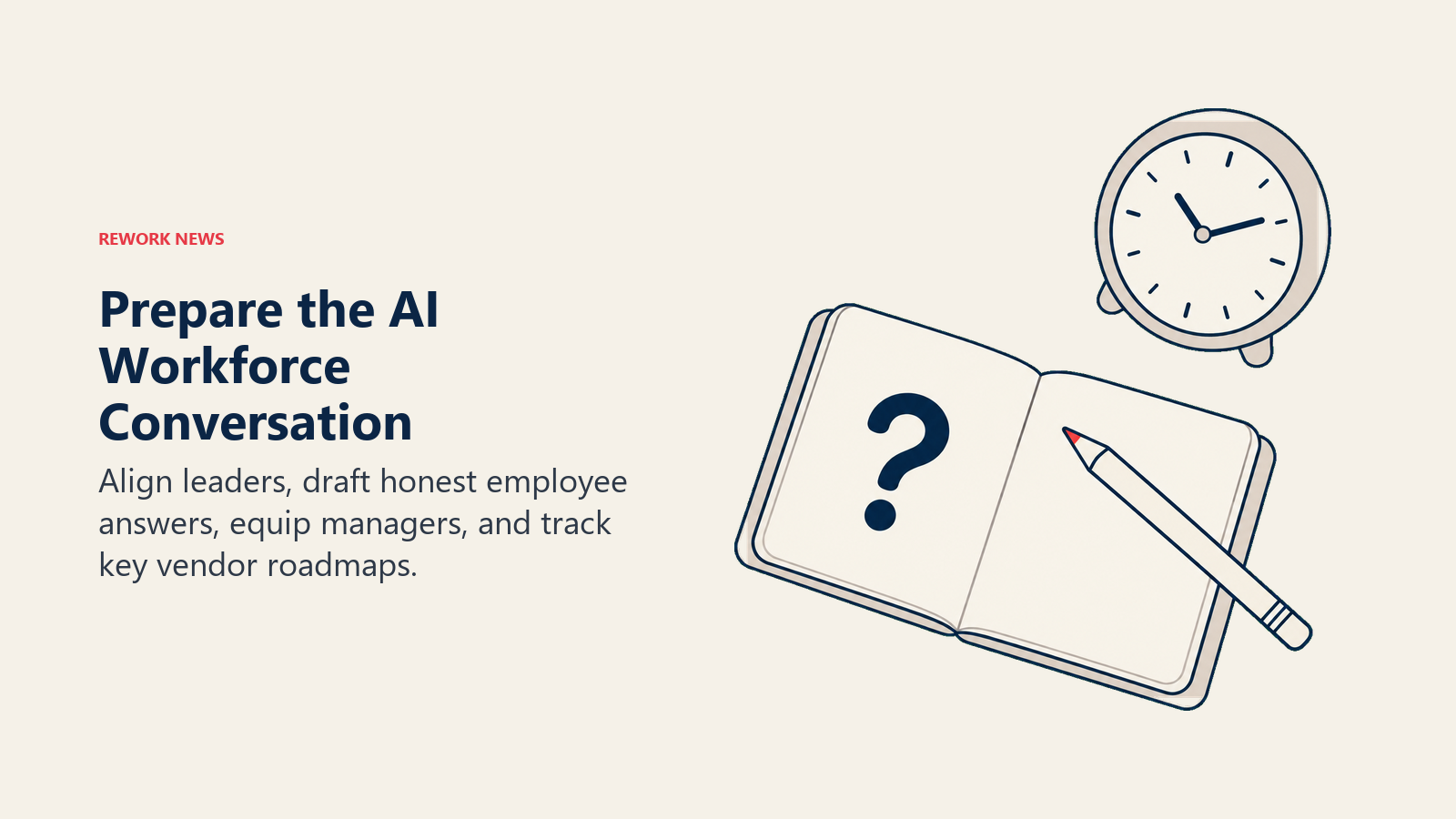
Hold a 30-minute session with your leadership team to align on the current state of AI adoption inside your business. Which functions are already using AI tools in meaningful ways? Where is AI being explored but not yet deployed? Your team's answers will be more varied than you expect.
Draft a short internal FAQ covering three to five questions your employees are most likely to ask about AI and jobs, with honest answers. This doesn't need to be published anywhere yet. The act of writing it will clarify where your position is solid and where it has gaps.
Ask your HR lead or People team whether manager-level conversations about AI and role evolution are happening, and whether managers feel equipped to have them. Unanswered questions don't disappear; they circulate informally.
Assign someone to track AI roadmap communications from your top five software vendors over the next quarter. If you rely on Atlassian, Salesforce, Workday, or their equivalents, knowing how they're restructuring their product teams gives you earlier signal on potential support and feature delivery changes. The Microsoft Copilot Wave 1 rollout is a concrete example of what that tracking looks like in practice for a widely-used platform.
The Q1 2026 pattern is a leading indicator, not a final answer. What it tells you is that structural AI-driven workforce changes are now visible at scale, they're being communicated publicly by major companies, and the board-level conversation about AI and headcount is going to come to every CEO, including you. Better to shape that conversation from a prepared position than to react to it from an unprepared one.
Frequently Asked Questions
How many AI-related tech layoffs happened in Q1 2026?
Roughly 52,000 tech sector jobs were eliminated in Q1 2026, with AI cited as a direct rationale by multiple major companies, and by early April the year-to-date total had crossed 90,000. Atlassian cut about 1,600 roles (10% of staff) to "self-fund AI investment," Workday cut about 1,750, and Salesforce eliminated several hundred across marketing, data analytics, and AI product teams.
Why are the 2026 AI layoffs different from the 2023 cuts?
The 2023 to 2024 wave was a correction: companies reversed COVID-era over-hiring when growth slowed, driven by financial discipline. The 2026 cuts are structural. Over 900 of Atlassian's 1,600 eliminated roles came from R&D, a deliberate bet that AI tooling can replace a portion of human engineering capacity. Leading firms are now confident enough in AI productivity gains to stake headcount decisions on them.
Which roles are most exposed to AI displacement?
R&D engineers, data analysts, and mid-tier marketing functions appear repeatedly across Q1 announcements, roles where AI tooling for code generation, data pipelines, and content workflows has reached a reliability threshold. What companies say they are investing in looks different: AI infrastructure, enterprise sales, and customer success. The pattern is less "AI replaces everyone" and more "AI lowers the marginal cost of certain knowledge work."
What should a CEO do about AI and workforce strategy?
Build a coherent internal position before you are asked about it. Be specific about what AI is and isn't replacing, separate what is changing now from what you are watching, acknowledge human impact without sanitizing it, name where human judgment is genuinely irreplaceable, and make only commitments you can keep. Drafting a short internal FAQ on AI and jobs is a useful first step.
Learn More
- AI Roles Eliminating and Creating in Mid-Market - Which functions are most exposed and which are gaining leverage
- Upskill vs. Hire AI-Native: ROI Case - The financial case for reskilling versus external hiring as AI reshapes roles
- The Hidden Cost of Delaying AI Upskilling - CFO-level analysis of what waiting costs organizations
- Three No-Code AI Agent Platforms Launched in One Quarter - How the agent wave changes the AI workforce conversation
Sources: Tech Layoffs in Q1 2026 (Technext), Atlassian's March 2026 team update, and Workday via Computerworld.
