More in
AI Workforce Transformation
Does AI Make Distributed Teams Easier or Harder to Lead?
Oct 11, 2026
Where AI Productivity Monitoring Turns Into Surveillance
Oct 11, 2026
Why Your Most Experienced People Resist AI Hardest (and Why You Need Them Most)
Oct 11, 2026
Is AI Making Teams Less Collaborative?
Oct 11, 2026
Should CEOs Use AI Themselves? Why Executive Fluency Sets the Adoption Ceiling
Oct 11, 2026
Does AI Favor Generalists or Specialists? What It Means for Who You Hire
Oct 10, 2026
Is Experience Still Worth Paying For When AI Narrows the Skill Gap?
Oct 10, 2026
When Every Candidate Uses AI, What Is a Resume Still Worth?
Oct 10, 2026
Should AI Screen Your Job Candidates? Where Automated Hiring Helps and Where It Backfires
Oct 10, 2026
Should Candidates Be Allowed to Use AI in Interviews?
Oct 10, 2026
Which Roles AI Is Actually Eliminating in Mid-Market Companies (and Which It's Creating)
Turn this article into takeaways for your work.


Each assistant summarizes the article only for you and suggests best practices for your work.
The headlines are designed to make you anxious. "AI will eliminate 300 million jobs." "Robots are coming for white-collar work." CEOs forward these articles to their CHROs at 11pm, and by Monday there's a task force.
But here's what those headlines almost never tell you: the job displacement story at a 200-person company looks nothing like the story at JPMorgan or Amazon. Enterprise giants have the budget to rip out entire departments and rebuild with AI infrastructure. Mid-market companies (the 50 to 500 employee segment) operate differently. They can't absorb disruption at that scale. And they don't need to.
What they do need is a clear-eyed picture of which roles are actually contracting at their size, which new roles are appearing in AI-forward companies like theirs, and what the net math looks like for headcount planning over the next 18 months.
That's what this piece is about.
The Displacement Narrative Is Incomplete
Most AI workforce research is based on large enterprise and economy-wide data. The World Economic Forum's Future of Jobs Report 2025 projects 170 million new roles created and 92 million displaced globally by 2030, a net positive of 78 million jobs. But that aggregate masks a timing problem: the elimination often happens faster than the creation, and the new roles require different skills than the ones lost.
For mid-market companies, the displacement story is more specific and more actionable than macro numbers suggest. The roles most vulnerable aren't "all administrative work." They're particular functions within particular team structures. And the roles being created aren't vague "AI-adjacent" positions. They're showing up in real org charts right now.
What's Actually Being Eliminated
At a 200-person company, these are the functions contracting most visibly in 2025-2026:
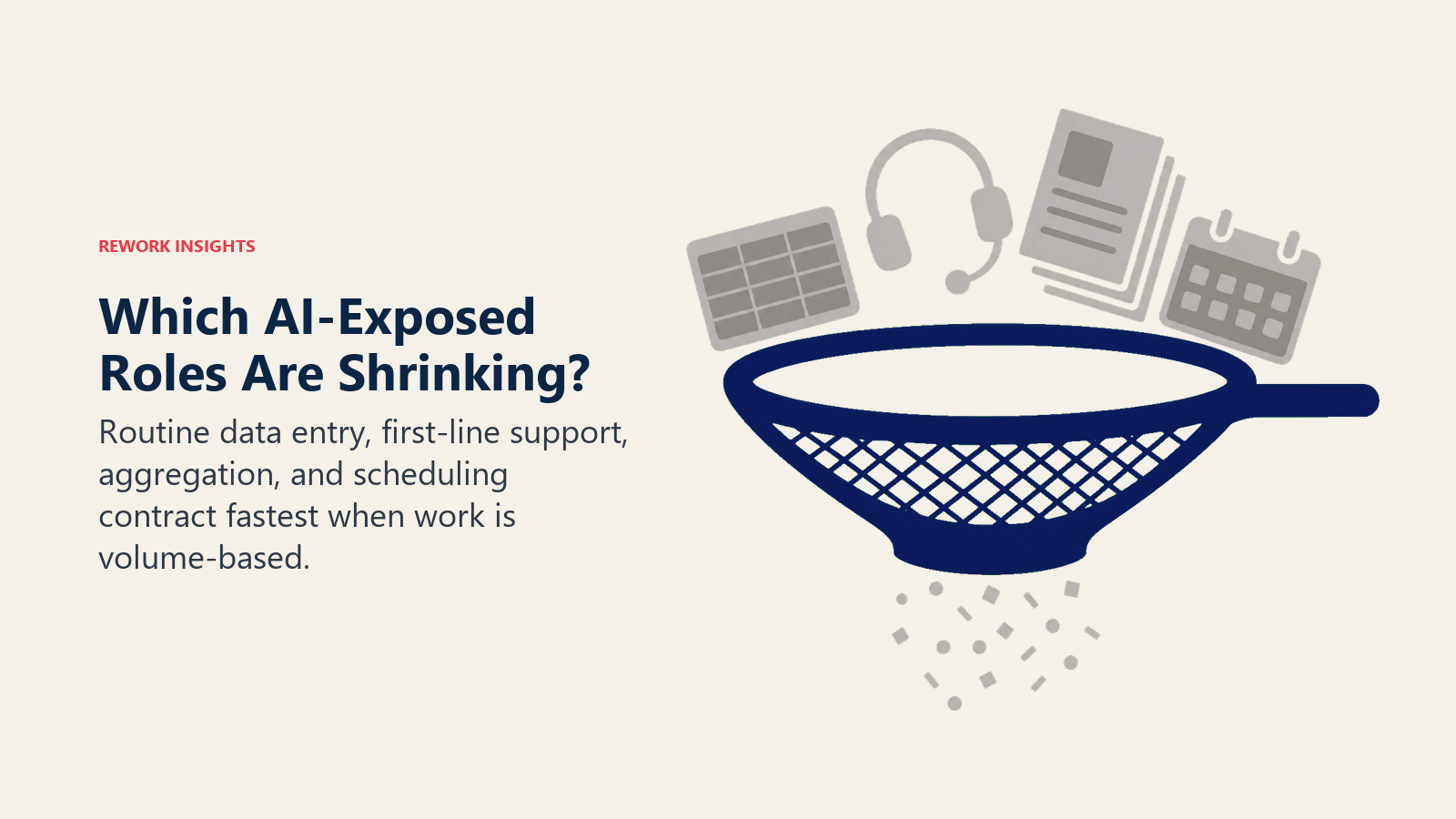
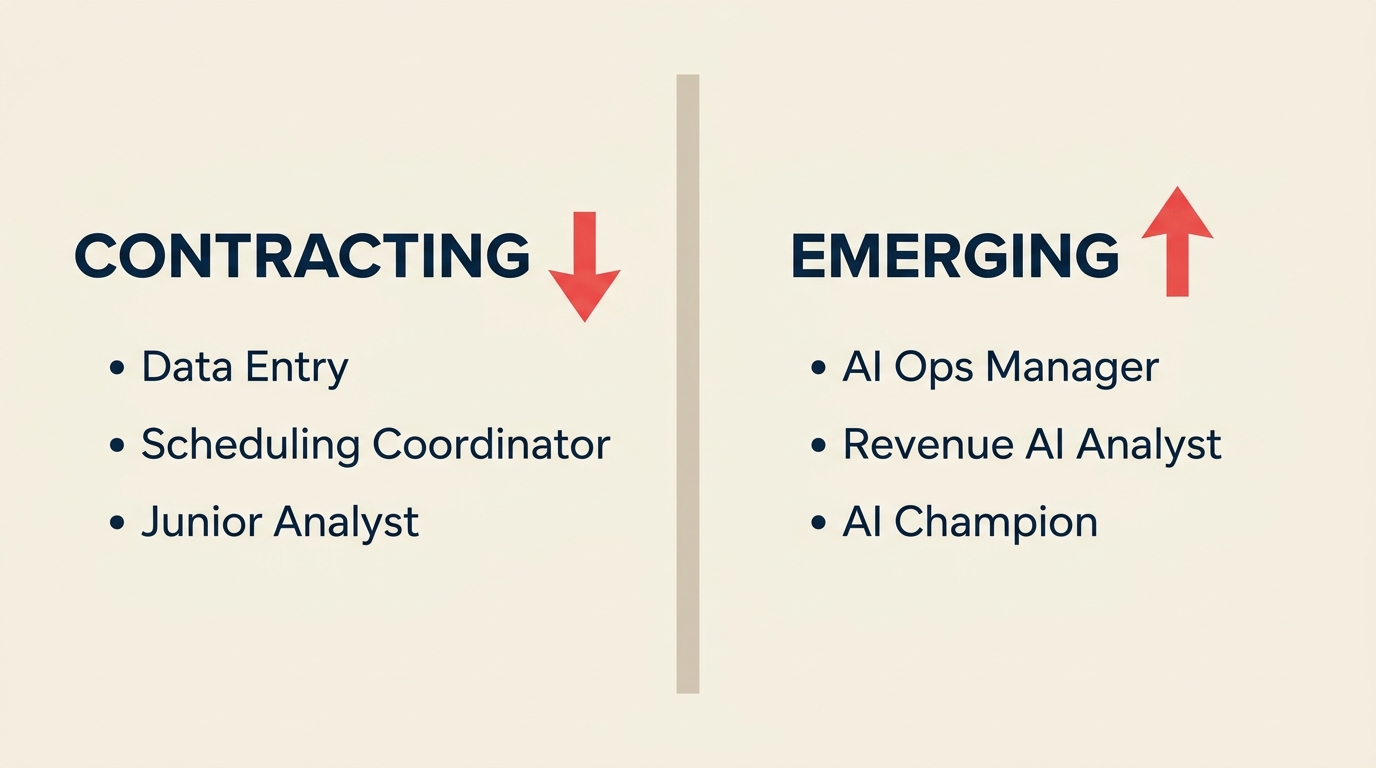
Data entry and report generation. This one is largely done. Companies that haven't already automated routine data entry (CRM updates, invoice processing, inventory logging) are behind the curve. The timeline for remaining manual data entry roles at mid-market companies is 12-18 months. Tools like Rework, HubSpot's AI features, and workflow automation platforms have closed the last gaps. These aren't roles that will evolve; they're roles that will end.
First-line customer support. This is more nuanced than it appears. Tier-1 support, password resets, order status queries, basic troubleshooting, is being handled by AI agents at an accelerating pace. But the contraction isn't always a headcount reduction. What's happening more often is that support teams are staying the same size while handling 3x the volume, with the first-line tasks absorbed by AI and human reps handling escalations and complex cases. A 10-person support team isn't becoming a 5-person team; it's becoming a 10-person team that does the work of what previously needed 30.
Mid-level analyst roles that aggregate rather than interpret. This is the subtler and more consequential shift. Companies have traditionally employed analysts, in finance, operations, marketing, sales, whose primary function was pulling data from multiple sources, building reports, and presenting summaries. That aggregation layer is now automated. What remains valuable is the interpretive work: applying judgment, identifying anomalies, making recommendations based on context that AI can't fully access. Roles that were 80% aggregation and 20% interpretation are at risk. Roles that are the inverse are not.
A manufacturing company in Ohio with 180 employees reduced its finance analyst headcount from four to two in 2024, not through layoffs, but through attrition and role redefinition. The two remaining analysts now spend their time on forward-looking modeling and board-level reporting, work that took 20% of their time before.
Specific administrative coordination roles. Scheduling coordinators, travel arrangers, meeting logistics managers: roles that existed primarily to manage calendars and logistics across teams are becoming redundant as AI assistants handle this natively. This is already happening at mid-market SaaS companies. A 120-person B2B software firm in Austin eliminated its executive assistant role last year, redistributing scheduling to each executive's AI assistant configuration.
What's Being Created
The new roles aren't hypothetical. They're appearing in job postings and org charts at AI-forward mid-market companies right now.
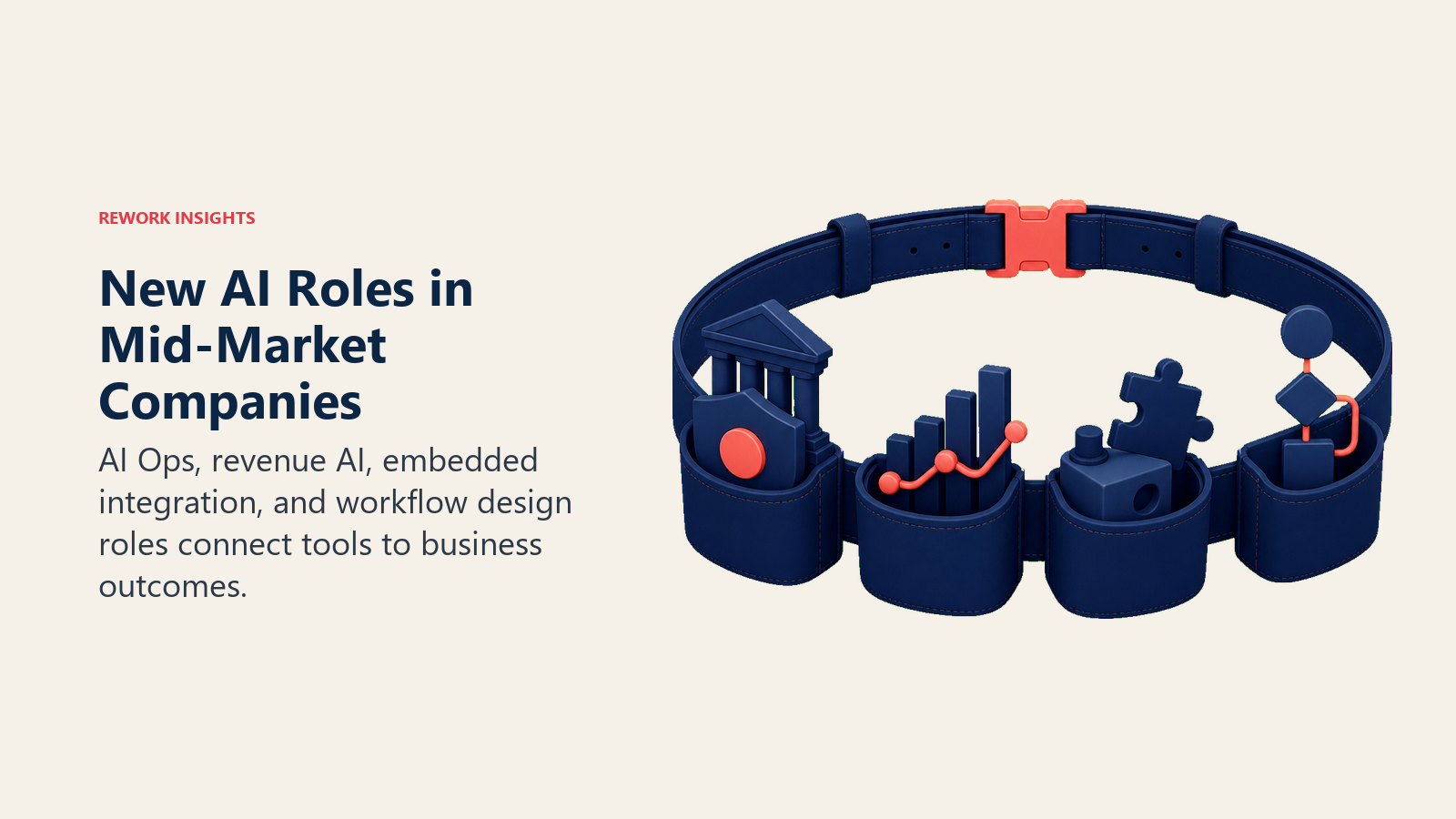
AI Ops Manager. This role owns the company's AI tool stack, procurement, configuration, integration, governance, and adoption. It's part IT, part operations, part change management. At a 150-person company, this is typically a single individual, often promoted from within operations or IT. The role didn't exist three years ago. It's now on job boards at companies with as few as 80 employees. For more on what this hire looks like in practice, see What the First AI Ops Manager Hire Looks Like in a 100-Person Company. The AI tools stack mid-market companies are using helps inform which tools this role needs to own.
Revenue AI Analyst. This is a hybrid role emerging specifically in CRO organizations. It sits at the intersection of sales operations, data science, and AI tooling, responsible for building and maintaining the AI-assisted pipeline models, optimizing lead scoring configurations, and translating AI-generated insights into rep-level coaching. A 250-person SaaS company with a 40-person sales team might have one or two people in this function. They're not traditional data analysts, and they're not traditional sales ops. They're something new. The AI skills matrix is a useful tool for defining what this role actually needs to know.
AI integration leads embedded in functional teams. Rather than centralizing all AI expertise in an IT or ops function, leading mid-market companies are embedding AI-fluent individuals directly into sales, finance, marketing, and customer success. These aren't AI experts in the technical sense, they're domain experts who have developed enough AI fluency to identify workflow opportunities, test tools, and coach their colleagues. A sales team of 15 might have one "AI-fluent" rep who owns the team's use of AI sales tools and reports to the VP of Sales on adoption and outcomes.
Prompt engineers and workflow architects. These roles are more common at companies that have built custom AI integrations, often using platforms like Make, Zapier, or direct API connections to OpenAI or Anthropic. They're not full-time positions at most mid-market companies. But they're showing up as part-time responsibilities, contract roles, and internal upskilling targets. Gartner research on emerging AI roles documents how these cross-functional AI positions are institutionalizing across company sizes.
The Role Transition Map
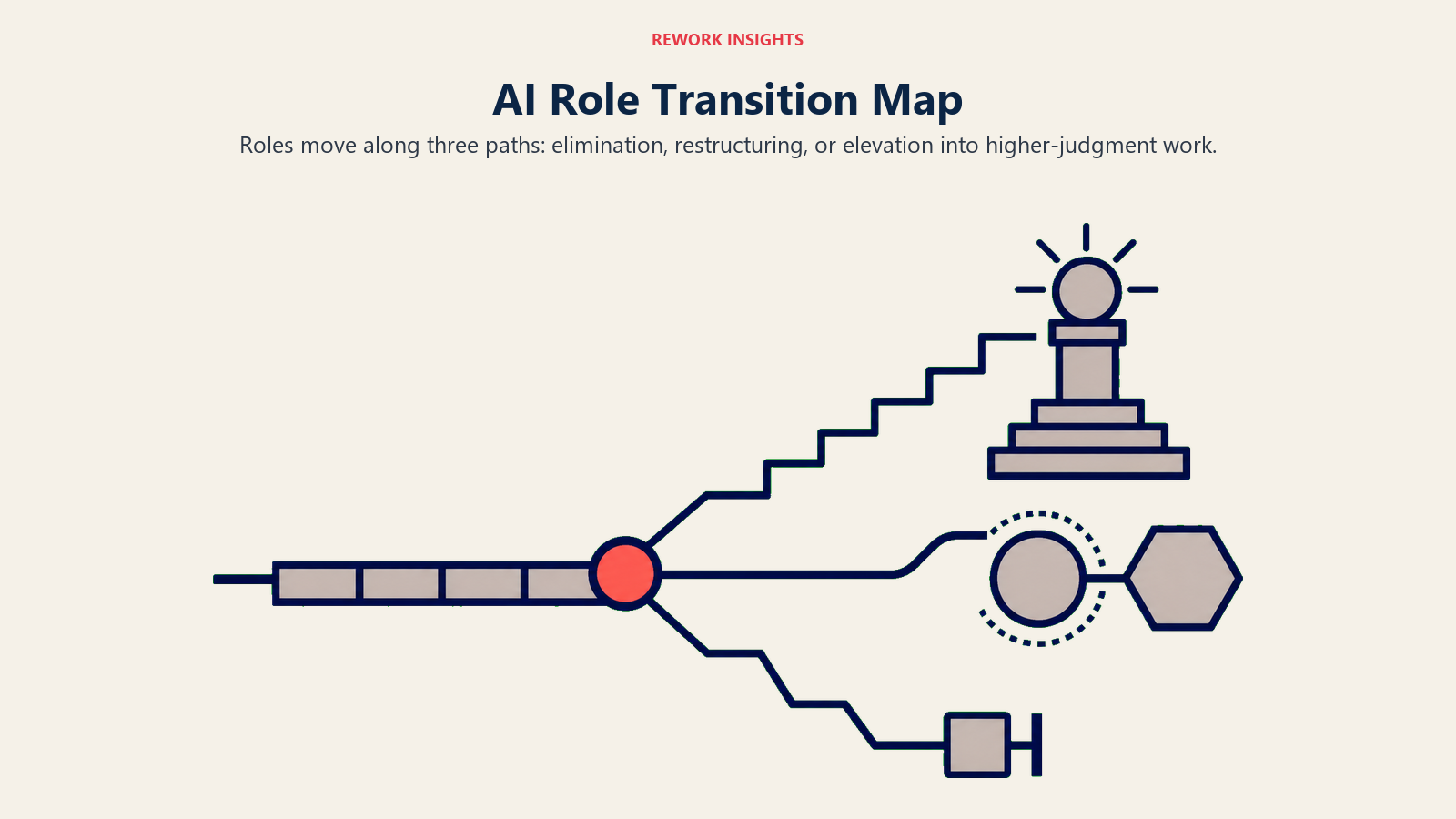
Here's how this plays out at the job level for a 200-person company:
| Old Role | Trajectory | New Role / Evolution |
|---|---|---|
| Data Entry Specialist | Eliminated (12-18 months) | None, absorbed by automation |
| First-Line Support Rep | Restructured | AI-Augmented Support Specialist |
| Mid-Level Financial Analyst | Contracting | Senior Analyst (interpretive focus) |
| Scheduling Coordinator | Eliminated | None, absorbed by AI assistants |
| Marketing Analyst (reporting) | Contracting | Growth Analyst (strategy + testing) |
| Sales Operations Analyst | Evolving | Revenue AI Analyst |
| IT Admin (tool management) | Evolving | AI Ops Manager |
| N/A | New | AI Integration Lead (embedded) |
The pattern here isn't purely elimination. It's compression and elevation. Roles that existed to handle volume are shrinking. Roles that require judgment, context, and cross-functional coordination are growing or being created from scratch.
The Net Headcount Math
Will mid-market companies end up with more or fewer employees after this transition?
The honest answer is: it depends on growth trajectory, industry, and how aggressively the company adopts AI tooling. But the aggregate data offers some guidance.
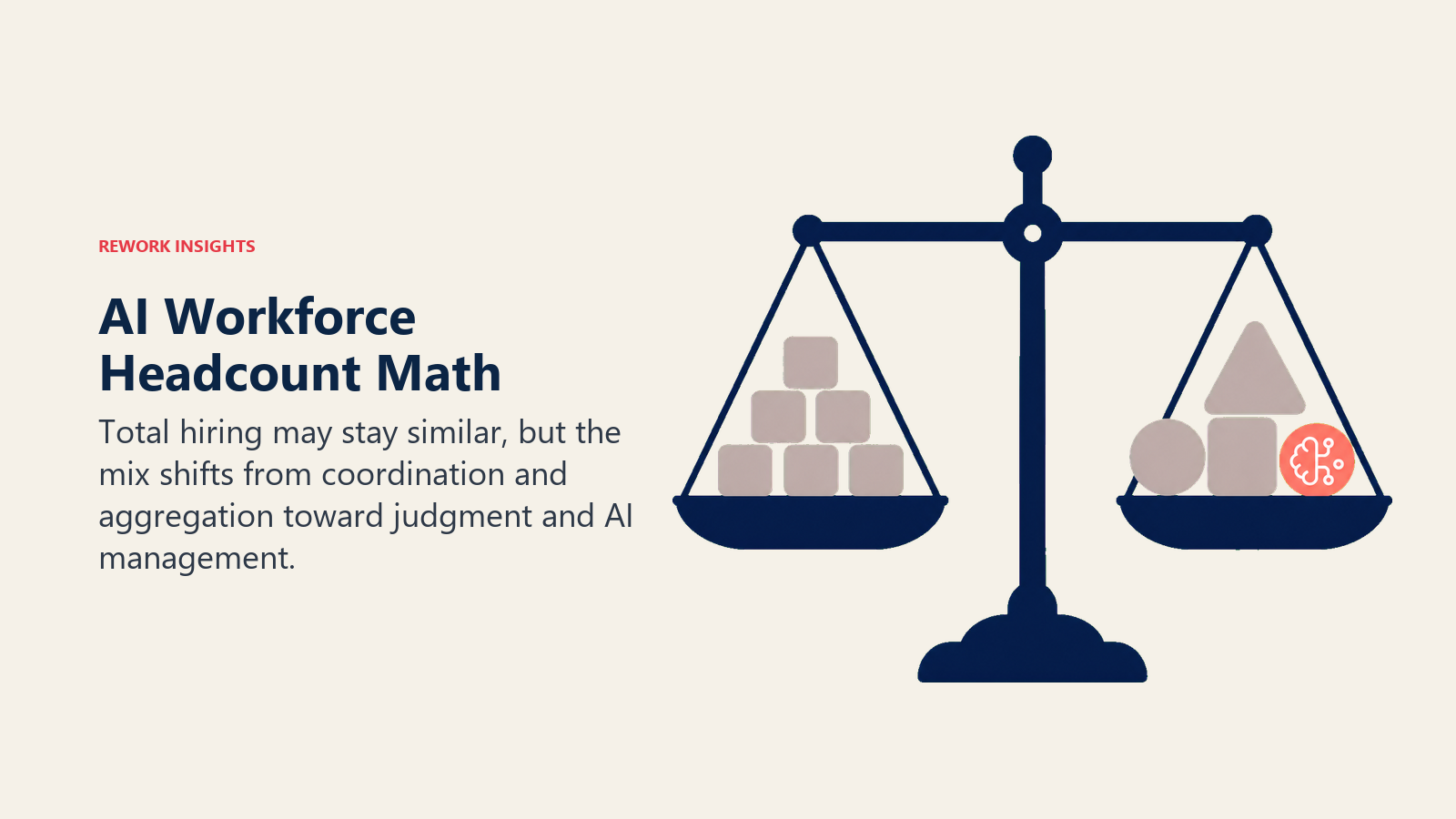
McKinsey's 2025 workforce research suggests that companies actively integrating AI into operations are growing headcount at roughly the same rate as before AI adoption, but with a different composition. They're hiring fewer administrative and data-processing roles and more roles focused on judgment, customer relationships, and AI management. LinkedIn's analysis of AI skills demand surge in 2026 shows this shift playing out in real job postings across every major industry sector.
For a mid-market company in a growth phase (say, scaling from 150 to 250 employees over 24 months), AI adoption doesn't mean hiring 100 fewer people. It likely means the composition of those 100 hires shifts. Fewer coordinators and junior analysts. More AI-fluent domain specialists and embedded integration leads.
For a mid-market company in a stable or cost-sensitive phase, the math is different. AI adoption can enable the same output with 10-20% fewer administrative and aggregation roles. Whether that leads to reduction or redeployment depends on leadership choices, not technology inevitability.
The Executive Decision Framework
Before making any workforce decision based on AI assumptions (whether hiring, restructuring, or cutting), ask these three questions:
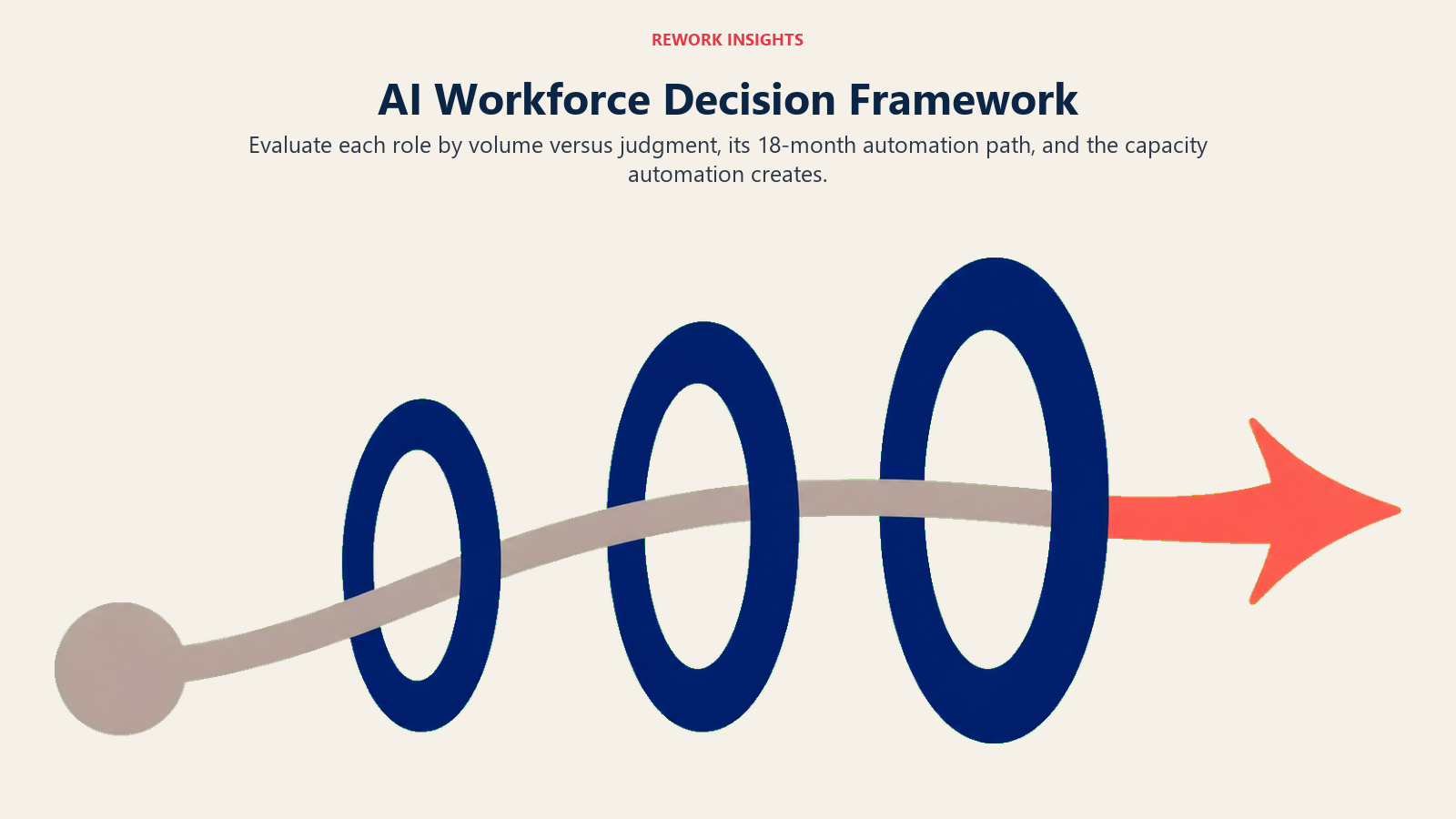
1. Is this role primarily about volume or judgment? Roles that exist to handle volume (data processing, report generation, scheduling, first-line support) are the roles AI is replacing fastest. Roles that exist to apply judgment in context (interpreting data, managing relationships, working through ambiguity) are much more durable. If you can't clearly answer this question for a given role, you probably don't understand the role well enough to restructure it.
2. What's the 18-month automation trajectory for this function? Not all AI adoption happens at the same speed. Customer support automation is moving faster than AI-assisted financial modeling. Data entry automation is largely complete; AI-assisted strategic planning is still nascent. Build your workforce planning around realistic timelines, not worst-case scenarios. This matters especially for the AI skills gap executives are getting wrong, rushed decisions based on inflated timelines cause as much damage as complacency.
3. What new roles does this automation enable? Every time AI absorbs a function, it creates capacity. The question is whether you're planning to capture that capacity in new, higher-value roles or simply booking it as cost savings. Companies getting this right are thinking about both sides of the equation simultaneously. See how leading mid-market companies are appointing AI executives to own this transition: The CAIO Is Not a Fad.
What the Org Chart Looks Like in 18 Months
The mid-market companies that are navigating this well aren't eliminating jobs wholesale. They're redefining them. And they're doing it through a combination of attrition management, role redesign, and deliberate upskilling, not reactive restructuring driven by fear of looking slow.
Here's what's different in the org charts of AI-forward mid-market companies:
Fewer siloed specialist roles that exist only to move information between systems. More generalist operators who use AI tools to handle what used to require three different specialists. Dedicated AI governance and ops functions, even if they're just one person. And embedded AI fluency in every revenue-facing team.
The companies that are struggling are the ones treating AI workforce transformation as an IT project or a cost-cutting exercise. The ones getting it right are treating it as an organizational design question: what does our company need to look like to compete in 2027, and what do we need to build, hire, and redefine to get there?
That's a different question than "which jobs will AI eliminate." And it's the right question to be asking.
Learn More
- The CAIO Is Not a Fad: Why Mid-Market Companies Are Appointing AI Executives
- The AI Skills Gap Executives Are Getting Wrong
- The Org Chart of the Future: What AI-Augmented Departments Actually Look Like
- Upskill or Hire AI-Native? The ROI Case Every Executive Needs to Run
- Industries Hiring AI Talent Fastest in 2026
- Hiring vs. Upskilling AI Framework
