More in
AI Workforce Transformation
Does AI Make Distributed Teams Easier or Harder to Lead?
Oct 11, 2026
Where AI Productivity Monitoring Turns Into Surveillance
Oct 11, 2026
Why Your Most Experienced People Resist AI Hardest (and Why You Need Them Most)
Oct 11, 2026
Is AI Making Teams Less Collaborative?
Oct 11, 2026
Should CEOs Use AI Themselves? Why Executive Fluency Sets the Adoption Ceiling
Oct 11, 2026
Does AI Favor Generalists or Specialists? What It Means for Who You Hire
Oct 10, 2026
Is Experience Still Worth Paying For When AI Narrows the Skill Gap?
Oct 10, 2026
When Every Candidate Uses AI, What Is a Resume Still Worth?
Oct 10, 2026
Should AI Screen Your Job Candidates? Where Automated Hiring Helps and Where It Backfires
Oct 10, 2026
Should Candidates Be Allowed to Use AI in Interviews?
Oct 10, 2026
The Hidden Cost of Delaying AI Upskilling: A CFO-Ready Analysis
Turn this article into takeaways for your work.


Each assistant summarizes the article only for you and suggests best practices for your work.
There's a memo that never gets written. It doesn't show up on the P&L, it doesn't trigger a budget variance, and no auditor flags it. But it's costing your company somewhere between $200,000 and $4 million a year, depending on headcount.
The memo would be titled: Cost of Delaying AI Workforce Investment, Q2 2026.
Most CFOs are trained to scrutinize investment decisions carefully. That instinct serves companies well. But the same rigor rarely gets applied to the cost of not investing, especially when the delay feels like prudence. "We'll wait until the technology matures." "Let the early adopters work out the kinks." "We'll revisit in Q4."
These are understandable positions. They're also expensive ones.
This analysis breaks down the four cost categories most finance teams miss when evaluating AI workforce decisions, provides a calculation framework for the delay cost model, and shows what the numbers look like across three company sizes. The goal isn't to alarm. It's to move this conversation from intuition to arithmetic.
The False Comfort of "Wait and See"
Before getting into the numbers, it's worth looking at what "wait and see" has cost companies historically.
Companies that delayed cloud adoption past 2015 didn't just miss early savings: they ended up paying infrastructure-plus-migration costs that early movers avoided entirely. Companies that deferred CRM rollouts into the mid-2010s lost deal velocity to competitors whose sales reps had better pipeline visibility. In both cases, the late adopters weren't being irrational. They were applying a reasonable risk filter. But the filter was pointed in the wrong direction: at the cost of moving, not the cost of waiting.
AI workforce transformation has a similar structure. The costs of delay aren't dramatic or sudden. They accumulate slowly, stay off-balance-sheet, and only become visible when you're already behind.
McKinsey's 2025 State of AI report found that companies with active AI upskilling programs reported 20–30% higher employee productivity in functions where AI tools were deployed. That's not a projection. It's a performance gap that's already open between your workforce and your competitors'. The AI augment vs. replace workforce data confirms this gap is growing, not stabilizing.
The Hidden Cost Stack: Four Categories CFOs Miss
1. Productivity Drag
Every hour your team spends on work that AI-enabled peers have automated is a labor cost with no productivity return. This isn't about replacing people. It's about the compounding cost of slower execution.
Consider a sales operations team of eight people. Competitor reps using AI for prospecting, outreach sequencing, and CRM data entry are reclaiming roughly 90 minutes per day per person (per Salesforce's 2025 State of Sales benchmarks). Your reps doing the same work manually are not slower, but they're producing the same output with more labor input. The gap is real and it's growing.
At an average fully loaded labor cost of $85,000 per employee, 90 minutes of daily inefficiency per person represents roughly $17,800 in annual labor cost that produces no incremental output. Multiply that across your revenue-generating headcount and the number gets uncomfortable fast.
2. Attrition Premium
AI-fluent talent is leaving companies that don't invest in their development. This is not speculation. It's a pattern showing up in exit interview data.
LinkedIn's 2025 Workplace Learning Report found that 70% of employees say they'd leave their current employer for one that invests more in their development. Among employees aged 28–42, AI skill development ranked as the top learning priority. When your company signals that AI upskilling isn't a priority, high-performers (especially those with technical aptitude) hear that message clearly. How AI is changing retention dynamics breaks this down by role type and tenure.
The cost of replacing a mid-level knowledge worker is well-documented: 50–150% of annual salary when you factor in recruitment fees, onboarding time, and productivity ramp. For a $90,000 employee, that's $45,000–$135,000 per departure. If delaying AI investment drives even two to three additional departures per year in a 200-person company, the attrition premium alone exceeds most AI training budgets.
3. Hiring Cost Inflation
The market has already priced AI fluency. Job postings for roles requiring AI skills command a 20–35% salary premium over equivalent roles without that requirement, according to 2025 data from Burning Glass Technologies. That gap is widening, not narrowing. The AI fluency salary premium data for 2026 shows exactly how this premium is growing across different role categories.
This creates a compounding dynamic for companies that delay upskilling. Teams that build AI capability internally (through training, tooling, and role redesign) can largely retain existing compensation structures. Companies that delay, then scramble to hire AI-native candidates to fill capability gaps, pay the market premium on top of recruitment costs.
A company planning to hire eight AI-fluent roles in 2027 instead of training existing staff in 2026 will likely spend $180,000–$300,000 more in salary premiums over a two-year horizon, before touching recruiting fees or onboarding costs.
4. Competitive Displacement
This is the hardest cost to model precisely, but it's often the largest. When competitors close deals faster, respond to customer needs more efficiently, or bring new products to market in shorter cycles because their teams are AI-augmented, the revenue impact is real. It just shows up as quota miss or churn rather than a line on a delay cost report.
Gartner's 2025 CIO Agenda survey found that 58% of business leaders cited workforce AI readiness as a primary constraint on their AI strategy's revenue impact. The companies that solve this constraint first get a durable advantage in sales velocity, service responsiveness, and operational throughput.
Building the Delay Cost Model
Here's a framework your finance team can use directly. For a more complete financial template, the AI training budget business case guide has a spreadsheet-ready model that finance teams can adapt. It requires three inputs:
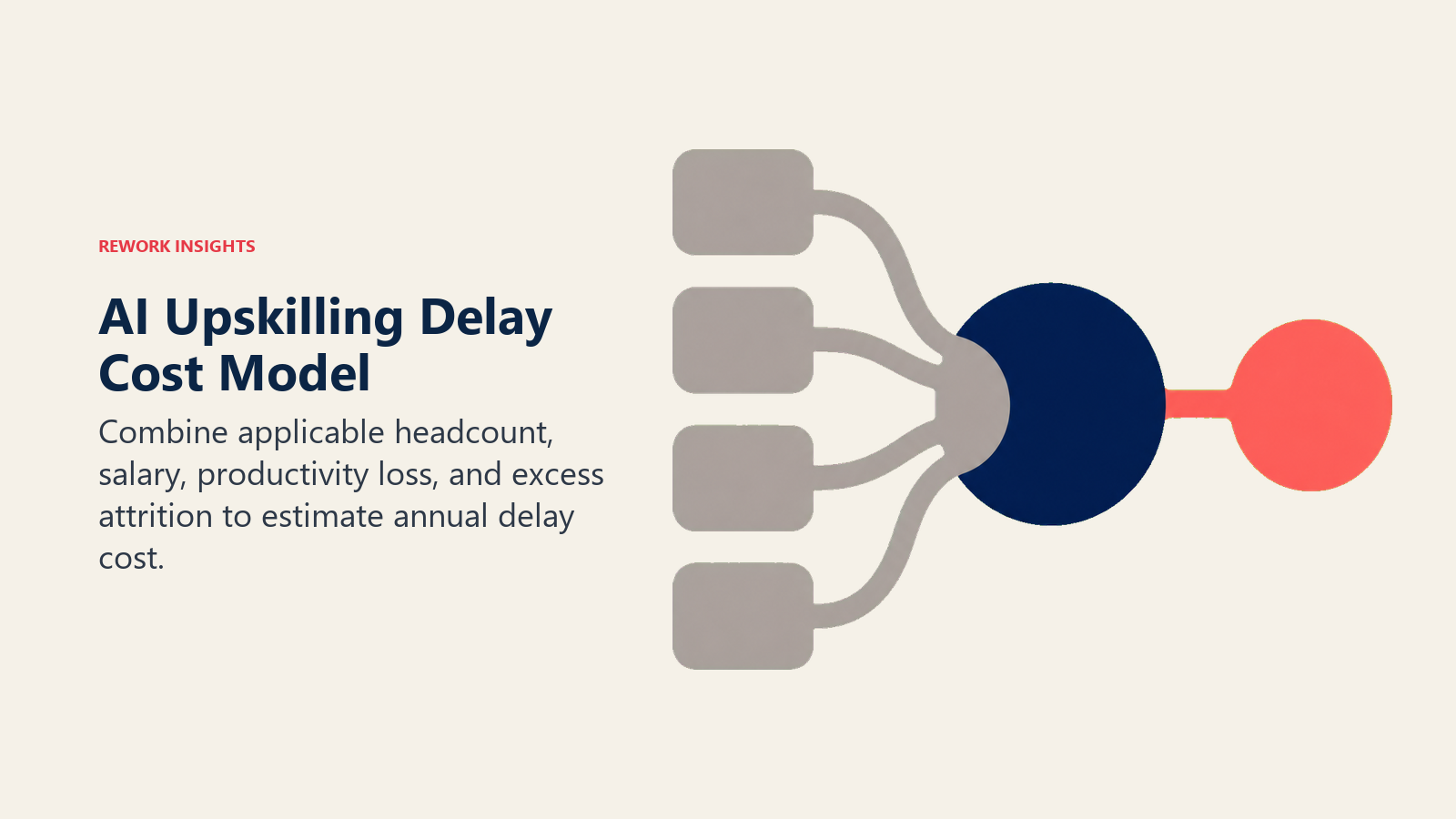
- H: Total headcount in roles where AI tools would apply (typically knowledge workers, sales, operations, customer success)
- S: Average annual fully loaded salary for those roles
- P: Estimated productivity loss rate from delayed adoption (conservative estimate: 8–12%)
Annual Delay Cost = H × S × P
You'll also want to add an attrition factor if you believe delayed investment increases turnover risk:
- A: Expected additional annual departures attributable to lack of AI investment (start with 1–2% of H as a conservative estimate)
- R: Average replacement cost per employee (use 75% of S as a standard estimate)
Attrition Cost = A × R
Total Annual Delay Cost = (H × S × P) + (A × R)
Real Cost Scenarios: Three Company Sizes
The same conservative delay model creates a very different liability as AI-applicable headcount grows.
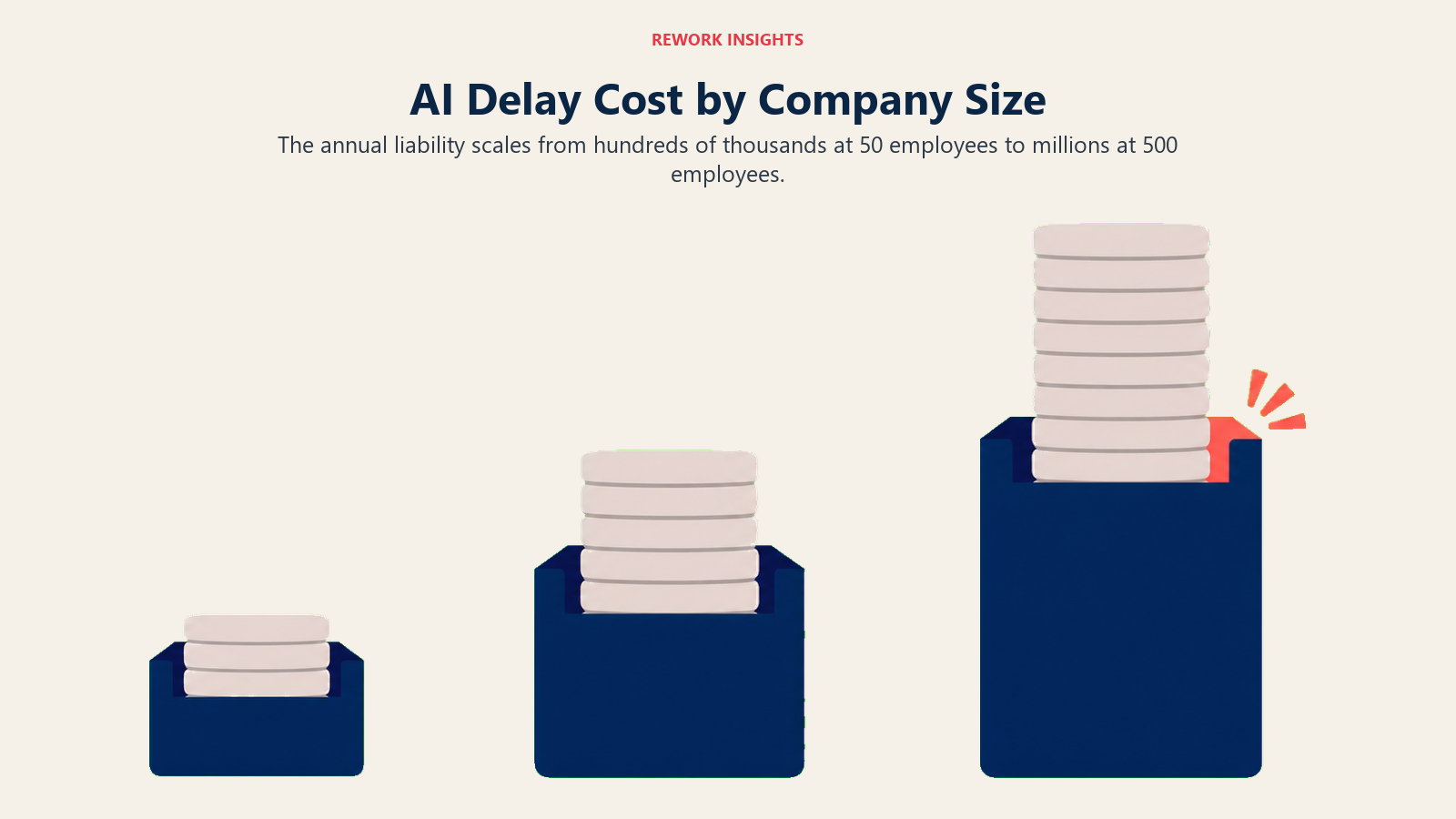
| Company Size | AI-Applicable Headcount | Avg. Salary | Productivity Loss (10%) | Attrition Cost (1.5% turnover, 75% replacement) | Annual Delay Cost |
|---|---|---|---|---|---|
| 50 employees | 35 | $80,000 | $280,000 | $31,500 | $311,500 |
| 200 employees | 130 | $85,000 | $1,105,000 | $131,625 | $1,236,625 |
| 500 employees | 320 | $90,000 | $2,880,000 | $324,000 | $3,204,000 |
These figures use conservative productivity loss estimates. If your teams are in functions where AI automation is more advanced (sales, customer support, content operations, data analysis), the productivity gap is wider and the delay cost is higher.
For the 200-person company scenario, $1.2 million in annual delay cost exceeds the fully loaded cost of a comprehensive AI upskilling program for the same workforce by a factor of three to five. The investment case isn't close.
The Compounding Effect: Why Month 6 Is the Inflection Point
Delay costs don't compound linearly. The first three months of inaction are relatively low-cost: competitors are still rolling out programs, the talent premium hasn't fully embedded itself, and the productivity gap is small.
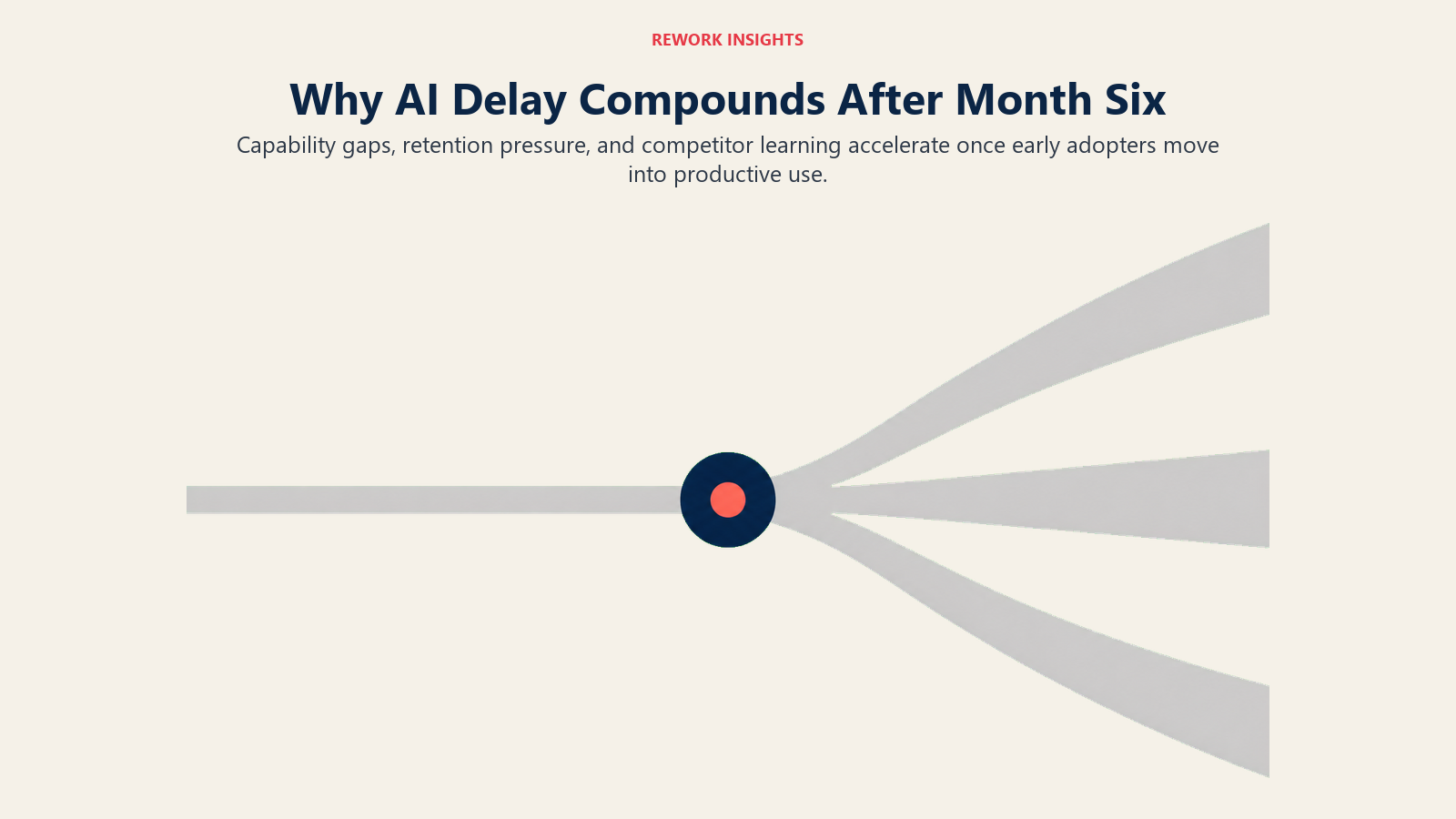
By month six, three things have typically happened:
The capability gap widens. Competitors who started AI training in Q1 have teams that are 30–60 days into productive AI tool use. The gap between their output and yours is no longer theoretical.
The talent market tightens. AI-fluent candidates who would have joined your team at market rate six months ago now have competing offers. The premium to attract them is higher.
Internal expectations shift. Employees who've been curious about AI development are now watching peers at other companies build skills. The attrition signal strengthens.
After month nine, you're not just paying the delay cost. You're also paying a catch-up premium. Accelerated training programs cost more per head than steady-state programs. And the competitive ground you've ceded doesn't automatically return when you close the capability gap.
The CFO Objection: "We'll Invest Once the Technology Matures"
This objection has historical precedent on its side. Enterprise technology adoption has a long history of early-mover failures: companies that over-invested in first-generation tools and wrote them off when the category consolidated.
But AI workforce investment doesn't follow the same risk profile as enterprise software procurement. You're not buying a platform that might be obsolete in three years. You're building human capability that compounds. The skills your team develops working with AI tools in 2026 make them more effective with whatever tools replace those tools in 2028. The organizational muscle for integrating AI into workflows doesn't depreciate.
The analogy to "wait until the technology matures" would have counseled against training your sales team on CRM in 2010 because the category was still evolving. The companies that waited didn't just miss the early-mover benefit. They let their competitors get three years of pipeline management discipline that compounded into structural sales advantages.
Workforce capability is different from software: it doesn't reset when you switch vendors. The hiring vs. upskilling AI decision framework breaks down when training pays off versus when new hires make more financial sense.
Q2 vs. Q4: The Side-by-Side Comparison
For a 200-person company, here's what the timing difference looks like in practical terms:
| Decision | Q2 Investment | Q4 Investment |
|---|---|---|
| Program start | April 2026 | October 2026 |
| Team productive with AI tools | July 2026 | January 2027 |
| Delay cost incurred (6 months) | $0 | ~$618,000 |
| Competitive gap vs. Q2 movers | Minimal | 6 months |
| Attrition risk window | Closed | Still open |
| Hiring premium exposure | Reduced | Full premium |
The Q4 scenario isn't wrong because it's too late to matter. It's costly because the six-month window between Q2 and Q4 has a quantifiable price. And that price is recurring: it resets every quarter the decision is deferred.
The Real Risk Assessment
Finance leaders are paid to identify and quantify risk. The framing that usually dominates AI workforce conversations positions investment as the risk and delay as the default. But the numbers above suggest the opposite framing is more accurate.
Investment risk for a 200-person company running a comprehensive AI upskilling program: $200,000–$400,000 over 12 months, with measurable productivity and retention outcomes.
Delay risk for the same company over the same period: $1.2 million in lost productivity and attrition costs, plus compounding competitive displacement.
The asymmetry isn't subtle. And it doesn't require heroic assumptions. Just conservative inputs applied consistently to headcount and salary data you already have.
The hidden cost of delaying AI upskilling isn't hidden because it's hard to calculate. It's hidden because we haven't been looking for it.
Learn More
If you're building the business case for AI workforce investment, these resources go deeper on the strategic and organizational dimensions:

Co-Founder, Rework.com
On this page
- The False Comfort of "Wait and See"
- The Hidden Cost Stack: Four Categories CFOs Miss
- 1. Productivity Drag
- 2. Attrition Premium
- 3. Hiring Cost Inflation
- 4. Competitive Displacement
- Building the Delay Cost Model
- Real Cost Scenarios: Three Company Sizes
- The Compounding Effect: Why Month 6 Is the Inflection Point
- The CFO Objection: "We'll Invest Once the Technology Matures"
- Q2 vs. Q4: The Side-by-Side Comparison
- The Real Risk Assessment
- Learn More