Skills-Based Hiring: How to Hire for Capabilities Over Degrees
Turn this article into takeaways for your work.


Each assistant summarizes the article only for you and suggests best practices for your work.
A college degree has long been the default hiring filter. It's familiar, easy to verify, and defensible. It's also increasingly inadequate. The credential that someone earned years ago tells you little about whether they can do the work you need done today.
Leading organizations are shifting to skills-based hiring - evaluating candidates on their actual capabilities rather than their educational pedigree. This isn't just about expanding talent pools (though it does that). It's about making better hiring decisions by focusing on what actually predicts job performance.
Why Credentials Are Losing Their Grip
Several forces are driving this shift:
Skills change faster than education. The skills needed for most jobs evolve constantly. A degree earned five years ago reflects what was taught five years ago, not what's required now.
Alternative learning paths work. Bootcamps, certifications, online courses, and on-the-job learning produce capable workers who never attended traditional universities.
Credential inflation failed. Requiring degrees for roles that don't need them didn't improve hiring outcomes. It just excluded capable candidates.
Talent scarcity demands it. With competition for talent intense, organizations can't afford to filter out qualified people based on credentials they don't actually need.
The Skills-Based Hiring Framework
A complete skills-based hiring system replaces credential proxies with role definitions, direct evidence, manager capability, and ongoing development.
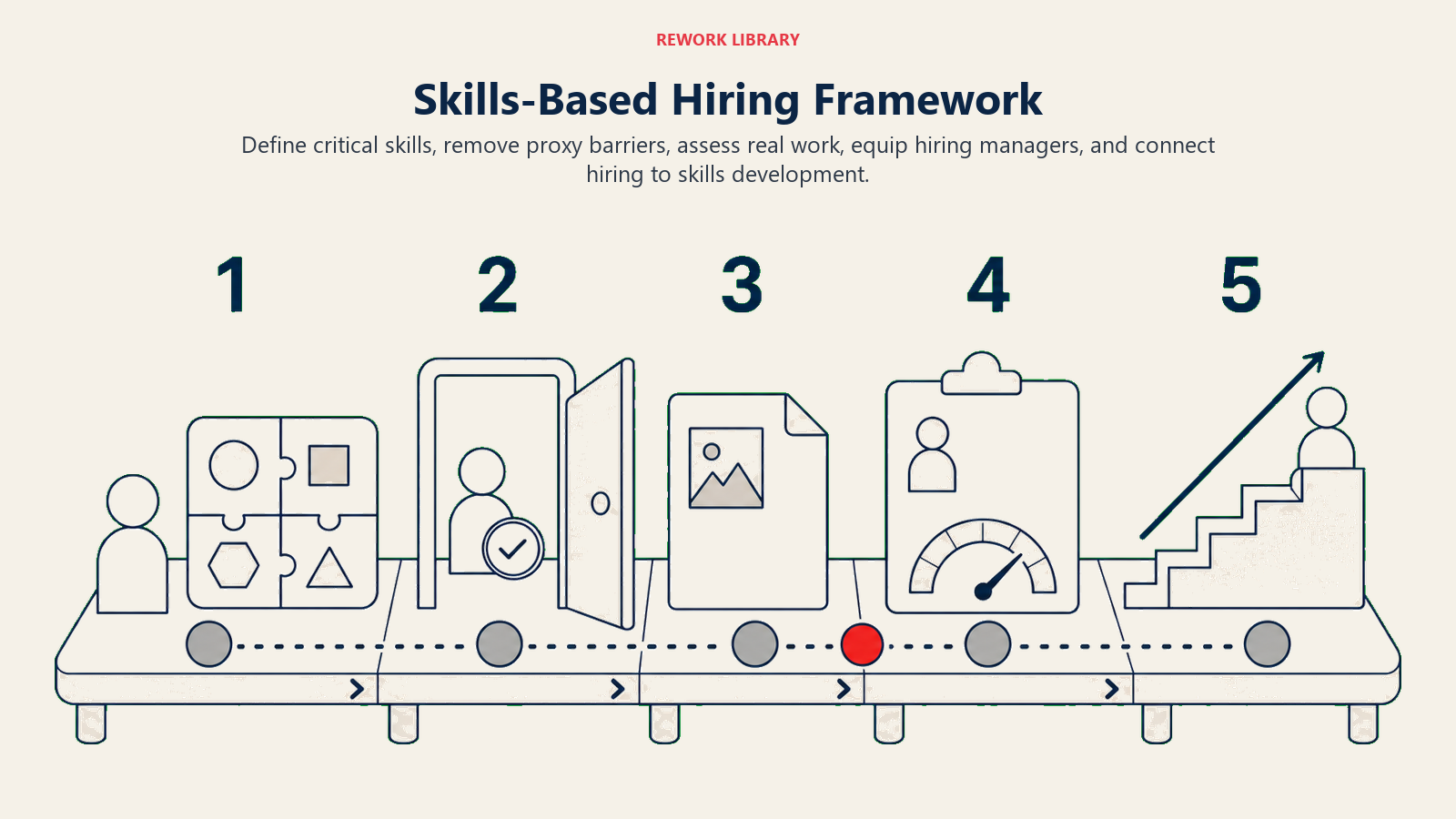
Transitioning from credential-based to skills-based hiring requires systematic change:
1. Define Required Skills Precisely
Start with clear-eyed analysis of what the job actually requires:
Identify critical skills. Not everything on a typical job description matters equally. What skills directly determine success in the role? Focus on those.
Distinguish types of skills. Technical skills (coding, data analysis) differ from interpersonal skills (communication, collaboration) and cognitive skills (problem-solving, learning agility). Each requires different assessment approaches.
Separate must-haves from nice-to-haves. Be honest about what someone genuinely needs on day one versus what they can learn on the job.
2. Remove Credential Barriers
Examine job requirements with skepticism:
Challenge degree requirements. For each role that lists a degree requirement, ask: "Would we reject a candidate who could demonstrably do this job but didn't finish college?" If the answer is no, the requirement shouldn't be there.
Question experience minimums. "5 years experience required" often means nothing specific. What would someone have learned in those five years? Can you test for that directly?
Audit job postings. Remove credential requirements that don't predict performance. This alone expands your talent pool significantly.
3. Build Skills Assessment Capability
If you're not filtering on credentials, you need better ways to evaluate skills:
Work samples. Have candidates demonstrate relevant skills through realistic tasks. A coding test for engineers, a writing sample for communicators, a case study for analysts.
Structured interviews. Ask every candidate the same questions, with rubrics for evaluating answers. This reduces bias and improves consistency.
Skills-based applications. Instead of asking for resumes, ask candidates to demonstrate specific competencies directly.
Trial periods. When possible, work with candidates on real projects before making permanent commitments.
4. Train Hiring Managers
Managers accustomed to credential filtering need support:
Explain the why. Help managers understand why skills-based hiring improves outcomes, not just diversity numbers.
Provide tools. Give managers structured interview guides, assessment rubrics, and clear criteria for evaluating skills.
Address concerns. Managers worry about risk. Show them that skills assessment actually reduces hiring risk compared to credential proxies.
Model the behavior. Senior leaders should visibly hire and promote based on skills, not pedigree.
5. Build Skills Development Infrastructure
Skills-based hiring creates an expectation of ongoing learning:
Clear skills frameworks. Define what skills matter at each level. Show people how to grow.
Learning resources. Provide access to training that builds relevant skills.
Skills-based advancement. Promote based on demonstrated capability, not just tenure.
Putting This Into Practice
Start here: Pick one role you hire for frequently. Strip the job description of all credential requirements. Rewrite it to describe the skills the person needs to demonstrate.
Common mistake: Removing degree requirements without building skills assessment capability. You just replace one flawed filter with no filter.
Measure success by: Quality of hires (performance ratings, retention, promotion rates) compared between traditionally-hired and skills-based-hired employees.
Skills-based hiring isn't just about being fair to candidates without traditional credentials. It's about making better hiring decisions by focusing on what actually matters: whether someone can do the work. The organizations that master this will access talent their competitors overlook and build teams based on capability, not pedigree.
