More in
AI at Work News
OpenAI Opened ChatGPT Advertising to Small Businesses at Any Budget
Jun 6, 2026
AI Is Everywhere at Work. Only 1 in 10 Say It Transformed the Job
Jun 6, 2026
Vibe Coding's $10.5B Moment: AI Now Starts Most New Software Builds
Jun 6, 2026
AI Agents Now Have More System Access Than Your Employees. Few Are Secured
Jun 5, 2026
Should You Build Your AI or Buy It? Watch What the Giants Bought.
Jun 5, 2026
Uber Caps Employee AI Spending at $1,500 Per Seat After a Budget Blowout
Jun 5, 2026
Trump's AI Executive Order Is Deregulatory. Your Compliance Risk Didn't Move
Jun 4, 2026
AI Pushed 220 Unicorns Below $1B. Pre-ChatGPT Companies Face a Reckoning
Jun 4, 2026
Token Prices Fell 67% This Year. Your AI Bill Is Going Up Anyway
Jun 3, 2026
Small Businesses Using AI Report Higher Revenue and Shorter Workdays
Jun 3, 2026
Agentshub.AI Just Made Enterprise AI Agents No-Code: What CROs Need to Decide in the Next 30 Days
Turn this article into takeaways for your work.


Each assistant summarizes the article only for you and suggests best practices for your work.
For the past 18 months, the question of whether to build custom AI agents for your sales organization has had an easy answer: wait. The tooling was immature, the build costs were high, and the enterprise-grade alternatives from Salesforce and HubSpot were close enough on the roadmap to justify patience.
That calculus just shifted.
According to a launch announcement covered by Yahoo Finance, Agentshub.AI released a no-code enterprise agent builder on April 6, 2026. The platform lets non-technical teams create autonomous or human-in-the-loop AI agents through a drag-and-drop interface, with pre-built templates spanning Sales, Marketing, Customer Success, RevOps, and HR. It integrates with more than 1,000 existing tools and deploys through a three-step process: pick an agent type, assign tasks, set the supervision level. No engineering team required.
That last part (no engineering team required) is the part CROs should pay attention to. It doesn't mean engineering doesn't matter. But it does mean the build-vs-buy calculus for custom sales agents just got more complicated. Here's how to think through it.
What Agentshub.AI Actually Is
The platform combines three components: an agent builder with a drag-and-drop interface, a library of pre-built AI Workforce templates, and an agent marketplace for finding additional pre-built agents. The founder, Kumar Manaswi, describes it as removing the choice between "expensive platforms or complex tools."
The Sales templates are the relevant ones for CROs. The platform is built around workflows for outbound sequences, pipeline management, customer success follow-up, and revenue operations. These are the exact workflows most sales leaders have been trying to automate piecemeal through their existing stack.
The 1,000+ integrations claim deserves scrutiny. Broad integration counts usually mean a mix of native integrations (deep, reliable) and connector-layer connections through tools like Zapier or Make (functional, but shallow). Before you evaluate this for any real sales workflow, you'll want to know which category your CRM, engagement platform, and data provider fall into.
Pricing is described as "accessible" but hasn't been publicly disclosed. That means the evaluation will require a direct conversation.
The Build-vs-Buy Decision You've Been Deferring
No-code platforms don't eliminate the build-vs-buy question. They restructure it.
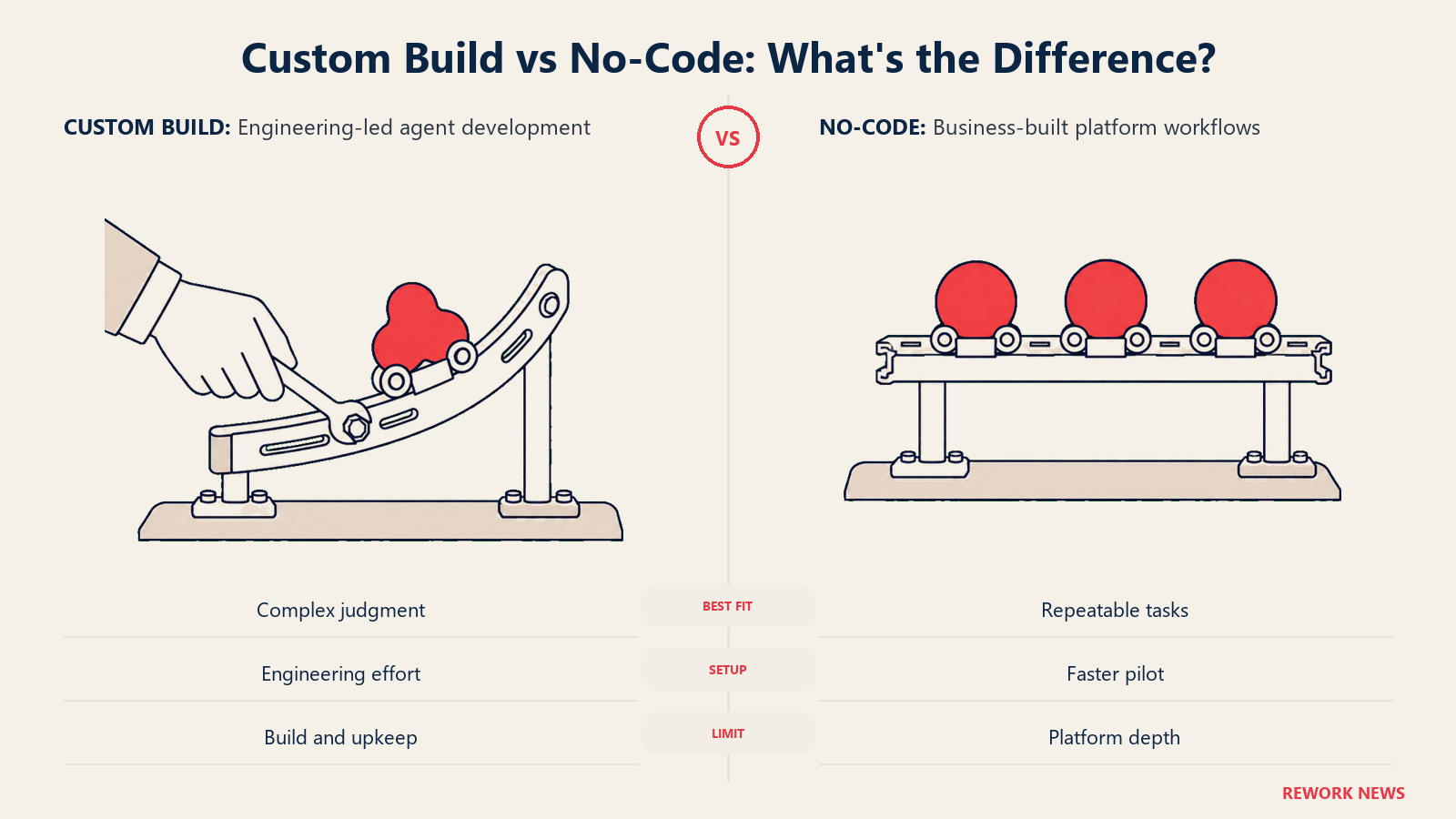
The traditional version of the question was: do we allocate engineering resources to build something custom, or do we wait for a vendor to ship it? No-code tools add a third path: do we build it ourselves, without engineering, on a platform that may or may not have the depth we need at scale?
For CROs, that third path has a specific risk profile. No-code agent builders tend to work well for high-volume, lower-complexity workflows: initial outreach sequences, meeting confirmation follow-ups, data entry into CRM fields, basic routing logic. They tend to hit limits when the workflow requires nuanced judgment: complex objection handling, multi-threaded account management, forecasting logic that depends on idiosyncratic pipeline signals.
The question you're actually answering in the next 30 days is: which of your sales workflows fall into which category?
What to Compare It Against
Agentshub.AI enters a market where two categories of competitor already exist.
The first category is the established CRM vendor's native agent layer. Salesforce Agentforce has been in market since late 2024 and has been building out its sales-specific agent capabilities through Wave 1 releases in 2026. HubSpot's Breeze agents have shipped meaningful features through the March 2026 product cycle. Both carry the advantage of native CRM data access: your agents run directly on your pipeline data, your contact history, and your forecasting signals without needing an integration layer in between.
The second category is build-from-scratch on enterprise infrastructure. OpenAI launched an enterprise platform for building and managing custom agents in February 2026, and NVIDIA released its open-source Agent Development Platform in March. Those options give you more control and potentially more depth, but they require technical resources to build and maintain.
Agentshub.AI sits between these two. More flexible than native CRM agents (it's not locked to one CRM ecosystem), but less technically powerful than building directly on enterprise AI infrastructure.
A Pilot Evaluation Framework for the Next 30 Days
Rather than a broad organizational decision, the most productive 30-day evaluation focuses on a single workflow. Here's a structure:
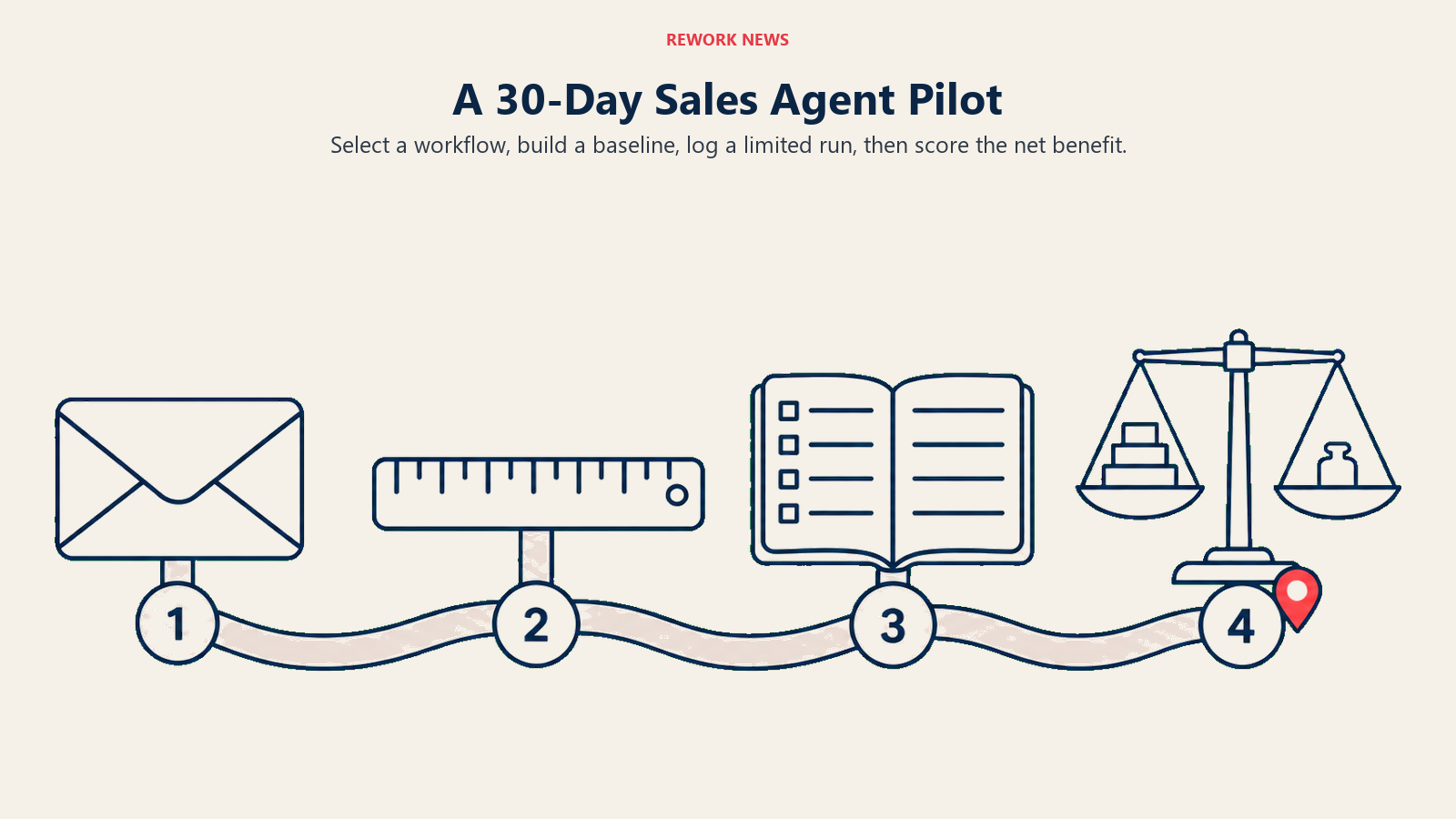
Week 1: Workflow selection. Pick one sales workflow with three characteristics: it's high-volume (your team does it 20+ times a week), it's currently handled manually or with fragile automation, and it has a measurable output (meetings booked, response rate, CRM data quality score). Don't start with your most complex workflow.
Week 2: Build and baseline. Get access to the platform and build the agent for that workflow. Simultaneously, pull two weeks of historical data on the same workflow to establish a baseline. What does "good" look like without the agent?
Week 3: Run and instrument. Let the agent run on a subset of the workflow (not your full pipeline). Log every action it takes. Flag the ones that would have required a different human judgment call. This is the data that tells you whether the agent's decision logic is good enough for your specific context.
Week 4: Score honestly. Compare agent outputs against baseline. But also score the secondary costs: time spent configuring the agent, fixing errors it made, and managing exceptions. The net benefit calculation needs to include all of those.
The contextual data point worth knowing: analyst research on enterprise agentic deployments suggests average ROI in the 171% range for companies that get this right. But that figure comes from aggregated survey data across many platforms and workflow types, not specifically from no-code platforms on sales use cases. Treat it as directional, not as a target your pilot should match.
What to Do This Week
The 30-day window matters because this space is moving fast. By the time Salesforce ships its next Agentforce wave and HubSpot's Breeze capabilities mature through Q2, the relative advantage of a no-code independent platform may narrow. The companies that pilot now learn what works in their specific context, and that knowledge compounds.
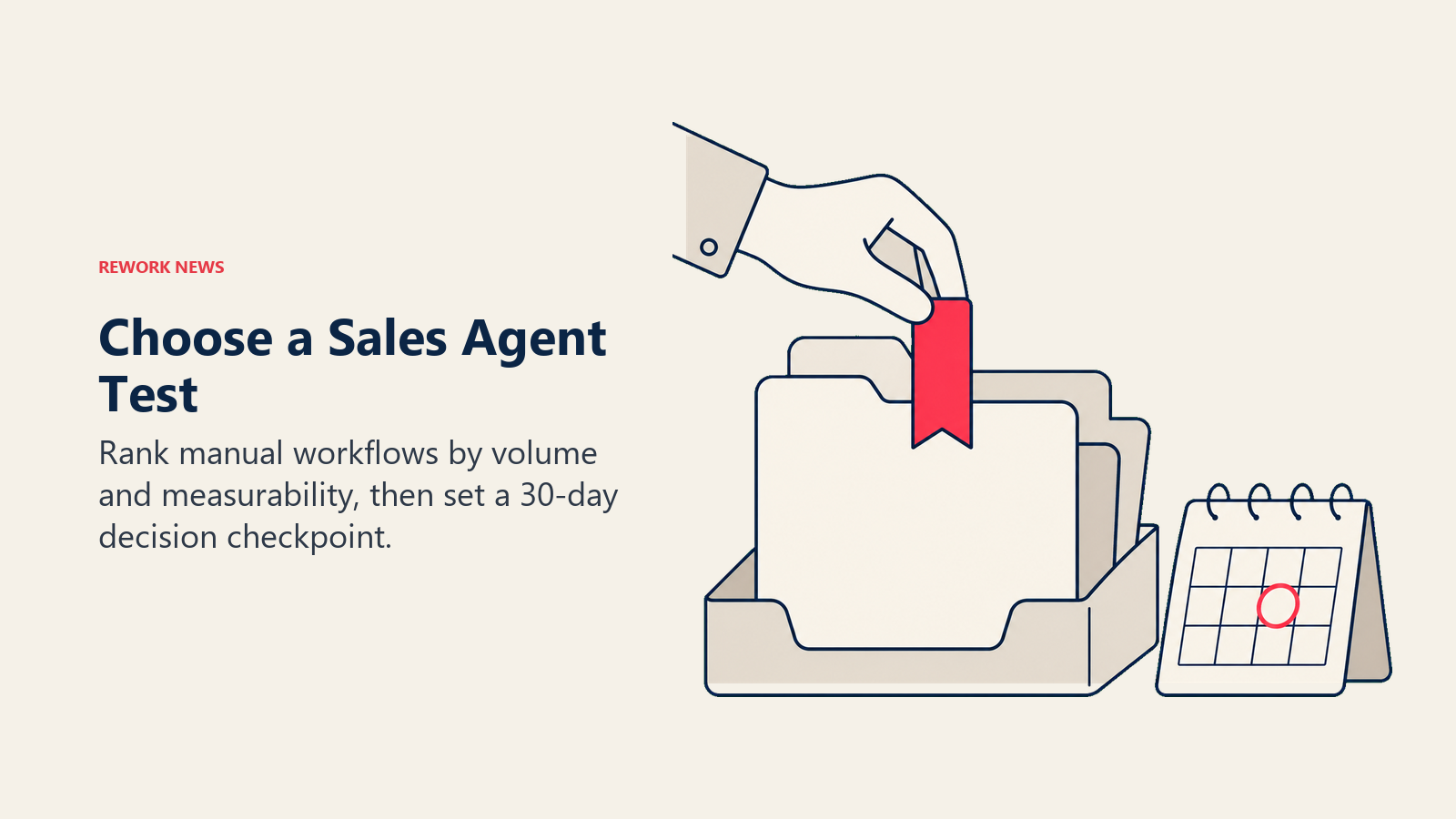
This week, do three things. First, request access or a demo from Agentshub.AI to get past the "accessible pricing" vagueness: you need a real number before you can evaluate it against your existing stack cost. Second, pull your list of sales workflows that are currently handled manually or with partial automation, and rank them by volume and measurability. Third, set a decision checkpoint for 30 days out: at the end of the pilot, you'll know whether to expand, replace with a CRM-native solution, or drop it and revisit in six months.
The build-vs-buy question for AI agents isn't going away. But right now, for the first time, the cost and complexity of the "build" side of that equation has dropped enough that the question deserves a real answer, not a deferral.
Learn More
- Three No-Code Agent Platforms in One Quarter: What CEOs Should Take From It: The broader strategic signal behind the no-code agent wave
- AI Agents in the Sales Pipeline: Understanding the full agentic picture before committing to a platform
- Sales Team AI Readiness Audit: Assessing which workflows are ready for no-code agent deployment
- Qualification Frameworks: Calibrating your agent to qualification logic that actually reflects how your best reps work
Source: Agentshub.AI launch coverage via Yahoo Finance, April 6, 2026.
