More in
AI Workforce Transformation
Does AI Make Distributed Teams Easier or Harder to Lead?
Oct 11, 2026
Where AI Productivity Monitoring Turns Into Surveillance
Oct 11, 2026
Why Your Most Experienced People Resist AI Hardest (and Why You Need Them Most)
Oct 11, 2026
Is AI Making Teams Less Collaborative?
Oct 11, 2026
Should CEOs Use AI Themselves? Why Executive Fluency Sets the Adoption Ceiling
Oct 11, 2026
Does AI Favor Generalists or Specialists? What It Means for Who You Hire
Oct 10, 2026
Is Experience Still Worth Paying For When AI Narrows the Skill Gap?
Oct 10, 2026
When Every Candidate Uses AI, What Is a Resume Still Worth?
Oct 10, 2026
Should AI Screen Your Job Candidates? Where Automated Hiring Helps and Where It Backfires
Oct 10, 2026
Should Candidates Be Allowed to Use AI in Interviews?
Oct 10, 2026
Upskill or Hire AI-Native? The ROI Case Every Executive Needs to Run
Turn this article into takeaways for your work.


Each assistant summarizes the article only for you and suggests best practices for your work.
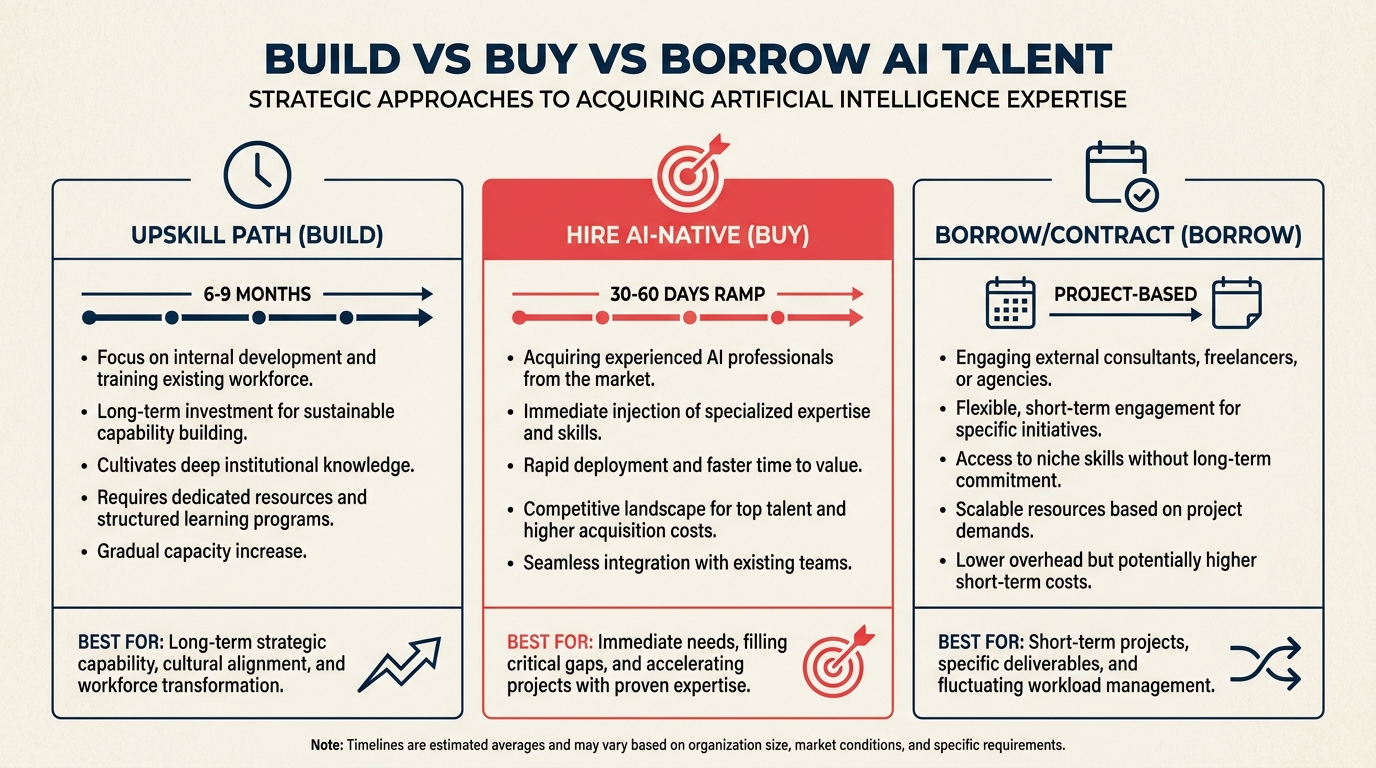
Every executive running a mid-market company right now is sitting on the same uncomfortable question: do I invest in making my existing team AI-capable, or do I bring in people who grew up working alongside AI and never knew anything else?
Both options cost real money. Both carry real risk. And the right answer isn't the same for every role, every company, or every stage of AI maturity. But there is a framework for running the numbers, and most executives aren't using it.
This is a capital allocation decision. Treat it like one.
What Upskilling Actually Costs
The first mistake executives make is underestimating what it really costs to make an existing employee AI-effective. "We'll just send people to a few workshops" is not a strategy. It's a way to spend $50K and move the needle on nothing.
Here's what a serious upskilling investment looks like on a per-employee basis for a mid-market GTM or ops role:
| Cost Category | Low Estimate | High Estimate |
|---|---|---|
| Training programs (licensing, courses) | $800 | $3,000 |
| AI tool licenses (12 months) | $600 | $2,400 |
| Internal coaching / manager time | $1,200 | $4,000 |
| Lost productivity during transition (10–20% over 6 months) | $8,000 | $18,000 |
| Total per employee | ~$10,600 | ~$27,400 |
That productivity dip is the line item most CFOs miss. When someone is learning a new way of working, they're slower, not faster, for the first three to six months. For a sales rep carrying a $600K quota, a 15% productivity drop during ramp costs you roughly $22,500 in pipeline contribution.
Timeline benchmarks from 2025 enterprise upskilling programs suggest:
- 3 months to basic AI fluency: someone can use tools, run prompts, and understand outputs
- 6–9 months to workflow integration: someone has replaced manual steps with AI-assisted workflows
- 9–12 months to reliable productivity lift: performance data shows measurable improvement over baseline
And the success rate matters. Industry data from corporate AI training programs shows that roughly 60–70% of employees reach target proficiency when programs are designed around actual job workflows. When programs are built around generic certification content, that number drops to around 35%. McKinsey's research on capability building consistently finds that context-embedded learning outperforms classroom instruction for skill retention and behavior change. The corporate AI reskilling budget benchmarks for 2026 give a useful reference for how much peer companies are actually allocating, which helps calibrate whether your proposed investment is in the right range before you take it to the board.
The ROI math only works if your program is designed right.
What Hiring AI-Native Actually Costs
On the other side, the talent market in 2026 is sending clear signals. AI-fluent candidates (people who can genuinely integrate AI into GTM, ops, or finance workflows, not just people who list "ChatGPT" on their resume) command a meaningful premium.
Current compensation data for mid-market roles:
| Role | Standard Comp Range | AI-Fluent Premium | AI-Fluent Range |
|---|---|---|---|
| Account Executive | $90K–$120K OTE | +18–22% | $107K–$146K OTE |
| Marketing Manager | $80K–$110K base | +15–20% | $92K–$132K base |
| Revenue Ops Analyst | $75K–$100K base | +20–25% | $90K–$125K base |
| Customer Success Manager | $70K–$95K base | +15–18% | $80K–$112K base |
That 15-25% premium is real, and it compounds. A $115K AI-fluent Account Executive versus a $95K standard hire is a $20K annual delta, before you factor in benefits, equity, and employer-side costs.
The ramp time story is more favorable for AI-native hires. Someone who already works with AI tools reaches full productivity in 30–60 days rather than the 90–120 days typical for a traditional hire learning new workflows. In a high-velocity sales environment, that's a meaningful difference.
But here's what doesn't show up in the spreadsheet: AI-native candidates expect AI-forward cultures. If you hire someone who's accustomed to working with AI agents, automated pipelines, and data-first decision-making, and they walk into a company that still runs on spreadsheets and weekly status emails, they'll be gone in 12 months. The mis-hire cost (typically 1.5-2x annual salary for a mid-market role) erases the productivity gains entirely. A practical way to assess culture readiness before you hire is to run an AI onboarding checklist against your current new-hire process and identify the gaps.
Availability is also constrained. Outside of major metro markets, the pipeline of genuinely AI-fluent mid-market talent is thin. If you're running a 150-person company in Austin, Charlotte, or Denver, you're competing with every other company in your market for the same small pool.
The Build-Buy-Borrow Decision Matrix
Not every role calls for the same answer. Here's a practical framework for deciding which path fits which position.
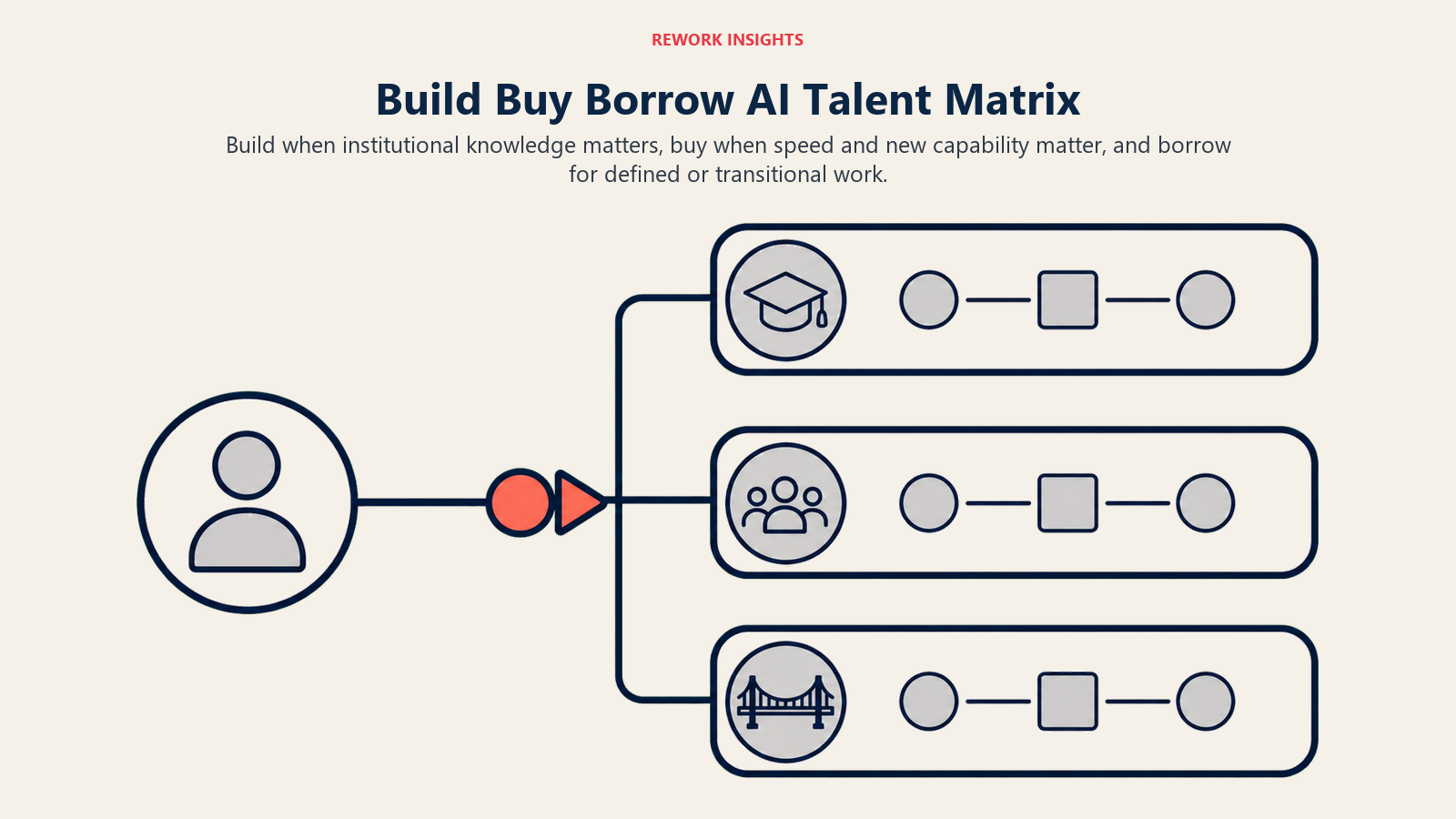
Build (Upskill Existing Employees)
Best fit when:
- The role carries high institutional knowledge value (relationships, process history, customer context)
- The employee has 3+ years of tenure and strong performance history
- The AI workflow change is additive, not replacive (AI augments the role, doesn't restructure it)
- Your culture can sustain a 6–9 month transition window
Typical roles: senior account managers, tenured customer success, finance leads, long-cycle enterprise sales
Buy (Hire AI-Native)
Best fit when:
- Speed to productivity outweighs ramp cost and culture fit risk
- The role is net-new (no incumbent to retrain)
- The function is undergoing structural change, not just tool adoption
- You're building a new capability, not maintaining an existing one
Typical roles: revenue ops, marketing automation, new SDR teams, data analysis, product operations
Borrow (Contractors or Fractional Talent)
Best fit when:
- AI capability is needed for a defined project or transition period
- You're evaluating whether a full-time AI-fluent hire is justified
- The work is episodic rather than continuous
- Budget for a full-time hire isn't cleared but the need is real
Typical use: AI workflow audits, CRM migration projects, demand gen buildouts, GTM operations redesign
The matrix isn't meant to be applied once. Run it role by role, and revisit it as the org evolves. The right answer for your VP of Sales development today might be different from the right answer for the next SDR class you hire. The hiring vs. upskilling AI framework provides a condensed version of this decision matrix that's easy to share with a CFO or board who wants to see the logic documented.
A Tale of Two Decisions
Company A: Upskill Path. A 180-person B2B software company with a mature inside sales team decided to invest in upskilling rather than replace their 22-person SDR team when they restructured their outbound motion around AI-assisted prospecting.
Total investment: approximately $340K across training, tools, and productivity buffer. Timeline: nine months to full integration. Result at month 12: average SDR productivity up 31% (measured by qualified meetings created per rep), with 19 of 22 reps reaching or exceeding new targets. The three who didn't were managed out through normal performance processes.
The CFO's calculation: $340K investment, offset by avoiding $440K in estimated replacement costs and onboarding risk, with a productivity improvement worth roughly $820K in incremental pipeline over the first year. Net positive in year one.
Company B: Hire AI-Native Path. A 90-person professional services firm decided to build a new revenue operations function from scratch rather than retrain their existing admin and analyst staff into rev ops roles.
They hired three AI-fluent revenue ops professionals at a combined $390K annual cost (versus the $280K they estimated for retraining existing staff). Ramp time was six weeks rather than the projected 20 weeks for a retraining path. At month eight, the rev ops function was running automated reporting, pipeline forecasting, and territory management that their legacy team couldn't have built in that timeframe regardless of training investment.
The CFO's calculation: $110K annual premium for hiring versus training, offset by 14 weeks of faster productivity (estimated $180K in recovered ops capacity) and the structural capability that wasn't achievable via upskilling alone.
Both decisions were right, for very different reasons.
The Hidden Variable: Retention Risk
Here's the factor that doesn't fit neatly into a spreadsheet but belongs in every executive conversation about this decision.
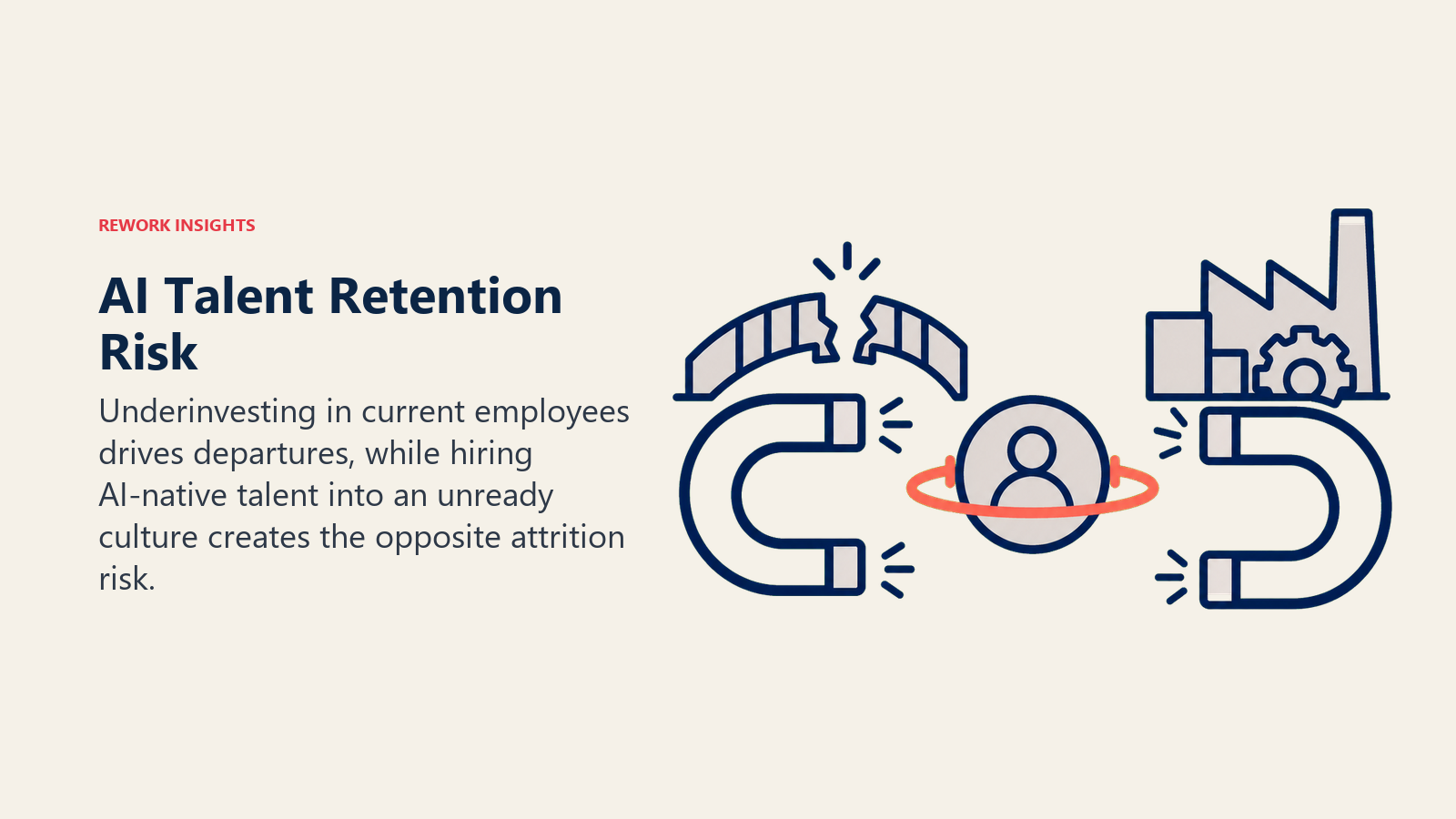
If you don't upskill your existing team, your best people leave. Not immediately, but predictably. Employees who see AI being used around them (in competitor companies, by peers at other firms) and don't have access to the same tools start to feel left behind. The departure rate among high performers in companies with no AI upskilling investment ran roughly 22% higher than industry baseline, consistent with Deloitte's Global Human Capital Trends research on the link between learning investment and employee retention.
But the reverse is also true. If you hire AI-native talent into a culture that hasn't adapted, they leave faster than average employees. AI-fluent hires in companies with low AI maturity reported significantly higher dissatisfaction rates at 6-month check-ins. Harvard Business Review research on talent retention identifies expectation mismatches as a primary driver of early attrition, especially when new hires enter cultures operating at a different capability level. Their tools are underused, their suggestions are ignored, and their expectations for how decisions get made aren't being met.
The retention risk cuts both ways. And the cost of turnover (recruiting fees, onboarding time, productivity gaps) runs 1.5 to 2x annual salary for a mid-market professional role. One mis-hire or one preventable departure in a key role can wipe out the savings you projected from choosing the cheaper upskilling path.
The question isn't just "what does it cost to build or buy?" It's "what does it cost when this decision goes wrong?"
Running Your Own Numbers
The framework above is reusable. For each role where you're facing this decision, build a simple model with five inputs:
- Current employee cost (fully loaded: salary, benefits, employer taxes)
- Upskilling cost (training + tools + productivity buffer for 6–9 months)
- AI-native hire cost (salary premium + recruiting fee + 60-day ramp buffer)
- Productivity lift value (estimated workflow improvement in dollar terms, by role)
- Retention risk adjustment (probability-weighted cost of a departure under each scenario)
Run the model over a 24-month horizon. Year one often favors upskilling. Year two often favors hiring, because the compounding productivity advantage of someone who's been AI-native since day one starts to outpace the productivity gain from someone who learned AI on the job.
For most mid-market companies running this analysis in 2026, the conclusion tends to land in the same place: upskill your tenured, relationship-heavy roles; hire AI-native for new capability builds and high-velocity functions; and use fractional talent as a bridge when you're not sure.
The Upskilling ROI Is Real, But Only If You Design It Right
The ROI case for upskilling is stronger than most executives think. But it only holds if the program is built around actual workflow change, not certification theater.
The companies seeing real returns from upskilling investments are those that started with the job to be done (what does this person need to do differently with AI?) rather than the credential to be earned (what certifications should we require?). They embedded AI tools directly into the workflows where they'd be used. They measured productivity change, not training completion. And they gave managers accountability for making the change stick.
The ROI case for hiring AI-native is strongest in GTM, ops, and data roles where speed to value outweighs the premium. But it only holds if your culture is ready to absorb those hires and let them work the way they know how.
This is a capital allocation decision. And like all capital allocation decisions, the executives who run the numbers before they decide, rather than after, tend to come out ahead.
Learn More
- The AI Skills Gap Executives Are Getting Wrong, Why most AI skills investments fail before they start
- Which Roles AI Is Actually Eliminating, The role-by-role breakdown for mid-market companies
- Why Every Sales and Marketing Hire Needs AI Fluency, What AI-fluent GTM talent actually looks like in practice
- The Org Chart of the Future, How AI-augmented departments are being structured today
- AI Training Budget Business Case
- Hidden Cost of Delaying AI Upskilling: A CFO Analysis

Co-Founder, Rework.com