More in
AI at Work News
OpenAI Opened ChatGPT Advertising to Small Businesses at Any Budget
Jun 6, 2026
AI Is Everywhere at Work. Only 1 in 10 Say It Transformed the Job
Jun 6, 2026
Vibe Coding's $10.5B Moment: AI Now Starts Most New Software Builds
Jun 6, 2026
AI Agents Now Have More System Access Than Your Employees. Few Are Secured
Jun 5, 2026
Should You Build Your AI or Buy It? Watch What the Giants Bought.
Jun 5, 2026
Uber Caps Employee AI Spending at $1,500 Per Seat After a Budget Blowout
Jun 5, 2026
Trump's AI Executive Order Is Deregulatory. Your Compliance Risk Didn't Move
Jun 4, 2026
AI Pushed 220 Unicorns Below $1B. Pre-ChatGPT Companies Face a Reckoning
Jun 4, 2026
Token Prices Fell 67% This Year. Your AI Bill Is Going Up Anyway
Jun 3, 2026
Small Businesses Using AI Report Higher Revenue and Shorter Workdays
Jun 3, 2026
When AI Lead Scoring or Forecasting Needs a Human in the Loop
Turn this article into takeaways for your work.


Each assistant summarizes the article only for you and suggests best practices for your work.
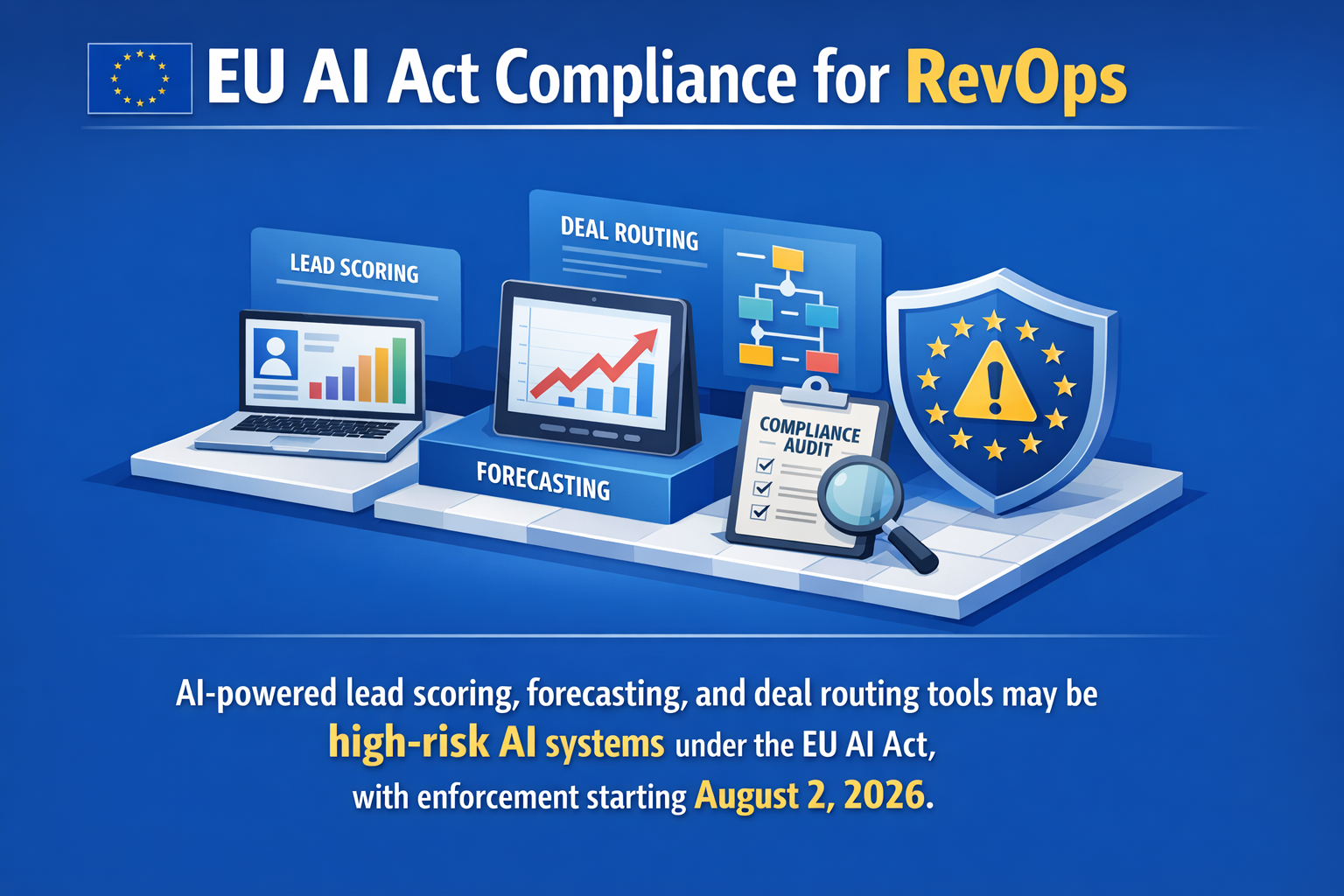
Your RevOps stack probably scores leads, forecasts pipeline, and routes deals with some AI help. Maybe it scores your reps, too. Under the EU AI Act, some of that carries real regulatory exposure. Most of it doesn't. The difference isn't which vendor you buy from. It's whose outcome the AI is deciding, and whether a person can still change that outcome before it lands.
This matters regardless of when enforcement actually starts, because the deadlines have already moved once and the underlying obligation (keep a human accountable for consequential AI decisions) doesn't go away just because a date does. Here's how to map your own stack, not a generic industry list.
The RevOps AI Risk Map
The EU AI Act's high-risk category that touches RevOps most directly is Annex III, and it's narrower than most compliance explainers suggest. It targets AI that evaluates the creditworthiness of natural persons, and separately, AI that monitors, evaluates, or allocates work to people in an employment relationship. B2B lead scoring of companies falls outside both of those, because a company isn't a natural person and a prospect isn't your employee. Here's how common RevOps tools sort against that line:
| RevOps AI use | When it may carry high-risk exposure | What keeps it lower-risk |
|---|---|---|
| Lead scoring of companies or accounts | Rarely. Scoring an organization isn't scoring a natural person's creditworthiness. | Keep inputs to firmographic and behavioral B2B data, not personal credit data about an individual. |
| Credit checks or payment-term decisions tied to an individual, sole proprietor, or guarantor | Falls inside the creditworthiness category when the AI evaluates a natural person. | Route the output to a human underwriter who can approve, deny, or adjust before the decision takes effect. |
| Pipeline forecasting (aggregate, territory, or segment level) | Low. It's informing a business decision, not a decision about a person. | Keep forecasts aggregate. Watch for vendors adding an individual "rep risk" layer on top. |
| Deal or lead routing | Rises if routing criteria act as a proxy for protected traits, or function as task allocation based on an individual's behavior. | Base routing on account attributes (territory, segment, size), document the logic, and review it periodically. |
| Rep performance analytics or activity scoring | Can fall under the employment-management category if AI monitors and evaluates an individual's performance or allocates their tasks. | Keep a manager in the loop for any comp, promotion, or performance-management action the analytics inform. |
Your forecast governance process is a useful place to start this inventory, because it already documents who touches pipeline numbers and when. Extend that same documentation habit to scoring and routing tools, and you've done most of the mapping work already.
Keep a Human Accountable for What the AI Decides
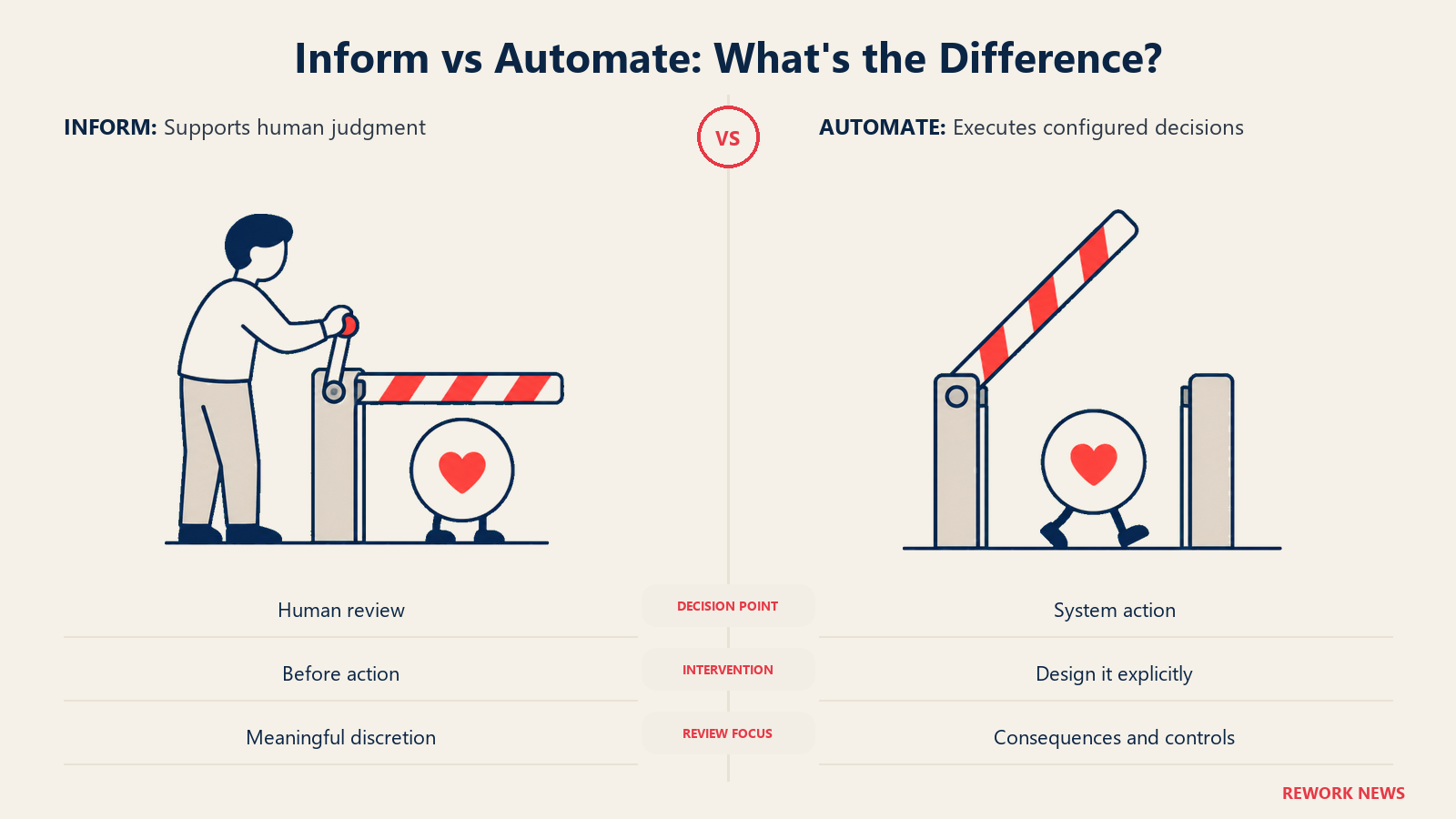
Regardless of which category a tool lands in, one distinction holds up no matter how the deadlines shift: does the AI inform a human decision, or does it make the decision and let a human rubber-stamp it afterward?
A deal health score that a rep or manager reviews before acting on it sits on the lower-risk end. Someone applies judgment and can override it. An AI system that auto-caps a credit limit, auto-excludes an account from an offer, or feeds directly into a performance review without a review step in between sits on the higher-risk end, because the human check happens too late to change anything.
This is also where most RevOps teams have a blind spot they don't expect: it's not just customer-facing scoring that carries exposure. AI that monitors and evaluates your own reps (activity scoring that feeds into coaching, territory reassignment, or task allocation based on individual behavior) sits in the same employment-management category as recruiting AI. If your RevOps workflow already leans on AI for this kind of analytics, the question to ask isn't whether the tool is sophisticated. It's whether a manager with real authority reviews what it recommends before anything happens to the rep.
Build the review step once, document it, and you've addressed both the EU AI Act's human-oversight expectation and basic management practice. That combination doesn't become obsolete if a deadline moves again.
Where the Deadlines Stand (as of October 2026)
The EU's Digital Omnibus on AI, which entered into force in late July 2026, pushed back the dates that most RevOps compliance checklists were built around, according to Orrick's analysis of the final text. Not everything moved. For the full timeline and what it means at the company level, see How to Prepare for AI Regulation When Deadlines Keep Moving; for the original enforcement overview this article updates, see the EU AI Act CEO briefing.
Key facts
- Obligations for standalone high-risk AI systems under Annex III (the creditworthiness and employment-management categories that touch RevOps) now take effect December 2, 2027, not August 2, 2026, per Orrick.
- High-risk AI embedded in regulated products (Annex I categories like medical devices and machinery) gets a longer runway, to August 2, 2028, per Orrick.
- Article 50 transparency rules (disclosing AI interaction, labeling synthetic content, notifying people about emotion or biometric analysis) still take effect August 2, 2026, unaffected by the high-risk delay, per Jones Walker.
- Providers with synthetic-content systems already on the market before August 2, 2026 get until December 2, 2026 to finish the technical watermarking piece of that transparency obligation, per Jones Walker.
- Morgan Lewis's client alert reads the delays as extra time to complete compliance work, not a material relaxation of the underlying obligations.
For RevOps specifically, that means the clock on credit-scoring and rep-monitoring AI runs longer than the 2026 date most teams had circled. It does not mean the underlying obligation went away, and it doesn't touch the transparency rules, which are a separate track entirely.
What to Do in the Next 30 Days
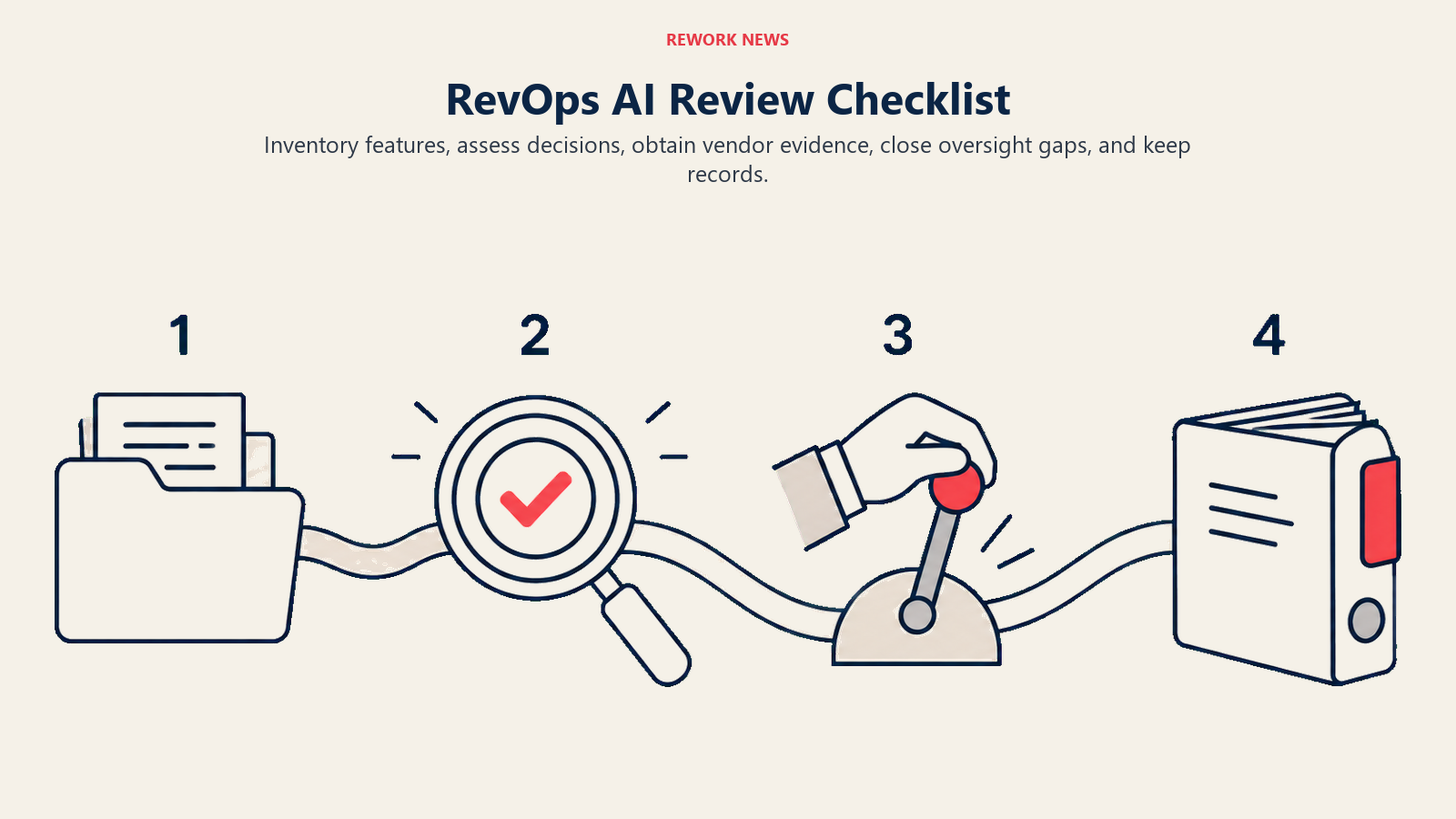
You don't need a legal opinion to start this. You need an inventory and an honest look at where a human can still change an outcome.
List every AI feature touching scoring, credit, routing, or rep performance. Go tool by tool: CRM scoring, CPQ or billing AI, routing logic, any "rep insights" or activity-scoring dashboard. If your lead scoring, routing, and underlying data model live across several disconnected tools, a platform like Rework that keeps them in one place makes this inventory faster to produce, since you're not reconciling AI logic across five separate systems.
Sort each one against the risk map above. Most B2B lead scoring clears easily. Anything touching an individual's credit or an employee's performance needs a closer look.
Check for a real human checkpoint, not a nominal one. Ask whether the person reviewing the AI's output has the time, context, and authority to actually change it. If the answer is no, that's the gap to close first, well before any deadline.
Confirm your Article 50 transparency items are already handled, since those run on the August 2026 clock regardless of the Annex III delay. If your tools generate synthetic content or interact directly with people, that disclosure work doesn't wait.
Write down what you find. A short memo naming each tool, its risk category, and its human-review step is worth more than a folder of vendor terms and conditions you haven't read.
Frequently Asked Questions about AI Regulation in RevOps
Does the EU AI Act delay mean RevOps teams can stop worrying about AI compliance?
No. The delay pushed the Annex III high-risk deadline for RevOps-relevant uses (credit scoring and employment-management AI) to December 2, 2027, but the obligation to document and oversee those systems is still coming. Separately, Article 50 transparency rules still start in August 2026 and aren't affected by the delay.
Is B2B lead scoring of companies or accounts considered high-risk under the EU AI Act?
Generally not. Annex III's creditworthiness category applies to evaluating natural persons, not organizations, so scoring a company or account on firmographic and behavioral data typically falls outside it. It can change if the scoring touches an individual's personal creditworthiness or financing.
What RevOps AI uses are most likely to be classified high-risk?
Two categories stand out: AI that evaluates the creditworthiness of an individual (a sole proprietor, guarantor, or consumer), and AI that monitors, evaluates, or allocates tasks to your own reps based on individual behavior or performance. Both fall under Annex III once the delayed obligations take effect.
What do we need to be able to show if a regulator or a customer's legal team asks about our AI tools?
A description of what the tool does and what data it uses, evidence that a human with real authority reviews its output before a consequential decision takes effect, and documentation that the training data was checked for quality and bias. None of that depends on which exact date enforcement starts.
Does using AI to score or monitor sales rep performance create compliance risk?
It can, if the AI's output feeds into decisions like task allocation, promotion, or termination without a manager reviewing it first. That use sits inside the EU AI Act's employment-management category, the same bucket as recruiting AI, which surprises most RevOps teams who assume the risk is only on the customer-facing side.