More in
AI at Work News
OpenAI Opened ChatGPT Advertising to Small Businesses at Any Budget
Jun 6, 2026
AI Is Everywhere at Work. Only 1 in 10 Say It Transformed the Job
Jun 6, 2026
Vibe Coding's $10.5B Moment: AI Now Starts Most New Software Builds
Jun 6, 2026
AI Agents Now Have More System Access Than Your Employees. Few Are Secured
Jun 5, 2026
Should You Build Your AI or Buy It? Watch What the Giants Bought.
Jun 5, 2026
Uber Caps Employee AI Spending at $1,500 Per Seat After a Budget Blowout
Jun 5, 2026
Trump's AI Executive Order Is Deregulatory. Your Compliance Risk Didn't Move
Jun 4, 2026
AI Pushed 220 Unicorns Below $1B. Pre-ChatGPT Companies Face a Reckoning
Jun 4, 2026
Token Prices Fell 67% This Year. Your AI Bill Is Going Up Anyway
Jun 3, 2026
Small Businesses Using AI Report Higher Revenue and Shorter Workdays
Jun 3, 2026
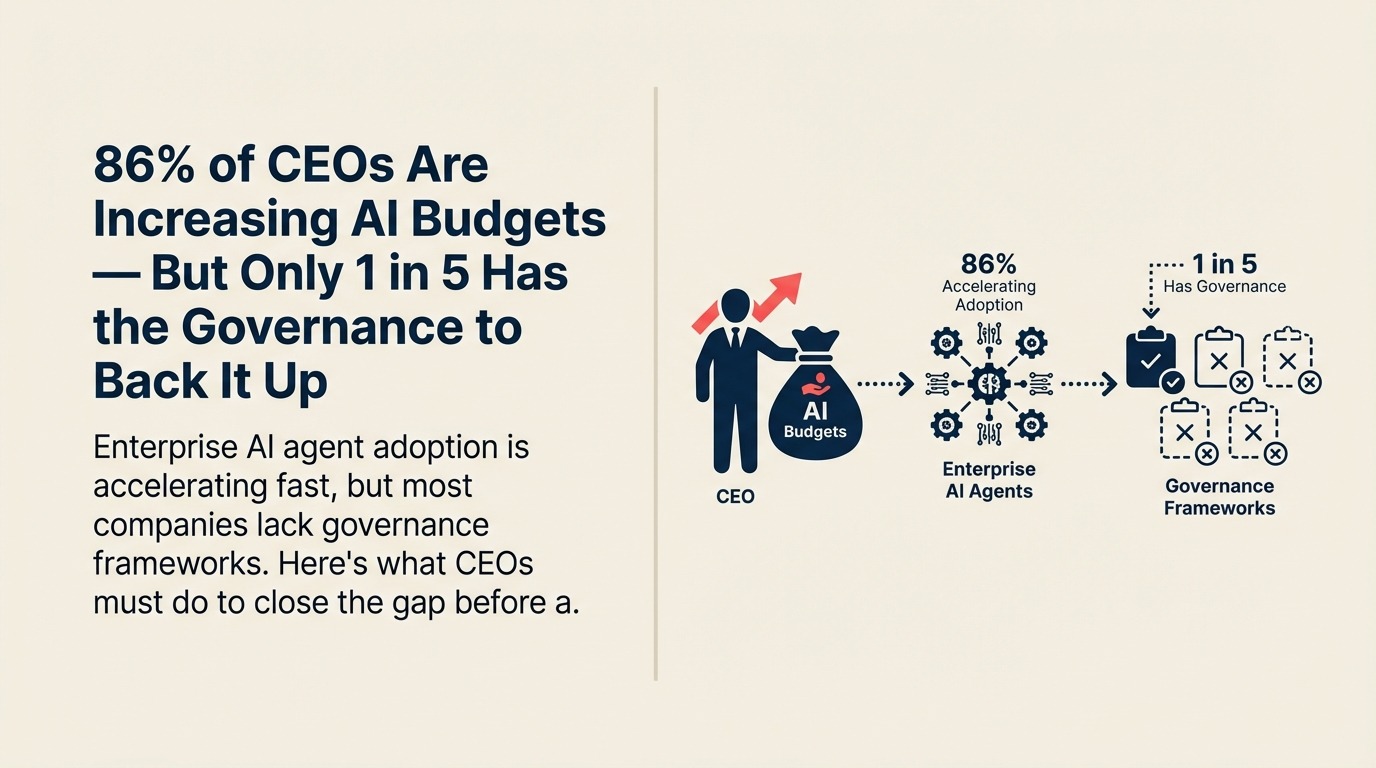
86% of CEOs Are Increasing AI Budgets: But Only 1 in 5 Has the Governance to Back It Up
Turn this article into takeaways for your work.


Each assistant summarizes the article only for you and suggests best practices for your work.
There's a split-screen happening inside most enterprise boardrooms right now. On one monitor: AI budgets are climbing. On the other: a nearly empty governance dashboard.
The numbers tell the story plainly. According to analyst data aggregated by Joget, drawing on publicly available Gartner and IDC research, 40% of enterprise applications will incorporate task-specific AI agents by the end of 2026. And the Deloitte State of AI in the Enterprise report found that 86% of surveyed organizations expect their AI investment to increase this year, with 64% already actively deploying AI across operations. That's real adoption at real scale.
But here's the part that should be on your next board agenda: only one in five companies has a mature governance framework in place to oversee what those autonomous agents are actually doing. The gap between spending and oversight isn't a CTO problem. It's a CEO accountability problem, and it's widening every quarter.
Why Governance Falls Behind Adoption
The pattern is familiar. A new capability arrives that promises measurable productivity gains. Pilot teams show results. Business units start buying tools. IT plays catch-up. And by the time anyone asks "but who's watching what these systems do?", the agents are already touching payroll logic, customer communications, and revenue forecasts.
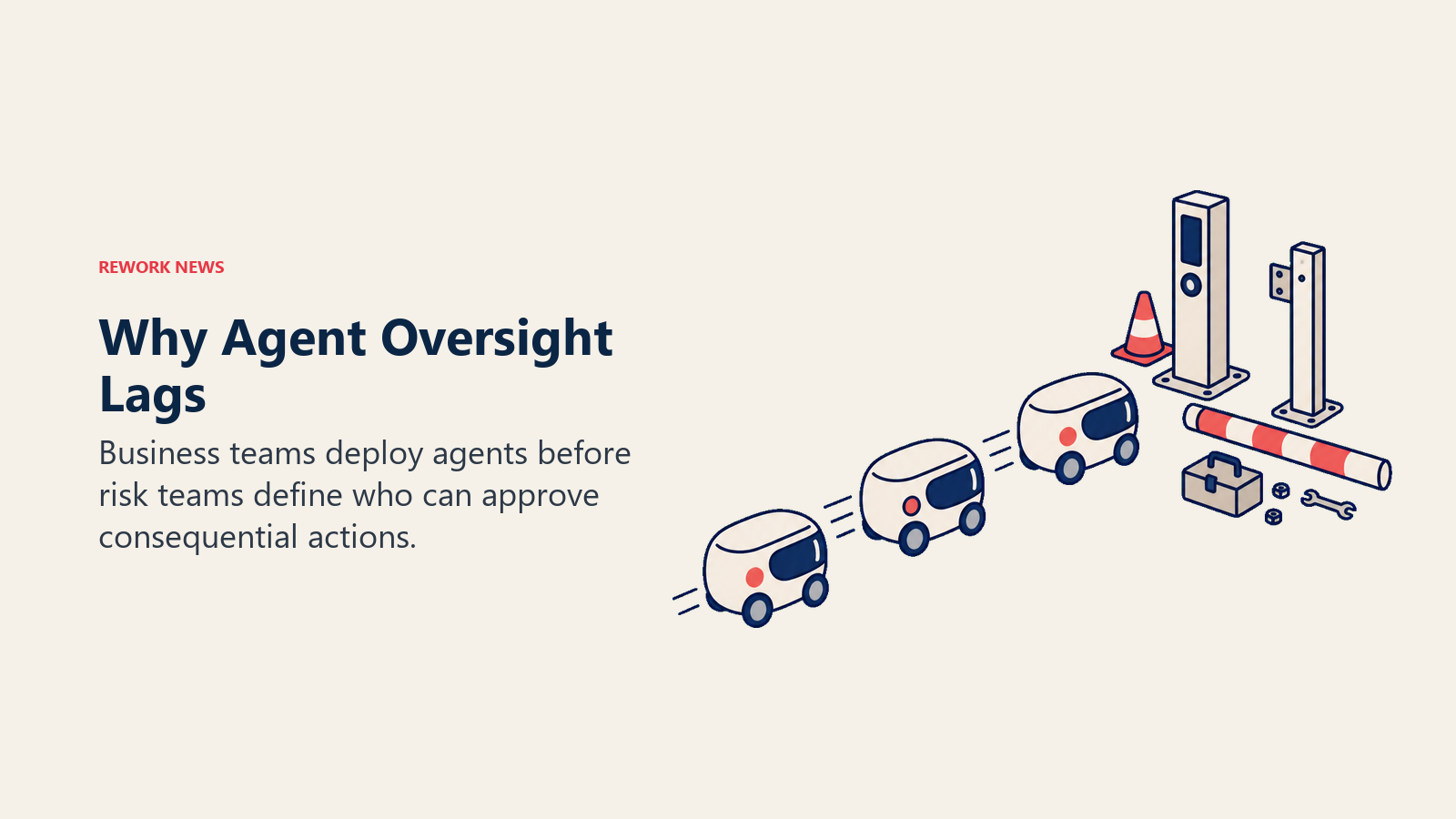
AI agents aren't just automating tasks. They're taking autonomous actions. That's a meaningful distinction. A scheduling bot that sends a meeting invite is not the same animal as an agent that resolves customer refunds, updates CRM records, reranks leads, or adjusts pricing logic based on real-time signals. That latter class of agent can create downstream consequences that compound before anyone notices.
Telecommunications companies are leading agentic adoption at 48%, followed by retail and CPG at 47%, according to the same analyst aggregation. These are sectors where agent errors aren't just embarrassing. They're regulatory events.
The governance gap exists not because companies don't care about risk, but because governance frameworks for autonomous agents are genuinely new. Most corporate risk functions built their playbooks around software that waited for human commands. Agents don't wait.
The Accountability Shift Is on the CEO
There's a tendency to frame AI governance as an IT or legal function. That framing misses the exposure. The governance gap in AI at work is already surfacing in revenue operations and customer-facing workflows, not just in back-office automation.
When an AI agent takes a consequential action (and it eventually will take one that's wrong), the board will ask: "Did the CEO know what controls were in place?" Not the CTO. Not the CRO. The CEO.
That's not a hypothetical. Governance incidents tied to automated systems have already generated regulatory scrutiny in financial services and healthcare. As AI agents expand into revenue operations, customer service, and procurement, the blast radius of governance gaps grows proportionally. The security side of that same gap is just as exposed: AI agents now hold more system access than your employees, and few are secured.
The 80% of companies without mature oversight aren't taking a calculated risk. They're taking an uncalculated one.
A 4-Step Governance Framework CEOs Should Demand
None of this requires stopping AI deployment. The point is to build oversight in parallel with adoption, not as a brake on it. Here's a practical structure that maps to how most mid-market enterprises are organized.
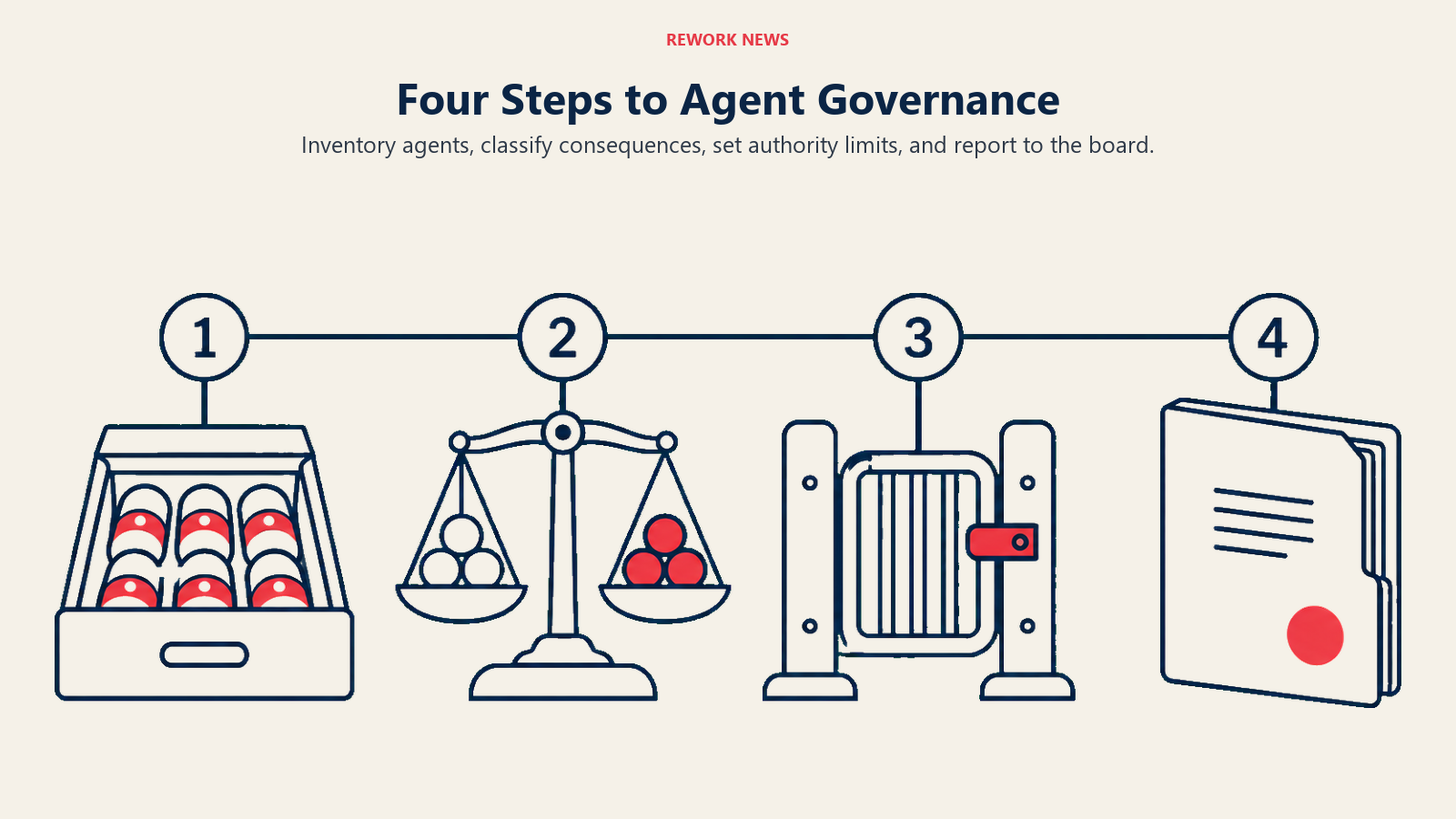
Step 1: Inventory what's actually running. Before you can govern AI agents, you need to know what's deployed. Most CEOs discover through this exercise that the real count is 3-5x what they were told. A useful starting point is understanding the distinction between AI copilots and agents, because the governance requirements differ significantly between the two. Shadow AI procurement is as real as shadow IT was a decade ago. CTO, CIO, and functional heads each own a piece of this picture. Make it a shared quarterly deliverable.
Step 2: Classify by consequence. Not all agents carry the same risk. Group them by the scope of autonomous action they can take. An agent that drafts outbound emails for review is low consequence. An agent that self-approves pricing changes or flags leads as disqualified without human review is high consequence. Your governance overhead should scale with that classification.
Step 3: Define decision boundaries explicitly. For any high-consequence agent, document what it can and cannot do without human sign-off. This is the agent's "authority envelope." It sounds basic, but most deployments don't have this written down. That's the gap regulators will probe first. Picking a published governance framework to anchor these boundaries is its own decision, which the comparison of OpenAI's frontier governance framework against NIST AI RMF walks through for technical leaders.
Step 4: Create a reporting path to the board. Mature governance means the board receives a periodic summary of: agents running, their classification, known incidents, and exceptions granted. This doesn't need to be a lengthy report. A one-page quarterly update is enough to demonstrate oversight is functioning.
The Productivity Case for Getting This Right
It's worth acknowledging what's on the other side of this equation. Companies that are deploying agents in support functions are reporting time savings of 40 or more hours per month for small teams, according to enterprise case studies cited in the research. The productivity case is real.
But productivity gains are only durable if the governance structure underneath them holds. An agent that saves 40 hours per month and then triggers a compliance incident in month eight isn't a productivity win. It's a deferred liability. Measuring AI ROI properly means accounting for that risk, not just reporting the time savings.
CEOs who build governance in now get to capture both: the efficiency gains and the confidence that comes from knowing what their AI systems are doing.
What to Put on the Next Board Agenda
The board conversation on AI typically gets stuck in two ruts: either it's a high-level "AI strategy" discussion with no operational grounding, or it devolves into a tools procurement briefing. The RevOps angle on this same problem (what AI agents are doing inside revenue workflows) is worth reviewing alongside the board-level picture. Neither is useful.
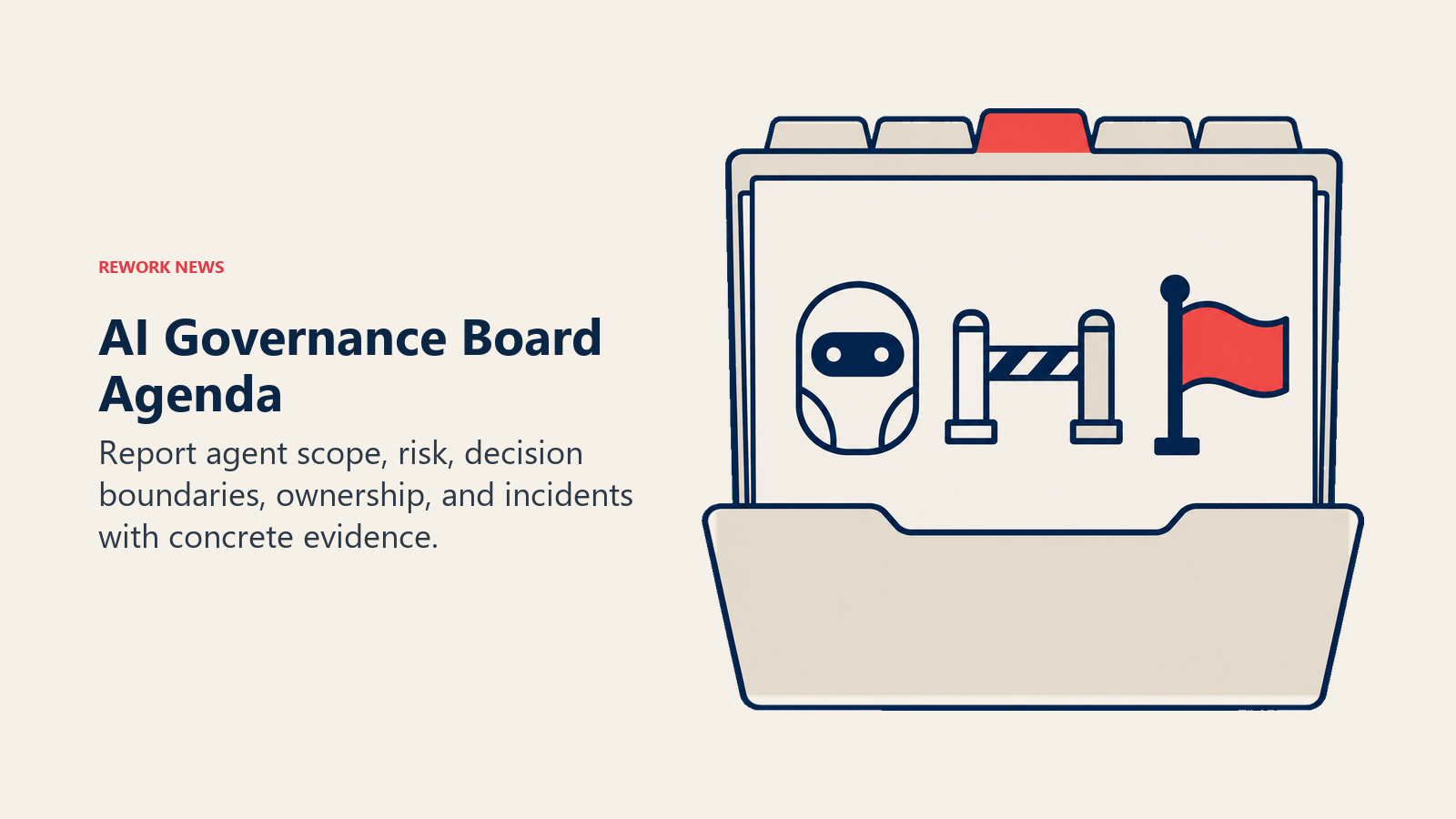
What the board actually needs to hear is simpler:
- How many autonomous AI agents are operating in material workflows?
- What is the consequence classification of each?
- What is the decision boundary for each high-consequence agent?
- Who owns the governance function and what is their escalation path?
- What incidents have occurred, and what was the resolution?
If your team can't answer these questions with specificity, that's the thing to report to the board, not the roadmap for fixing it later. The gap between AI spending and AI governance closes when CEOs treat it as a board-level accountability issue rather than a downstream technology task.
Eighty-six percent of organizations are increasing AI budgets. The ones that will look back on 2026 as a competitive advantage, rather than a governance incident, are the ones building oversight at the same pace.
Learn More
- AI Governance Policy for Departments, Building the authority envelopes and decision boundaries your board needs to see
- EU AI Act: What Every CEO Needs to Know, The regulatory enforcement timeline that makes governance an urgent priority
- Three No-Code Agent Platforms in One Quarter, Why the governance question just got harder as agents become easier to deploy
- AI Workforce Transformation Roadmap, 12-month framework for aligning AI deployment with organizational readiness
Data in this article draws on research aggregated by Joget from publicly available Gartner and IDC summaries and the Deloitte State of AI in the Enterprise report.
