Management Theory Timeline
Turn this article into takeaways for your work.


Each assistant summarizes the article only for you and suggests best practices for your work.
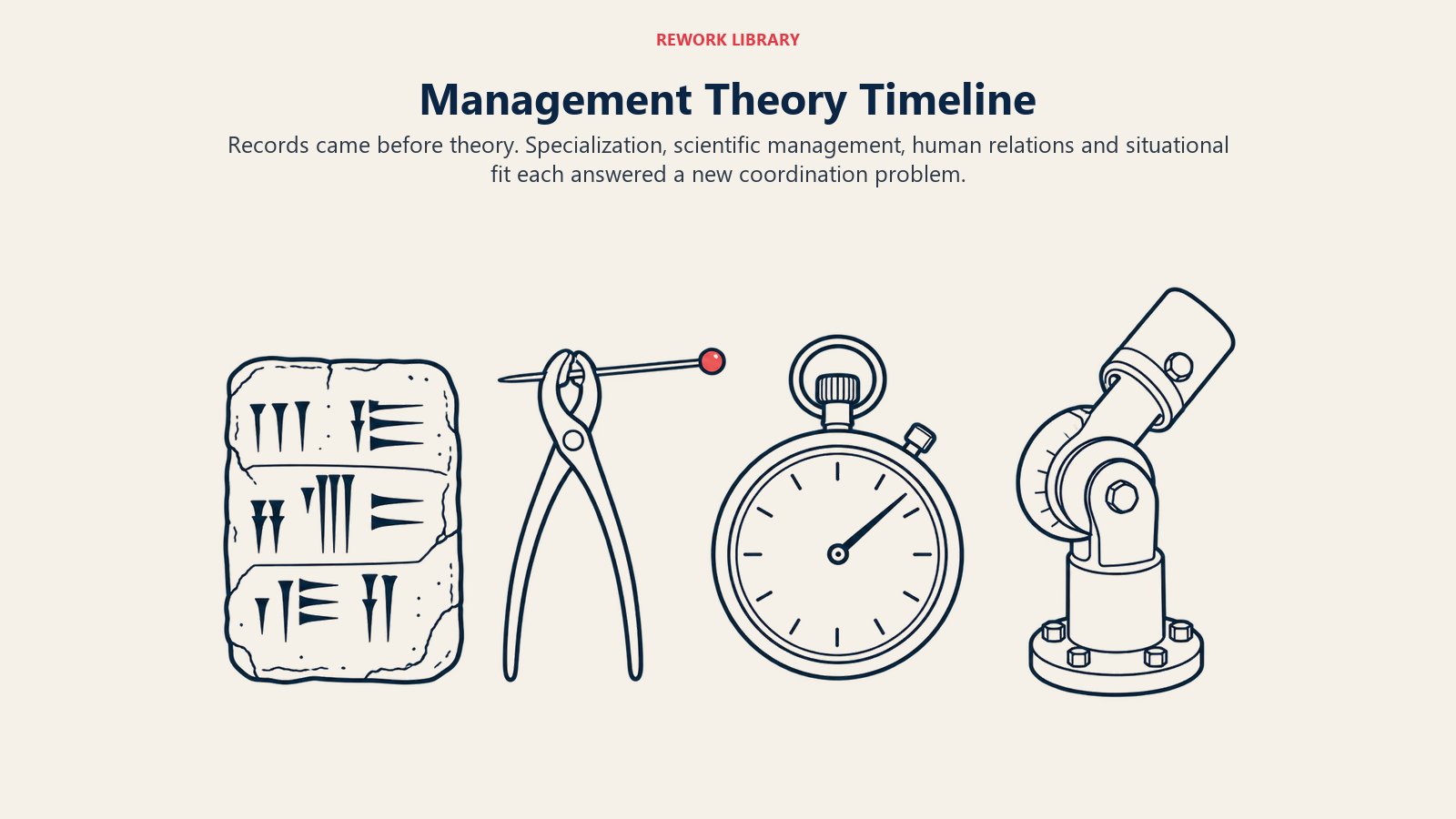
In the late fourth millennium BCE, in the Sumerian city of Uruk, specialists pressed signs into clay tablets. They kept track of land, labor and animals. Nothing on those tablets argues about how to lead people. But someone already had to know who was owed what, and how much work was done. Every theory below is a later answer to that same need.
The management theory timeline starts about 5,000 years ago. Accountants in Sumer were logging institutional assets on clay, long before anyone wrote a theory. The named theories arrive in a rush from 1776. They run from Smith's division of labor to Taylor's scientific management in 1911 and Fayol's functions in 1916. Then come the Hawthorne studies of the 1920s, Barnard in 1938, Drucker in 1954 and contingency theory in the 1960s. Agile and AI-era coordination follow.
The Uruk specialists were a small group. Their credit-card-sized tablets were divided into boxes, one unit of accounting each, with totals on the back. The throughline is a branching tree: each school answered a flaw in the one before it, and the argument is still going. This page is the dated reference. For the story told as one narrative, read The History of Management.
Two companion pages go deeper on specific questions. The ranking of competing schools is in The Schools of Management Thought, in Order, and the argument over the title is in Who Is the Father of Modern Management?. This page gives you the dates.
Timeline at a Glance
| Year | Milestone | Why It Mattered |
|---|---|---|
| About 3100 BCE | Accountants at Uruk record land, labor and animals on clay tablets | Written records of who did what, and what it cost, came before any theory of managing. |
| 27th year of Khufu's reign | Inspector Merer's logbook tracks a crew of about 200 men hauling casing stone | The oldest papyrus found in Egypt is a work schedule. |
| Ancient India (English translation 1915) | Kautilya's Arthashastra describes an accountants' office and the duties of government superintendents | A state manual treated records, wages and embezzlement as management problems. |
| 1494 | Pacioli's Summa prints the "method of Venice" for double-entry bookkeeping | The ledger became a teachable, portable system. |
| 1776 | Adam Smith describes division of labor in a pin factory | Splitting work into steps multiplied output and created the coordination job. |
| 1832 | Charles Babbage applies division of labor to mental work | The idea that mental work can be divided like manual work entered print. |
| 1855 | Daniel McCallum charts the New York and Erie Railroad | Reporting lines were drawn for an operation too big to see. |
| 1878 | Frederick W. Taylor enters Midvale Steel's machine shop | The shop floor became a place to run time studies. |
| 1911 | Taylor publishes The Principles of Scientific Management | Work design became a managerial duty. |
| 1913 | Ford's moving assembly line starts at Highland Park | The line, not the worker's effort, set the pace. |
| 1916 | Henri Fayol's Administration industrielle et generale appears in French | Managing was defined as its own set of functions. |
| 1920s | Max Weber's writing on bureaucratic organization reaches readers after his death in 1920 | Rules, roles and records were argued as the fair way to run large organizations. |
| 1924 | Mary Parker Follett publishes Creative Experience | "Power-with" challenged managing as commanding. |
| 1924 to 1927 | Western Electric runs its Hawthorne illumination tests | Light levels did not explain output, so researchers turned to people. |
| 1938 | Chester Barnard publishes The Functions of the Executive | An organization was defined as a system of coordinated activity. |
| 1943 | Abraham Maslow publishes "A Theory of Human Motivation" | Needs were ordered into a hierarchy managers could reason about. |
| 1950 | W. Edwards Deming lectures in Japan on July 15 | Statistical quality control reached executives. |
| 1954 | Peter Drucker publishes The Practice of Management | Management became a discipline with a body of knowledge. |
| 1960 | Douglas McGregor publishes The Human Side of Enterprise | Managers were asked to test their own assumptions about people. |
| 1961 | Burns and Stalker publish The Management of Innovation | Mechanistic and organic structures fit different conditions. |
| 1962 | Alfred Chandler publishes Strategy and Structure | Structure was shown to follow strategy in large firms. |
| 1965 | Joan Woodward publishes Industrial Organization: Theory and Practice | Production technology joined the factors that shape organization. |
| 1967 | Lawrence and Lorsch publish Organization and Environment | Fit between organization and environment became the test. |
| 1973 | Henry Mintzberg publishes The Nature of Managerial Work | Observation of what managers do replaced assumption. |
| 1978 | Herbert Simon wins the Nobel Prize in economics | Decision-making inside organizations was recognized as a field. |
| 1982 | Peters and Waterman publish In Search of Excellence | Management ideas became a mass-market genre. |
| 1990 | Peter Senge publishes The Fifth Discipline; Michael Hammer's reengineering essay runs in HBR | Learning and redesign became the two big change ideas of the decade. |
| 1992 | Kaplan and Norton publish the balanced scorecard in HBR | Measurement widened beyond financial results. |
| 2001 | The Agile Manifesto is published | Short feedback loops replaced long fixed plans. |
| 2021 to 2022 | Trip.com runs a randomized hybrid-work trial of 1,612 employees | Work arrangements were tested with a control group. |
The Ledger Years (about 3100 BCE-1775)
Clay, papyrus and paper keep the books before anyone theorizes
Picture a clay tablet the size of a credit card, ruled into boxes, one unit of accounting in each. The historian-compiled entry at HistoryofInformation.com describes the earliest accounting tablets of the late fourth millennium BCE this way, and reports that about 5,000 proto-cuneiform tablets were excavated at Uruk between 1928 and 1976 by the German Archaeological Institute. The tablets recorded institutional assets, the entry says, and writing was known to a handful of expert users. Nobody called this management. But a temple that tracked wages and harvests was already running on records.
Egypt left a more vivid picture of work in motion. In 2013, a French and Egyptian team led by Pierre Tallet and Gregory Marouard found a logbook at the Red Sea harbor of Wadi al-Jarf. Live Science reports that its author, an inspector named Merer, was in charge of a team of about 200 men, that he recorded the logs in the 27th year of Khufu's reign, and that the limestone for the pyramid's casing came from Tura by boat, a trip that took four days. The log is a timetable, a crew schedule with cargo and destinations. It is the oldest papyrus document ever found in Egypt, about 4,500 years old.
India's contribution was a manual for officials. R. Shamasastry's English translation of Kautilya's Arthashastra was printed in Bangalore in 1915. Its Book II, "The Duties of Government Superintendents," covers keeping accounts in the office of accountants and detecting what government servants embezzle from state revenue. The chapter on accounts specifies the office layout, with seats for clerks and well-arranged shelves of account books, and the records to keep: profit, loss, expenditure, wages paid and the number of free laborers engaged. It is an early written statement that managing means keeping records and checking them.
Compare the three. Sumer wrote down what was owed, Egypt scheduled labor, and the Arthashastra audited the officials who did both. None of them had a theory of motivation or of structure. That came later, and it started with a printed book. In November 1494, Luca Pacioli published his Summa at Paganinus de Paganinis's press in Venice. HistoryofInformation.com quotes the Dictionary of Scientific Biography describing its bookkeeping treatise as the first printed work setting out the "method of Venice," meaning double-entry bookkeeping.
The era solved the problem of memory: an owner could stop remembering every debt and every shift. It left the problem of scale. A ledger shows what happened, but not how to arrange people so more of it happens.
What this means for teams today: Records come first. If your team can't show who owns what and what was done last week, no theory will help.
Smith's Pin Factory (1776-1877)
Splitting the work creates the job of coordinating it
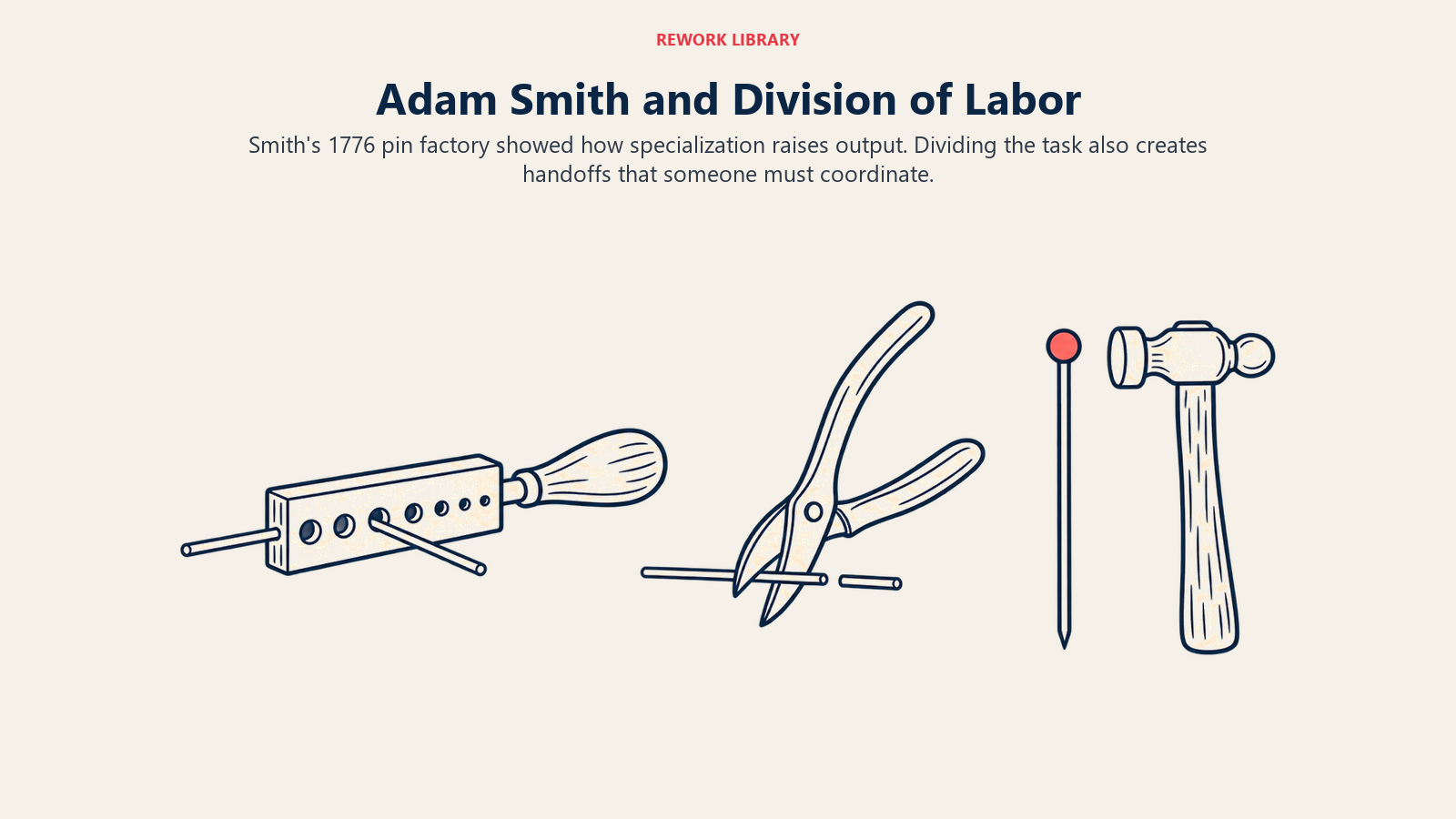
In a small pin manufactory, in the example Adam Smith used, one person drew the wire, another straightened it, a third cut it, and so on through about eighteen operations. In The Wealth of Nations, published in 1776, Smith wrote that ten people working this way could make upwards of 48,000 pins a day, while working separately and untrained they could not each make twenty. It is the first famous argument for specialization. It also leaves an unstated cost: somebody must now coordinate the steps.
Charles Babbage, the same Babbage who designed calculating engines, extended the argument. In On the Economy of Machinery and Manufactures (1832), Chapter 20 argues that division of labor applies as well to mental operations as to mechanical ones, and illustrates it with a large series of calculations. The idea that you can break thinking into units, assign them and price them is the seed of every later work-design method.
The railroads forced the next step. In 1855, Daniel McCallum, general superintendent of the New York and Erie Railroad, produced a chart to define a structure for a business that had grown unwieldy. Slate's account says the chart put daily responsibility in the hands of divisional superintendents, who reported to the central office, and that McCallum designed hourly, daily and monthly reports that let him calculate metrics such as cost per ton-mile. The chart is generally recognized as the first formal organizational chart.
The era solved visibility: owners could see inside a business too big to walk. It created a new problem, which was how to get more output from the people in those boxes.
What this means for teams today: Every handoff in your company descends from the pin line. If you can't draw who does what and who decides, you have specialization without coordination.
The Efficiency Years (1878-1923)
Taylor times the work while Fayol and Weber define the job
At Midvale Steel in 1878, Frederick Winslow Taylor entered the machine shop after an apprenticeship as a pattern-maker and machinist. In The Principles of Scientific Management, published in 1911, he recounts that Midvale's president allowed him to spend money on a careful, scientific study of the time required to do various kinds of work. At Bethlehem Steel he reported raising pig-iron loading from 12 and a half tons to 47 tons per man per day. His summary of the shift fits in five words: the system must be first. The method and the criticism are in our article on scientific management.
Henry Ford turned the same logic into flow. The Library of Congress says Ford introduced the moving assembly line at Highland Park in October 1913 and that assembly time fell from 12.5 hours to 93 minutes. The Henry Ford museum adds that the line arrived in stages, starting around April 1, 1913, with flywheel magnetos on moving lines. Output now depended on the design of the line more than on any worker's effort.
While Taylor studied the shop, Henri Fayol looked at the top. Fayol was an engineer who became Managing Director of the Commentry-Fourchambault combine in 1888 and held the post until 1918, according to the biographical foreword in the English translation. The foreword by L. Urwick says his Administration industrielle et generale first appeared in French in 1916, in the Bulletin of the Societe de l'Industrie Minerale. Fayol defined managing as five activities: forecasting and planning, organizing, commanding, coordinating and controlling. The summary of his principles is in administrative management.
Max Weber died in 1920, per the introduction to Talcott Parsons's translation, and his writing on bureaucratic organization reached readers afterward, with Parsons describing bureaucracy as a peculiar feature of modern Western society. In the translation's account, the bureaucratic official normally draws a fixed salary and holds an "office" with a defined sphere of competence, kept apart from private affairs. See bureaucratic leadership for both sides.
The era solved effort, flow and authority. It left a question Taylor's method barely asked: what the people doing the work thought and needed.
What this means for teams today: Write down the best-known way to do repeatable work, then improve it with the people who do it. Treat any single-number productivity target with suspicion, because tons per day measured what was easy to count.
After Hawthorne (1924-1960)
Researchers go looking for light and find people
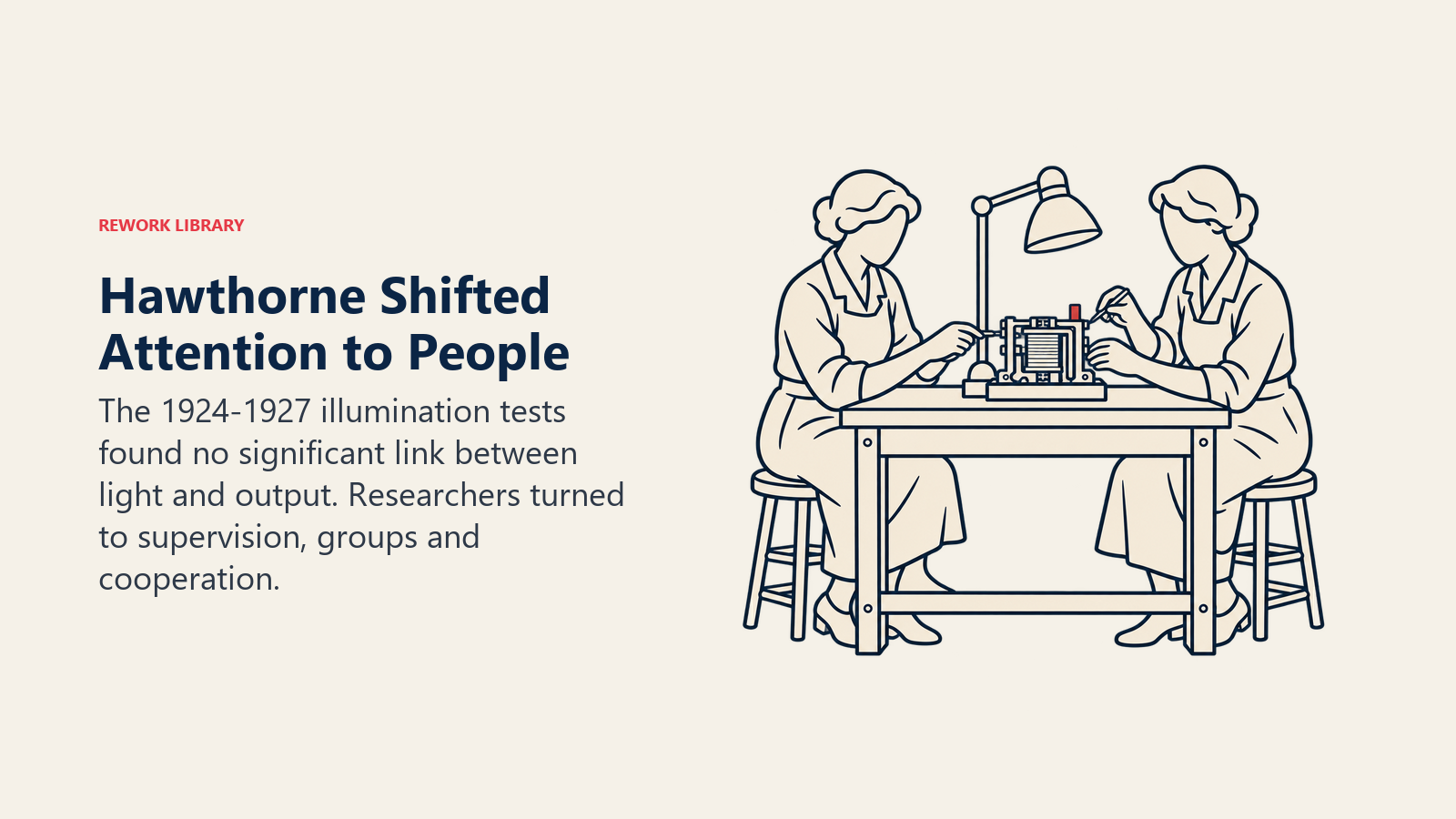
In 1924, with the Hawthorne Works of Western Electric as the setting, a sequence of illumination tests began. Harvard Business School's Baker Library says the tests ran from 1924 to 1927 and showed no significant correlation between productivity and light levels, which sent researchers looking at other factors. The HBS exhibit notes that Elton Mayo arrived at the Hawthorne Works in 1928 and that the relay-assembly studies, which began in 1927, ran until 1932. The interpretation has been debated ever since; see the Hawthorne effect.
The thinking had a precursor. Mary Parker Follett's Creative Experience, first edition April 1924, contrasted "power-with" with "power-over" in how experts and the people they serve relate. In 1938, Chester Barnard, a long-time AT&T executive, published The Functions of the Executive. He defined a formal organization as "a system of consciously coordinated activities" of two or more persons, and made cooperation the unit of study.
Psychology supplied the vocabulary. Abraham Maslow's 1943 paper in Psychological Review described needs as a "hierarchy of relative prepotency," in which a chronically gratified need stops acting as an active organizer of behavior. The Nobel Prize site notes that Herbert Simon, trained in political science, held that people deviate from strictly rational choices and described companies as adaptable systems.
Quality and goals arrived in the same stretch. W. Edwards Deming was invited to Japan by the Union of Japanese Scientists and Engineers, and JUSE records that his visit began on July 15, 1950, with an eight-day course and a one-day course for top management. In 1954, Peter Drucker published The Practice of Management, which the Drucker Institute calls widely considered the first book to organize running an organization into an integrated body of knowledge. See management by objectives and the profile of Peter Drucker. The era closed with Douglas McGregor's 1960 book, which MIT Sloan says is best known for splitting corporate thinking into Theory X and Theory Y. A fuller treatment is in McGregor's Theory X and Y, and Deming's approach is in the Deming profile.
The era solved the people problem Taylor ignored. It created a new one, since a theory about people in general said little about which structure suits which situation.
What this means for teams today: Test your assumptions about your people before you design the system. Regular one-on-ones, honest feedback and clear goals are the working remains of this era.
The Contingency Years (1961-1989)
No one best way: structure depends on the situation
In 1961, Tom Burns and G. M. Stalker published The Management of Innovation through Tavistock. A summary by the Talking About Organizations podcast says it began with a rayon mill that looked efficient until the researchers found its R&D laboratory regarded with suspicion, and that the book separated two management systems: mechanistic, akin to bureaucratic structures that suit stable conditions, and organic, which suits changing conditions. The same summary stresses that both are useful, and that success depends on fit.
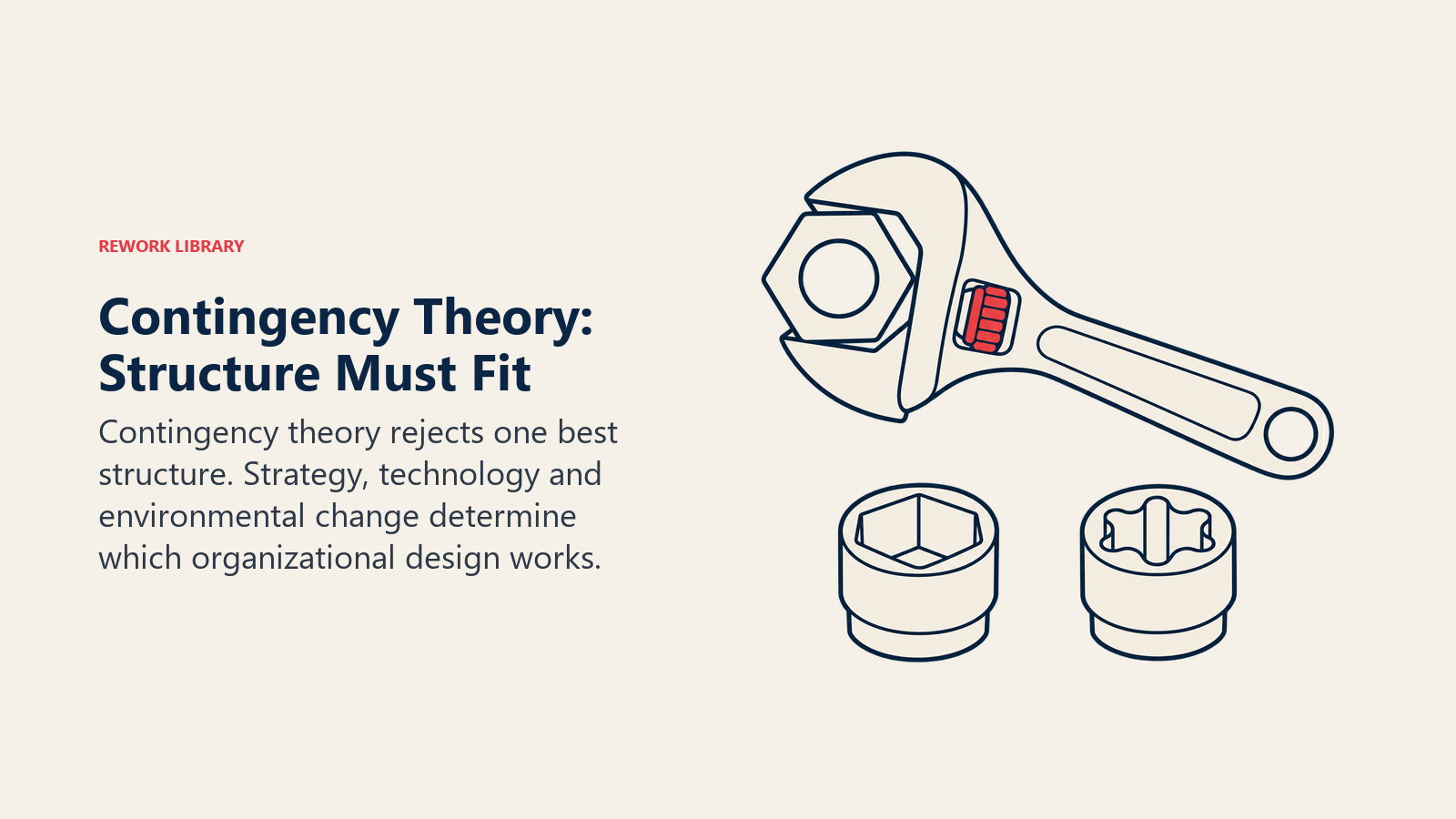
Alfred Chandler followed in 1962 with Strategy and Structure, published by MIT Press. Its chapters on du Pont and General Motors, among other firms, argue that a company's structure follows its strategy. In his own words: "Unless structure follows strategy, inefficiency results." Joan Woodward's Industrial Organization: Theory and Practice appeared in 1965, growing out of a project first reported in a 1958 pamphlet, Management and Technology. Then in 1967 Paul Lawrence and Jay Lorsch published Organization and Environment and their paper on differentiation and integration. A summary of the paper says it compared six industrial organizations and found that performance depends on meeting the integration and differentiation needs of the environment. On the leadership side, the same logic appears in Fiedler's contingency model.
Observation arrived next. In 1973, Henry Mintzberg published The Nature of Managerial Work. His later HBR article opens with the point that managers, asked what they do, say they plan, organize, coordinate and control, and then invites you to watch what they actually do. In 1978, Herbert Simon received the Nobel Prize "for his pioneering research into the decision-making process within economic organizations," per the Nobel site. And in 1982 Thomas Peters and Robert Waterman published In Search of Excellence: Lessons from America's Best-Run Companies with Harper & Row.
The era solved the false promise of a single best method. It left a mess for practitioners: if everything depends, how does anyone decide?
What this means for teams today: Before copying a model, ask what conditions it was built for. A structure that suits stable, repeatable work will choke a team doing something new, and the reverse is also true.
Learning, Agile and Agents (1990-present)
Learn faster, measure better, then share the work with software
In 1990, Peter Senge published The Fifth Discipline. A summary at the University of Colorado lists its five disciplines of the learning organization, with systems thinking as the fifth, the one that fuses the others. In the July-August 1990 issue of Harvard Business Review, Michael Hammer argued in "Reengineering Work: Don't Automate, Obliterate" that after a decade of restructuring and downsizing, many U.S. companies were still unprepared for the 1990s. Two years later, Kaplan and Norton opened their balanced scorecard article with: "What you measure is what you get." Deming's quality line carried on in total quality management and lean methodology.
Software teams broke with long plans. The Agile Manifesto of 2001 states four preferences, including individuals and interactions over processes and tools, and responding to change over following a plan. Remote and hybrid work then became a testable question. In a randomized trial run from August 2021 to January 2022 with 1,612 graduate employees at Trip.com, the authors report in Nature that hybrid work reduced quit rates by one-third and did not affect performance grades. It is one firm, so treat it as strong evidence from a single setting.
The newest move is coordinating with software. Microsoft's 2024 Work Trend Index, published on May 8, 2024, reports that 75% of global knowledge workers were using generative AI at work, and that employees were bringing their own AI to work. Those are survey results from a vendor that sells AI, but the pattern is plain: use ran ahead of the management practices around it.
The era solved speed and learning. It created a decision problem that old theories only partly cover: which choices stay with people, and which a system prepares or makes.
What this means for teams today: Assign a human owner to every automated workflow, the way you would for a new hire. Fix a process before you automate it, and say in writing which approvals stay human.
Key People
| Name | Role | Contribution | Year |
|---|---|---|---|
| Merer | Egyptian inspector | Logged a 200-man crew hauling casing stone | 27th year of Khufu's reign |
| Luca Pacioli | Friar and mathematician | Printed the "method of Venice" for double-entry bookkeeping | 1494 |
| Adam Smith | Moral philosopher and economist | Used the pin factory to explain division of labor | 1776 |
| Charles Babbage | Mathematician and inventor | Applied division of labor to mental work | 1832 |
| Daniel McCallum | Railroad general superintendent | Drew the Erie Railroad's organization chart | 1855 |
| Frederick W. Taylor | Engineer | Scientific management | 1911 |
| Henri Fayol | Mining executive | Five functions of management | 1916 |
| Max Weber | German sociologist | Analysis of bureaucratic organization | 1920s |
| Mary Parker Follett | Management thinker | "Power-with" in Creative Experience | 1924 |
| Elton Mayo | Harvard researcher | Arrived at the Hawthorne Works in 1928 | 1928 |
| Chester Barnard | AT&T executive | Organization as coordinated activity | 1938 |
| Abraham Maslow | Psychologist | Hierarchy of needs | 1943 |
| Herbert Simon | Economist | Decision-making in organizations | 1978 |
| W. Edwards Deming | Statistician | Taught quality control to Japanese executives | 1950 |
| Peter Drucker | Management writer | The Practice of Management | 1954 |
| Douglas McGregor | MIT professor | Theory X and Theory Y | 1960 |
| Tom Burns and G. M. Stalker | Researchers | Mechanistic and organic systems | 1961 |
| Alfred Chandler | Business historian | Structure follows strategy | 1962 |
| Paul Lawrence and Jay Lorsch | Harvard researchers | Differentiation and integration | 1967 |
| Henry Mintzberg | Management scholar | Studied what managers actually do | 1973 |
Key Facts
Key Facts: Management Theory Timeline
- About 5,000 proto-cuneiform tablets were excavated at Uruk between 1928 and 1976, mostly accounting records.
- Smith wrote that ten workers could make upwards of 48,000 pins a day, where working separately they could not each make twenty.
- Taylor reported loading 47 tons of pig iron per man per day instead of 12 and a half, in his own account.
- Fayol's Administration industrielle et generale first appeared in French in 1916.
- Chandler wrote that inefficiency results unless structure follows strategy.
- A randomized trial of 1,612 Trip.com employees found hybrid work cut quit rates by one-third.
The Pattern Behind the History
Across the six eras, the same loop repeats. We call it the Scale-Strain-Rethink Loop. It's our synthesis of the dates above, not a research finding.
- Scale outgrows sight. Temples, pyramid crews, pin factories, railroads and remote teams each grew past what one person could watch.
- A record or rule appears. Clay accounts, ledgers, org charts, time studies and dashboards turned work into something visible.
- The rule strains someone. Taylor's system strained workers, and bureaucracy strained change. Each tool worked for one condition and failed in another.
- The rethink adds a variable. People, goals, situation, learning and now software each entered when the last model could not explain the strain.
What It Teaches Teams Today
- Start with records. Every era began by making the work visible.
- Expect your fix to create the next problem. Plan the review of a new process the day you launch it.
- Match structure to conditions. The contingency years showed that the right design depends on stability and change.
- Keep the old tools. Standard work lives in agile checklists, objectives live in OKRs and the org chart lives in every permission model.
- Decide human versus software roles on purpose. The newest question is the oldest one: who owns the decision.
The management theory timeline reads like a long series of corrections. Each school fixed the last one's blind spot and left its own. When you pick a method for your team, ask which blind spot it was built to fix, and whether you have that problem.

Co-Founder, Rework.com