The Schools of Management Thought, in Order
Turn this article into takeaways for your work.


Each assistant summarizes the article only for you and suggests best practices for your work.
In 1855, General Superintendent Daniel McCallum of the New York and Erie Railroad drew a chart. It gave each divisional superintendent daily responsibility for a stretch of the line. The chart set the pattern for everything that followed. An organization outgrows the old way of managing. Someone proposes a fix. And the fix has a blind spot.
The schools of management thought arrived in this order. First came scientific management, then administrative management and bureaucracy. Those are the classical schools, from 1878 to the early 1920s. Human relations followed from 1924. The quantitative, systems and contingency schools came in the 1950s and 1960s. Then came quality and lean, and agile. The word "schools" is a filing system, not a founding event.
UCLA professor Harold Koontz popularized the word in 1961, when he counted six schools and called the field a jungle. He counted eleven when he went back in 1980. Each school grew out of what the previous one missed, which is why the order matters more than the labels. This article follows that relay. For the wider story of management as a discipline, start with the pillar, The History of Management, and for a plain dated list see the management theory timeline.
Timeline at a Glance
| Year | Milestone | Why It Mattered |
|---|---|---|
| c. 3100-2900 BCE | A Sumerian administrative account on clay, with entries on malt and barley groats | Managing other people's output was already being written down. |
| 1104 | Venice establishes the Arsenale | A state shipyard that built warships for the next 800 years. |
| 1776 | Adam Smith's pin factory in The Wealth of Nations | Division of labor was argued as a way to multiply output. |
| 1855 | McCallum's Erie Railroad organization chart | Authority and reporting lines were drawn on paper. |
| 1911 | Taylor publishes The Principles of Scientific Management | The first school gets a founding text. |
| 1916 | Fayol's Administration industrielle et générale appears in a mining society bulletin | Management is described from the top of the firm, as functions. |
| 1921-22 | Weber's Economy and Society is published after his death | Bureaucracy is analyzed as a form of organization. |
| 1924-1932 | Hawthorne studies at Western Electric | Attention shifts from task design to people and groups. |
| 1950 | Deming lectures in Japan at JUSE's invitation | Quality control reaches top management. |
| 1957 | Churchman, Ackoff and Arnoff publish Introduction to Operations Research | Management decisions get a mathematical toolkit. |
| 1961 | Koontz publishes "The Management Theory Jungle" | The schools are counted and named. |
| 1961 | Burns and Stalker publish The Management of Innovation | Mechanistic and organic systems of management are set side by side. |
| 1967 | Lawrence and Lorsch publish their study of differentiation and integration | Contingency research reaches Administrative Science Quarterly. |
| 1980 | Koontz publishes "The Management Theory Jungle Revisited" | The count grows from six to eleven. |
| 2001 | Seventeen developers meet at Snowbird, Utah, and write the Agile Manifesto | Iteration replaces the long fixed plan. |
The Precursors (c. 3100 BCE-1850s)
Managers existed long before any school named them
Picture a Sumerian scribe pressing a reed into wet clay to record malt and barley groats. The Metropolitan Museum of Art holds such an administrative account, dated to around 3100-2900 BCE. That tablet is a precursor, not a school: nobody there called it management, but someone was already tracking what a workforce consumed and produced.
Other civilizations wrote the practice down in more detail. The Sanskrit Arthashastra, in R. Shamasastry's 1915 English translation, devotes its Book II to "The Duties of Government Superintendents." It names a superintendent for the treasury, the storehouse, commerce, weights and measures, tolls, weaving, agriculture and ships. It even specifies the accountants' office, with the door facing north or east and the account-books on well-arranged shelves. Venice built the same instinct into a factory. Its Arsenale, established in 1104, produced warships for 800 years, and a Glasgow paper notes that commentators cite it as an early production line. They rely on historian Frederic Lane's account of the July 1574 visit, when the Doge showed King Henri III of France a galley taken from bare hull to finished vessel in a few hours.
The modern argument arrives in print. In The Wealth of Nations (1776), Adam Smith reported that ten people dividing the steps of pin-making could make upwards of forty-eight thousand pins in a day, where working separately they could not each have made twenty. In 1832, Charles Babbage gave the idea its own chapter in On the Economy of Machinery and Manufactures, calling the division of labor "perhaps the most important principle" of a manufacture's economy. And in 1855 McCallum's Erie Railroad chart placed daily responsibility with divisional superintendents, who reported to him and the central office. It is generally recognized as the first formal organizational chart.
Dividing work solved output and created a new problem: someone now had to coordinate the pieces, and nobody yet had a method for doing it.
For teams today: every handoff you manage descends from Smith's pin line. If you can't draw who does which step and who decides, you have division of labor without coordination.
The Classical Years (1878-1920s)
Three men, three answers: the shop, the office, the rulebook
Three classical schools ran side by side from the 1870s to the early 1920s, each looking at a different part of the same organization. The first was in the shop. Frederick Winslow Taylor entered the machine shop of Midvale Steel in 1878 and became foreman. He obtained the permission of Midvale's president to spend money on a careful study of the time required to do various kinds of work. His 1911 book The Principles of Scientific Management turned that into doctrine: study the task, find the best method, select and train the worker, and pay for results. In the same book he describes Frank Gilbreth's bricklaying studies, which cut the motions per brick from eighteen to five, and he summed up his case in one line: "in the future the system must be first." Our article on scientific management covers the method and its critics in full.
The second school looked down from the top. Henri Fayol had joined the French mining and metals company Commentry-Fourchambault in 1860 and was its director-general from 1888 to 1918. His Administration industrielle et générale first appeared in 1916 in the bulletin of a mining society, and its first two parts were published that year. He described management as forecasting and planning, organizing, commanding, coordinating and controlling, and listed fourteen principles. English readers got the book in Britain in 1929 and in Constance Storrs's translation in 1949. The argument for management as a learnable skill is summarized in administrative management.
The third school was Max Weber's. His analysis of bureaucracy appeared in Economy and Society, published after his death in 1920 and dated 1921-22. The 1947 English translation by Henderson and Parsons renders his claim that a purely bureaucratic organization is, from a technical point of view, capable of attaining the highest degree of efficiency, with precision, stability, discipline and "calculability of results" for those at the top. Weber was describing a form of authority, not recommending paperwork. The strengths and failure modes are in bureaucratic leadership.
The classical schools made management teachable. Their shared blind spot was the person doing the work, treated as an input to be measured, instructed or slotted into a role. Which of these men, or Peter Drucker after them, deserves the title of father of modern management is its own debate, traced in who is the father of modern management.
For teams today: keep Taylor's habit of timing the work, Fayol's habit of naming the manager's job, and Weber's habit of writing down who decides. Drop the assumption that people follow a design without having a view of it.
The Hawthorne Turn (1924-1960)
Lighting tests find people instead
This school overlapped with the classical years. It began inside a factory testing whether working conditions affected output. The Harvard Business School archive records that Western Electric ran lighting tests in three departments from 1924 to 1927 and found no significant link between light levels and output. In 1927 the company started a relay assembly test room, where a recording device punched a paper tape for every relay finished. Superintendent George Pennock asked Harvard's Elton Mayo for guidance, and Mayo arrived in 1928. The test room ran until 1932 with six young women as operators. A separate study of fourteen men in a bank wiring room saw productivity hold steady, partly because the men had an informal agreement not to exceed what they saw as a fair quota. Mayo and Roethlisberger concluded that attitudes, supervision and informal relationships within the group were key to productivity. The debate about what the data really showed continues, and our Hawthorne effect article walks through it.
Other thinkers gave the new school its vocabulary. Chester Barnard's The Functions of the Executive came out from Harvard University Press in 1938, a book about the executive's role. Abraham Maslow's 1943 paper in Psychological Review ordered needs from physiological through safety, love, esteem and self-actualization. Maslow was writing as a psychologist, but his ladder became a staple of management teaching. In 1960, Douglas McGregor's The Human Side of Enterprise gave managers a mirror: Theory X assumes people dislike work and need close control, and Theory Y assumes they can be trusted and empowered. See human relations theory and McGregor's Theory X and Y.
The human relations school fixed the classical blind spot. Its own blind spot was that morale and structure don't automatically produce results, and that it offered few tools for hard choices about money, inventory or sequence.
For teams today: a manager's assumptions about people shape the system they build. Run McGregor's test on your own policies: would they look the same if you believed Theory Y?
The Jungle Years (1950s-1980)
Rival schools multiply until Koontz calls it a jungle
This era overlapped with the human relations school and with the quality movement below, and it is the one that gave the field its schools. Three new approaches arrived in parallel, each with its own gurus and its own vocabulary.
The first was quantitative. Its tools came from operations research. The Operations Research Society of America was formed in 1952 and The Institute of Management Sciences followed in 1953. Churchman, Ackoff and Arnoff's textbook Introduction to Operations Research followed in 1957. The management science school's question was how to make a decision with the numbers, and its blind spot was the decisions the numbers can't see.
The second was systems. Ludwig von Bertalanffy's 1950 paper in Science, "The Theory of Open Systems in Physics and Biology", introduced the theory of open systems in physics and biology. Management writers carried the idea across. In 1951, Trist and Bamforth published a study of the social and psychological consequences of the longwall method of coal-getting, and Koontz later credited Trist with the sociotechnical approach, in which social and technical systems are considered together. By December 1972, Kast and Rosenzweig were applying general system theory to organization and management in the Academy of Management Journal.
The third was contingency. In 1961 Tom Burns and G. M. Stalker published The Management of Innovation, based on twenty firms and best known for its "mechanistic" and "organic" systems. Their central chapter argues that effective organization does not approximate one ideal type, and varies with the rate of technical or market change. Joan Woodward's Industrial Organization: Theory and Practice followed from Oxford University Press in 1965. Lawrence and Lorsch's 1967 article on differentiation and integration in complex organizations appeared in Administrative Science Quarterly. Fiedler had published his contingency model of leadership effectiveness in 1964. The contingency idea rejected the one best way. For the leadership version see contingency leadership theory.
Where the list of schools came from
The schools did not label themselves. Harold Koontz of UCLA did it for them. His 1961 article in the Academy of Management Journal, "The Management Theory Jungle," sorted the competing camps, and his April 1980 sequel in the Academy of Management Review went back to count them again. The lists below follow a published review of the 1980 paper by Willson Gustiawan.
| Koontz, 1961 | Koontz, 1980 | |
|---|---|---|
| Count | Six schools | Eleven approaches |
| The list | Management process; empirical or case; human behavior; social system; decision theory; mathematics | Empirical or case; interpersonal behavior; group behavior; cooperative social system; sociotechnical system; decision theory; systems; mathematical or "management science"; contingency or situational; managerial roles; operational theory |
The review reports that one early approach had split in two, and that Koontz saw signs of a possible convergence into a more unified theory. He described his own operational approach as one that draws knowledge from the other schools. So the tidy sequence in this article is a later textbook simplification of a messier fight. Koontz's categories overlap with ours but are not identical, and his count went up, not down, over two decades.
The jungle gave management a map and a warning. Every school was partly right, and each was sold as the whole answer.
For teams today: when a consultant arrives with one framework for every problem, you are in the jungle. Ask which problem the framework was built for, and what it ignores.
The Quality Revolution (1950-1990s)
Japan's factories teach the West to stop the line
This movement ran alongside the jungle and was less interested in theory than in a working floor. The Union of Japanese Scientists and Engineers, JUSE, invited W. Edwards Deming to Japan, and in 1950 he taught an eight-day quality control course in Tokyo, followed by a one-day course for top management at Hakone. His royalties from the lecture transcript funded what became the Deming Prize.
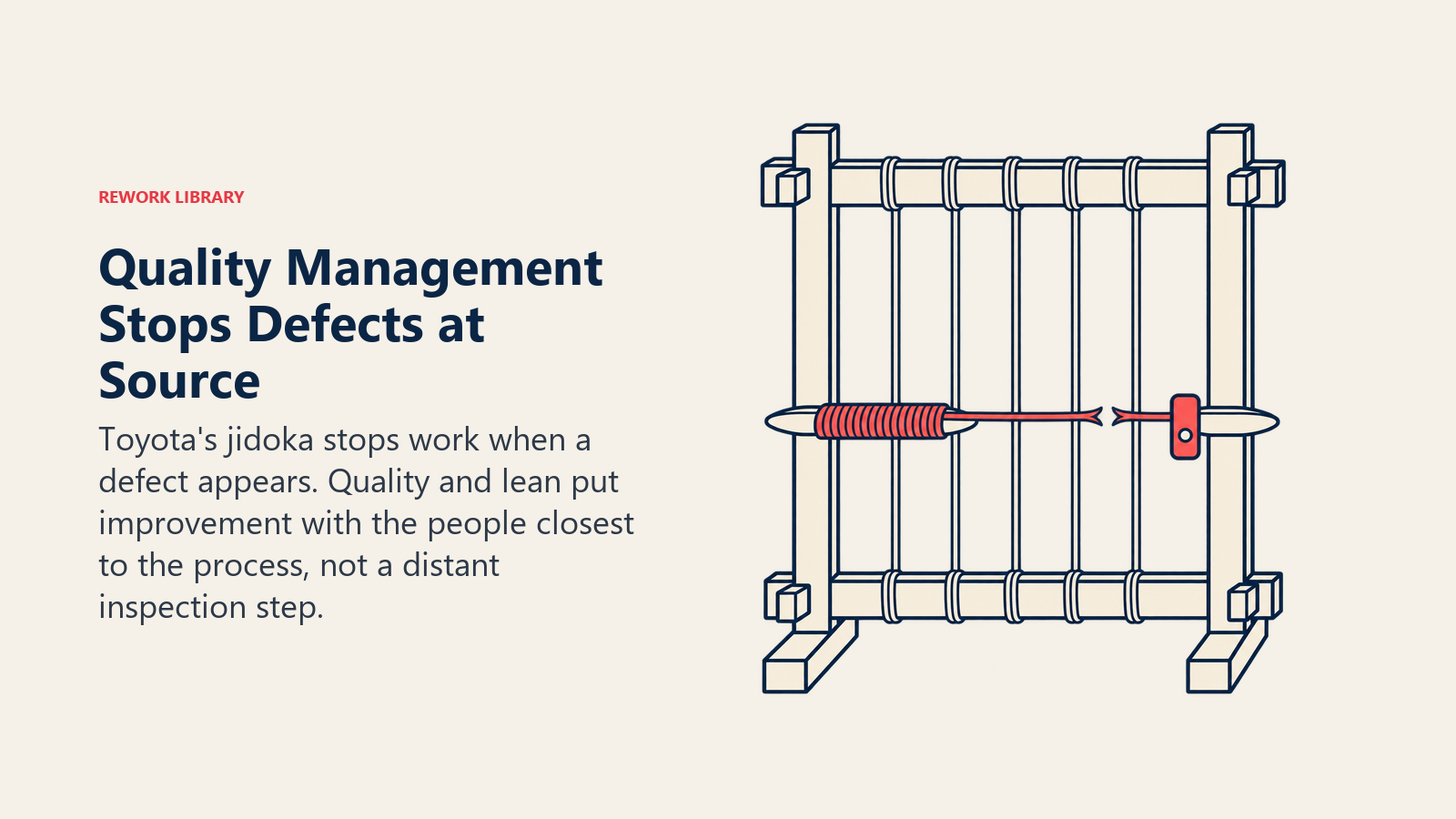
Toyota's own account of its production system rests on two pillars. Jidoka, "automation with a human touch," traces to Sakichi Toyoda's automatic loom and its weft-breakage stopping device of 1896. Just-in-Time, producing only what customers need, when they need it, is credited to Kiichiro Toyoda, and Taiichi Ohno created its basic framework. The Western names for these ideas came later and are covered in total quality management and lean methodology.
This school handed management a method for improving the work where it happens, using data and the people closest to it. Its limit is that it improves a process, and it can't tell you whether you are running the right business.
For teams today: build the habit of stopping when something is wrong and asking why, not routing around it.
The Agile Turn (1986-present)
Software teams replace the long plan with short loops
The last school in the standard order started in product development. In the January 1986 issue of the Harvard Business Review, Hirotaka Takeuchi and Ikujiro Nonaka argued in "The New New Product Development Game" that good quality, low cost and differentiation were no longer enough, and that development also takes speed and flexibility.
Fifteen years later, on February 11-13, 2001, seventeen developers met at The Lodge at Snowbird, a ski resort in Utah, and wrote the Agile Manifesto. It states four values, including "Responding to change over following a plan." In our reading, agile is the contingency idea turned into practice: short feedback loops, because the environment won't hold still. Its blind spot is the one Weber's school addressed. Without clear ownership and records, speed can become confusion at scale.
The newest question is how to coordinate people and software agents together. It has no school yet, and the history here suggests it will get one, probably labeled by someone else, later.
For teams today: match the cycle to the uncertainty. Use short loops where requirements shift, and written rules and owners where mistakes are expensive.
The Schools Compared
The table below puts the schools in order. The last two columns are our reading of each school, not a finding from the sources.
| School | Core question | Founders and founding text | What it got right | Blind spot |
|---|---|---|---|---|
| Scientific management | What is the best way to do this task? | Taylor, 1911 | Work can be studied and standardized | Treats people as inputs |
| Administrative management | What does a manager do? | Fayol, 1916 | Management is a teachable skill | Principles stated as universal |
| Bureaucracy | How do we run a large organization fairly? | Weber, 1921-22 | Roles, rules and records create consistency | Rules outlive their purpose |
| Human relations | What motivates people at work? | Mayo and Roethlisberger at Hawthorne, 1924-1932; McGregor, 1960 | Groups, norms and supervision matter | Few tools for hard trade-offs |
| Quantitative | How do we decide with the numbers? | Churchman, Ackoff and Arnoff, 1957 | Models improve repeatable decisions | Misses what can't be counted |
| Systems | How do the parts affect each other? | Bertalanffy, 1950; Kast and Rosenzweig, 1972 | Interdependence is visible | Abstract, hard to act on |
| Contingency | What fits this situation? | Burns and Stalker, 1961; Lawrence and Lorsch, 1967 | No single best way | "It depends" can excuse any choice |
| Quality and lean | How do we remove waste and defects at the source? | Deming in Japan, 1950; Toyota Production System | Improvement belongs to the people doing the work | Optimizes the process, not the strategy |
| Agile | How do we learn fast when we can't plan? | Takeuchi and Nonaka, 1986; Agile Manifesto, 2001 | Short loops fit uncertainty | Speed without ownership |
Key People
| Name | Role | Contribution | Year |
|---|---|---|---|
| Adam Smith | Moral philosopher and economist | Pin-factory argument for division of labor | 1776 |
| Daniel McCallum | General superintendent, New York and Erie Railroad | Early formal organizational chart | 1855 |
| Frederick W. Taylor | Engineer and consultant | The Principles of Scientific Management | 1911 |
| Henri Fayol | Director-general, Commentry-Fourchambault | Five functions and fourteen principles | 1916 |
| Max Weber | Sociologist | Analysis of bureaucracy | 1921-22 |
| Elton Mayo | Harvard researcher | Brought in to guide the Hawthorne research; co-author of its conclusions | 1928 |
| Douglas McGregor | MIT professor | Theory X and Theory Y | 1960 |
| Harold Koontz | UCLA professor | Named and counted the schools | 1961, 1980 |
| Tom Burns and G. M. Stalker | Researchers | Mechanistic and organic organizations | 1961 |
| W. Edwards Deming | Statistician and quality teacher | Taught quality control to Japanese industry | 1950 |
| Hirotaka Takeuchi and Ikujiro Nonaka | Management scholars | Speed and flexibility in product development | 1986 |
Key Facts
Key Facts: Schools of Management Thought
- Koontz's 1961 article named six schools, and his 1980 sequel listed eleven approaches.
- Taylor entered the machine shop of Midvale Steel in 1878, 33 years before his book.
- Western Electric's relay test room ran from 1927 to 1932 with six women operators.
- Fayol was director-general of Commentry-Fourchambault from 1888 to 1918.
- Seventeen developers wrote the Agile Manifesto at Snowbird, Utah, on February 11-13, 2001.
- Venice's Arsenale was established in 1104 and built ships for roughly 800 years.
The Pattern Behind the History
We call it the Blind-Spot Relay. It is our synthesis of the timeline above, not a research finding.
- Each school answers the last one's blind spot. Taylor's people-as-inputs invited Hawthorne. Hawthorne's softness invited the quantitative school. Rigid designs invited contingency and agile.
- Practice comes before the text. Taylor started at Midvale in 1878 and published in 1911. Fayol led his company from 1888 and published in 1916. The schools describe what practitioners already did.
- Schools don't die, they become toolkits. Time studies, functions, org charts, surveys, models and short loops all coexist in one ordinary company.
- Later writers draw the borders. The neat sequence is a classification. Koontz's own count changed between 1961 and 1980.
What It Teaches Teams Today
Treat the schools as a diagnostic menu, not a choice of religion.
- Work is unclear or inconsistent: reach for the classical tools, such as written procedures, clear roles and decision rights.
- Performance is flat despite good process: look at the human relations questions. How are people treated, and what do managers assume about them?
- Decisions are expensive or repeated: use models and measures, then check what they leave out.
- Teams affect each other in unexpected ways: think in systems and map the dependencies.
- A method that worked in one place fails in another: ask the contingency question about environment, technology and size.
- Defects and waste keep recurring: apply quality and lean thinking.
- Requirements keep changing: shorten the loop, as agile does, and keep owners clear.
And when someone offers a single framework for everything, remember Koontz's jungle. The pillar, The History of Management, gives the broader frame.

Co-Founder, Rework.com
On this page
- Timeline at a Glance
- The Precursors (c. 3100 BCE-1850s)
- The Classical Years (1878-1920s)
- The Hawthorne Turn (1924-1960)
- The Jungle Years (1950s-1980)
- Where the list of schools came from
- The Quality Revolution (1950-1990s)
- The Agile Turn (1986-present)
- The Schools Compared
- Key People
- Key Facts
- The Pattern Behind the History
- What It Teaches Teams Today