The History of the Division of Labor
Turn this article into takeaways for your work.


Each assistant summarizes the article only for you and suggests best practices for your work.
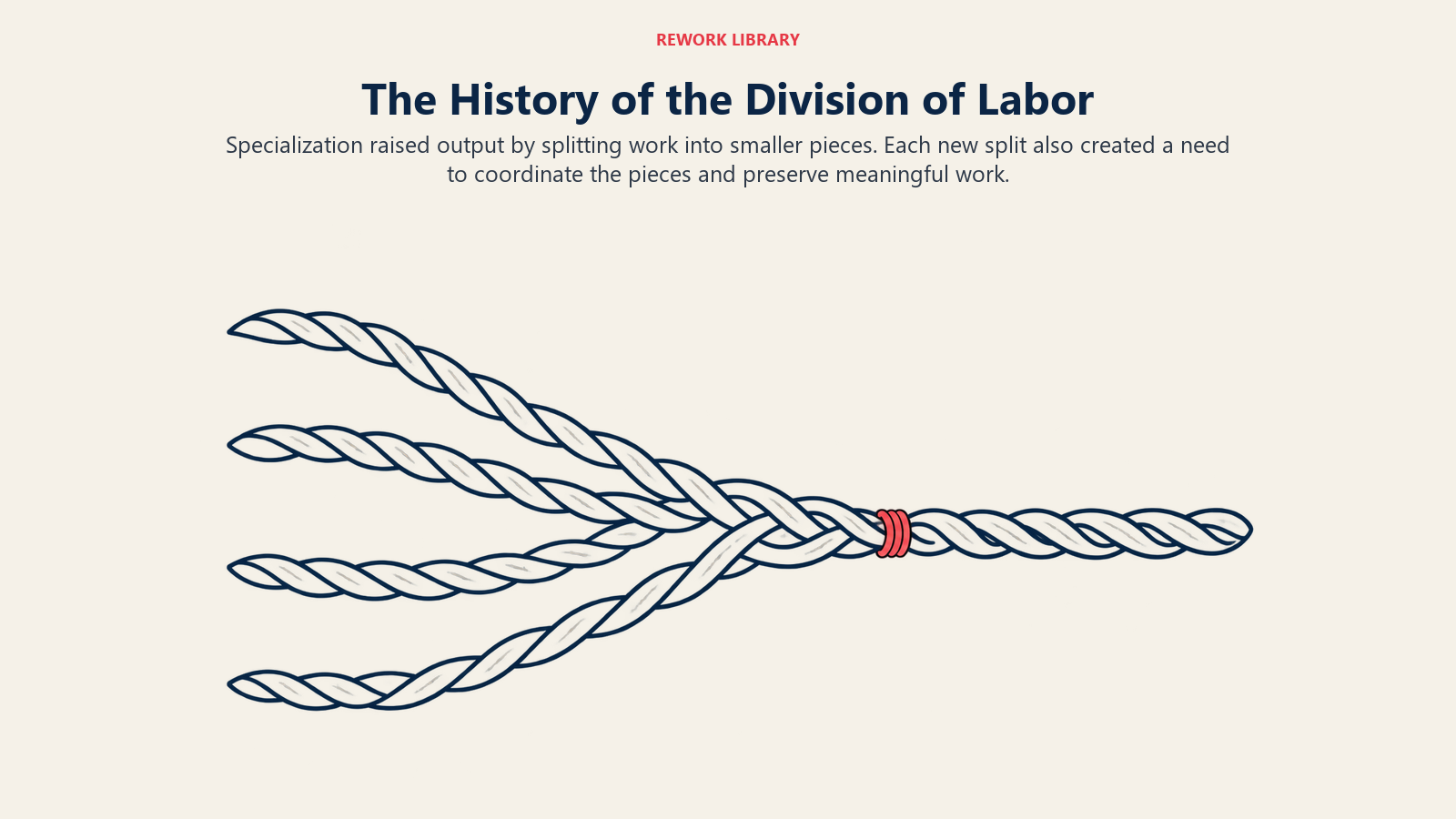
Picture a pin in 1776. Adam Smith described how it was made. Making one took many separate operations. Divided among workers, those operations produced far more pins in a day than each worker could make alone.
The division of labor took its modern name and numbers from Smith's pin factory. But splitting work among specialists is far older. Sumerian scribes were copying a standard list of professions in the earliest writing, around 3200 BCE. Greek writers were arguing for specialization in the fourth century BCE. The throughline is a trade. Each time work was divided, output per person rose and a new problem appeared. Who coordinates the pieces? And what happens to the person who does only one of them?
This page follows that idea backward to the earliest records of organized specialist work, and forward to the factory floor, the critics, the rebuilds and software. For the wider story it sits inside, start with the history of management.
Timeline at a Glance
| Year | Milestone | Why It Mattered |
|---|---|---|
| Around 3200 BCE | Writing begins in the late-Uruk period, and scribes copy a Standard Professions List | Named occupations were written down at the dawn of record-keeping, a precursor and not the concept. |
| 2112-2004 BC | In Ur III Girsu, wool is weighed out to weavers and finished textiles are weighed back | Output was planned, issued and checked by a central office. |
| Late reign of Khufu | Inspector Merer's team logs limestone shipments to the Great Pyramid | The oldest papyrus archive found in Egypt records a crew with a task, a ledger and deliveries. |
| 4th century BCE | Plato and Xenophon explain why specialization raises quality | The first theories of why splitting work helps, one tied to nature and one to market size. |
| 1776 | Adam Smith's Wealth of Nations opens with the pin factory | The idea became the first subject of political economy. |
| 1832 | Charles Babbage publishes On the Economy of Machinery and Manufactures | Division was shown to save money by matching skill to each step, and to apply to mental work. |
| 1867 | Marx's Capital, volume one, criticizes division of labour in the workshop | The cost to the worker became a central argument. |
| 1893 | Durkheim's The Division of Labour in Society | Specialization was recast as a source of social interdependence. |
| 1911 | Taylor's The Principles of Scientific Management | Planning was separated from doing, as a formal method. |
| October 1913 | Ford introduces the moving assembly line at Highland Park | Assembly time fell from 12.5 hours to 93 minutes. |
| 1916 | Fayol's administration work lists division of work first among 14 principles | Division was named a management principle, with stated limits. |
| 1951 | Trist and Bamforth publish their coal-getting study in Human Relations | Researchers began to study what a work system does to a work group. |
| 1976 | Hackman and Oldham publish "Motivation through the design of work" | Job design got a testable model. |
| 2020 | The World Bank's report on global value chains | Almost half of global trade involved production split across borders. |
| 2023 | "GPTs are GPTs" estimates which work tasks language models could affect | Division of labor is now applied to the task, not the job. |
The Specialist Workshop (around 3200-300 BCE)
Scribes, weavers and cobblers divide the work
The earliest documented trace sits in the first writing. The Oracc lexical-list project says writing was introduced in the late-Uruk period, around 3200 BCE, and that early accounts were built around commodities and names or titles. One of the oldest school texts, the Standard Professions List, is attested already in Uruk IV, according to Piotr Michalowski, and its Early Dynastic version runs 129 lines. Scribes copied it in cities from Uruk to Ebla for centuries. The list shows that people wrote down named occupations at the start of record-keeping. It does not tell us how those jobs split the work, so treat it as a precursor.
Managed production is easier to see in Ur III Girsu, which Richard Firth dates to 2112-2004 BC. Under the a2-ges-gar-ra system, the centre issued wool by weight to groups of weavers and weighed the finished textiles on return. Firth counts over 170 texts using the term, more than a hundred of them about wool or flax, and one tablet he translates allots 20 kg of wool for first-quality textiles. The weavers wove. The office decided how much of what to make, and weight was the control. That separation of deciding from doing comes up again in every later era.
Egypt left a different record. In 2013 archaeologists at Wadi el-Jarf found papyri that Pierre Tallet's IFAO edition calls the oldest papyrus archive ever found in Egypt, dated to the end of Khufu's reign. They are the archives of a team of sailors, with accounts of goods delivered to the workers and logbooks of limestone carried from the Tura quarries to the Great Pyramid. A later Egyptian crew shows finer specialization. A review of Davies's study of the workmen of Deir el-Medina says the gang that quarried and decorated the royal tombs was split into left and right sides, each headed by a Chief Workman, with a scribe reporting to the Vizier, and with specialist draughtsmen and sculptors alongside the ordinary workmen.
Greek writers supplied the theory. In the Republic, Plato's Socrates says we are not all alike and that work is done more plentifully and better when one person does the one thing that suits their nature at the right time. Plato died around 348/347 BCE. Xenophon's Cyropaedia, which Britannica dates to the 4th century BCE and describes as an idealized biography of Cyrus, makes a different argument in Book VIII. In a small city one craftsman makes beds, chairs, ploughs and tables. In great cities, he writes, demand is wide enough that a shoemaker can make only men's sandals, while others only stitch, cut or fit the parts. His cause is the size of the market, not the worker's nature.
Compare the two. Mesopotamian and Egyptian officials recorded how work was organized and checked. Greek writers asked why it worked. Nobody here used the phrase division of labor in Smith's sense, so keep the precursor and the concept apart: these societies specialized, and the Greeks reasoned about it, but the measuring came later.
What this means for teams today: The oldest management record is a ledger of who did what. If you can't say who owns each step of your work, you are behind a Sumerian weaving office.
Smith's Pin Factory (1776-1832)
Pins, the price of skill, and tables by the hundred
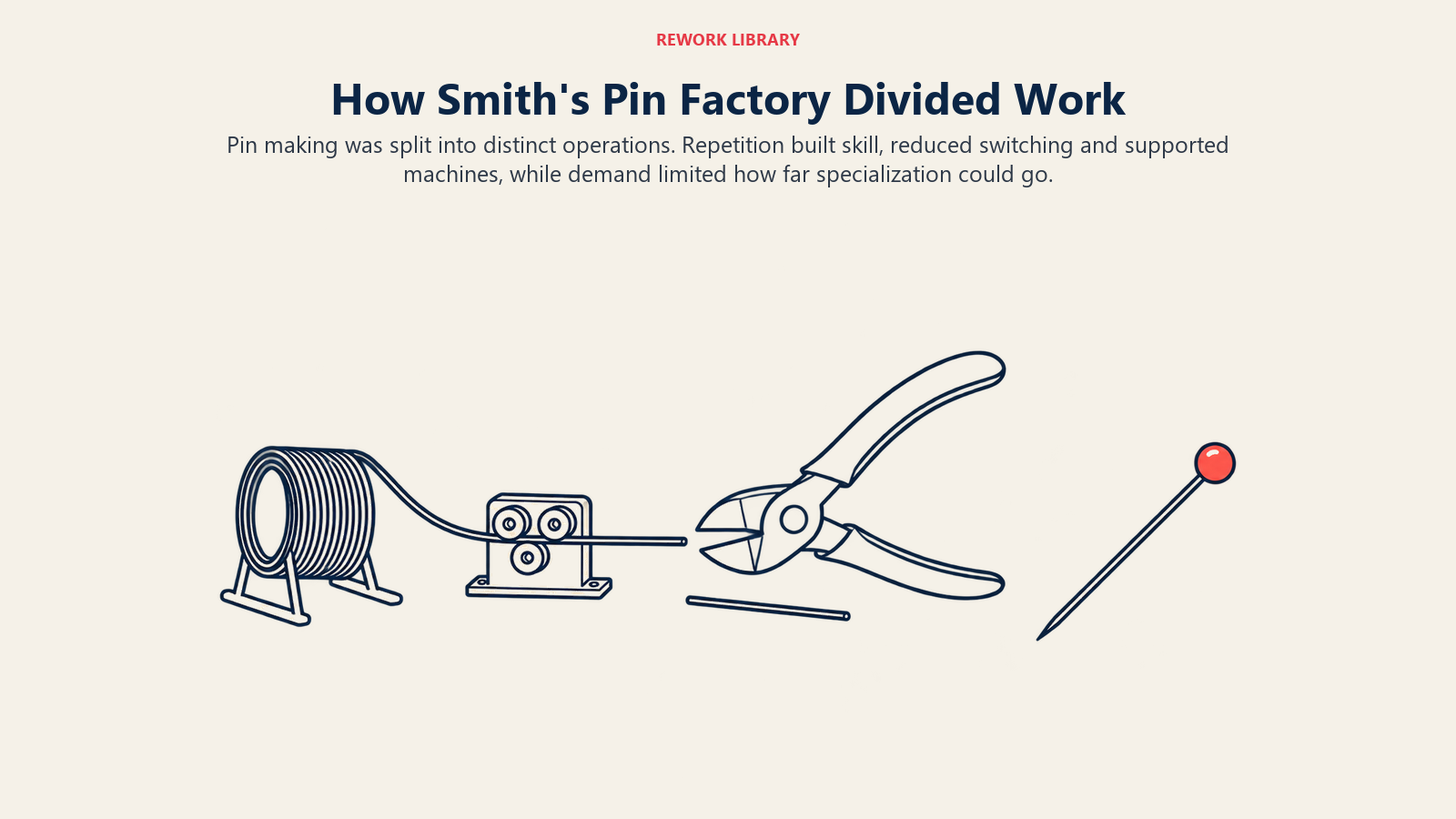
After a long gap in this story, the idea got its famous example. In The Wealth of Nations (1776), Book I, Chapter I, Adam Smith described a small pin manufactory where the business was divided into about eighteen distinct operations. One draws the wire, another straightens it, a third cuts it, a fourth points it. He gave three reasons for the gain: greater dexterity in each worker, less time lost in passing from one kind of work to another, and the invention of machines that let one person do the work of many. In Chapter III he added a condition that Xenophon had already sketched: the division of labour is limited by the extent of the market.
Smith also turned Plato around. He argued that the difference of natural talents between people is much less than we think, and that it is more the effect of the division of labour than its cause. A philosopher and a street porter, he wrote, start out alike and then diverge through the work they are put to. In Book V he warned about the cost: a person whose whole life goes into a few simple operations can become stupid and ignorant for lack of any need to think. The founding text carried its own warning label.
Charles Babbage supplied the arithmetic. His On the Economy of Machinery and Manufactures (1832) added a principle he said Smith's list left out: a master manufacturer who divides work into processes can buy exactly the skill and force each process needs, whereas one worker doing everything must have the skill of the hardest step and the strength of the heaviest. Using the pin trade, he worked out that paying the best-paid pin worker to do every step would make the pins cost three times and three quarters as much.
Babbage then took the idea out of the workshop. He relates that a French mathematician, M. de Prony, opened a copy of Smith in a bookseller's shop, hit the chapter on pins, and conceived the plan of manufacturing logarithm tables the same way. Babbage reports three sections: a few eminent mathematicians designed the formulas, a second group converted them into numbers, and a third, of sixty to eighty people, used only addition and subtraction. Nine-tenths of that third group, he writes, knew no arithmetic beyond the first two rules. The tables filled seventeen folio volumes. This is division of mental labor, and it is one root of the idea that computation could be mechanized.
What this means for teams today: Babbage's principle still prices every job. Don't spend your best people's hours on steps a cheaper skill could do, and don't split the work so far that nobody sees the whole.
The Critics Answer (1867-1893)
One idea, two verdicts: crippled workers, bound societies
The factory drew its critics. Karl Marx's Capital, volume one, chapter fourteen, first published in 1867, argues that manufacture turns the worker into a "crippled monstrosity" by forcing detail dexterity at the expense of the whole. He also separates two things: division of labour inside a workshop and division of labour across a society differ, he writes, not only in degree but in kind. Society's split is arranged by exchange. The workshop's is arranged by an employer's plan.
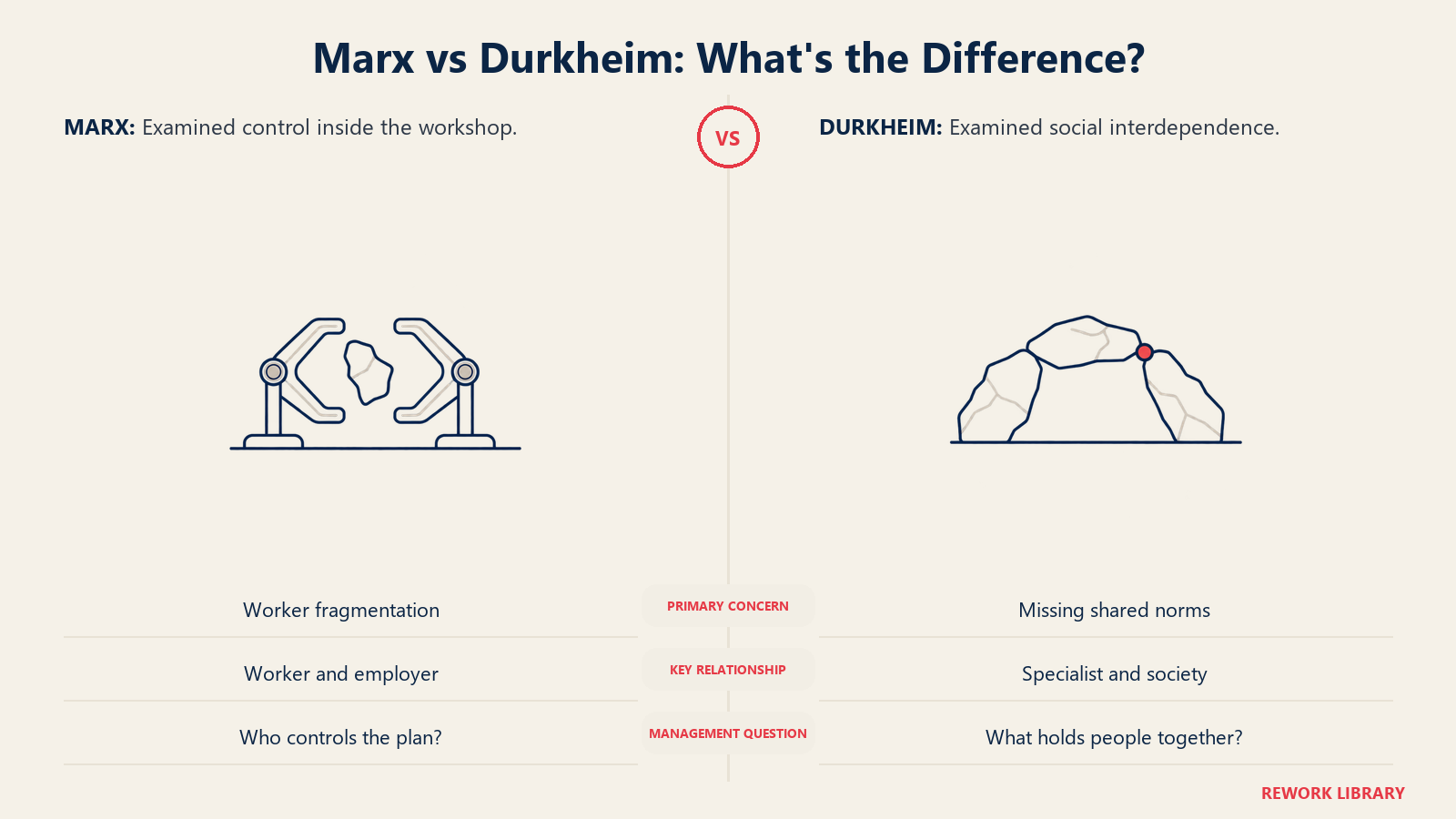
Émile Durkheim read the same facts and drew another conclusion. Britannica says his doctoral thesis, De la division du travail social (1893), held that societies with little division of labour showed mechanical solidarity, while those with high specialization showed organic solidarity. Specialization made people more alien to one another and more dependent on one another, because no individual built a product alone. For Durkheim the question was whether the new interdependence came with shared rules.
Hold both. Marx located the harm in who controls the plan. Durkheim located the risk in missing norms between the specialists. Both are still asked in every reorganization.
What this means for teams today: Specialists need a shared picture of the whole product. Without it you get Marx's fragment-worker on the inside and Durkheim's strangers on the outside.
The Taylor and Ford Years (1911-1922)
Planning splits from doing, then the work starts moving
Frederick W. Taylor made the split a method. In The Principles of Scientific Management (1911) he described an "almost equal division of the work and responsibility" between management and workmen. Management took over what it was better fitted for: study, planning and instruction. He listed a planning department, time study, standardization and functional foremanship among the elements of the system. This is division of labor between thinking and doing, and its rise and backlash are traced in our history of scientific management. Our articles on scientific management, time and motion study and standard work cover the tools.
Henry Ford moved the pieces past the people. The Library of Congress dates the moving assembly line at Highland Park to October 1913 and says assembly time fell from 12.5 hours to 93 minutes. In My Life and Work (1922) Ford described the chassis line as forty-five operations or stations, and wrote that the man who places a part does not fasten it, the man who puts in a bolt does not put on the nut. In the same book he said an inquiry found 7,882 different jobs in the factory. Division had gone from the pin to the plant.
Meanwhile Henri Fayol, writing from the top, put division of work first in his list of 14 principles. He wrote that specialization belongs to the natural order and that workers kept on the same part gain ability, sureness and accuracy. Then he added a limit: division of work has its limits, which experience and a sense of proportion teach us not to exceed. His work first appeared in French in 1916, and the English translation by Constance Storrs cited here was published in 1949. See Fayol's administrative management, and for how his principles were written and spread, our history of Henri Fayol and the principles of management.
The era solved cost and speed. It created the next problem: the more finely the work was cut, the more planners, schedulers and foremen it took to put it back together.
What this means for teams today: Every handoff has a coordination cost. Before splitting a process again, count the people it will take to reassemble it.
The Backlash (1951-1980s)
Researchers and Toyota put the jobs back together
A long stretch separates Ford's line from the next turn, and the turn came from researchers. E. L. Trist and K. W. Bamforth's 1951 paper in Human Relations examined the social and psychological consequences of the longwall method of coal-getting, and asked how the technology and the social structure of the work system shaped the work group. The title alone puts the work group on the same footing as the machine.
Frederick Herzberg took the criticism into the job itself. HBR's summary says he researched employee motivation across the 1950s and 1960s. His classic article told managers to stop leaning on praise, punishment and cash and to make jobs more interesting instead, by enriching the work itself rather than piling more of the same tasks onto it. Hackman and Oldham gave the argument a model in 1976, later summarized as five core dimensions that include skill variety and task identity. Read our guide to the job characteristics model.
Toyota took a different road through the same problem. Takahiro Ōba's 2020 paper, citing an interview with Taiichi Ōno, says Toyota valued multi-skilled workers, operators who perform several standard operations along a workflow, as opposed to all-round workers who can do any operation. Specialization stayed, but each person owned a run of connected steps. The principles behind that are in our lean methodology article.
Notice the shape. The backlash did not abolish division of labor. It rearranged the divisions so that the person kept more of the whole.
What this means for teams today: Widening a job by adding more of the same tasks does not help. Add the planning, the checking or the customer contact that makes the work meaningful.
The Unbundled Task (2009-present)
Borders, firms and software take slices of the work
The newest slicing is smaller than the job. The World Bank's World Development Report 2020 says almost 50 percent of global trade involves global value chains, with goods crossing borders multiple times. Smith's pin line now runs across countries, with the same logic: specialize where the work is best done, then coordinate.
Specialization has also moved into the knowledge itself. In a 2009 paper in the Review of Economic Studies, Benjamin Jones argued that as the burden of knowledge grows, innovators can choose narrower expertise, which reduces individual capacity and leads to greater reliance on teamwork. The model predicts increased specialization and teamwork, which echoes Babbage's mental labor.
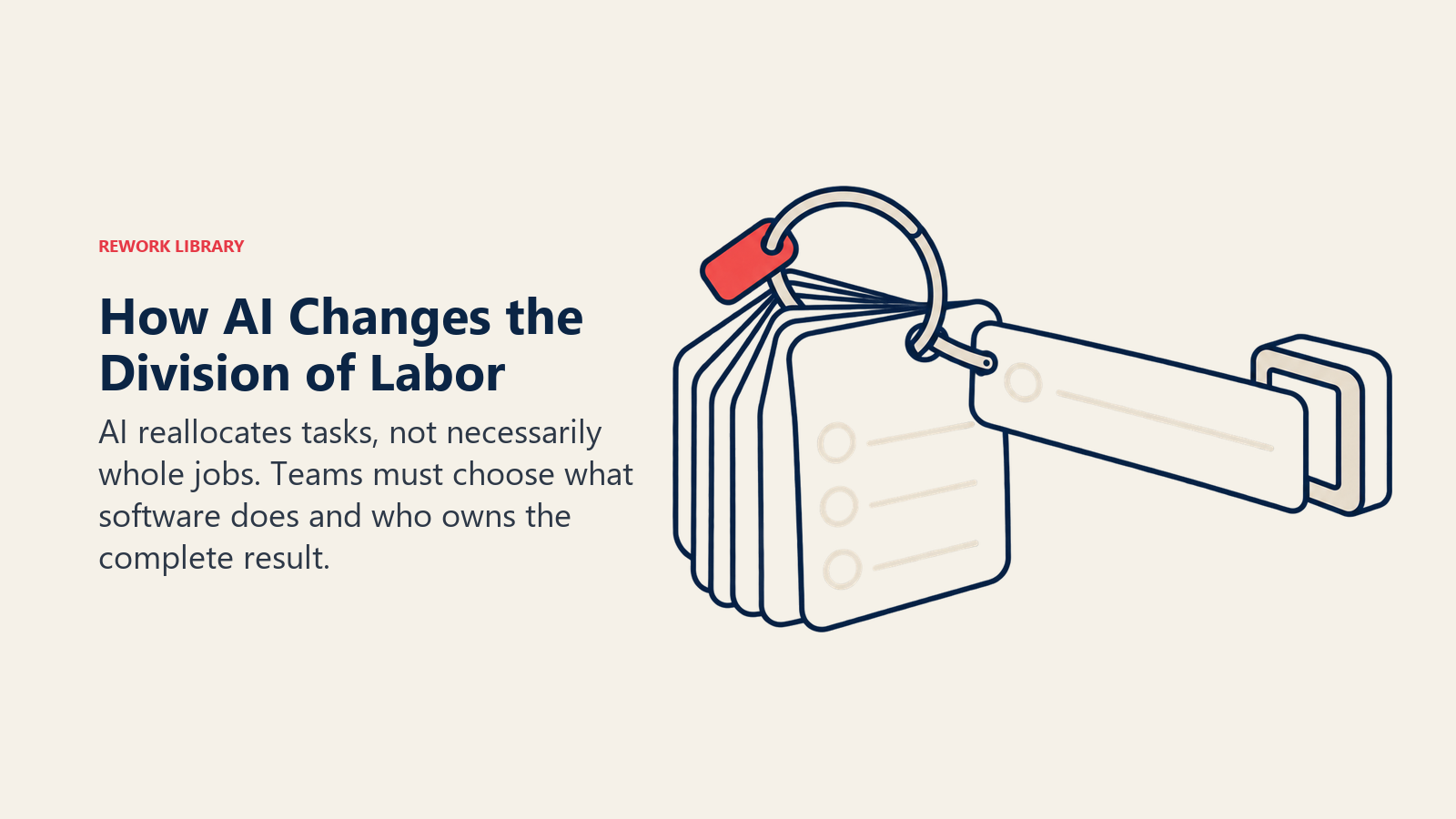
Software now takes slices too. In "GPTs are GPTs", Eloundou, Manning, Mishkin and Rock estimated that around 80 percent of the US workforce could have at least 10 percent of their work tasks affected by large language models, and about 19 percent could see at least half their tasks affected. These are exposure estimates for tasks, not measured outcomes, but the unit of analysis is the telling part. The question is no longer which job a machine replaces. It is which tasks inside each job move to it. That is Babbage's principle again: assign each piece to the cheapest capable worker, human or not.
What this means for teams today: Map work at the task level before you automate. Decide which slices a person must still own, and write down who answers for the whole.
Key People
| Name | Role | Contribution | Year |
|---|---|---|---|
| Plato | Greek philosopher | Argued that work is better done when one person does one thing suited to their nature, in the Republic | 4th century BCE |
| Xenophon | Greek historian | Tied specialization to the size of the city and its demand, in the Cyropaedia | 4th century BCE |
| Adam Smith | Moral philosopher | Described the pin factory and its three gains in The Wealth of Nations | 1776 |
| Charles Babbage | Mathematician and engineer | Showed that division lets a manufacturer buy only the skill each step needs | 1832 |
| Karl Marx | Economist and critic | Argued that workshop division cripples the individual worker | 1867 |
| Émile Durkheim | Sociologist | Linked high specialization to organic solidarity | 1893 |
| Frederick W. Taylor | Engineer and consultant | Divided planning from doing in scientific management | 1911 |
| Henry Ford | Manufacturer | Broke assembly into stations on the moving line | 1913 |
| Henri Fayol | Mining executive and writer | Listed division of work first among 14 principles, with a limit | 1916 |
| E. L. Trist and K. W. Bamforth | Researchers | Studied the work group inside a technical system | 1951 |
| Hackman and Oldham | Organizational psychologists | Built a job design model | 1976 |
Key Facts
Key Facts: Division of Labor History
- Smith wrote that ten workers in a small pin manufactory could make upwards of forty-eight thousand pins in a day, where alone none could make twenty.
- Babbage reported that Prony's third section of sixty to eighty calculators used only addition and subtraction, and that nine-tenths knew no more arithmetic.
- The Library of Congress says Ford's line cut assembly from 12.5 hours to 93 minutes from October 1913.
- Ford's own book counted 7,882 different jobs in the factory when an inquiry was made.
- Herzberg's best-known HBR article argued that managers motivate people by making their jobs more interesting, not through praise, punishment or cash.
- The World Bank says almost half of global trade involves global value chains.
The Pattern Behind the History
We call this the Split and Rejoin pattern. It is our reading of the timeline, not a research result.
- Split where the market is big enough. Xenophon's great cities and Smith's chapter on the extent of the market make the same point: demand pays for specialists.
- Price the pieces. Babbage showed that splitting lets you pay for exactly the skill each step needs, which is why the split spreads.
- Pay the human cost. Smith, Marx and Herzberg each named what a narrow job does to the person doing it.
- Rejoin the pieces. Each era added a coordinator: Fayol's limit, Taylor's planners, Durkheim's shared norms, Toyota's multi-skilled operators.
- Cut finer. The unit shrinks from trade to operation to task, and the cycle starts again.
What It Teaches Teams Today
- Specialize where demand is steady enough to keep a specialist busy. Xenophon's small city is a good model for a small team: a generalist is fine until volume justifies a role.
- Price a split before making it. Babbage's test still works: are you paying for skill you don't need at a step?
- Count the coordination cost. Every split adds handoffs, and someone has to own the whole outcome. Fayol's own limit is the warning.
- Enrich, don't just enlarge. Give each specialist a view of the finished product, a piece of the planning and a way to hear from the customer.
- Slice work at the task level before automating, and name a human owner for each automated slice.
For the larger arc, read the management theory timeline, the schools of management thought, and the productivity side of the story in the origin of productivity and the history of productivity.
Every era divided the work to gain something and then paid to put it back together. Teams that know the price of both halves will make better cuts.

Co-Founder, Rework.com