Who Is the Father of Modern Management?
Turn this article into takeaways for your work.


Each assistant summarizes the article only for you and suggests best practices for your work.
Picture a ledger from about 2028 BCE. A scribe in Umma, in southern Mesopotamia, presses wedge-shaped marks into a small clay tablet. It records rations of beer, bread, oil and onions for messengers, according to the Metropolitan Museum of Art's entry. Nobody who made it would have called the job management. And yet someone was clearly counting, assigning and checking.
Peter Drucker holds the title "father of modern management." His 1954 book The Practice of Management is widely considered the first book to organize management into one body of knowledge. Frederick Winslow Taylor carries a different title, Father of Scientific Management. Henri Fayol, a French mining executive, wrote the first widely cited account of what managers do. The title is contested because three men answered three different questions: how to do the work, what a manager does, and what management is for.
Management as a practice is older than the word by thousands of years. And each of those three answers arrived in a different decade. The fight over the "father" is really a fight over the day the practice became a subject people could study and teach.
Timeline at a Glance
For the full chronology of management ideas, read the management theory timeline. This table covers only the dates that bear on the title.
| Year | Milestone | Why It Mattered |
|---|---|---|
| Around 2600 BCE | Inspector Merer's team logs its daily work hauling stone for Khufu's pyramid | The oldest surviving papyrus archive shows work gangs managed by written records. |
| Ca. 2028 BCE | Ur III scribe records rations for messengers on a clay tablet | Written accounting of goods and rations for a state. |
| 1776 | Adam Smith describes the pin factory | Division of labor makes coordination a task of its own. |
| 1832 | Charles Babbage publishes On the Economy of Machinery and Manufactures | He treats the pricing of skill as a design choice for the manager. |
| 1855 | Daniel McCallum's New York and Erie Railroad organization diagram | Authority and reporting lines are drawn on paper. |
| 1878 | Taylor enters the Midvale Steel machine shop | The start of the work studies that led to scientific management. |
| 1911 | Taylor publishes The Principles of Scientific Management | A named method for designing work. |
| 1916 | Fayol's treatise on administration appears in French | Management is described as a set of functions at the top of the firm. |
| 1929 | First English translation of Fayol, by J. A. Coubrough | A small printing reaches Britain, and none is published in the United States. |
| 1946 | Drucker publishes Concept of the Corporation after studying General Motors | The large corporation becomes an object of study. |
| 1949 | Constance Storrs's translation, General and Industrial Management, is published by Pitman | Fayol finally reaches the English-speaking world at scale. |
| 1954 | Drucker publishes The Practice of Management | The first integrated book on managing an organization. |
| 1973 | Drucker publishes Management: Tasks, Responsibilities, Practices | A reference work for managers in business, nonprofits and government. |
| 2005 | BusinessWeek calls Drucker "the man who invented management" shortly before his death | The title settles on him in the public record. |
The Ancient Administrators (c. 2600 BCE-1700s)
Scribes, ledgers and manuals ran big work long before the word
Begin on the Nile, at the end of the reign of Khufu. In 2013 archaeologists at Wadi el-Jarf, a Red Sea port used in the 4th Dynasty, found a cache of papyri at the entrance of a storage gallery. Pierre Tallet's publication calls it the oldest papyrus archive ever found in Egypt. It holds accounts of goods delivered to workers and the logbooks of a crew under an inspector named Merer, who moved limestone blocks by boat from the quarries at Tura to the Great Pyramid at Giza. The entries read like a shift roster: the inspector spends the day with his team hauling stone at Tura South, and spends the night there. Tallet estimates the team at about 40 members, a figure he derives from the monthly bread ration someone was sent to collect in Heliopolis, and he dates the log to the year after Khufu's 13th census, Year 26 of the reign. An earlier 2014 article by Tallet and Gregory Marouard, as reported by Live Science, put Merer in charge of about 200 men in Khufu's 27th year, so the crew size depends on which reading you follow.
A different culture, a different tool. The Met holds an Ur III tablet from Umma, dated around 2028 BCE, that records rations of beer, bread, oil and onions for messengers. Egyptians tracked labor in daily logs that follow a crew through time. The Sumerians tracked goods in ledgers that follow commodities through a state. Both were solving one problem: how a ruler checks that people he can't see did the work he can't watch.
India produced a manual of the craft. The Arthashastra, attributed to Kautilya, is a Sanskrit treatise on statecraft whose second book is titled "The Duties of Government Superintendents" in R. Shamasastry's English translation. It describes an accounts office, with the door facing north or east, shelves of account books and clerks at assigned seats. It also builds in an incentive rule: a superintendent who raises his department's net revenue is rewarded eight times the gain, and one who lowers it pays eight times the loss. And it counts the ways people cheat, noting about forty ways of embezzlement. The date and authorship of the text are debated: the World History Encyclopedia notes that the attribution to Kautilya has been challenged. Shamasastry's English translation was published in 1915, which is why the text entered the modern conversation at all.
Keep the precursor apart from the concept. Merer's crew, the Umma scribe and the Arthashastra's accountants practiced management, but nobody had separated it as a field, and nobody argued about who founded it. What they leave behind is a useful test for the "father" question: a father is someone who turned a practice into a subject, with a name, a theory and students. The next era shows how that began.
For teams today: the oldest management tools are the written log, the ledger and the clear rule about who checks whom. If your team can't produce its own version of Merer's daily record, you are managing by memory.
The Factory Thinkers (1776-1880s)
Smith divides the work, Babbage prices it, McCallum draws it
Move to a pin factory in Adam Smith's The Wealth of Nations (1776). Ten men, each performing one or two of the steps, could by Smith's count make upwards of forty-eight thousand pins in a day. Smith was an economist, not a manager, and he wrote about the gain from specialization. But he planted the problem every later claimant would address: once work is divided, someone must coordinate the pieces.
The first writer to treat that as the manager's job was Charles Babbage. In On the Economy of Machinery and Manufactures (1832), after quoting Smith's three causes of gain from division of labor, Babbage adds a principle he says had been overlooked: by dividing the work into processes of differing skill or force, the master manufacturer can buy exactly the amount of each that each process needs, rather than paying skilled wages for everything. That is a managerial decision about job design and pay, made more than two decades before McCallum's chart and nearly eight decades before Taylor's book.
The railroad supplied the scale. In 1855, Daniel McCallum, general superintendent of the New York and Erie Railroad, published a diagram of the company's organization. The Library of Congress catalogs it as a 1855 map by McCallum and G. H. Henshaw. Slate, summarizing the historian Caitlin Rosenthal, says the chart put daily responsibilities in the hands of divisional superintendents who reported to a central office, and that McCallum used hourly, daily and monthly reports to calculate metrics such as cost per ton-mile.
None of these men gets the "father" title, and the reason is instructive. Smith described the economics, Babbage described the factory, and McCallum drew a chart for one company. None of them wrote a general account of the manager's job or founded a movement around it. They supplied the problems that the next era would claim to solve.
For teams today: every org chart descends from McCallum's, and every pay scale from Babbage's observation that skill has a price. Ask whether your design pays skilled people for skilled work only.
The Taylor Years (1878-1915)
An engineer times the work and earns a title of his own
The setting is the machine shop of the Midvale Steel Company. Frederick Winslow Taylor writes that he came into the shop in 1878. Stevens Institute of Technology records that he began as a machine-shop laborer and earned a bachelor's degree in 1883 by correspondence while working. ASME, the professional society, says that he earned the title "Father of Scientific Management" for his shop-management philosophies, and Stevens notes he was elected ASME's president in 1906.

His 1911 book, The Principles of Scientific Management, gave the movement its name and its pitch. Taylor wrote that at the Bethlehem Steel yard pig iron was being loaded at 12 and a half tons per man per day, and that the task he and his colleagues set under the new plan was 47 tons per man per day. Those figures are his own account. The line that mattered more than the numbers was a claim about priority: in the past the man had been first, and in the future the system must be first. Work, in other words, could be studied and designed, and the designing was the manager's job. Our article on scientific management sets out the method and its critics, and time and motion study covers its core tool.
Why Taylor is called the father of scientific management but not of management as a whole is clear from his own scope. He worked, as the later foreword to Fayol puts it, primarily at the operative level, from the bottom of the industrial hierarchy upward. He answered the question how to do the work well. He did not describe the whole manager's job or the executive's, and he died in 1915, before the most important treatise on administration reached readers.
For teams today: Taylor's lasting idea is that the process deserves as much attention as the person. His lasting mistake was to treat the person as an input to the process.
The Fayol Rediscovery (1916-1949)
A mining chief describes the manager's job, and English waits
Go next to a coal and steel combine in central France. Henri Fayol had joined the Commentry pits as an engineer in 1860, according to L. Urwick's foreword to the English edition, and in 1888 he became managing director of a company on the verge of bankruptcy, with no dividend paid since 1885. Under his leadership it recovered and kept growing. He retired in 1918, aged 77.
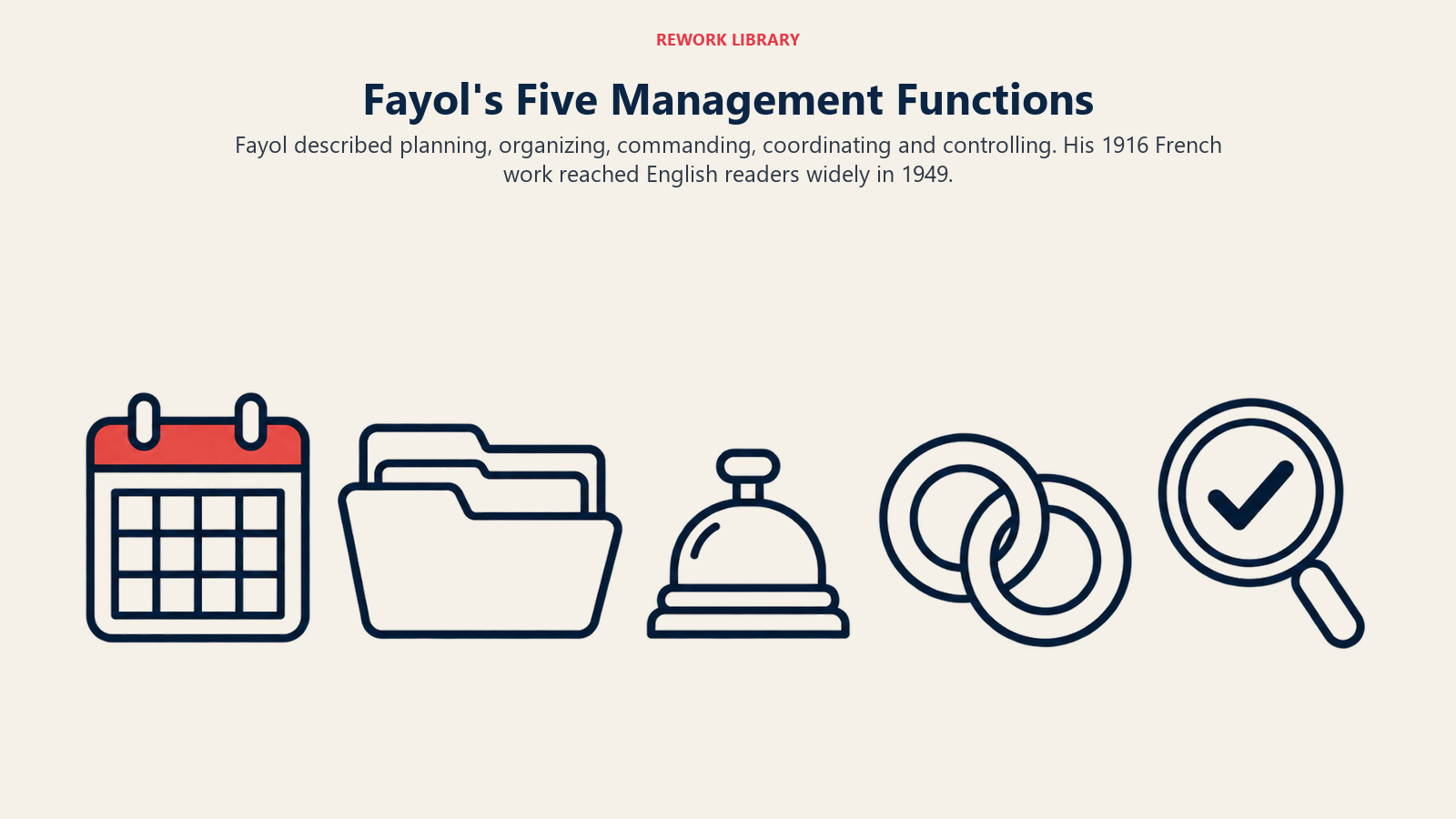
His theory of administration first appeared in French in 1916, in the third issue of the year of the Bulletin de la Société de l'Industrie Minérale. Urwick says it was no sudden exposition: Fayol had sketched the direction in papers delivered in 1900 and 1908. The treatise's famous line is a list of five activities, which the Storrs translation renders as forecasting and planning, organizing, commanding, coordinating and controlling. That is the origin of the functions of management taught in every business course; see functions of management and administrative management for detail.
The dates matter here, and they are easy to blur. The French original dates to 1916. The first English edition was issued in 1929, translated voluntarily by J. A. Coubrough and printed in Geneva, with a few hundred copies going to a British publisher. No English translation had been published in the United States, Urwick writes, and he calls Fayol the greatest of the European pioneers of management. The wider English edition, translated by Constance Storrs and published by Pitman in London, carries the date 1949. So English-speaking managers met Fayol roughly three decades after the French did, and well after Taylor's name was famous. That gap is much of why Fayol is not the common answer to the "father" question in the United States.
Urwick adds that people tried to set Fayol against Taylor, and that Fayol himself said so was false at a congress in Brussels in 1925. Urwick's reading is that the two were complementary: Taylor worked up from the shop floor, Fayol down from the managing director's chair. Fayol, for his part, wrote in the book that Taylor had rendered great service in drawing attention to the importance of a staff mechanism for running workshops.
For teams today: Fayol's five activities still describe a manager's week. Use them as a checklist: are you planning, organizing, directing, coordinating and checking, or only reacting?
The Drucker Years (1946-2005)
Management becomes a discipline, and one man gets the title
The scene shifts to General Motors. Peter Drucker, born in Vienna on 19 November 1909 and an immigrant to the United States in 1937, was invited inside General Motors, and the result was Concept of the Corporation in 1946. He met GM's chairman Alfred Sloan during the study. His first book, The End of Economic Man, was about the rise of the Nazis, which tells you where his interest started: how organized society holds together or fails. This era overlaps the last: Concept of the Corporation appeared three years before the Pitman edition of Fayol.
The turning point was 1954. In The Practice of Management, Drucker pulled together what had existed as separate books on finance or personnel. By the Drucker Institute's account, he recalled that earlier writing resembled a book on anatomy that discussed one joint without mentioning the skeleton, and that while writing the book he was very conscious of laying the foundations of a discipline. It introduced management by objectives, which you can read about in management by objectives. In 1959, the Institute notes, he coined the term "knowledge work." In 1973 came Management: Tasks, Responsibilities, Practices, which the Institute says became the playbook for generations of executives in business, nonprofits and government. For his profile as a leader, see Peter Drucker's leadership.
Near the end of his life, Drucker listed what he considered his main contributions, and the third was that he established the study of management as a discipline in its own right. That is the sense in which "father of modern management" fits him. Taylor designed the work, Fayol described the manager's job, and Drucker argued management was a discipline of its own and that it governed every organization, not only the business. In 2002 Drucker received the Presidential Medal of Freedom, and the Drucker Institute records President Bush calling him the world's foremost pioneer of management theory. Shortly before his death on 11 November 2005, BusinessWeek called him "the man who invented management."
Note the careful wording in both. "Foremost pioneer" and "invented management" are praise for a body of work, not a claim that nothing existed before. As the first three eras show, a great deal did.
For teams today: Drucker's contribution is the question that comes before the technique: what is this organization for, and what results does each person owe it? Start there before you reorganize or buy a tool.
The Contested Crown (2005-present)
Each claimant owns a different half of the job
Today the title sits where the public record put it. The Drucker Institute's own page about him is headed The Father of Modern Management. ASME's profile of Taylor carries the other, narrower title. Urwick, who wrote the foreword to Fayol's English edition, called him the greatest of the European pioneers. And the field keeps producing new claimants as it widens: Mary Parker Follett, whose writings of the 1920s were collected in 1995 as Mary Parker Follett: Prophet of Management by Harvard Business School Press, is another name often put forward.
The lasting disagreement is a disagreement about definitions, much like the one in who invented the Internet. If management means the study of work design, the father is Taylor. If it means the functions an executive performs, Fayol has the stronger claim. If it means a discipline of results, responsibility and people across all institutions, Drucker does. The table below lays it out. For a map of how those schools split and competed, read schools of management thought.
| If by "management" you mean | The name usually given | Evidence |
|---|---|---|
| The scientific design of work | Frederick Winslow Taylor | ASME gives him the title Father of Scientific Management; book published 1911 |
| The functions a manager performs | Henri Fayol | French treatise 1916; English editions 1929 and 1949 |
| Management as a discipline of its own | Peter Drucker | The Practice of Management, 1954; BusinessWeek's "man who invented management" |
| Organizational structure on paper | Daniel McCallum | New York and Erie Railroad diagram, 1855 |
| The economics of dividing work | Adam Smith, then Charles Babbage | Wealth of Nations 1776; Babbage 1832 |
| Administration in the ancient world | Unnamed scribes and officials | Egyptian papyri, Sumerian tablets, the Arthashastra |
For teams today: when someone declares a single founder of a field, ask what definition is doing the work. The same habit settles most arguments in your own company about who "invented" a process.
Key People
| Name | Role | Contribution | Year |
|---|---|---|---|
| Merer | Egyptian inspector | His logbooks record daily work of a crew hauling stone for Khufu's pyramid | Khufu's Year 26 |
| Adam Smith | Economist | Described division of labor through the pin factory | 1776 |
| Charles Babbage | Mathematician and inventor | Argued that dividing work lets a manufacturer pay only for the skill each step needs | 1832 |
| Daniel McCallum | Railroad general superintendent | Published the organization diagram of the New York and Erie Railroad | 1855 |
| Frederick Winslow Taylor | Engineer, ASME president | Wrote The Principles of Scientific Management | 1911 |
| Henri Fayol | Mining engineer and managing director | Described the managerial activities of an executive | 1916 |
| L. Urwick | British management writer | Wrote the foreword to Fayol's English edition and defended the Taylor and Fayol pairing | 1949 |
| Mary Parker Follett | Management writer | Her 1920s writings were collected as Prophet of Management | 1920s; collected 1995 |
| Alfred Sloan | GM chairman | Met Drucker during his study of General Motors and became his model of the effective executive | 1940s |
| Peter Drucker | Writer and consultant | Wrote The Practice of Management and defined management as a discipline | 1954 |
Key Facts
- In his 1911 book Taylor set the Bethlehem Steel pig-iron task at 47 tons per man per day, in place of 12 and a half tons.
- Fayol's theory first appeared in French in 1916; the first English edition came out in 1929 and the Pitman edition carries the date 1949.
- The Drucker Institute says The Practice of Management (1954) is widely considered the first book to organize running an organization into an integrated body of knowledge.
- ASME says Taylor earned the title Father of Scientific Management.
- The Library of Congress catalogs the New York and Erie Railroad's organization diagram as an 1855 map.
- Merer's logbooks, found at Wadi el-Jarf, make up the oldest papyrus archive ever found in Egypt, according to the excavator.
The Pattern Behind the History
Our synthesis, not published research: the "father of modern management" title followed four habits.
- One title, three questions. Taylor answered how to do the work, Fayol what a manager does, Drucker what management is for.
- Language gates fame. Fayol's 1916 treatise reached English readers in 1929 in a small printing and at scale in 1949; Taylor's 1911 book was English from the start.
- Practice comes before the name. Egyptian crews, Sumerian ledgers and the Arthashastra's accounts offices managed work long before anyone wrote a theory of it.
- The title goes to the one who defines the field. The label sits with the person who gave later readers a discipline to teach, not the first person who did the work.
What It Teaches Teams Today
- Ask which question you're answering. A process problem is Taylor's question, an ownership problem is Fayol's, a purpose problem is Drucker's. Using the wrong lens wastes the quarter.
- Write the log. Merer's crew left a daily record that is still readable 4,500 years later. A dated, written record of who did what settles more arguments than a good memory.
- Don't confuse the first with the founder. Every function in your company has a precursor that nobody credited. Credit the predecessor when you present the new method.
- Read the foreword, not just the book. The Taylor and Fayol rivalry was partly invented by their followers, and Fayol himself rejected it. Your internal factions may be similar.
For the wider story of how management ideas grew and split, return to the history of management.

Co-Founder, Rework.com