The History of Matrix and Flat Organizations
Turn this article into takeaways for your work.


Each assistant summarizes the article only for you and suggests best practices for your work.
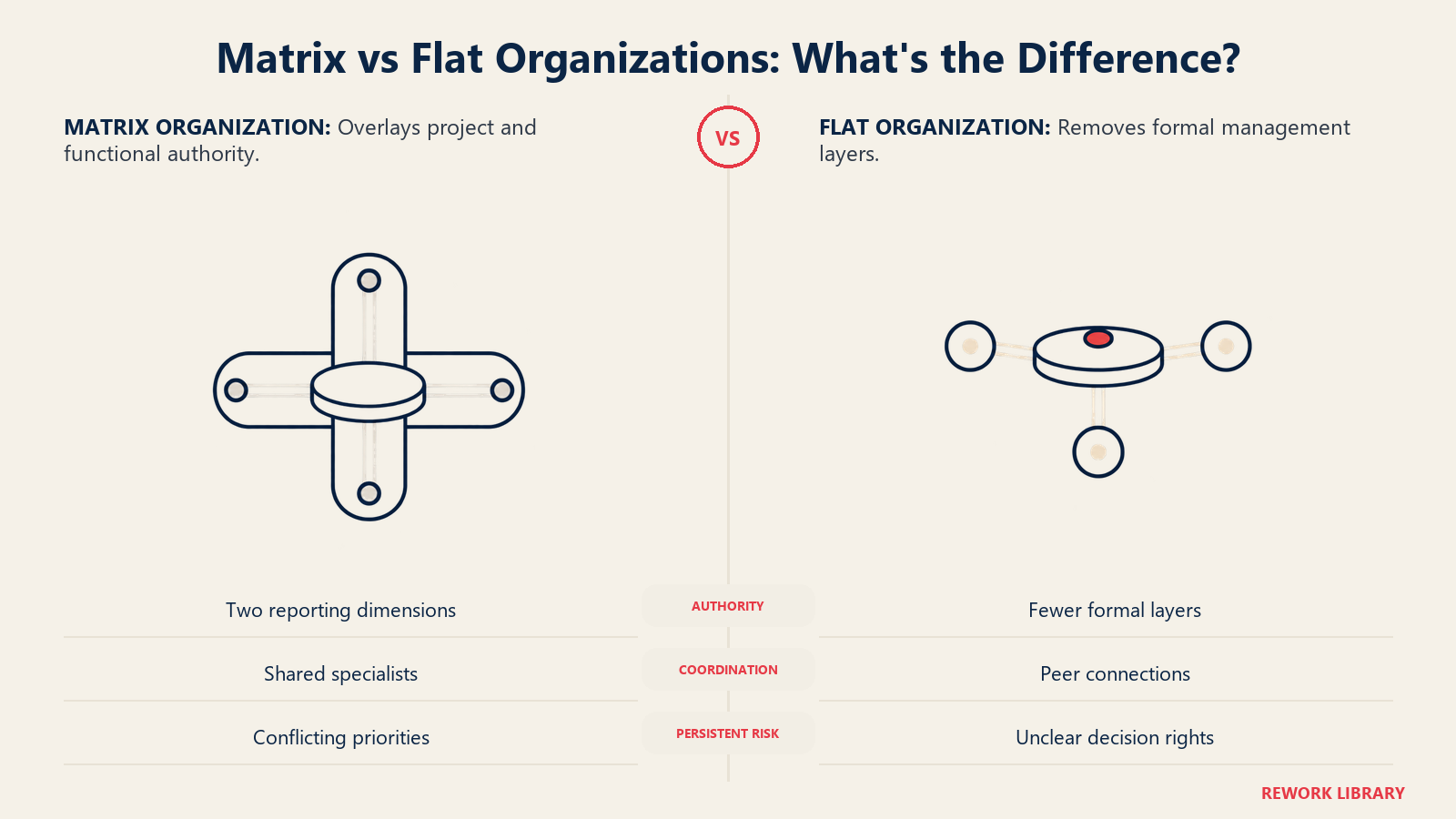
In the 1960s, an aerospace firm wanted a government contract. It had to hand over a chart of the project management team. The chart had to show who would run the work and how that team related to the rest of the company. The firms did not want to rebuild their management systems for it. So they drew horizontal project units across their existing vertical departments. The grid we call a matrix was born from paperwork.
The matrix organization took shape in the US aerospace industry of the 1950s and 1960s. Complex government projects forced companies to lay a project line of command over their functional departments. Flat organizations are a reaction to the same pyramid. The throughline is simple: the pyramid gives clarity and costs speed. Every escape from it trades one problem for another.
Flat organizations got their best-known experiments from W. L. Gore in 1958, Valve in 2012 and Zappos in 2013. This article follows what came before that chart, what came after it, and the opposite experiments that tried to remove the grid and the pyramid together. If you want the wider story first, start with The History of Management.
Timeline at a Glance
| Year | Milestone | Why It Mattered |
|---|---|---|
| 1st to 3rd centuries CE | Rome's imperial province splits military and civil command under a governor from finance under a procurator | An early, documented case of two lines of authority inside one territory. |
| Between 1570 and 1600 | Haudenosaunee Confederacy forms under a common council | A confederation that decided by unanimity, a precursor of rule without a single boss. |
| 1855 | Daniel McCallum draws the New York and Erie Railroad chart | Authority and reporting lines were put on paper. |
| 1911 | Taylor describes functional management with eight men replacing the single foreman | The first widely read case for more than one boss per worker. |
| 1920s | Sloan at General Motors and Pierre du Pont at DuPont build multidivisional firms | The decentralized pyramid became the standard big-company form. |
| 1950s and 1960s | Aerospace programs formalize the matrix | Two bosses became a designed feature, not an accident. |
| 1958 | Bill Gore leaves DuPont and starts W. L. Gore | The company later became the best-known long-running flat "lattice". |
| May 1978 | Davis and Lawrence publish "Problems of Matrix Organizations" in HBR | The first mainstream warning that the matrix has "pathologies". |
| 1982 | Peters and Waterman call the matrix the wrong kind of complex response | The backlash got a bestseller behind it. |
| January 1988 | Drucker forecasts organizations with half the management levels | Delayering moved from complaint to forecast. |
| July 1990 | Bartlett and Ghoshal publish "Matrix Management: Not a Structure, a Frame of Mind" | The debate moved from boxes to behavior. |
| 2012 | Valve publishes its handbook for new employees | A flat company explained itself in public. |
| Late 2013 | Zappos announces its move to holacracy | The largest company to attempt it at the time. |
| January 2020 | Quartz reports Zappos has quietly moved away from holacracy | The flat experiment came back toward managers. |
| March 2023 | Meta announces it will flatten its organization | Flattening returned as a cost and speed program. |
Chains of Command (antiquity-1920s)
The pyramid is built, and the first doubts appear
Picture a Roman legion on the march. Britannica describes the late Republican and imperial legion as ten cohorts, with each centurion commanding a century, the smallest unit. It is a clean chain: one man answers to the man above him, all the way up. That is the model every later structure reacted against.
Rome also left a record of something less tidy. In Britannica's account of Roman Britain, the governor represented the emperor and held supreme military as well as civil jurisdiction, while the finances sat with the provincial procurator, an independent official of equestrian status. Two senior officials, two lines, one province. Britannica adds that Britain was split in two in the early 3rd century to reduce the power of its governor to rebel, as Albinus had done in 196. This is a precursor, not a matrix. Nobody was sharing a team, and the split worked as a check on power. But it shows an old instinct: when one chain holds too much, divide the authority.
At the other end of the spectrum is the council. Britannica, following the Peacemaker tradition, places the formation of the Haudenosaunee Confederacy between 1570 and 1600. The nations met in a common council of clan and village chiefs, where each nation had one vote and unanimity was required for decisions. It was a confederation of peoples, not a company, so treat it as a precursor of rule without a single boss rather than an ancestor of the modern flat organization.
The modern pyramid arrived with railroads and factories. In 1855, Daniel McCallum, general superintendent of the New York and Erie Railroad, drew the first formal organizational chart to manage a business that had become unwieldy, with divisional superintendents carrying daily responsibility and reporting up. Max Weber (1864 to 1920) then described the type in theory. Britannica summarizes his bureaucracy as clear lines of command and control, with authority organized hierarchically, and records kept so the organization could outlast any one leader. Our article on bureaucratic leadership covers the strengths and failure modes of that design.
Frederick Taylor, one of the rival claimants in the argument over the father of modern management, came closest to a multi-boss idea in 1911. In The Principles of Scientific Management he wrote that, under functional management, the old-fashioned single foreman is superseded by eight different men, including an inspector, a gang boss and a speed boss, each with special duties. In a P&G case paper, researchers summarizing Jay Galbraith note that the idea did not catch on, and that Fayol's line-and-staff model, in which specialists advise without formal authority, preserved unity of command. For the detail, see Fayol's administrative management principles.
The last piece of this era is the decentralized pyramid. In Alfred Chandler's account, Sloan at General Motors and Pierre du Pont at DuPont independently built multidivisional, decentralized structures, and GM's restructuring followed Durant's leading it to the brink of collapse in 1920. By 1960, American Heritage notes, that form had become the accepted way to run the most complex industrial enterprises. The pyramid had learned to split into divisions. It had not learned to coordinate across them.
What this means for teams today: Every reporting line you draw is a choice about where information stops. If two senior people in your company can both say "that's mine," you have the Roman governor and procurator problem, whether you meant to or not. Write down who decides what before you add a second line.
The Aerospace Matrix (1950s-1977)
Two bosses become a design, not an accident
The problem was how to run a large project through functional departments for a government customer who wanted one point of responsibility. A Project Management Institute chapter written for a 1979 seminar says the formalized matrix was first developed and documented in the US aerospace industry during the large, complex projects of the 1950s and 1960s. The chapter explains the logic. A very large project could become a pure project organization with everything under one hierarchy, and that worked when the customer insisted and was willing to pay. But aerospace also had many projects that were not large, only complex, and companies would not make each one a little empire. The same text says the pure "microcompanies" were unwieldy, so the matrix was the next step.
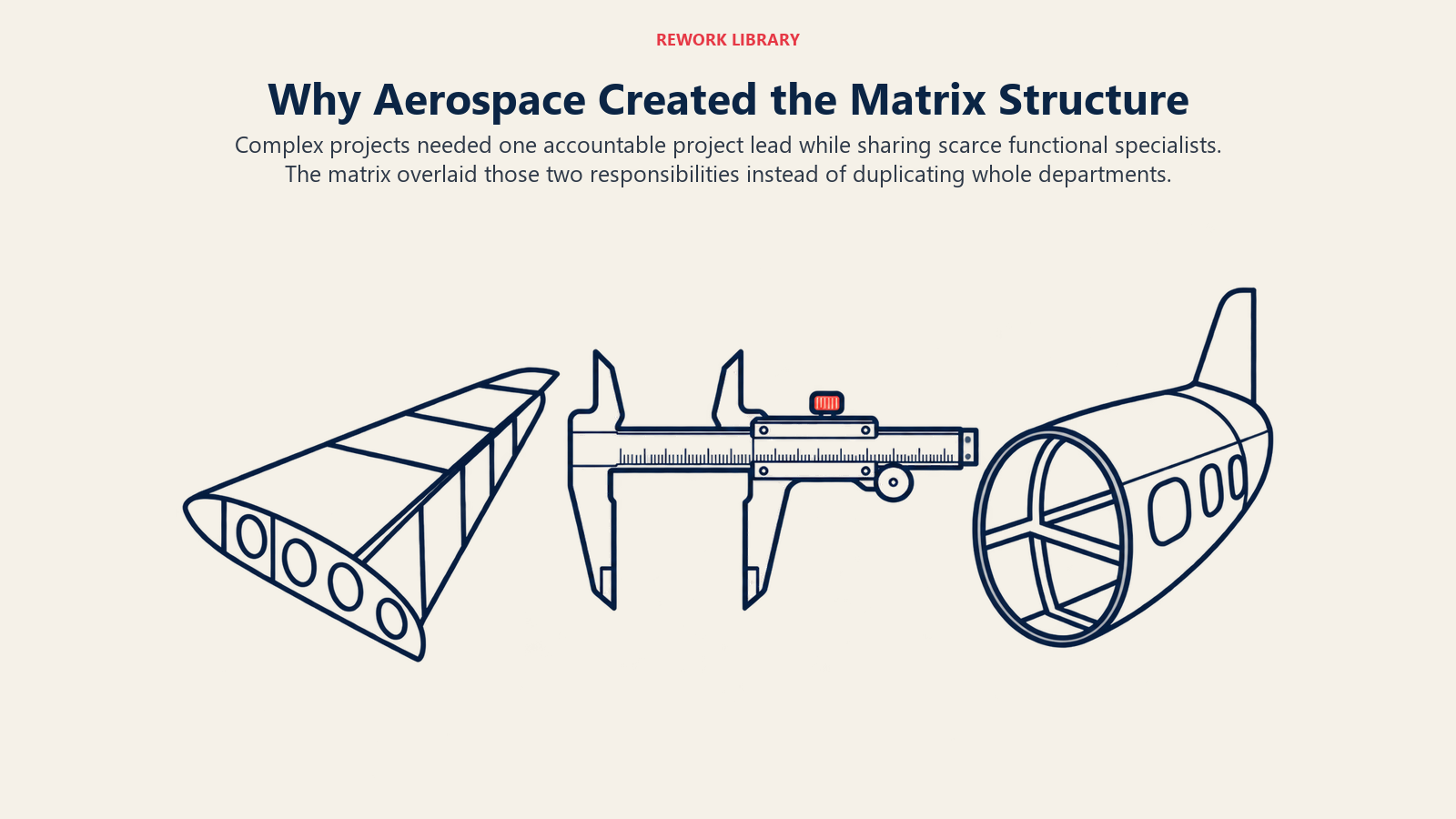
Britannica puts it plainly: it is difficult to trace the exact origins, but the term first emerged from aerospace in the 1960s, and firms built horizontal project units over vertical hierarchies. The PMI chapter, quoting Davis and Lawrence, suggests the word suited mathematically trained engineers who saw a gridlike structure forming. It also says the matrix meant abandoning the old rule "Thou shalt have but one boss above thee."
Why then? In the P&G case paper's summary of Galbraith, the late 1960s left the US government short of money for the space program, the Vietnam build-up and the supersonic transport at once. Cost and schedule joined technical performance as priorities, and project managers responsible for those two reported alongside engineering managers to the same general managers. The paper says the matrix was adopted by many companies in the early 1970s, and that the success of the moon program made the press treat it as the new management trend.
Then the books arrived. In 1977 Stanley Davis and Paul Lawrence published Matrix, and the same paper reproduces a General Electric planning bulletin of September 1976 that described the form as complex and sometimes frustrating, but a bellwether of things to come. For a deeper look at the school of thought behind this period, see the schools of management thought, in order.
What this means for teams today: A matrix is a tool for a specific problem: a lot of complex, cross-functional work with scarce shared specialists. If your work is routine and your teams are stable, you probably don't need two bosses. If you do have two, tell each boss in writing which decisions are theirs.
The Matrix Backlash (1978-1990s)
Dual authority meets recession and fashion
The turn came within a year of the book. In May 1978, Davis and Lawrence published Problems of Matrix Organizations in the Harvard Business Review, describing the matrix as a popular new structure with "some significant pathologies". The PMI chapter lists the pathologies the authors named: power struggles, anarchy, groupitis, collapse during an economic crunch, excessive overhead, decision strangulation, sinking, layering and navel gazing. It adds that the matrix tended to blossom in growth and be cast away in decline, because top management then reached for a firmer hand.
The fashion cycle did the rest. The P&G paper, citing Galbraith, says the matrix was often wrongly adopted, hastily installed and inappropriately implemented, so word spread that it did not work. In 1982 Tom Peters and Robert Waterman, in In Search of Excellence, called it the wrong kind of complex response. Galbraith argued that this was unfair, since Boeing, Intel, Digital Equipment, Fluor and Bechtel all used a matrix, but the paper says managers still avoided it.
Meanwhile, the pyramid itself was under attack. In the January-February 1988 Harvard Business Review, Peter Drucker forecast that the typical large business 20 years on would have fewer than half the levels of management of its counterpart then, and no more than a third the managers. He expected it to resemble a hospital, a university or a symphony orchestra more than a 1950s manufacturer. Delayering, as the practice came to be called, was now a stated direction, and within a few years the reengineering boom would cut layers in the name of whole processes.
Then Christopher Bartlett and Sumantra Ghoshal changed the question. Their July-August 1990 article, "Matrix Management: Not a Structure, a Frame of Mind", opens with the claim that top managers were losing control because their companies could not carry out their strategies, and that over 20 years "strategic thinking has far outdistanced organizational capabilities". The title carries their answer: the fix was less about the boxes and more about the mindset of the people in them. The P&G paper reports that Galbraith later wrote that the matrix was reinstated in the late 1990s and took its normal place in organization design.
What this means for teams today: If a reorganization is failing, check the support systems before you blame the structure. Galbraith's list in the case paper includes information systems, planning, budgeting and performance reviews. A matrix with one boss controlling the bonus is a hierarchy with extra meetings. And if a downturn arrives, decide in advance whether you will tighten the structure or keep it, rather than reorganizing in a panic.
Gore's Lattice (1958-2012)
A founder removes the boss and keeps the company
This era runs alongside the last two: while big firms argued about two bosses, a few companies tried none. In 1958, Bill Gore left his research job at DuPont, on the advice of his wife Vieve, to start his own company around PTFE, the material DuPont had developed. Gore's own culture page says its people work in a "lattice" communications structure, building connections without the constraints of traditional chains of command. It describes the approach as one that Bill and Vieve Gore believed would let people solve problems creatively. The structure comes from the founders' own design rather than from a management trend.
Others tried a similar bet. Ricardo Semler, majority owner of Semco in São Paulo, wrote in the September-October 1989 Harvard Business Review that his company treated its employees like responsible adults. In his account, most set their own working hours, all had access to the company books, and more than 150 managers set their own salaries and bonuses.
In 2012, Valve put the case in a handbook for new hires. Its chapter titled "Welcome to Flatland" says that hierarchy is great for maintaining predictability and repeatability, and explains that at Valve there is no management and nobody "reports to" anybody else. Even the founder is not your manager. The handbook also warns that structures which persist for long begin to serve their own needs, and it is candid about the limits: it says the model needs freedom from outside pressure, that being self-funded was key, and that a founder confident enough to build this kind of place is rare.
What this means for teams today: Valve's handbook names its own conditions: freedom from outside pressure, being self-funded and a founder confident enough to build the place. If you lack those, copy the habits, such as open books and project-by-project teams, before you copy the structure. Our article on hierarchical versus egalitarian cultures helps you judge how your people react to authority, and teal organizations covers the self-management model that grew from these experiments.
The Holacracy Moment (2013-2020)
Zappos tries a system, then goes back toward managers
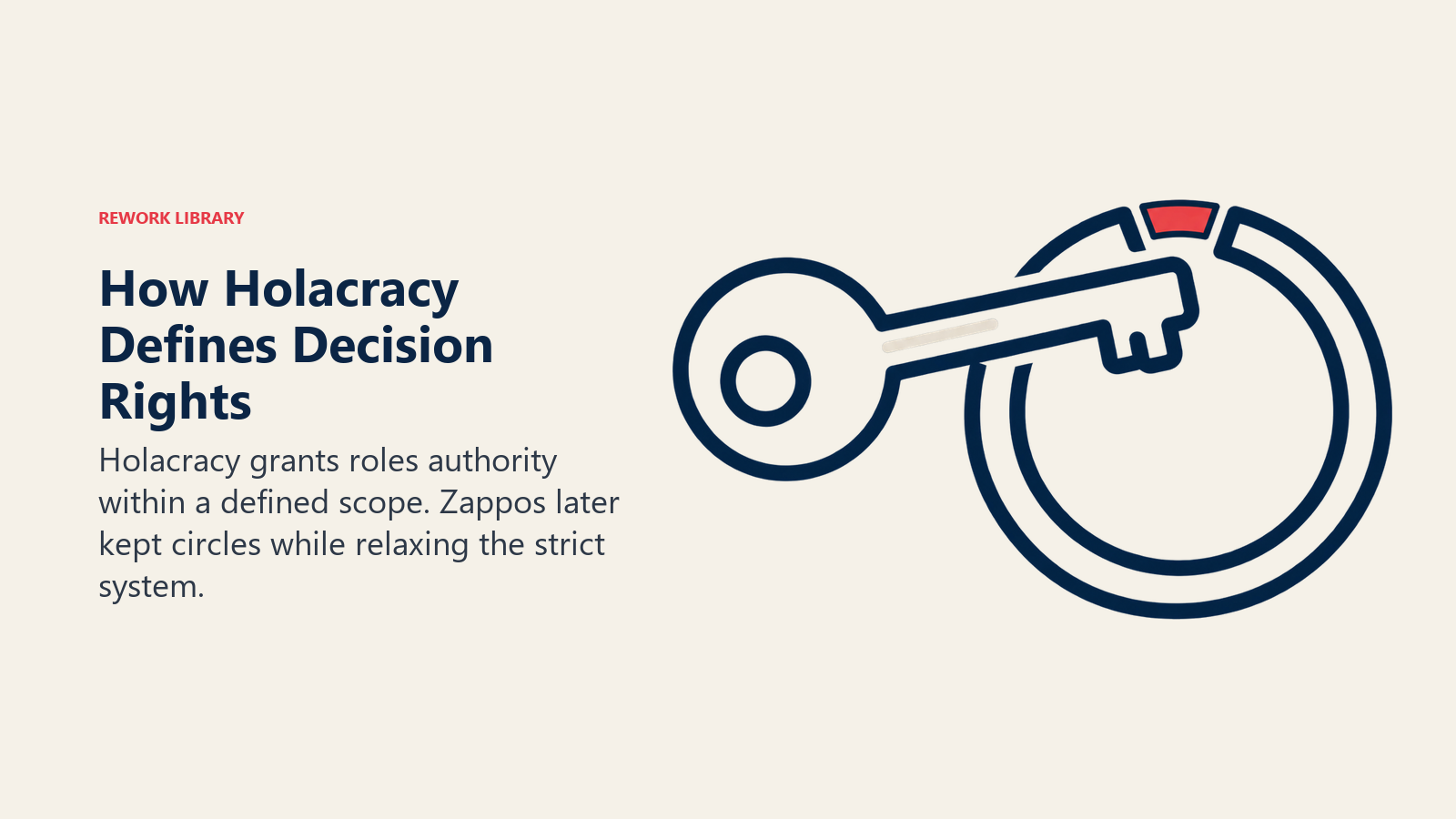
In late 2013, Zappos announced a major reorganization. Quartz reported that CEO Tony Hsieh told employees the company was moving to Holacracy, a system with no job titles and no managers, made up of circles, around 400 of them once the rollout finished. The system came from Brian Robertson, who founded the consultancy HolacracyOne in 2007. Zappos, with 1,500 employees, would be the largest company to implement it so far. Holacracy's own site describes the core rule: no "boss card" lets anyone overrule a role's decisions within its scope.
The rollout was hard. In March 2015, Hsieh gave employees an ultimatum to commit fully or leave, and Quartz reports that 18% took a buyout offer. A July 2016 Harvard Business Review article by Ethan Bernstein, John Bunch, Niko Canner and Michael Lee, Beyond the Holacracy Hype, opens in a Zappos team room in May 2015, where the circle charged with overseeing adoption was questioning whether the method worked.
By January 2020, Quartz reported that Zappos had been quietly moving away from holacracy: it did away with its rigid meeting process and brought managers back, while keeping its circles. The same report says early adopters such as Medium had already abandoned the system, and that Zappos moved toward a marketplace in which teams run like small businesses with their own profit-and-loss statements. The experiment did not end self-organization at Zappos. It ended the strict version. For the system itself, see our explainer on holacracy.
What this means for teams today: A complete operating system is a heavy thing to install on a company that already has customers to serve. Take what is portable: clear roles instead of vague titles, and decisions made by whoever is closest to the work. Pilot it in one team before you adopt it across the company.
The Great Flattening (2023-present)
Cost pressure turns layers into a target
The next wave did not start with philosophy. On March 14, 2023, Mark Zuckerberg wrote that every layer of a hierarchy adds latency and risk aversion, and that Meta would remove multiple layers of management, ask many managers to become individual contributors, and in general not want managers to have more than 10 direct reports. The same post said Meta expected to reduce its team by around 10,000 people and close around 5,000 open roles.
In September 2024 Andy Jassy told Amazon staff that as the company had grown it had added managers and layers, and he asked each senior leadership organization to raise the ratio of individual contributors to managers by at least 15% by the end of Q1 2025. He framed it as removing layers and flattening, so decisions could be made closer to the front lines.
What replaces the layers is the open question. Neither idea has won outright: the P&G case paper says the matrix returned in the late 1990s, and Zappos kept parts of its flat structure while bringing managers back. Our article on org design and delayering with AI separates the claims from the evidence on whether software can absorb a management layer.
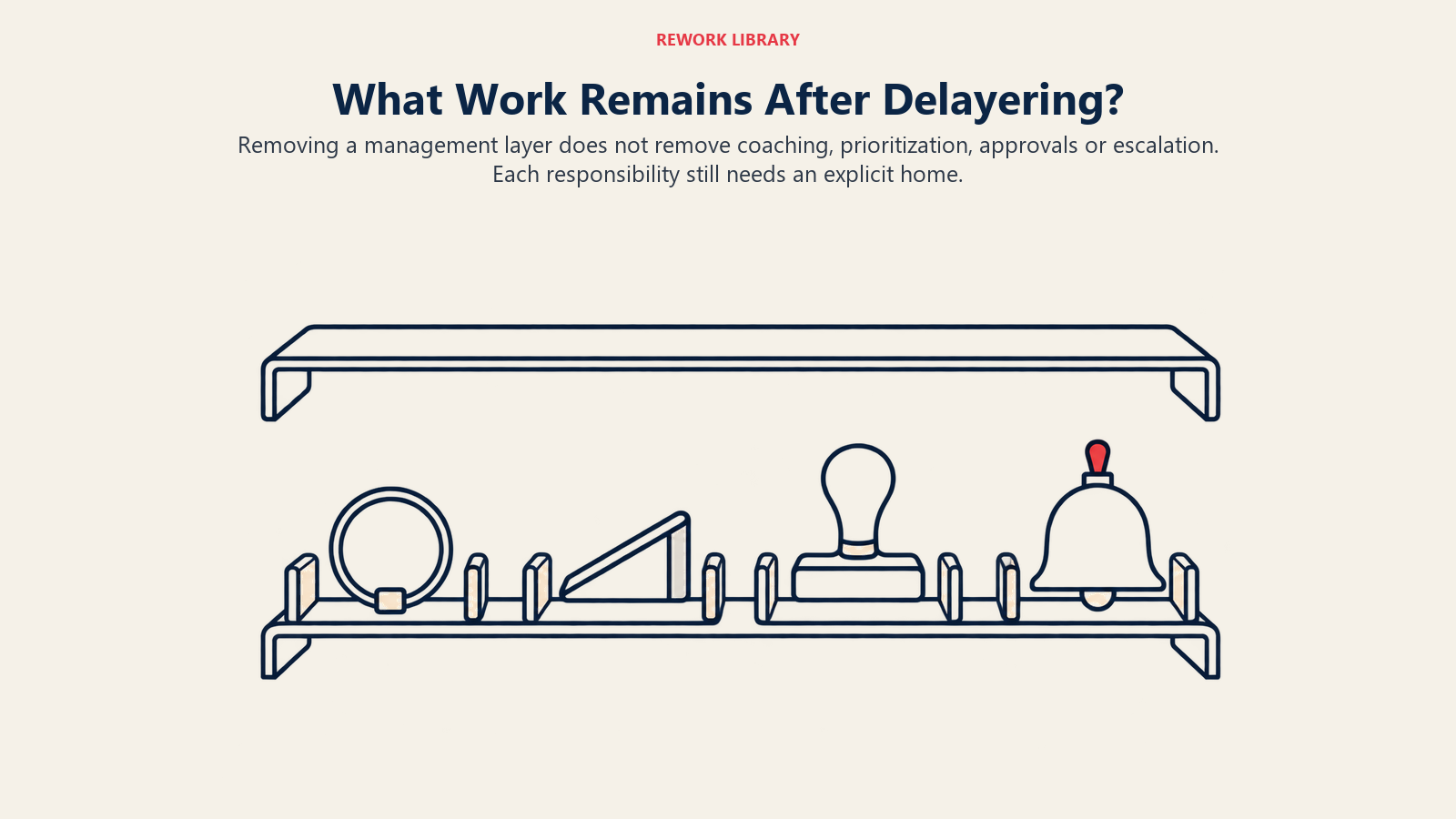
What this means for teams today: Before you cut a layer, list what it does: coaching, prioritization, approvals, escalation. Each of those still has to happen somewhere. Flattening removes the title, not the work.
Key People
| Name | Role | Contribution | Year |
|---|---|---|---|
| Daniel McCallum | General superintendent, New York and Erie Railroad | Drew the first formal organizational chart | 1855 |
| Max Weber | German sociologist | Described bureaucracy and its hierarchical authority | Died 1920 |
| Frederick W. Taylor | Engineer and author | Proposed functional management with eight men replacing the foreman | 1911 |
| Alfred Sloan and Pierre du Pont | Executives at GM and DuPont | Built multidivisional, decentralized firms | 1920s |
| Jay Galbraith | Organization design theorist | Traced the matrix to aerospace and explained why it failed and returned | 1970s to 2009 |
| Stanley Davis and Paul Lawrence | Authors | Named the matrix's pathologies in HBR | 1978 |
| Peter Drucker | Management author | Forecast organizations with far fewer layers | 1988 |
| Christopher Bartlett and Sumantra Ghoshal | Authors | Argued matrix management is a frame of mind | 1990 |
| Bill and Vieve Gore | Founders of W. L. Gore | Built and sustained the lattice | 1958 onward |
| Ricardo Semler | Majority owner of Semco | Described a company with self-set hours and salaries | 1989 |
| Brian Robertson | Founder of HolacracyOne | Created the Holacracy system Zappos adopted | 2007 onward |
| Tony Hsieh | CEO of Zappos | Led Zappos into holacracy and then toward a market system | 2013 to 2017 |
Key Facts
Key Facts: Matrix and Flat Organizations
- Britannica says the term "matrix" first emerged from the aerospace industry in the 1960s, when government contractors had to chart their project teams.
- A PMI chapter from 1979 says the matrix meant abandoning the rule of one boss per worker.
- In 1988, Drucker predicted large businesses would have fewer than half the levels of management within 20 years.
- Zappos told employees in March 2015 to commit to holacracy or leave, and 18% took a buyout, according to Quartz.
- In 2024 Amazon asked each senior leadership organization to raise its ratio of individual contributors to managers by at least 15% by the end of Q1 2025.
The Pattern Behind the History
We call this the Pyramid Pendulum. It is our reading of the timeline, not a research finding. Four points repeat.
- The pyramid buys clarity and costs speed. Weber's lines of command and Meta's "layers add latency" are the same trade seen from opposite ends.
- Each escape recreates a smaller pyramid. Taylor's eight bosses, Gore's lattice and Zappos' circles each made a new structure with its own rules. Zappos brought back managers while keeping circles.
- Stress swings the pendulum. The matrix bloomed in growth and was cast away in recession; flattening came back with cost pressure in 2023 and 2024.
- Structure needs a frame of mind. Bartlett and Ghoshal said so in 1990, and Galbraith blamed the matrix's decline on hasty installation without the supporting systems.
What It Teaches Teams Today
- Pick the structure for the work, not the fashion. Complex cross-functional projects fit a matrix. Routine, repeatable work fits a clear line. Small teams of self-directed people can run flat for a time.
- Decide who decides. Every structure in this history failed or thrived on decision rights, not on the shape of the chart. A short written list of who decides what beats a redesign. Use a RACI-style approach if you need a format.
- Teach influence before you add a second boss. People in a matrix or flat team get work done by persuasion. Build that skill with influencing without authority.
- Treat a flattening as a change in work, not a headcount line. Name the jobs the removed layer did, and give each one a new home.
- Expect the pendulum. Whatever you adopt will be tested by the next downturn or growth spurt. Review it on a schedule instead of waiting for the crisis. For more on how organizations moved through these ideas, see the management theory timeline.
Matrix and flat structures are two answers to one old question: how many people should one person answer to? The history says neither answer is permanent, and the organizations that last are the ones that keep checking whether their structure still fits their work.

Co-Founder, Rework.com