The Hawthorne Studies: What Really Happened
Turn this article into takeaways for your work.


Each assistant summarizes the article only for you and suggests best practices for your work.
In the mid-1920s the Hawthorne plant had a practical problem. It was one of the most advanced factories in America. Its managers asked engineers to test what lighting did to output. The answer from the first experiment was not the one they expected.
The Hawthorne studies began in November 1924, when Western Electric and the National Research Council started a lighting test at the company's Hawthorne Works in Cicero, Illinois. They grew over eight years into the Relay Assembly Test Room, a program of more than 21,000 interviews and a bank wiring observation room. They became the founding story of the human relations movement. The throughline is a narrow engineering question that turned into a famous story about attention. Later researchers kept testing that story against the original records.
The legend that grew from the first experiment isn't quite the one in the archives either. This article follows the studies from their precursors to the 2011 re-analysis. For the concept itself, read our explainer on the Hawthorne effect. For the school of thought that grew from the studies, see human relations theory. For the wider map, start with the history of management.
Timeline at a Glance
| Year | Milestone | Why It Mattered |
|---|---|---|
| 1915 | Britain's Health of Munition Workers Committee is appointed to study fatigue and hours | Output was studied against fatigue in factories, a decade before Hawthorne. |
| 1918 | A British board for industrial fatigue research is established | The wartime fatigue work gets a successor body. |
| Nov 1924 | Western Electric and the National Research Council begin illumination tests | The first Hawthorne experiment. |
| Apr 1927 | The Relay Assembly Test Room opens with a two-week baseline | A small, observed group replaces the whole department as the unit of study. |
| 1928 | Elton Mayo arrives at the Hawthorne Works | Harvard enters the research. |
| 1928 to 1930 | The interviewing program reaches 21,126 interviews | Attention turns from conditions to attitudes. |
| Nov 1931 to May 1932 | The Bank Wiring Observation Room studies 14 men | Observation, not interviews, shows a group setting its own pace. |
| 1933 | Mayo publishes The Human Problems of an Industrial Civilization | A book-length argument that workers' social bonds matter. |
| 1939 | Roethlisberger and Dickson publish Management and the Worker | The full research account appears. |
| 1953 | The term "Hawthorne effect" is in print in a methodology textbook | The studies become a warning label for researchers. |
| 1958 | Henry Landsberger publishes Hawthorne Revisited | A book that reviews the critics of the research. |
| 1967 | Alex Carey's "The Hawthorne Studies: A Radical Criticism" appears in American Sociological Review | An early critical paper on the studies. |
| 1978 | Franke and Kaul publish the first statistical analysis of the relay room data | By the authors' reading, discipline and the Depression explain most of the output. |
| 2011 | Levitt and List publish their analysis of the recovered illumination data | The famous lighting story does not appear in the numbers. |
The Fatigue Years (1915-1924)
Fatigue becomes a subject for measurement before Hawthorne exists
In September 1915 the Minister of Munitions appointed a committee to advise on industrial fatigue and hours of labor, chaired by Sir George Newman. This is a precursor of the Hawthorne work, not part of it. In August 1916 the physician H. M. Vernon reported to it that cutting hours often raised hourly output, and that the right number of hours depended on the kind of work. A historian of the period, A. J. McIvor, notes that the committee's work led directly to the Industrial Fatigue Research Board in 1918.
The same question reached the United States through two doors. One was welfare capitalism. Harvard Business School's archive says employers adopted benefits such as pensions, sick pay and recreation programs to build loyalty and reduce turnover and unionization, and that Western Electric offered all of these. The other was a Harvard connection. Elton Mayo, born in Adelaide in 1880, became a research associate at Wharton in 1923 and studied how fatigue affected employee turnover. Wallace Donham, dean of Harvard Business School, noticed his work and in 1925 asked Harvard's president for funds to make him an associate professor in human relations.
The plant itself was already known for method. Construction of the Hawthorne Works began in 1905 on more than 100 acres, and by 1929 over 40,000 people worked there, according to Harvard's archive, while a later economic study puts the 1920s workforce at roughly 35,000. The archive adds that Western Electric was an early adopter of scientific management, partly inspired by Taylor's time and motion studies. To see how that school rose and was restricted, read the history of scientific management.
What it means for teams today: The question behind Hawthorne, whether the way people are treated changes how much they produce, was already being asked with data. A team that asks it now is joining a century-old inquiry, not inventing one.
The Lighting Tests (1924-1927)
Engineers vary the light and find that light is not the main factor
In Cicero, employees inspected small parts, assembled relays and wound coils under lamps that the engineers changed on schedule. Western Electric, with the National Research Council of the National Academy of Sciences, began the tests in November 1924 to study the relation of lighting to efficiency. A later economic study adds that the council's lighting committee included prominent engineers with Thomas Edison as honorary chairman, and that Western Electric sent engineers George Pennock and Clarence Stoll to oversee the work from 1924 to 1927.
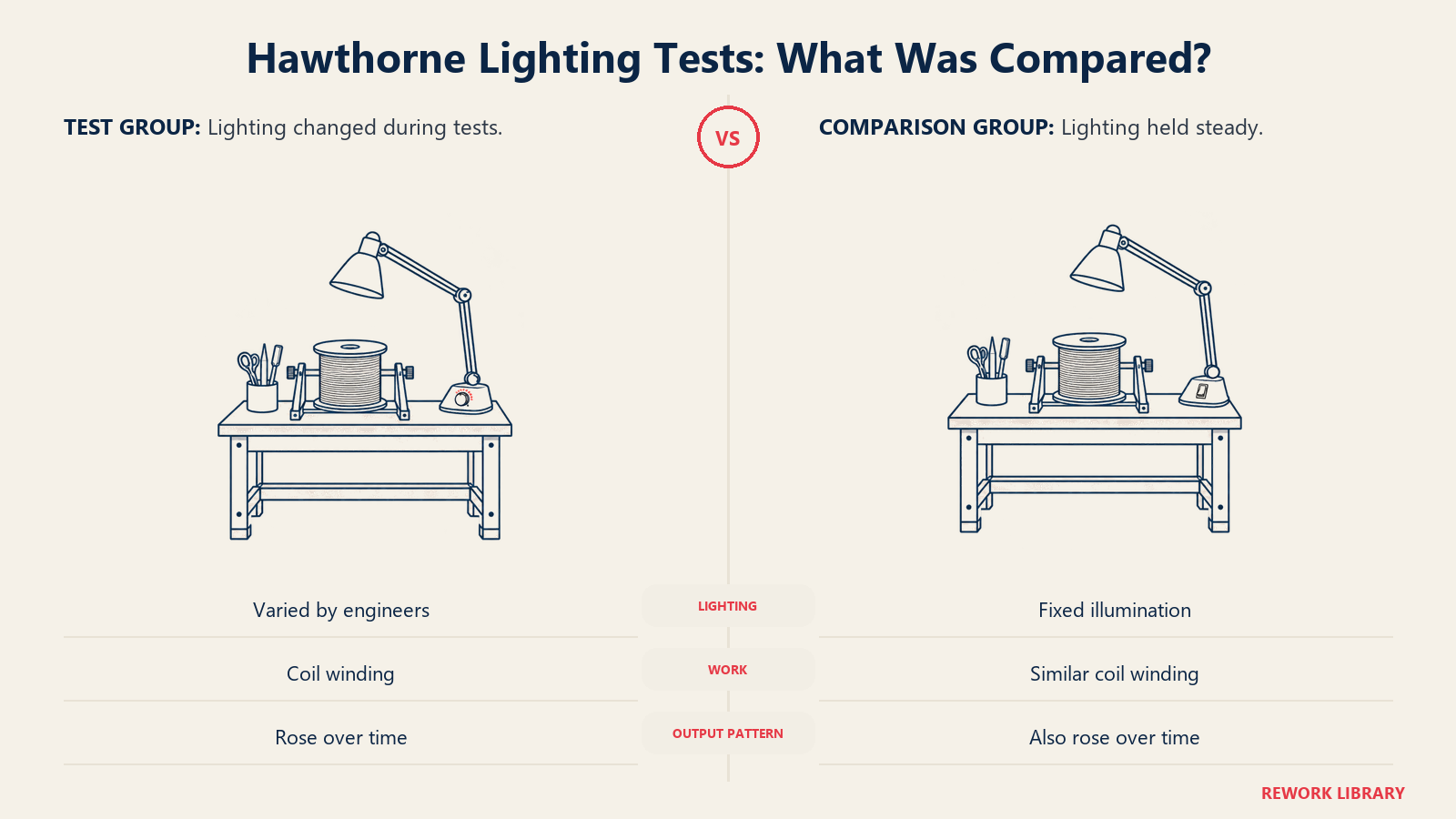
The tests ran in stages. The first used three departments: inspectors of small parts, relay assemblers and coil winders. The second used only the coil winders, split into a test group and a control group of similar experience and output. The third lowered the test group's light in steps from 10 to 3 foot-candles while the control group stayed at 10. Roethlisberger and Dickson's account, quoting the council's engineer C. E. Snow, says efficiency in both groups rose slowly and steadily as light fell, and that production dropped only when the operators protested they could hardly see. In a final informal test, two operators worked in a darkened room at about the light of a moonlit night and kept their output. In another, the investigator swapped bulbs for bulbs of the same size and asked how the new light felt, and the women reported that the "brighter" or "dimmer" light was better or worse, while their production did not materially change.
That is the raw material of the legend, but note what the book actually concluded. It said the tests fell short of the company's expectations because they failed to answer the lighting question, and drew two lessons: that light is only one, and apparently a minor, factor among many, and that one variable could not be isolated in ordinary shop departments. Nobody wrote a final report. Gale, writing in a medical journal in 2004, says the studies were never written up and the original reports were lost, as quoted in the economists' later paper. That gap is why the story could grow.
The company took the practical lesson. A small group in a separate room would be easier to observe than a department. That decision opened the next phase.
What it means for teams today: Their first design could not isolate one factor from many. Before you pilot a change, list what else will move at the same time.
The Test Rooms (1927-1932)
A relay bench, 21,000 interviews and a wiring room
The Relay Assembly Test Room
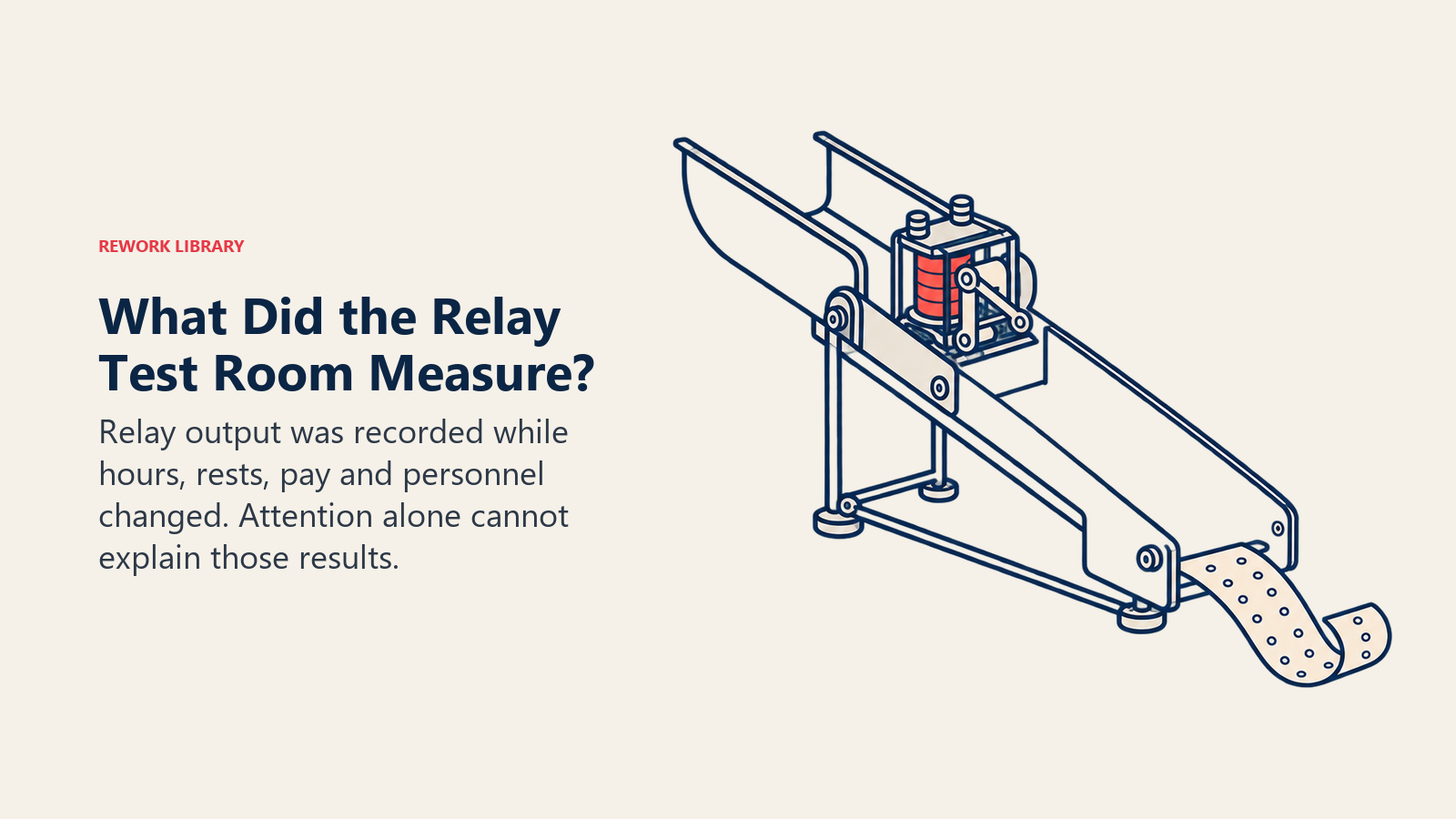
In the Relay Assembly Test Room, completed relays dropped into a chute, and a device punched holes in a moving paper tape to record each worker's output. The job was the assembly of a telephone relay from about 35 small parts and four machine screws, a task of about a minute, so each operator finished roughly 500 a day. The first period, a baseline from April 25 to May 10, 1927, took place while the five chosen operators were still in their regular department. The experiment, planned for a short time, continued for five years.
Over the next periods the investigators changed rest pauses and hours. In Period VII the operators had a fifteen-minute morning rest and a ten-minute afternoon rest. In Period VIII the operators unanimously chose to stop at 4:30 p.m. instead of 5:00, bringing the week to 43 hours 10 minutes from the original 48. Over the years output rose significantly. In September 1928 they ran a deliberate test: a return to the original 48-hour week with no rests, for 12 weeks. The operators disliked it, and the observer found they were trying to hold output down to make sure rests came back. Hourly output fell for four of the five, yet total weekly output reached a new high. When rests returned in Period XIII, the operators said, "We never want to work without rest periods again."
Elton Mayo arrived in the middle of this. Superintendent Pennock had turned to Harvard for guidance, and Harvard's archive records that Mayo came to the plant in 1928. Harvard's archive quotes Mayo saying the women became a team. Sources differ slightly on the number: the Harvard archive says six single women in their teens and early twenties worked in the room over time, while the 1939 account describes five operators at the benches plus a layout operator. The archive says supervisors reviewed production records, physical exams and daily logs, and that the researchers could not be sure whether the rise came from rest periods, shorter hours, wage incentives, group dynamics or special attention.
The record also shows facts the legend leaves out. In January 1928 management replaced two of the five operators. Roethlisberger and Dickson describe the pair as moody, inattentive and uncooperative, and the replacements were chosen for experience. The pay system also changed after the first two periods, from a large-group incentive to a small-group incentive. Later critics would put these two facts at the center.
What it means for teams today: The observer in the room was a friend, a rule-maker and a data collector at once. If someone on your team runs an experiment and also manages the people in it, say so when you report the result.
The Interviews and the Wiring Room
From 1928, interviewers sat down with employees across the plant. Mayo and his assistant Fritz Roethlisberger oversaw more than 21,000 interviews between 1928 and 1930, and the 1939 account's own table totals 21,126 across the three years. The researchers learned that people talked more freely when encouraged to speak, and defined the interview as "a conversation in which the employee is encouraged to express himself freely". Interviews averaged about 30 minutes and later stretched to 90 minutes or two hours. Roethlisberger concluded that employees valued informal relationships of interconnectedness. The comments informed supervisor training and a routine counseling program.
The interviews raised a question they could not answer: how did groups hold their members to a pace? To find out, the researchers built the Bank Wiring Observation Room. It held fourteen men working under standard shop conditions, nine wiremen, three solderers and two inspectors, observed from November 1931 until May 1932, when it ended for lack of work. No changes were made. The men worked under a group piecework plan in which the whole department's output set the pay pool.
What the observer found was a norm. In interviews, twenty of the twenty-two men who discussed output said that wiring two equipments constituted a day's work, which came to 6,000 or 6,600 connections, well under the official bogey. The men often stopped when they reached their quota, even before quitting time. Harvard's archive describes this as an implicit understanding among the workers not to exceed what they considered a fair quota. It is soldiering again, the same behavior Taylor had tried to engineer out of shops, now seen as a group's decision.
By 1932 the Depression had hit. The archive says mass layoffs at Western Electric halted the experiments in the early 1930s. The tests that produced the legend had ended; the interpretations were just beginning.
What it means for teams today: The group in the wiring room did not ignore the standard out of laziness. It set its own. If your team's pace differs from your target, ask the group what it believes a fair day is.
The Human Relations Years (1933-1950s)
Mayo and Roethlisberger turn the data into a doctrine
A new book arrived in 1933. Mayo published The Human Problems of an Industrial Civilization, arguing that modern society had destroyed "the belief of the individual in his social function and solidarity with the group", and that an administrative elite would need to improve worker morale. Harvard's archive records a 1934 review calling it the most important book on its subject in recent years. In 1938 Harvard professor T. N. Whitehead published The Industrial Worker. In 1939 Roethlisberger, with Hawthorne's William Dickson and Harold Wright, published Management and the Worker, a 600-page best-seller by the archive's count.
The studies reached a wider audience through lectures, newspaper headlines and a 1946 Fortune feature on Mayo. At Harvard, Dean Donham had shifted the business school from scientific management and applied economics toward human relations, and Mayo's 1935 course covered physiology, psychopathology and anthropology. In a 1929 letter to Pennock, Mayo wrote that the change being pursued was "not mechanical but humane". Abraham Zaleznik, a Harvard professor of leadership, said in 1984 that Mayo's ideas had become part of the "orthodoxy of modern management".
This is where the school of thought took form. Its 1939 report also argued that no company matches its formal organization chart, because the chart leaves out the informal groups. For the movement that grew from it, read the history of the human relations movement. For what it argued, see human relations theory and the ordered map in the schools of management thought.
What it means for teams today: A good story outruns its evidence when it matches what leaders already want to believe. Ask what the data would look like if the story were wrong.
The Critics (1953-2008)
Sociologists and statisticians go back to the numbers
By the 1950s the studies had become a warning for researchers. A 2014 systematic review dates the first use of the term "Hawthorne effect" to a 1953 methodology textbook, in a chapter by John R. P. French. In 1958 Henry Landsberger's Hawthorne Revisited examined Management and the Worker, its critics, and later developments in human relations. Roethlisberger himself returned to the story: in 1966 he and Dickson published Counseling in an Organization, and Harvard's archive notes he described the effect as subjects changing their performance because they are being observed.
The critique came in waves. In 1967 Alex Carey's "The Hawthorne Studies: A Radical Criticism" appeared in American Sociological Review. Franke and Kaul later credited Carey with the suggestion that the replacement of two relay workers was a key part of the experiment. In 1978 Richard Franke and James Kaul published the first statistical analysis of the relay room data in the same journal. Using time-series regression on nearly five years of data, they found that managerial discipline, economic adversity and the quality of raw materials explained most of the output, and concluded that "humanitarian procedures must provide their own justification." A 1983 critique and reanalysis by M. Bloombaum took up Franke and Kaul's work in turn, so the dispute ran both ways. Other scholars, including Jeffrey Sonnenfeld in 1985 and Richard Gillespie in 1991, reexamined the studies on methodological and ideological grounds, and Harvard's archive notes that each generation read them through its own lens.
What it means for teams today: A famous finding deserves a second look at the raw data. If your own pilot cannot be re-analyzed by someone outside it, keep the records.
The Recovered Data (2009-present)
Economists find the lighting numbers and the legend does not appear
For decades the illumination data were thought to be gone. The economists Steven Levitt and John List traced them to a microfiche room in a Milwaukee library and a second archive in Boston, coded them, and published the analysis as a working paper in 2009 and in American Economic Journal: Applied Economics in January 2011. Their abstract says that "existing descriptions of supposedly remarkable data patterns prove to be entirely fictional".
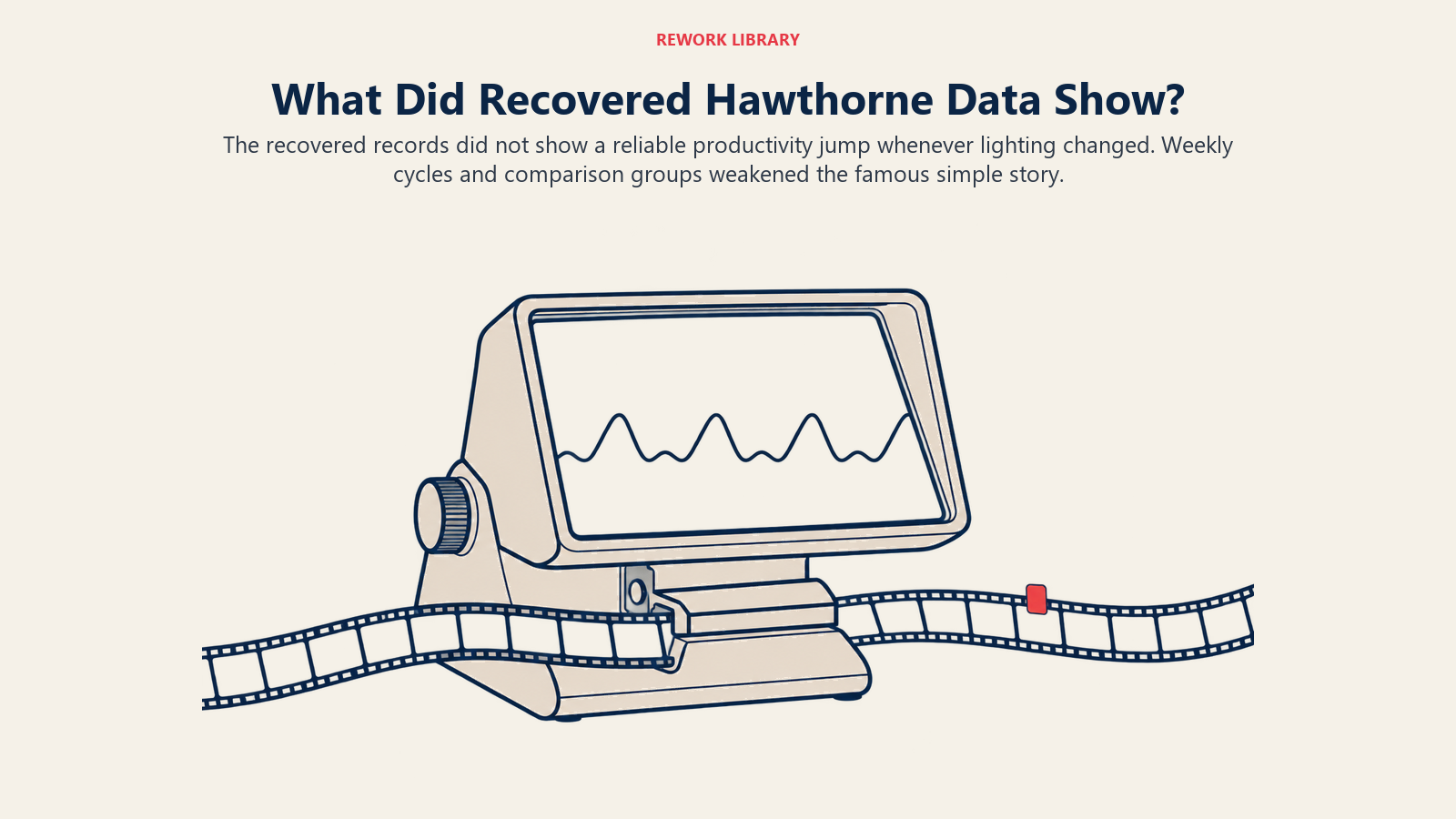
The details matter. Output in the first year did rise, peaking roughly 10 percent above baseline, but the daily data show the dominant pattern was a weekly cycle with low Saturday and Monday output, not a response to the lamps. In the second round, room 1 reached about 20 percent above baseline, but rooms 2 and 3, no longer in the experiment, also rose. They found no systematic evidence that productivity jumped each time the light changed, but did find weak evidence consistent with subtler effects: output was 3 to 4 percent higher while experiments were ongoing in one specification, though that result disappeared with tighter controls, and productivity responded more to experimenter-made light changes than to natural ones. The Hawthorne effect, in other words, is not a guaranteed feature of being observed.
So what is left? The studies still show that groups set norms, that supervision and small changes in treatment matter, and that nobody should draw a general law from a single factory. For the concept as managers use it today, see the Hawthorne effect. For the larger timeline into which these studies fit, see the management theory timeline.
What it means for teams today: Observation changes behavior a little, and context changes it a lot. Measure against a baseline and a comparison group before crediting your attention for a result.
Key People
| Name | Role | Contribution | Year |
|---|---|---|---|
| George Pennock | Western Electric superintendent | Oversaw the tests and invited Mayo | 1924-1928 |
| Clarence Stoll | Western Electric engineer | With Pennock, ran the illumination experiments | 1924-1927 |
| Elton Mayo | Harvard Business School professor | Interpreted the studies; wrote the 1933 book | 1928-1933 |
| Fritz Roethlisberger | Mayo's research assistant, later HBS professor | Oversaw the interviews with Mayo; co-wrote the 1939 account | 1928-1939 |
| William Dickson | Chief of Employee Relations Research, Hawthorne Works | Co-wrote Management and the Worker | 1939 |
| Wallace Donham | Dean, Harvard Business School | Backed human relations at Harvard | 1925 |
| Henry Landsberger | Author | Published Hawthorne Revisited | 1958 |
| Alex Carey | Critic | "A Radical Criticism" in American Sociological Review | 1967 |
| Richard Franke and James Kaul | Statistical analysts | First time-series analysis of the relay data | 1978 |
| Steven Levitt and John List | University of Chicago economists | Recovered and analyzed the illumination data | 2009-2011 |
Key Facts
Key Facts: The Hawthorne Studies
- The illumination tests began in November 1924 and ended in April 1927.
- The Relay Assembly Test Room continued for five years after its April 1927 baseline.
- The interviewing program reached 21,126 interviews in 1928, 1929 and 1930.
- The Bank Wiring Observation Room observed fourteen men from November 1931 to May 1932.
- The 1978 Franke and Kaul analysis attributed about 90 percent of output variance to experimental variables such as discipline and the Depression.
- Levitt and List found the lighting data in two archives and reported no systematic evidence that output jumped whenever light changed.
The Pattern Behind the History
Across these eras, four moves repeat. We call this the Question-Story-Audit cycle, our own synthesis and not a research finding.
- A narrow question gets a surprising answer. Does light change output? Not in the way the engineers expected.
- The surprise becomes a story. A simple reading, that attention beats conditions, travels faster than the records behind it.
- The story becomes a doctrine. Books, lectures and a business school course turn a set of experiments into a school of thought.
- Later audits trim the claim and keep a smaller truth. Critics find the replaced workers, the pay change and the Depression, and the recovered data show weaker effects, but groups still set norms.
What It Teaches Teams Today
- Keep the data. The illumination records survived in a library microfiche room and sat unanalyzed for most of a century.
- Report what changed alongside the treatment. Two operators were replaced and pay changed in the relay room. A result that omits these tells the wrong story.
- Use a comparison group and a baseline. The lighting tests showed seasonal and weekly cycles that a before-and-after view mistakes for effects.
- Respect the group's pace. The wiring room norm was a rule the men made together. Ask before you override it.
- Treat a famous finding as a hypothesis. The studies still matter for what they ask, not for the legend.
If you want the people side of this story, continue with who is the father of modern management, then read how scientific management rose and was restricted before Hawthorne offered an alternative.

Co-Founder, Rework.com
On this page
- Timeline at a Glance
- The Fatigue Years (1915-1924)
- The Lighting Tests (1924-1927)
- The Test Rooms (1927-1932)
- The Relay Assembly Test Room
- The Interviews and the Wiring Room
- The Human Relations Years (1933-1950s)
- The Critics (1953-2008)
- The Recovered Data (2009-present)
- Key People
- Key Facts
- The Pattern Behind the History
- What It Teaches Teams Today