The History of OKRs
Turn this article into takeaways for your work.


Each assistant summarizes the article only for you and suggests best practices for your work.
Peter Drucker put the problem plainly in 1954. In a business, managers are not automatically directed toward a common goal. Specialized work, hierarchy and differences in vision between levels got in the way. Every era in this story is an attempt to close that gap between busy and aligned.
OKRs (Objectives and Key Results) took their modern shape inside Intel under Andy Grove, who adapted Drucker's management by objectives. They spread after John Doerr presented them to Google's founders around 1999. The throughline is an import and a transformation. The old question is how to make sure everyone pulls toward the same goal. Managers' agreements answered it first. Then came a chip company's quarterly habit. Then a start-up's whole operating system.
This page follows it from ancient account-books to the criticism OKRs face today. For the concept itself, start with what the OKR framework is and the OKR glossary entry; this article tells where they came from. The structures those goals had to travel through have their own story in the history of matrix and flat organizations.
Timeline at a Glance
| Year | Milestone | Why It Mattered |
|---|---|---|
| Around 200 BCE to 200 CE | Local scribes in Qin and Han China prepare annual account-books that are forwarded up the bureaucracy | Reporting results upward on a fixed cycle is an old administrative habit, a precursor and not the concept. |
| Around 200 BCE to 200 CE | In Han China, poor assessment results could get an official dismissed | Early evidence that measured results were tied to consequences. |
| 1943 | Drucker's study at General Motors leads to Concept of the Corporation | A 1995 magazine profile traces what became known as management by objectives to this work. |
| 1954 | Drucker publishes The Practice of Management with a chapter on management by objectives and self-control | Managers set their own objectives and steer themselves by measurement. |
| 1970 | Harry Levinson asks "Management by Whose Objectives?" in HBR | A prominent HBR critique of how MBO was practiced. |
| 1982 | W. Edwards Deming's Out of the Crisis is published, with 14 points for management | Point 11b says to eliminate management by objective and numerical goals. |
| 1983 | Andy Grove's High Output Management is published by Random House | The book lays out the two questions behind objectives and key results. |
| 1999 | John Doerr introduces OKRs to Google's founders (Google's own guide says early 2000) | OKRs jump from one chip company to the start-up world. |
| 2009 | "Goals Gone Wild" appears in Academy of Management Perspectives | Researchers list the side effects of over-prescribed goal setting. |
| 2018 | Doerr publishes Measure What Matters | OKRs reach mainstream management reading. |
| April 2018 | Doerr's TED2018 talk on setting the right goals | The method gets a global audience beyond business readers. |
| November 2023 | A study of a large software company's goal setting, with 512 survey responses, is posted on arXiv | Evidence on how OKR-style goal setting works inside real teams. |
The Account-Book Years (around 200 BCE to 200 CE)
Officials answer to yearly numbers
Nobody called it objectives, but the earliest documented form of measuring results and holding managers to them sits in the Chinese empires. Under the Qin and Han, local scribes spent their working year compiling annual account-books that were forwarded to the next level of the bureaucracy. A study in Asia Major built on newly unearthed administrative documents describes how hard that paperwork was, with tight schedules, material constraints and pressure from both the state and local superiors.
The numbers had consequences. A 2023 article in Frontiers of History in China, drawing on the Juyan bamboo and wooden slips, reports that in the Han dynasty "incompetence" came to include poor performance assessment results, and that the most common penalty was dismissal. Superiors or recommenders could be held accountable too.
Keep the precursor and the concept apart. These officials were measured on reports their superiors demanded, not on objectives they had agreed to, and nobody set key results. What carries forward is the shape: a cycle of reporting, a judgment, and a consequence. The modern story is about changing who sets the target and what happens when it is missed.
What this means for teams today: If your goals are only a number that gets reported upward, you have the oldest version of the idea. The rest of this history is about making the target something the person agreed to.
Drucker's Objectives (1943-1954)
Managers set their own goals and steer by them
The modern line starts with Peter Drucker. A 1995 profile in the American Management Association's magazine says his first major consulting project was a 1943 study at General Motors that led to Concept of the Corporation, and describes that work as detailing what is now known as management by objectives. The same issue put a Drucker line on its cover: "Management by objectives works if you know the objectives."
The full statement came in 1954. The Drucker Institute says The Practice of Management is widely considered the first book to organize the work of running an organization into an integrated body of knowledge. Its eleventh chapter, titled "Management by Objectives and Self-Control," argues that every manager's job must be directed toward the objectives of the whole business, and tells the story of three stonecutters: one making a living, one doing the best stonecutting in the county, and one building a cathedral. In the text of the book, Drucker has each manager develop and set the objectives of his own unit, with higher management reserving the power to approve them. He describes a "manager's letter" that executives he knew had subordinates write twice a year, listing their own objectives, the standards they believed applied to them, and what they planned to do next.
The longer story of MBO itself, from Mesopotamian work quotas to the federal rollout of the 1970s and the quality movement's objections, is told in the history of management by objectives.
Notice the second half of the title. For Drucker the point of measurement was self-control, meaning the manager's ability to direct his own work, and he warned that control must never become domination of one person by another. That intent is the part the later story keeps losing and rediscovering.
The era solved the alignment problem for large firms, and it created a new one: objectives drifted into paperwork, and "self-control" became a boss checking a form. Our article on Drucker's leadership covers the man, and who deserves the title father of modern management covers the rival claims.
What this means for teams today: Let people draft their own goals and negotiate them, as Drucker's managers did. A goal handed down with no say in it is a quota with a better name.
The MBO Backlash (1970-1980s)
Critics say objectives became a boss's scorecard
Within a generation, management by objectives had a reputation problem. In 1970, Harry Levinson wrote what HBR now calls a classic article, and it argued that the typical MBO effort perpetuates and intensifies hostility, resentment and distrust between a manager and subordinates. He called it "industrial engineering with a new name," applied to higher managerial levels.
The sharpest attack came from the quality movement. W. Edwards Deming's 14 points, from Out of the Crisis (first published in 1982), include a line that reads Eliminate management by objective, along with numerical goals and quotas, substituting leadership. Drucker himself later sounded skeptical. In that 1995 interview issue his line ran on the cover: MBO "works if you know the objectives."
This era overlaps the next one, and the two are connected. While critics were calling MBO a failure of annual forms, someone was rebuilding it inside a company that could not afford forms.
What this means for teams today: If your OKRs feel like annual MBO with new vocabulary, the criticism applies. Ask whether people write their own goals, and whether you can talk about misses without them landing in someone's review.
Grove's Intel (to 1983)
A chip company rebuilds MBO as a quarterly habit
Andy Grove, who took part in founding Intel and later became its president and then CEO, ran the company the way he wrote about it. His book High Output Management came out from Random House in 1983, and Google's guide summarizes its core as two questions. As Grove explained, a system of shared objectives needs answers to "Where do I want to go?" which supplies the objective, and "How will I pace myself to see if I am getting there?" which supplies the milestones, or key results.
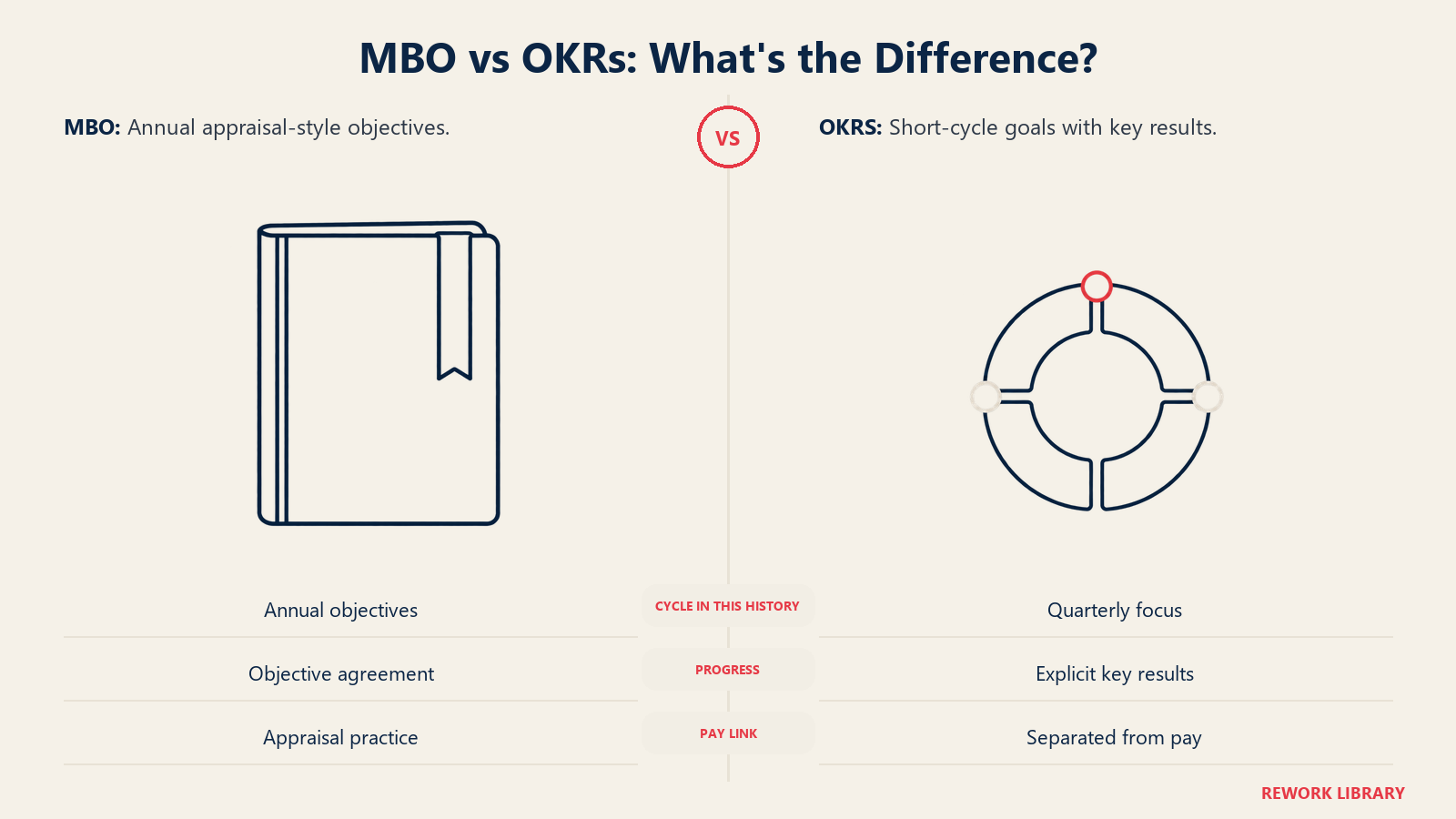
The rebuild was practical. Google's guide says that when Doerr joined Intel, the company was moving from memory chips to microprocessors, and Grove and his management team needed a way to help employees focus on a set of priorities to make the switch. Doerr's own site adds that Grove's name for the method was originally "iMBOs," for Intel Management by Objectives, and that "key results" was a term Grove seems to have coined himself. It lists the differences from Drucker-style MBO: OKRs run quarterly, not annually, and they are divorced from compensation.
Look at what changed. Drucker's objectives anchored annual appraisal. Grove's version gave a company a short cycle and a clear priority during a hard transition, and it separated goals from pay so that people could aim high and report honestly. For the book and the man, see Grove's High Output Management and Andy Grove's leadership profile.
What this means for teams today: A short cycle and a clear priority are what OKRs added to MBO. If you run yearly goals, add a quarterly check and cut the list to the few things that matter this quarter.
The Google Years (1999-2017)
A start-up adopts OKRs and spreads them
The pitch is the best-documented moment in the story. According to Doerr's site, he introduced OKRs to Google's founders in 1999, presenting a PowerPoint around a ping-pong table that doubled as a boardroom table, to a team that included Larry Page, Sergey Brin, Marissa Mayer, Susan Wojcicki and Salar Kamangar. Google's own guide dates it slightly later, saying Doerr introduced OKRs to Google's leadership in early 2000, and that they tested them over the next couple of quarters. Both accounts agree on the substance, and they differ only on timing.
| Question | Doerr's site says | Google's guide says |
|---|---|---|
| Who named OKRs? | Doerr "crafted the name" | Doerr learned OKRs from Grove at Intel |
| When did Google get them? | 1999 | Early 2000, then tested for a couple of quarters |
| Where did "key results" come from? | A term Grove seems to have coined | Milestones that answer Grove's second question |
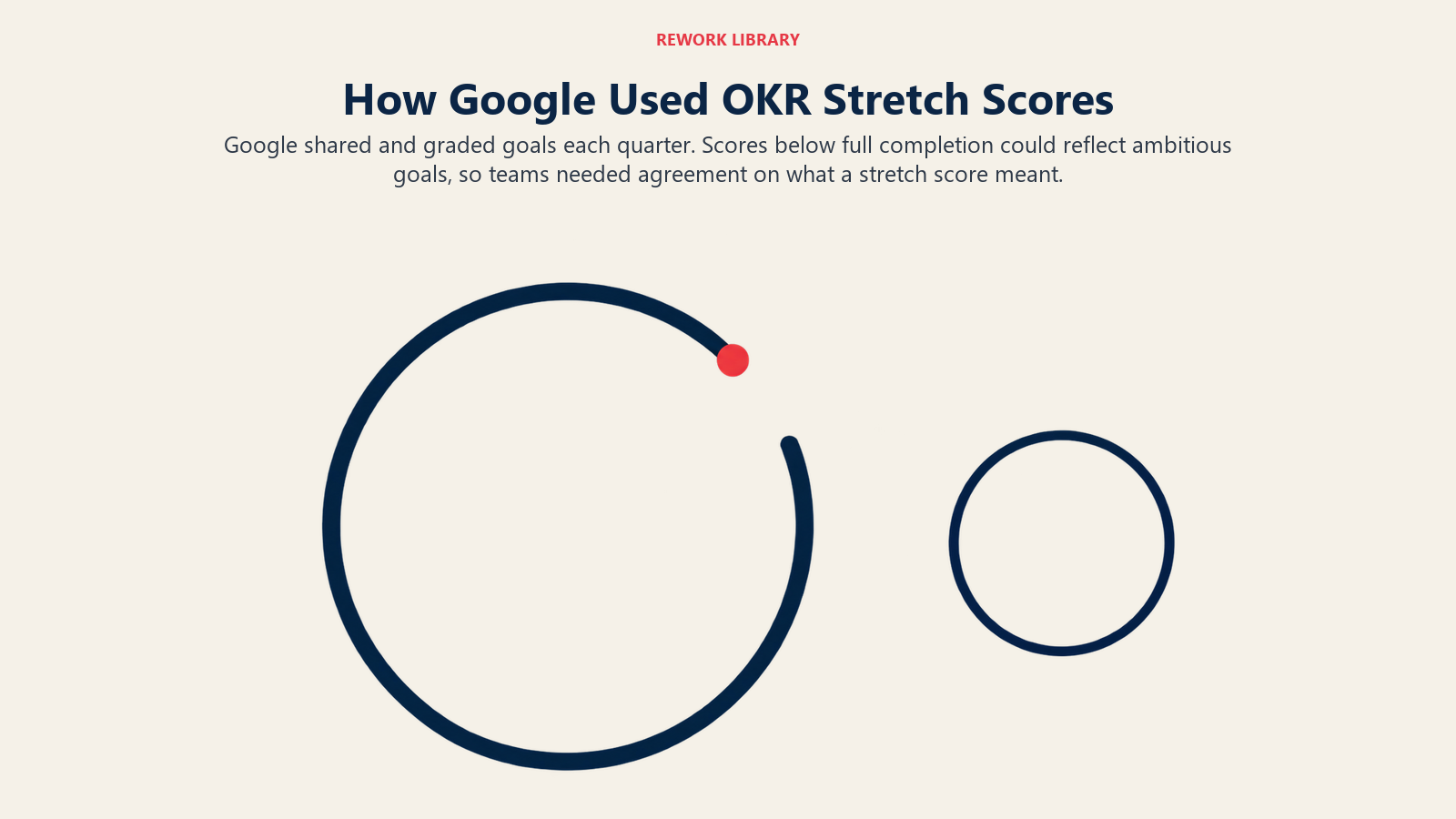
Google then turned the method into its own practice. Its guide says OKRs are graded on a 0.0 to 1.0 scale, with 60 to 70 percent the sweet spot, that Google sets annual and quarterly OKRs, and that it holds company-wide meetings each quarter to share and grade them. The guide also notes that OKRs are not synonymous with performance evaluation, which repeats Grove's separation from pay. It reports that Sears Holding Company rolled OKRs out to 20,000 employees.
The critics kept going while the method spread. In February 2009, researchers published "Goals Gone Wild" in Academy of Management Perspectives, a paper whose authors argue for prescribing goals in doses, with a warning label. Harvard Business School's coverage lists the side effects it names, among them a rise in unethical behavior, over-focus on one area, distorted risk preferences, corrosion of culture and reduced intrinsic motivation. The same paper does not argue against goals; it argues against handing them out like a vitamin.
Our profile of John Doerr's leadership covers the investor's side of this chapter.
What this means for teams today: Copy Google's grading idea only if you accept its trade: stretch goals mean most teams will score below full marks. Say so before the quarter starts.
The Book and the Backlash (2018-present)
OKRs go mainstream, and doubts follow
In 2018 the method went public. Doerr's site says that in 2018 he authored Measure What Matters, a handbook for setting and achieving audacious goals, and in April 2018 he gave a TED talk describing OKRs as a system used by Google, Intel and Bono. From there the framework left Silicon Valley: Doerr's site lists adopters from Allbirds and Netflix to Code for America.
Evidence from inside real teams is more cautious than the book. A 2023 arXiv preprint by Jenna Butler, Thomas Zimmermann and Christian Bird studied goal setting at a large multinational software company, with 47 interviews and 512 survey responses from a team of over 4,000 engineers. It found that tracking, measuring and setting goals is hard work regardless of tools, that middle management is critical to turning lofty goals into work items, and that engineers' attitudes decide whether the process succeeds. That echoes Drucker's 1954 warning that objectives need participation to mean anything. For how the idea compares with plain metrics, see OKR versus KPI and the curated Awesome OKRs reading list.
The open question is the old one. If OKRs are tied to pay, they inherit what Levinson and Deming criticized. If they are separate from pay, they need managers who run a real conversation each quarter. The method is only as good as that conversation.
What this means for teams today: Invest in the middle managers. The preprint's finding about their role is the closest thing this history has to a lab result, and it matches what Drucker described in 1954.
Key People
| Name | Role | Contribution | Year |
|---|---|---|---|
| Peter Drucker | Management writer and consultant | Set out management by objectives and self-control in The Practice of Management | 1954 |
| Harry Levinson | HBR author | Criticized the typical MBO effort in HBR | 1970 |
| W. Edwards Deming | Quality theorist | Listed eliminating management by objective among his points | 1982 |
| Andy Grove | Intel executive and author | Wrote High Output Management, the source of the two questions | 1983 |
| John Doerr | Venture investor | Named OKRs and, per his own site, presented them to Google's founders | 1999 |
| Ordóñez, Schweitzer, Galinsky and Bazerman | Management researchers | Published the side effects of over-prescribed goals | 2009 |
Key Facts
Key Facts: OKR History
- Drucker's chapter on management by objectives and self-control appeared in The Practice of Management, which the Drucker Institute dates to 1954.
- Grove's name for his version was "iMBOs," for Intel Management by Objectives, according to Doerr's site.
- The two questions behind objectives and key results come from High Output Management, published in 1983.
- Doerr's site says he introduced OKRs to Google's founders in 1999; Google's guide says early 2000.
- Google grades OKRs on a 0.0 to 1.0 scale, where a 60 to 70 percent average is the sweet spot.
- A 2023 study of one software company drew on 47 interviews and 512 survey responses.
The Pattern Behind the History
We call this the Borrow and Rebuild pattern. It is our reading of the timeline, not a research result.
- Borrow. Each stage took an older practice and reused it: annual reports, then Drucker's objectives, then Grove's reworking, then Google's adoption.
- Shorten. The cycle shrank from yearly to quarterly, and the list of goals shrank to what matters now.
- Separate. OKRs split goals from compensation, according to Doerr's site, the opposite of the appraisal use critics attacked.
- Spread. A method scales when someone with reach carries it to new organizations, as Doerr did.
- Doubt returns. Every stage drew a critic: Levinson, Deming, the "Goals Gone Wild" authors.
What It Teaches Teams Today
- Keep the goal the person's own. Drucker's managers wrote their objectives, and a 2023 study found attitudes decide success.
- Keep the cycle short and the list shorter. That is Grove's contribution.
- Keep goals away from pay if you want honest reporting, the separation Doerr's site describes.
- Expect stretch goals to score below 100 percent, and tell people before the quarter begins.
- Read the critics. Levinson and Deming describe the failure modes your own version can drift into.
For the wider story, read the history of management, the management theory timeline, and the schools of management thought.
OKRs are old ideas with a new coat: agree on direction, measure progress, and talk about it often. The teams that get value from them tend to be the ones that keep the conversation human.

Co-Founder, Rework.com