Henri Fayol and the Principles of Management: A History
Turn this article into takeaways for your work.


Each assistant summarizes the article only for you and suggests best practices for your work.
Picture the company in 1888. By the account in L. Urwick's foreword to the English edition, Commentry-Fourchambault was going downhill. No dividend had been paid since 1885. Its ironworks were losing money, and its coal seams were nearing exhaustion. The man given the job of saving it was a mining engineer. He had been with the firm since 1860.
Henri Fayol's principles of management came out of one French mining and metals company between 1888 and 1916. Fayol ran it as managing director for thirty years. In a 1916 paper he described what he did. He listed five activities (forecasting and planning, organizing, commanding, coordinating, controlling) plus fourteen working principles. A practitioner wrote the doctrine. Translators and textbook authors decided how far it traveled. A later generation of researchers tested it against what managers actually do.
What he did next, and how he later explained it, is the origin of the most quoted list in management. For the concept itself, start with administrative management and the functions of management. This article tells where the list came from, and what happened to it. The wider story sits in the history of management.
Timeline at a Glance
| Year | Milestone | Why It Mattered |
|---|---|---|
| 1841 | Henri Fayol is born into a family of the French petite bourgeoisie | He became an engineer, not an academic. |
| 1860 | Fayol, aged 19, is appointed engineer at the Commentry pits | The start of a career spent with one company. |
| 1888 | He becomes managing director of the near-bankrupt company | The practice behind the doctrine. |
| 23 June 1900 | Fayol addresses the international mining and metallurgy congress and calls for shared study of administration | His first public appeal for a doctrine. |
| 1908 | He speaks again, at the Société de l'Industrie Minérale's jubilee congress | The second preview of the book, published only as a summary. |
| 1916 | Administration industrielle et générale appears in the society's Bulletin | The five functions and fourteen principles in print. |
| 1919-1925 | Fayol's Centre d'Études Administratives meets in Paris | An attempt to turn the doctrine into a shared research program. |
| 1921 | Fayol publishes his reform study of the French postal and telegraph service | The principles are applied to the state. |
| 1925 | Fayol dies, aged 84; Dunod issues the monograph as a book the same year | The doctrine loses its main advocate. |
| 1929 | J. A. Coubrough's first English translation is printed in Geneva | A few hundred copies reach Britain. Gulick and Urwick's volume dates it 1930. |
| 1937 | Luther Gulick coins POSDCORB, adapted from Fayol's analysis | Fayol's list reaches American public administration. |
| 1949 | Constance Storrs's translation is published by Pitman in London | English-speaking managers get a full edition. |
| 1961 | Harold Koontz names the "management process school" first of six schools | The functions become a recognized school of thought. |
| 1973 | Henry Mintzberg publishes The Nature of Managerial Work | Observation of managers challenges the list. |
The Precursors (antiquity-1860)
Superintendents and ledgers, but nobody called it management
Start with a practice, not a theory. The Arthashastra, a Sanskrit treatise on statecraft attributed to Kautilya, devotes its second book to "The Duties of Government Superintendents" in R. Shamasastry's 1915 English translation. It describes a superintendent of accounts with a prescribed office and shelves of account books, and a reward-and-penalty rule that pays a superintendent eight times any gain in revenue and charges him eight times any loss. It also lists about forty ways of embezzlement, which is its way of saying that control is a managerial duty. Scholars debate the text's date and authorship, so treat it as a record of a tradition of administration rather than a dated event.
Keep the precursor apart from the concept. These authors described how officials should run departments. They did not separate "management" as a skill that could be taught across industries, and nobody drew up a list of functions that applied to a coal pit as well as a court. That step needed an industrial firm large enough to be unmanageable by one person's eye, and a manager willing to write down what he did.
What this means for teams today: The oldest management advice is about records and checks: who reports, who verifies, who is rewarded for what. If your team cannot say who checks whose work, you are in the Arthashastra's world, not Fayol's.
Fayol's Pits (1860-1900)
A mining engineer rises from the shaft to the boardroom
The scene is a coal and iron combine in central France. Fayol was born in 1841, went to the National School of Mines at Saint-Étienne, and, according to Urwick's foreword, graduated as a mining engineer at nineteen and joined the Commentry group of pits of the Commentry-Fourchambault Company in 1860. Urwick divides his working life into four periods. From 1860 to 1872 he was an engineer, and a subordinate, working on problems such as the fire hazards of coal mining. From 1872 to 1888 he directed a group of pits and wrote a geological monograph on the Commentry coal measure, published in three volumes between 1886 and 1893. From 1888 to 1918 he was managing director. After 1918 he devoted himself to promoting his theory.
The turnaround is the practical core of the story. When he took charge in 1888, Urwick writes, the works at Fourchambault and Montluçon were losing heavily and the Commentry coal was nearing exhaustion. Fourchambault was closed, Montluçon kept running, Imphy grew into a leading producer of special steels, and the company bought the Bressac pits in 1891 and the Decazeville pits and works in 1892. It became Commentry-Fourchambault-Decazeville, known as "Comambault." Urwick says Fayol himself always attributed the success not to personal qualities but to the steady application of certain simple principles. That is an executive's claim about his own record, and it is the only evidence we have for the link, but it explains why he later wrote principles down.
What this means for teams today: Fayol built the theory after running the business for decades. Write your own management rules from what you have actually done, and test them on the next quarter.
The Doctrine Years (1900-1918)
Two speeches and a paper turn experience into a list
The first public statement came on 23 June 1900. Urwick calls it a paper to the Congrès international des Mines et de la Métallurgie. Fayol's own later account, in the Storrs translation, says the congress gave him the chance to argue that engineering students spent too long on higher mathematics and too little on management. The historian Jean-Louis Peaucelle, in a study of Fayol's method, says the speech was also a call for pooling administrative experience, a call that mining engineers of the time did not answer. Fayol repeated the appeal in 1908 at the society's jubilee congress at Saint-Étienne, in a long speech that, Peaucelle notes, appeared only in summary in the society's publications. Wren, Bedeian and Breeze, in a 2002 paper in Management Decision, argue that readers should go back to these early presentations, and they publish a previously untranslated one, because they show how his reflections evolved.
The full statement came in 1916. Urwick says the monograph appeared in the third issue for that year of the Bulletin of the Société de l'Industrie Minérale, and that the war of 1914-18 delayed its delivery by two years. The society reprinted 2,000 copies, followed by others, and by 1925 15,000 copies had been printed. Fayol finished only the first two of the four parts he planned, which are the ones that hold the doctrine.
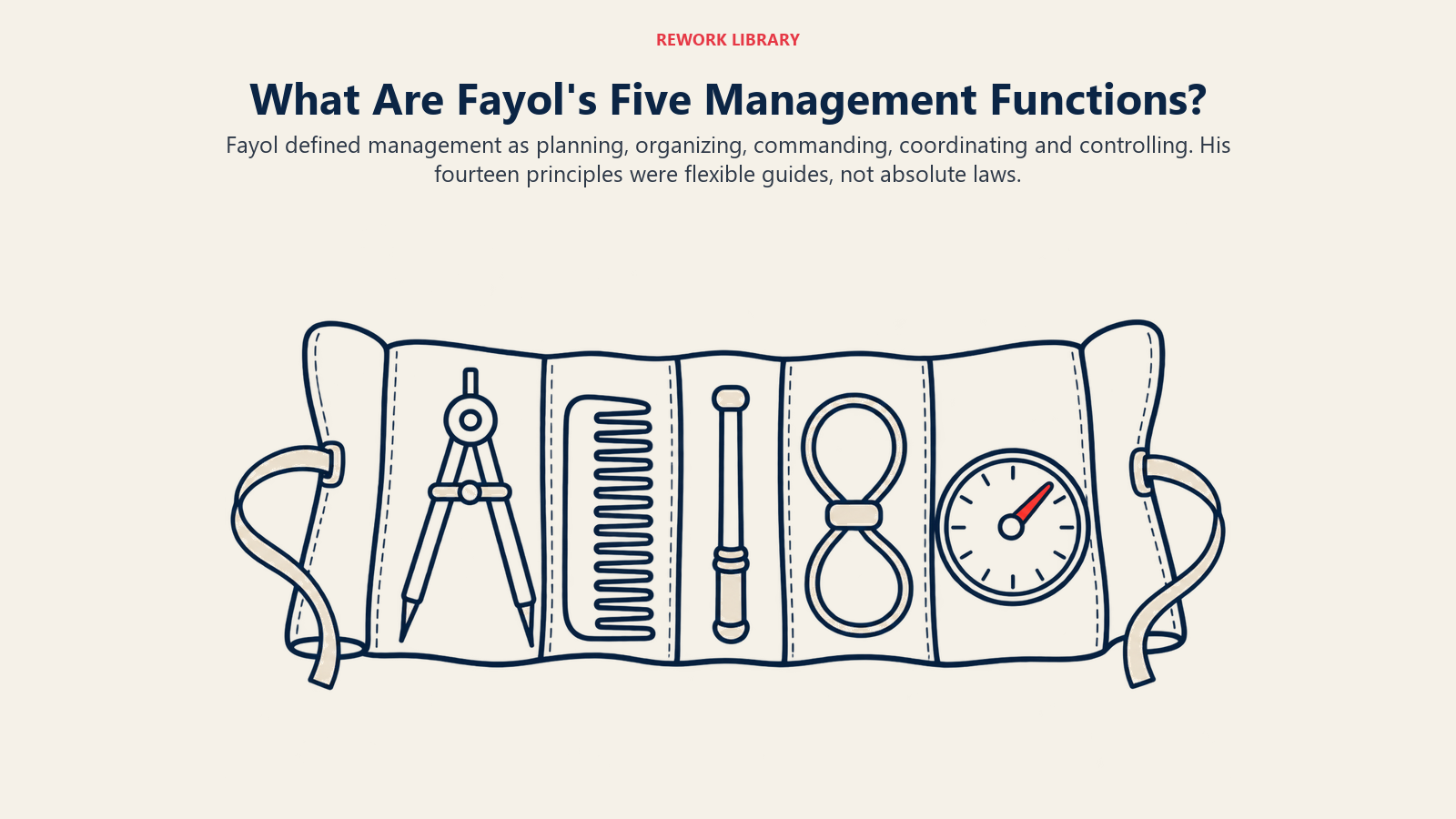
Here is what those two parts say. Fayol divides the activities of an industrial firm into six essential functions, namely technical, commercial, financial, security, accounting and managerial. His argument is that the higher you go, the more the job is managerial ability and the less it is technical skill. He then defines management as five activities: to forecast and plan, to organize, to command, to coordinate and to control. And he explains why management is not taught. In his words, there was no generally accepted theory of it, and without theory no teaching is possible.
The fourteen principles follow. He is explicit that they are not laws: he writes that nothing is rigid or absolute in management affairs, and that the list has no limit in number as long as experience confirms a rule.
| # | Principle | What Fayol is after |
|---|---|---|
| 1 | Division of work | Specialization produces more and better work with the same effort, within limits |
| 2 | Authority | The right to give orders goes with responsibility |
| 3 | Discipline | Agreed obedience, respected on both sides |
| 4 | Unity of command | An employee receives orders from one superior only |
| 5 | Unity of direction | One head and one plan for a group of activities with one aim |
| 6 | Subordination of individual interests | The general interest comes first |
| 7 | Remuneration | Pay that is fair to both sides |
| 8 | Centralization | The right degree depends on the firm |
| 9 | Scalar chain | The line of superiors from top to bottom |
| 10 | Order | A place for each one, and each in their place |
| 11 | Equity | Kindliness combined with justice |
| 12 | Stability of tenure | Costly turnover of managers is a sign of bad running |
| 13 | Initiative | Freedom to propose and carry out a plan |
| 14 | Esprit de corps | Harmony among personnel, and no "divide and rule" within one's own team |
The list is Fayol's own, as translated by Constance Storrs, and the right-hand column paraphrases his chapter. Two details are often lost. On the scalar chain, Fayol shows that going up and down every rung of the chain can mean twenty transmissions and weeks of delay, so he allows a direct link between peers, a "gang plank," as long as their superiors approve. And on structure, he observes that as a group grows, each new superior usually has no more than four or five immediate subordinates, a cousin of what later writers call span of control; see span of control when agents do the work.
Fayol knew Taylor's work too. Peaucelle says Taylor's texts were published in France in 1907, and that Fayol tried from then on to explain why his own theory was superior. In the book, Fayol credits Taylor with having rendered great service by drawing attention to the staff mechanism a workshop needs, and objects to Taylor's functional foremen as a breach of unity of command. For the other side of that contrast, read scientific management and the story of its rise and backlash in our history of scientific management.
What this means for teams today: Treat any list of principles, Fayol's included, as a set of questions. His own warning is that a rule has to be applied in proportion to the situation.
The Fayolisme Years (1918-1925)
A retired chief tries to teach the state
After retiring as managing director in 1918, aged 77, Fayol spent his last years spreading the doctrine. Urwick lists what followed. He founded a Centre of Administrative Studies, where eminent men from many professions met weekly with Fayol presiding. Peaucelle gives the Centre's dates as 1919 to 1925 and its address as 100 rue de Vaugirard in Paris, and says its aim was to collect facts and organize collective study of administration. A lecturer named Carlioz gave a series on "Fayolisme" at the School of Higher Commercial Studies as early as 1918. Marshal Lyautey circulated 2,000 copies of a pamphlet applying Fayol's principles to military administration through the French army in Morocco.
The harder task was the government. Fayol was invited by the Under-Secretary of State for Posts and Telegraphs to investigate that department, and his reform study appeared as a pamphlet in 1921. The same year he wrote an article titled "The State's Administrative Ineptitude" in the Revue politique et parlementaire. On 13 September 1923, at the Second International Congress of Administrative Science in Brussels, he delivered an address on the administrative theory in the state, which Sarah Greer later translated for Gulick and Urwick's 1937 volume. At his death he was investigating the French tobacco monopoly.
Urwick adds that early followers tried to cast Fayol against Taylor, and that Fayol told a Brussels congress how false he found that contrast. The speech, Urwick says, led to the merger of two French bodies into one national organization for scientific management. Peaucelle dates that body, the CNOF, to 1925 and reads the compromise as a win for the Taylorites. Peaucelle also argues that the movement was left without the tools its rival had built: Taylorites developed a profession of consultants who could be hired to change a workshop, while Fayol offered reform from above, and his followers struggled after his death. He concludes that Fayolisme failed in France after 1925. Urwick's foreword and Gulick's 1937 volume tell a different story abroad, which is the next era.
The sources differ on the year of the Brussels congress: Urwick places the remark at a congress of "1925," while Gulick's volume dates Fayol's own Brussels address to September 1923.
What this means for teams today: A framework needs people who can apply it for others. Fayol's followers had a doctrine but no consultants to install it, and the rival method took the market.
Fayol in English (1925-1972)
Translators and textbook authors carry the list across the Atlantic
Fayol died in late 1925, aged 84, and the monograph was issued as a book by Dunod that year. For the next two decades his work reached English readers in small doses. The first English edition was the 1929 translation by J. A. Coubrough of The British Xylonite Co., who translated it voluntarily; it was printed by the International Management Institute at Geneva, and a few hundred copies went to Pitman for distribution in Great Britain. No English translation was published in the United States. Gulick and Urwick's 1937 volume gives the Geneva imprint as 1930, a variant worth knowing when you track down a copy.
What did reach America in 1937 was an adaptation. In "Notes on the Theory of Organization," written while he served on a committee advising the President, Luther Gulick asked what the work of a chief executive is. His answer was POSDCORB, a made-up word for planning, organizing, staffing, directing, coordinating, reporting and budgeting, "adapted from the functional analysis elaborated by Henri Fayol." Gulick had swapped Fayol's list for his own seven, added staffing, reporting and budgeting, and aimed it at public administration. The same book carried Urwick's chapter on Fayol and Greer's translation of the Brussels address.
The full English edition took until 1949, when Pitman published Storrs's translation as General and Industrial Management, with Urwick's foreword calling Fayol the greatest of the European pioneers of management. EBSCO's research starter reports that Fayol's major influence on American management came after the Second World War, and that by the 1950s most management textbooks were organized around his five functions. In 1961 Harold Koontz put a label on that approach. A review of his work lists the management process school first among six schools in his "Management Theory Jungle" article, one that treats management as a process of getting things done through people in organized groups and begins from the functions of managers. Our article on the schools of management thought shows where it sits among the rivals, and Who Is the Father of Modern Management? covers why Fayol's claim to the title is rarely the first answer in the United States.
What this means for teams today: The version of an idea that spreads is the one that is easy to carry. Fayol's five verbs and Gulick's seven letters traveled further than his fourteen paragraphs of nuance.
The Folklore Challenge (1973-present)
Researchers watch managers and the list stops looking so tidy
In 1973 Henry Mintzberg published The Nature of Managerial Work with Harper & Row. His article version, "The Manager's Job: Folklore and Fact," ran in the Harvard Business Review in July-August 1975 and won the McKinsey award for the best HBR article of that year. Its opening line, in the HBR reprint, says that if you ask managers what they do, they will most likely tell you they plan, organize, coordinate and control. Four of Fayol's five verbs, in other words, had become the standard answer. Mintzberg's method was to watch what managers actually did, and the gap between that and the list is the challenge.
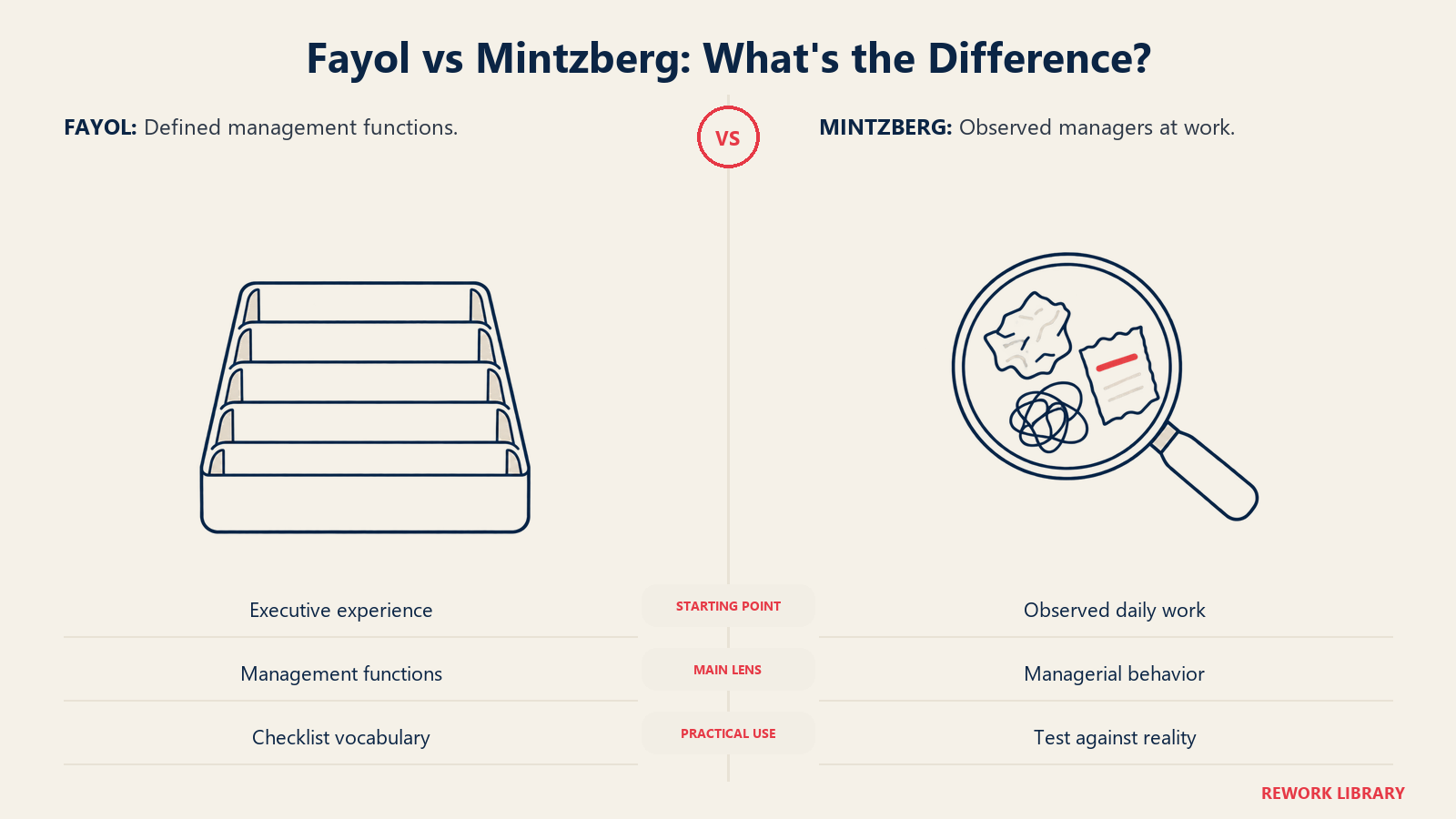
That challenge changed the question, not the principles. Fayol never claimed to describe a typical day; his own text says the managerial function is distinct and runs from the head to the members of the organization. The question since 1975 has been whether his list is a description, a prescription or a vocabulary. The most useful answer for a working manager is the third: five words to check whether anything is missing.
His fourteen principles live on in arguments rather than textbooks. Unity of command is the rule teams test whenever someone has two bosses, as in a matrix structure; see the history of matrix and flat organizations. Fayol's warning that dual command wreaks havoc, and that men cannot bear it, is the starting point of every complaint about conflicting priorities. The scalar chain and centralization are the principles that agile and flat structures push back on, and bureaucratic leadership covers the sibling tradition of clear roles and written rules. Span of control returns whenever software agents take over routine work and a manager's team gets larger. Remember Fayol's own caveat: the list never claimed to be complete.
What this means for teams today: Use the five functions as a checklist, not a diary. If you run a week with no planning, no coordination across teams and no control, a gap shows up whatever you call it.
Key People
| Name | Role | Contribution | Year |
|---|---|---|---|
| Henri Fayol | Mining engineer, managing director of Commentry-Fourchambault | Wrote Administration industrielle et générale with five functions and fourteen principles | 1916 |
| L. Urwick | Author of the foreword and co-editor of the 1937 volume | Wrote the foreword to the 1949 English edition and a chapter on Fayol in the 1937 volume | 1937, 1949 |
| J. A. Coubrough | Translator, The British Xylonite Co. | Made the first English translation | 1929 |
| Constance Storrs | Translator | Made the Pitman translation, General and Industrial Management | 1949 |
| Luther Gulick | Public administration scholar, co-editor of the 1937 volume | Coined POSDCORB, adapted from Fayol | 1937 |
| Paul Vanuxem | Organizer of the Centre d'Études Administratives | Charged with organizing the Centre, per Peaucelle | 1917-1925 |
| Frederick Winslow Taylor | Engineer, scientific management | Fayol praised his staff mechanism but disputed his functional foremen | 1911 |
| Harold Koontz | Management scholar | Named the management process school | 1961 |
| Henry Mintzberg | Management scholar | Studied what managers actually do | 1973, 1975 |
Key Facts
- Urwick says Fayol was managing director from 1888 to 1918 after joining the Commentry pits in 1860.
- Fayol's paper first appeared in the third 1916 issue of the Bulletin of the Société de l'Industrie Minérale.
- By 1925, 15,000 copies of the paper had been printed in French.
- Gulick's 1937 POSDCORB was adapted from Fayol's analysis of the work of administration.
- Fayol wrote that there is no limit to the number of principles, as long as experience confirms them.
- EBSCO's research starter says most management textbooks of the 1950s were organized around Fayol's five functions.
The Pattern Behind the History
Our synthesis, not published research. Fayol's history shows five moves.
- Practice comes first. Fayol ran the company for 28 years before the paper appeared.
- Doctrine needs carriers. The Taylorites built consultants; Fayol's Centre built discussion, and the rival won in France.
- Translators set the reach. The gap between 1916, 1929 and 1949 shaped who knew Fayol.
- Simple versions travel. Five verbs and one acronym spread more widely than the full text.
- Observation tests the list. Mintzberg's studies of managers asked whether the verbs describe the work.
What It Teaches Teams Today
- Check the five functions each quarter. Ask where your team plans, organizes, directs, coordinates and controls, and which one nobody owns.
- Pick one boss per task. If a matrix gives someone two managers, write down who decides when they disagree.
- Let peers talk directly. Fayol's gang plank is the answer to slow escalation: allow it, and tell the superiors afterward.
- Don't divide your own team. Fayol's warning against "divide and rule" within a firm still applies to rival managers.
- Keep the proportion. He says no principle is rigid. Apply each to the situation you are in.
The long view of Fayol is that a manager's own notes became a vocabulary used far beyond his company. For the dated map of what came before and after, see the management theory timeline.

Co-Founder, Rework.com