The History of Business Process Reengineering
Turn this article into takeaways for your work.


Each assistant summarizes the article only for you and suggests best practices for your work.
The problem it answered was a familiar one. By the late 1980s many companies had spent years cutting costs. They still moved slowly. Michael Hammer's 1990 article opened by saying that despite a decade of restructuring and downsizing, many US companies were unprepared for the 1990s. Work was split among departments, each tuned for itself. Nobody owned the path from customer request to delivery.
Business process reengineering (BPR) got its name in 1987, when Michael Hammer coined the term. It reached a mass audience through his July-August 1990 Harvard Business Review article and his 1993 book with James Champy. The idea is much older: stop polishing individual tasks and redesign the whole process that delivers the result. Reengineering rose fast and was blamed for layoffs. Then it went underground, where it still shapes how teams map and redesign work.
For the matching concept, see business process reengineering. For the wider story it belongs to, see the history of management.
Timeline at a Glance
| Year | Milestone | Why It Mattered |
|---|---|---|
| 1104 | Venice establishes its Arsenal | Ships were built in stages as hulls moved between sheds, an early staged production flow. |
| 1776 | Adam Smith publishes The Wealth of Nations | Division of labor became the standard way to organize work. |
| October 1913 | Ford introduces the moving assembly line at Highland Park | Redesigning the whole flow, not each worker, changed output. |
| December 1921 | Frank and Lillian Gilbreth present "Process Charts" to ASME | The whole process was drawn on one page before anything was changed. |
| 1987 | Hammer coins "business process re-engineering" | The movement got its name. |
| Summer 1990 | Davenport and Short publish "The New Industrial Engineering" in Sloan Management Review | IT and process redesign were linked in print. |
| July-August 1990 | Hammer's "Reengineering Work: Don't Automate, Obliterate" appears in HBR | Redesign from scratch reached executives. |
| 1993 | Hammer and Champy publish Reengineering the Corporation | A best-selling manifesto set off the boom. |
| 1995 | Hammer reports that nearly 80% of reengineering efforts fall short | The backlash begins. |
| Late 1996 | A Wall Street Journal piece quotes Hammer: "I wasn't smart enough about that" | A founder publicly admits the people problem. |
| 2002 | Champy publishes X-Engineering the Corporation | Redesign extends across company boundaries. |
| December 2010 | OMG publishes BPMN 2.0 | A shared notation for process models. |
| 2011 | IEEE Task Force on Process Mining publishes its manifesto | Event logs began to show how work really flows. |
The Arsenal Idea (1104-1776)
Venice and a pin factory split work into stages
Picture the Arsenal of Venice: covered sheds along a canal, an unfinished hull floating from one shed to the next, and craftsmen at each stop adding their part. The World History Encyclopedia says the Arsenale was first established in 1104 and describes ships built in stages, with prefabricated parts stored so warships could be assembled quickly. It adds that Henry III of France spent a full day there in 1574 as the Doge's guest, shown each stage of construction so Venice could demonstrate that it could replace a lost warship quickly.
This was a precursor, not reengineering. The Venetians designed a production flow, but nobody framed it as a method for redesigning work that already existed. The pin factory came next. In Book I, Chapter 1 of The Wealth of Nations, first published in 1776, Adam Smith argued for the division of labor. Splitting a job into narrow steps raised output, and it also created the handoffs that reengineering would later attack. Smith's logic became the default design for offices as well as factories.
What this means for teams today: Every handoff in your company is a design choice someone made, even if nobody remembers making it. Start by listing yours.
The Flow Years (1913-1921)
Ford and the Gilbreths put the whole process on one page
In October 1913 at Highland Park, Michigan, Henry Ford introduced the moving assembly line. The Library of Congress says work that took 12.5 hours was cut to 93 minutes. The point for this story is how the gain came about. Ford did not ask each worker to try harder. He redesigned the path the work took.
The Gilbreths supplied the method for seeing a path. Frank and Lillian Gilbreth's paper Process Charts, prepared for the American Society of Mechanical Engineers meeting of December 5 to 9, 1921, calls the chart a device for visualizing a process as a means of improving it. They argued that the entire process should be visible at once before any change is made to a subdivision, because a local change made without regard to what comes before and after it will often suit the ultimate plan poorly. They also wrote that the chart applies to the routine of production, selling, accounting and finance, which means they were already pointing at office work.
That is the clearest early statement of the reengineering instinct: look at the whole, then change the parts. It is still a precursor. The Gilbreths improved a process; they did not propose throwing it out.
What this means for teams today: Before you fix a step, draw the whole flow. Business process mapping is the modern version of the Gilbreth chart.
The Name Arrives (1987-1990)
Computers expose how fragmented the work is
By the late 1980s, companies had bought computers for each function and found the functions still did not connect. Hammer, speaking to Computerworld, described technology silos that had been the pride of individual units but cost money in duplicated effort and slow time to market by the end of the decade. He told the magazine he coined the term business process re-engineering in 1987. Strategy+Business adds that Hammer, Champy and Thomas Davenport had been working together in Cambridge, Massachusetts from the mid-1980s, and that the consulting firm Index adopted "reengineering" after rejecting "transformation," which it thought sounded too touchy-feely.
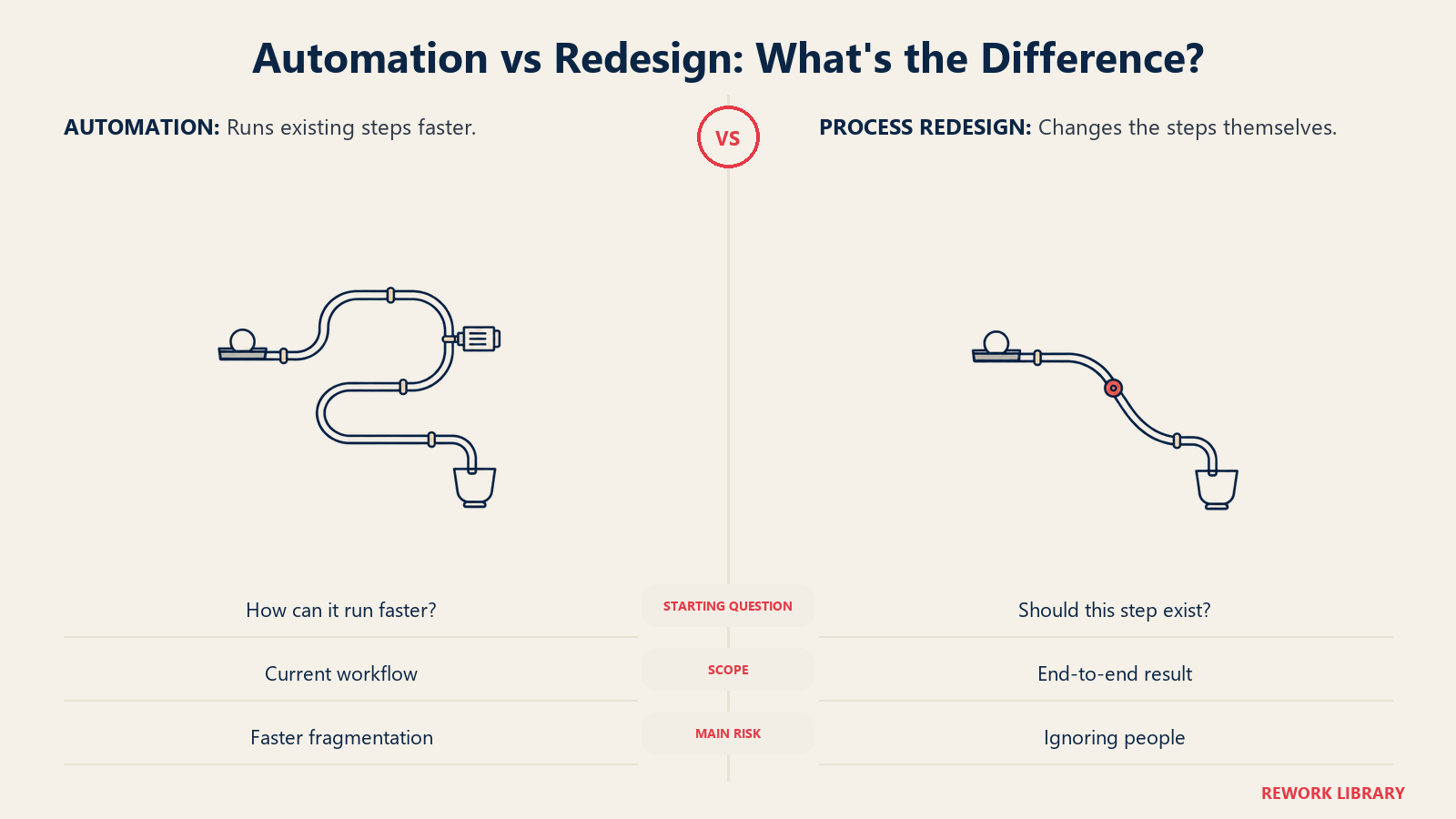
In 1990 two papers landed. Thomas Davenport and James Short's "The New Industrial Engineering: Information Technology and Business Process Redesign" ran in Sloan Management Review, Summer 1990. Hammer's HBR article followed in July-August 1990. Its title carried the whole argument: don't automate a bad process, obliterate it and start again. The same instinct already lived inside the quality movement, so Deming's work and Peter Drucker's belong to the background, but reengineering was louder and more radical.
What this means for teams today: Automating a broken process gives you a faster broken process. Ask whether the step should exist before asking how to speed it up.
The Reengineering Boom (1993-1995)
A best-selling manifesto sets off a consulting gold rush
In 1993 Hammer and Champy published Reengineering the Corporation. Champy later summarized the thesis in Computerworld: companies had become too bureaucratic and too dependent on specialization, splitting work among specialists and then reassembling it, and it was not working. Computerworld reported that by the mid-1990s U.S. companies were spending about $22 billion on BPR, with Eastman Kodak, Ford and Taco Bell reporting great results. It cites Consolidated Edison cutting administrative costs by 80% in procurement and Harley-Davidson cutting manufacturing time from 72 days to two. Those are the claims as reported then, not independently audited results.
Strategy+Business puts the scale a little differently, saying a $50 billion consulting industry had grown around reengineering by 1994. The two figures measure different things and come from different sources, so treat both as signs of scale, not exact totals.
What this means for teams today: Big claims about a method deserve a close look at what was actually measured. Start with one process and one result you can count.
The Backlash (1995-2000s)
Layoffs, failed projects and an apology from the founders
The same Computerworld report says Hammer himself reported in 1995 that nearly 80% of reengineering efforts were falling short of their stated goals. Strategy+Business cites unnamed studies in the early 1990s finding that 70 percent or more of initiatives had made things worse. Different figures, same direction.
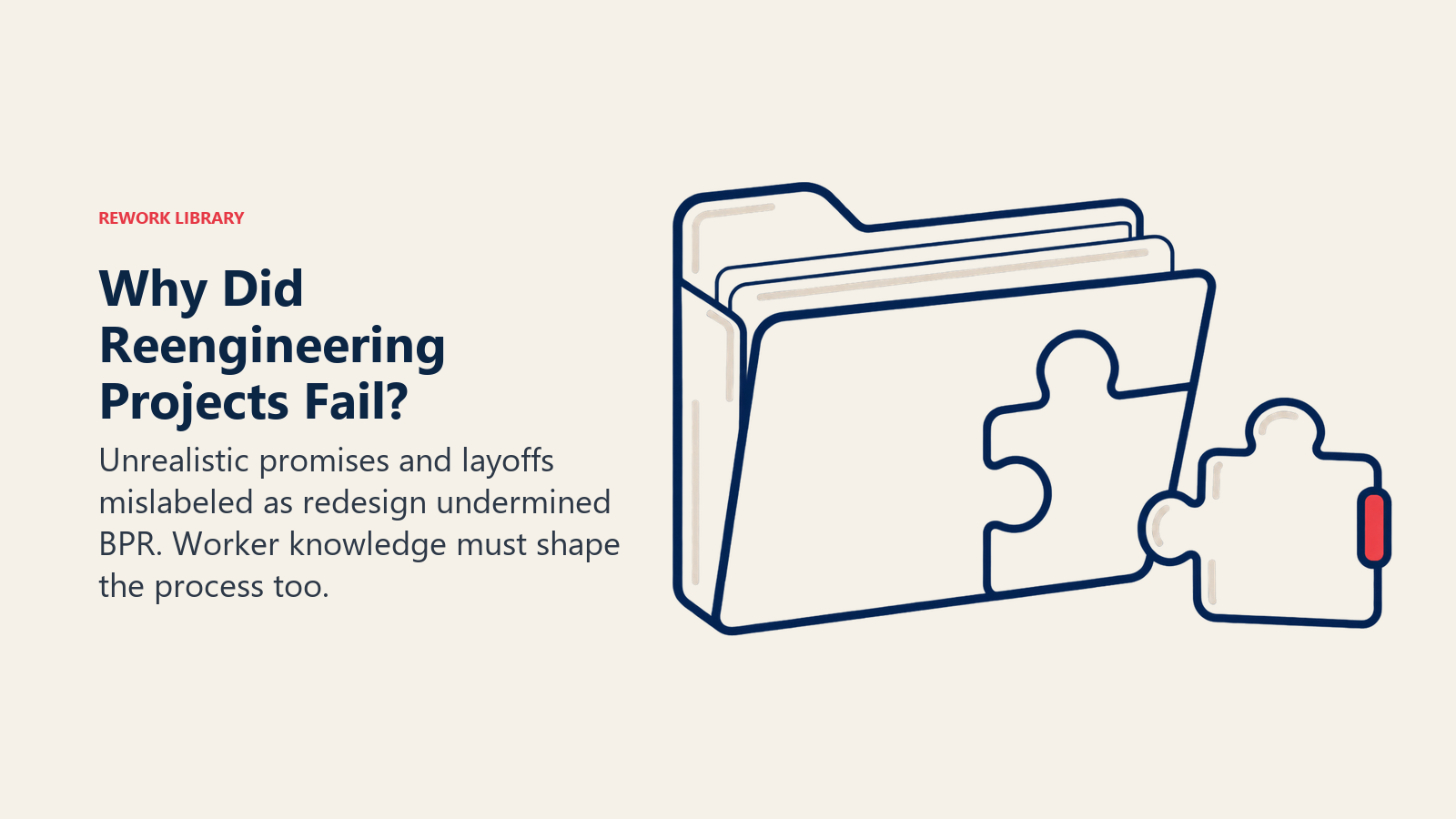
The causes were mixed. Authors Davenport and Laurence Prusak, writing in Computerworld in 2003, point to unrealistic expectations: the books implied a whole company could be redone in about a year, and heavy reliance on enterprise software vendors produced generic processes. They also describe how Pacific Bell announced 10,000 job cuts in 1995 under the reengineering banner, and argue that executives used the word as a code for downsizing. Champy agreed that some managers mislabeled downsizing as BPR, cutting parts of a company in half without changing the work itself.
The founders said so in public. The Computerworld piece quotes a late-1996 Wall Street Journal report that Hammer and the other leaders of the reengineering industry forgot about people, and Hammer's own words: "I wasn't smart enough about that." Strategy+Business adds that Champy apologized in Across the Board and Davenport in the first issue of Fast Company. Its author argues the movement never built a solid theory that could resist downsizing as the default move.
What this means for teams today: Redesign without the people who do the work fails, and redesign used as a cost-cutting label ends trust. Say plainly whether a process project is about speed, quality or headcount.
The Quiet Return (2000s-present)
Reengineering goes underground and returns as process management
Hammer and Champy never accepted that the idea had died. In 2002 Champy told Computerworld that BPR "went underground", and that Dell and Cisco had pushed it far with the Internet. Hammer said some firms came to it indirectly through enterprise software projects in the late 1990s, and that success depends on managing it as process work and not a software install, with more investment in training and change management than people expect. Champy's X-Engineering the Corporation (2002) pushed the same logic across company boundaries.
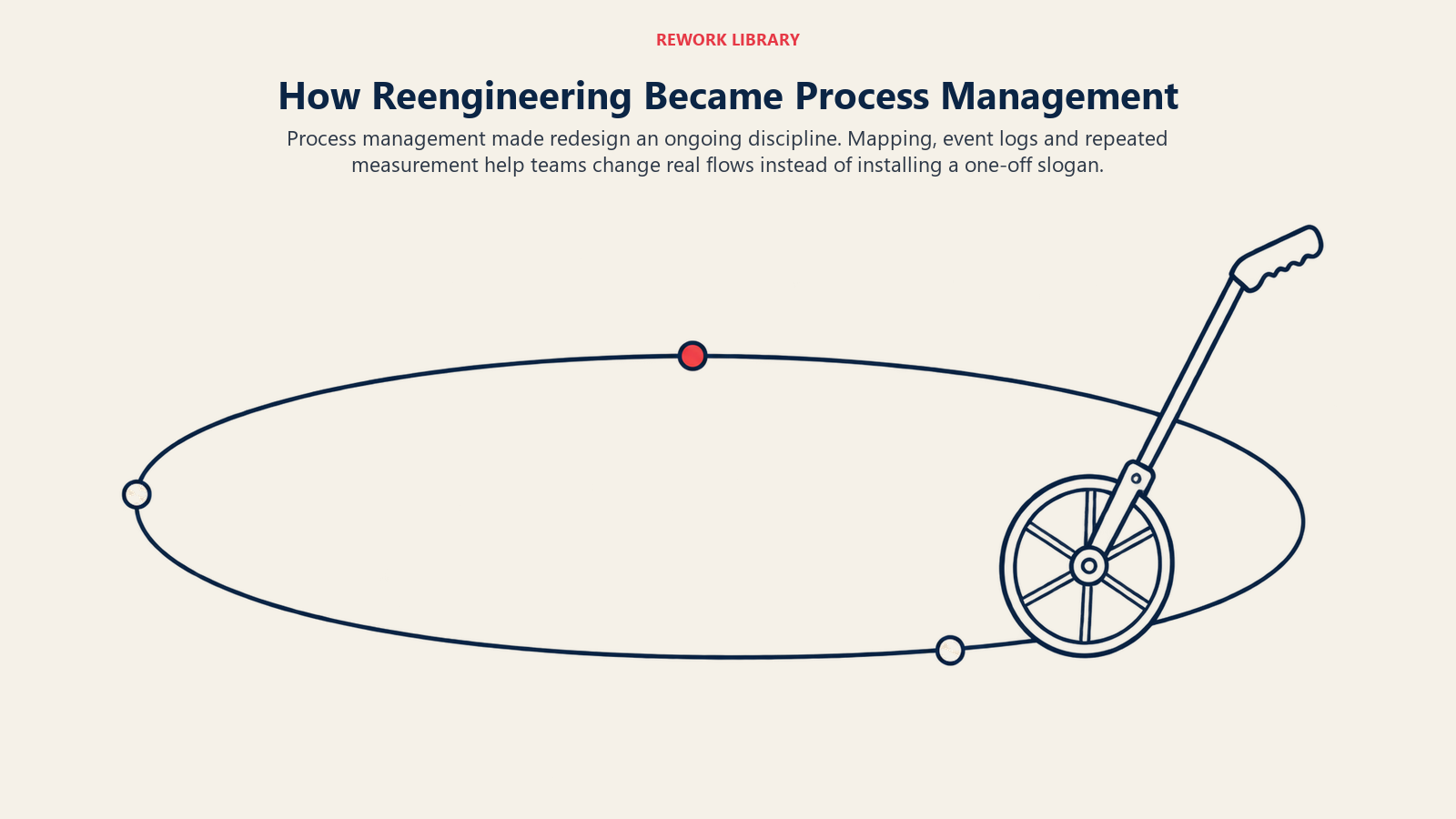
The ideas settled into other names. Hammer died in 2008, when MIT described him as a research affiliate in its Engineering Systems Division and co-author of an international best seller. Meanwhile, process work became a standing discipline: business process management, the BPMN 2.0 notation published by OMG in December 2010, quality methods such as Six Sigma, and process mining. The IEEE Task Force on Process Mining, a group of more than 75 people from over 50 organizations, published its manifesto with the stated goal of improving the redesign, control and support of operational business processes. Instead of asking consultants to guess where work stalls, teams can read it from system logs.
Today the same question returns with automation and AI: which steps should software run, and which should disappear? Fixing a process before you automate it is the oldest lesson here. The overlap with flatter structures is covered in org design and delayering and in the history of matrix and flat organizations.
What this means for teams today: Treat redesign as a routine, not a one-off program. Map, measure, change one flow, and involve the people who run it.
Key People
| Name | Role | Contribution | Year |
|---|---|---|---|
| Frank and Lillian Gilbreth | Industrial engineers | Presented "Process Charts" to ASME | 1921 |
| Michael Hammer | Consultant, former MIT computer science professor | Coined the term; wrote the HBR article and the book | 1987-1993 |
| James Champy | Consultant | Co-wrote Reengineering the Corporation; later wrote X-Engineering the Corporation | 1993, 2002 |
| Thomas Davenport | Academic and author | Co-wrote the Sloan Management Review paper on IT and process redesign | 1990 |
| James Short | Academic | Co-author of the same paper | 1990 |
Key Facts
Key Facts: Business Process Reengineering
- Venice's Arsenal was first established in 1104 and built ships in stages.
- Ford's Highland Park line cut assembly from 12.5 hours to 93 minutes, according to the Library of Congress.
- The Gilbreths presented the process chart to ASME in December 1921.
- Hammer says he coined the term in 1987, and his HBR article ran in July-August 1990.
- By the mid-1990s U.S. companies were spending about $22 billion on BPR, per Computerworld.
- In 1995 Hammer reported nearly 80% of efforts falling short of their goals.
The Pattern Behind the History
We call this the Whole-Process Pattern. It is our synthesis of the timeline above, not a research finding.
- See the whole path first. Venice, Ford and the Gilbreths all began from the end-to-end flow, not from a single task.
- Technology widens the target. Computers and the Internet moved redesign from the factory floor to offices and then across company lines.
- Radical language outruns evidence. "Obliterate" sold the idea and also set expectations that most projects could not meet.
- People decide the outcome. The backlash was driven by layoffs and by leaving the people who do the work out of the design.
- The idea survives under new names. Process management, BPMN and process mining carry the work forward without the slogan.
What It Teaches Teams Today
- Map before you change. Draw the path from request to result, as the Gilbreths did in 1921.
- Question the step, not just the speed. If a step adds nothing for the customer, remove it before you automate it.
- Name the goal. Efficiency, quality and headcount cuts are different projects. Mixing them destroyed trust in the 1990s.
- Involve the people doing the work. Hammer's own admission was that this was missed.
- Keep it going. Treat process improvement as an ongoing habit, linked to Drucker-style management by objectives and the wider management theory timeline.
For where this fits among competing schools, see the schools of management thought and who is the father of modern management.
The long view is simple: redesigning a whole process is old, useful and easy to do badly. The teams that got value from it kept the idea and dropped the slogan.

Co-Founder, Rework.com