The History of Wi-Fi
Turn this article into takeaways for your work.


Each assistant summarizes the article only for you and suggests best practices for your work.
The problem was cables. Through the 1980s, local networks meant pulling wire through walls to every desk and machine, as the story of Ethernet shows. A radio link promised the same connection with no drilling. But rules on who could use the airwaves stood in the way, and so did the lack of one shared standard.
Wi-Fi was not invented in a single moment. Its two roots are a 1971 radio network in Hawaii and a 9 May 1985 US decision to let ordinary products use spread spectrum radio without a license. The first Institute of Electrical and Electronics Engineers (IEEE) standard for wireless LANs, 802.11, was approved on 26 June 1997. The name "Wi-Fi" came from an industry group formed in 1999. The throughline: a regulator opened free spectrum, engineers argued their way to one shared standard, and a consumer product made it matter.
Wi-Fi is what happened when both barriers fell.
A quick definition first. A "wireless LAN" is a local network that uses radio instead of cable. "Spread spectrum" means a signal is deliberately spread over a wide band of frequencies, which makes it harder to jam and lets many users share the air. For the long-distance story, start with the pillar, The History of the Internet.
Timeline at a Glance
| Year | Milestone | Why It Mattered |
|---|---|---|
| 1895-1901 | Marconi sends wireless signals, then crosses the Atlantic in December 1901 | Radio communication becomes practical. A precursor, not Wi-Fi. |
| 10 Jun 1941 | Hedy Kiesler Markey (Hedy Lamarr) and George Antheil file a frequency-changing "secret communication system"; US 2,292,387 issues 11 Aug 1942 | An early patent on hopping between carrier frequencies. A precursor of the idea, not the origin of Wi-Fi. |
| Jun 1971 | ALOHAnet begins serving inter-island computer access in Hawaii | Shows many senders can share a radio channel with simple random access. |
| 9 May 1985 | The FCC adopts spread spectrum rules for unlicensed use | Opens bands in which anyone may build a radio product. |
| Nov 1987 | Dutch engineers at NCR's Utrecht lab demonstrate a 100 kbit/s radio link between two PCs | The WaveLAN team that fed the first standard. |
| Sep 1990 | The first meeting of the IEEE 802.11 working group | Rivals begin writing one wireless LAN standard. |
| 23 Jan 1996 | CSIRO's US patent 5,487,069 is granted | A technique for indoor echoes that later standards used. |
| 26 Jun 1997 | IEEE 802.11-1997 is approved | The first wireless LAN standard. |
| 21 Jul 1999 | Apple announces AirPort for the iBook | Wireless networking reaches ordinary buyers. |
| 16 Sep 1999 | 802.11a and 802.11b are approved | 802.11b brings 11 Mbit/s to the 2.4 GHz band. |
| 2000 | The Alliance adopts the name Wi-Fi | The standard gets a name people can say. |
| 3 Oct 2018 | Wi-Fi Alliance introduces numbered generations, from Wi-Fi 4 to Wi-Fi 6 | Users can compare generations without reading standards. |
| 23 Apr 2020 | The FCC makes 1,200 MHz in the 6 GHz band available for unlicensed use | Wi-Fi gets nearly five times more spectrum in the US. |
| 8 Jan 2024 | Wi-Fi CERTIFIED 7 is introduced | 320 MHz channels and Multi-Link Operation. |
The Radio Ancestors (1895-1984)
Wireless works, but nobody can network with it
The turning point in this long prelude is the first wireless signal that carried a message. In 1895 Guglielmo Marconi began experiments at his father's estate in Pontecchio and sent wireless signals about one and a half miles. By December 1901 he had sent signals across the Atlantic, from Poldhu in Cornwall to St. John's in Newfoundland, about 2,100 miles. Radio could now carry a message without a wire. Turning that into a network of computers took another seventy years.
A second precursor is worth separating out. On 10 June 1941, Hedy Kiesler Markey, the film actress known as Hedy Lamarr, and the composer George Antheil filed a patent for a "secret communication system". It changed the carrier frequency over time using synchronized paper records at transmitter and receiver, and was meant especially for remote control of craft such as torpedoes. The patent describes a player-piano record with 88 rows of perforations permitting 88 carrier frequencies, and it issued on 11 August 1942. This is frequency hopping on paper. It is a precursor of an idea that spread spectrum radio later used, and nobody built a wireless LAN from it.
The concept itself starts in Hawaii. At the University of Hawaii in the late 1960s, Norman Abramson, Franklin Kuo and Wes Peterson started the ALOHA System. The Computer History Museum's catalog entry says the project ran from late 1968 to the mid-1970s and built a packet radio network whose terminals shared a "random-access, broadcast channel". The IEEE milestone record says the network began providing inter-island access to the university's computers in June 1971, that it was the first to show shared channels could work at scale with simple random access, and that it led directly to Ethernet and personal wireless communication technologies. It is also a tie to the ARPANET and to packet switching: the same record notes that ALOHAnet was asked in December 1972 to prepare to connect to the ARPANET by satellite.
ALOHAnet was a radio link to a central computer, not Wi-Fi. What it proved was the rule underneath: many senders can share one channel if they accept collisions and retry. Ethernet's inventors borrowed it first, and wireless LANs followed. The IEEE record adds a point that still holds: 802.11 Wi-Fi is half-duplex, unlike ALOHAnet's separate inbound and outbound frequencies.
For teams today: the earliest version of an idea is rarely the product. Lamarr's patent and Marconi's radio were true ancestors, but the working network needed rules for sharing the air first.
After the 1985 Ruling (1985-1990)
The FCC opens the air to anyone with a product
The turning point is a regulation. On 9 May 1985, the FCC adopted rules on spread spectrum. According to a Clemson University event page, the rules opened the 915 MHz, 2.4 GHz and 5.8 GHz industrial, scientific and medical (ISM) bands to radio systems using spread spectrum. Michael Marcus, who has written a first-person history of the decision, describes the meeting as one that "attracted little attention outside the few companies that lobby the agency". The same page says the rules began as an effort to remove outdated technical regulations, not as a plan to launch particular products. IEEE's record says the 1985 decision led to new 802 work groups for wireless LANs.
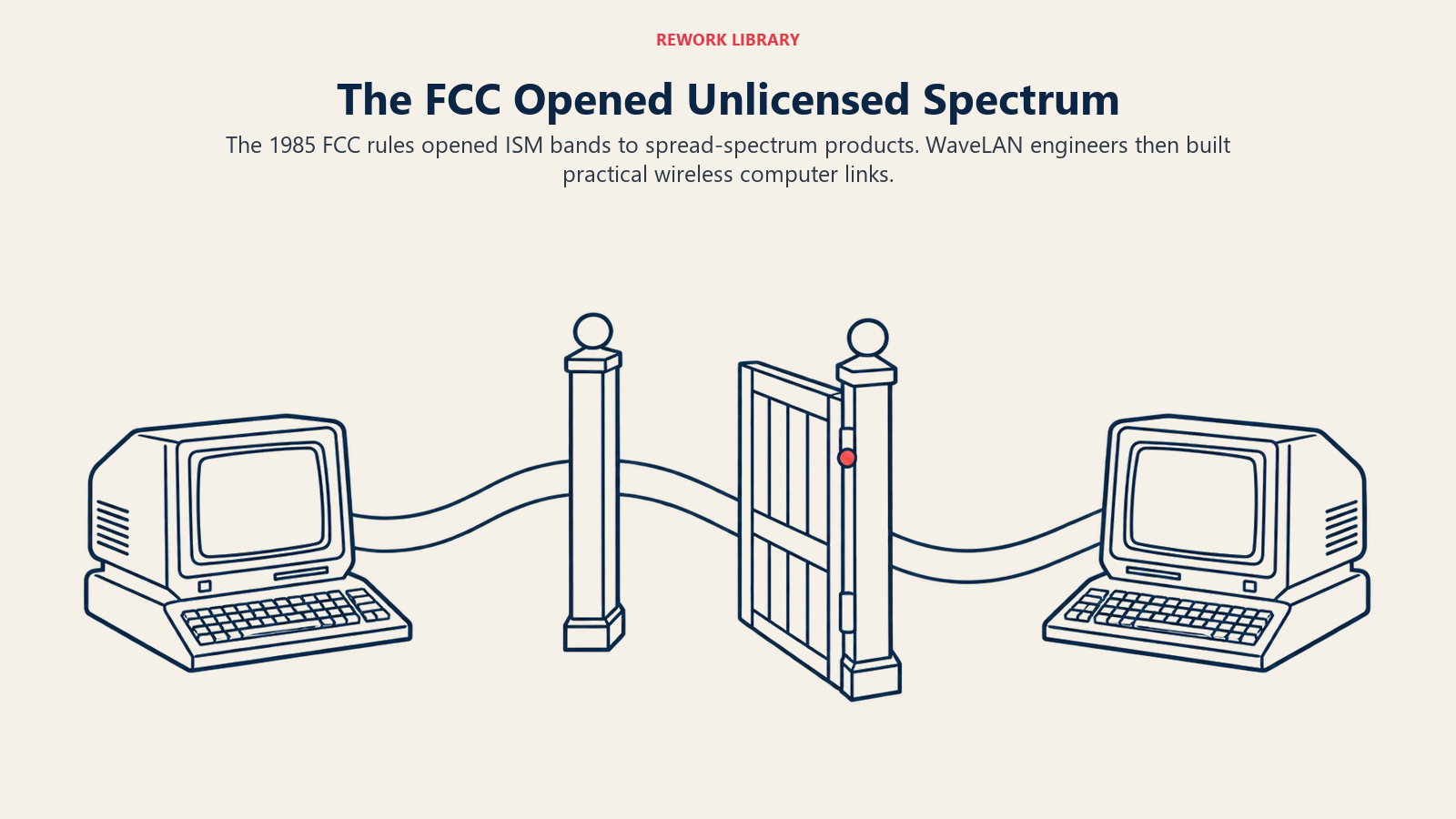
Picture an engineering lab in Utrecht, part of NCR Corporation in 1985. The IEEE milestone record on WaveLAN says that in November 1987 a Dutch team demonstrated a 100 kbit/s radio link between two PCs to NCR reviewers, followed by a 200 kbit/s prototype in August 1988. The first public demonstration was at Networld 90 in Dallas in 1990. The WaveLAN product reached 2 Mbit/s, which the record says was about ten times faster than competing systems at the time, and it used direct sequence spread spectrum. The record also credits the team with a medium access design that used immediate acknowledgments to improve reliability.
That left a new problem: a working product from one company is not a standard. Compare the cable world, where Ethernet had become a shared standard by 1983.
For teams today: a rule change can open a market before any product exists. The 1985 decision named no product, and it still shaped what got built.
The Committee Years (1990-1998)
Rival radios become one standard
The turning point is a meeting. IEEE 802 began paperwork for a wireless LAN working group in July 1990, and its first meeting was in September 1990. Vic Hayes, an NCR engineer, took the chair. His ETHW biography says he chaired the group that defined IEEE 802.11 from its inception in 1990 through 2000, and that he is popularly known as the "Father of Wi-Fi".
Committee work is slow, and this one took seven years. The working group's timeline page shows the base standard, IEEE 802.11-1997, approved on 26 June 1997. The WaveLAN team's direct sequence modem and acknowledgment-based access method were taken into it, per the IEEE milestone record, which also says the team helped push the rival HomeRF and HIPERLAN efforts aside. IEEE's WaveLAN page says 802.11b later added 11 Mbit/s while staying compatible with those rates.
A standard on paper is not yet a product that works out of the box. The standard settled the language and left the testing open. That is the same gap the early Internet closed with TCP/IP, a shared protocol that let separate networks interconnect.
For teams today: a standard is necessary but not sufficient. Someone has to test whether products actually work together.
The Brand Years (1999-2008)
An alliance names it, and Apple puts it in a laptop
The turning point is a trade group. The Wireless Ethernet Compatibility Alliance (WECA) was founded in 1999 and became the Wi-Fi Alliance a year later, according to the Alliance's own history. One of the founders, David Cohen, says the aim was to "establish interoperability very, very quickly". Phil Belanger served as chairman from 1999 to 2001. The Alliance's history page says it adopted "Wi-Fi" as the proper name for its technical work in 2000. The IEEE milestone record on WaveLAN lists the first Wi-Fi certifications as 2000. The group's job was to run interoperability tests and put a mark on products that passed, so a buyer did not need to read a standard.
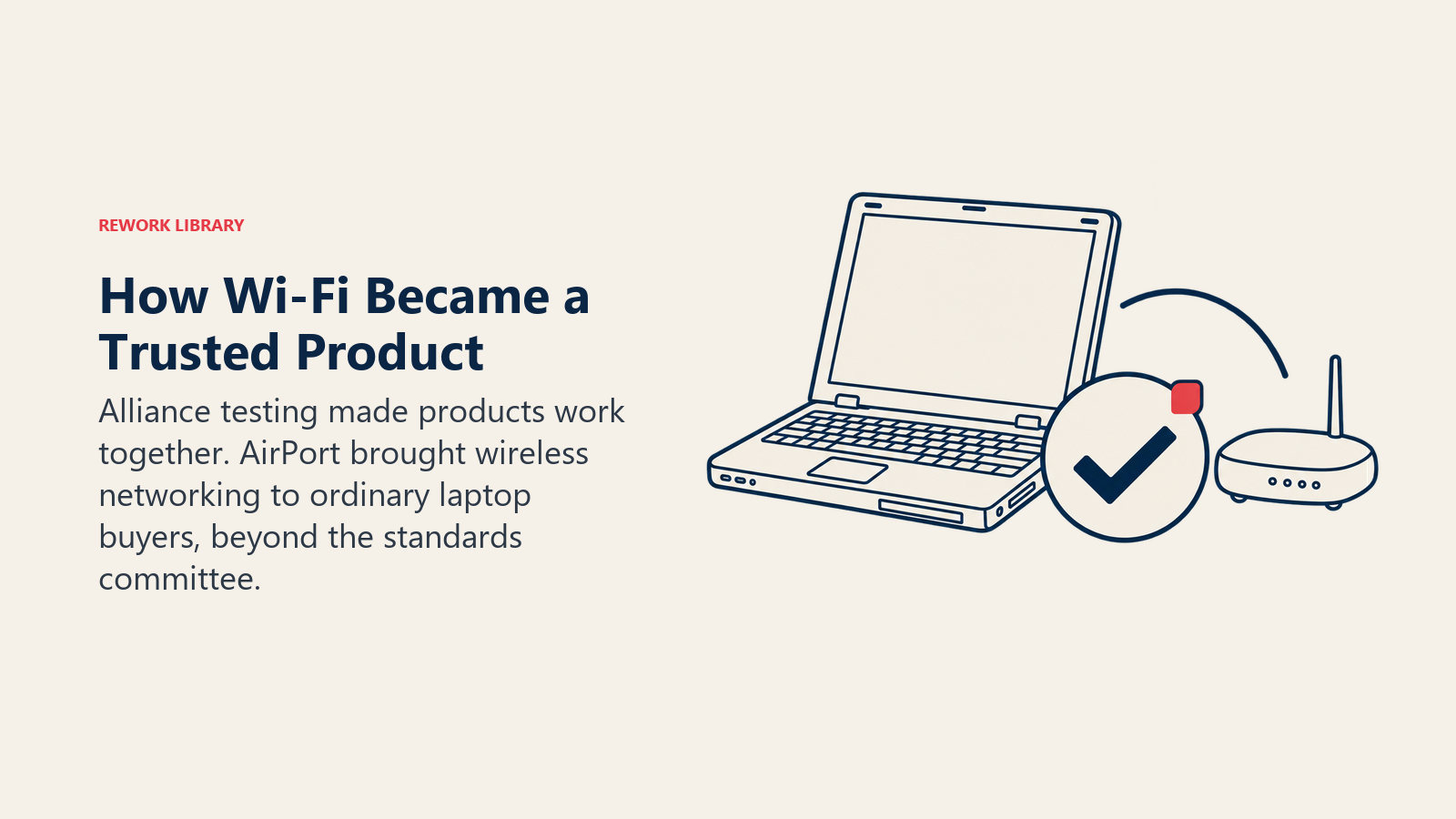
The product moment came from Apple. On 21 July 1999 Apple unveiled the iBook at $1,599, with an optional AirPort card at $99 and an AirPort base station at $299 that served up to ten iBooks over an 11 Mbit/s radio link, developed with Lucent. A laptop with wireless networking for $99 changed what a home or a coffee shop could do. The IEEE record lists the AirPort launch among the key years, and the Alliance founders' retrospective cites Apple's decision to integrate Wi-Fi into the iBook. The month after, 802.11a and 802.11b were approved on 16 September 1999. Later amendments followed: 802.11g carries a 2003 designation in the same timeline.
One more set of facts belongs here, because it is often misattributed. Australia's national science agency CSIRO holds US patent 5,487,069, "Wireless LAN," with a priority date of 27 November 1992 and a grant date of 23 January 1996. The five named inventors include John O'Sullivan. CSIRO's account says it solved indoor multipath, where radio waves bounce off walls and furniture and smear data, using parallel sub-channels, error correction and interleaving. It says the technology was first embodied in an industry standard in 1999 (802.11a) and later in 802.11g and 802.11n, and that by 2012 CSIRO had licence agreements with 23 companies representing around 90% of the industry and revenue above $430 million. So CSIRO's patent covers an important technique inside later Wi-Fi. It does not cover the 1997 standard's origin. Both accounts are true at once.
The Alliance also pushed for more spectrum. Hayes's biography says that through the Alliance he helped mobilize industry, and the World Radio Conference of 2003 allocated an additional 455 MHz in the 5 GHz area for wireless access devices.
The business climate around those years is covered in the dot-com bubble.
For teams today: the brand did as much as the engineering. A neutral name and a test mark turned a technical standard into something buyers trusted.
The Speed Race (2009-2019)
Every few years, a faster generation
The turning point is a naming change. By 2018, Wi-Fi had grown through a string of lettered amendments that confused buyers: the timeline lists 802.11n in 2009, 802.11ac in 2013 and 802.11ax in 2021 as designations. On 3 October 2018 the Alliance introduced Wi-Fi 6 for 802.11ax devices, Wi-Fi 5 for 802.11ac and Wi-Fi 4 for 802.11n. Its CEO said that for nearly two decades users had "had to sort through technical naming conventions". Certification for Wi-Fi 6 was due in 2019.
Security was the other story of the decade. On 25 June 2018 the Alliance introduced WPA3, a successor to WPA2 that gives personal networks stronger protection against password guessing, blocks outdated legacy protocols and requires Protected Management Frames. It keeps a transitional mode so WPA2 devices continue to work. An Enhanced Open program, announced alongside it, adds data protection to open networks such as coffee shops and airport portals.
The new problem was crowding. More devices, more video, and more neighbors shared the same few bands, and each faster generation made the air busier. The Alliance's own pitch for Wi-Fi 6 was that it would improve experience across consumer and enterprise settings. The next fix was not a faster modem. It was more spectrum.
For teams today: a plain numbering scheme beats a clever one. Customers cannot compare "ax" and "ac", but they can compare 5 and 6.
The 6 GHz Age (2020-present)
The regulator that started the story widens the road
The turning point is another FCC vote. On 23 April 2020 the Commission adopted rules making 1,200 megahertz of spectrum in the 6 GHz band (5.925-7.125 GHz) available for unlicensed use. The FCC said this would increase the spectrum available for Wi-Fi by nearly a factor of five. Indoor low-power operation is allowed across the full 1,200 MHz, standard-power devices in 850 MHz, and an automated frequency coordination system keeps unlicensed devices from interfering with existing microwave links used by utilities and public safety. The pattern repeats: 1985 opened the first bands, 2020 opened the biggest new one.
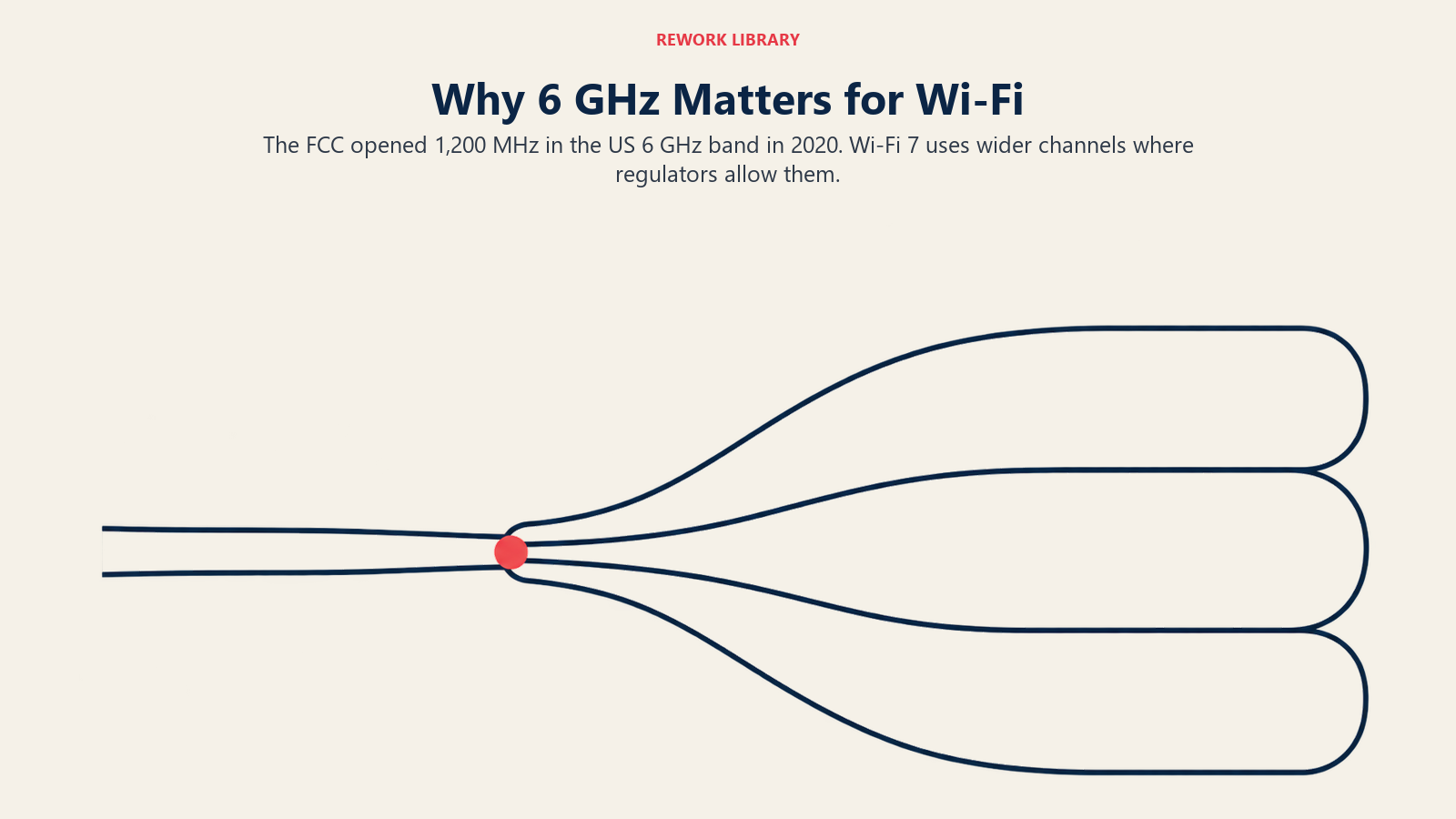
Then the next generation arrived. On 8 January 2024 the Alliance introduced Wi-Fi CERTIFIED 7, built around 320 MHz channels (available where regulators open 6 GHz), Multi-Link Operation, which lets a device use several links at once, and 4K QAM, which the Alliance says is about a fifth faster than 1024 QAM. The IEEE's working group page lists IEEE Std 802.11be-2024 as published on 22 July 2025, and the base IEEE Std 802.11-2024 as published on 28 April 2025.
The scale is hard to overstate. A Wi-Fi Alliance report, cited on IEEE's page for the 802 family, values Wi-Fi at $3.3 trillion globally in 2021, and IEEE describes the core 802.11 work today as integrating with 5G infrastructure while raising speed and capacity. That cellular side has its own story, told in the history of the mobile internet. Wired and wireless networking now share the same family of standards. For the wired side, read the history of Ethernet, and for the machines on both ends, the history of computers.
For teams today: the space you build on can be rewritten by a vote. If your product depends on shared infrastructure, track the rulemakers as closely as the engineers.
Key People
| Name | Role | Contribution | Year |
|---|---|---|---|
| Guglielmo Marconi | Inventor | Early wireless telegraphy; transatlantic signals in 1901 (precursor) | 1895-1901 |
| Hedy Lamarr and George Antheil | Inventors | Patent for a frequency-changing secret communication system (precursor) | 1941-1942 |
| Norman Abramson and Franklin Kuo | University of Hawaii | Led ALOHAnet, the shared-channel radio network | 1968-1971 |
| Michael Marcus | Author of the history of the FCC decision | Documented the 1985 spread spectrum rulemaking | 1985 |
| Vic Hayes | NCR, then chair of IEEE 802.11 | Chaired the standards working group from 1990 to 2000 | 1990-2000 |
| John O'Sullivan and colleagues | CSIRO | Inventors named on US 5,487,069 | 1992-1996 |
| Phil Belanger | Wi-Fi Alliance founder | Chairman of the Alliance, 1999 to 2001 | 1999-2001 |
Key Facts
- The FCC adopted its spread spectrum rules on 9 May 1985, opening the 915 MHz, 2.4 GHz and 5.8 GHz bands.
- IEEE 802.11-1997 was approved on 26 June 1997.
- Apple's AirPort card cost $99 and its base station $299 at launch on 21 July 1999.
- By 2012 CSIRO had licence agreements with 23 companies covering around 90% of the industry.
- The FCC's April 2020 order opened 1,200 MHz of the 6 GHz band, nearly five times more spectrum for Wi-Fi.
- A Wi-Fi Alliance report values Wi-Fi at $3.3 trillion globally in 2021.
The Pattern Behind the History
We call the sequence the Open Air, Shared Rulebook Pattern. It is our synthesis of the history above, not a research finding.
- Free the spectrum. The FCC's 1985 and 2020 rulings each created room for products before anyone had built them.
- Borrow the sharing rule. ALOHAnet showed many senders can share one channel, and IEEE says it led to personal wireless communication.
- Put rivals in one room. NCR's design and others went into a single IEEE standard instead of competing dialects.
- Test and name it. An alliance certified interoperability and gave the standard a name buyers could ask for.
- Wait for the retail moment. AirPort in a $1,599 laptop did more for adoption than the 1997 standard did.
What It Teaches Teams Today
- Watch the rulemakers. Two FCC votes, 35 years apart, bracket this entire history.
- Standardize, then certify. The 1997 standard was not enough. The Alliance's testing is what made products work together.
- Name it for the buyer. "Wi-Fi 6" replaced a code only engineers could read.
- Tell precursors from the concept. Lamarr's patent and Marconi's radio mattered, but neither is the start of Wi-Fi. State what each one actually did.
- Credit more than one inventor. NCR's modem, CSIRO's multipath technique and the IEEE standard are three different contributions, each real.
Wi-Fi shows how an open band, one shared rulebook and a recognizable name can put a technology in every pocket. To see where the wireless edge meets the rest of the network, read the Internet timeline and who invented the Internet.

Co-Founder, Rework.com