How AI Moved from Research Labs to Everyday Work
Turn this article into takeaways for your work.


Each assistant summarizes the article only for you and suggests best practices for your work.
The question for an office in 1890 was not "can a machine think?" It was "can a machine count faster than a room full of clerks?" That is where this story starts.
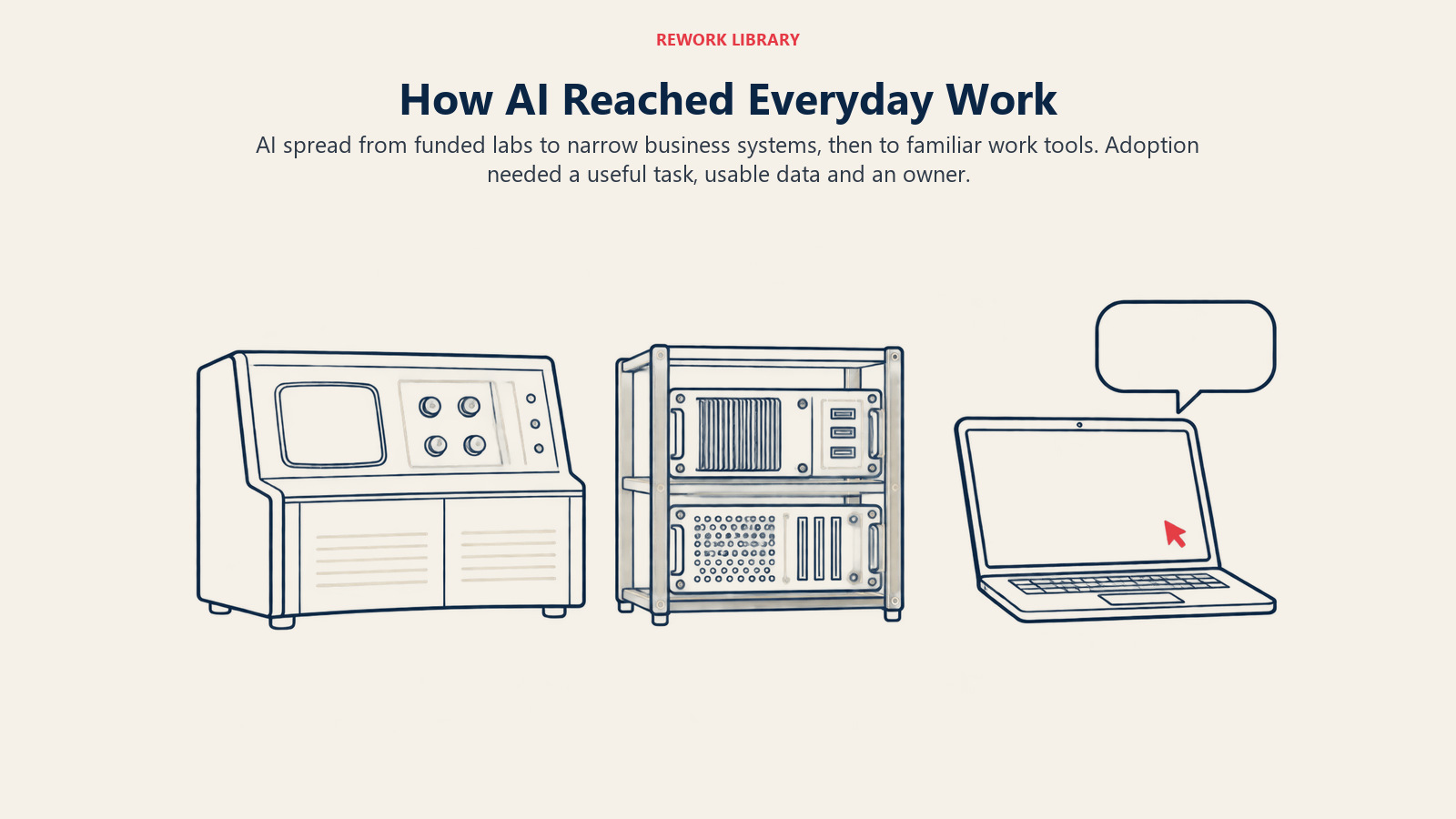
AI left the research lab for the office in stages over about 70 years. Defense money built the first labs in the 1960s. A rule-based program began configuring computer orders at Digital Equipment Corporation in 1980. A free chat tool put the technology on ordinary desks on November 30, 2022. The thread through all of it is simple. AI spread where a narrow task, usable data and a willing buyer lined up. It stalled where they didn't.
This is the story of that spread, told by following the work instead of the algorithms. For the technical chronology, see our AI timeline from Turing to large language models, and for the earliest ideas, read the origin of artificial intelligence. The wider cycle of hype and winter sits in the history of AI pillar.
Timeline at a Glance
| Year | Milestone | Why It Mattered |
|---|---|---|
| 1890 | Hollerith tabulating machines process the US census | Machines took over mass clerical counting. |
| 1951 | LEO, built by the Lyons tea company, runs its first operational business program | A business, not a laboratory, paid for a computer to do office work. |
| 1963 | MIT begins Project MAC under a Defense Department-backed contract | Government money built a lab around interactive computing. |
| 1966 to 1972 | SRI builds Shakey, a robot that senses, plans and moves | Lab AI became a visible demonstration of planning. |
| 1980 | R1 starts configuring VAX orders at Digital Equipment Corporation | Rule-based AI began doing paid work in manufacturing. |
| 2003 | Amazon publishes its item-to-item recommendation method | Machine learning ran quietly inside a mass-market product. |
| 2011 | Apple ships Siri with the iPhone 4S | A voice assistant reached consumers. |
| 2021 to 2022 | GitHub Copilot launches as a preview, then reaches general availability | AI sat inside a daily work tool for developers. |
| Nov 2022 | ChatGPT launches as a free research preview | A chat box made AI usable without a developer. |
| 2023 | Early studies measure productivity gains on real tasks | Evidence moved from demos to numbers. |
| Nov 2023 | Microsoft 365 Copilot becomes generally available to enterprises | AI arrived inside Word, Excel and Outlook. |
| 2025 to 2026 | Surveys put organizational AI use at 88%; agents start acting on screens | Adoption became the norm, with gaps by firm size. |
The Tabulator Age (1890-1950s)
Machines take over the clerk's counting
Picture the US Census Bureau in 1880: rooms of clerks tallying paper schedules by hand. That count took seven years and cost around $5.8 million. For 1890, the Bureau used Herman Hollerith's machines instead. The same source says about 63 million punched cards, each roughly 6 by 3¼ inches, ran through 43 tabulating machines, and the job took less than three years.
Nobody called this artificial intelligence, and it wasn't. It was a precursor: a machine doing counting that people had done by hand. But it set the pattern that AI later inherited. A technology becomes economically important when it takes a high-volume, repetitive task off a pile of clerks, and the buyer is an institution with a deadline.
The business version came six decades later in Britain. J. Lyons & Co. had grown into a company that by the 1930s ran over 250 teashops. Its staff Oliver Standingford and Raymond Thompson designed LEO, the Lyons Electronic Office, modelled on Cambridge's EDSAC. In 1951 its first operational program calculated the weekly value of the company's baked goods, as the British Computer Society records. In 1954 Lyons formed LEO Computers Ltd to sell the machine and its successors. For the hardware side of this story, see the history of computers.
The new problem was familiar to anyone who has bought software since. A machine could do the arithmetic, but somebody had to define the job, feed it clean data and change the process around it. Hollerith and LEO sold machines. The hard part was the workflow.
What this means for teams today: the first win is usually a counting, matching or valuing job that a team already does in bulk. Find that job before you look for something clever.
The Lab Years (1956-1970s)
Defense money builds the first AI labs
Walk into 545 Technology Square in Cambridge, Massachusetts, in 1964 and you would find the eighth and ninth floors of the Beta building given to Project MAC. According to an MIT fact sheet from February 1964, MIT had taken part since spring 1963 in a Department of Defense program, with a contract of $2,220,000 awarded by the Office of Naval Research on behalf of the Advanced Research Projects Agency. MAC stood for machine-aided cognition and multiple access computers. Robert Fano was the project director, and the goal was to study how on-line computer use could help people in research, engineering, design, management and education.
That is the funding model that shaped the field. Government agencies, not customers, paid for the labs. Researchers pursued long-range ambitions, such as machines that plan and understand language, without needing a product to ship.
The most famous result of the era was a robot. From 1966 to 1972, SRI's Artificial Intelligence Center built Shakey, which could sense its surroundings, reason about them and carry out tasks involving planning, route-finding and moving simple objects. Life magazine called it the "first electronic person" in 1970, and it now sits in the Computer History Museum. It was a landmark of research, built for study, not for sale or for an office.
The lab model solved a funding problem and created a distribution problem. The people who understood the technology had no customers, and the people with the work to do had no way to try it. The first AI winter that followed in the 1970s is covered in our timeline. What matters here is the gap itself.
What this means for teams today: research results and workable products are different things. When a vendor shows a lab demo, ask who has run it on real work, with real exceptions, for a year.
The Rulebook Years (1980-1990s)
Rules earn their keep, then cost more to maintain
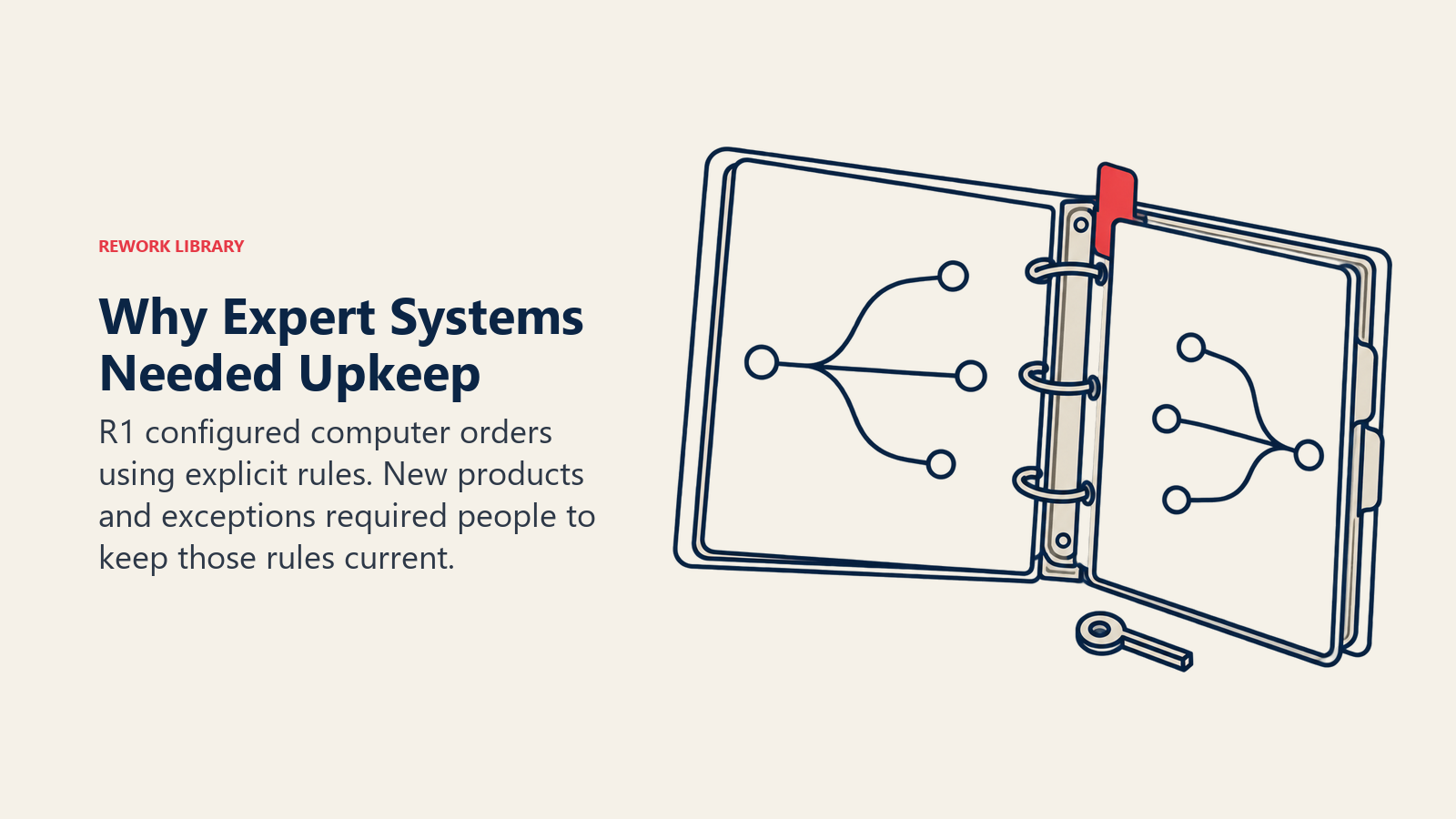
In December 1978, John McDermott's team at Carnegie Mellon began work on R1, a rule-based program that configures VAX 11 computer systems. Digital Equipment Corporation's manufacturing organization has used it since January 1980 to configure almost all VAX 11 systems it shipped, according to the 1981 paper by McDermott and Barbara Steele. A customer's order came in, and a diagram of how the components fit together came out, with any missing parts added.
This is the moment AI first showed up on a business payroll. It's also a diffusion story in miniature. R1 was written in OPS5, and the same paper notes the research behind that language was sponsored by the Defense Advanced Research Projects Agency. Research that defense money had paid for was now a tool inside a computer maker's factory.
The catch sits a few lines from the success. Digital had a group of 15 people responsible for maintaining R1 and extending its capabilities, and the paper itself is about adding rules so the program could accept customer-specific constraints. Every new product and every exception meant more rules, written by people who understood both the domain and the language. That upkeep is part of why rule-based systems lost momentum later in the 1980s.
The era's lesson was about scope. Rule-based AI worked where the domain was narrow, the logic was explicit and the savings justified a standing team. It didn't generalize. When the world changed faster than the rulebook, the program fell behind.
| Era feature | Rulebook Years | Lab Years |
|---|---|---|
| Who paid | A company with a manufacturing problem | Defense research agencies |
| What got built | A narrow program for one job | A research platform or robot |
| Main limit | Maintenance of hand-written rules | No customer, no daily use |
| Staff needed | A standing group to update rules | Researchers and students |
What this means for teams today: price in the upkeep. Any system that encodes your process, whether rules, prompts or workflows, needs an owner when products, prices and policies change.
The Quiet Years (1990s-2021)
Learning models go to work without announcements
Open Amazon.com in 2003 and the store rearranged itself around you. The company's engineers Greg Linden, Brent Smith and Jeremy York described the method in a January 2003 paper in IEEE Internet Computing: item-to-item collaborative filtering. They described a retailer environment with tens of millions of customers and millions of catalog items, results needed in no more than half a second, and an algorithm whose online computation scales independently of the number of customers and catalog items. The store, they wrote, showed programming titles to a software engineer and baby toys to a new mother.
That's the template for the quiet decades. Machine learning rarely arrived as a product with "AI" on the box. It arrived as a feature inside something people already used: a recommendation, a ranking, a score. Because the feature sat inside an existing workflow, adoption didn't need training or a change policy. It needed data and engineering.
The consumer interface came later. On October 4, 2011, Apple introduced Siri with the iPhone 4S as an assistant that could make calls, send texts, schedule meetings, search the Internet and give directions through spoken requests. It launched in beta, in a handful of languages. It put spoken requests to software in front of a large consumer audience, a step toward the chat tools that followed.
Work tools followed, starting with software developers. In June 2022, GitHub announced that Copilot was generally available to individual developers, after a technical preview that began in 2021 and reached more than 1.2 million developers in its first year. GitHub reported that in files where Copilot was enabled, nearly 40% of code was written by Copilot in popular languages such as Python. That is a vendor's own figure for its own product, so treat it as a sign of use, not independent proof of productivity.
The Quiet Years built the habits and data pipelines that the next era needed. They also left a gap: for most office workers, AI was still something that happened to your data, not something you operated. For the wider arc of how classical machine learning became business AI, see the evolution of business AI.
What this means for teams today: your highest-return AI may already be a ranking, scoring or forecasting model inside a system you own. Look there before you buy a new tool.
The ChatGPT Age (2022-present)
A chat box puts the technology on every desk
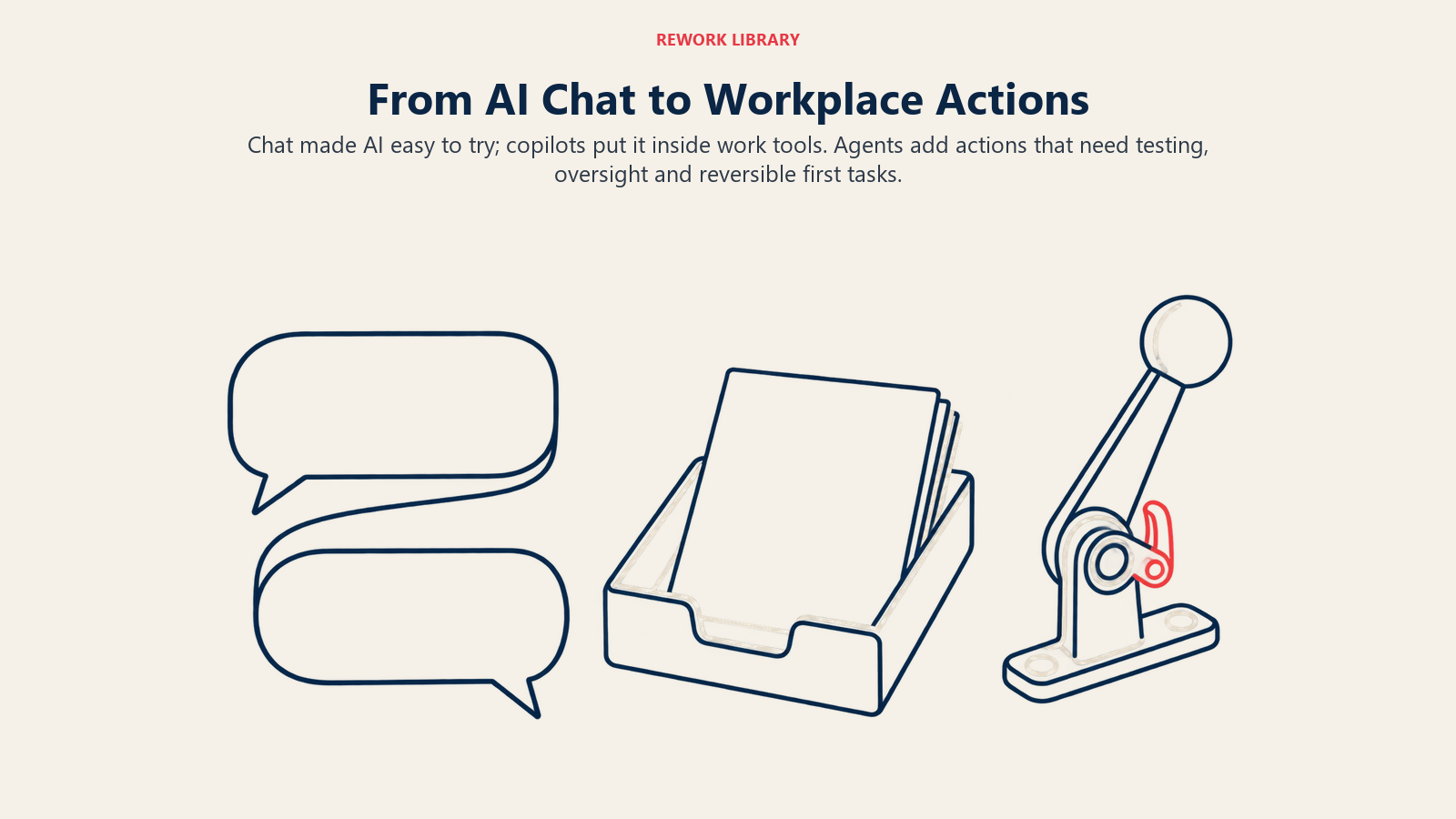
On November 30, 2022, OpenAI released ChatGPT, a model that interacts in a conversational way, so it could answer follow-up questions and admit mistakes. Usage was free during the research preview. There was no sign-up form for a developer key and no integration project. Anyone with a browser could try it on a real task that afternoon.
The measurements arrived within months, and they came from real tasks. In a study covering 5,179 customer support agents, Erik Brynjolfsson, Danielle Li and Lindsey Raymond found access to a generative AI assistant raised productivity, measured as issues resolved per hour, by 14% on average, and by 34% for novice and low-skilled workers, with minimal impact on experienced ones. In a preregistered experiment published in Science, Shakked Noy and Whitney Zhang gave 453 college-educated professionals writing tasks and found ChatGPT cut completion time by 40% and raised quality by 18%.
The third study added the warning. Harvard Business School researchers worked with 758 Boston Consulting Group consultants. On tasks inside AI's capability, those with AI completed 12.2% more tasks and finished 25.1% faster. On a task chosen to fall outside it, AI users were 19% less likely to produce correct solutions. The pattern is a jagged frontier: strong in one place, wrong in the next, with nothing on the screen telling you which you're in.
| Study | Who and what | Headline result |
|---|---|---|
| Brynjolfsson, Li and Raymond (NBER) | 5,179 customer support agents | 14% more issues resolved per hour; 34% for novices |
| Noy and Zhang (Science) | 453 professionals on writing tasks | 40% less time; 18% higher quality |
| Harvard Business School and BCG | 758 consultants on 18 tasks, plus one outside AI's reach | 12.2% more tasks, 25.1% faster inside the frontier; 19% less likely to be correct outside it |
Vendors moved quickly to embed the technology. On November 1, 2023, Microsoft made Microsoft 365 Copilot generally available to enterprise customers, built into Word, Excel, PowerPoint, Outlook and Teams, with a chat feature that searches a user's emails, meetings, chats and documents. For how this product category works, see our guide to AI copilots.
Adoption numbers depend on who asks and how. Stanford's AI Index said 78% of organizations reported using AI in 2024, up from 55% the year before, and its next edition says organizational adoption reached 88%. The Census Bureau, surveying all US businesses, gets lower numbers. Its Business Trends and Outlook Survey shows overall AI use hovering between 17% and 20% from December 2025 to May 2026, with 37% of firms of 250 or more employees using AI. Census changed its question wording in November 2025 to cover use "in any business function," so older figures aren't directly comparable. Workers differ again. Pew's survey of 5,273 US workers, conducted in October 2024, found about one in six said at least some of their work is done with AI, and 55% rarely or never used chatbots at work.
These aren't contradictions. They measure different groups: large organizations answering a survey about any use, versus every business in the country, versus individual workers. Together they say adoption is wide but uneven, and widest where firms are large.
The newest step moves AI from drafting to doing. On OSWorld, which tests AI agents on real computer tasks, Stanford's 2026 report says agents rose from 12% to about 66% task success, though they still fail about 1 in 3 attempts on structured benchmarks. Our guide to what an AI agent is explains how these systems differ from a chat box. And for what the evidence says about results so far, see how AI is changing work and the AI productivity paradox.
What this means for teams today:
- Assume people already use these tools, and give them a rule for what data can go in.
- Test on your own tasks. The frontier is jagged, and your tasks may sit on either side.
- Pilot agents on reversible work first, and keep a person accountable for what leaves the building.
Key People
| Name | Role | Contribution | Year |
|---|---|---|---|
| Herman Hollerith | Inventor | Punched-card tabulating machines used for the US census | 1890 |
| Oliver Standingford and Raymond Thompson | J. Lyons & Co. staff | Designed LEO, an early business computer | 1951 |
| Robert Fano | MIT professor | Directed Project MAC | 1963 |
| John McDermott | Carnegie Mellon researcher | Led the team that built R1 for Digital Equipment Corporation | 1978 to 1980 |
| Greg Linden, Brent Smith, Jeremy York | Amazon engineers | Described item-to-item collaborative filtering | 2003 |
| Erik Brynjolfsson, Danielle Li, Lindsey Raymond | Economists | Measured generative AI in a customer support setting | 2023 |
| Shakked Noy and Whitney Zhang | MIT economists | Ran the ChatGPT writing-task experiment | 2023 |
Key Facts
- The 1880 US census took seven years; the 1890 count, run on 43 tabulating machines, took less than three.
- MIT's Project MAC began with a $2,220,000 contract awarded through the Office of Naval Research for ARPA.
- Digital Equipment Corporation kept 15 people to maintain and extend its R1 configuration program.
- In a study of 5,179 support agents, generative AI raised issues resolved per hour by 14%, and by 34% for novices.
- Stanford's AI Index puts organizational AI adoption at 88%, while the Census Bureau's all-business survey shows 17% to 20%.
The Pattern Behind the History
Across five eras, the same four conditions decided whether AI reached real work. We call this the Lab-to-Desk Pattern. It's our synthesis of the history above, not a research finding.
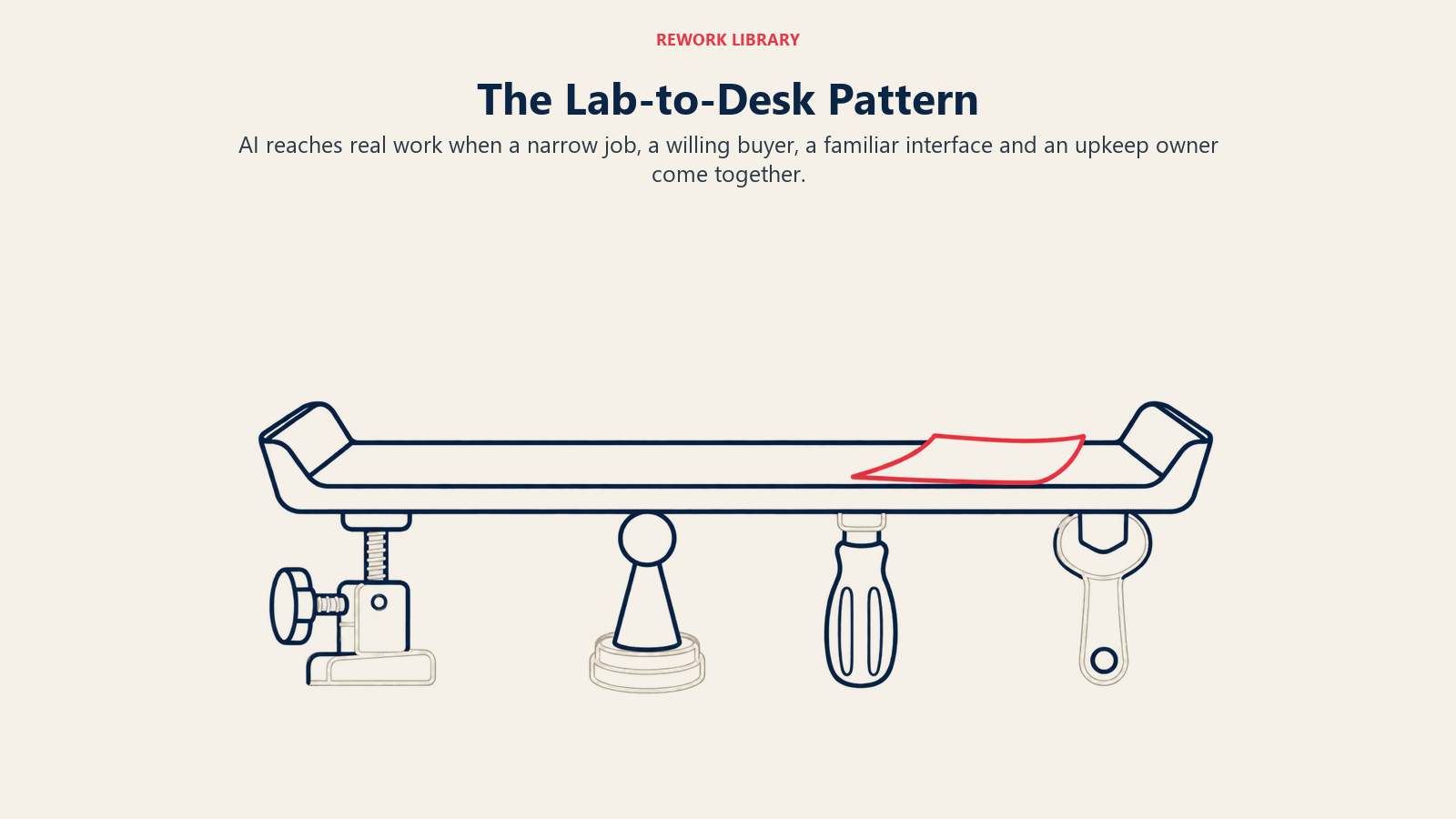
- A narrow job first. Tabulating a census, valuing bakery output, configuring a computer order, ranking items for a shopper.
- A buyer with a deadline or a cost. The Census Bureau, a tea company, a computer maker, a retailer.
- An interface people already use. A recommendation on a web page, a chat box, a button inside Word.
- An owner for the upkeep. R1 needed 15 people; today's tools need someone to own prompts, data and exceptions.
When any one of these was missing, the technology stayed in the lab or faded after a promising start.
What It Teaches Teams Today
The history is a checklist for any AI purchase. Start with a job that is narrow, high-volume and measurable. Put it where people already work. Name an owner before launch. And test on your own tasks, because the studies show gains and failures can sit side by side.
It also explains why adoption numbers vary. A large firm with a data team, a clear job and an owner is far more likely to have AI in production than a five-person shop with none of those. If you're mapping where your team stands, our 5 stages of AI maturity and what is business AI are good next reads. And every era of new office technology brought the same promise of more output; the history of productivity shows what happened next.
