Deep Blue and the History of Game-Playing AI
Turn this article into takeaways for your work.


Each assistant summarizes the article only for you and suggests best practices for your work.
In 1770, an inventor named Wolfgang von Kempelen presented a chess-playing machine to the Empress Maria Theresa of Austria-Hungary. The Turk toured courts and fairs for decades, drawing crowds who believed they were watching a thinking machine. It was a trick.
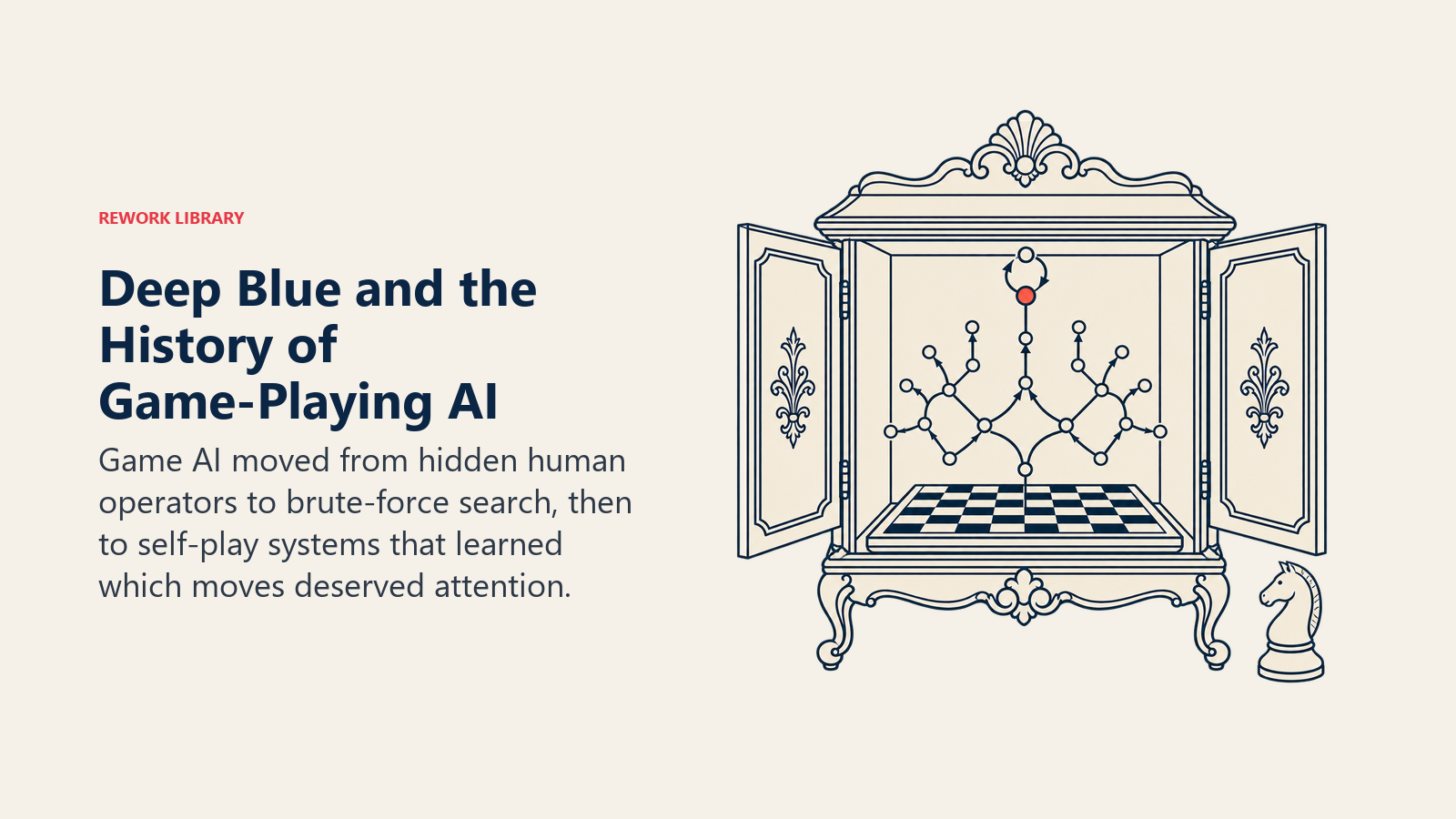
Game-playing AI began on paper in 1949-1950, when Claude Shannon described how a computer could play chess. It reached its public turning point in May 1997, when IBM's Deep Blue beat world champion Garry Kasparov in a six-game match. For almost fifty years the winning recipe was faster search over hand-built knowledge. After 2015 it became programs that taught themselves by playing. The wider field's story is in The History of AI. This article follows one thread of it, the games.
IBM notes that chess has long been considered an ideal test of whether a computer could rival the human brain, a simple rule set with a vast number of possible games. How the field went from that hoax to machines that teach themselves is the story below.
Timeline at a Glance
| Year | Milestone | Why It Mattered |
|---|---|---|
| 1770 | Von Kempelen presents the Turk | The first famous "chess machine" was a hoax run by a hidden person. |
| 1914 | Torres Quevedo's El Ajedrecista debuts at the University of Paris | A real automaton that forced checkmate in one endgame, built in 1912. |
| 1950 | Shannon publishes "Programming a Computer for Playing Chess" | The first blueprint for a chess program: evaluate positions, search ahead. |
| 1957 | Alex Bernstein writes the first complete chess program, on an IBM 704 | Chess moved from theory to running code. |
| 1959 | Arthur Samuel reports a checkers program that learns | A program improved its own play past its author's, in 8 to 10 hours of machine time. |
| 1970 | The first all-computer chess tournament, at the ACM convention | Programmers began to compete and share techniques in the open. |
| 1978 | David Levy wins a ten-year-old bet that no computer could beat him | Human masters still held the line. |
| 1989 | Deep Thought and Hitech beat two grandmasters; IBM hires Hsu and Campbell | The champion became a realistic target. |
| 1992 | TD-Gammon draws 19-19 over 38 games at a backgammon World Cup | A neural network taught itself a game by playing itself. |
| 1996-1997 | Deep Blue loses to Kasparov in February 1996, then wins the May 1997 rematch 3.5 to 2.5 | The first computer win over a reigning champion under tournament time controls. |
| 2007 | Schaeffer's team announces that checkers is solved | Perfect play by both sides ends in a draw. |
| 2011 | IBM's Watson beats Ken Jennings and Brad Rutter on Jeopardy! | A game of language, not board positions. |
| 2016 | AlphaGo beats Lee Sedol 4-1 in Seoul | Go, long thought a decade away, fell to learned neural networks plus search. |
| 2017 to 2019 | Libratus (2017) and Pluribus (2019) beat professionals at poker | Games with hidden information, and then more than two players, fell too. |
| 2018 | DeepMind publishes AlphaZero in Science | One system taught itself chess, shogi and Go from the rules alone. |
The Automaton Years (1770-1949)
A famous fake, then one honest machine
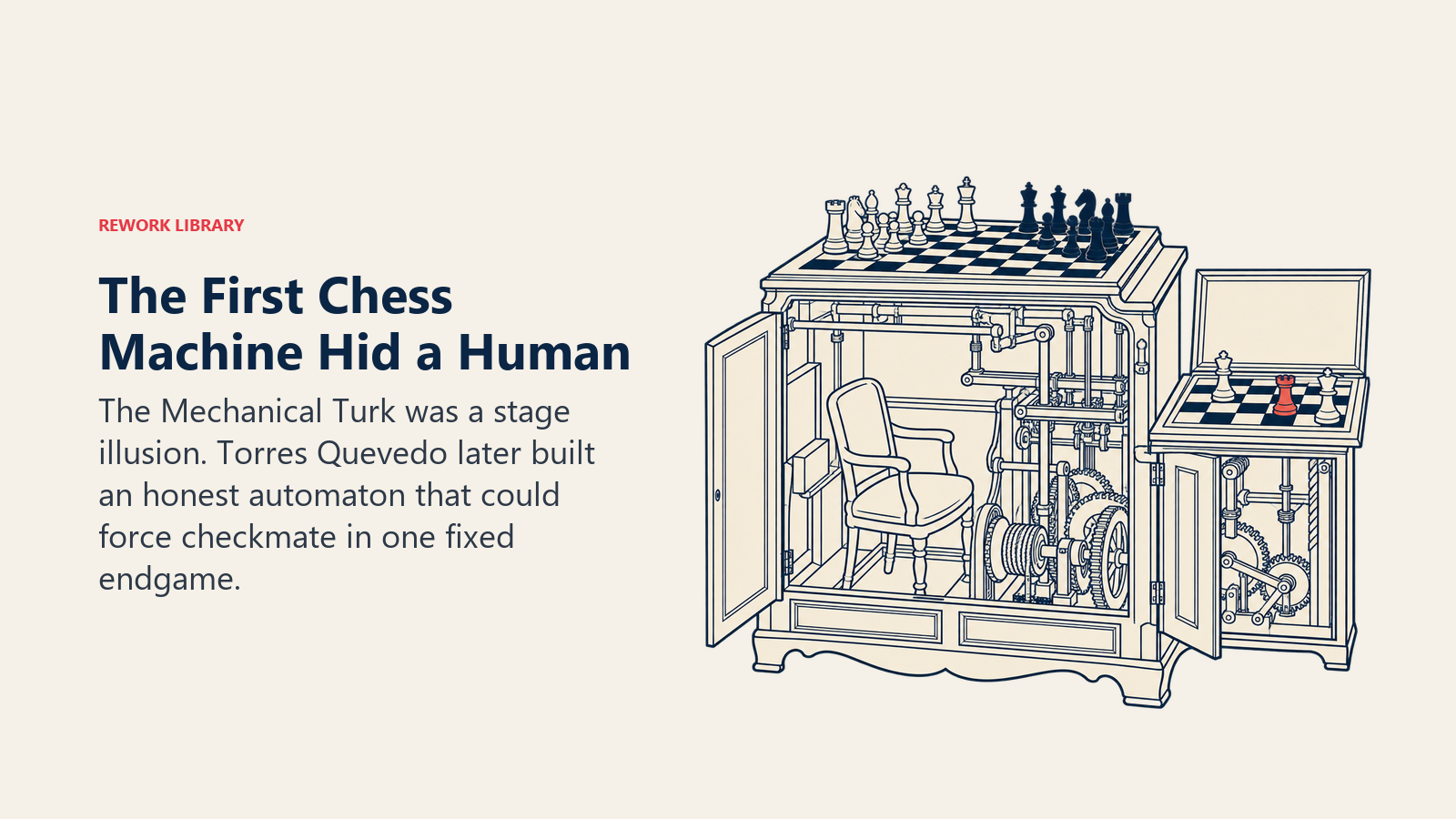
For the next eighty-five years the Turk drew audiences wherever it was shown, and many left convinced a machine had beaten them at chess. Edgar Allan Poe tried to expose it in an 1836 essay. The truth, per Smithsonian Magazine, was that a human sat inside the cabinet, hidden by sliding panels and a rolling chair while the interior was shown, and the operators were often chess champions. The Computer History Museum notes the Turk's opponents included Charles Babbage, a name that links this hoax to the early history of computing.
Keep precursor and concept apart. The Turk was a precursor in the public imagination, not artificial intelligence. It showed that people wanted a thinking machine badly enough to believe in one.
The first honest attempt came from a Spanish engineer. Leonardo Torres Quevedo built El Ajedrecista in 1912 and debuted it at the University of Paris two years later. It played a king and rook against a human's lone king, moved its pieces mechanically, and was guaranteed to win within its fixed starting conditions. Shannon himself, in 1950, called it a more honest attempt to design a chess-playing machine than the Turk, and noted that the endgame is simple enough for an explicit rule set. Unlike von Kempelen, Torres Quevedo wasn't trying to make money as a showman. IEEE Spectrum says he wanted to explore machines that make choices.
What the era left behind was a question: could a machine choose moves by rules, without a hidden person? One narrow endgame said yes. The whole game, with its enormous space of possible positions, said not yet.
For teams today: a demo is not a system. When a vendor shows a seamless AI, ask what is really doing the work behind the cabinet doors, and under what conditions it holds.
Shannon's Blueprint (1950-1969)
Theory on paper, then the first programs on IBM machines
In March 1950, the Philosophical Magazine printed a paper Claude Shannon of Bell Telephone Laboratories had received in November 1949. He argued that a program could play chess and that the problem was a stepping stone to others, including routing telephone calls, translating languages and making strategic military decisions. He also did the arithmetic that frightened everyone: roughly 10 to the 120th power variations from the opening position, so a machine checking one variation per microsecond would need over 10 to the 90th power years for its first move.
His answer was selective search. A "type A" strategy looks at every variation to a fixed number of moves and scores the end positions with a formula. A "type B" strategy improves it by looking deeper only at stable positions and skipping pointless lines. Shannon also admitted the weak spot: the machine would not learn from its mistakes, and the only way to improve its play was to improve the program.
Practice followed. In 1957, IBM engineer Alex Bernstein wrote the first complete chess program, which ran on an IBM 704 at 42,000 instructions per second with 70 kilobytes of memory. In 1962, an MIT program on an IBM 7090 became the first to play regular chess credibly, at 1,100 positions per second. By the end of the 1960s, according to the Computer History Museum, programs could occasionally beat amateur players.
Meanwhile, Arthur Samuel took on the problem Shannon had set aside. His 1959 paper on checkers reported a program that learned to play better than the person who wrote it, given only the rules, a sense of direction and a list of features whose weights were unknown, in 8 or 10 hours of machine play. IBM's account says he coined the term "machine learning" and that his program beat checkers master Robert Nealey in 1962. For where that idea went next, see the history of machine learning.
The era solved the question of how a program could choose moves. It created the next one: how deep could it search before the clock ran out?
For teams today: the first useful step in automating a hard task is often a crude evaluation plus a search over options. Write down your scoring rule before you shop for tools.
The Search Years (1970-1988)
Faster hardware beats clever rules
The early pioneers had hoped programs would choose moves mainly by human-style rules of thumb. By the 1970s, the Computer History Museum says, a turning point arrived: the new generation still used heuristics, but also used faster and more specialized hardware to search game trees of millions of positions, something no human could do. Computers were doubling in speed about every two years, and the first all-computer chess tournament took place at the ACM convention in 1970. By the end of the decade, top programs played at the USCF 2000 "expert" level.
The human champions held on. In 1978, International Master David Levy won a bet he had made ten years earlier that no computer would beat him. At the 1984 ACM conference, a panel of experts couldn't agree on whether a computer would ever defeat the top human player.
Inside that doubt, a student at Carnegie Mellon University named Feng-hsiung Hsu got to work. In 1985 he helped develop ChipTest, a machine that won the 1987 North American Computer Chess Championship. The Computer History Museum holds an oral history with Hsu that covers ChipTest, Deep Thought and Deep Thought II. The Museum's exhibit calls this stage embedding software in hardware.
This era is the template for what came next. It showed that speed could substitute for understanding, which solved the strength problem and created a philosophical one: was a machine that calculated its way to victory doing anything like thinking?
For teams today: raw capacity beats elegance more often than people admit. Before you refine a model, check whether the real limit is compute, data or time.
The Deep Blue Match (1989-1997)
IBM goes after the world champion, and loses once before winning
In 1989, Deep Thought and Carnegie Mellon's Hitech each beat a grandmaster, and the goal of beating the world champion suddenly looked within reach. That same year, Hsu and Murray Campbell were hired at IBM Research, along with Joe Hoane, Jerry Brody and C. J. Tan on the team, and the machine was renamed Deep Blue, a nod to IBM's nickname, Big Blue.
Two parallel stories ran alongside. At the University of Alberta, Jonathan Schaeffer's Chinook project began in 1989, earned the right to play for the World Championship in 1990, and lost narrowly to Marion Tinsley in 1992. In the 1994 rematch Tinsley withdrew because of illness, and he died eight months later. And at IBM's Hawthorne lab, Gerald Tesauro's TD-Gammon, announced in 1992, taught itself backgammon through about 300,000 games against itself over a month, using a temporal difference method conceived by Richard Sutton. It went 19-19 in 38 games at a World Cup of Backgammon event. Tesauro remarked that games are a convenient test domain, and he and the Deep Blue team stressed their programs did not "think" in the human sense. The method is a close cousin of today's reinforcement learning.
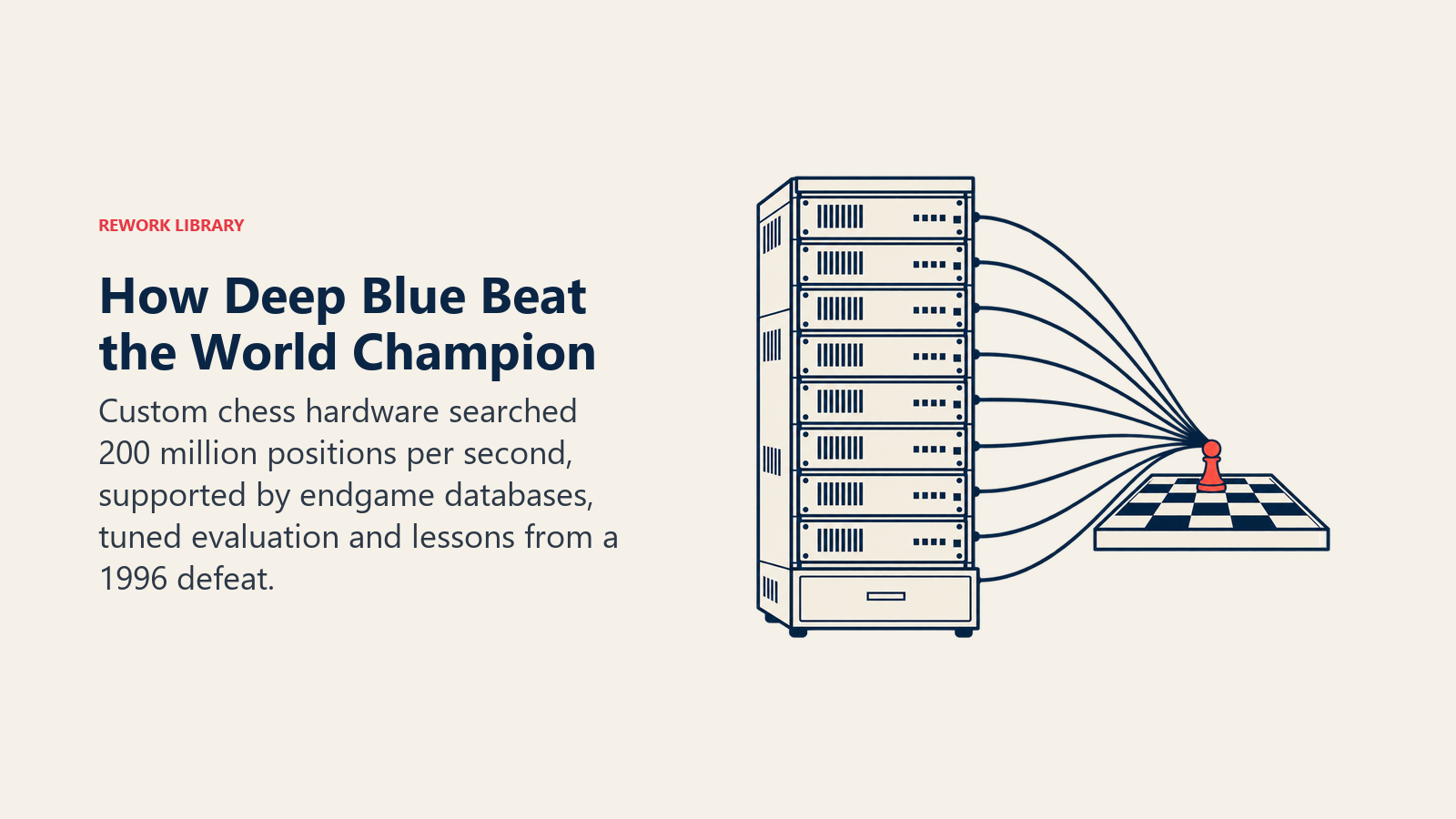
Then came the match. In February 1996 in Philadelphia, Deep Blue won the first game, the first victory by a computer over a reigning world champion under regular time controls. Kasparov recovered and took the match 4-2. The IBM team improved its endgame databases, built a stronger evaluation function, hired more grandmasters as advisers and added ways to disguise the machine's strategy.
In May 1997, at the Equitable Center in New York, Kasparov won game one and Deep Blue won game two. Three games were drawn. Deep Blue won game six and the match, 3.5 to 2.5, running on 32 processors and evaluating 200 million positions per second. Kasparov said afterward, per IBM, that the computer was far stronger than anybody expected. The Computer History Museum describes it as the first time a reigning world chess champion lost a match to a computer, and asks whether such a machine was thinking at all.
The era solved the old challenge. It also showed the cost of the method: Deep Blue's strength came from chess-specific hardware, databases and tuning, and IBM says only its underlying architecture later informed work in areas such as financial modeling.
For teams today: a win on a closed benchmark proves the benchmark, not general ability. Ask how much of a system's success is specific to the task it was built for.
The Learning Turn (1998-2018)
Self-play replaces hand-written chess knowledge
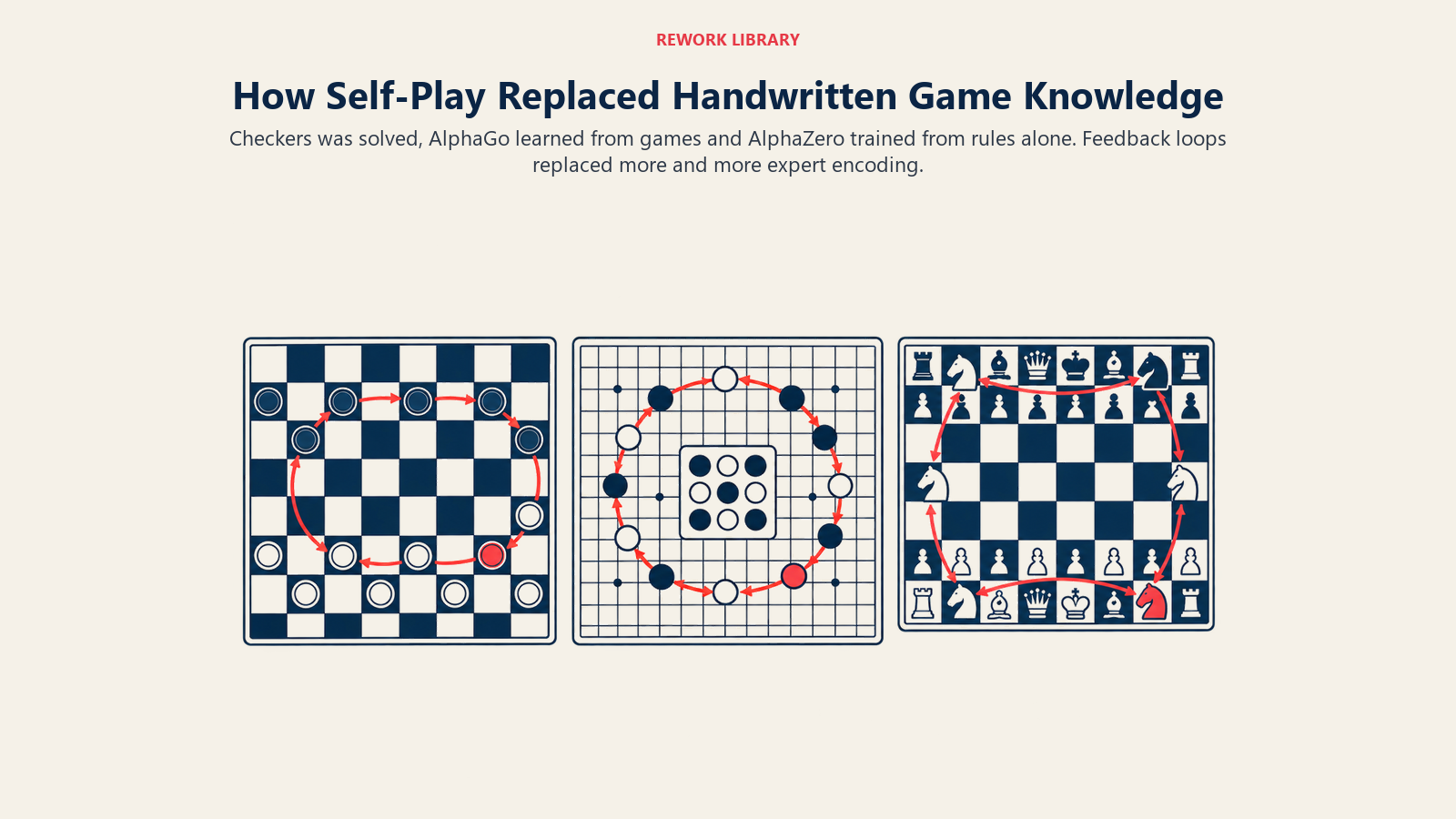
After 1997, the board-game frontier shifted from "can a machine win" to "how does it learn to." Checkers reached its end first: in 2007, Schaeffer's team announced in Science that checkers is solved, with perfect play by both sides leading to a draw among roughly 500 billion billion positions, a computation that began in 1989.
In February 2011, IBM's Watson played a different kind of game. Watson won with USD 77,147 against Ken Jennings's USD 24,000 and Brad Rutter's USD 21,600 in a televised Jeopardy! contest. It answered natural-language questions, not board positions, and IBM says it kicked off an era of natural language processing, a thread continued in AI moving from research labs to work.
The real break was Go. In October 2015, DeepMind's AlphaGo beat European champion Fan Hui 5-0, and in March 2016 it won 4-1 against Lee Sedol in Seoul, a match DeepMind says over 200 million people watched. The Nature paper describes how: deep neural networks, "value networks" to judge positions and "policy networks" to choose moves, trained first on human expert games and then by reinforcement learning from self-play, combined with Monte Carlo search. The same paper calls it the first time a program had beaten a professional at full-sized Go, a feat "previously thought to be at least a decade away." The shift from Deep Blue is stark. Deep Blue searched; AlphaGo learned what to search for. These are neural networks of the kind described in the history of deep learning. One of the paper's authors, Demis Hassabis, is profiled in our Hassabis leadership guide.
Then the human data went away. AlphaGo Zero, in Nature in 2017, used reinforcement learning alone, without human data, guidance or domain knowledge beyond the rules. DeepMind introduced AlphaZero in late 2017 and published the full evaluation in Science in December 2018. In chess AlphaZero first outperformed Stockfish after just 4 hours, in shogi after 2 hours and in Go, past the AlphaGo version that beat Lee Sedol, after 30 hours. Against Stockfish it won 155 games and lost six out of 1,000.
The era solved the dependence on hand-written knowledge. It created a new problem: all these games let both players see the whole board.
For teams today: the biggest gains came when people stopped encoding expert rules and set up a loop where the system could improve itself. Check where your own process still relies on rules that a feedback loop could replace.
The Hidden-Information Years (2017-present)
Poker and negotiation, where nobody sees everything
This era overlaps the last, because the next frontier was already open in January 2017. Poker hides each player's cards, so an AI has to bluff and read misleading signals. In a contest that began January 11 at Rivers Casino in Pittsburgh, Libratus faced four professionals over 20 days and 120,000 hands in heads-up no-limit Texas Hold'em. Its creators, Tuomas Sandholm and Noam Brown, describe it as the first AI to defeat top human professionals in that game, using a precomputed strategy blueprint, a nested subgame-solving step and a module that improves the blueprint over time.
In July 2019, Carnegie Mellon and Facebook AI announced Pluribus, which defeated leading professionals in six-player no-limit Texas Hold'em. Two pros each played 5,000 hands against five copies of Pluribus, and in another test, 13 pros played 10,000 hands in total. Meta's write-up notes that earlier benchmark wins, checkers, chess, Go and two-player poker, had all been two-player or two-team games.
The next step added language. In November 2022, Meta announced CICERO for the negotiation game Diplomacy. In 40 games against humans on an online platform, it achieved more than double the average score of human players and ranked in the top 10% of participants who played more than one game.
Notice what changed. Chess and Go were closed worlds. Poker and Diplomacy involve hidden information, other people's motives and, for CICERO, free-form talk. That is much closer to the situations teams face at work, and much harder to verify. The language half of that shift is told in the history of large language models.
For teams today: the further a game moves from a clean board, the less a headline score tells you. Test an AI system in your own messy conditions, with your own hidden information, before you rely on it.
Key People
| Name | Role | Contribution | Year |
|---|---|---|---|
| Wolfgang von Kempelen | Inventor | Built the Turk, a chess "automaton" run by a hidden person | 1770 |
| Leonardo Torres Quevedo | Spanish engineer | El Ajedrecista, a rook-and-king endgame automaton | 1912-1914 |
| Claude Shannon | Bell Telephone Laboratories | The 1950 paper on programming chess | 1949-1950 |
| Alex Bernstein | IBM engineer | First complete chess program | 1957 |
| Arthur Samuel | IBM researcher | Checkers program that learned from play | 1959-1962 |
| Feng-hsiung Hsu and Murray Campbell | Carnegie Mellon, then IBM Research | Built ChipTest, Deep Thought and Deep Blue | 1985-1997 |
| Garry Kasparov | World Chess Champion | Won 1996 match 4-2, lost 1997 rematch | 1996-1997 |
| Jonathan Schaeffer | University of Alberta | Lead author of the Chinook project's checkers solution | 1989-2007 |
| Gerald Tesauro | IBM researcher | TD-Gammon, a self-taught backgammon network | 1992 |
| Demis Hassabis and David Silver | DeepMind | AlphaGo, AlphaGo Zero and AlphaZero | 2015-2018 |
| Tuomas Sandholm and Noam Brown | Carnegie Mellon | Libratus and Pluribus poker AIs | 2017-2019 |
Key Facts
- IBM's Deep Blue beat Kasparov 3.5 to 2.5 in May 1997 after losing their February 1996 match 4-2.
- Shannon's 1950 paper estimated roughly 10 to the 120th power variations from the chess starting position.
- TD-Gammon played about 300,000 games against itself in a month in the early 1990s.
- Checkers was announced solved in 2007: perfect play is a draw.
- AlphaGo beat Lee Sedol 4-1 in March 2016.
- AlphaZero first outperformed Stockfish after just 4 hours of training.
The Pattern Behind the History
Across six eras, the same five moves repeat. We call the sequence the Benchmark Ladder. It's our synthesis of the history above, not a research finding.
- A closed game becomes the benchmark. Shannon hoped chess would be a stepping stone, and Tesauro called games a convenient test domain.
- Compute and search win first. Deep Blue's 200 million positions per second beat the champion before any machine understood chess.
- Learning replaces hand-built knowledge. Samuel, TD-Gammon and AlphaZero each let the program improve by playing.
- A win makes the next game harder. Poker hides cards, and Diplomacy adds language and trust.
- Winning the game is not the same as thinking. The Deep Blue and TD-Gammon teams both said their programs did not think in the human sense.
What It Teaches Teams Today
- Pick the benchmark with care. A closed game gives a clean score, but a real business problem has hidden information and moving rules.
- Separate capacity from cleverness. Deep Blue won with custom hardware and tuning, and AlphaGo with learning. Know which one your project needs.
- Plan for the specific system, not the general one. Deep Blue's strength was built around chess, so a narrow win is not automatically a platform.
- Let systems learn from outcomes where you can. The jump from search to self-play came from a feedback loop, not new rules.
- Treat headline wins as the start of testing. A system that beats champions under tournament rules still needs checking against your own data and conditions.
Game-playing AI shows that a win on a clear scoreboard is only the first step. Each time machines mastered a game, the next one was messier and closer to real work. For the founding ideas behind it all, see the history of symbolic AI, the history of neural networks and the AI timeline.

Co-Founder, Rework.com