What Was the AI Winter?
Turn this article into takeaways for your work.


Each assistant summarizes the article only for you and suggests best practices for your work.
The best place to start is Austin, Texas, in 1984. The Association for the Advancement of Artificial Intelligence (AAAI) held its annual meeting there. It was starting to feel like a trade show. Expert system startups were mushrooming, and government money was flooding in.
An AI winter is a period when funding, hiring and belief in artificial intelligence fall together because results lagged the promises. Popular accounts name two: a first one in the mid-1970s and a second from the late 1980s into the mid-1990s. The term itself is from 1984, when AI researchers used it at their own annual meeting to describe a crash they feared was coming. The throughline: promises outran results, funders priced the gap, and money moved to work that could show a return. Historians still argue about how deep the first winter really was.
According to the historian Thomas Haigh's account of the boom and bust, Yale's Drew McDermott opened a panel there by describing a "deep unease" that expectations were too high. Then he sketched a worst case in which every startup fails, funders walk away, and researchers rename their projects. That scenario, he said, was "called the 'AI Winter' by some." For the wider arc around it, see The History of AI.
Timeline at a Glance
| Year | Milestone | Why It Mattered |
|---|---|---|
| 1832-1842 | Work on Babbage's Difference Engine halts, then government funding ends | A precursor: public money withdrawn from a calculating machine that never got finished. |
| 1954 | The Georgetown-IBM translation demonstration | Selected sentences read well, and expectations for machine translation ran ahead of the evidence. |
| 1966 | ALPAC reports on machine translation | An outside committee judged a decade of spending and found little to show for it. |
| July 1972 | Lighthill dates his survey of AI | A mathematician outside the field named the "combinatorial explosion" as the obstacle. |
| 1973 | SIGART has 1,241 members; by mid-1978 it has 3,500 | Haigh's evidence that the AI community kept growing through the supposed first winter. |
| 1983 | DARPA launches Strategic Computing | A large government bet on expert systems, language and vision. |
| 1984 | The "Dark Ages of AI" panel at AAAI-84, Austin | A panel where researchers described an "AI Winter" scenario at their own annual meeting. |
| End of 1987 | DARPA abandons its autonomous land vehicle effort | A flagship Strategic Computing goal was dropped. |
| 1989 | DEC has 59 technical staff maintaining its expert systems | It showed why companies stopped buying: upkeep cost real experts. |
| 1997 | Deep Blue beats Kasparov, 3.5 to 2.5 | Narrow, specialized AI got a public win during the slump. |
| 2012 | AlexNet wins ImageNet with 15.3% top-5 error | Learning from data, shelved under other names for years, returned. |
| December 2025 | Bank of England says AI-focused valuations are stretched | The "is another winter coming" question moved into central bank reports. |
| July 2026 | AI company equity valuations fall sharply | A sell-off hit markets, with no spillover to core markets according to the Bank. |
The Unfinished Engine (1832-1842)
A precursor: public money stops when a machine won't finish
Nobody called it an AI winter in the 1830s, and it had nothing to do with artificial intelligence. But the nearest documented ancestor of the pattern is a calculating machine. The Computer History Museum records that work on Charles Babbage's Difference Engine was halted in 1832 after a dispute with his engineer, Joseph Clement, and that government funding was finally axed in 1842. A sponsor had backed a machine that promised to do mental work mechanically. It stopped paying when the finished article kept receding.
Treat this as a precursor, not the concept. Babbage's backers were a handful of officials, not a field of competing labs, and the machine was a single project, not a research program. The shared shape is small but real: a sponsor funds a promised machine, the machine does not arrive on schedule, and the sponsor decides the bill is closed. The term for that pattern did not exist until the 1980s.
The Overpromise Years (1954-1966)
Selected sentences translate, and everyone extrapolates
In January 1954, at the Georgetown-IBM demonstration, a computer translated a handful of carefully chosen sentences. The later ALPAC report on the Georgetown-IBM experiment said such samples on simple, selected text were "deceptively encouraging." The practical hope was fast, accurate translation of foreign technical papers. In the decade to 1966, ALPAC found, the US government spent some $20 million on machine translation and related work.
The same optimism ran through the young field launched at the 1956 Dartmouth conference. In 1964 a National Academy of Sciences committee, chaired by Bell Labs' John R. Pierce, began asking whether the spending was justified. Its 1966 answer was a hard no for the near term. The detailed story is in the first AI winter, and this article doesn't retell it.
What the era created was the raw material for every later winter: public promises with no schedule attached. What it means for teams today is simple. A demo on selected inputs is not a forecast, so ask what the pilot leaves out.
The First Chill (1966-1980)
An outside audit lands, but the field keeps growing
The 1966 ALPAC report was the first outside verdict. The second came from Britain. Sir James Lighthill, a Cambridge mathematician, dated his survey of AI July 1972 for the UK's Science Research Council. He blamed the "combinatorial explosion," the way the number of possible moves in a problem outgrows any gain from faster computers. The report was published in 1973 and is the document most often cited as the start of the first AI winter. The first AI winter covers the report, the Perceptrons book and the 1969 US funding rule in detail.
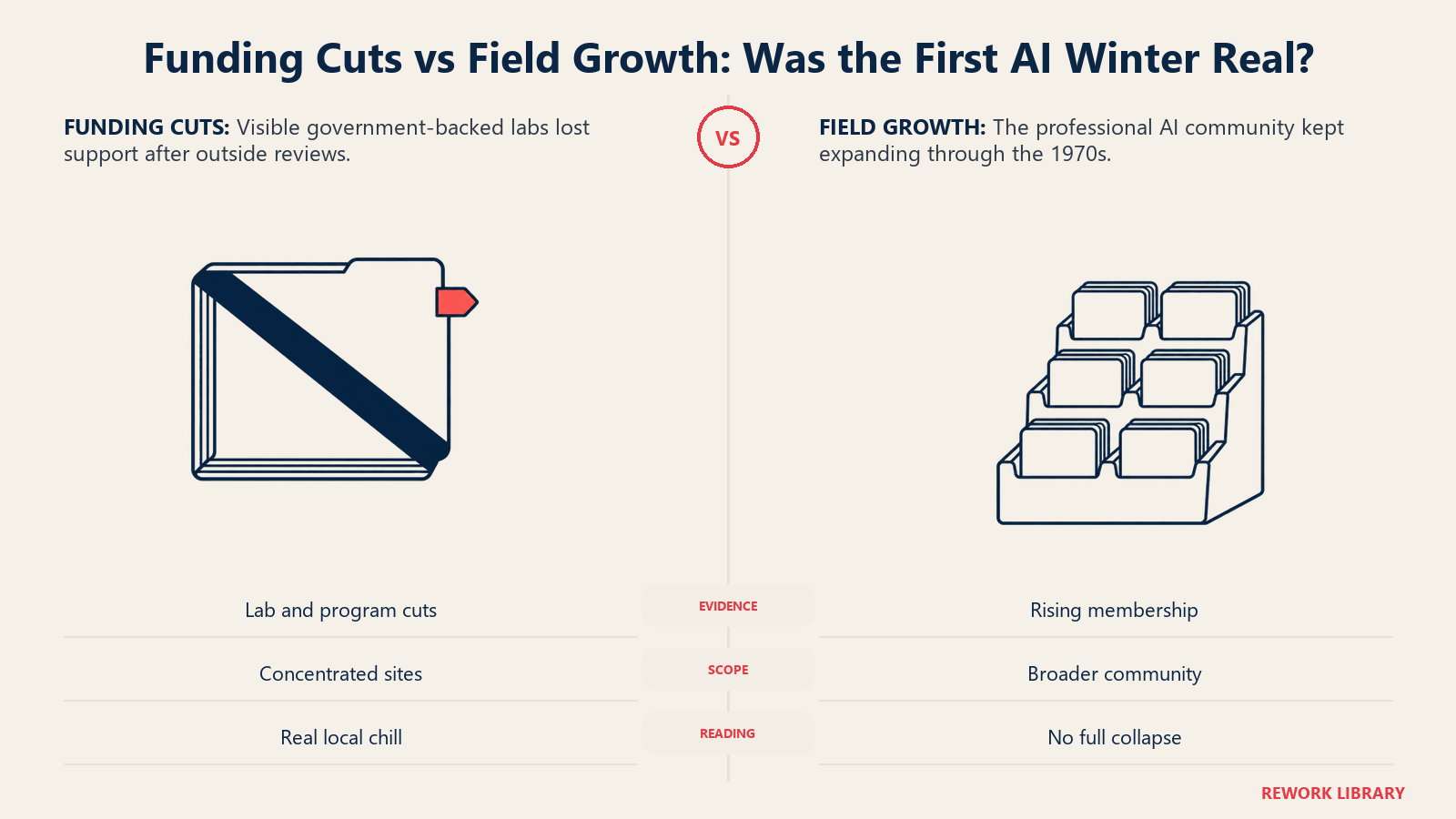
Here the story gets disputed. The popular dating, which Haigh notes is repeated online, puts a first winter at 1974 to 1980. Haigh argues the data don't support a broad collapse. When the Lighthill report appeared, he reports, the ACM's AI special interest group, SIGART, had 1,241 members, about double its 1969 level. By mid-1978 it had almost tripled to 3,500, growing faster than the ACM as a whole. In his reading, Lighthill's report was commissioned with the specific aim of justifying withdrawal of funding from Donald Michie's Edinburgh lab, and it is unclear whether it caused a broad international funding collapse. Haigh puts it flatly in a later column: the first winter of the 1970s "never happened".
So there are two defensible readings. One is that confidence and funding fell sharply at a handful of elite, government-funded labs, and Britain in particular. The other is that the wider discipline kept professionalizing. Both can hold, because the people who write memoirs worked at the labs that felt the cuts. The era solved a real problem, because sponsors finally had outside judgment. It also left a sticky story that outlived the evidence.
For teams today: a cut at the most visible sites doesn't mean the whole field stopped. Before you call something dead, check who is still using it.
The Boom and the Panel (1980-1987)
Rule-based programs earn money, and a warning is voiced
The thaw after the 1970s came from a narrow place: expert systems. Haigh describes how XCON, a rule-based program built for Digital Equipment Corporation, was said by DEC to save more than $40 million a year, and how startups sprang up at what one founder remembered as the rate of one a week. Fear of Japan's Fifth Generation project unlocked the public purse, with Britain's Alvey project, Europe's ESPRIT and DARPA's Strategic Computing Initiative, launched in 1983, following. The longer story of those programs is in the history of expert systems.
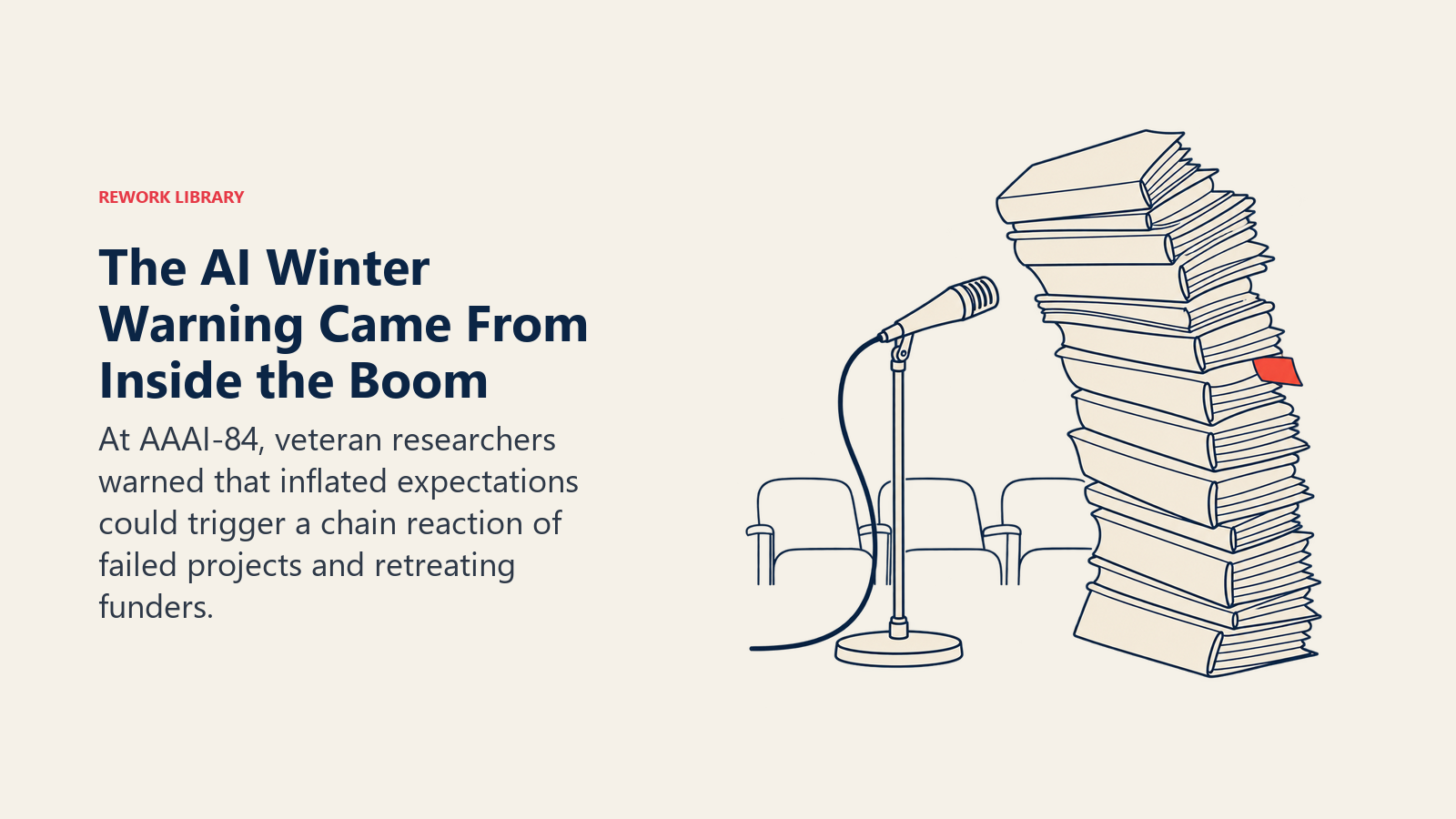
The 1984 Austin panel came at the height of this boom. The published record, The Dark Ages of AI: A Panel Discussion at AAAI-84, appeared in AI Magazine in the fall of 1985. It lists Drew McDermott, M. Mitchell Waldrop, B. Chandrasekaran, John McDermott and Roger Schank, and its abstract says the panel discussed a widespread concern among long-term AI researchers that expectations were too high and could lead to serious setbacks.
Who coined "AI winter" is less settled than the popular version suggests. A scholarly encyclopedia entry says the term was coined in 1984 at the AAAI, and credits Marvin Minsky and Roger Schank with using it for the coming bust. Haigh's account, which quotes the published panel, has McDermott naming the scenario and noting it was "called the 'AI Winter' by some." Both agree the term was in circulation among researchers by 1984, and it borrowed its image from the nuclear-winter debate of the time.
That analogy is the point. A nuclear winter was a chain reaction: a local event triggers a global chill. McDermott's worst case had the same structure, with one collapsing project dragging down the next.
For teams today: when the experts closest to a boom publish a warning, read it. The unease at Austin was an internal signal, three years before any budget moved.
The Real Winter (1987-1990s)
Maintenance bills, cancelled programs and a two-decade slump
Haigh's answer to "what was the AI winter" is the late 1980s, not the 1970s. In his telling, DARPA abandoned its autonomous land vehicle effort at the end of 1987, and its leadership chose to sweep Strategic Computing aside and refocus on high-performance computing. Companies that had bought expert system software found the systems needed new experts to maintain them. By 1989, DEC had 59 technical staff assigned to maintain the rules behind its internal expert systems, and few companies could afford that. The details, including the Lisp machine collapse, are in the second AI winter.
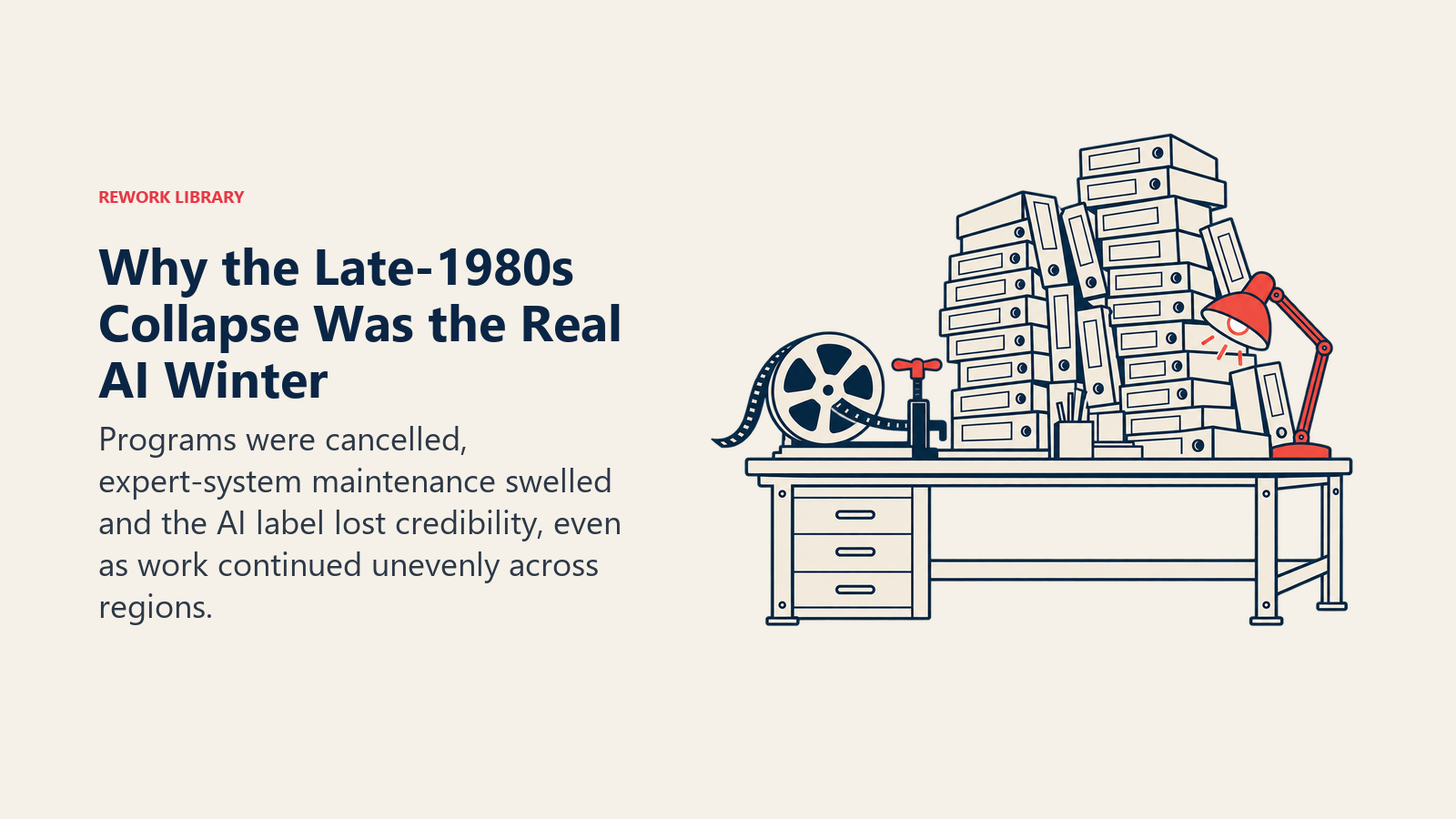
How long the winter lasted depends on the measure. The popular dating of the second winter ends in 1993. Haigh calls it a two-decade slump and points to two signs. Mentions of AI in books fell sharply through the 1990s, and by 2010 were less than a third of their peak. And from 1995 to 2010, he notes, 16 successive Turing Award selection committees saw nothing in AI to match advances in other areas of computer science.
He adds a caution. The chart reflects the US and UK. In South Korea, he says, AI publications and funding rose steadily in the late 1980s and early 1990s. Even the real winter, then, was regional.
The winter was not a shutdown, and it was not only a funding story. It was a reputation story: "AI" became a word researchers avoided.
For teams today: a downturn rarely hits everyone equally. When you read that a field is in winter, ask where, and by what measure.
The Thaw (1990s-2016)
Learning from data returns under other names
Each thaw came differently. The first came from a bounded, paying use: rule-based programs in the 1980s. The second came from learning from data, which had been sidelined but never abandoned. Haigh writes that the work on connectionist approaches began in the 1980s but, because AI had been redefined around symbolic methods, was pursued under other brands such as machine learning and pattern recognition. That's why the thaw is easy to miss. The field didn't return under its old name.
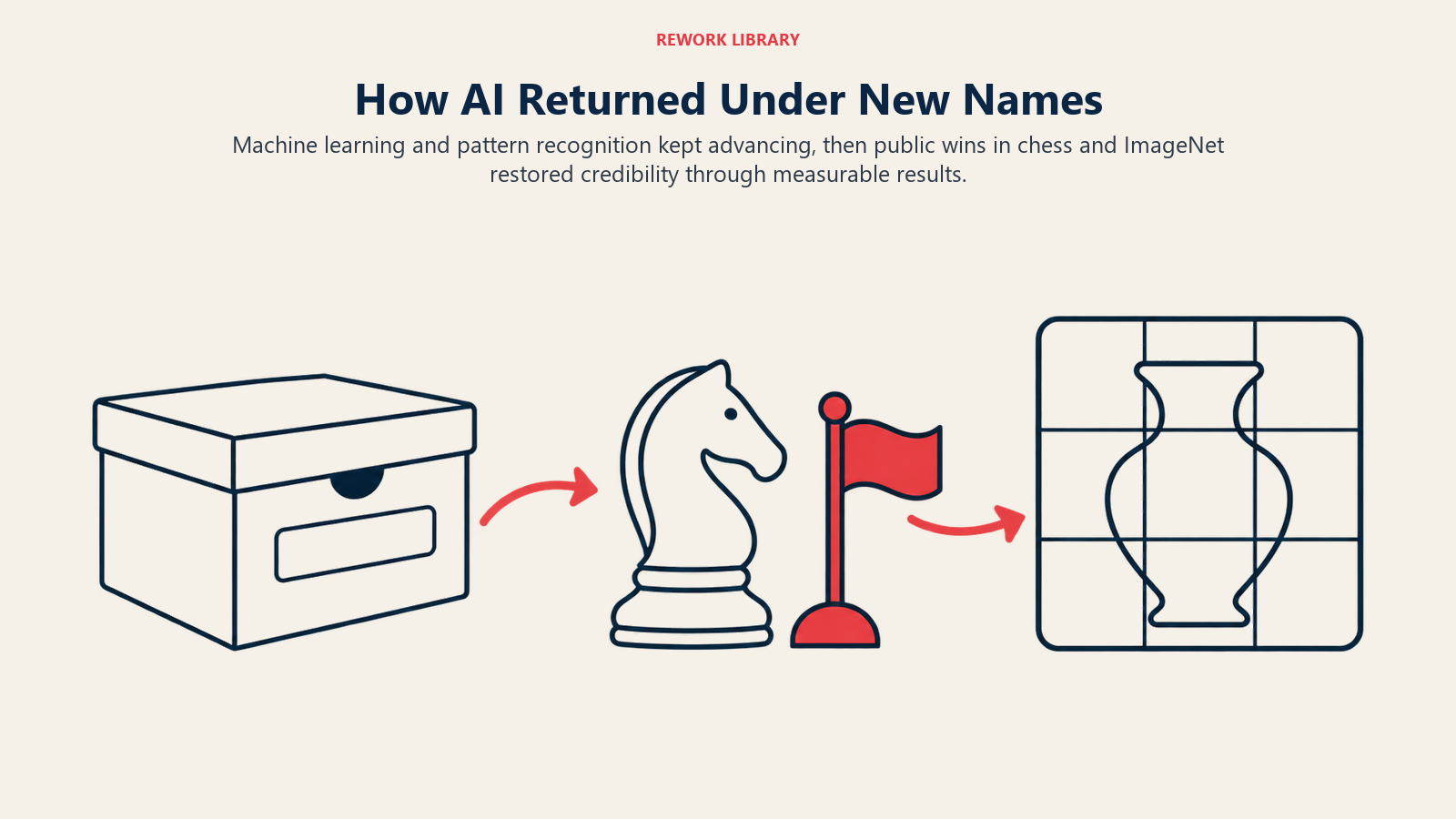
Public milestones marked it. In May 1997, IBM's Deep Blue beat Garry Kasparov 3.5 to 2.5, the first win by a computer over a reigning world champion under standard tournament time controls. In 2012, a deep convolutional network won the ImageNet competition with a top-5 error of 15.3%, against 26.2% for the second-best entry. Many histories treat it as the point where deep learning took over perception tasks. The threads are traced in the history of neural networks, the history of machine learning and the history of deep learning.
What the thaw solved was the credibility problem: the new methods were measured on public benchmarks. What it created was a new boom with the old question attached. The machine learning and neural network pages explain the methods behind it.
For teams today: the idea that ends a winter is often one that was running quietly under a different label. Look at what's already working in your operations before buying what's new.
The Next Winter Debate (2022-present)
Central banks ask whether valuations have run ahead of results
The question now is whether the current boom ends the same way. Two sets of dated evidence bear on it, and they point in different directions.
On the cautious side, the Bank of England's December 2025 Financial Stability Report said many risky asset valuations remain materially stretched, particularly for AI-focused technology companies, and that US equity valuations were close to the most stretched since the dot-com bubble. In October 2025 the IMF's briefing on the world economy flagged the echoes of the late 1990s dot-com boom and warned that markets could reprice sharply. Then in July 2026, per the Bank's September 2026 Financial Policy Committee record, equity valuations for AI companies fell sharply, amplified by an unwinding of stretched positions and deleveraging. The Committee found no spillover to core markets, and warned a sharper correction remains possible.
On the other side, usage is broad. Stanford's 2026 AI Index reports that organizational adoption reached 88% and that US private AI investment reached $285.9 billion in 2025. For a longer view of that adoption, see how AI moved from research labs to everyday work.
These are market and adoption signals, and neither measures what earlier winters turned on: whether funders believe the next result is coming. A fall in share prices is not the same thing as a collapse in research money, and Haigh ties the 1980s boom largely to government spending, not just share prices. Whether the sell-off becomes a winter depends on whether AI systems keep delivering measurable results in real workflows. Nobody can say yet, and this article doesn't forecast it.
For teams today: treat a valuation scare and a capability plateau as separate risks. Plan so that your AI projects are justified by measured results, whichever way the market goes.
Key People
| Name | Role | Contribution | Year |
|---|---|---|---|
| Charles Babbage | Mathematician and engine designer | His government-funded Difference Engine stalled; funding ended in 1842 (precursor) | 1832-1842 |
| John R. Pierce | Bell Labs, ALPAC chair | Led the committee that judged machine translation | 1964-1966 |
| Sir James Lighthill | Cambridge mathematician | Wrote the survey dated July 1972 behind the 1973 report | 1972 |
| Donald Michie | Edinburgh AI researcher | Led the lab Haigh says the report was aimed at | 1973 |
| Drew McDermott | Yale professor | Opened the 1984 panel and sketched the winter scenario | 1984 |
| Roger Schank | AI researcher | Panelist at AAAI-84; credited with the term in some accounts | 1984 |
| Marvin Minsky | MIT AI researcher | Credited with the term alongside Schank in some accounts | 1984 |
| Thomas Haigh | Historian, University of Wisconsin-Milwaukee | Argues the first winter never happened and the real one began in the late 1980s | 2023-2024 |
Key Facts
- ALPAC found that the US government had spent about $20 million on machine translation and related work in the decade before its 1966 report.
- SIGART grew from 1,241 members in 1973 to 3,500 by mid-1978, the opposite of a collapse in the AI community.
- The "Dark Ages of AI" panel met in Austin and was published in AI Magazine in 1985.
- DEC had 59 technical staff maintaining its internal expert systems by 1989.
- From 1995 to 2010, 16 successive Turing Award committees found no AI work to match advances in other areas.
- AlexNet's 2012 top-5 error was 15.3%, against 26.2% for the runner-up.
The Pattern Behind the History
Across the eras, five moves repeat. We call the sequence the Hype-Audit-Rename Cycle. It's our synthesis of the history above, not a research finding.
- A narrow demo becomes a broad promise. Georgetown's selected sentences in 1954 and expert systems in the 1980s both did this.
- An outsider audits the gap. ALPAC in 1966, Lighthill in 1972 and the Austin panel in 1984 each priced the distance between claim and result.
- Money concentrates, then leaves the visible sites. Cuts hit a few well-known labs and programs first, and the story gets told from there.
- The field renames itself. Researchers moved to "machine learning" and "pattern recognition" rather than "AI."
- A measurable result ends the chill. Paying rule-based programs in the 1980s, then public benchmarks in 1997 and 2012.
What It Teaches Teams Today
- Write the pass mark before the pilot. ALPAC could judge translation because cost and quality were measurable.
- Listen to the insiders. The most specific warning in 1984 came from inside the AAAI.
- Budget for upkeep. DEC's 59 maintainers are the clearest cost of the second winter.
- Keep the paused idea alive. The method that ended the second winter had been running under other names for years.
- Separate market risk from capability risk. A sell-off in AI shares says little about whether your own workflow results hold up. For why projects stall, see why most AI transformations fail.
The AI winter was less a freeze than a repricing, and each thaw came when someone showed a measurable result. Read the history once, then ask of any AI project in your own budget which narrow result it will prove, who will audit it, and what you'll do if the audit says no.

Co-Founder, Rework.com
On this page
- Timeline at a Glance
- The Unfinished Engine (1832-1842)
- The Overpromise Years (1954-1966)
- The First Chill (1966-1980)
- The Boom and the Panel (1980-1987)
- The Real Winter (1987-1990s)
- The Thaw (1990s-2016)
- The Next Winter Debate (2022-present)
- Key People
- Key Facts
- The Pattern Behind the History
- What It Teaches Teams Today