The Second AI Winter: Why Expert Systems Collapsed
Turn this article into takeaways for your work.


Each assistant summarizes the article only for you and suggests best practices for your work.
In the mid-1980s, a brochure for one expert system declared, "We've built a better brain." Stanford's Nils Nilsson quoted a 1984 science writer's report. It said the salesmen sometimes sounded like "carnival barkers."
The second AI winter was the downturn that followed the expert systems boom, roughly from 1987 into the mid-1990s. Between 1980 and 1984, Digital Equipment Corporation, Japan, Britain and the US Defense Department all put money behind knowledge-based AI. By 1987 the field's membership had peaked. The specialized Lisp machines were losing to ordinary workstations, and DARPA's new AI director began cutting programs. The throughline: the programs worked in narrow cases, the promises did not, and the rules cost more to keep current than anyone had budgeted.
Booms built on a new technology and a large expectation are older than computing. In 1720, according to Royal Museums Greenwich, speculators paid inflated prices for shares of London's South Sea Company, which had been formed in 1711 to supply enslaved people to Spanish America on the assumption that the profits would be enormous. That assumption proved wrong and the share price collapsed. It's a precursor, not the same event: this boom was funded largely by government programs and corporate budgets, not share speculation. But the sequence, a real business, a huge forecast, then a reckoning, is the one this article follows.
What happened after the brochures stopped working is the story below. For the earlier winter, see the first AI winter. For the longer arc, see The History of AI and what the AI winter was.
Timeline at a Glance
The Race Begins (1980-1984)
Japan's plan sets off a global funding race
On a factory floor in early 1980, an order for a VAX computer arrives at Digital Equipment Corporation, and a program checks that the parts fit together. Since January 1980, according to John McDermott and Barbara Steele's 1981 conference paper, DEC's manufacturing organization had used that program, R1, to configure almost all the VAX 11 systems it shipped. It was the proof sponsors wanted: rule-based AI doing a paid job. The full story of that system is in the history of expert systems.
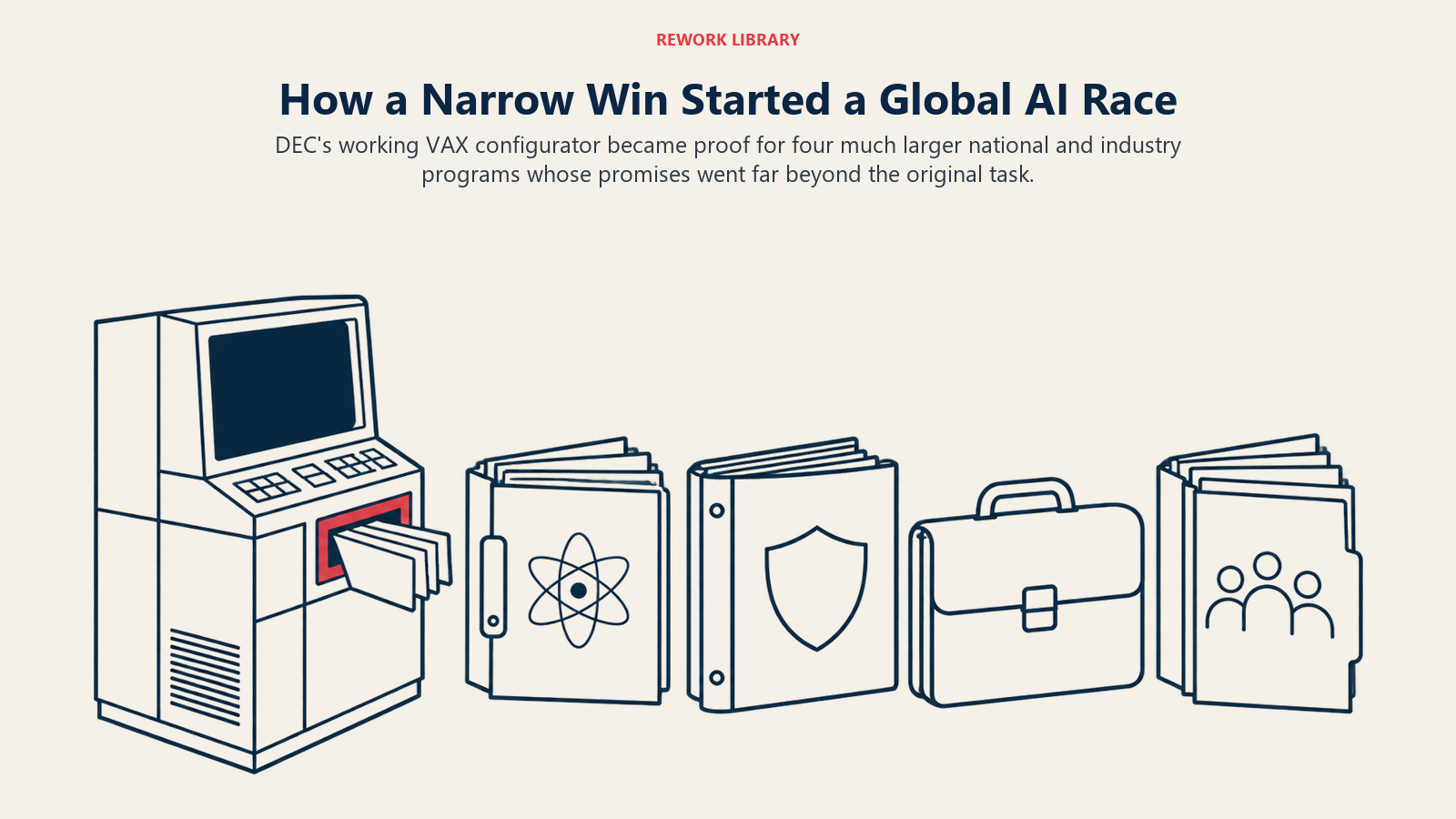
The next move was national. Nilsson reports that Japan's Ministry of International Trade and Industry announced its Fifth Generation Computer Systems project at a Tokyo conference in October 1981 and launched it in 1982 with a new institute, ICOT. It was a ten-year plan to build machines that could draw AI-style inferences from large knowledge bases and talk with people in natural language, with a budget of ¥54.2 billion, roughly $380 million at the 1990 exchange rate. The American computer industry, he writes, worried that its lead might be eroded.
Everyone answered, and the answers were bigger than the question. Four of them are compared below.
| Program | Who | Start | Scale | What happened |
|---|---|---|---|---|
| Fifth Generation Computer Systems | Japan, MITI and ICOT | 1982 | ¥54.2 billion over ten years | Extended two years in 1993; many observers now see most results as of historical interest only. |
| Strategic Computing | US, DARPA | 1983 | Just over $1 billion, 1983 to 1993 | Gone from the DARPA budget in 1993. |
| Alvey Programme | UK government and industry | 1983 | £350 million recommended; peak about £45 million in 1987 | Ran until 1991. |
| MCC | US industry consortium, Austin | 1982-1983 | Planned annual budget of $50 to $100 million | Staff fell from about 400 in 1985 to 58 by June 2000, when the board voted to dissolve it. |
In the US, the push had a sponsor and a sales pitch. Nilsson describes DARPA's Robert Kahn planning a Strategic Computing program in which, in historian Alex Roland's words, "expert systems would be the centerpiece." Roland also says Congress was more exercised by Japan's program than the Reagan administration or the computer community. The plan was written up in October 1983, with $50 million approved to begin work in fiscal year 1984. In June 1983, Edward Feigenbaum told a House committee that the era of reasoning machines was inevitable, and he and Pamela McCorduck warned in their book on the Japanese project that the stakes were national.
In Britain, a committee chaired by John Alvey reported that Japan's project was seen as a "major competitive threat." The programme it recommended was accepted in 1983. Its director, Brian Oakley, later said that if the Lighthill report was paradise lost for British AI, the Alvey report was "paradise regained".
This era solved a funding problem. Basic AI research had spent the 1970s under attack, and now governments competed to pay for it. It created an expectations problem. Programs that had worked on narrow, well-defined tasks were being sold as the foundation for general machine reasoning.
For teams today: a competitor's announcement is not a business case. When a rival's AI program makes headlines, write down the specific task you'd automate and its measured cost before the budget moves.
The Warning Shot (1984-1986)
Insiders say out loud that the hype is too high
In Austin, Texas, at the 1984 AAAI convention, a panel met under a title that sounds like a joke now: "The 'Dark Ages' of AI." The published account, in AI Magazine in 1985, summarizes its subject as a "deep unease" among veteran researchers. Nilsson quotes the chair, Drew McDermott of Yale, saying he thought it important to take steps so the "AI Winter" wouldn't happen, by disciplining the field and educating the public. It was a warning, not a postmortem, and it put the winter metaphor into the field's own vocabulary. The worry came from researchers who had been around longer than the last four years or so.
Meanwhile the money kept coming. Nilsson counts AAAI membership rising from around 5,000 shortly after the society's 1980 founding to 16,421 in 1987, most of the new members from industry and government. New companies were selling expert system software, Prolog tools and Lisp machines. He quotes a brochure for an expert system called TIMM that read, "We've built a better brain," and promised that expert systems "don't get sick, resign, or take early retirement." Nilsson adds that some of the blame for inflated sponsor expectations belonged to researchers who made exaggerated promises.
The costs of the working systems were already visible to anyone who looked. The 1981 R1 paper reports that DEC had a group of 15 people responsible for maintaining R1 and extending its capabilities, and that the program's configuration knowledge was about 850 rules. A system that earns money still needs people to keep it correct, and the same paper describes adding rules so R1 could accept customer-specific constraints.
This era solved a credibility problem inside the field, because insiders named the risk early. It created the opposite problem. The warning had no mechanism behind it, and nobody had a way to slow the spending.
For teams today: when your own experts start saying "we may be overpromising," treat it as data. Write down the goal that would count as success, and the date you'll check.
The Bust (1987-1989)
Lisp machines lose to workstations and the funding turns
By 1988, a buyer weighing a specialized Lisp machine had a new question to answer. The Computer History Museum describes the LMI Lambda of 1986 as a Lisp computer based on MIT's CADR design, built because Lisp ran slowly on expensive conventional computers. That was the market premise, and ordinary workstations erased it. A course paper on Symbolics from MIT's open courseware reports that product revenue fell from $101.6 million in fiscal 1986 to $82.1 million in 1987 and $55.6 million in 1988, and that a Symbolics 3600-series system cost $36,000 to $125,000 in 1988, against a Sun machine from $14,000 that could run Lisp well enough for development. Nilsson's summary is shorter: the Lisp machine makers enjoyed initial success but gradually lost out to other workstation providers. The Lisp side of this story is told in the history of LISP.
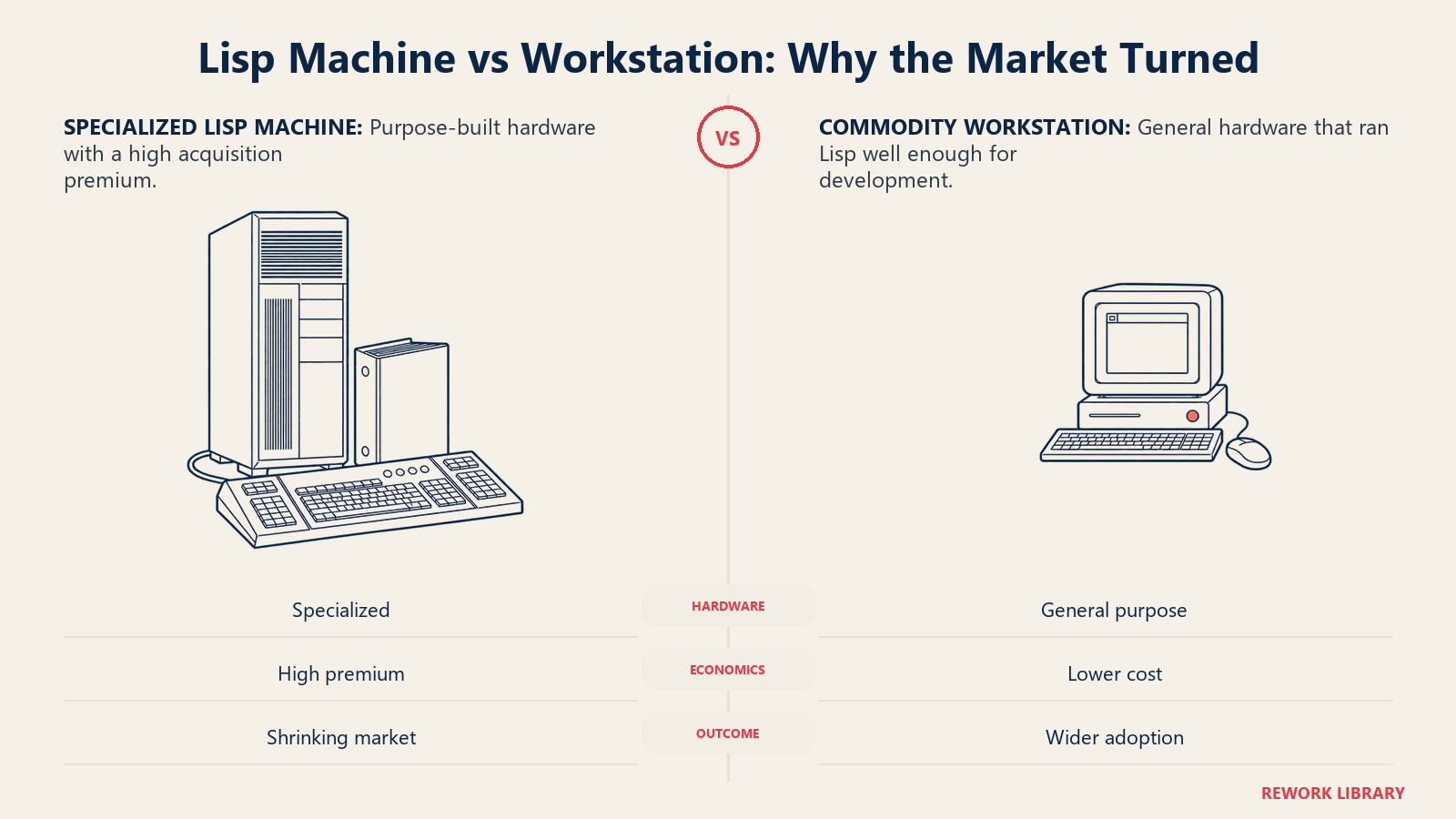
The expert system vendors faced a different squeeze. Nilsson writes that it was not too difficult for clients to build their own versions on low-cost workstations and personal computers, so many expert systems companies closed, were bought, or turned to services. The product was the idea, and ideas copy.
Then the public money moved. Jacob Schwartz, a mathematician who was skeptical about some AI approaches, became director of DARPA's Information Systems Technology Office in September 1987, and Nilsson says he promptly cancelled some AI programs and did not renew others. In his own article on the limits of AI, Schwartz described the field's history as very limited successes followed by failure to reach broader goals. Per Roland, quoted by Nilsson, DARPA's budget for basic AI and Strategic Computing research fell from $47 million to $31 million between 1987 and 1989. The cut wasn't uniform: Roland also says Carnegie Mellon's budget for speech understanding and autonomous vehicles went up in the same years.
Why the rule bases broke
Three technical problems sat under the financial one, and all of them were known before 1987.
- Brittleness. Nilsson writes that expert systems break down when faced with problems outside their area of expertise, or inside it when needed knowledge hadn't been written into the rules. He relays a story, introduced with "it is said," in which John McCarthy told MYCIN a patient was male and had undergone amniocentesis, and the program accepted both. It is told as hearsay, but the point it makes, that the program didn't know what it didn't know, is Nilsson's own.
- The knowledge acquisition bottleneck. Feigenbaum named it in his 1977 paper, calling the acquisition of domain knowledge "the bottleneck problem" in building practical intelligent agents.
- Upkeep. DEC's configuration systems are the success story, and they show the cost. Nilsson cites a DEC paper reporting that by 1989 the company's configuration systems held about 17,500 rules, with a net return estimated at more than $40 million per year. R1 alone held about 850 rules in 1981, so the rule base DEC had to keep current grew roughly twentyfold in eight years.
This era solved one thing: it showed which AI applications paid for themselves. It created a shortage of everything else. When the buyers found they could get rule engines on cheaper machines, and sponsors found the general machine reasoning they'd paid for wasn't arriving, the premium for specialized AI products shrank.
For teams today: price the maintenance before you approve the pilot. Ask who updates the rules, prompts or data when the product line changes, and what that costs per year.
The Long Chill (1990-1995)
The flagship programs close, and the sponsors look elsewhere
By the early 1990s the flagship programs were finishing and the verdicts were mixed. Japan's Fifth Generation project reached the end of its plan, and the independent evaluators who reviewed it in 1992 read it differently. Wolfgang Bibel of Technical University Darmstadt, in a report dated 4 June 1992, judged it an "outstanding success" for showing that logic could be a uniform framework for designing machines and software. Seif Haridi and Siwert Sundström of the Swedish Institute of Computer Science wrote that the technical results, given a fixed time and temporary staff, surpass expectations, yet the project "remains unfinished" and its software should be ported to widely accessible machines. Nilsson's assessment of the commercial side is blunter. Many observers, he writes, think most of the results are of historical interest only: improvements in commercial workstations and even personal computers made them superior to the project's parallel inference machines. The project was extended by two years in 1993.
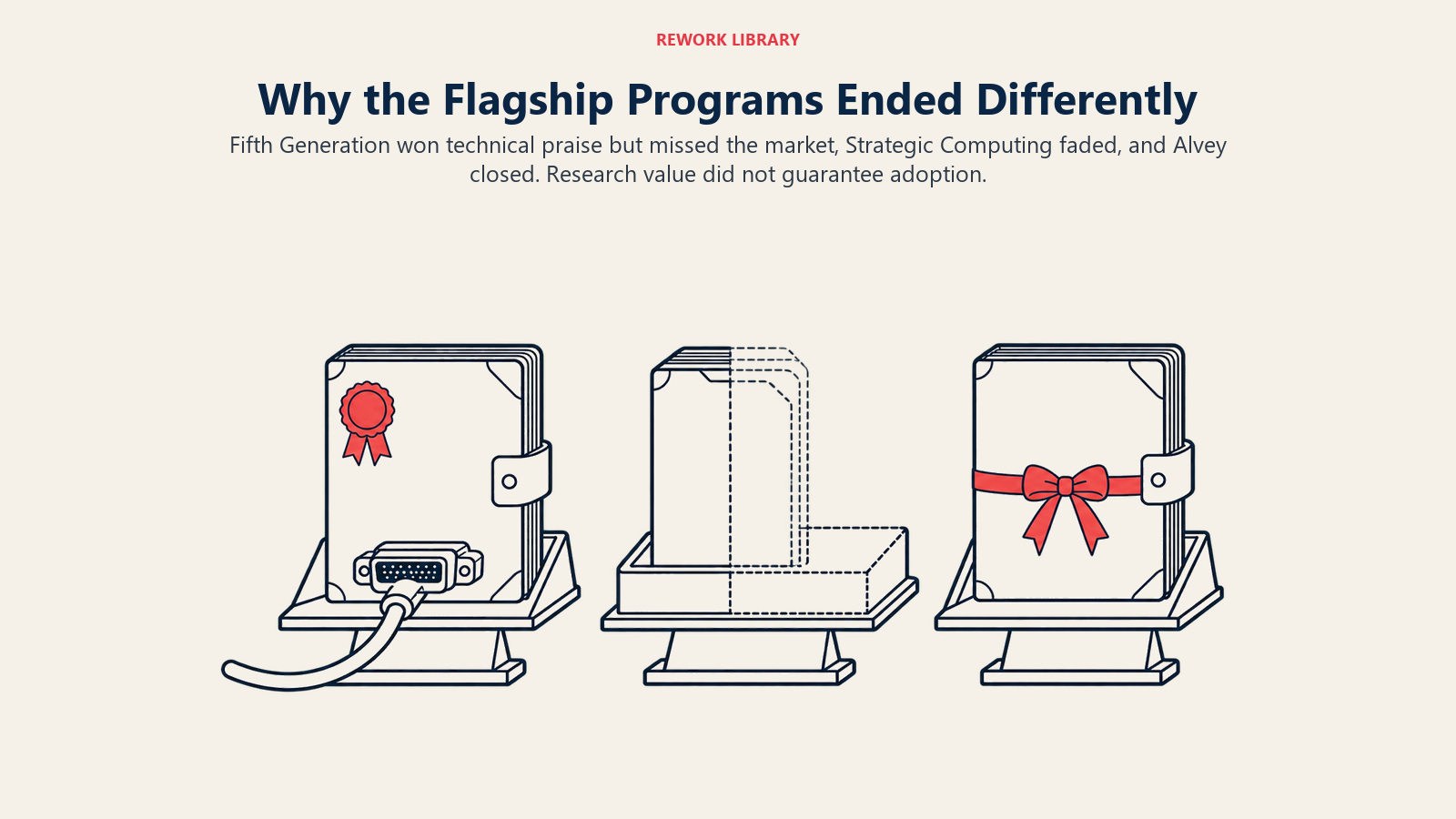
Strategic Computing faded without a verdict. Nilsson reports that Kahn and several other planners had left DARPA by late 1985, that the office was reorganized in 1986, and that Roland found the program was never mentioned in public documents after 1989 and vanished from the DARPA budget in 1993. Most commentators, he says, doubt it achieved its goal of pulling new AI technology into its applications; as Roland puts it, the applications improvised "ad-hoc, off-the-shelf solutions to meet demonstration deadlines." Yet the program also nourished the AI technology base, and AI research later prospered. Alvey ended in 1991, and MCC lost momentum after its first president left in 1987.
The field itself shrank. Nilsson counts AAAI membership as leveling off between 4,000 and 5,000 by 1996, advertising in AI Magazine dropping, several AI companies closing and some large companies ending their AI research. He is clear that the winter was brief for the ideas: it endured only for a season, a season of renewed efforts, not hibernation.
This era solved a measurement problem, because the programs had finally been evaluated. It created a naming problem. Sponsors were still interested in the abilities AI had promised, just not under that heading.
For teams today: a program can meet its research goals and still miss the market. Ask for both scorecards, the technical one and the one a customer would write.
The Rebrand (1990s-2010s)
Intelligence moves inside other software
What does an AI winter look like from inside a company? Nilsson's answer is a change of vocabulary. During the winter, he writes, many AI researchers began to focus on more modest and achievable goals, and one heard fewer brave predictions. Companies and government agencies with money to spend looked to computer technologies generally, rather than AI specifically, and funds went to databases, user interfaces, graphics, networks, data mining and information retrieval. Search, inference, expert systems, speech recognition and language processing were used as components of large integrated systems. Researchers became satisfied with adding bits of intelligence here and there.
The rules didn't disappear. They went into business software. Nilsson traces how expert-system inference engines became business rule engines, taking the same IF-THEN form: a rule such as "when our widget inventory is below 200, notify widget production" can answer questions or place orders. Some of the people who'd sold expert system software switched to business-rule software. Nilsson adds that researchers turned to new ideas, among them learning from data, the thread covered in machine learning and in the history of machine learning.
The era solved the survival problem. By hiding the rules inside products that solved ordinary business tasks, the ideas outlived the label. It left AI less visible as a category, since a component doesn't get its own budget line.
For teams today: judge a tool by the task it performs, not by whether the vendor says AI. Some of the most durable automation in your company probably has no AI label.
The Age of Agents (2020s-present)
Models decide, tools act, and the old costs come back
The knowledge acquisition bottleneck has a new answer. A language model absorbs patterns from text and can be pointed at a task in plain language, so nobody interviews an expert for 850 rules. The costs didn't vanish; they moved. Stanford's 2026 AI Index reports that AI agents leapt from 12% to about 66% task success on OSWorld, a test of real computer tasks, yet still fail roughly 1 in 3 attempts on structured benchmarks, and it describes the uneven pattern as a "jagged frontier." That's brittleness in a new form. In the same report, Gemini Deep Think earned a gold medal at the International Mathematical Olympiad, yet the top model reads analog clocks correctly just 50.1% of the time.
Upkeep returns too. An agent that acts needs rules about what it may do, which actions need approval, which amounts trigger a human. Those limits are the cousin of an expert system's rule base, and they need an owner as DEC's did. Our guides to what an AI agent is and to agent guardrails cover how teams set them.
The funding story echoes as well. The first winter followed reports that priced promises, and the second followed the end of a boom that sponsors had paid for in advance. That doesn't prove another winter is coming. It says what to look for: spending ahead of measured results, hardware or vendor categories whose premium depends on a scarcity that may not last, and demos that exclude the hard cases. This is our reading of the pattern, not a forecast.
For teams today: pilot an agent on your hardest cases, count the maintenance, and keep a way to switch vendors if the category's economics change.
Key People
| Name | Role | Contribution | Year |
|---|---|---|---|
| John McDermott | Carnegie Mellon researcher | Built R1 for DEC; co-author of the 1981 maintenance paper | 1978-1981 |
| Barbara Steele | Carnegie Mellon researcher | Co-author of the 1981 R1 paper | 1981 |
| Kazuhiro Fuchi | Head of ICOT's research center | Led Japan's Fifth Generation research | 1982 |
| Robert Kahn | DARPA IPTO director | Planned the Strategic Computing program | 1983 |
| Robert Cooper | DARPA director | Pushed an application-first plan to win Congress | 1983 |
| Edward Feigenbaum | Stanford computer scientist | Named the knowledge bottleneck; testified to Congress | 1977, 1983 |
| John Alvey | Senior director, British Telecommunications | Chaired the UK committee that recommended Alvey | 1982 |
| Bobby Ray Inman | Former intelligence official | First president of MCC | 1982-1987 |
| Drew McDermott | Yale researcher | Chaired the 1984 "Dark Ages of AI" panel | 1984 |
| Jacob Schwartz | Mathematician, DARPA ISTO director | Cancelled and did not renew AI programs | 1987-1989 |
| Alex Roland | Historian | Wrote the book on Strategic Computing that Nilsson draws on | 2002 |
Key Facts
- Japan's Fifth Generation project had a ten-year plan and a budget of ¥54.2 billion, about $380 million at the 1990 exchange rate.
- DARPA spent just over $1 billion on Strategic Computing between 1983 and 1993.
- DEC had 15 people maintaining R1 in 1981, when it held about 850 rules.
- AAAI membership peaked at 16,421 in 1987 and was between 4,000 and 5,000 by 1996.
- DARPA's basic AI and Strategic Computing budget fell from $47 million to $31 million between 1987 and 1989.
- Symbolics product revenue fell from $101.6 million to $55.6 million between fiscal 1986 and 1988.
The Pattern Behind the History
Across six eras, four moves repeat. We call the sequence the Race-Premium-Cut-Hide Pattern. It is our synthesis of the history above, not a research finding.
- A rival's announcement starts a race. Japan's 1981 plan produced Alvey, MCC and Strategic Computing within two years.
- A premium builds on a scarcity. Lisp machines sold at $36,000 to $125,000 until a $14,000 workstation could do the job.
- Sponsors cut when the general promise lags the narrow result. DARPA's budget fell $16 million in two years, while Carnegie Mellon's speech and vehicle budgets rose.
- The idea hides inside ordinary software. Rules became business rule engines, and AI became "components."
What It Teaches Teams Today
- Price the upkeep, not the build. DEC needed 15 people for one program in 1981.
- Write down what the demo leaves out. MYCIN and R1 worked in their domains and broke outside them.
- Watch for a premium built on scarcity. Specialized hardware lost to commodity machines.
- Do not confuse a bust with a verdict. The ideas survived the winter, and the winter lasted a season by one historian's reckoning.
- Keep two scorecards. The Fifth Generation project passed one and not the other.
The second winter was less a collapse of an idea than a repricing of a product category: sponsors found out what rule-based AI cost to maintain and what cheaper machines could do instead. Read the history once, then ask of any new AI program who will keep it correct, what happens when a cheaper platform arrives, and which task it will prove.

Co-Founder, Rework.com