The Dartmouth Conference of 1956: Why It Still Matters
Turn this article into takeaways for your work.


Each assistant summarizes the article only for you and suggests best practices for your work.
In 1955, the people who would make AI were spread across many disciplines. Some said cybernetics, some automata theory, some complex information processing. Some simply said "thinking machines," as Grace Solomonoff's account of the summer puts it. They had no shared word, meeting place or agreed problem. John McCarthy, a young mathematics professor at Dartmouth, decided to fix that with a summer of work and a funding request.
The Dartmouth Summer Research Project on Artificial Intelligence was a workshop at Dartmouth College in Hanover, New Hampshire, in the summer of 1956. It grew out of a grant proposal dated August 31, 1955. McCarthy, Marvin Minsky, Nathaniel Rochester and Claude Shannon wrote it. The throughline: it didn't build a thinking machine. It gave a scattered set of researchers one name, one agenda and one set of personal connections. That was enough to start a field.
Timeline at a Glance
| Year | Milestone | Why It Mattered |
|---|---|---|
| 1666 | Leibniz publishes his dissertation on the art of combinations | It sketched a "universal characteristic" and a logical calculus, an early plan for reasoning by calculation. |
| 1673 | Leibniz takes calculating-machine designs to London | A machine that did arithmetic made mechanized thought concrete. |
| October 1950 | Alan Turing publishes "Computing Machinery and Intelligence" | It replaced "Can machines think?" with a game anyone could run. |
| February 1955 | McCarthy first asks the Rockefeller Foundation for summer funding | The seminar idea predates the famous proposal by half a year. |
| June 1955 | McCarthy and Shannon meet Rockefeller's Robert Morison | The foundation's doubts shaped the final request. |
| August 31, 1955 | The four-author proposal is dated | It contains the term "artificial intelligence" and the founding conjecture. |
| September 2, 1955 | The proposal is sent to the Rockefeller Foundation | Solomonoff's account gives this as the mailing date. |
| About June 18, 1956 | The first participants arrive in Hanover | The workshop begins informally, with McCarthy already in residence. |
| August 17, 1956 | Ray Solomonoff gives the final talk | The summer ends after about eight weeks. |
| 1958 | McCarthy designs Lisp | The summer's list-processing discussions led to the language of early AI. |
| 1959 | McCarthy and Minsky found the MIT AI Project | The first coordinated AI lab at MIT. |
| 1963 | McCarthy starts the Stanford AI Project | A second center of gravity, on the West Coast. |
| 1973 | The Lighthill report is published | It questioned the field's progress and hurt its funding. |
| July 13-15, 2006 | AI@50 returns to Dartmouth | Five original attendees came back. |
| June 2017 | "Attention Is All You Need" appears | The architecture behind today's language models. |
The Reckoning Dream (1660s-1950)
Reasoning as calculation, centuries before the computer
Picture Gottfried Leibniz in the 1670s, in Paris, sketching a machine that could add, subtract, multiply and divide, then carrying the designs to London. The Stanford Encyclopedia of Philosophy records that he designed such a machine during his Paris years, beginning in 1672, and that his 1673 trip to London was meant in part to show the designs to the Royal Society. Seven years earlier, in 1666, his Dissertation on the Art of Combinations had outlined a "universal characteristic" and a logical calculus that would occupy him for much of his life.
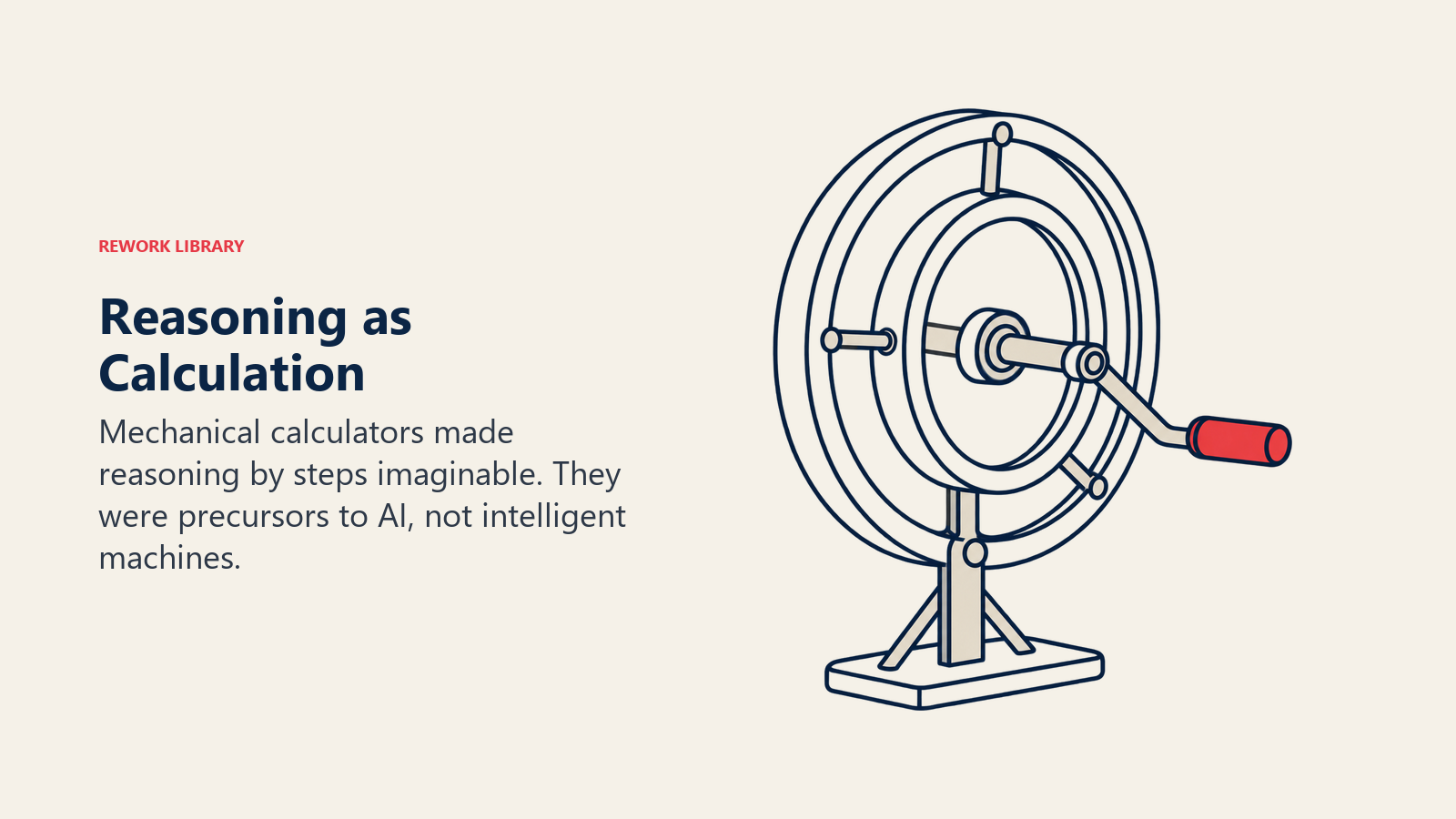
Leibniz was not the first. Around 1305 to 1308, the Majorcan thinker Ramon Llull wrote the Ars generalis ultima, whose figures of concentric circles "must be rotated to form the different combinations" of concepts. These were precursors, not artificial intelligence. Nobody called it that, and the wheels produced pairings rather than conclusions. The full prehistory, from myth to the 1930s, is in What Is the Origin of Artificial Intelligence?, so this article picks up where the theory finally met hardware.
By the 1940s, two traditions were circling the same question. One was cybernetics, which Norbert Wiener defined as the science of control and communication in the animal and the machine, taking the word from the Greek for "steersman," per Solomonoff's account. The other was the logic-and-computation line that Alan Turing carried forward. In October 1950, Turing's paper in the journal Mind opened with the sentence "I propose to consider the question, 'Can machines think?'" and swapped it for an imitation game played through typed answers. The paper also predicted that in about fifty years a machine could fool an average interrogator for five minutes.
What this era solved was a question: reasoning could in principle be described as steps. What it left open was everything practical. There were only a few hundred computers in the world in 1956, the Dartmouth Alumni Magazine notes, each room-sized and far weaker than a smartphone. The idea was ready. The community was not.
For teams today: a long-running idea becomes a project only when someone sets a date, a place and a list of people. Expect the same of any initiative you're sponsoring.
The Dartmouth Summer (1955-1956)
A grant request becomes the founding event
In February 1955, McCarthy first approached the Rockefeller Foundation for money for a summer seminar of about ten people, according to Solomonoff's account. In June he and Claude Shannon met Robert Morison, the foundation's director of biological and medical research, who was unsure a project this visionary would be funded. McCarthy pressed on with Shannon, Minsky and Nathaniel Rochester, and the four-author proposal is dated August 31, 1955. Solomonoff's account says it was sent to the foundation on September 2.
The proposal, preserved in AI Magazine's 2006 reprint and hosted by Stanford, lists the authors' affiliations: McCarthy at Dartmouth College, Minsky at Harvard, Rochester at IBM and Shannon at Bell Telephone Laboratories. It proposes a "2 month, 10 man study of artificial intelligence" for the summer of 1956, resting on the conjecture that every aspect of learning or any other feature of intelligence can in principle be described precisely enough for a machine to simulate it. It names seven problem areas: automatic computers, programming a computer to use a language, neuron nets, the theory of the size of a calculation, self-improvement, abstractions, and randomness and creativity. The budget asks the Rockefeller Foundation for $13,500, though the listed items add up to $13,000.
The name was a choice. Per Solomonoff's account, McCarthy picked "artificial intelligence" partly for its neutrality, steering clear of narrow automata theory and of cybernetics, which was tied to analog feedback and to Wiener's leadership.
Then came the summer. Sources disagree on how long it lasted: it is often said to have run six weeks, while Solomonoff's notes put it at roughly eight, from about June 18 to August 17. Who came is just as messy. McCarthy's May 26, 1956 list to Morison named 11 planned attendees, but the actual group came and went. Solomonoff reports that only he, Minsky and McCarthy stayed the whole time, and that daily sessions drew from three to about eight people. Trenchard More replaced Rochester for three weeks, and Donald MacKay and John Holland never came. Newell and Simon, Shannon, Selfridge, Ashby, McCulloch, Abraham Robinson, Arthur Samuel, Alex Bernstein and Julian Bigelow all appear in Solomonoff's notes, some for a day or less. Other accounts say about 20 people took part, including Warren McCulloch for a few hours.
They had the top floor of the Dartmouth math department. Sessions were closer to discussion than lecture. Ashby described his homeostats, adaptive electromechanical machines. Samuel talked about checkers and learning, Bernstein about chess, Bigelow about the danger of speaking vaguely and hoping to translate it into machine language later. One afternoon they looked up the word "heuristic" in a dictionary. When McCarthy sounded the group out on a shared project around chess, on August 7, the reactions ranged from keen to cool, and, in Solomonoff's words, it did not become a group project.
The money was part of the problem. The proposal asked for $13,500. The Dartmouth Alumni Magazine reports that the foundation gave half of a requested $14,000, and McCarthy later said Rockefeller gave nowhere near enough for everyone to stay all summer. Participants had other commitments, so they came for short, different stretches.
For teams today: an offsite with a name and a deadline starts a movement even when the agenda fails. Budget for partial attendance and don't make the goal depend on everyone being present.
The Symbolic Years (1956-1969)
Programs that reason, and the first labs
The strongest thing to come out of the summer was a way of working. Allen Newell, J. C. Shaw and Herbert Simon had begun building the Logic Theorist in 1955, a program that, per the Computer History Museum, would eventually prove 38 theorems from Whitehead and Russell's Principia Mathematica and introduced heuristics, list processing and "reasoning as search." Their paper appeared in the proceedings of the September 1956 IRE Symposium on Information Theory. Solomonoff's account notes that McCarthy missed the deadline for his own summary and for Solomonoff's paper, so only the Logic Theorist and a paper by Rochester and colleagues on Hebb's cell assemblies made it in.
Researchers regard the summer's main result as the debut of a "new paradigm" of symbolic information processing, replacing brain modelling tied to cybernetics and neural nets, Solomonoff's account says. It adds that Minsky's own interest moved from brain modelling to symbolic AI after Dartmouth. Solomonoff himself left the summer unimpressed, writing that the research project "wasn't very suggestive" but that the contacts and a written report were worth having.
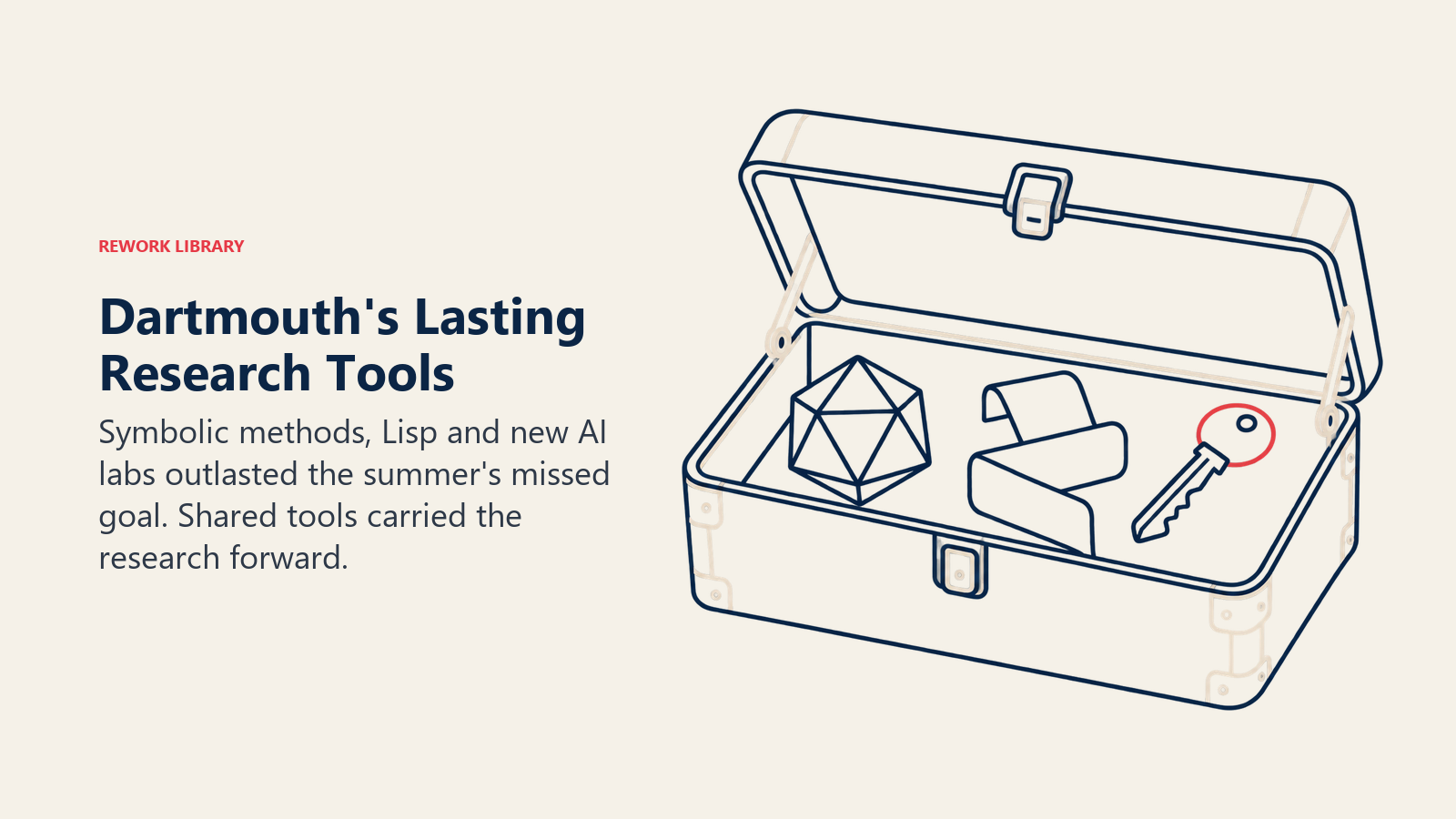
Tools followed. McCarthy's wish for an algebraic list-processing language arose at Dartmouth, where Newell, Shaw and Simon described their IPL 2. In summer 1958, working at IBM at Rochester's invitation, he arrived at the recursive, conditional-expression design that became Lisp, as his own history of Lisp recounts. In 1959, McCarthy and Minsky started the AI Project at MIT, which MIT calls the first coordinated AI research on campus. In 1963 the project joined Project MAC, funded with a $2 million DARPA grant, and McCarthy, by then at Stanford, founded the Stanford AI Laboratory the same year.
The programs that followed, from the first chatbots to the rule-based systems in the history of expert systems, grew up in the labs this summer helped create.
What the era solved was a method: represent knowledge as symbols and search. What it created was a promise. The proposal's own goal, machines that use language, form abstractions and improve themselves, set a bar that the programs of the day could not clear.
For teams today: the labs, tools and vocabulary outlasted the original goal. When a program misses its headline target, check what infrastructure and shared language it left behind.
The Winter (1970s-1980s)
The report that questioned the promises
In July 1972, the Cambridge mathematician Sir James Lighthill finished a survey of the field for the UK's Science Research Council. His report, published in 1973, singled out the "combinatorial explosion" as a general obstacle and named machine translation as the area of the most notorious disappointments, citing a 1966 review by the US National Academy of Sciences. It sorted AI into three categories, which McCarthy's reply said left no place for the core of AI: the study of information structure and problem solving. McCarthy also conceded Lighthill was partly right, criticizing overly bold claims about general problem-solving systems.
The Dartmouth Alumni Magazine describes the aftermath bluntly: because the summer failed to deliver a thinking machine, AI was dismissed as a pipe dream and funding dried up for a time. Historians call the period the first AI winter. The 1956 proposal had asked for a breakthrough from "a carefully selected group" in one summer. Seventeen years later the field was being asked what it had produced.
Work did not stop. Rule-based programs, covered in the history of expert systems, found narrow commercial jobs, while research into machine learning continued at a smaller scale. The lesson of the winter is that a field can lose its funding and keep its ideas.
For teams today: announce a roadmap you can defend. Gaps between what a program promised and what it did are what funders and boards remember.
The Retrospective (1990s-2016)
The founders look back
By the early 2000s, the founding story needed to be written down while its authors were alive. Dartmouth held AI@50, the fiftieth anniversary conference, on July 13-15, 2006. James Moor's report in AI Magazine lists its three goals: to celebrate the 1956 project, to assess how far AI had come, and to project where it should go. The Computer History Museum records that five original attendees returned: McCarthy, Minsky, Trenchard More, Oliver Selfridge and Ray Solomonoff. Dan Rockmore interviewed surviving participants for a documentary, per the Alumni Magazine.
The reappraisal was honest. Solomonoff's report calls the summer both a milestone and, to some, "a piece of AI mythology," and says it did not achieve the collective results the organizers wanted. AI@50 treated Dartmouth less as a triumph than as a founding act, with the work done afterward.
By then, the narrow tools were working. The lineage from the symbolic era ran into natural language processing and machine learning, the two areas that most of what we now call artificial intelligence depends on.
For teams today: hold a retrospective at the milestone, not just at the end. Fifty years later, the founders were still arguing about what the summer had meant.
The Language Age (2017-present)
The old goals arrive in a browser tab
Return to the 1955 proposal's wish list: machines that use language, form abstractions, and improve themselves. In June 2017, eight researchers posted "Attention Is All You Need", proposing the Transformer, a network architecture "based solely on attention mechanisms" that dropped recurrence and convolutions and trained faster. Models built on it became the large language models people now use daily, and tools that act on those models, such as the systems described in what is an AI agent, extend the goal from talking to doing.
The shape of the approach is not what the Dartmouth group expected. Their summer favored symbols and hand-built search; the winners learned from data at scale. But the target they named, general machine capability across language and abstraction, is the one the industry is still chasing. For the full chain of milestones after Dartmouth, see The History of AI, the AI timeline, and how AI moved from research labs to everyday work.
For teams today: the question hasn't changed since 1955. Define what you want a machine to do in plain terms, then test whether it does.
Key People
| Name | Role | Contribution | Year |
|---|---|---|---|
| John McCarthy | Assistant professor of mathematics, Dartmouth | Organized the project and picked the name; later designed Lisp | 1955-1958 |
| Marvin Minsky | Harvard Junior Fellow | Co-proposed the study; stayed the whole summer; co-founded the MIT AI Project in 1959 | 1955-1959 |
| Nathaniel Rochester | Head of information research, IBM | Co-proposed the study; his student Trenchard More attended three weeks | 1955-1956 |
| Claude Shannon | Bell Telephone Laboratories | Co-proposed the study; met Morison with McCarthy | 1955 |
| Robert Morison | Rockefeller Foundation | Reviewed the funding request | 1955 |
| Ray Solomonoff | Technical Research Group, New York | One of three who stayed all summer; wrote on inductive inference | 1956 |
| Allen Newell, Herbert Simon, J. C. Shaw | Carnegie Tech and RAND researchers | Built the Logic Theorist | 1955-1956 |
| Trenchard More | Rochester's student | Kept notes that document the summer | 1956 |
| Sir James Lighthill | Cambridge mathematician | Surveyed the field for the Science Research Council | 1972-1973 |
Key Facts
- The proposal is dated August 31, 1955 and asked for a "2 month, 10 man study of artificial intelligence."
- Solomonoff's notes put the workshop at roughly eight weeks, from about June 18 to August 17, 1956, though it is often said to have lasted six.
- Only McCarthy, Minsky and Solomonoff stayed the whole summer; daily sessions drew three to about eight people.
- The Logic Theorist eventually proved 38 theorems from Principia Mathematica.
- AI@50 ran July 13-15, 2006 at Dartmouth.
- The MIT AI Project began in 1959; Stanford's AI lab started in 1963.
The Pattern Behind the History
Our synthesis, not published research: the Dartmouth story follows four beats that show up again whenever a new technology gets organized.
- Name it. A neutral, memorable word let rival camps join one banner.
- Convene it. A few weeks in one place linked people who had worked alone.
- Miss the goal. The summer did not produce the machine or a group project.
- Keep the network. Labs, languages and students carried the idea forward for decades.
What It Teaches Teams Today
- Give your initiative a name and a date. A shared word and a deadline do more than another status meeting.
- Expect the plan to shrink. Dartmouth was funded at a fraction of the request, and attendance came in short bursts. Scope for the people you'll actually get.
- Measure by what lasts. The summer failed as a project and succeeded as a network. Ask what relationships, tools and vocabulary a pilot leaves behind.
- Don't promise the headline. A "two month" study of machine intelligence set a bar the field spent decades answering. Promise the next measurable step.
- Revisit your origin story. The founders themselves later called it both a milestone and a myth. Check what your own launch actually achieved.

Co-Founder, Rework.com