The AI Productivity Paradox: Why Adoption Hasn't Shown Up in the Numbers
Turn this article into takeaways for your work.


Each assistant summarizes the article only for you and suggests best practices for your work.
The AI productivity paradox is the gap between how widely companies have adopted generative AI and how little of that adoption shows up in measured financial performance. Surveys put enterprise AI use above 80 percent, but McKinsey finds only 39 percent of companies attribute any EBIT impact to it, and MIT researchers found 95 percent of generative AI pilots show no measurable return. The gap is real, but it is not proof AI doesn't work. It is a measurement and implementation lag with a well-documented precedent.
If you run a company and you've felt this tension personally, you're not imagining it. Your team uses AI tools constantly. Your P&L doesn't move. Both things are true at once, and the reason why is more useful to understand than either the hype cycle or the backlash cycle currently on offer. This article stays narrowly on the P&L gap; for the wider set of controlled studies on AI and work generally, see how AI is changing work and what the evidence shows.
Key Facts
- 95 percent of generative AI pilots deliver no measurable P&L impact, versus 5 percent that capture most of the value, per MIT NANDA's "The GenAI Divide: State of AI in Business 2025," based on 300+ deployments, 52 interviews, and 153 leader surveys (MIT NANDA, "The GenAI Divide: State of AI in Business 2025", via Fortune).
- 88 percent of organizations report using AI in at least one business function, but only 39 percent attribute any EBIT impact to it, and just 6 percent qualify as "AI high performers" with 5 percent or more EBIT impact (McKinsey, The State of AI: Global Survey 2025).
- Gartner predicts over 40 percent of agentic AI projects will be canceled by the end of 2027 because of escalating cost, unclear business value, or inadequate risk controls (Gartner forecast, reported by RCR Wireless).
- Economist Erik Brynjolfsson and coauthors modeled a "Productivity J-Curve": general-purpose technologies depress measured productivity early because the required intangible investments (retraining, process redesign, new roles) don't show up in official statistics until later (Brynjolfsson, Rock, Syverson, NBER Working Paper 25148).
- In 1987, economist Robert Solow wrote that "you can see the computer age everywhere, except in the productivity statistics," describing a decades-long lag between IT investment and measured output gains (Solow, New York Times Book Review, 1987, cited via Stand-Up Economist).
What the AI Productivity Paradox Actually Means
The term describes a specific, measurable mismatch: adoption curves that look like a hockey stick, laid next to performance curves that look flat. It is not a claim that AI is useless. It's an observation that the value AI creates has not yet made it through the pipes that connect individual tool use to company-level financial results.
Three things are getting compressed into one word ("AI") that need separating:
- Usage: whether employees open a tool and get something out of it. This is genuinely widespread.
- Workflow change: whether the underlying process, not just one step in it, has been redesigned around what AI actually does well. This is rare.
- P&L impact: whether the workflow change shows up as lower cost, higher revenue, or faster cycle time at a scale a CFO would notice. This is rarer still.
Most of the public conversation treats usage as a proxy for impact. The data says that's a mistake, and it's the same mistake economists made watching businesses buy computers in the 1980s.
The Adoption Numbers Are Real
Start with what isn't in dispute. Generative AI use inside companies grew faster than almost any enterprise technology on record. Multiple large surveys, run independently, converge on adoption rates above 80 percent for at least one business function. Employees are using it for drafting, summarizing, coding assistance, and research, often without formal sanction from IT.
This part of the story gets told constantly, because it's the easy part to measure. Login counts, license seats, and self-reported usage surveys are cheap to collect and flattering to report. It's the second half of the story, what that usage actually does to the business, that gets much harder to pin down, and much less flattering. That aggregate adoption number also hides a split inside a single company: see the AI adoption divide for why some employees have rebuilt their workflow around these tools while others haven't opened one yet.
The Impact Numbers Tell a Different Story
McKinsey: high adoption, low attribution
McKinsey's 2025 State of AI survey, fielded across nearly 2,000 participants in 105 countries, found 88 percent of organizations use AI somewhere in the business, up from 78 percent the year before. But when asked to attribute financial results to that use, only 39 percent could point to any EBIT impact at all, and most of those reported the impact was under 5 percent of EBIT. Only 6 percent of respondents qualified as "AI high performers," defined as organizations reporting both meaningful value and 5 percent or more EBIT impact from AI.
The report's own explanation for the split is not that AI underdelivers. It's that high performers do something different structurally: they are nearly three times more likely to have redesigned the underlying workflow around AI, rather than dropping a chatbot into an unchanged process. That distinction (redesign versus bolt-on) is the thread that runs through every credible study on this topic, and it's worth holding onto as you read the rest of this article.
MIT NANDA: the GenAI Divide
The starkest number in circulation comes from MIT's Project NANDA, published as MIT NANDA, "The GenAI Divide: State of AI in Business 2025", via Fortune The researchers reviewed more than 300 public AI deployments, ran 52 structured interviews, and surveyed 153 senior leaders, all between January and June 2025. Their headline finding: despite an estimated $30 to $40 billion in enterprise generative AI investment, 95 percent of pilots produced no measurable P&L impact. A concentrated 5 percent of deployments captured most of the value that did exist.
The report's diagnosis matters more than the shock number. It points to a "learning gap": most enterprise AI tools don't retain context, don't improve from feedback inside the specific workflow they're deployed in, and get abandoned by frontline staff who route around them the moment friction appears. That's not a data or talent problem. It's an integration problem, and integration problems are fixable in ways that "the technology doesn't work" problems are not.
Gartner: the cancellation wave
Gartner's June 2025 forecast adds a third data point from a different angle: project mortality. The firm predicts more than 40 percent of agentic AI projects, meaning initiatives built around autonomous, multi-step AI agents rather than single-turn chat, will be canceled before the end of 2027. Gartner's cited reasons are escalating cost, unclear business value, and inadequate risk controls, plus a market flooded with what the firm calls "agent washing," vendors relabeling ordinary automation or rule-based bots as agentic systems without the underlying capability to back it up.
Read together, McKinsey, MIT, and Gartner aren't describing three unrelated phenomena. They're describing the same funnel from three vantage points: wide adoption at the top, a redesign bottleneck in the middle, and a project-failure filter at the bottom that disproportionately kills the initiatives that never got past the pilot stage.
We Have Seen This Movie Before: The Solow Paradox
In 1987, at the peak of the personal computer boom, economist Robert Solow wrote a line that has outlived almost everything else he published for a general audience: "You can see the computer age everywhere, except in the productivity statistics." Businesses had spent heavily on PCs and enterprise software through the 1980s. National productivity statistics, at the time, showed no corresponding acceleration. The investment was visible. The payoff wasn't, at least not yet.
What resolved the Solow paradox wasn't a better chip or a faster network. It was the 1990s wave of organizational change that caught up to the hardware: ERP systems that forced companies to redesign how orders, inventory, and finance talked to each other, retail and logistics firms that rebuilt supply chains around real-time data instead of periodic batch updates, and a decade of management practice catching up to what the technology had made possible years earlier. Productivity growth accelerated sharply in the back half of the 1990s, roughly a decade after the PC's mass adoption, once those complementary investments were in place.
The parallel to generative AI isn't a metaphor. It's a documented pattern with a name in the economics literature, and it implies a falsifiable claim: AI's productivity gains will show up in the data once companies do the organizational work, not before, and not automatically just because more people have logged into a chatbot.
The J-Curve: Why Measured Productivity Lags Real Investment
Erik Brynjolfsson, Daniel Rock, and Chad Syverson formalized this pattern in their Productivity J-Curve model, published through the National Bureau of Economic Research. Their argument: general-purpose technologies (electricity, computing, and now AI belong to this category) require enormous complementary investment to pay off. Retraining staff. Rebuilding business processes around what the technology actually does well, instead of forcing it into the shape of the old process. Developing new products and business models the old infrastructure couldn't support.
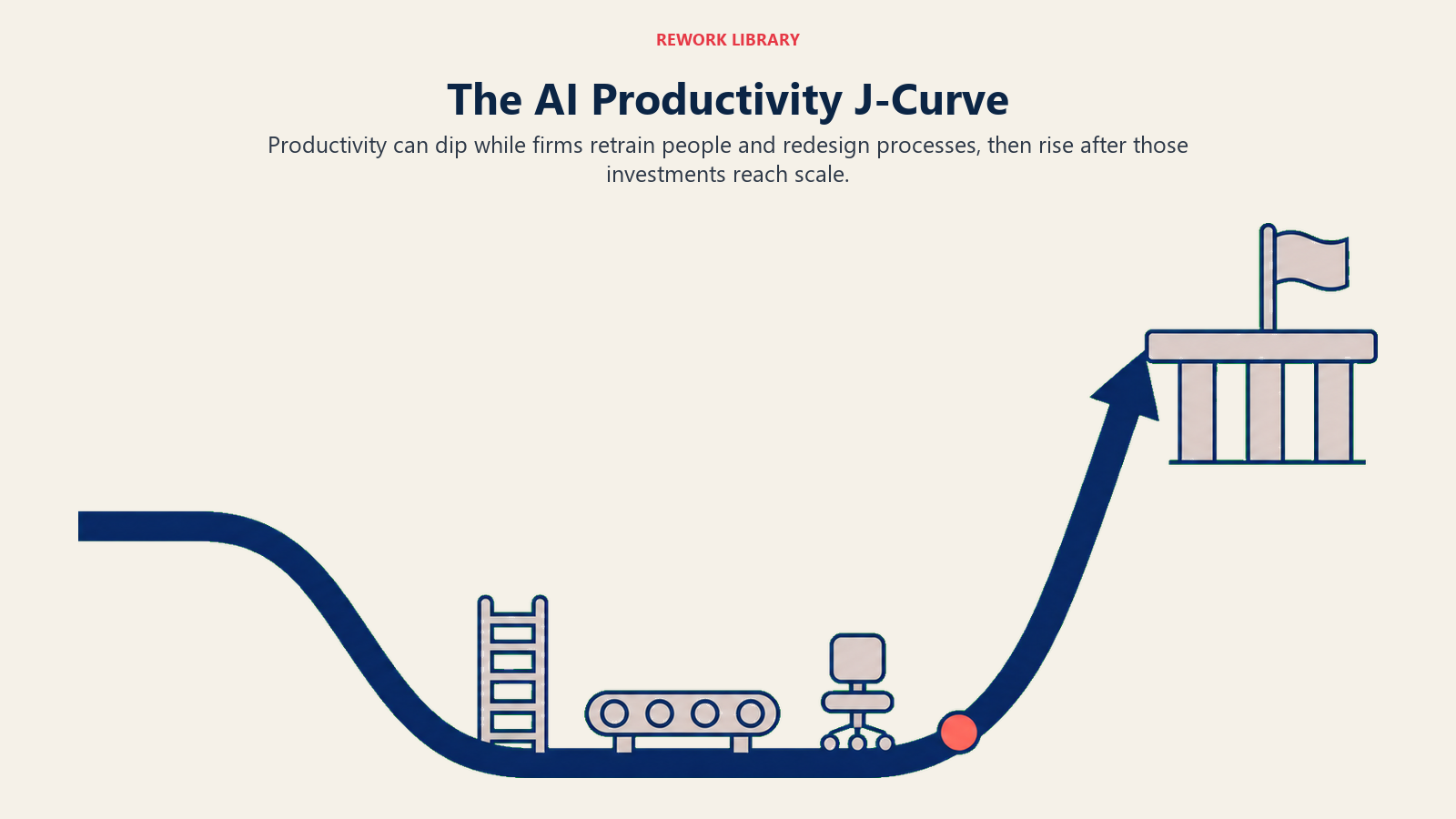
Here's the part that explains the paradox directly: those complementary investments are largely intangible, and intangible investment is measured badly, or not at all, in the statistics reported as "productivity." A company that spends six months redesigning its customer service workflow around an AI system is making a real investment with a real future payoff. In the year it happens, that spending shows up as a cost, dragging measured productivity down, not as an asset building future output. The payoff arrives later, once the redesigned workflow runs at scale, but by then it's often credited to "better management" rather than to the AI investment made years earlier.
Brynjolfsson's team estimated that adjusting official productivity statistics for these intangible IT-related investments would put measured total factor productivity roughly 16 percent higher than the government's own numbers, using historical computer-era data. The J-curve shape (a dip, then a delayed rise) is the mechanism. The Solow paradox and the current AI productivity paradox are both snapshots taken during the dip.
Claimed Gain vs. Measured Gain vs. What Explains the Gap
| Claim in circulation | What's actually measured | What explains the gap |
|---|---|---|
| "AI makes knowledge workers 30-40% more productive" (vendor and pilot-study claims) | McKinsey: only 39% of firms attribute any EBIT impact to AI; most of that under 5% of EBIT | Individual task speedups rarely survive contact with an unredesigned end-to-end workflow; the saved time gets absorbed rather than converted to output |
| "Nearly every company is now an AI company" (adoption headlines) | 88% report some AI use, but two-thirds haven't begun scaling past pilots (McKinsey) | Adoption measures logins and licenses, not whether the workflow around the tool actually changed |
| "Agentic AI will run entire back-office functions" (2024-2025 vendor pitch) | Gartner: 40%+ of agentic AI projects forecast to be canceled by end of 2027 | Agents deployed onto un-redesigned processes lack the context, memory, and defined authority to complete multi-step work reliably |
| "Generative AI pilots prove the ROI case" (internal pilot readouts) | MIT NANDA: 95% of pilots show no measurable P&L return; 5% capture most of the value | Pilots optimize for a demo, not for retention of context or integration into the workflow staff actually use day to day |
| "This changes everything within a year or two" (general commentary) | Brynjolfsson's J-curve: GPT-driven productivity gains historically arrive on a decade-plus lag after mass adoption | Complementary intangible investment (retraining, redesign, new roles) takes years and is invisible to short-run statistics |
Why Pilots Die in Production
MIT's interviews point to a consistent, actionable failure pattern. Pilots get built to impress a steering committee, not to survive a frontline team's actual day. They're demoed once, approved, then handed off with no context-retention or feedback loop to let the tool improve inside the specific workflow it lands in. The moment a pilot creates friction, a wrong answer, a broken handoff, an extra approval step nobody planned for, staff quietly route around it, and usage settles back to the pre-pilot baseline within months.
That's an organizational failure, not a capability one: nobody owned the integration, nobody measured whether the workflow got shorter, and nobody built the feedback loop that earns trust over time. It's also why the technical debt from rushed pilots compounds instead of resolving; a tool bolted onto an unredesigned process becomes one more system to maintain, not less work. The staff routing around a friction-prone pilot are usually doing so on top of an already full day, which is the same mechanism behind pace and burnout in the AI era: a tool that promises relief but adds a verification step nobody scheduled.
The Organizational Rework That Actually Unlocks Value
Every credible study points to the same fix, described in slightly different language each time.
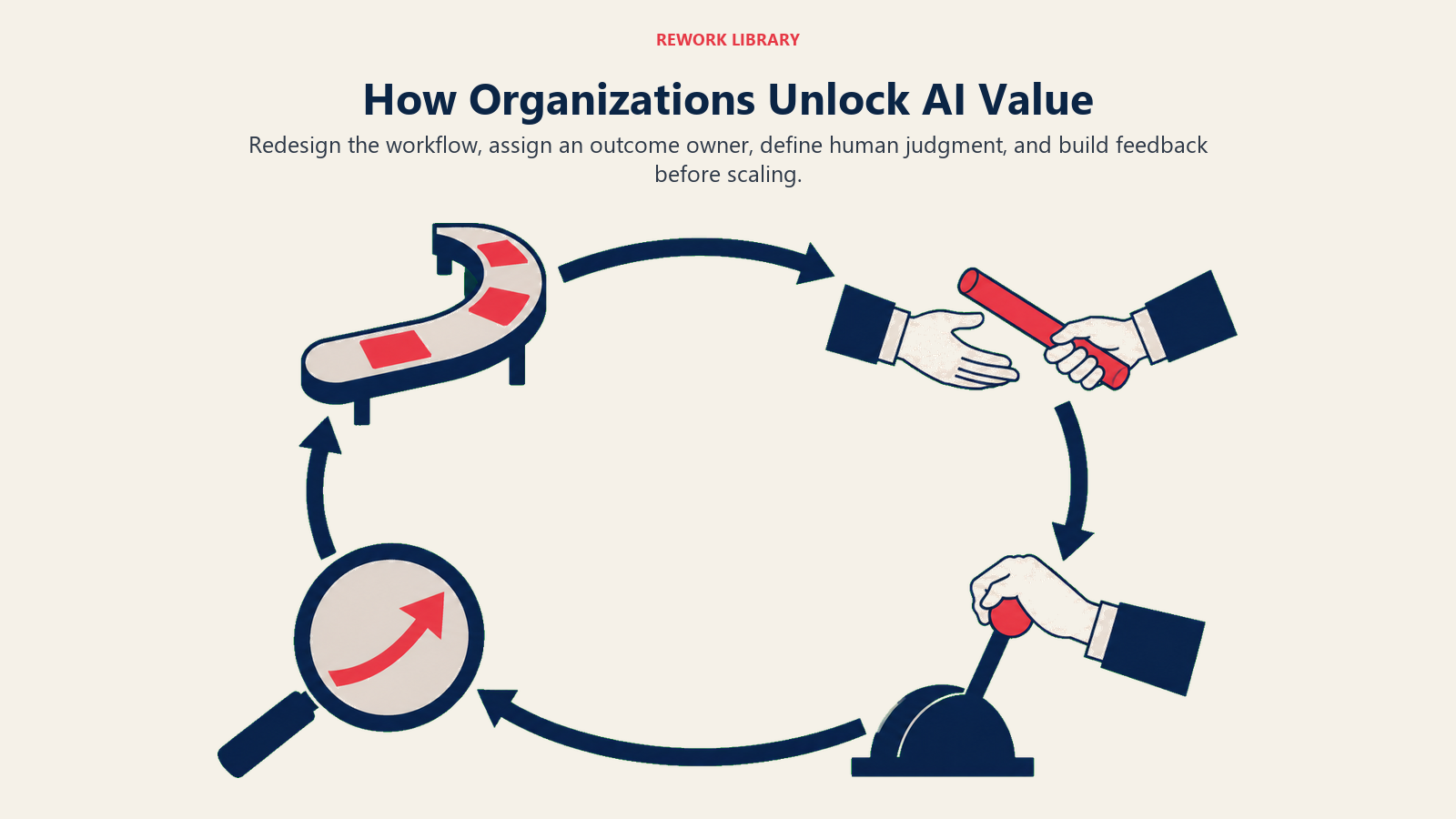
Redesign the workflow, don't bolt AI onto it
McKinsey's high performers are nearly three times more likely to have rebuilt the process around AI's actual capabilities, rather than inserting a tool into a process designed for humans doing every step manually. MIT's successful 5 percent embedded AI into high-value workflows deeply enough that the tool retained context and improved with use, instead of treating each interaction as a one-off. The common thread: the unit of change is the workflow, not the tool.
Give someone real ownership of the outcome, not just the rollout
A pilot with no named owner accountable for a business metric (cost per ticket, cycle time, error rate) tends to drift into a usage-count vanity metric instead. Organizations getting measurable P&L impact assign a business owner, not just an IT sponsor, and hold that person to the same outcome bar as any other operating initiative.
Decide, deliberately, what stays human
Making a redesigned workflow work means being explicit about where human judgment, escalation authority, and final accountability sit, rather than assuming the agent will "figure it out." That's an organizational design question as much as a technical one, and it connects directly to how human-agent teams get structured day to day, and to the deliberate choices some companies make about what to keep human as a strategy rather than an afterthought.
Build the feedback loop before scaling, not after
Tools that don't learn from the specific context they're deployed in are the pattern MIT flagged as the core driver of the 95 percent failure rate. That means budgeting time and ownership for tuning and feedback collection as part of the rollout, not as a "phase two" that never gets funded once the launch looks fine on a usage dashboard.
None of this is exotic. It's the same discipline that resolved the Solow paradox in the 1990s: rebuilding the process, not just adding the tool, with the same budget and executive attention as the tool itself. Companies closing this gap also treat it as a culture question, not just a workflow one; see building an AI-ready culture and what an AI-native culture actually looks like for the norms side of the same problem.
What This Means for Leaders Making Decisions Now
Three things follow directly from the evidence above, not from either the hype or the backlash version of this story.
Treat pilot success and production success as two different bars. A pilot that impresses a room proves the model can do the task once, under supervision. It says nothing about whether the workflow survives six months of real use without a dedicated owner, so budget and staff that second bar separately.
Measure the workflow metric, not the usage metric. Login counts and license seats always look good early. Cost per resolved ticket, cycle time, or error rate against a pre-AI baseline are the numbers that actually predict next year's P&L. If you can't name the specific metric an AI initiative is supposed to move, the workflow redesign hasn't happened yet, only the tool rollout has. And once a redesign does free up real hours somewhere, that time doesn't distribute itself. See the productivity dividend for the decision most leaders never make on purpose: who actually gets the hours AI saves.
Budget for the multi-year timeline the historical pattern shows, not the single-quarter timeline vendors pitch. The Solow paradox took roughly a decade to resolve through sustained organizational investment, not a model upgrade. That gap between the demo and the durable result is exactly what AI governance processes and honest impact assessment are meant to close, by forcing real measurement discipline onto initiatives that would otherwise be judged on how they looked in a steering-committee slide.
The paradox is not a verdict on the technology. It is a snapshot of an unfinished job, the organizational half of the work that general-purpose technologies have always demanded before their productivity gains become visible. Generative AI and AI agents can genuinely change how work gets done. Whether that shows up in your numbers next year or in five years depends less on which model you licensed and more on whether anyone in your organization has been given the time, authority, and accountability to finish the redesign the tool made possible but didn't do for you.
Frequently Asked Questions about the AI Productivity Paradox
What is the AI productivity paradox?
It's the observed gap between how widely companies have adopted generative AI (over 80 percent report using it in at least one function) and how rarely that use shows up as measured financial performance. McKinsey found only 39 percent of organizations attribute any EBIT impact to AI, and MIT NANDA found 95 percent of pilots show no measurable P&L return.
Is the AI productivity paradox proof that AI doesn't work?
No. Every major study points to an implementation and measurement gap, not a capability gap. McKinsey's "AI high performers" get real EBIT impact from the same technology by redesigning workflows around it rather than adding it to unchanged processes. The tool's capability isn't the bottleneck the data identifies.
How is this similar to the Solow paradox from the 1980s?
Economist Robert Solow observed in 1987 that heavy computer investment hadn't shown up in productivity statistics yet. That gap closed in the 1990s once companies finished redesigning processes around computing, roughly a decade after mass adoption began. Several economists now describe the current AI gap as a repeat of the same pattern.
What is the Productivity J-Curve and why does it matter here?
It's a model from economists Erik Brynjolfsson, Daniel Rock, and Chad Syverson explaining why new general-purpose technologies depress measured productivity before they raise it. The required investments (retraining, process redesign, new roles) are intangible and get counted as costs in official statistics before their payoff appears as output.
Why do so many AI pilots fail to reach production impact?
MIT NANDA's research found most pilots are built to impress a one-time demo rather than to survive daily use. They lack context retention and feedback loops, so staff route around friction the first time it appears, and usage quietly reverts to baseline within months.
What does Gartner's agentic AI cancellation forecast actually predict?
Gartner forecasts more than 40 percent of agentic AI projects, meaning multi-step autonomous AI initiatives, will be canceled by the end of 2027, citing escalating cost, unclear business value, and inadequate risk controls, plus a market where many vendors relabel ordinary automation as "agentic."
What should a leader actually do differently given this data?
Redesign the underlying workflow rather than inserting AI into an unchanged process, assign a named business owner accountable for a specific outcome metric (not just a usage count), and budget for a multi-year timeline rather than expecting quarter-over-quarter EBIT impact from a recent pilot.
When will the AI productivity paradox resolve?
There's no fixed date, but the historical precedent (the Solow paradox took roughly a decade to close) suggests it resolves gradually, company by company, as each organization finishes the workflow redesign work, not on a single industry-wide date tied to a model release.

Co-Founder, Rework.com
On this page
- Key Facts
- What the AI Productivity Paradox Actually Means
- The Adoption Numbers Are Real
- The Impact Numbers Tell a Different Story
- McKinsey: high adoption, low attribution
- MIT NANDA: the GenAI Divide
- Gartner: the cancellation wave
- We Have Seen This Movie Before: The Solow Paradox
- The J-Curve: Why Measured Productivity Lags Real Investment
- Claimed Gain vs. Measured Gain vs. What Explains the Gap
- Why Pilots Die in Production
- The Organizational Rework That Actually Unlocks Value
- Redesign the workflow, don't bolt AI onto it
- Give someone real ownership of the outcome, not just the rollout
- Decide, deliberately, what stays human
- Build the feedback loop before scaling, not after
- What This Means for Leaders Making Decisions Now