The History of AI Copilots
Turn this article into takeaways for your work.


Each assistant summarizes the article only for you and suggests best practices for your work.
Picture a programmer in 2020 with a text editor open and a half-written function. The help available then was a menu of method names. A year later, the editor could propose the next lines of code.
An AI copilot is software that works beside a person inside their own tools, suggesting, drafting or looking things up while the person stays in charge. The idea of a computer as a thinking partner goes back to J. C. R. Licklider's March 1960 paper "Man-Computer Symbiosis." The product category took shape on June 29, 2021, when GitHub announced a technical preview of GitHub Copilot. The word spread across office software in 2023. The throughline: the goal of a machine that helps a person think is more than 60 years old. What changed is that language models finally made the help good enough for daily work.
That jump, and the way a single word ("copilot") then stuck to a whole family of products, is the story below. For the wider field around it, see The History of AI. For the definitions, see AI copilots and what Microsoft Copilot is.
One distinction runs through this article. Licklider, Engelbart, the Office Assistant, IntelliSense and Siri are precursors: they pursued the same goal, but none was called a copilot and none ran on a general-purpose language model. The concept itself, an assistant built on a large language model that works inside the user's workflow and carries the name, begins with GitHub Copilot in 2021.
Timeline at a Glance
| Year | Milestone | Why It Mattered |
|---|---|---|
| March 1960 | Licklider publishes "Man-Computer Symbiosis" | A precursor: the first widely cited case for people and computers thinking together. |
| October 1962 | Engelbart's "Augmenting Human Intellect" report at SRI | A precursor: a framework for machines that raise a person's capability. |
| February 3, 1997 | Microsoft announces Visual Basic 5.0 with IntelliSense | A precursor: lists of valid code offered at the cursor. |
| 1997 | Office Assistant ships in Office '97, built on the Lumiere research | A precursor: probabilistic guesses about what a user needs, shown as an animated helper. |
| October 4, 2011 | Apple introduces Siri with the iPhone 4S | A precursor: an assistant for millions, but one that answered commands. |
| June 29, 2021 | GitHub announces the technical preview of Copilot | The first product of the category, as an "AI pair programmer." |
| July 2021 | Codex paper posted | The model behind a production version of GitHub Copilot. |
| June 21, 2022 | GitHub Copilot becomes generally available to all developers | Preview ended; individual developers could use it. |
| February 2023 | Peng et al. post a controlled experiment on Copilot | A measured speed result, with a narrow population. |
| March 16, 2023 | Microsoft announces Microsoft 365 Copilot | The word moved from code to office documents. |
| May 10, 2023 | Google announces Duet AI for Workspace | A rival suite offered the same pattern under another name. |
| November 1, 2023 | Microsoft 365 Copilot reaches general availability for enterprises | Preview ended; enterprise rollout began. |
| November 15, 2023 | Bing Chat becomes Copilot | One brand across products. |
| May 19, 2025 | GitHub introduces a Copilot coding agent | The copilot began taking whole tasks, not only suggestions. |
The Symbiosis Idea (1960-1996)
Two researchers argue computers should think with people
In March 1960, J. C. R. Licklider published "Man-Computer Symbiosis" in the IRE Transactions on Human Factors in Electronics (vol. HFE-1, pp. 4-11). It's available in full. He called symbiosis an expected development in cooperative interaction between people and electronic computers, and he stated the aim of the paper as presenting the concept and fostering its development. His reasons were practical. He had tracked his own working day and concluded that about 85 per cent of his "thinking" time went to getting into a position to think: the clerical and mechanical work that came before any real thinking. The machine's job, he argued, was to take that clerical load so people could do the formulative, decision-making part.
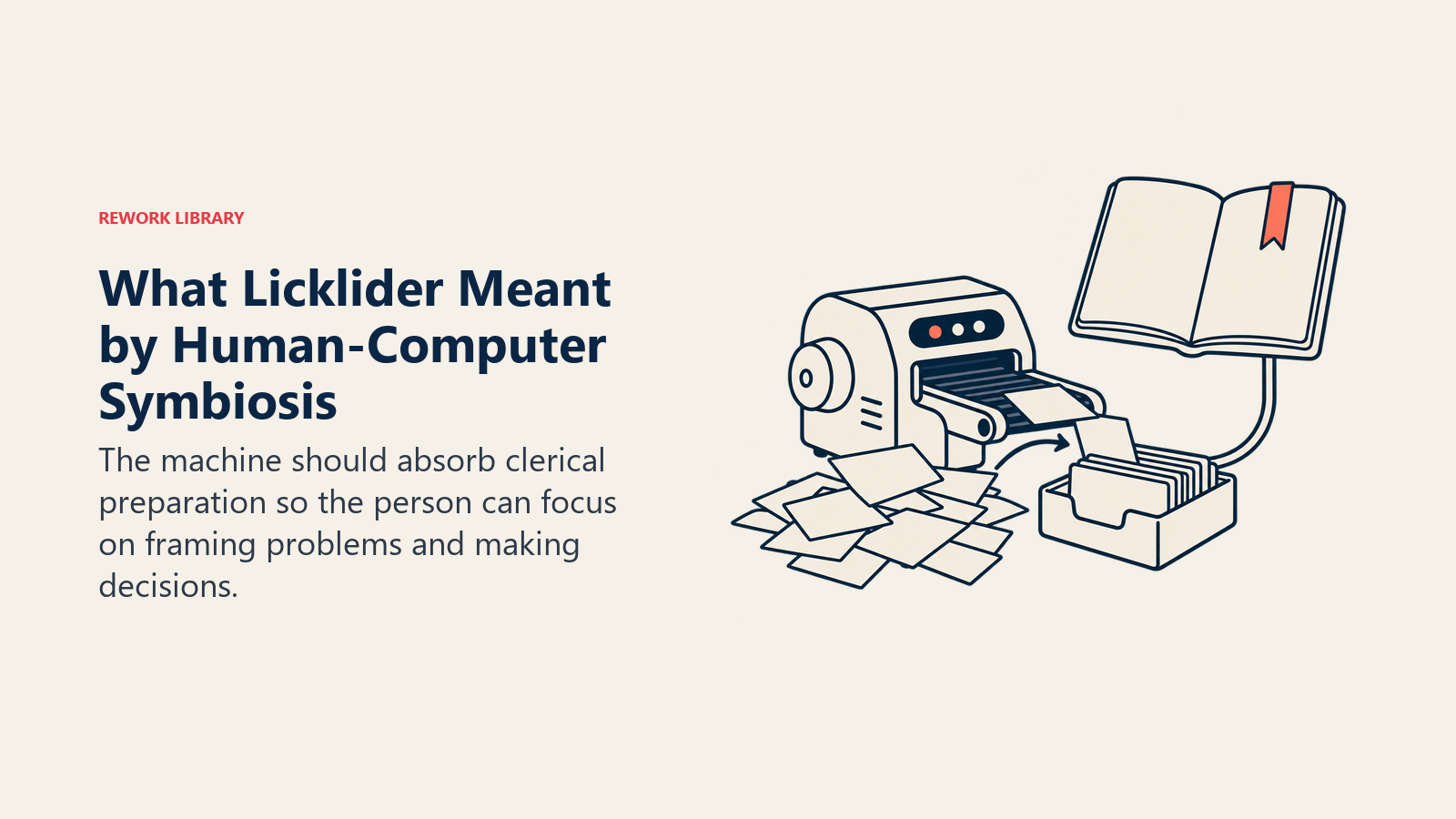
Two years later, in October 1962, Douglas Engelbart published "Augmenting Human Intellect: A Conceptual Framework", an SRI summary report (AFOSR-3223) sponsored by the Air Force Office of Scientific Research. The report defines augmenting human intellect as increasing a person's capability to approach a complex problem and to find solutions that suit his needs. Notice what both documents share. Neither describes a program that does the job for you. Both describe a partnership in which the human sets the goal and the machine removes friction.
These are precursors, not copilots. Nobody in 1960 or 1962 had a machine that could read a sentence and continue it, so the idea lived in papers and prototypes. What it solved was the framing: the right relationship between a person and a computer is cooperation. What it left open was how to get a machine good enough to cooperate in ordinary work.
For teams today: the oldest lesson is the framing. Before you buy a copilot, name the clerical work it should take, as Licklider did with his own day, and measure that.
The Assistant Years (1997-2020)
A paperclip, a pop-up list and a voice
The next documented step to reach ordinary users came from Microsoft. In 1998, Eric Horvitz, John Breese, David Heckerman, David Hovel and Koos Rommelse presented "The Lumiere Project" at the Conference on Uncertainty in Artificial Intelligence. It described Bayesian models that infer a software user's goals and needs from their actions and queries. The abstract says Lumiere prototypes served as the basis for the Office Assistant in the Microsoft Office '97 suite. That animated helper, which many people remember as Clippy, is the first widely shipped attempt at an assistant that watched your work and offered help. It guessed from rules and probabilities, not from language understanding,.
A quieter assistant shipped the same year. On February 3, 1997, Microsoft announced Visual Basic 5.0, Professional Edition and described its IntelliSense technology as offering a point-and-click list of values that can be typed at a given point in code. This is the ancestor of the autocomplete that code copilots later extended: it knew what was legal at the cursor, but it couldn't write anything new.
The voice branch came in 2011. In its October 4 release for the iPhone 4S, Apple said the phone introduces Siri, an intelligent assistant that helps you get things done just by asking. Siri reached a mass audience as an assistant for spoken requests, years before language models could draft text. For the parallel history of conversational software, see the first AI chatbots and the history of natural language processing.
What the era solved: it proved that assistance could sit inside everyday software. What it left unsolved: every suggestion came from a fixed menu or a narrow model, so the help broke down whenever the task left the script. Through the 2010s, the work that changed that was the research behind the transformer and neural language models.
For teams today: an assistant that interrupts is worse than none. The Office Assistant's reputation is a reminder that relevance and timing decide whether help is welcome.
The Codex Preview (2021-2022)
A language model learns to finish the programmer's sentence
By 2021 the ingredients existed. Large language models had grown, and generative AI had moved from labs into products. OpenAI's Codex paper, submitted July 7, 2021, introduced a GPT language model fine-tuned on publicly available code from GitHub, and said a distinct production version of Codex powers GitHub Copilot. The paper reports that Codex solved 28.8% of problems on its HumanEval test.
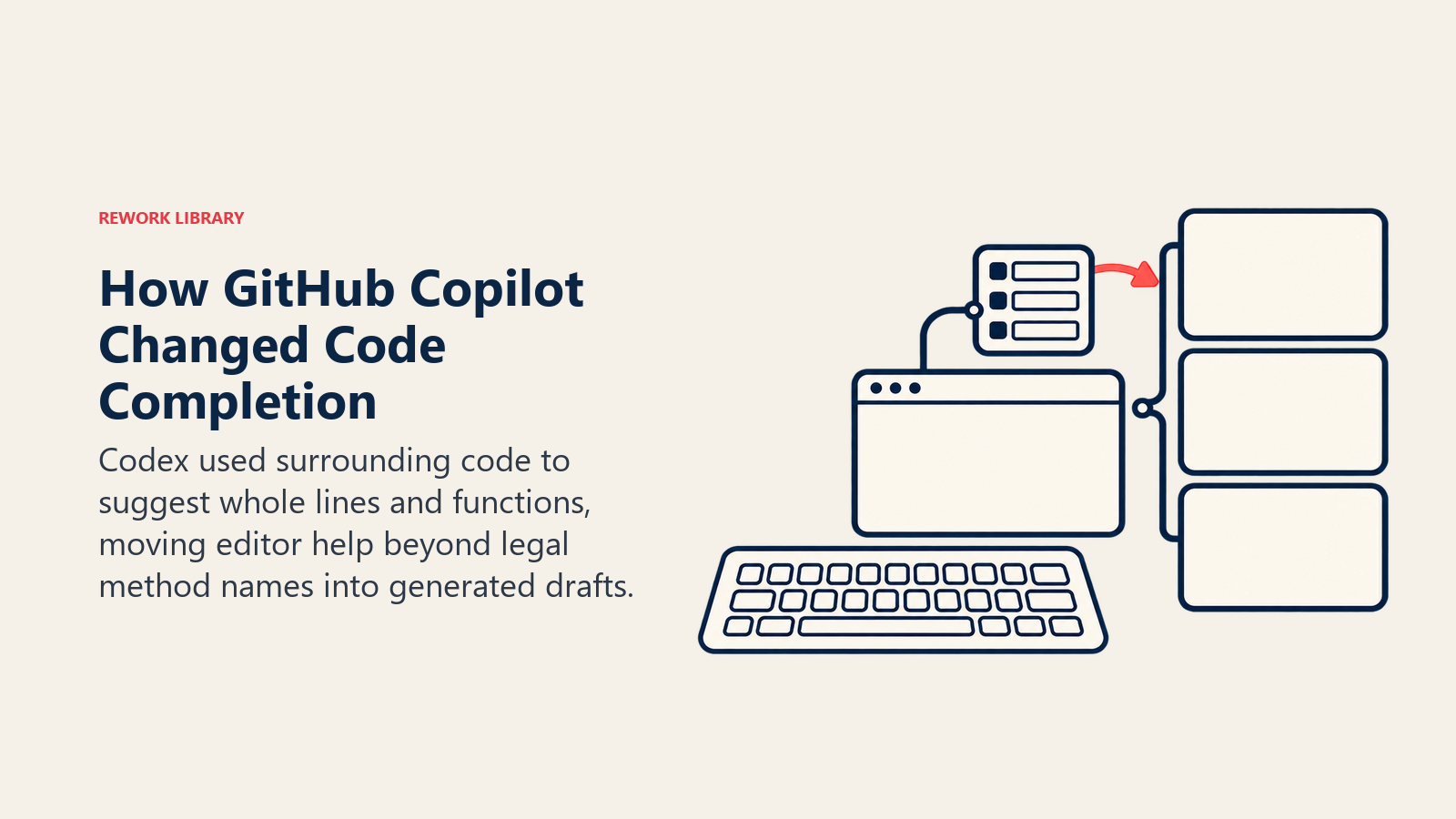
The product arrived first. On June 29, 2021, Nat Friedman announced a technical preview of GitHub Copilot, calling it an AI pair programmer, developed with OpenAI and powered by Codex. The post says it drew context from the code you're working on and suggested whole lines or entire functions, and that it worked especially well for Python, JavaScript, TypeScript, Ruby and Go. The word is worth pausing on. GitHub's own phrase was "pair programmer," a human working practice. The "copilot" name was in the product title; the pair-programming metaphor was in the description.
Technical preview and general availability are different dates, and the two are often mixed up. The preview opened June 29, 2021. On June 21, 2022, Thomas Dohmke announced that GitHub Copilot was generally available to all developers, with individual developers getting access first and a business offering to follow later that year. GitHub reported more than 1.2 million developers in the preview during the previous 12 months, and said that in files where Copilot was enabled, nearly 40% of code was being written by it in popular languages like Python. That figure is GitHub's own report, not an independent study.
An early controlled experiment followed. In February 2023, Sida Peng, Eirini Kalliamvakou, Peter Cihon and Mert Demirer posted "The Impact of AI on Developer Productivity: Evidence from GitHub Copilot". The experiment ran from May 15 to June 20, 2022. They recruited 95 professional programmers through the freelancing platform Upwork and randomly split them into 45 treated and 50 control; 35 developers across the two groups completed the task and survey. Everyone was asked to write an HTTP server in JavaScript as quickly as possible. The treated group finished 55.8% faster, with a 95% confidence interval of 21-89%. The control group could use internet search and Stack Overflow. Most participants were aged 25-34 and from India and Pakistan, and the paper notes that less experienced developers benefited more. So the number describes one task, a small sample of freelancers, and one tool in 2022. It doesn't describe every job, and the authors themselves list limits.
What the era solved: a model-backed assistant sat inside the editor and handled the boilerplate. The new problems were correctness, code ownership and how much to trust a confident suggestion.
For teams today: treat any vendor productivity claim as a claim about a task and a population. Ask who was measured, on what job, and whether your work looks like theirs.
The Copilot Label Spreads (2023-2024)
One word moves from the editor to the whole office
On March 16, 2023, Jared Spataro introduced Microsoft 365 Copilot, described as "your copilot for work." It combined large language models, including GPT-4, with Microsoft Graph data (documents, email, calendar, chats and meetings) and the Microsoft 365 apps: Word, Excel, PowerPoint, Outlook and Teams. Business Chat was a new cross-app experience. At that point Microsoft was testing with a small group of customers.
The September 21, 2023 announcement said Copilot would be generally available for enterprise customers on November 1, after use by tens of thousands of enterprise users in an early access program. Then, on November 15, Microsoft said Bing Chat and Bing Chat Enterprise would simply become Copilot, and described one copilot experience running across all its surfaces. The word had stopped naming a feature and started naming a brand.
Competitors built the same pattern under other names. On May 10, 2023, Google announced Duet AI for Google Workspace, with features such as "Help me write" in Gmail and Docs. On February 21, 2024, Google said Duet AI for Google Workspace is Gemini for Google Workspace. Salesforce announced a public beta of Einstein Copilot on February 27, 2024, calling it a conversational, generative AI assistant for CRM, and general availability on April 25, 2024. Both Salesforce pages now carry a note that Einstein Copilot was upgraded to Agentforce. The names changed within a year; the pattern persisted.
| Product | Announced | Where it works | Later name |
|---|---|---|---|
| GitHub Copilot | June 29, 2021 (preview) | Code editors | Same |
| Microsoft 365 Copilot | March 16, 2023 | Word, Excel, PowerPoint, Outlook, Teams | Same |
| Duet AI for Workspace | May 10, 2023 | Gmail, Docs, Slides, Sheets, Meet | Gemini for Google Workspace |
| Einstein Copilot | February 27, 2024 (beta) | Salesforce CRM | Agentforce |
The era solved distribution: employees met the assistant in tools they already used, with their own documents as context. It created governance questions. A copilot that reads your email and files is only as safe as your permissions, and an organization's messy folders become the assistant's blind spots. The pattern is covered in the workflow copilot pattern.
For teams today: a copilot inherits your data hygiene. Fix access rules and naming before rollout, not after.
The Agent Turn (2025-present)
The helper starts taking whole tasks
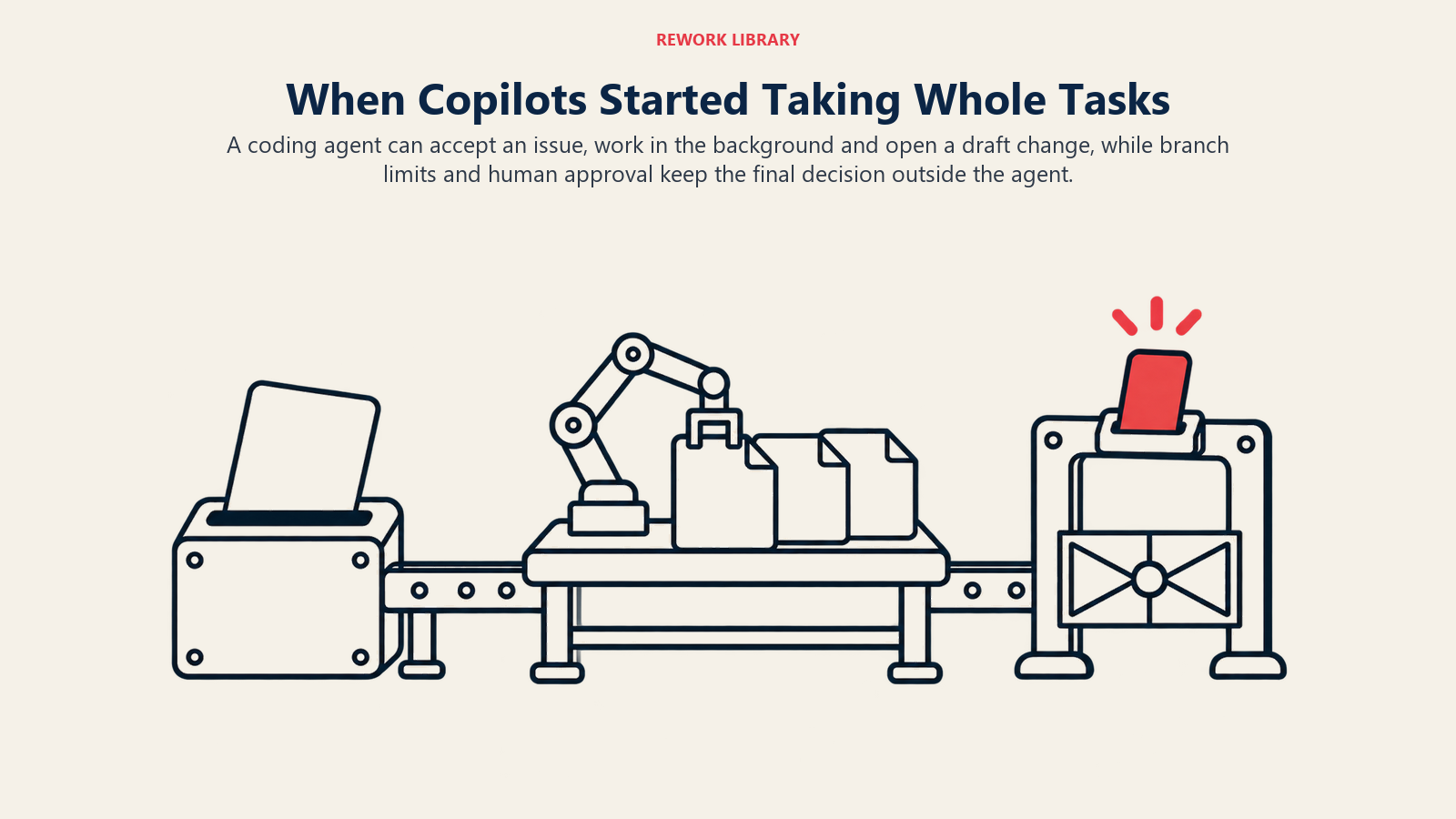
The newest change is that some copilots stopped waiting for the next keystroke. On May 19, 2025, GitHub described a new coding agent: assign a GitHub issue to Copilot, and it works in the background with GitHub Actions and pushes commits to a draft pull request, then asks the person to review. The post says the agent can only push to branches it creates, that the developer who requested the pull request can't approve it, and that workflows don't run until a human approves them. Notice the design choice. As the assistant got more capable, the safeguards were put at the review step, which is where Licklider's division of labor (machine for routine work, human for judgment) shows up again.
This is where the copilot meets the agent. A copilot responds inside your session; an agent takes a goal and works toward it. For that line of history see the history of AI agents, what an AI agent is and the future of AI history. For how this technology reached ordinary employees, see AI moving from research labs to work.
For teams today: more autonomy needs more review design. Decide who approves what before you let any assistant act for you.
Key People
| Name | Role | Contribution | Year |
|---|---|---|---|
| J. C. R. Licklider | Researcher | "Man-Computer Symbiosis" | 1960 |
| Douglas Engelbart | Researcher at SRI | "Augmenting Human Intellect" framework | 1962 |
| Eric Horvitz and co-authors | Microsoft researchers | Lumiere, basis of the Office Assistant | 1998 |
| Nat Friedman | GitHub | Announced the GitHub Copilot technical preview | 2021 |
| Mark Chen and co-authors | OpenAI researchers | Codex, behind a production version of Copilot | 2021 |
| Thomas Dohmke | GitHub | Announced general availability (2022) and the coding agent (2025) | 2022, 2025 |
| Sida Peng and co-authors | Researchers | Controlled experiment on Copilot | 2023 |
| Jared Spataro | Microsoft | Announced Microsoft 365 Copilot | 2023 |
Key Facts
- Licklider's paper appeared in March 1960 in the IRE Transactions on Human Factors in Electronics.
- The Office Assistant in Office '97 was based on Lumiere prototypes.
- GitHub Copilot's technical preview was announced June 29, 2021; general availability followed June 21, 2022.
- In a 2022 experiment with 95 freelance programmers, the treated group wrote a JavaScript HTTP server 55.8% faster (95% confidence interval 21-89%).
- Microsoft 365 Copilot was announced March 16, 2023 and became generally available to enterprises November 1, 2023.
- On November 15, 2023, Bing Chat and Bing Chat Enterprise became Copilot.
The Pattern Behind the History
Across six decades the same sequence repeats. We call it the Partner-to-Platform Pattern. It's our synthesis of the history above, not a research finding.
- A vision of partnership comes first. Licklider and Engelbart described cooperation before any machine could deliver it.
- Narrow assistants prove the interface. The Office Assistant, IntelliSense and Siri put help inside everyday tools but ran on fixed rules.
- A general model removes the ceiling. Codex let one model write code from context, and the same trick carried to documents.
- A name travels faster than a technology. "Copilot" went from a code editor to office suites, a search product and a CRM in under three years.
- Autonomy follows, and so does the need for review. The coding agent kept the human at the approval step.
What It Teaches Teams Today
- Start from a task, not a label. Licklider measured his own day. Do the same for your team before choosing a tool.
- Read the claim, then the sample. The best-known speed result covers one coding task and 95 freelancers, so check it against your own work.
- Prepare your data. A copilot that draws on email and files exposes every access mistake you already have.
- Don't confuse the name with the capability. The label has been applied to products with very different abilities, and some have since been renamed.
- Design the review step. Whoever approves the output is the real control.
The copilot looks like a product of 2021, and it is. But the question behind it is Licklider's: which parts of a working day should a machine take, and which must a person keep? Ask it of every tool you adopt. For more of the record, see the history of generative AI and the history of large language models.
