The First AI Winter: Causes and Lessons
Turn this article into takeaways for your work.


Each assistant summarizes the article only for you and suggests best practices for your work.
In April 1964, US agencies that had paid for machine translation for a decade asked the National Academy of Sciences a plain question. Should they keep paying?
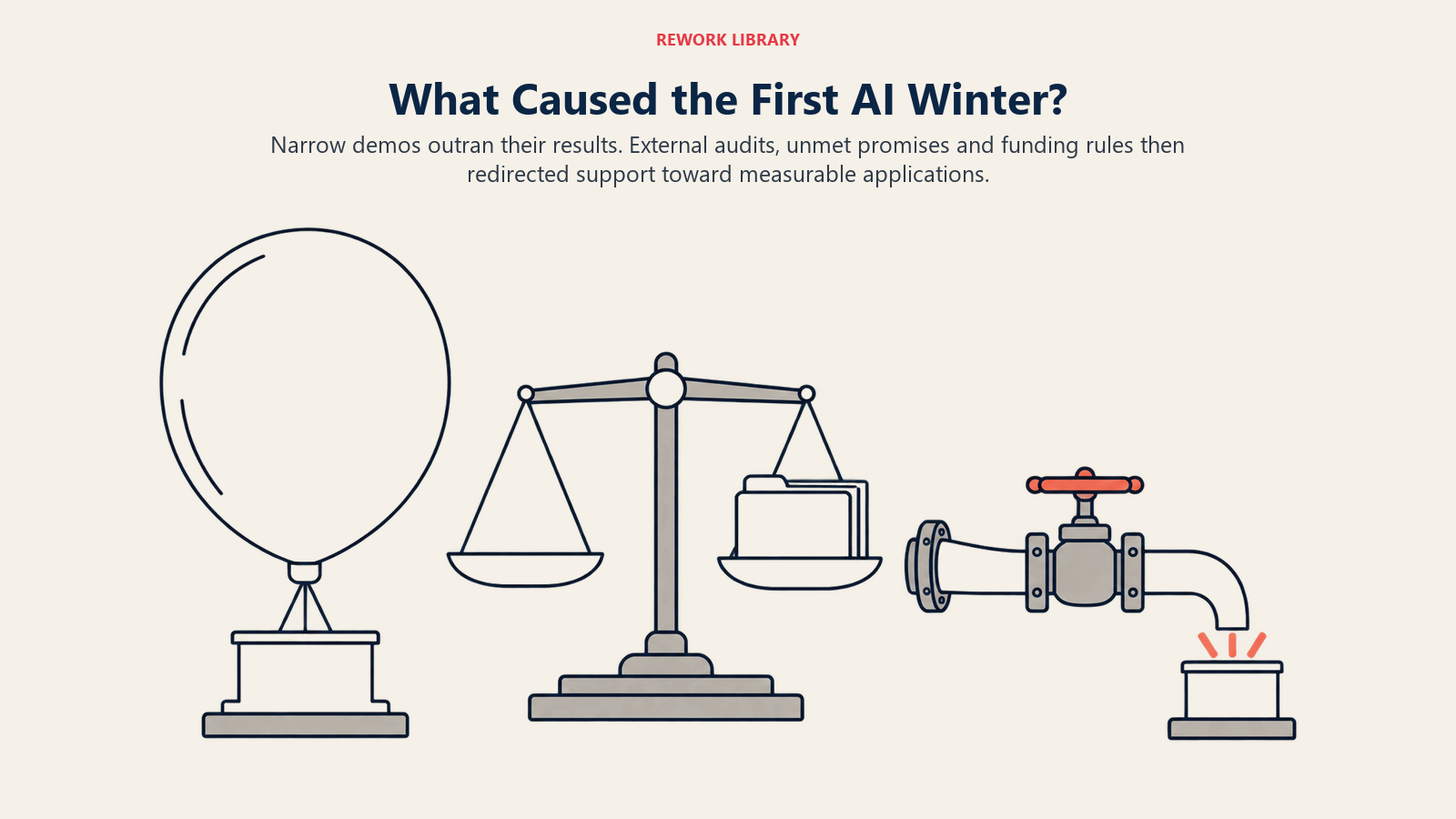
The first AI winter was the stretch in the late 1960s and 1970s when funders and universities lost confidence in artificial intelligence. A short chain of documents built it: a US report on machine translation in 1966, a book on perceptrons in 1969, a US defense funding rule in November 1969, and a British survey written in 1972 and published in 1973. The throughline is simple. Promises made in the 1950s ran ahead of results. Outside reviewers priced the gap, and money moved to narrower work that could show a return. The story is also more mixed than the legend.
That question, repeated in different forms in Washington and London, is the story below. For the wider arc around this episode, see The History of AI and the AI timeline.
Timeline at a Glance
| Year | Milestone | Why It Mattered |
|---|---|---|
| January 7, 1954 | The Georgetown-IBM translation experiment | Simple, selected sentences read well, and set expectations for machine translation. |
| 1957-1958 | Rosenblatt begins the perceptron work at Cornell Aeronautical Laboratory | It started neural networks as a rival to symbolic AI. |
| April 1964 | The ALPAC committee holds its first meeting | Three US agencies asked outsiders to judge machine translation. |
| 1966 | ALPAC publishes Language and Machines | It found no useful machine translation of general scientific text in prospect. |
| 1969 | Minsky and Papert publish Perceptrons | It set out mathematical limits of single-layer perceptrons. |
| November 19, 1969 | Section 203 of Public Law 91-121 | US defense research had to show a direct military link. |
| March 1970 | DARPA's speech understanding study begins | It set a narrow goal with a date and a test. |
| July 1972 | Lighthill dates his survey of AI | A mathematician outside AI judged the field for the UK's research council. |
| Early 1973 | The Lighthill report is published | UK confidence in AI research fell for nearly a decade. |
| June 1973 | BBC debate on the report | Lighthill faced Michie, Gregory and McCarthy on television. |
| September 1976 | DARPA's speech systems are demonstrated; no follow-on is funded | One system met the goals, and the program still ended. |
| 1982-1983 | Britain's Alvey committee reports and the programme begins | Public money for AI-related research returned. |
The Early Promise (1954-1963)
A few sentences translate, and everyone extrapolates
On January 7, 1954, a joint Georgetown University and IBM experiment translated simple, selected text, including sentences like "TNT is produced from coal." The later ALPAC report calls such early samples "deceptively encouraging." The report says the digital computer quickly suggested that machine translation might be possible, and the idea captured the imagination of scholars and administrators. The practical goal was to turn foreign technical text into accurate English that nobody could tell from an American scientist's own writing.
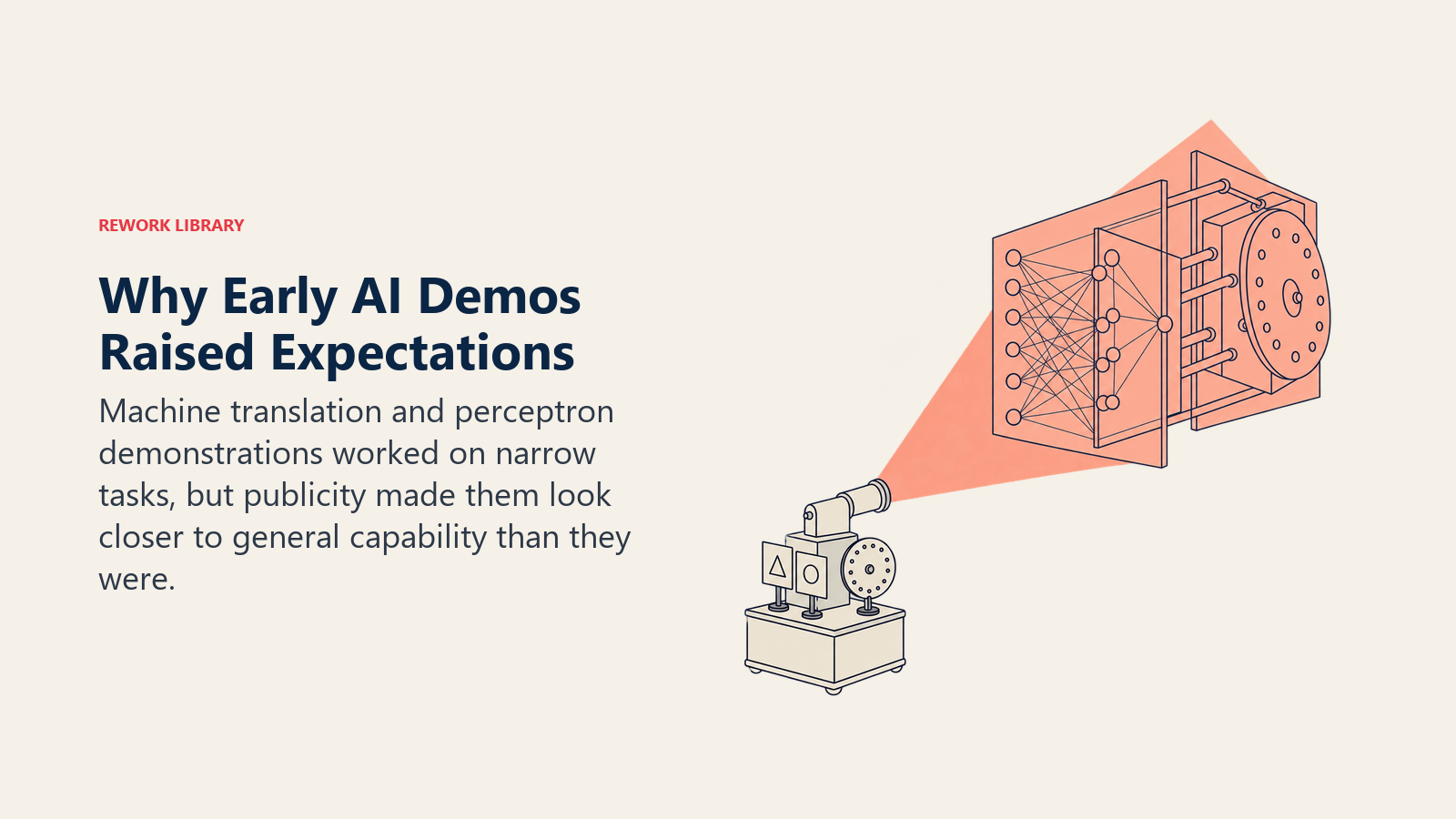
The same optimism ran through the young field. The 1955 Dartmouth proposal had asked for a two-month study of machine intelligence. In 1957 Frank Rosenblatt, a psychologist at the Cornell Aeronautical Laboratory in Buffalo, began work on neural networks he called perceptrons, per Nils Nilsson's history of the field. The sociologist Mikel Olazaran, in his history of the perceptron controversy, notes that Rosenblatt published his first important papers in 1958, that a team built the Mark 1 perceptron with Office of Naval Research funding, and that the project drew considerable attention outside the research community.
Later, Lighthill described the mood from the other side. In his 1972 survey, he wrote that workers entered the field around 1950, and even around 1960, with high hopes that were far from realized by 1972. The early era solved a real problem: it gave researchers money and a mission. It created a quieter one, a set of public expectations that no lab had a schedule for meeting. The wider story of who paid for those labs is in how AI moved from research labs to everyday work.
For teams today: a demo on selected inputs is a proof of concept, not a forecast. Write down which inputs your pilot excludes, and who will hold the promise if production data looks different.
The Verdict Years (1964-1969)
An outside audit, a hard proof and a new funding rule
In April 1964, the Automatic Language Processing Advisory Committee, chaired by John R. Pierce of Bell Telephone Laboratories, held its first meeting. The committee's report explains that the National Academy of Sciences formed it at the request of the National Science Foundation's director, Leland Haworth, on behalf of the Defense Department, the CIA and the NSF. Its question was whether machine translation justified continued support.
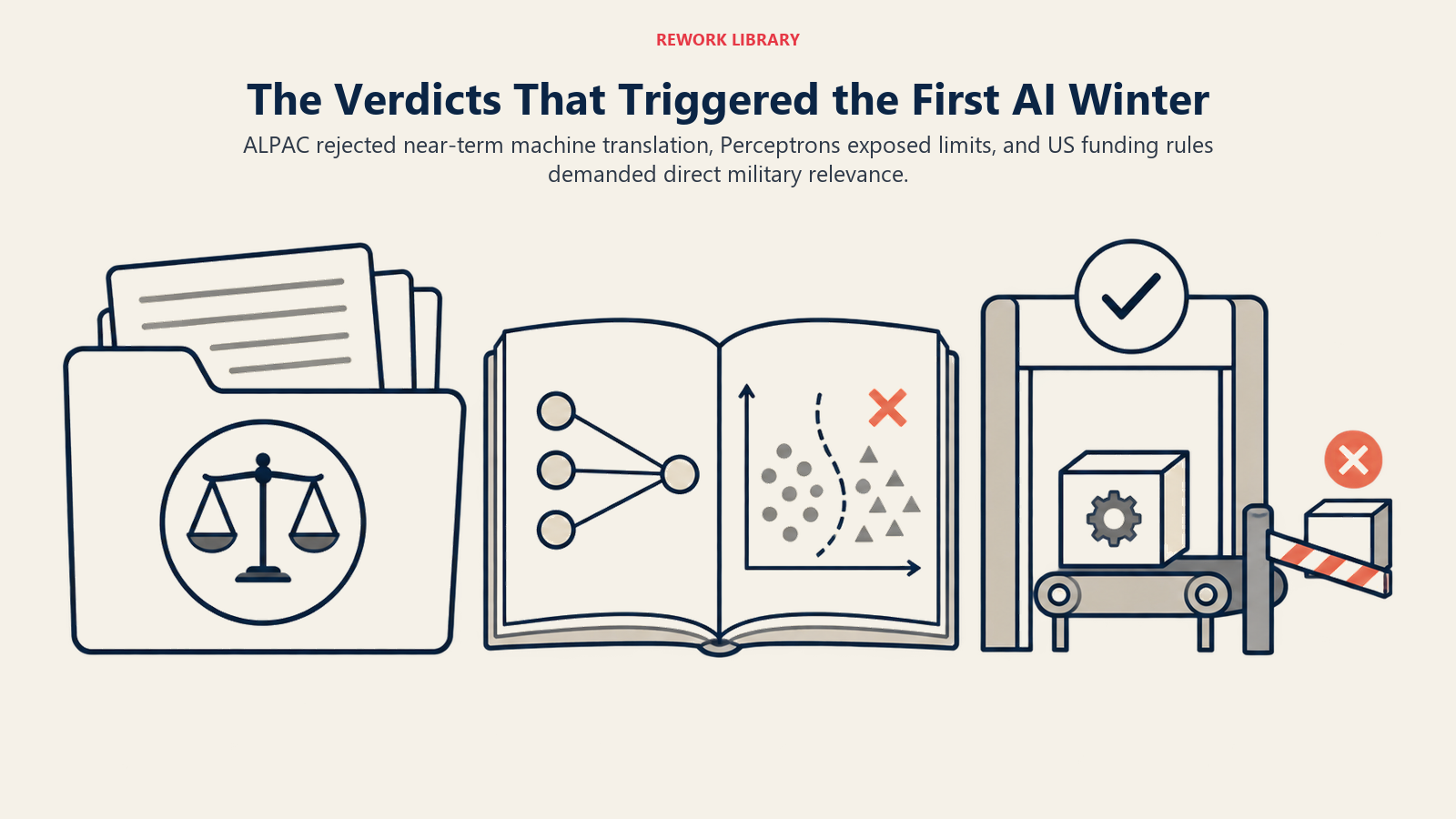
The answer was no, at least for the near term. Over the previous ten years, the report says, the government had spent some $20 million on machine translation and closely related subjects, more than a year of government translation cost. It concluded that there had been no machine translation of general scientific text, and "none is in immediate prospect." The committee noted that when the Georgetown project tried to produce useful output in 1962 after eight years of work, the machine output had to be post-edited, and the edited translation took slightly longer and cost more than conventional human translation. The report did not call for an end to language research. It recommended funding computational linguistics as a science and improving human translation, and a July 1966 follow-up letter says Pierce was asked for a separate statement on computational linguistics because of a fear that the report alone might end its support.
Neural networks faced a different kind of verdict. In 1969, Marvin Minsky and Seymour Papert published Perceptrons. According to Olazaran, they showed that for a single-layer perceptron to compute parity, at least one association unit had to receive connections from every input. The book was a "final push" in a debate that, in his account, was already largely settled in the mid-1960s, when the main criticisms were known and the SRI and Widrow projects hit their own crises. Nilsson, who worked on neural nets at SRI, remembers the technical wall: nobody knew how to adjust weights in more than one layer of a multilayer network.
The popular version is blunter. Olazaran quotes a 1988 textbook claiming that after Minsky and Papert's book there was "an almost total shift in research funding" from neural networks to symbolic AI. His own sociological study treats that as a story told afterward. Be careful with it. The book mattered, but the evidence shows a research program that was already running out of road.
The last piece was a funding rule. On November 19, 1969, Congress passed Public Law 91-121. Section 203 said no funds authorized by the act could be used for research that lacked "a direct and apparent relationship to a specific military function or operation." Nilsson says this Mansfield Amendment pushed DARPA's computer research toward applications, and that DARPA managers were able to cushion its impact by emphasizing applications in how they described programs.
These verdicts solved an accountability problem, because sponsors finally had an outside judgment. They created a selection problem, because the people judging were not always judging the same thing the researchers meant.
For teams today: ask for an outside reviewer before a project's second year, and say in advance what result would justify more funding. An audit that arrives unplanned feels like an attack.
The Lighthill Report (1970-1973)
A mathematician outside the field prices the promise
Consider the position of the UK's Science Research Council in the early 1970s. It was receiving a growing number of applications for AI research, and Lighthill's survey says the volume and variety of disciplines involved were enough that the council had to take a general view. Its Chairman, B. H. Flowers, wrote in the paper's preface that he could not assemble a dispassionate panel of experts as usual, so he asked Sir James Lighthill, Lucasian Professor of Applied Mathematics at Cambridge, for a personal review.
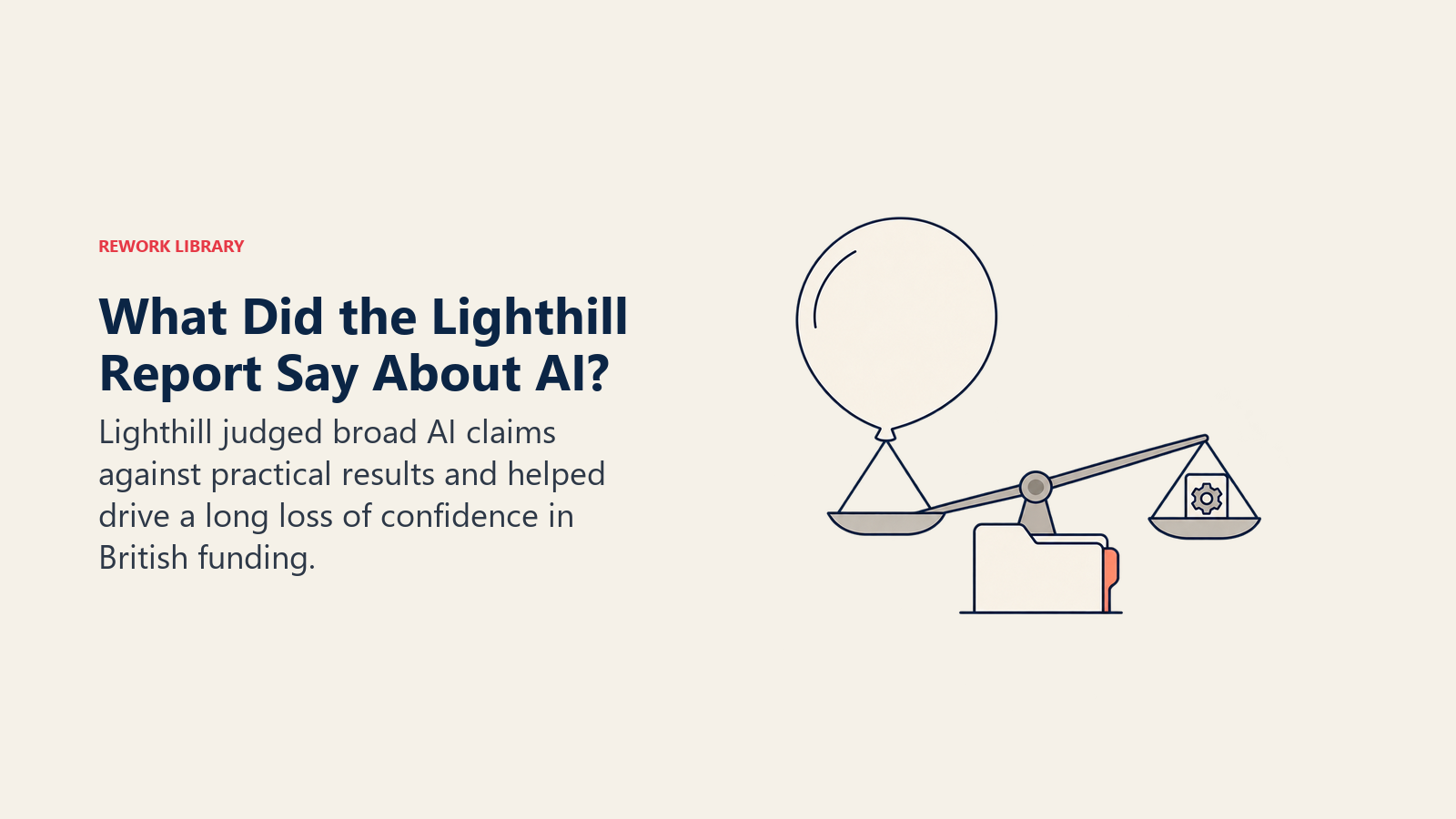
Lighthill agreed on the understanding that he would describe how AI looked to a layperson after two months reading the literature and talking to people in the field. His report is dated July 1972. He split the work into three categories: advanced automation (category A), computer-based study of the nervous system (category C) and a bridge between them centered on building robots (category B). Categories A and C had respectable achievements, he said, but fewer than hoped, and progress in the bridge category had been even more discouraging.
His general explanation for the disappointment was the "combinatorial explosion," the way the number of possibilities in a problem such as theorem proving grows faster than faster computers can help. He called machine translation the area of the "most notorious disappointments," citing the 1966 National Academy review, and said large spending on machine recognition of ordinary speech had been "wholly wasted." He also pointed out that predictions publicized about AI had gone further than most researchers in the field expected.
The council discussed the report in September 1972 and decided to publish it together with alternative points of view from Stuart Sutherland, Roger Needham, Christopher Longuet-Higgins and Donald Michie, as the preface records. Chilton Computing's archive says it was published in early 1973, and that it supported automation and simulation of neurophysiological and psychological processes but was critical of basic research in robotics and language processing.
Meanwhile, in the United States, DARPA's Larry Roberts and Cordell Green organized a March 1970 meeting that led to a speech understanding study group chaired by Allen Newell, per Nilsson. The group recommended a narrower system than Roberts first described: 1,000 words, continuous speech, a highly artificial syntax, demonstrable in 1976. That is the pattern of the period in one program: smaller goals, a date and a test.
In June 1973 the BBC broadcast a debate at the Royal Institution with Lighthill, Michie, Gregory and McCarthy. By then the argument had left the council room.
For teams today: a critique from an outsider is information about how your work reads to funders. Read it for the question behind the conclusion, as Lighthill's was really about scale.
The First Winter (1973-1980)
Confidence falls in Britain, while US money narrows rather than vanishes
The winter did not look the same everywhere. In Britain, the Chilton overview says, Lighthill's report provoked a massive loss of confidence in AI among the academic establishment and the funding body, one that persisted for almost a decade. AI research continued, but the next attempt at a major activity did not come until a September 1982 review meeting.
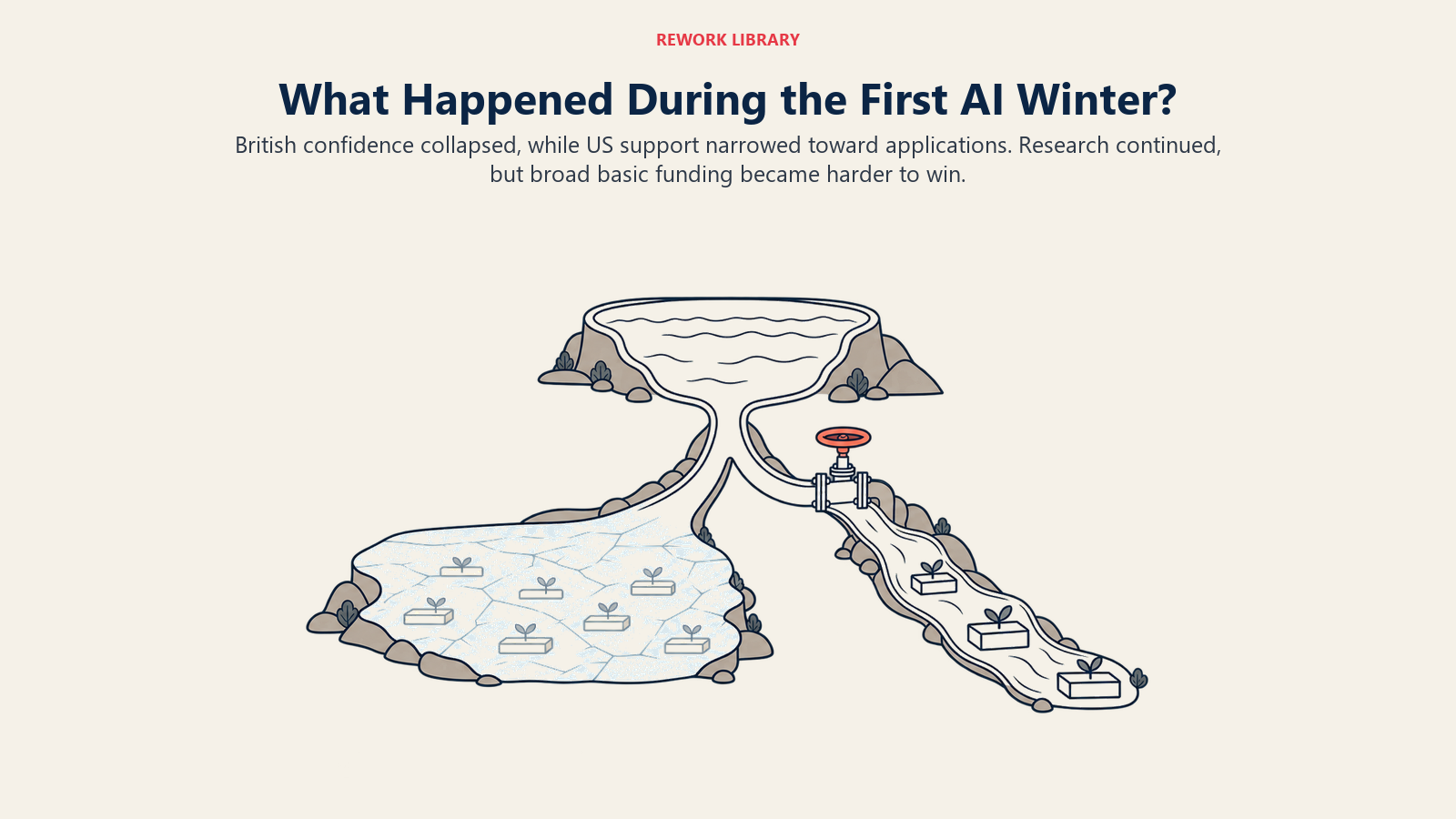
In the United States, the picture was more mixed. Nilsson writes that even though the Mansfield Amendment and the Lighthill report caused difficulties for basic AI research during the 1970s, the promise of applications sustained overall funding from both government and industry. Larry Roberts, who led DARPA's computer research office, recalled that the amendment forced more paperwork and a mix tilted toward development, though he did not think he had to drop a project because of it. Applications work grew, and the Information Sciences Institute was formed in 1972 to pursue it.
The speech program shows the same mix. In September 1976, Carnegie Mellon's HARPY and HEARSAY-II and BBN's HWIM were demonstrated. MIT's Dennis Klatt wrote that only HARPY met the ARPA goals, and DARPA decided not to fund a proposed follow-on, per Nilsson. Yet a National Research Council report, quoted by Nilsson, credits that research with later commercial speech products, and Dragon's NaturallySpeaking traces its roots to CMU work done between 1971 and 1975. A program can be cancelled and still pay off.
The neural network side went quiet. Olazaran's study finds that a funding shift away from neural networks is the standard account, though his own analysis gives it a more complicated history. Either way, work on multilayer learning slowed in this decade. The winter solved the field's credibility problem by forcing it to name its targets. It also left ideas such as multilayer learning with little support until the 1980s.
For teams today: a cooled budget is not the same as a dead idea. Keep the one-person experiment alive, and document why it paused, so it can restart when the constraint (data, compute, budget) moves.
The Thaw (1980-1987)
Rule-based programs earn money, and governments spend again
The thaw came from a narrower direction. In January 1980, Digital Equipment Corporation began using John McDermott's R1 program to configure VAX orders, a story told in the history of expert systems. Rule-based programs promised the very thing the 1970s critics had asked for: a bounded domain, a clear test and a measurable saving. The related approach is covered in the history of symbolic AI.
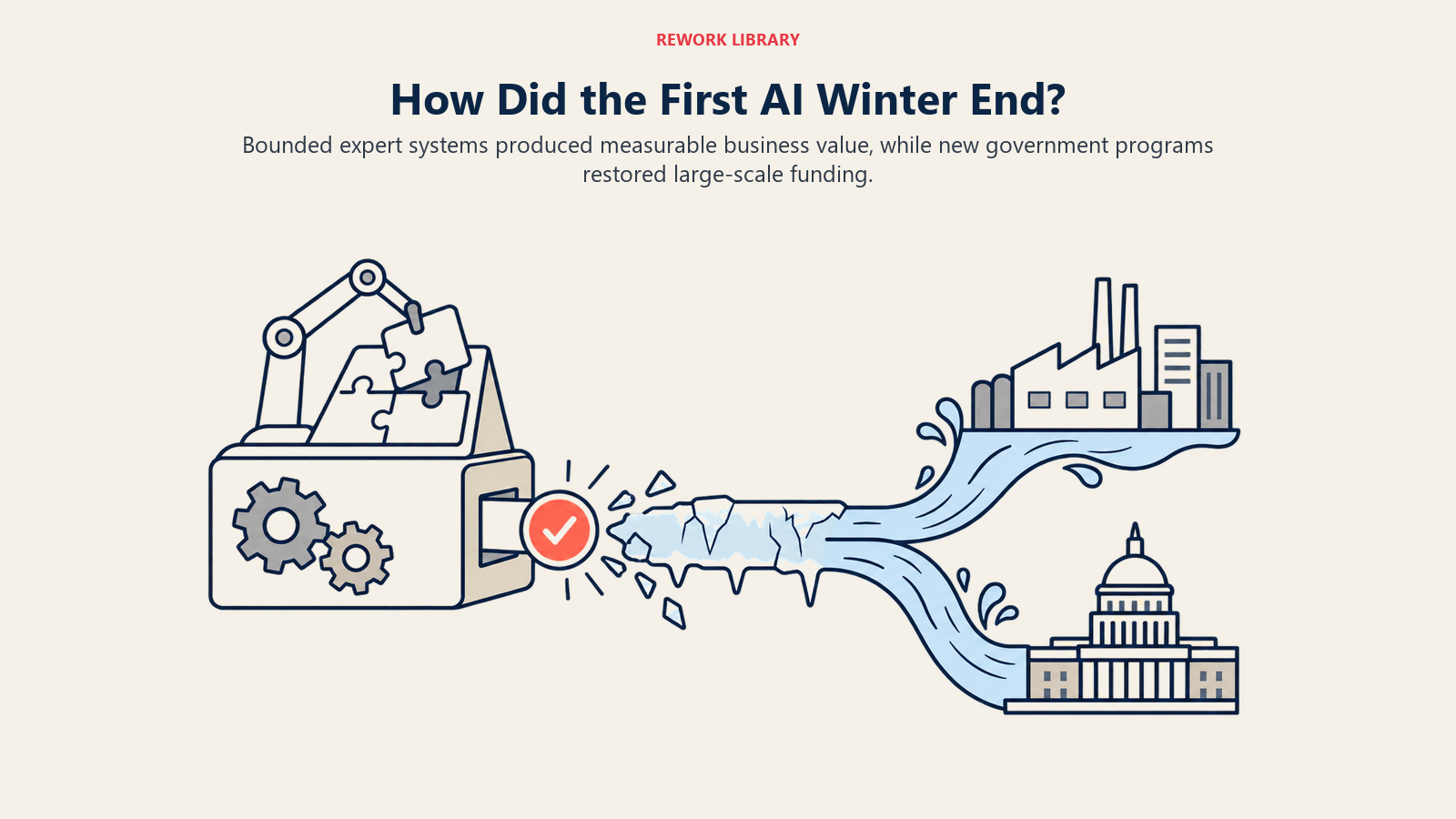
Governments followed. In March 1982, per Nilsson, the British government set up a committee chaired by John Alvey, whose report that year recommended a five-year programme with a recommended budget of £350 million. The government accepted it in 1983, and the programme's funding peaked at around £45 million in 1987. Chilton's archive notes the September 1982 review meeting on intelligent knowledge-based systems led to the IKBS part of the programme. Nilsson adds that Japan's Fifth Generation project helped prompt such responses. In the United States, DARPA resumed speech recognition funding in 1984 as part of Strategic Computing.
The money came with the same old question attached: could the new programs keep their promises?
For teams today: funding returns to the narrow, measurable version of an idea first. Build your next pitch around a task someone already pays to do.
Echoes (1987-present)
Later downturns repeat the shape, and cut ideas come back
By 1987 the new boom was already turning. The expert system and Lisp machine downturn is covered in the history of expert systems under the name The Second Winter (and in full in the second AI winter), and Nilsson says it grew from sponsors' inflated expectations combined with systems that failed to match them. The form was the same as in 1966 to 1973.
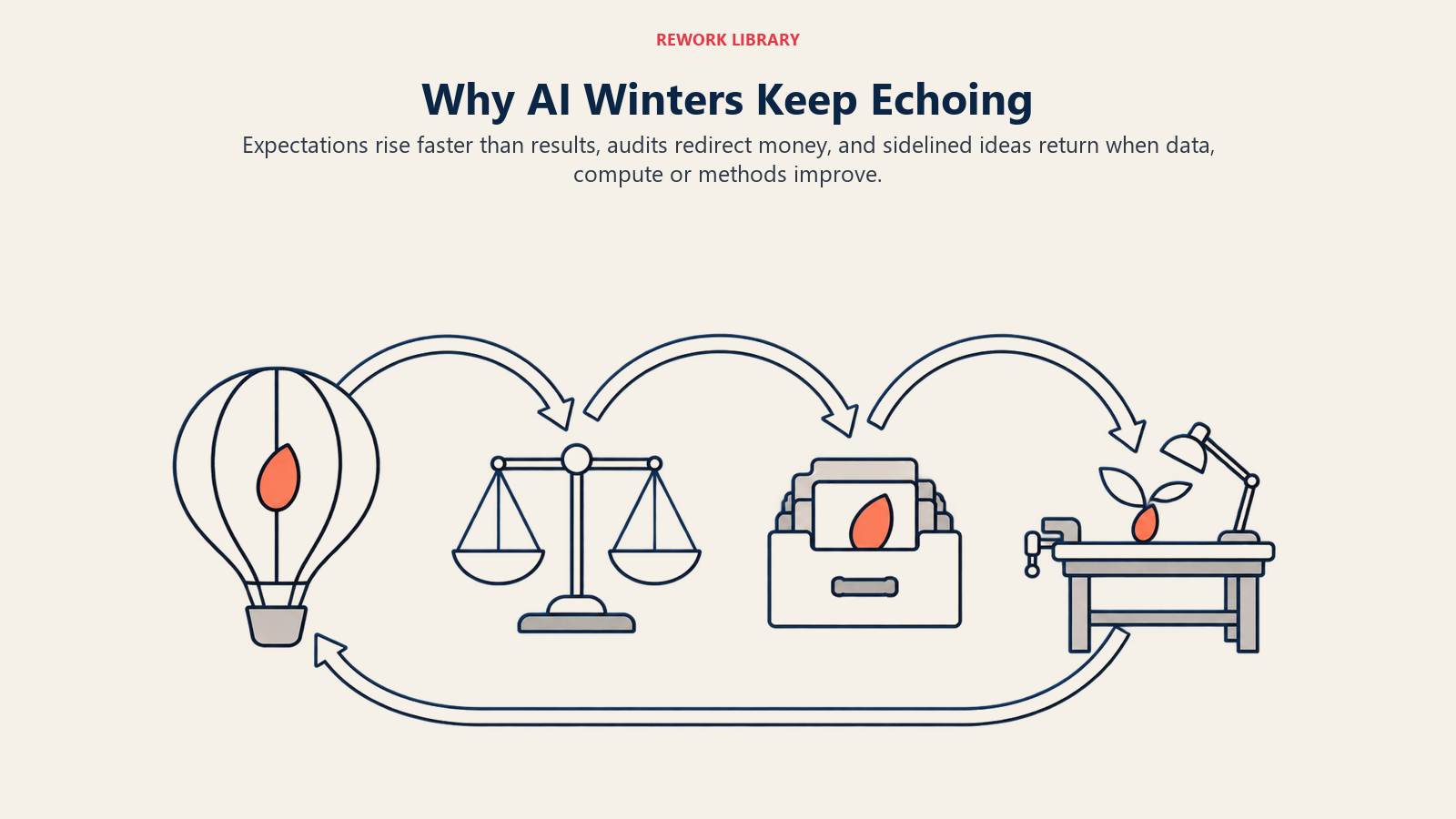
The ideas the first winter sidelined did not vanish. In the late 1970s, a group at the University of California at San Diego led by David Rumelhart and James McClelland began studying parallel distributed processing, an approach in which, Nilsson notes, some systems allowed looping connections like Rosenblatt's original general perceptrons. Learning from data, first through neural networks and then broader machine learning, became the way the field moved on. The history of machine learning and the history of deep learning follow those two threads out of the winter. And speech, which Lighthill judged harshly, returned as a product line: Nilsson traces Dragon's speech software to the work at Carnegie Mellon.
The winter taught the field to ask for measurement. It did not teach it to stop promising. That is why the reasons most AI transformations fail still look so much like 1966.
For teams today: when a technology has been written off, check whether the constraint that sank it still applies.
Key People
| Name | Role | Contribution | Year |
|---|---|---|---|
| John R. Pierce | Bell Telephone Laboratories, ALPAC chair | Led the committee that judged machine translation | 1964-1966 |
| Leland Haworth | Director, National Science Foundation | Requested the ALPAC committee on behalf of three agencies | 1963 |
| Frank Rosenblatt | Psychologist, Cornell Aeronautical Laboratory | Began the perceptron work | 1957-1958 |
| Marvin Minsky and Seymour Papert | MIT researchers | Authors of Perceptrons | 1969 |
| Larry Roberts | DARPA computer research director | Sought speech understanding; managed Mansfield-era funding | 1966-1970s |
| Allen Newell | Carnegie Mellon researcher | Chaired the speech understanding study group | 1970 |
| B. H. Flowers | Chairman, Science Research Council | Commissioned and published the Lighthill survey | 1972 |
| Sir James Lighthill | Cambridge mathematician | Wrote the survey behind the winter | 1972 |
| Donald Michie | Edinburgh AI researcher | Argued against the report in print and on BBC | 1973 |
| John McCarthy | Stanford AI researcher | Debated Lighthill on BBC | 1973 |
Key Facts
- ALPAC reported that the US government had spent some $20 million on machine translation and related subjects over the previous ten years.
- Lighthill's survey was dated July 1972, after two months spent reading the literature and talking with workers.
- Section 203 of Public Law 91-121 was approved on November 19, 1969.
- Britain's loss of confidence in AI persisted for almost a decade, until a September 1982 review.
- DARPA's speech program had a 1976 deadline and a 1,000-word target; only HARPY met the goals, and no follow-on was funded.
- The Alvey committee recommended a budget of £350 million in 1982.
The Pattern Behind the History
Across six eras, four moves repeat. We call the sequence the Promise-Audit-Pivot Pattern. It is our synthesis of the history above, not a research finding.
- The promise outruns the demo. Translation in 1954 and perceptrons in 1958 both won attention on narrow tests.
- An outsider prices the gap. ALPAC in 1966 and Lighthill in 1972 each asked what the money had bought.
- Money moves to the narrow and measurable. Section 203 and the 1,000-word speech target both demanded a stated use.
- The shelved idea waits for its constraint to move. Speech, translation and neural networks all came back later.
What It Teaches Teams Today
- Set the pass mark before the pilot. ALPAC could judge translation because cost and quality were measurable.
- Invite the audit early. Lighthill was commissioned by the funder, not by the field.
- Match goals to what exists. DARPA's study group cut Roberts's 10,000-word idea to 1,000 words.
- Keep the paused idea documented. Neural networks and speech both resumed.
- Do not confuse a budget cut with a verdict. The US kept funding applications through the 1970s.
The first winter was less a freeze than a repricing: sponsors learned to ask what a promise would cost and when it could be tested. Read the history once, then ask of any new AI project which narrow task it will prove, who will audit it and what happens if the audit says no.

Co-Founder, Rework.com