The Future of AI History: What the 2020s Changed
Turn this article into takeaways for your work.


Each assistant summarizes the article only for you and suggests best practices for your work.
In 1973, Britain's research council asked a mathematician to judge AI. He was not an AI researcher. The Royal Society says the Science Research Council commissioned Sir James Lighthill because UK AI work seemed not to deliver on its promises. Funding for basic AI research in Britain "dried up quickly" afterward.
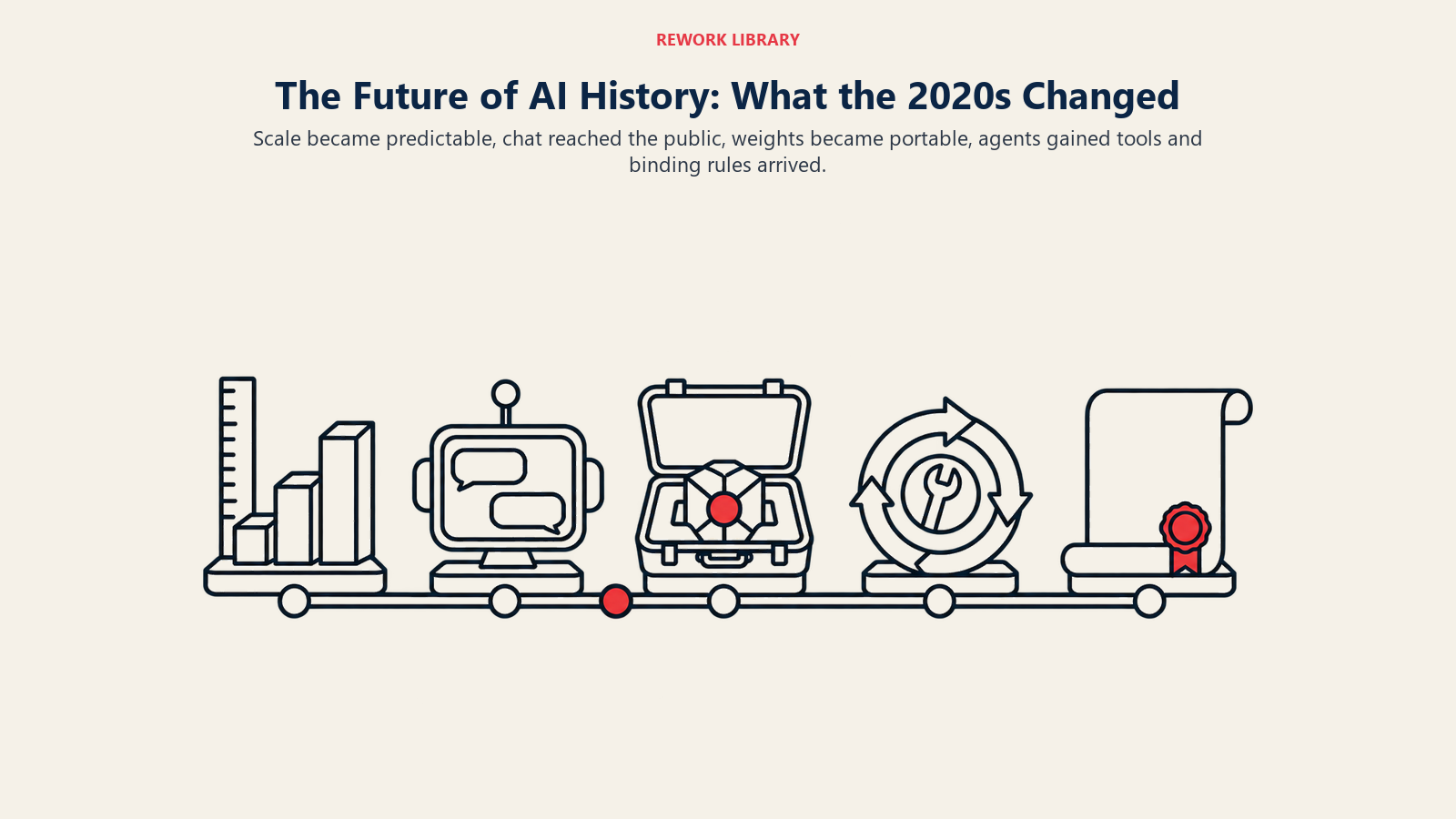
The 2020s changed AI in five ways the earlier booms never managed together. Results improved predictably with scale, a free chat interface reached the public in November 2022, and anyone could download model weights. Programs began to act through tools, and the EU's AI Act became the first binding rulebook. The shape of the story didn't change. Every earlier boom, from the 1956 founding to the 1980s expert systems, priced its promises ahead of its results. The 2020s are new in mechanism and old in pattern. A team should ask which applies to its decision.
That is the oldest question in this series: what happens when expectations outrun evidence? This closing article of the topic does not predict the answer for the 2020s. It lays the decade beside the record so you can read the signals yourself. For the whole arc, start with The History of AI and the AI timeline; for the definition of the forward-looking question, see what the future of AI means.
Timeline at a Glance
| Year | Milestone | Why It Mattered |
|---|---|---|
| 1956 | The Dartmouth summer project, covered in the Dartmouth conference | The field's founding moment, and the start of its first promises. |
| 1973 | The Lighthill report leads to a funding collapse in Britain | A precedent: an outside review punctures a boom. |
| 1992 | Japan's Fifth Generation project is abandoned after hundreds of millions of dollars | A precedent: a national AI program ends short of its stated goal. |
| March 13, 2019 | Rich Sutton publishes "The Bitter Lesson" | A researcher argues that general methods using computation win. |
| January 23, 2020 | Kaplan et al. post "Scaling Laws for Neural Language Models" | Loss followed power laws in model size, data and compute. |
| May 28, 2020 | The GPT-3 paper posts, with 175 billion parameters | Scale made few-shot prompting work. |
| August 16, 2021 | Stanford posts "On the Opportunities and Risks of Foundation Models" | The field gets a name for models adapted to many tasks. |
| March 29, 2022 | DeepMind posts the Chinchilla paper | Argued that data should scale with model size. |
| November 30, 2022 | ChatGPT launches as a free preview | Generative AI became a product anyone could type to. |
| February 27, 2023 | Meta researchers post LLaMA | Strong models released to the research community. |
| March 15, 2023 | The GPT-4 technical report posts | A multimodal model taking image and text inputs. |
| August 1, 2024 | The EU AI Act enters into force | The first broad binding AI law in a major market. |
| December 20, 2024 | A US Department of Energy report on data center electricity is released | Compute became an energy question. |
The Boom-and-Bust Inheritance (1956-1995)
Three decades of promises, reviews and funding cuts
Start with the room where the field got its name. In the summer of 1956 a small group gathered at Dartmouth to work on machine intelligence, and the story of that meeting is in the Dartmouth conference article. What followed was a pattern, not a straight line. The first reckoning arrived in the 1960s and 1970s, told in the first AI winter. The second followed the expert systems boom of the 1980s, told in the second AI winter. The general explanation of both is in what the AI winter was.
Two episodes are worth carrying into the 2020s because they show how a boom ends. In Britain, the Lighthill review came after the Science Research Council decided AI was not delivering. The Royal Society's account says Lighthill doubted that AI was a valid integrated field, saw it as useful for supporting work in psychology, neurology and automation, and, as historians have noted, may have received a strong steer on what to conclude. The SRC invited AI scientists to respond, including Donald Michie, who defended Edinburgh's work and asked for more hardware money. Funding for basic AI research in Britain dried up quickly.
In Japan, the Fifth Generation Computer Systems project aimed at machines that could reason, not just calculate. In June 1992 the evaluator Wolfgang Bibel of Technical University Darmstadt called the project "an outstanding success" for showing that logic could be a single framework for designing machines and software. The same year, the Computer History Museum's timeline records that MITI gave up the project after spending hundreds of millions of dollars, and notes that its announcement had prompted American companies to form a research consortium. Both statements are true, and that is the lesson: a program can pass its technical review and still miss the goal it was sold on. The longer treatment of that period is in the history of expert systems and the history of symbolic AI.
This era solved the problem of getting AI funded at all. It created a credibility problem that lasted: sponsors learned to discount the field's forecasts. Keep precursor and concept apart, though. These booms were driven largely by government programs and corporate budgets built around hand-written rules, which is not how the 2020s were built.
For teams today: the first question for any AI proposal is the one these reviews asked. What does it do on your task, measured by you, and who keeps it correct?
The Scaling Bet (2019-2021)
Researchers find that more compute keeps working
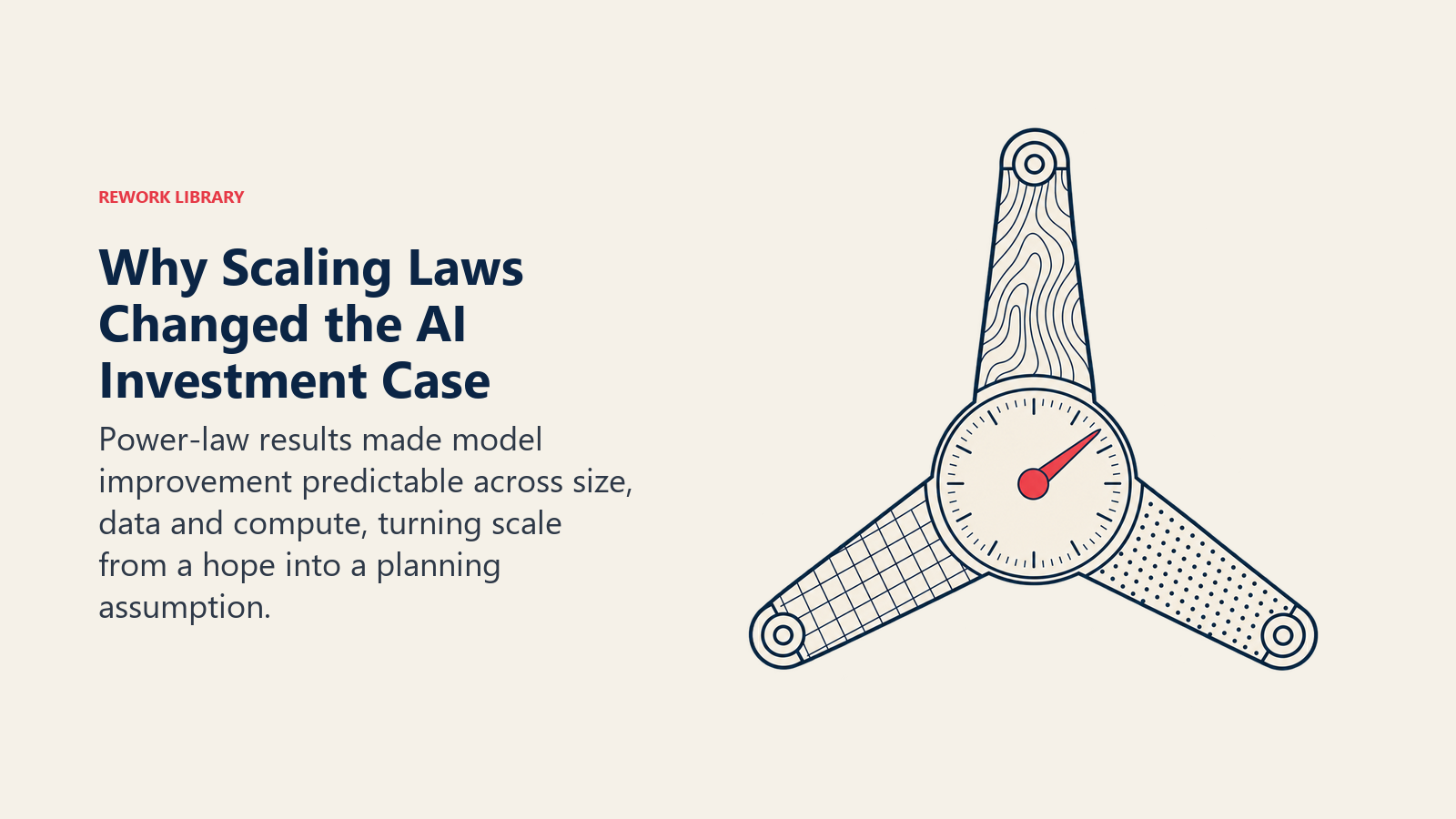
The shift began with a claim about method. On March 13, 2019, Rich Sutton wrote that general methods that leverage computation are ultimately the most effective, and he tied that to the long fall in the cost of computation. It was an essay, not an experiment. The experiment came ten months later. On January 23, 2020, a team at OpenAI posted "Scaling Laws for Neural Language Models". Its abstract reports that loss follows power-law relationships with model size, dataset size and training compute, with some trends holding across more than seven orders of magnitude, and that architectural details such as width or depth have minimal effect within a wide range. The result mattered because it turned a hope into a planning tool: spend more, and the loss falls by a predictable amount.
Four months later the same lab posted the GPT-3 paper. Language Models are Few-Shot Learners, posted May 28, 2020, described a model with 175 billion parameters, ten times more than any previous non-sparse language model, evaluated on tasks specified only through text, without gradient updates or fine-tuning. The authors report that scaling up substantially improves few-shot performance, and they note it still struggles on some datasets. The architecture behind it is in the history of transformer models, and the longer path is in the history of large language models and the history of deep learning.
In August 2021 a Stanford group of 114 authors, led by Rishi Bommasani at the Center for Research on Foundation Models, posted a paper that named the pattern: foundation models, trained on broad data and adaptable to many tasks. The abstract points to emergent capabilities from scale, and warns that a foundation model's defects carry over to everything adapted from it. The concept is explained in foundation models.
This era solved the problem that haunted the winters: no one had known whether progress would continue. It created a dependence on very large budgets, since the method that worked was the one that cost the most.
For teams today: a result that improves with spending is a different kind of claim from a hand-built demo. Ask which kind you are being sold.
The ChatGPT Moment (2022-2023)
A free chat box puts the technology in public hands
On March 29, 2022, DeepMind researchers posted "Training Compute-Optimal Large Language Models", arguing that current large models were substantially undertrained and that model size and training tokens should be scaled equally. Their test model, Chinchilla, had 70 billion parameters and four times more data than the 280-billion-parameter Gopher on the same compute budget, and it outperformed Gopher and several larger models on many tasks. The recipe changed, but the direction held.
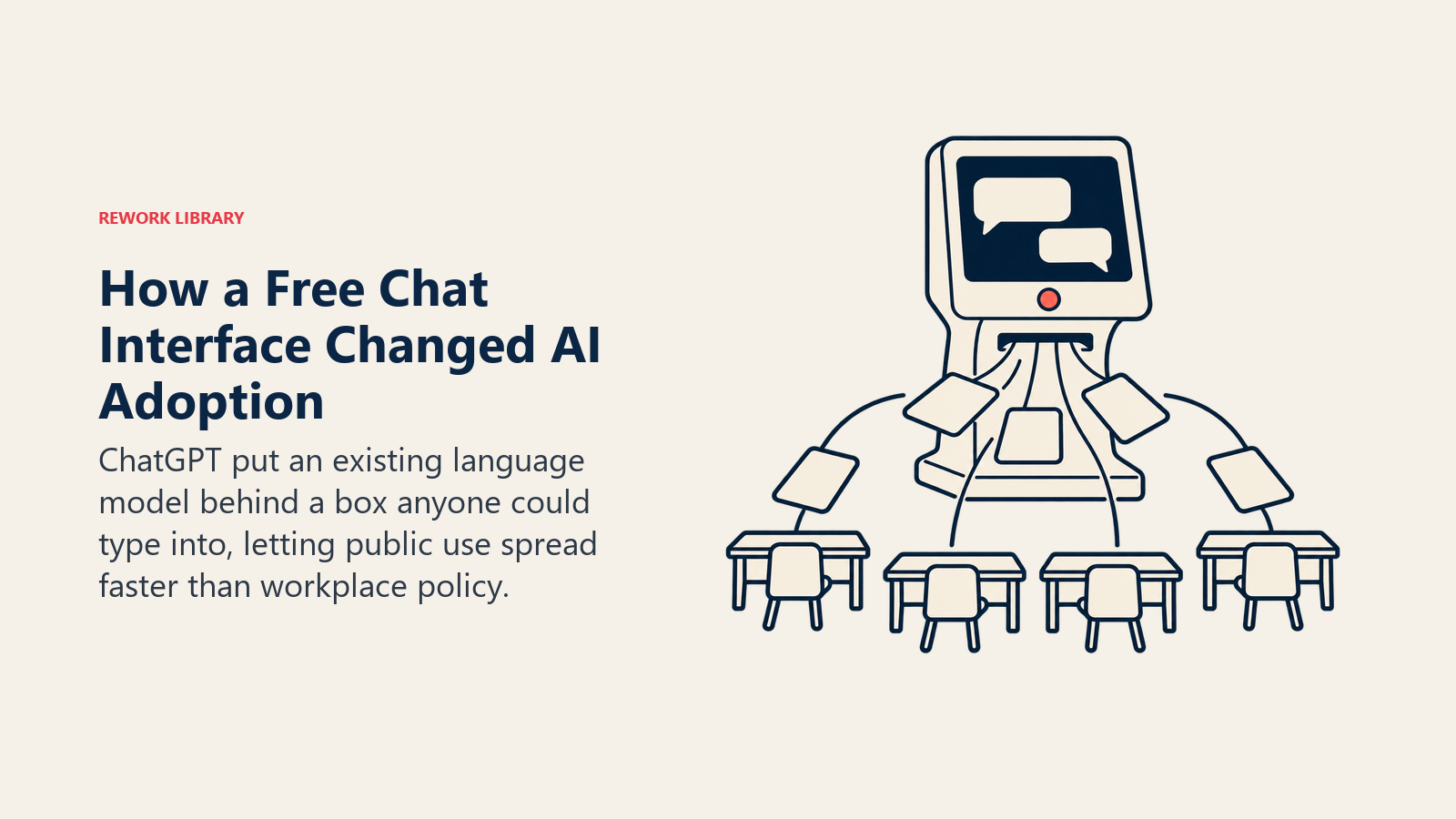
The public learned about it eight months later. ChatGPT launched on November 30, 2022 as a free preview built on GPT-3.5. The same page attributes to Sam Altman the statement that it reached one million users within five days. That is the company chief's figure, not an independent count. What mattered was the interface: the research was already public, and the new thing was that anyone could type to it. The route from lab to desk is traced in how AI moved from research labs to work and in the history of generative AI.
On March 15, 2023, the GPT-4 technical report described a large multimodal model that takes image and text inputs and produces text outputs, and reported that it scored in roughly the top 10% of test takers on a simulated bar exam. Multimodal models, meaning systems that handle more than one kind of input, are covered in multimodal AI.
A later measure of how fast adoption moved comes from Stanford's yearly survey. Its 2026 AI Index report states that generative AI reached 53% population adoption within three years, with a spread by country: 61% in Singapore, 64% in the UAE and 28.3% in the United States, which ranked 24th. That is the report's own population estimate.
This era solved reach. It created the problems of accuracy, trust and workplace policy that most teams now manage. The concept most readers meet first is covered in large language models.
For teams today: the arrival of a tool is not the arrival of a process. Adoption by individuals can run years ahead of the rules your company has written.
The Open-Weights Turn (2023-present)
Strong models leave the lab as files
An open-weight model is one whose trained parameters are published so others can run and adapt it. On February 27, 2023, Meta researchers posted "LLaMA: Open and Efficient Foundation Language Models", a set of models from 7 billion to 65 billion parameters. The abstract says the authors trained on publicly available datasets exclusively, reports that LLaMA-13B beat the 175-billion-parameter GPT-3 on most benchmarks, and says the models were released to the research community. In the generative image field the same pattern had appeared months before, as the history of generative AI records for Stable Diffusion.
The effect, three years on, shows in the Stanford report. It states that industry produced over 90% of notable frontier models in 2025, and that the U.S.-China model performance gap has effectively closed, with the two countries trading the lead multiple times since early 2025 and the top model, as of March 2026, leading by 2.7%. It adds that open-source contributions from the rest of the world are outpacing Europe on GitHub and approaching the United States. These figures measure who builds frontier models, not which licence they use.
Notice what is different from the 1980s. A rule-based expert system was a product that clients could copy. Open weights make the model itself a commodity input, which moves the competition to data, evaluation and workflow. Whether that favors the many builders or a few large ones is still contested.
For teams today: you can choose among models. Keep your prompts, test sets and data portable so a vendor change is an edit, not a rebuild.
The Build-Out (2022-present)
Agents act through tools, and compute becomes an energy question
Two developments run side by side here, and both overlap with the eras above.
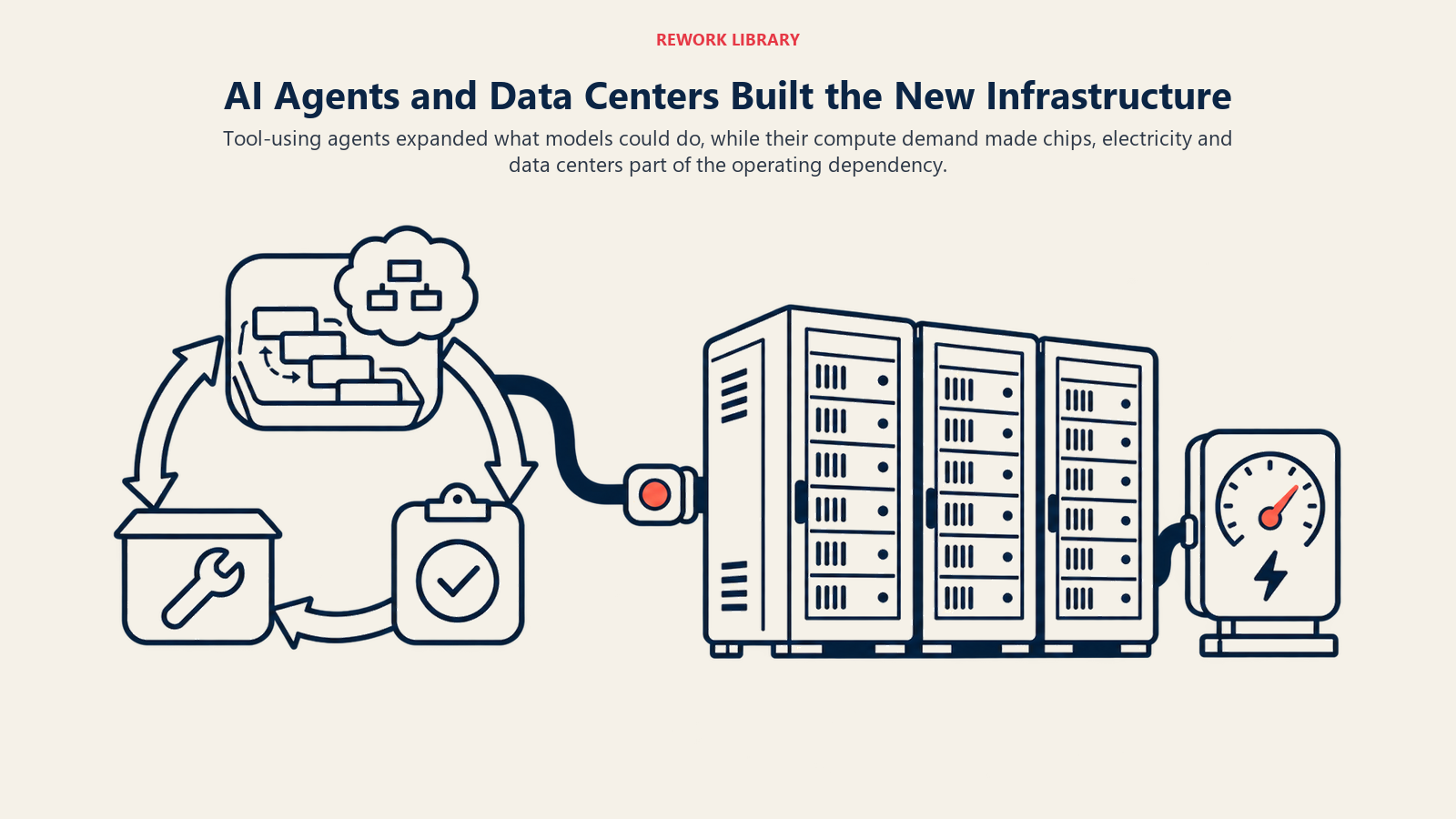
The first is agents. On October 6, 2022, researchers posted "ReAct: Synergizing Reasoning and Acting in Language Models". Its abstract describes models generating both reasoning traces and task-specific actions in an interleaved manner, with reasoning helping the model plan and revise, and actions letting it gather information from external sources. That is the pattern behind AI agents, and the field's own history is told in the history of AI agents and the history of AI copilots. The 2026 AI Index reports that agents made a leap from 12% to about 66% task success on OSWorld, a test of real computer tasks across operating systems, though they still fail roughly one in three attempts on structured benchmarks, and a figure caption puts the human baseline at 72.35%. The same report uses the phrase "jagged frontier" for a pattern in which a model wins a gold medal at the International Mathematical Olympiad but reads analog clocks correctly just 50.1% of the time. This is brittleness in a new form, the same word historians used for expert systems that broke outside their domain. How teams limit what an agent may do is covered in AI agent guardrails.
The second is infrastructure. The Stanford report states that the United States hosts 5,427 data centers, more than 10 times any other country, and that a single company, TSMC, fabricates almost every leading AI chip, which makes the global AI hardware supply chain dependent on one foundry in Taiwan. The electricity side was measured in a report from Lawrence Berkeley National Laboratory, which the Department of Energy released on December 20, 2024. According to the DOE summary, US data centers used 4.4% of the country's electricity in 2023, with use rising from 58 TWh in 2014 to 176 TWh in 2023. The same report projects a share of 6.7% to 12% by 2028, an increase of 325 to 580 TWh. That is a projection from one laboratory with a wide range, and not a forecast to plan around as fact.
The comparison with earlier eras is instructive but not clean. The 1980s bet was on specialized hardware: Lisp machines that lost out to cheaper workstations. The 2020s bet is on general chips and larger buildings, and no one yet knows whether the economics will hold. Treat that as an open question.
For teams today: pilot an agent on your hardest cases, count the upkeep, and ask your vendor what their cost depends on. Energy and chip supply are now part of the dependency list.
The Rulebook Years (2024-present)
The first broad AI law arrives with a calendar
Earlier booms ran with almost no law written for them. The 2020s are the first with a calendar. The European Commission's page on the AI Act states that Regulation (EU) 2024/1689 entered into force on 1 August 2024, and sets out when its parts apply. Entry into force and application are different facts, so the dates below are labeled.
| Date | What applies | Status per the Commission page |
|---|---|---|
| 1 August 2024 | The Act enters into force | Fact |
| 2 February 2025 | Prohibited AI practices and AI literacy obligations | Applies |
| 2 August 2025 | Governance rules and obligations for general-purpose AI models | Applies |
| 2 August 2026 | General application, with exceptions; transparency rules take effect in August 2026 | Applies |
| 2 December 2027 | High-risk use cases in sensitive areas such as biometrics, education and employment (Annex III) | Extended to this date |
| 2 August 2028 | High-risk systems embedded in regulated products (Annex I) | Extended to this date |
The extensions come from the "AI Omnibus," part of the EU's simplification package. The page says it was adopted on 19 November 2025, reached political agreement on 7 May 2026 and entered into force on 27 July 2026. The point for history is the shape: a law written during a boom, then adjusted as implementation proved harder than the calendar assumed.
This era solved a gap that every earlier boom had left open, the absence of any agreed rule for who is accountable. It created a compliance workload, and that workload varies by where a company sells and what its systems do. Rules in other countries differ and are changing, so check the source for each market you operate in.
For teams today: put the regulatory dates on the same calendar as your project dates, and name one owner for tracking them.
Key People
| Name | Role | Contribution | Year |
|---|---|---|---|
| Sir James Lighthill | Cambridge mathematician | Reviewed UK AI research for the Science Research Council | 1972-1973 |
| Donald Michie | Edinburgh AI researcher | Defended UK AI work against the Lighthill review | 1973 |
| Wolfgang Bibel | Technical University Darmstadt | Evaluated the Fifth Generation project | 1992 |
| Rich Sutton | Reinforcement learning researcher | Wrote "The Bitter Lesson" | 2019 |
| Jared Kaplan, Sam McCandlish and co-authors | OpenAI researchers | Scaling laws for language models | 2020 |
| Tom B. Brown and co-authors | OpenAI researchers | The GPT-3 paper | 2020 |
| Rishi Bommasani and co-authors | Stanford CRFM | Named and analyzed foundation models | 2021 |
| Jordan Hoffmann and co-authors | DeepMind researchers | Compute-optimal training, Chinchilla | 2022 |
| Sam Altman | OpenAI chief executive | Reported ChatGPT's first-week user count | 2022 |
Key Facts
- The Fifth Generation project was abandoned in 1992 after hundreds of millions of dollars in spending.
- The scaling-laws paper reports power-law trends across more than seven orders of magnitude.
- GPT-3 has 175 billion parameters, ten times more than any previous non-sparse language model.
- ChatGPT launched on November 30, 2022; the one million users in five days figure is Sam Altman's.
- The EU AI Act entered into force on 1 August 2024; its high-risk dates now run to December 2027 and August 2028.
- US data centers used 4.4% of the country's electricity in 2023, and a DOE-released report projects 6.7% to 12% by 2028.
The Pattern Behind the History
Read across the whole record, the repeats and the new elements separate cleanly. We call this the Repeat-and-New Ledger. It is our synthesis of the history above, not a research finding.
What repeats:
- Promises run ahead of results. From the Lighthill review to the Fifth Generation verdict, sponsors discounted forecasts after the fact.
- A review or a cost surprise ends a boom. An outside assessment in Britain, a budget decision elsewhere.
- Narrow success is sold as general. Expert systems worked in their domains; the 2026 AI Index's "jagged frontier" describes the same unevenness.
- The label moves, the tools stay. Rules became business software after the second winter.
What is new:
- Performance that scales predictably. The scaling-law result gave planners a curve, which earlier eras never had.
- A mass-market interface. A free chat box reached more people than any earlier AI product.
- A global commodity. Open weights and multiple strong builders mean no single lab owns the capability.
- A physical footprint. Chips and electricity are now part of the story, and a single foundry fabricates almost every leading chip.
- A statute. The AI Act is the first broad binding law with a published calendar.
What It Teaches Teams Today
- Ask the 1973 and 1992 questions. What does the system do on your task, and who keeps it correct?
- Treat forecasts as attributed claims. The data center projection is one laboratory's range, and the adoption figure is one report's estimate.
- Plan for model change. Frontier leadership has changed hands, so portability protects you.
- Count the full cost. Compute, energy and upkeep were the hidden bills of earlier eras too.
- Track the rulebook. Dates have already moved once; read the source for each market.
- Leave the open questions open. Whether scaling continues, whether the economics hold and whether adoption turns into measured results are not settled by this record.
The record gives a way to read the 2020s without predicting them. Check what is repeating, check what is new, and write down what would change your mind. For where this fits, return to The History of AI and the history of machine learning.

Co-Founder, Rework.com