The History of AI Agents
Turn this article into takeaways for your work.


Each assistant summarizes the article only for you and suggests best practices for your work.
In 1970, Life magazine looked at a wheeled research robot in Menlo Park, California. It called the machine the "first electronic person". Its builders had given it a program that had to work out its own steps.
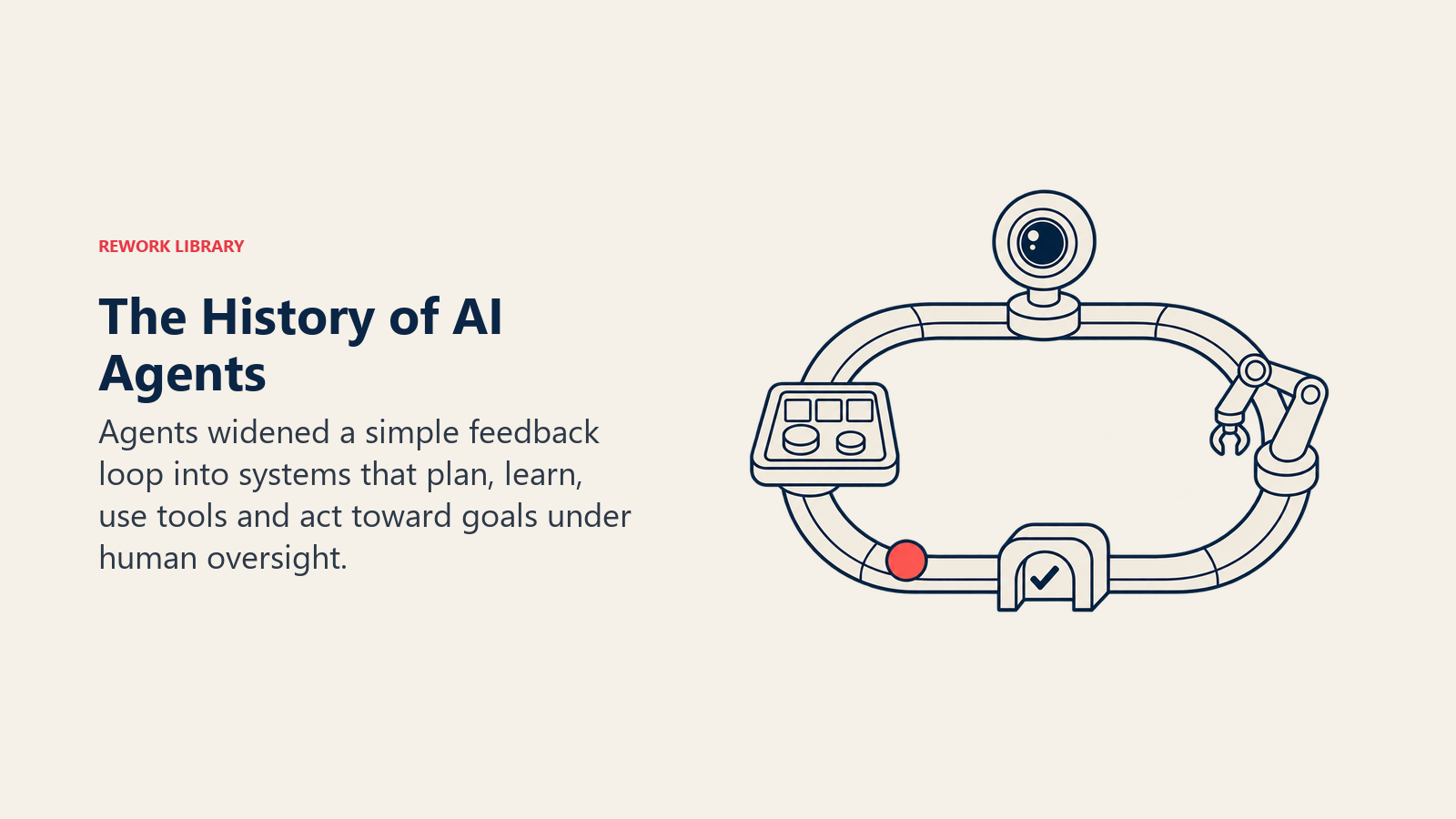
An AI agent is a system that perceives its situation, decides and acts toward a goal. The field only adopted the word as its organizing idea in the early 1990s. The ancestors are far older: feedback machines in 1943, the robot tortoises of 1949, the planning robot Shakey in the late 1960s. The throughline: every era got a little more of the loop (sense, decide, act, adjust) running without a person in it. Every era's limit was what the machine could understand about the world it acted in. For the wider field, see The History of AI.
Decades later, software systems read a goal, call tools, check the results and try again, inside business systems rather than a lab. This article follows the line between those scenes, and says plainly at each step what was a precursor and what was the concept itself. For the definition, see what an AI agent is.
Timeline at a Glance
| Year | Milestone | Why It Mattered |
|---|---|---|
| 3rd century BCE | Ctesibius develops a float-regulated water clock | An early, documented machine that corrects itself by feedback. |
| 1206 | Al-Jazari writes his book of mechanical devices | Automata that perform scripted actions, such as a hand-washing peacock. |
| 1943 | Rosenblueth, Wiener and Bigelow publish "Behavior, Purpose and Teleology" | Put goal-directed behavior of machines and animals on one footing. |
| 1948 | Wiener publishes Cybernetics (cited here) | Gave the field of control and communication a name and a book. |
| 1949 | Grey Walter shows Elmer and Elsie to the press | Small robots that seek light and avoid obstacles with a two-tube "brain". |
| 1966-1972 | SRI builds Shakey | A mobile robot that planned its own actions. |
| 1970-1971 | Fikes and Nilsson describe STRIPS | A planner whose action format still shapes planning languages. |
| 1980 | Smith publishes the Contract Net Protocol | Separate program nodes divide work by negotiation. |
| 1991 | Rao and Georgeff formalize BDI agents | Beliefs, desires and intentions became a standard agent model. |
| 1991 | Brooks publishes "Intelligence without Representation" | Argued for simple reactive "Creatures" tied to the world. |
| 1995 | Wooldridge and Jennings survey intelligent agents | Fixed a working definition of agent for the field. |
| 2013 | Mnih and colleagues post "Playing Atari with Deep Reinforcement Learning" | A learning agent that plays from raw pixels. |
| 2015-2016 | AlphaGo beats Fan Hui, then Lee Sedol | Learning agents beat top human players at Go. |
| 2022 | ReAct is posted on arXiv | Language models interleaved reasoning with actions. |
| 2023 | Toolformer, Generative Agents and AutoGPT | Tool use, simulated agents and a viral autonomous loop. |
| 2024 | Anthropic publishes "Building effective agents" | Drew a line between fixed workflows and agents. |
The Feedback Idea (3rd century BCE-1950s)
Machines that correct themselves, long before anyone says agent
The oldest relevant machines are not agents, but they share one trick: they watch their own output and adjust. A 2021 review of water-clock history places the principle of feedback control with Ctesibius, in Ptolemaic Egypt in the 3rd century BCE, where a float governed the flow of water that drove a clock. Later, the engineer al-Jazari compiled his book of mechanical devices in 1206. A 1315 Syrian copy shows a peacock-shaped basin that pours water and releases a small figure offering soap, though the museum notes it's not certain the device was ever built. These are precursors in the plainest sense: they act on a schedule or on a float, with no goal beyond the mechanism.
The leap to a theory came during the Second World War. In 1943, Arturo Rosenblueth, Norbert Wiener and Julian Bigelow published "Behavior, Purpose and Teleology" in Philosophy of Science. A German-language history of cybernetics describes it as the first public statement of what living things and machines share in behavior, with goal-directed behavior controlled by feedback labelled "teleological". Wiener's book Cybernetics followed in 1948, published by Wiley in New York, as Owen Holland's history of the tortoises cites it.
Then someone built it. W. Grey Walter, at the Burden Neurological Institute in Bristol, England, made small three-wheeled robots he named Machina speculatrix. By December 1949 he was demonstrating the first two, Elmer and Elsie, to the press, and he described them in a May 1950 Scientific American article titled "An Imitation of Life". Sources differ on exactly when work began: one account says spring 1948, Holland's history notes that Walter's son recalled no robots being mentioned that spring. IEEE Spectrum's account says a rotating photocell steered a tortoise toward light, a touch sensor made it reverse and turn after hitting an obstacle, and a low battery sent it back to its hutch to recharge. The "brain" was two vacuum tubes. Walter's own point was that simple parts interacting freely could produce complex behavior.
This era solved the question of whether a machine could pursue something on its own. It left a harder problem: these machines reacted to light and bumps, and nobody knew how to give a machine a goal it could reason about.
For teams today: a closed loop beats a one-shot script. If a process only runs forward and never checks its own result, it's closer to a clockwork automaton than an agent.
Shakey's Lab (1966-1972)
A robot gets a plan, a map and a language
In 1966 the Artificial Intelligence Center at SRI, in Menlo Park, started the research that would run through 1972. SRI's own history page calls Shakey the first mobile robot able to perceive and reason about its surroundings, able to plan, find routes and rearrange simple objects. The IEEE, in the 2017 dedication of a Milestone plaque, credited it as the first physical system to combine logical reasoning, plan creation and execution, learning, vision, navigation and English-language communication. Life magazine in 1970 called it the "first electronic person", a headline that tells you more about the press than about the robot.
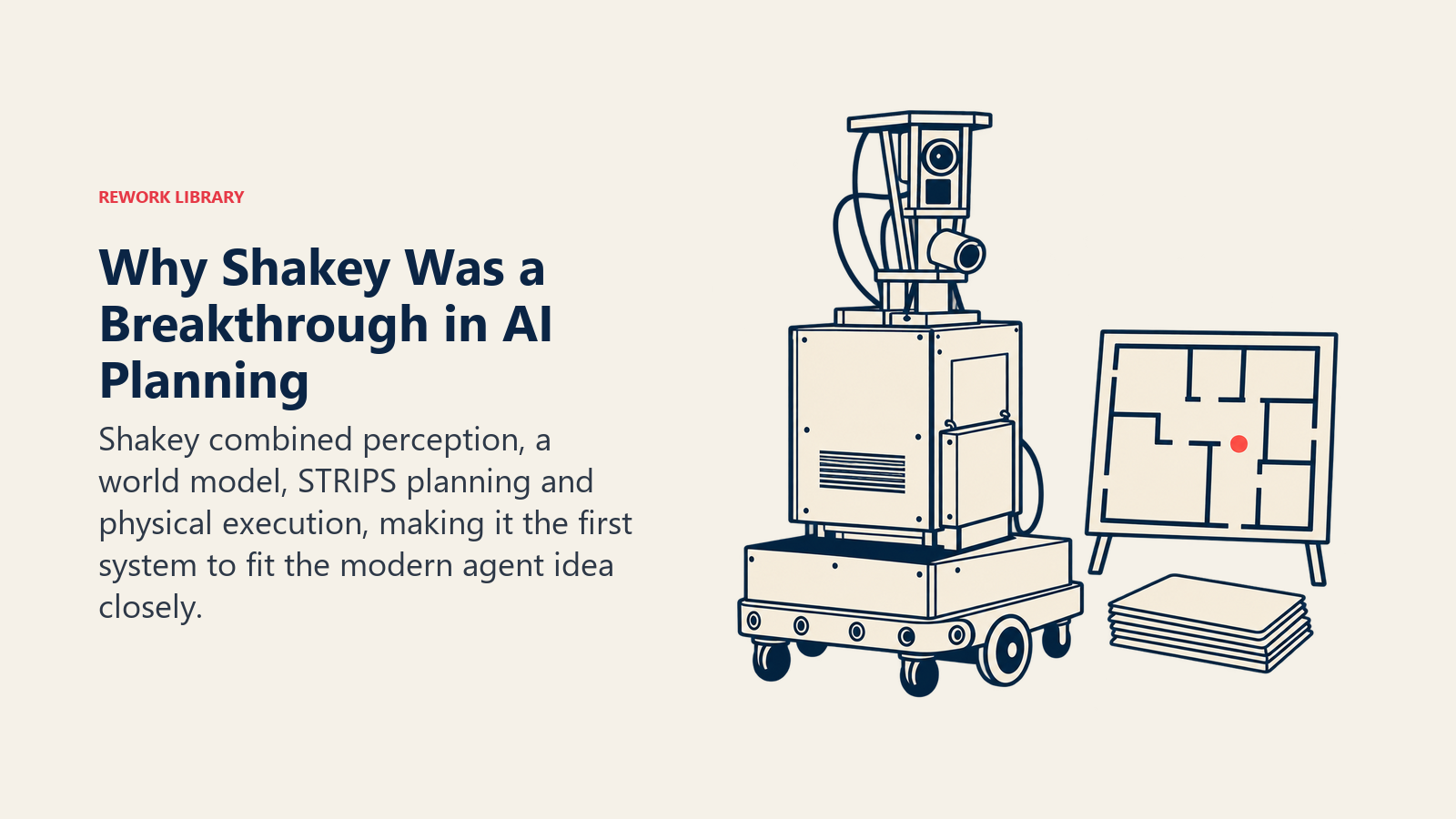
The lasting contribution was software. In October 1970, Richard Fikes and Nils Nilsson published SRI Technical Note 43, STRIPS: a problem solver sponsored by ARPA and NASA, developed alongside the robot work. The paper was presented at IJCAI in 1971. The paper describes how STRIPS searches a space of world models for a sequence of operators that turns an initial model into one where the goal can be proven, using a theorem prover and means-ends analysis. In plain terms, you describe what the world looks like, what each action requires and changes, and the program finds the sequence. Nilsson later edited the project's full account as Shakey the Robot, SRI Technical Note 323, April 1984.
This is the first system that fits the modern idea closely: a goal, a model of the world, a planner and an executor. It also shows the limit of the symbolic approach described in the history of symbolic AI. A plan is only as good as the world model, and real rooms don't stay put. The same brittleness helped drive the disappointment recounted in the first AI winter.
For teams today: planning is the easy part to automate and the world model is the hard part. When you design a workflow for an agent, spend your time on what it's allowed to see and what each action actually changes.
The Agent Turn (1980-2000s)
Software nodes negotiate, believe and intend, and the word gets a definition
By 1980 the question had moved from one robot to many programs working together. In the December 1980 issue of IEEE Transactions on Computers, Reid G. Smith described the Contract Net Protocol, in which tasks are distributed through negotiation between nodes that have work and nodes that may be able to do it. His manuscript was received in March 1980. It's multi-agent thinking before the vocabulary arrived: no single node had enough information to solve the whole problem, so they had to cooperate.
The 1980s expert-system wave, covered in the history of expert systems, supplied rules but not initiative. The next move was philosophical. Michael Bratman's 1987 theory treated intentions as partial plans of action that an agent commits to, distinct from beliefs and desires. In February 1991 Anand Rao and Michael Georgeff, at the Australian Artificial Intelligence Institute, issued a technical note that formalized this as a branching-time model in which intentions have equal status with beliefs and desires. It appeared in the proceedings of KR91. The result is the belief-desire-intention (BDI) agent, a design that still shows up in agent frameworks.
A rival camp argued against building agents around internal models at all. Rodney Brooks's paper opens by saying that "Artificial intelligence research has foundered on the issue of representation". He had written it at the MIT AI Laboratory in 1987, and it was published in Artificial Intelligence in 1991. His alternative was building complete mobile robots, which he called Creatures, from parallel layers that connect directly to the world through perception and action. It echoes Grey Walter's tortoises, forty years on.
Then the field named itself. In 1995, Michael Wooldridge and Nicholas Jennings published a survey in The Knowledge Engineering Review. It offered a weak notion of agency: an agent is a hardware or software system with four properties, autonomy (operating without direct human intervention), social ability (interacting with other agents), reactivity (responding to changes in its environment) and pro-activeness (taking the initiative toward goals). The same year, Stuart Russell and Peter Norvig published Artificial Intelligence: A Modern Approach, whose preface states that "The unifying theme of the book is the concept of an intelligent agent." That's the point where the concept itself, not just its precursors, becomes the field's standard framing.
This era solved the vocabulary and gave agents a cooperative, goal-driven shape. It left them hand-built: every belief, rule and plan came from an engineer. The learning side of the story, in the history of machine learning, had yet to meet it.
For teams today: the four properties are still a decent checklist. Ask of any "agent" product whether it acts without a person nudging each step, reacts to what changes, pursues a goal and coordinates with other systems.
The Reward Years (2010s-2021)
Agents stop being programmed and start learning from outcomes
The 2010s agents were learners. On December 19, 2013, Volodymyr Mnih and six co-authors posted Playing Atari with Deep Reinforcement Learning. A convolutional network took raw pixels and outputs a value estimate of future rewards. With the same architecture and algorithm applied to seven Atari 2600 games, it outperformed all previous approaches on six and, the authors report, surpassed a human expert on three. Nobody had told it the rules. It had only a score to chase. This grew from the neural methods in the history of deep learning and the history of neural networks.
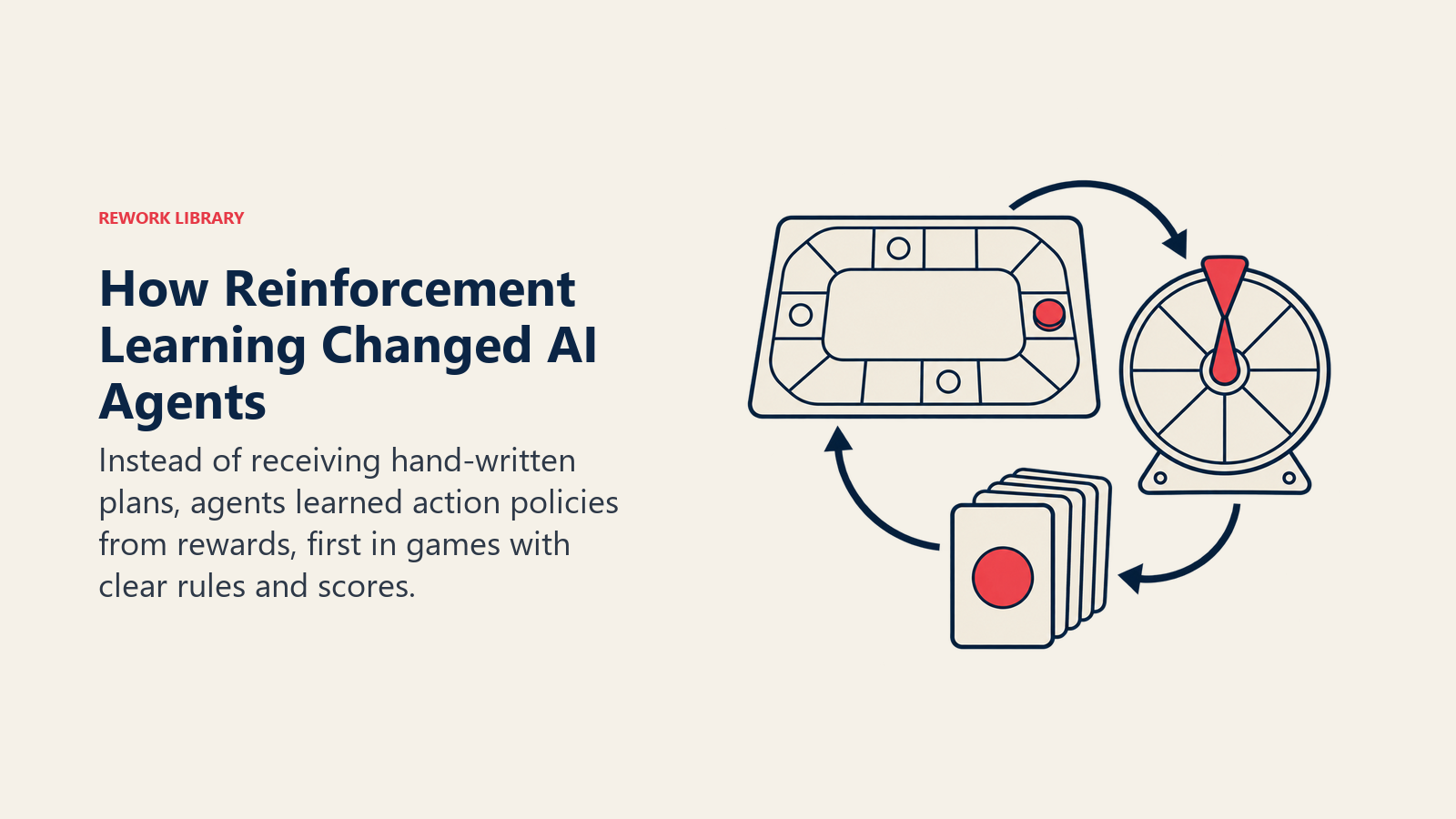
Games became the public test. DeepMind's AlphaGo won 5-0 against European champion Fan Hui in October 2015, described as the first match between an AI system and a Go professional. In March 2016 it beat Lee Sedol 4-1 in Seoul, in a match that over 200 million people watched. These agents were built for one closed world with a clear score.
That last gap defines the era's limit. A reward is easy to define in Go and hard to define for "handle this customer well".
For teams today: an agent optimizes the score you give it. If your measure is wrong, a very capable agent will pursue the wrong thing very capably, so define success before you automate.
The Tool-Using Models (2022-2023)
Language models learn to reason, call tools and loop
The large language models in the history of large language models could talk about anything but touch nothing. In October 2022, Shunyu Yao and colleagues posted ReAct, a method where a model generates both reasoning traces and task-specific actions in an interleaved way, such as looking something up before answering. That lookup step has its own lineage, told in the history of retrieval-augmented generation. On February 9, 2023, Timo Schick and colleagues posted Toolformer, showing that language models can teach themselves to use external tools through simple APIs. The models behind this are the ones in the history of transformer models.
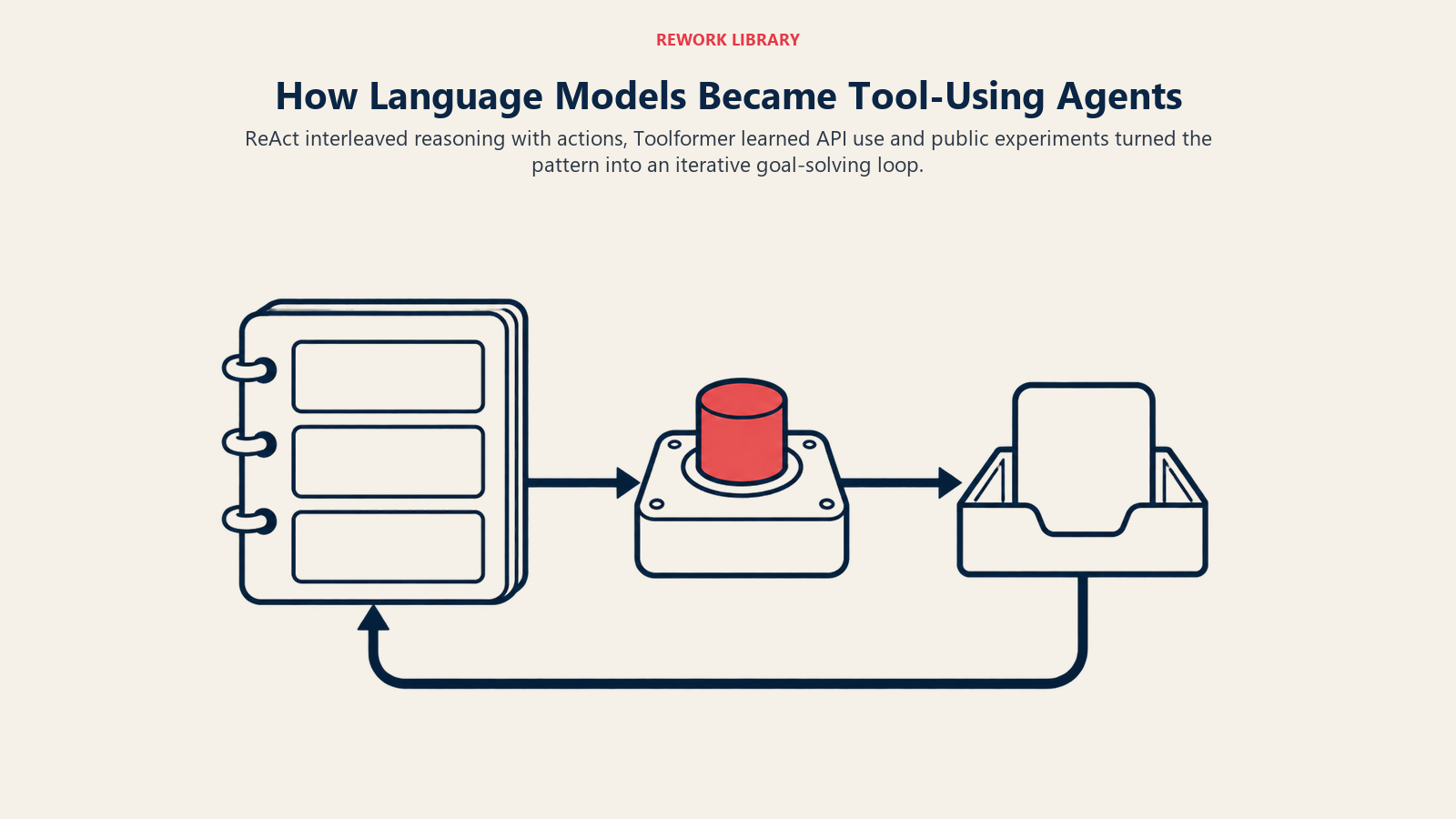
Then came the public experiments. On April 7, 2023, Joon Sung Park and co-authors posted Generative Agents, in which 25 language-model agents lived in a sandbox town inspired by The Sims. Around the same time, AutoGPT, released on March 30, 2023 by Toran Bruce Richards of Significant Gravitas according to IBM, popularized a loop in which a model breaks a goal into subtasks, writes its own prompts and refines its approach from the results. These were demonstrations of the pattern, and a long way from a managed business process.
This is the moment the older concept and the newer technology meet. The BDI era's goals and the planner era's actions are back, but the world model is now a language model and the plan is written in prose. The risks, covered in the history of generative AI, come along: a fluent plan can still be wrong.
For teams today: a demo that works once is not a process. Run any agent on a fixed set of your own tasks before trusting it, and look at the failure cases first.
The Age of Agents (2024-present)
Standards, computer use and a line between workflows and agents
By late 2024 the work shifted from "can it?" to "how do we run it?". On October 22, 2024, Anthropic released computer use in public beta, letting a model operate a computer by looking at a screen, moving a cursor, clicking and typing. On November 25, 2024 it announced the Model Context Protocol, an open standard for connecting AI assistants to the content repositories, business tools and development environments where data lives. Both are one vendor's announcements of its own products.
The most useful contribution may have been a definition. In "Building effective agents", published December 19, 2024, Anthropic separates workflows, systems where models and tools are orchestrated through predefined code paths, from agents, systems where models dynamically direct their own processes and tool usage. That echoes the weak notion of agency from 1995: the question is who holds the initiative, the code or the model. For the business-facing side, see agentic AI and AI agents versus chatbots and RPA. Assistants that sit beside a person rather than act for one are the subject of the history of AI copilots, and where the field goes next is in the future of AI history.
The history is still open. The live problems are the old ones: reliability, oversight and what an agent is allowed to touch.
For teams today: decide who holds the initiative on purpose. For well-understood steps, a fixed workflow is cheaper and easier to audit. Reserve true agents for work where the steps can't be known in advance, and decide in writing which actions need a human's approval.
Key People
| Name | Role | Contribution | Year |
|---|---|---|---|
| Ctesibius | Engineer, Ptolemaic Egypt | Float-regulated water clock, an early feedback device | 3rd century BCE |
| Norbert Wiener, Arturo Rosenblueth, Julian Bigelow | Scientists | "Behavior, Purpose and Teleology" | 1943 |
| W. Grey Walter | Neurophysiologist, Bristol | Robot tortoises (Machina speculatrix) | 1949-1950 |
| Nils Nilsson, Richard Fikes | SRI researchers | Shakey project, STRIPS planner | 1966-1972 |
| Reid G. Smith | Researcher | Contract Net Protocol | 1980 |
| Anand Rao, Michael Georgeff | Australian AI Institute | BDI agent formalism | 1991 |
| Rodney Brooks | MIT AI Laboratory | Creatures and behavior-based robotics | 1987-1991 |
| Michael Wooldridge, Nicholas Jennings | Researchers | The weak notion of agency | 1995 |
| Stuart Russell, Peter Norvig | Authors | AI as the study of intelligent agents | 1995 |
| Volodymyr Mnih and co-authors | DeepMind researchers | Deep reinforcement learning on Atari | 2013 |
| Shunyu Yao and co-authors | Researchers | ReAct | 2022 |
| Timo Schick and co-authors | Researchers | Toolformer | 2023 |
| Joon Sung Park and co-authors | Stanford and Google researchers | Generative Agents | 2023 |
Key Facts
- Grey Walter described his robot tortoises in a May 1950 Scientific American article, and a tortoise's "brain" was two vacuum tubes.
- SRI's Shakey research ran from 1966 to 1972.
- The 1995 definition lists four properties: autonomy, social ability, reactivity and pro-activeness.
- The 2013 Atari paper reports a single network beating all previous approaches on six of seven games.
- AlphaGo beat Lee Sedol 4-1 in March 2016.
- Generative Agents placed 25 agents in a sandbox town.
The Pattern Behind the History
Across six eras, agents grew by gaining one capability at a time. We call it the Loop-Widening Pattern. It's our synthesis of the history above, not a research finding.
- Close the loop. Feedback lets a machine correct itself, from the float clock to the tortoise.
- Add a goal and a world model. Planners like STRIPS let a machine work out its own steps.
- Name and share the design. BDI, Contract Net and the 1995 definition turned one-off programs into a field.
- Learn the policy. Reinforcement learning replaced hand-written rules with outcomes.
- Borrow general knowledge. Language models supplied a world model broad enough to act in open tasks, at the cost of reliability.
What It Teaches Teams Today
- Check for the loop. If a system doesn't observe the result of its actions and adjust, it's automation, not an agent.
- Define the goal first. Every era failed or succeeded on how well the goal and the world were specified.
- Keep the world model honest. Shakey's plans broke when the room changed. Agents today break when the data they see is stale or incomplete.
- Use the cheapest tool that works. A fixed workflow beats an agent for steps you already know.
- Decide where a human approves. The more initiative a system has, the more a mistake costs.
AI agents show that a simple loop (sense, decide, act, adjust) can be widened for centuries as the machine's understanding of the world improves. Ask of any new agent: which part of the loop is actually new here? For more on where the field began, see the Dartmouth conference of 1956 and the AI timeline.

Co-Founder, Rework.com