The First AI Chatbots: From ELIZA to Conversational AI
Turn this article into takeaways for your work.


Each assistant summarizes the article only for you and suggests best practices for your work.
In 1966, computers were shared, room-sized machines reached through typewriter terminals. Almost nobody outside a lab had talked to one. Joseph Weizenbaum's program ran on the time-sharing system at the Massachusetts Institute of Technology (MIT). It took a typed sentence and typed something back. By his own account, the machinery was small. The reactions were not.
The first AI chatbot was ELIZA, a program Weizenbaum described in the January 1966 issue of Communications of the ACM while at MIT. The idea of a talking machine is older. Descartes argued in 1637 that no machine could answer freely, and Alan Turing turned that argument into a test in 1950. The throughline of the whole history is a gap between sounding fluent and understanding. Every generation of chatbot has closed part of that gap and opened another.
Timeline at a Glance
| Year | Milestone | Why It Mattered |
|---|---|---|
| 1637 | Descartes sets out a test for telling a machine from a person | It framed open-ended conversation as the hard part of imitating a mind |
| 1950 | Turing publishes "Computing Machinery and Intelligence" in Mind | It turned "can machines think?" into a conversation game |
| January 1966 | Weizenbaum publishes ELIZA in Communications of the ACM | The best-known early program built to converse in natural language |
| 1967 | Weizenbaum describes his secretary asking for privacy with ELIZA | An early written account of a user confiding in a script |
| 1971 | Winograd's SHRDLU report appears as MIT AITR-235 | A program that followed English commands, in a tiny world |
| September 1972 | PARRY and DOCTOR converse across the ARPANET | Two chatbots talked to each other, recorded in RFC 439 |
| 1976 | Weizenbaum publishes Computer Power and Human Reason | The inventor warned about how people treated his program |
| November 8, 1991 | First Loebner Prize contest in Boston | A public, scored Turing-style competition began |
| 1997 | Jabberwacky goes live on the web | A bot that built replies from what visitors typed |
| 2000-2001 | A.L.I.C.E. wins the Loebner Prize | Open-source pattern matching scaled to tens of thousands of rules |
| October 4, 2011 | Apple announces Siri with the iPhone 4S | Conversation reached a mass-market phone |
| Late 2014 | Amazon begins selling Echo with Alexa by invitation | The assistant moved into the home as a voice-only device |
| November 30, 2022 | OpenAI releases ChatGPT as a free research preview | A language model with a chat window reached the general public |
| February 14, 2024 | A British Columbia tribunal rules against Air Canada over its chatbot | A ruling that a company owns what its chatbot says |
The Imitation Game (1637-1950)
Descartes sets the bar and Turing makes it a game
Picture a French philosopher in the 1630s imagining a machine built to look and act like a person. In Part V of the Discourse on Method, published in 1637, René Descartes argued that such a machine could be made to emit words, but could never arrange them variously "so as appositely to reply," as even the dullest person can, in John Veitch's English translation. He was describing a test for telling a person from an imitation. Nobody called it a chatbot, but the problem is the same one: speech that fits the moment.
Three centuries later Alan Turing made the test concrete. In "Computing Machinery and Intelligence," published in Mind in 1950, he set aside the question "Can machines think?" and described an imitation game with three players: a man, a woman, and an interrogator in another room. The interrogator works out which is which from typed answers, ideally sent by teleprinter so that voice gives nothing away. Turing then asked what happens when a machine takes the man's place. He predicted that in about fifty years an average interrogator would have no better than a 70 per cent chance of the right identification after five minutes of questioning. Stuart Shieber's account of the first Loebner contest restates that prediction as a target for the year 2000.
Descartes and Turing attacked the same problem differently. Descartes drew a line a machine could never cross. Turing replaced the line with a procedure, and a procedure is something a programmer can try to beat. But Turing's paper was a thought experiment. It specified no program. For the wider story of how the field got started, see the origin of artificial intelligence and the Dartmouth conference of 1956.
What it means for teams today: a chatbot's job is defined by behavior, not by what's inside. Write the test before you buy the tool: which questions, from which customers, judged by whom.
The ELIZA Years (1966-1972)
A few hundred rules convince people they are heard
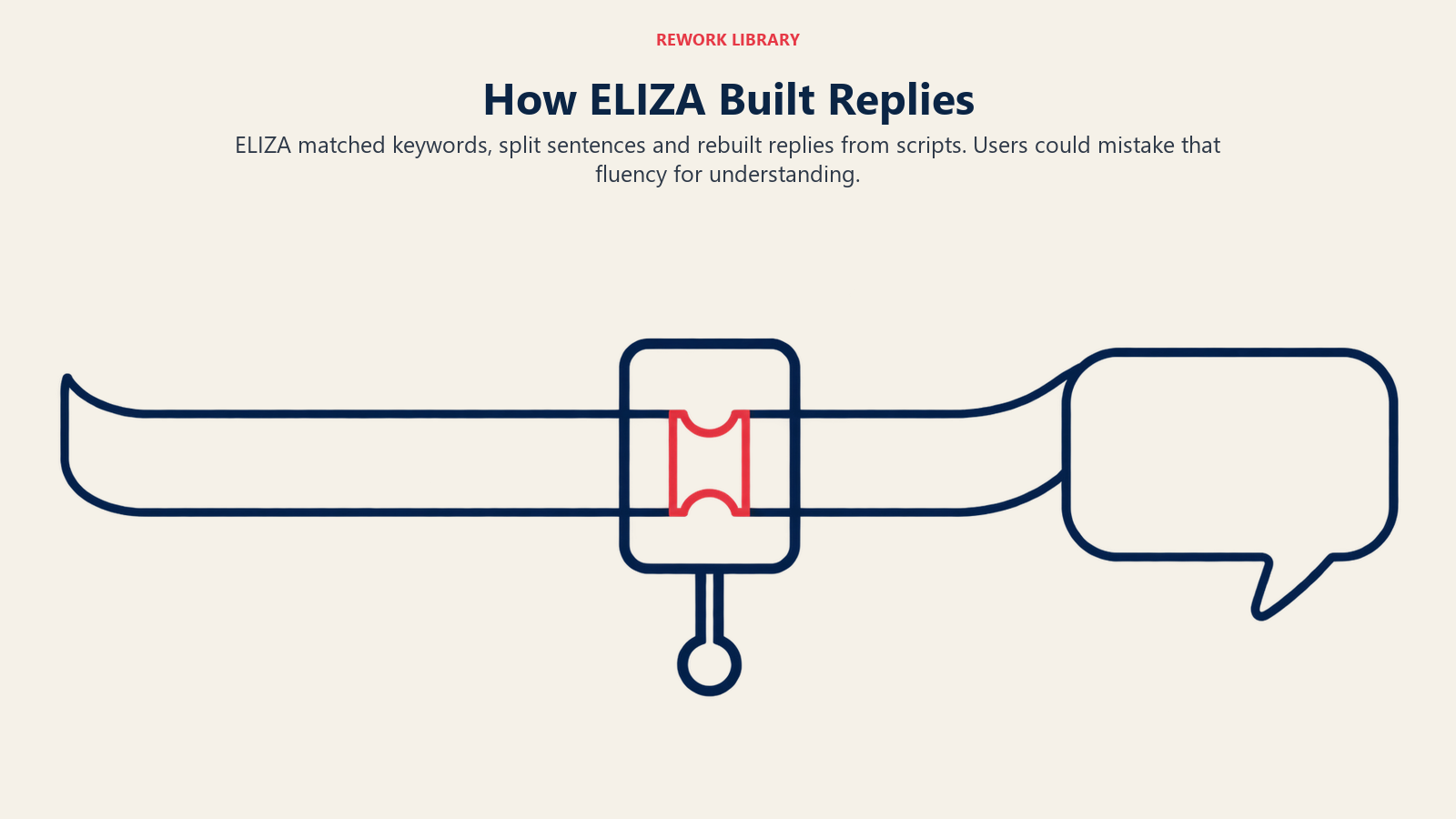
The setting is MIT's Project MAC, where a time-sharing system let many people use one computer at once. Weizenbaum's 1966 paper, "ELIZA: A Computer Program For the Study of Natural Language Communication Between Man And Machine," names Project MAC as its sponsor, funded by the Advanced Research Projects Agency. The method was simple. ELIZA scanned the typed sentence for a keyword. Each keyword had ranked decomposition rules that split the sentence into parts, and reassembly rules that built a reply from those parts. If no keyword matched, it fell back on a content-free remark or a stored earlier line. The rules lived in a "script," kept as data apart from the program. The best-known script made ELIZA respond roughly as a Rogerian psychotherapist would, a role Weizenbaum chose because a therapist can plausibly appear to know little about the outside world. In the published sample, a user types "Men are all alike" and ELIZA answers "IN WHAT WAY".
The paper is candid about the trick. Weizenbaum wrote that ELIZA "maintains the illusion of understanding with so little machinery," and said its success depended on the human partner's willingness to believe in it. The program kept almost none of what it was told. What happened next surprised him. In his 1967 follow-up, "Contextual understanding by computers," and again in his 1976 book, he told of his secretary, who had watched him build the program, starting a conversation with it and then asking him to leave the room. The ELIZA Archaeology researchers are confident she really used ELIZA, though they note the published sample conversation was tidied and may blend several sessions. The Computer History Museum records that Weizenbaum was alarmed that users invested emotion and meaning in the chats even when they knew ELIZA lacked understanding. The tendency has since carried the program's name: the ELIZA effect.
Two other programs from this period show what came next. At Stanford's AI Laboratory, psychiatrist Kenneth Colby and colleagues built PARRY, which the Computer History Museum describes as a rules-based chatbot like ELIZA that mimicked patients with schizophrenia. Its source code survives as MLISP and PDP-10 assembly for a DEC PDP-10 running the WAITS operating system. On September 18, 1972, PARRY, running at Stanford's SAIL, held a conversation across the ARPANET with a Rogerian therapist program called DOCTOR running at BBN. Vint Cerf circulated the transcript as RFC 439, "PARRY Encounters the DOCTOR," in January 1973. It is one of the earliest records of two chatbots talking to each other over a network.
The other direction was understanding a small world properly. At MIT, Terry Winograd's SHRDLU, reported in AITR-235 (1971), answered questions, carried out commands and took in new facts through ordinary English dialogue. Its world was a simple robot with one hand and one eye handling toy objects. When a sentence was beyond its heuristics, it asked the user for clarification. Winograd argued in the report that a computer can't handle language sensibly without understanding the subject under discussion. SHRDLU understood more than ELIZA, but only inside its box. ELIZA could talk about anything and understood nothing.
The problem these programs answered was how to make a computer take part in language at all. The problem they created was the trust gap: fluent output makes people assume more is behind it. Expert systems would go the SHRDLU way and bet on deep knowledge in narrow domains.
What it means for teams today: assume customers will read more intelligence into your bot than it has. Design the first message so it says what the bot can and cannot do, and give people a clear route to a human.
The Scripted Decades (1972-2010)
Contests, showmen and open-source rule sets
Overlapping the ELIZA years, the long middle of the story belongs to scripted bots and the people who staged them. In 1984, Warner Books published The Policeman's Beard Is Half-Constructed, 120 pages of prose and poetry credited to Racter, a program written by William Chamberlain and Thomas Etter. It showed that generated text could be a product, long before anyone asked whether the program understood a word.
Public Turing-style competition arrived on November 8, 1991, when a tournament billed as the first actual administration of the Turing test filled two floors of The Computer Museum in Boston. Shieber's report describes the setup. New York manufacturer Hugh Loebner had established the prize, and Robert Epstein of the Cambridge Center for Behavioral Studies organized it. A committee headed by philosopher Daniel Dennett included Weizenbaum himself. Ten agents took part, six of them computer programs, and ten judges with no special expertise in computer science scored them. The first prize was a nominal $1,500, with $100,000 reportedly earmarked for the first program to pass the full Turing test.
The committee knew a full test was out of reach, so it restricted the topic and the tenor of the conversation. The six programs chose topics such as burgundy wines, dry martinis and whimsical conversation. The average rankings placed the two human confederates above all six programs. Joseph Weintraub's program, on whimsical conversation, ranked highest. Five judges ranked it as human, and across the contest there were eight cases of a computer judged to be a human. One of them was an entry from Colby, the creator of PARRY, which was twice rated human. Shieber's verdict was blunt: the competition had no clear purpose and its design prevented any useful outcome. Showmanship was being rewarded, not understanding.
The web changed the economics. Jabberwacky launched on the web in 1997 and replied by finding patterns in previous questions people had asked, often quoting them verbatim. A.L.I.C.E. took the ELIZA architecture and scaled it. Richard Wallace's account of the program says the first edition was written in 1995 in the SETL language, moved to Java in 1998, and won the Loebner Prize as "the most human computer" in 2000 and 2001. It used AIML, an XML format for stimulus-response bots, and Wallace reports more than 500 volunteers contributing. He conceded that some see A.L.I.C.E. as a simple extension of ELIZA, and said the comparison is fair on architecture, but that A.L.I.C.E. held more than 40,000 categories of knowledge against ELIZA's roughly 200.
The era's problem was maintenance. Every response was a rule somebody had to write, which is the same cost curve that wore down the expert systems of the 1980s. And a bot trained on strangers' typing, like Jabberwacky, repeated whatever strangers had said.
What it means for teams today: a scripted bot is only as good as its rule set, and rule sets age. Budget an owner and a weekly review of failed conversations, because the unmatched questions are where the next rules come from. Wallace built this loop into A.L.I.C.E. and called it targeting: unmatched inputs are logged and handed to a human who writes the missing rule.
The Assistant Era (2011-2021)
Conversation leaves the keyboard for the phone and the kitchen
On October 4, 2011, in a press release datelined Cupertino, Apple announced that the iPhone 4S "also introduces Siri, an intelligent assistant that helps you get things done just by asking." Siri launched in beta, in English (localized for the US, UK and Australia), French and German, and the phone went on sale on October 14. The Computer History Museum notes that Siri began as a spinoff from SRI International's laboratories and as a standalone app before Apple brought it in. The new idea was the job: Siri did not chat for chat's sake. It made calls, sent messages and set reminders.
Amazon made the same bet with a speaker. Its June 2015 release describes Echo as "a new category of device designed around your voice" that had been offered on an invitation basis for about seven months, with Alexa, built in the cloud, as the brain behind it. Launch features were hands-free music, information from Wikipedia and the web, weather, timers, news, and shopping and to-do lists.
Assistants differ from the chatbots before them in what they connect to. They hold less open conversation and more narrow commands tied to a calendar, a music service or a store. That is the territory the conversational AI label covers, and it rests on advances in natural language processing that moved speech recognition from a novelty to a daily tool. The problem it created was the ceiling: an assistant that does thirty things well fails on the thirty-first, and users could not tell where the edge was.
What it means for teams today: a bot tied to real actions earns more trust than one that only talks. Start with the five requests your customers make most often, make those work end to end, and say plainly what you do not handle.
The Chat Window Era (2022-present)
A language model learns to hold the thread
On November 30, 2022, OpenAI released ChatGPT. Its launch post says the dialogue format makes it possible for ChatGPT to answer followup questions, and that usage was free during the research preview. The same page lists the weakness plainly: ChatGPT "sometimes writes plausible-sounding but incorrect or nonsensical answers." Under the hood was a large language model rather than a rule set. For the technology that made this possible, see the AI timeline and the story of how AI moved from research labs to everyday work.
The old trust gap came back with higher stakes. In November 2022, Jake Moffatt used a chatbot on Air Canada's website while booking a flight after a family death. The chatbot suggested bereavement fares could be applied for retroactively. Air Canada did not allow that, and refused the refund. In Moffatt v. Air Canada, decided on February 14, 2024 by the British Columbia Civil Resolution Tribunal, Air Canada argued it could not be held liable for what the chatbot said. The tribunal member, Christopher Rivers, called the suggestion that the chatbot is a separate legal entity "a remarkable submission," held that the airline is responsible for all the information on its website whether it comes from a static page or a chatbot, and found that the airline did not take reasonable care to ensure the chatbot was accurate. The case turned on a small-claims refund, but it set out the logic any deployer should expect: the bot's words are yours.
Today's chatbots sit within a larger shift. A bot that answers is a chatbot. A system that uses tools and takes actions toward a goal is closer to an agent, and AI agents differ from chatbots in exactly the way that raises the cost of a wrong answer. A fluent wrong answer is now called an AI hallucination, and it is ELIZA's illusion of understanding with better grammar.
What it means for teams today: write down who owns every statement the bot can make, test it on your own policies before launch, and put guardrails in place before you let it do more than answer.
Key People
| Name | Role | Contribution | Year |
|---|---|---|---|
| René Descartes | Philosopher | Described conversation as the test separating persons from machines | 1637 |
| Alan Turing | Mathematician | Proposed the imitation game in Mind | 1950 |
| Joseph Weizenbaum | MIT computer scientist | Built ELIZA, then warned about trusting it | 1966 |
| Kenneth Colby | Stanford psychiatrist | Led the PARRY project | Early 1970s |
| Terry Winograd | MIT researcher | Built SHRDLU and reported it as AITR-235 | 1971 |
| Vint Cerf | RFC author | Circulated the PARRY and DOCTOR transcript as RFC 439 | 1973 |
| Hugh Loebner and Robert Epstein | Sponsor and organizer | Launched the Loebner Prize contest | 1991 |
| Richard Wallace | Creator of A.L.I.C.E. | Built AIML and an open-source bot community | 1995-2001 |
| Christopher Rivers | Tribunal member | Decided Moffatt v. Air Canada | 2024 |
Key Facts
Key Facts: chatbot history
- ELIZA was published in Communications of the ACM, volume 9, number 1, in January 1966, with funding via MIT's Project MAC.
- RFC 439 records PARRY meeting the DOCTOR program on September 18, 1972, across the ARPANET.
- The first Loebner Prize contest was held on November 8, 1991, with ten agents, six of them computer programs, and a $1,500 prize.
- A.L.I.C.E. held more than 40,000 categories against ELIZA's roughly 200, according to its creator.
- Apple announced Siri on October 4, 2011, and the iPhone 4S went on sale on October 14.
- The Moffatt v. Air Canada decision of February 14, 2024 held the airline responsible for what its chatbot told a customer.
The Pattern Behind the History
Across 400 years, from Descartes to ChatGPT, the same four moves repeat. We call the sequence the Fluency-Understanding Gap. It's our synthesis of the milestones above, not a research finding.
- Form passes for substance. ELIZA, Racter and the Loebner winners all won attention with the shape of conversation, not its content.
- The user fills the gap. People supplied the missing meaning, and Weizenbaum's secretary is the example he left on record.
- The test rewards the trick. Restricted topics and short chats made the 1991 contest easier to game than Turing's open game.
- Each fix creates an accountability question. Rules created a maintenance burden, assistants created an edge-of-ability problem, and language models created a liability one.
What It Teaches Teams Today
- Define the pass mark first. Turing's lesson is that a bot is judged on behavior. Pick the 20 real questions that matter and score the bot on them.
- Name an owner. Rule sets in the scripted decades and prompts and knowledge bases now both go stale. Someone has to review the failures every week.
- Expect people to over-trust it. The ELIZA effect is the default. Say what the bot is, and always give a human exit.
- Own the words. After Moffatt v. Air Canada, "the chatbot said it" is not a defense for a company that deployed it.
- Match the tool to the job. A narrow assistant with real actions can beat a general chatter for the same support queue.
Where to Go Next
- The History of AI: A Timeline of Key Milestones: the full arc from Turing to agents.
- What is an AI chatbot?: the plain-English definition and the main types.
- What is conversational AI?: how today's assistants and bots handle dialogue.
- AI agents vs chatbots, RPA and automation: choosing between a bot that answers and one that acts.
The best defense against the gap between sounding right and being right is the oldest one: test the bot the way a skeptical customer would, and keep a person accountable for what it says.

Co-Founder, Rework.com