The 5 Stages of AI Maturity: A Self-Assessment Framework for Executives

Turn this article into takeaways for your work.


Each assistant summarizes the article only for you and suggests best practices for your work.
Every CEO wants to know where their company stands on AI. The board is asking. Investors are asking. Competitors are announcing things that may or may not be real.
Here's the honest answer for most mid-market companies in 2026: you're at Stage 1 or Stage 2. And that is perfectly normal. Stage 1 is where the majority of companies with 50-500 employees find themselves today. Stage 2 is where the most forward-leaning of those companies have moved in the past 18 months. McKinsey's gen AI rollout research found that only 1% of organizations have reached a "mature" stage where gen AI is fundamentally changing business outcomes, while 39% are still in the emerging (pilot) stage. You're not behind. You're in the majority.
This is the canonical reference for the ACE Framework's Level 5 maturity model. Use it to benchmark where you are, understand what Stage 3 actually requires (it's not what most people think), and set realistic expectations for what each transition involves. Each stage has the same structure: who's there, what they have, what they need next, and the common trap to avoid.
Why maturity models matter for executives
Not to impress consultants. Not to produce a framework for the board deck. For three practical reasons:
Realistic expectations. The Chief Executive Officer (CEO) who understands their company is at Stage 1 doesn't approve Stage 3 investments. The CEO who doesn't know they're at Stage 1 approves a $500,000 vector database infrastructure project, discovers their data is too messy for any AI to use meaningfully, and has to explain to the board why the initiative stalled.
Correct sequencing. Each stage has prerequisites. You cannot skip them. A company that tries to deploy production AI at scale (Stage 3 behavior) without completing Stage 2 (validated pilots with measurable baselines) will face adoption failures, governance incidents, and ROI ambiguity. The prerequisites aren't bureaucratic checkboxes. They're the conditions that make the next stage work.
Investment calibration. Stage 1 to Stage 2 costs look very different from Stage 2 to Stage 3. Knowing your stage tells you what investments are appropriate now and what should wait. The Honest Cost of AI Transformation covers these numbers in detail.
No stage is the "right" stage for every business. A 40-person professional services firm may be optimally positioned at Stage 2 indefinitely. A Series C SaaS company competing on product velocity may need to reach Stage 4 to stay competitive. The goal is the right stage for your business model, not the highest possible stage.
Key Facts: AI Maturity Distribution in 2026
- Only 1% of organizations consider their AI strategy "mature" in terms of fundamentally changing business outcomes, while 39% remain in the emerging pilot stage; the majority of mid-market companies with 50-500 employees are at Stage 1 or 2 (McKinsey State of AI 2025)
- 45% of organizations with high AI maturity keep their AI projects operational for at least three years, compared to only 20% of low-maturity organizations; in high-maturity organizations, 57% of business units trust and actively use AI solutions versus just 14% in low-maturity organizations (Gartner, 2025)
- Organizations that have scaled AI (Stage 3 and above) generate 3-year total shareholder returns roughly 4x higher than AI laggards, and the gap between leaders and laggards is widening, not closing (BCG, 2025)
The ACE Maturity Curve
The canonical maturity model for organizations applying the ACE Framework (Ingest, Analyze, Predict, Generate, Execute) to their business transformation. The ACE Maturity Curve maps how an organization's use of AI capabilities deepens and broadens across five stages. At Stage 1 (Ad-Hoc), isolated Generate capabilities are in use by individuals with no organizational layer. At Stage 2 (Pilot), one to three bounded use cases test specific ACE capabilities against measurable baselines. At Stage 3 (Scaled), multiple ACE capabilities run in production across functions with shared infrastructure. At Stage 4 (Integrated), AI is a first-class component in core workflows, with full Ingest-to-Execute chains operating without per-step human decision points. At Stage 5 (Transformational), proprietary ACE deployments form a competitive moat, and the business offers products that wouldn't exist without AI. The ACE Maturity Curve is the reference model for diagnostics, investment sequencing, and board reporting across the collection. When other articles reference "Stage 2" or "Stage 4," they are using this framework.
Stage 1: Ad-Hoc
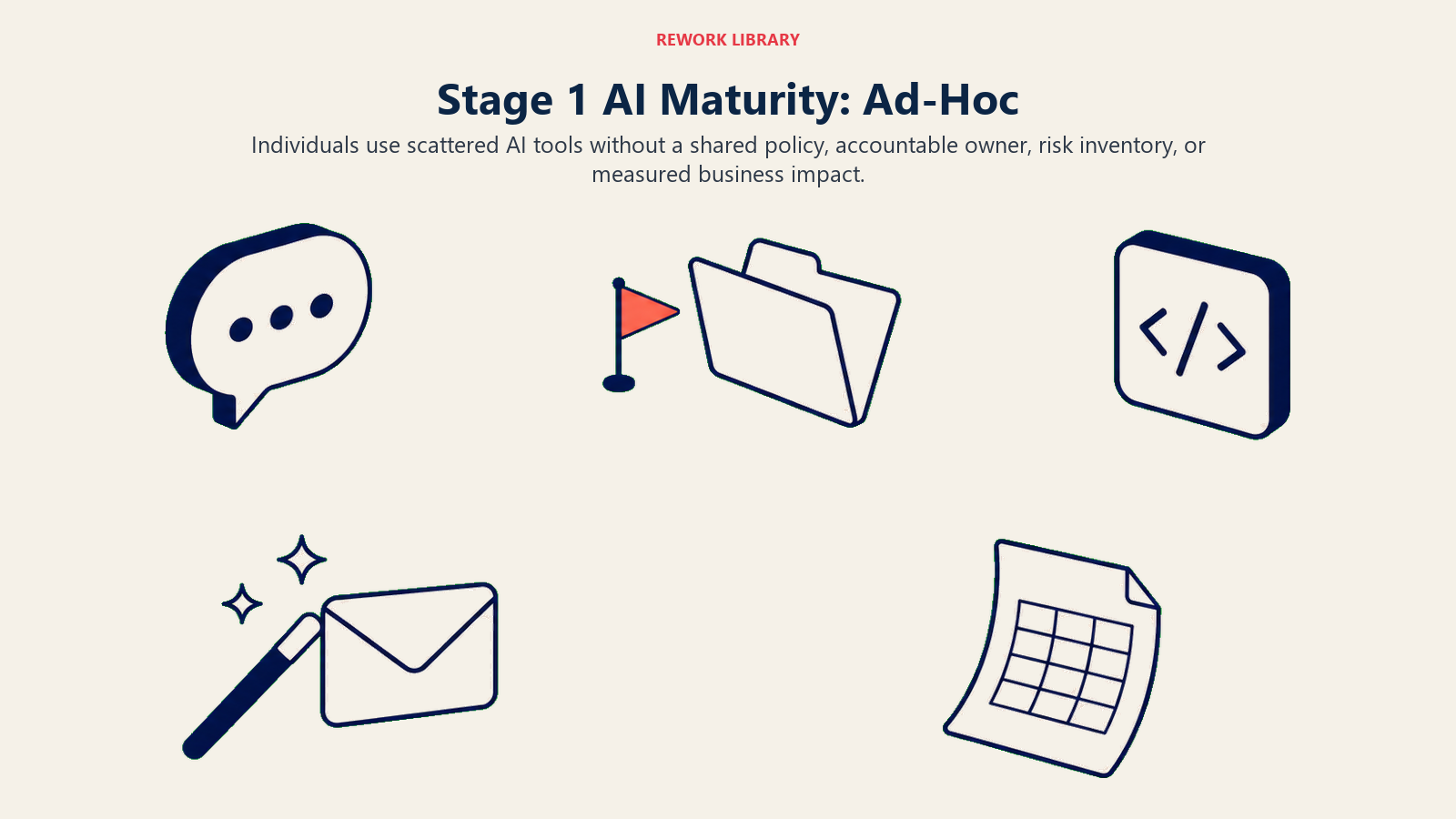
Definition: Individual employees using AI tools without organizational strategy, governance, or shared infrastructure.
Who is here: The majority of mid-market companies in 2026. Companies with 50-500 employees where someone on the marketing team uses ChatGPT, some engineers use Copilot, and a few sales reps have tried an AI email assistant. The tools are scattered, the usage is undocumented, and leadership doesn't have a clear picture of how many AI tools are in use or what data they're touching.
What they have:
- Individual curiosity and scattered experiments
- At least one team that's saving real time with AI tools at the personal level
- No organization-wide AI policy or acceptable use framework
- No shared vocabulary for what AI does (the ACE Framework isn't being used)
- No measurement of AI's impact on business metrics
- No accountability owner for AI
What they need next:
- A written AI use policy that employees can actually follow
- A maturity audit: what tools are in use, what data are they accessing, what's the risk exposure
- Use case prioritization: what are the three highest-value business problems AI could address
- An accountability owner (doesn't have to be a full-time Chief AI and Innovation Officer; a transformation lead or CIO with this mandate works)
Common trap: Stage 1 organizations are vulnerable to vendor excitement. A compelling vendor demo and a motivated internal champion produce a $200,000 enterprise AI platform contract before the company has answered basic questions: what data will this run on, who will manage it, what does success look like? BCG found that only 4% of organizations are creating substantial AI value, and that the gap between leaders and laggards is widening, not closing. The differentiator is almost always governance and data foundation, not tool selection. The organization deploys a sophisticated tool on top of unaddressed data and governance problems, produces inconsistent results, and concludes that "AI doesn't work for us."
The Stage 1-to-2 transition is governance, not technology. Don't spend on enterprise tooling before clearing Stage 1 basics. See Stage 1 to 2: From Ad-Hoc to Pilot for the specific transition checklist.
"78% of knowledge workers use personal AI tools at work without explicit employer approval, according to Microsoft's 2024 workplace research. At Stage 1, this is the default state. The company hasn't approved the tools, but the tools are being used. The AI policy is the first and most important governance action any organization can take." (Rework)
Stage 1 reality check: If employees are using AI tools you didn't approve, if nobody in the organization can answer "what AI tools are currently being used and what data do they access," or if you don't have a written AI use policy, you are at Stage 1 regardless of what's in the board deck.
Stage 2: Pilot
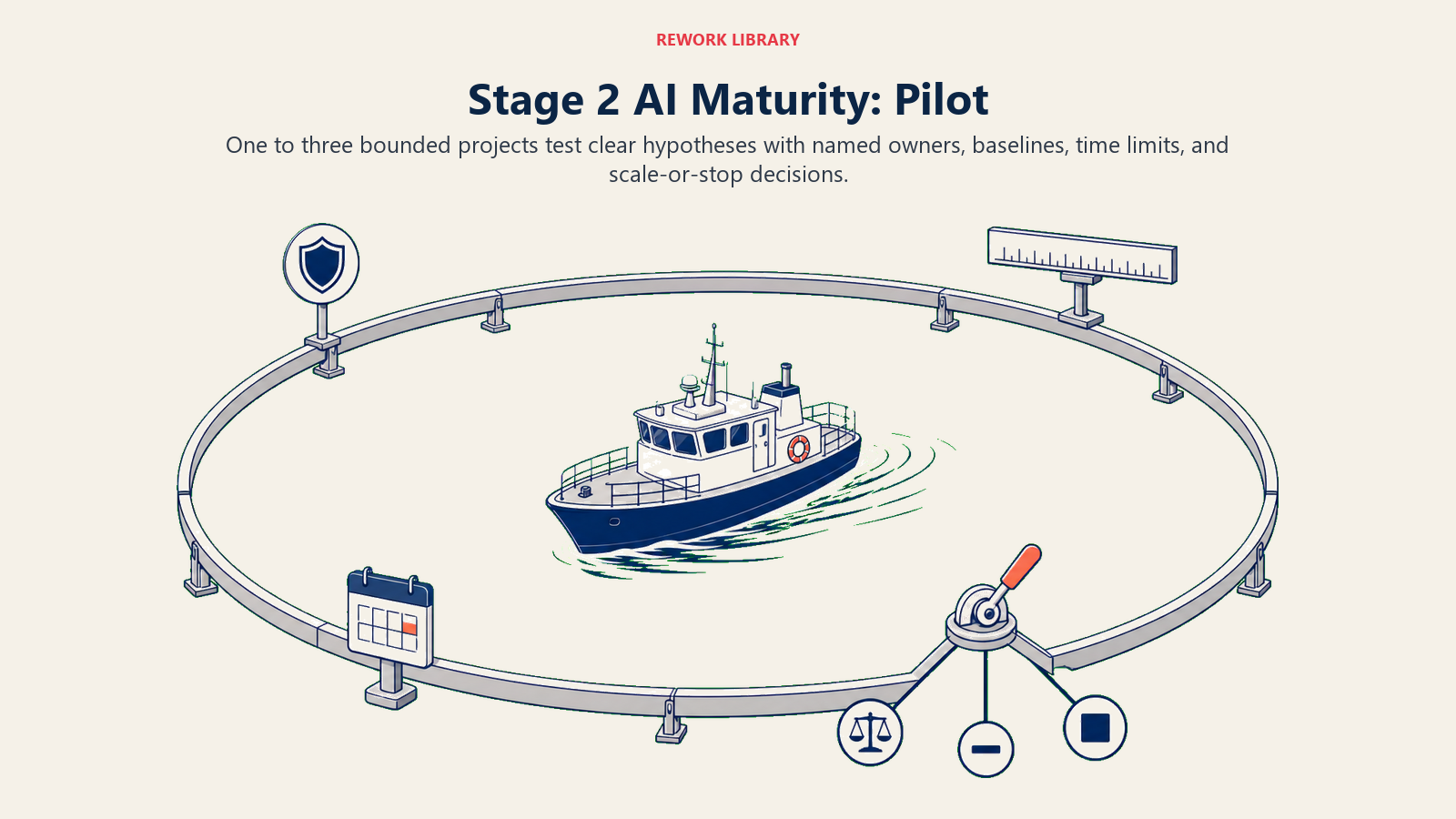
Definition: One to three bounded AI projects with defined hypotheses, named owners, and measurable baselines.
Who is here: Companies that said yes to AI experiments in 2024-2025 and ran them with some structure. The Chief Information Officer (CIO) or a business unit leader sponsored a pilot. There's a defined problem statement. Someone measured (or tried to measure) the before-and-after. The company is evaluating whether the pilot results justify production deployment.
What they have:
- At least one AI pilot running or recently completed
- Some infrastructure decisions made (which large language model API or platform, who maintains it)
- Early results: mixed but instructive. The pilot probably worked partially and produced as many questions as answers.
- A sense of what the data quality problems are, even if not fully resolved
- An emerging internal champion who understands AI at a deeper level than everyone else
What they need next:
- Production deployment of at least one pilot. This is the Stage 2-to-3 jump: getting out of pilot mode and committing to full deployment on the full affected team.
- A documented decision on the first pilot: scale, pivot, or shut down. Endless pilots that stay in "evaluation" mode are Stage 2 purgatory.
- A data infrastructure plan: what data cleanup and infrastructure investment are required to support production scale
- A scale plan for the second and third use cases
Common trap: Pilot purgatory. The pilot ran. The results were positive but not overwhelming. The decision to move to production keeps getting pushed because the team isn't sure the results are good enough to bet on at scale. Deloitte's State of AI in the Enterprise 2026 found that only 34% of organizations are truly reimagining the business with AI. The rest are stuck in efficiency pilots that never convert to transformation. Other priorities take over. The pilot runs for 14 months. Nobody can clearly articulate whether it worked.
The antidote to pilot purgatory is a pre-committed decision protocol: before the pilot starts, define what "good enough to scale" looks like. If the results hit that threshold, the next phase is automatically approved. If they don't, the pilot is shut down and learnings are documented. The decision process should take a meeting, not a quarter. Stage 2 to 3: From Pilot to Scaled covers how to structure that decision.
"Deloitte's 2026 State of AI in the Enterprise found that only 34% of organizations are genuinely reimagining business processes with AI. The remaining 66% are running efficiency pilots that have not converted to transformation. The Stage 2 pilot is not the destination. It's the test that earns the right to deploy." (Rework, based on Deloitte 2026)
Stage 2 reality check: If your pilots have been running for more than nine months without a clear production deployment decision, you are in pilot purgatory. The problem is not the technology. The problem is the decision-making process.
Stage 3: Scaled
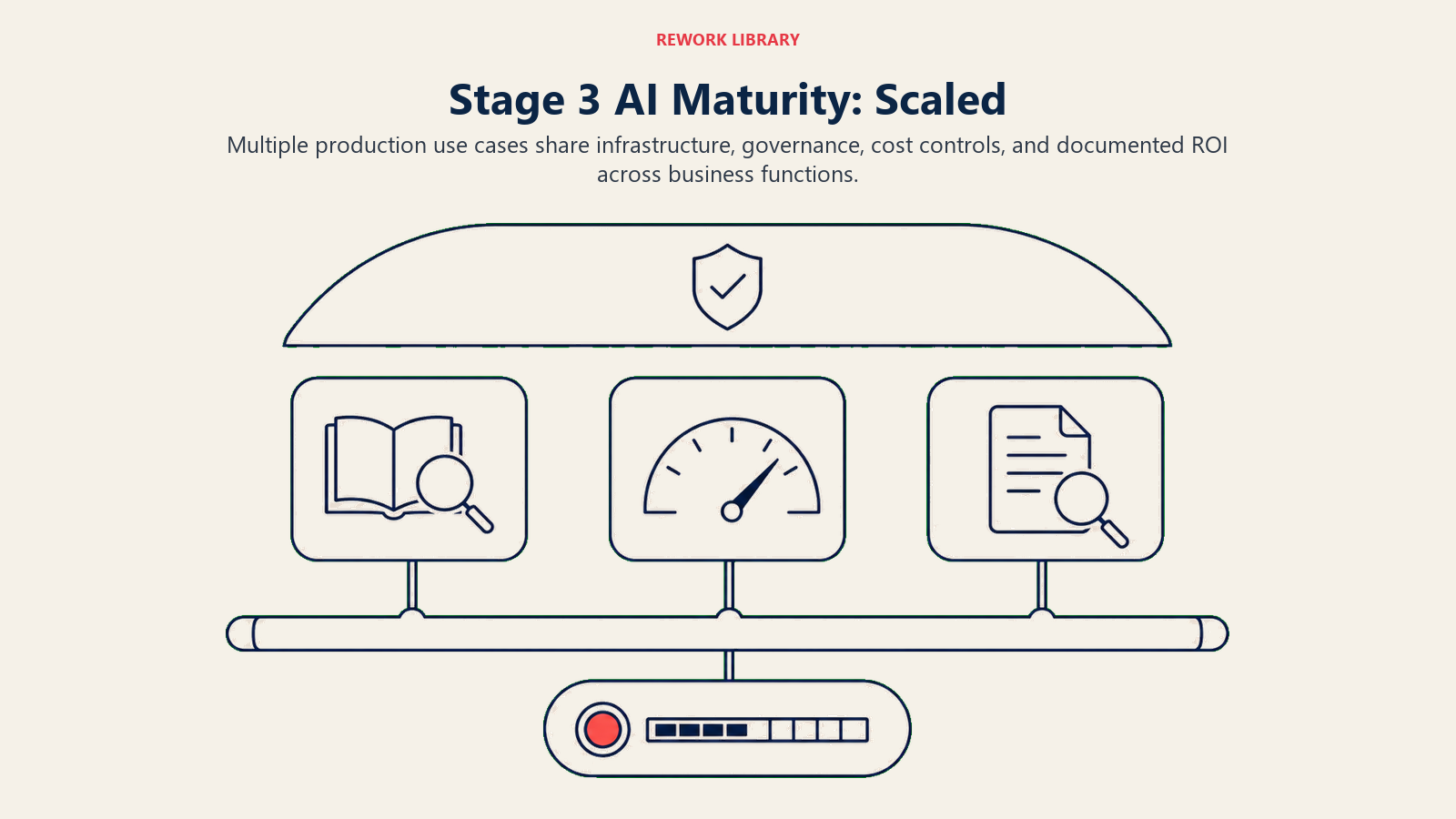
Definition: Multiple AI use cases running in production with shared infrastructure, measurable return on investment on at least two use cases, and a functioning AI team or Center of Excellence (CoE).
Who is here: The top 20% of mid-market companies. Most enterprise technology companies. The businesses that moved their Stage 2 pilots to production in 2024-2025 and have built the infrastructure to support more.
What they have:
- Two or more AI applications in full production (not pilot, not limited rollout)
- Shared AI infrastructure: likely a vector database, retrieval-augmented generation (RAG) pipeline for at least one use case, an API layer connecting AI to core business systems
- Measurable, documented return on investment on at least two use cases (time saved, conversion rate improvement, error rate reduction)
- An AI team (CoE) or at least one dedicated AI lead with cross-functional authority
- A governance framework that covers the production systems (not just a policy, but active monitoring and audit trails)
- Beginning to standardize AI patterns across the org (the most common ones: RAG-based knowledge assistants, lead/risk scoring, document analysis)
What they need next:
- Integration depth: AI moving from a separate layer on top of existing systems to AI baked into the core workflows themselves. The difference between "there's an AI assistant available in the sidebar" and "the workflow is designed around what AI can do."
- Governance maturity: as the number of AI systems in production grows, governance complexity grows. Stage 3 organizations need formal model monitoring, performance degradation detection, and incident response procedures.
- Cost governance: Stage 3 is where AI infrastructure costs start compounding. Token costs, compute costs, vector database storage costs, and engineering maintenance add up. Stage 3 organizations that don't monitor AI costs by use case can find themselves spending significantly more than their ROI justifies.
Common trap: Scaling the wrong patterns. Stage 3 organizations have the infrastructure and team to scale AI broadly. But they're scaling whatever was tried first, not necessarily what delivers the highest value. A company might have excellent RAG-based document search running at scale while missing a higher-value Predict use case (lead scoring, churn prediction) that would deliver 5x more ROI. Stage 3 is the stage where the portfolio of AI investments needs strategic curation, not just technical execution. Sequencing AI Patterns in a Multi-Year Roadmap gives a framework for making those portfolio choices.
"Gartner's 2025 survey found that 45% of high-maturity organizations keep AI projects in production for at least three years, versus 20% of low-maturity organizations. The Stage 3 threshold is not just about having AI in production. It's about building the infrastructure and governance that makes AI durable, not a series of one-off deployments that require restarts as systems and data evolve." (Rework, based on Gartner 2025)
Stage 3 reality check: Stage 3 is where AI stops feeling like an experiment and starts feeling like infrastructure. If you're managing AI the same way you manage other technology projects (project-by-project, siloed by team, no shared infrastructure), you haven't reached Stage 3 regardless of how many pilots you've run.
Stage 4: Integrated
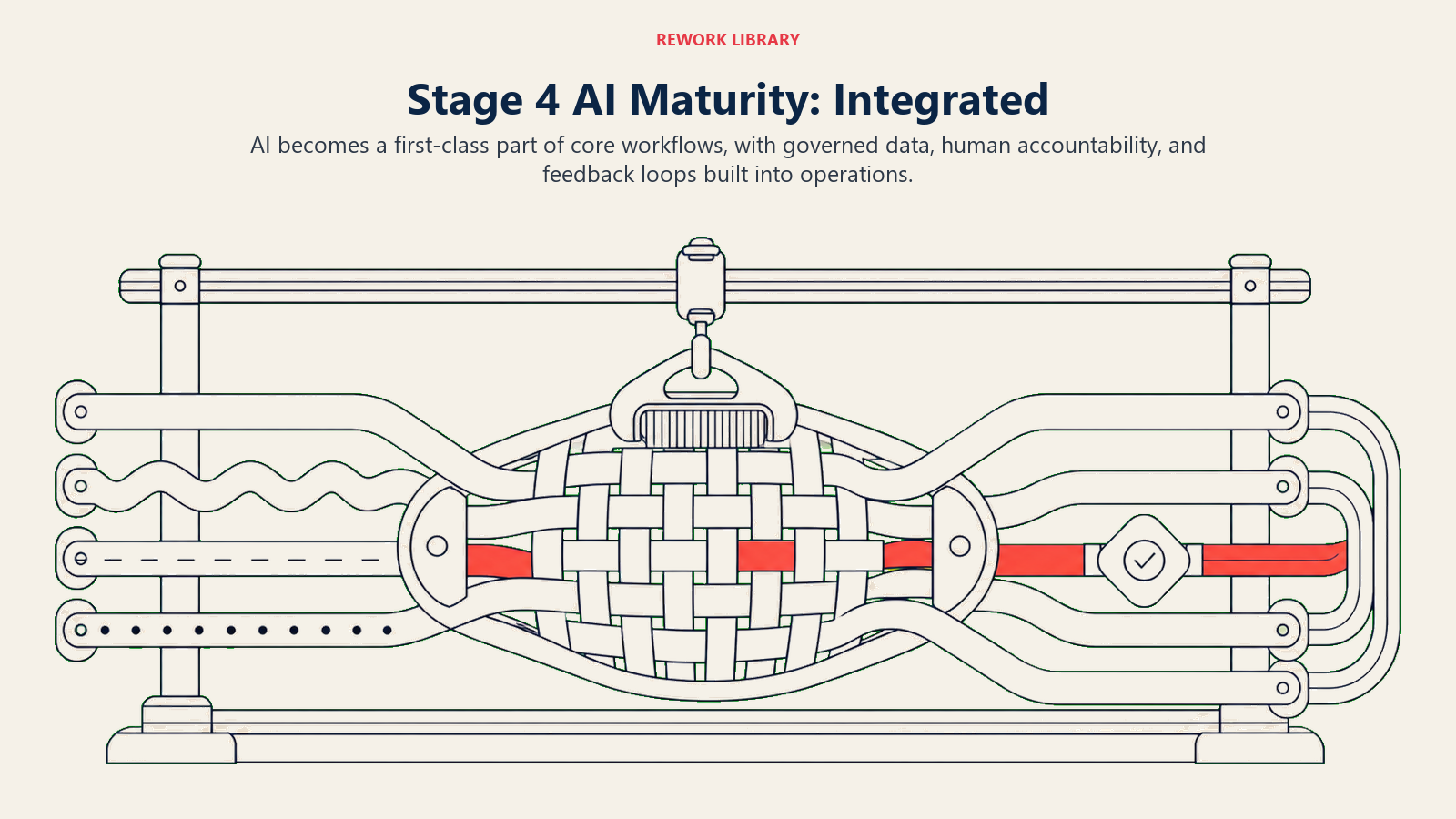
Definition: AI baked into core workflows and systems as a first-class component, not a separate tool layer. AI is part of how the business operates, not an add-on to how it operates.
Who is here: Advanced enterprises. AI-native companies. A growing subset of well-capitalized mid-market businesses in high-velocity sectors (fintech, SaaS, digital health). These are organizations where you can't remove the AI without breaking the workflow.
What they have:
- Full data infrastructure: clean, accessible, governed data across core business systems
- AI embedded in customer-facing and internal workflows at every major touchpoint
- Mature accountability frameworks: clear ownership for AI-produced outputs, incident response protocols, regular model performance reviews
- Cross-functional alignment on AI: the CEO, CIO, and COO are coordinated on AI strategy, not running independent initiatives
- Feedback loops from AI operations into product, strategy, and workforce planning
- AI literacy across the organization: the majority of employees understand what the AI systems they work with do and what their responsibility is when those systems produce questionable outputs
What they need next:
- Product-level AI thinking: not "how does AI improve our operations" but "how does AI change what we can sell?" This is the question that separates Stage 4 from Stage 5. Stage 4 organizations are better at what they already do. Stage 5 organizations offer something they couldn't offer before.
- Regulatory and ethical readiness: Stage 4 organizations have AI embedded in consequential decisions (credit, hiring, customer service, pricing). The regulatory environment around AI in consequential decisions is evolving rapidly. Stage 4 organizations need to be ahead of this curve, not reacting to it.
- Board-level AI governance: the board needs enough AI literacy to govern the company's AI risk exposure. This is increasingly a fiduciary requirement.
Common trap: Over-integrating before governance catches up. Stage 4 organizations can embed AI deeply into consequential processes (underwriting, hiring, customer service decisions) faster than their governance frameworks mature to manage those systems responsibly. When something goes wrong at Stage 4, it's not a pilot that failed. It's a production system that affected real customers, real employees, or real business outcomes. The reputational and regulatory exposure is correspondingly higher.
The integration and governance investments need to advance together, not sequentially.
Stage 5: Transformational
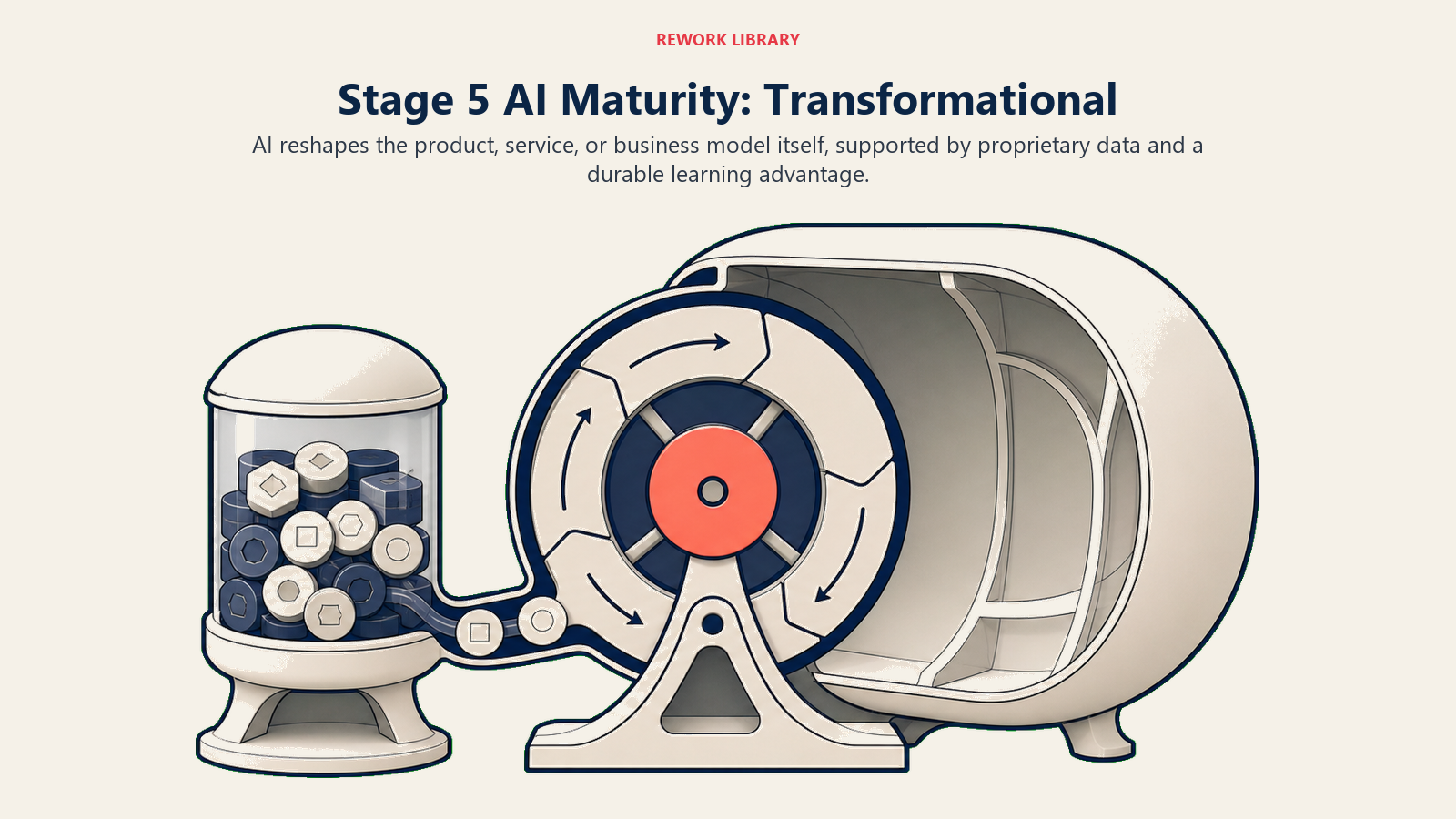
Definition: AI reshapes what products and services the business offers, not just how they're delivered. The business model is different because of AI. The competitive moat is partly AI-derived.
Who is here: AI-native companies and a small number of large enterprises as of 2026. OpenAI, Anthropic, Perplexity are born at Stage 5. Salesforce, Microsoft, and Adobe have reached Stage 5 in their core product offerings through deliberate AI-first product bets. Legacy enterprises with genuine Stage 5 deployments (not press releases) can be counted on one or two hands in any given industry.
What they have:
- Proprietary models or proprietary fine-tuned models trained on unique data
- Data moats: accumulated data that competitors can't replicate easily
- AI as core product surface: the customer buys the AI capability, not just the software that happens to use AI
- Board-level AI governance with genuine expertise, not just nominal oversight
- Regulatory relationships and proactive engagement with AI policy
- An org structure where AI is not a separate team but is integrated into product, engineering, and business decision-making at every level
What they need next:
- The Stage 5 challenge is not more AI. It's governance and ethics at a level that matches the influence the company's AI has. When AI reshapes what a business offers, the AI's impact on customers, employees, and markets is large enough to attract regulatory and public scrutiny. Stage 5 organizations that don't invest in responsible AI at this level face the regulatory and reputational risks associated with that influence.
- Competitive durability: proprietary models and data moats erode over time as competitors build their own. Stage 5 organizations need to continuously invest in the next layer of differentiation.
"BCG's 2025 global research found that organizations that have scaled AI generate 3-year total shareholder returns roughly 4x higher than laggards. But 'scaled AI' is Stage 3 and above, not Stage 1 experimentation dressed up as transformation. The competitive compounding starts at the Stage 2-to-3 transition, not the announcement of AI strategy." (Rework, based on BCG 2025)
Stage 5 reality check: If a competitor acquired your company's AI systems and the company's products still worked essentially the same way, you're not at Stage 5. Stage 5 means AI is the product or is so deeply embedded in the product that they can't be separated.
Important note for mid-market executives: Stage 5 is not the goal for most businesses. A 200-person professional services firm that reaches Stage 3 and maintains it consistently is well-positioned. A regional bank that reaches Stage 4 with strong governance is better positioned than a large bank that announced Stage 5 ambitions without the foundation to support them. The right stage for your business is the one that matches your competitive context, not the highest number on this scale.
How the transitions actually work
The maturity model is most useful when it clarifies the specific condition that lets an organization move from one stage to the next.
Each stage transition has a primary requirement. Not a list of requirements. One thing that, if absent, makes the transition impossible.
| Transition | Primary requirement | Secondary requirements |
|---|---|---|
| Stage 1 to 2 | Governance (AI policy + accountability owner) | Use case prioritization, data audit, leadership mandate |
| Stage 2 to 3 | Production discipline (get one pilot to full deployment) | Data infrastructure, shared AI team, ROI measurement |
| Stage 3 to 4 | Integration depth (AI in the core workflow, not the sidebar) | Full data infrastructure, governance maturity, cross-functional alignment |
| Stage 4 to 5 | Product courage (betting AI changes what you offer, not just how you deliver it) | Proprietary data/models, board-level AI governance, regulatory readiness |
The transitions take longer than most organizations expect. Stage 1 to Stage 2 typically takes 6-12 months for a company running it correctly. Stage 2 to Stage 3 typically takes 12-24 months. The organizations that try to compress these timelines skip the prerequisite work, run into the failure modes described above, and lose more time than they saved.
Self-assessment diagnostic
The diagnostic is designed to force an honest stage assessment before the organization commits budget or executive attention.
Answer these five questions to identify your current stage. Answer them honestly, not aspirationally.
1. Does your organization have a written AI use policy that all employees know about, with a named accountable owner?
- No, or I'm not sure: Stage 1
- Yes: proceed to question 2
2. Is at least one AI initiative currently running with a defined business problem, measurable baseline, and named owner?
- No, or "we're exploring": Stage 1
- Yes, in pilot but not production: Stage 2
- Yes, in full production on the full affected team: proceed to question 3
3. Are two or more AI applications running in production, supported by shared infrastructure (not separate one-off deployments), with documented ROI on each?
- No: Stage 2
- Yes, but managed as separate tools per team: early Stage 3
- Yes, with shared infrastructure and a functioning AI team or CoE: Stage 3
4. Is AI a first-class component in your core operational or customer-facing workflows (meaning you couldn't remove it without breaking the workflow)?
- No, it's a tool layer on top of existing systems: Stage 3
- Yes, integrated into core workflows with full data infrastructure and cross-functional governance: Stage 4
5. Does your business offer products or services that are meaningfully differentiated by AI, products that competitors without AI infrastructure cannot replicate?
- No: Stage 4 or below
- Yes, with proprietary models or data moats and AI-core products: Stage 5
Most readers of this article will land at Stage 1 or Stage 2. If you're genuinely at Stage 3, you already know it because you've felt the operational shift. If you're tempted to round up to a higher stage, that's the diagnostic telling you something useful: the aspiration is real, but the prerequisites aren't fully in place yet.
Rework Analysis: The ACE Maturity Curve data consistently shows that the most consequential transition is Stage 2 to Stage 3, not Stage 1 to Stage 2. Stage 1 to Stage 2 is a governance and prioritization problem: most organizations can complete it in 6-12 months with CEO mandate and clear use case selection. Stage 2 to Stage 3 is an infrastructure and discipline problem: moving one pilot to full production while building shared AI infrastructure, typically taking 12-24 months and requiring $200,000-500,000 in data and engineering investment above Stage 2 costs. The organizations that get stuck are almost always stuck at Stage 2, not Stage 1. They've run the pilots. They haven't committed to production. The BCG 4x total shareholder return advantage belongs to Stage 3+, not Stage 2.
What honest looks like in 2026
Benchmarks matter because most AI programs sound more mature in planning decks than they look in operating reality.
The majority of mid-market companies in 2026 are at Stage 1. Roughly a quarter have reached Stage 2. A smaller cohort, perhaps the top 10-15% of mid-market, have crossed into Stage 3. BCG's research found that organizations that have scaled AI generate three-year total shareholder returns roughly four times higher than laggards, which means the Stage 2-to-3 transition is not just operational, it's compounding competitively.
That's not a failure. That's the state of an industry three years into the mainstream generative AI wave. Stage 1 is where you start. Stage 2 is where the foundational decisions get made. Stage 3 is where AI starts paying back the investment reliably.
The companies that will have durable AI advantages in 2028 and beyond are the ones who do Stage 1 and Stage 2 right in 2025 and 2026: governance, data foundation, validated pilots, production discipline. Not the ones who announce Stage 5 ambitions at conferences.
For the quarter-by-quarter roadmap to move through the early stages correctly, The 18-Month CEO AI Agenda is the operational companion to this article. For the Stage 1-to-2 transition specifically, Stage 1 to 2: From Ad-Hoc to Pilot covers the governance and use case work in detail. For Stage 2-to-3, Stage 2 to 3: From Pilot to Scaled covers what production discipline actually requires.
See also:
- What AI Transformation Means at the C-Level: the business definition this maturity model is built around
- Why Most AI Transformations Fail: why so many companies stall at Stage 2
- The SaaS AI Maturity Stages: how SaaS-specific dynamics change the maturity calculus
Stage reference summary
| Stage | Defining characteristic | Who's here (2026) | Primary next step |
|---|---|---|---|
| 1: Ad-Hoc | Individuals using AI without org strategy | Majority of mid-market | Governance + use case audit |
| 2: Pilot | Bounded projects with defined hypotheses | ~25% of mid-market | Move one pilot to production |
| 3: Scaled | Multiple production use cases, shared infrastructure | Top 10-15% of mid-market | Integrate into core workflows |
| 4: Integrated | AI in core workflows, not a tool layer | Advanced enterprise, AI-native companies | Product-level AI thinking |
| 5: Transformational | AI reshapes what products are offered | AI-native + a handful of enterprises | Governance and competitive durability |

Co-Founder, Rework.com