Workplace Rituals and Culture: Why Repeated Behavior Beats a Poster
Turn this article into takeaways for your work.


Each assistant summarizes the article only for you and suggests best practices for your work.
Updated August 2026
A workplace ritual is a repeated, deliberately designed behavior a team performs together on a predictable schedule, a Monday standup, a Friday shoutout channel, a retro after every sprint, a goodbye lunch, that carries meaning beyond its logistics. Rituals work because people copy behavior faster than they memorize slogans, which is why a ritual teaches a new hire more about "how we really work" in one repetition than a values deck teaches in an hour.
Every company has rituals whether or not anyone designed them. The question is never whether rituals exist, it's whether they were built on purpose to reinforce the culture leaders actually want, or whether they accumulated by accident and now quietly reinforce something nobody would choose if asked directly. A standup that turns into status theater, a recognition channel nobody posts in anymore, a "mandatory fun" happy hour half the team resents attending, these are rituals too. They just teach the wrong lesson.
This article covers what actually counts as a ritual versus a perk, the six main types worth building on purpose, why rituals beat a poster at transmitting culture, how to design one deliberately, the specific gap remote and hybrid teams have to close, what happens when a ritual goes stale or curdles into forced fun, and the new rituals showing up now that some teammates are AI agents.
What Counts as a Ritual (and What's Just a Perk)
Not every recurring thing a company does is a ritual. Free snacks, a ping-pong table, a Slack channel that exists but nobody posts in, these are perks or infrastructure. A ritual has three things a perk usually lacks: it repeats on a predictable cadence, it involves a shared action people actually perform together (not just consume), and it carries meaning that points at something the group values, even if nobody states that meaning out loud.
That third element is what separates a ritual from a routine. A daily standup where everyone reports status into a form isn't really a ritual, it's a task. The same standup, done as a round-robin where everyone speaks and gets heard before the day starts, is a ritual: it enacts the belief that everyone's update matters, every single day, whether or not anyone ever says that belief out loud.
Rituals as the Visible Layer of Culture
Edgar Schein's framework describes culture in three layers: visible artifacts, stated values, and the underlying assumptions nobody says out loud. Rituals sit at the artifact layer, but unlike a poster or a mission statement, they're artifacts people actively perform, not just read past on their way to the kitchen. That's covered in more depth in Schein's three levels of culture, and it's the reason a ritual is a more honest signal of the underlying assumptions than almost anything a company puts in writing. You can hang a value on the wall. You can't fake a ritual for very long, because a ritual requires the whole team to keep showing up and performing it, and a ritual nobody believes in quietly dies within a quarter.
Key Facts
- Only about one in three US employees strongly agree they received recognition or praise for good work in the past seven days, the cadence Gallup recommends for recognition to sustain engagement. Source: Gallup
- Employees who say they don't feel adequately recognized are twice as likely to say they'll quit within the next year. Source: Gallup
- A manager is the source of the most meaningful recognition for 28% of employees, more than senior leaders (24%), skip-level managers (12%), customers (10%), or peers (9%) combined at the top spot. Source: Gallup
- In a Harvard Business School study spanning five experiments and more than 1,000 participants, performing a shared group ritual, even a simple, invented one, raised how meaningful people judged their work to be by 16%. Source: Harvard Business School / HBS Working Knowledge
- Only 22% of voluntary leavers report being extremely satisfied with their exit experience, and those who are extremely satisfied are 43% more likely to say they'd recommend their former employer as a great place to work. Source: Gallup
The Six Types of Workplace Rituals Worth Designing
Most companies have some version of all six of these already. The difference between a ritual that transmits culture and one that just fills time is almost never the format, it's whether anyone designed it on purpose and keeps it honest.
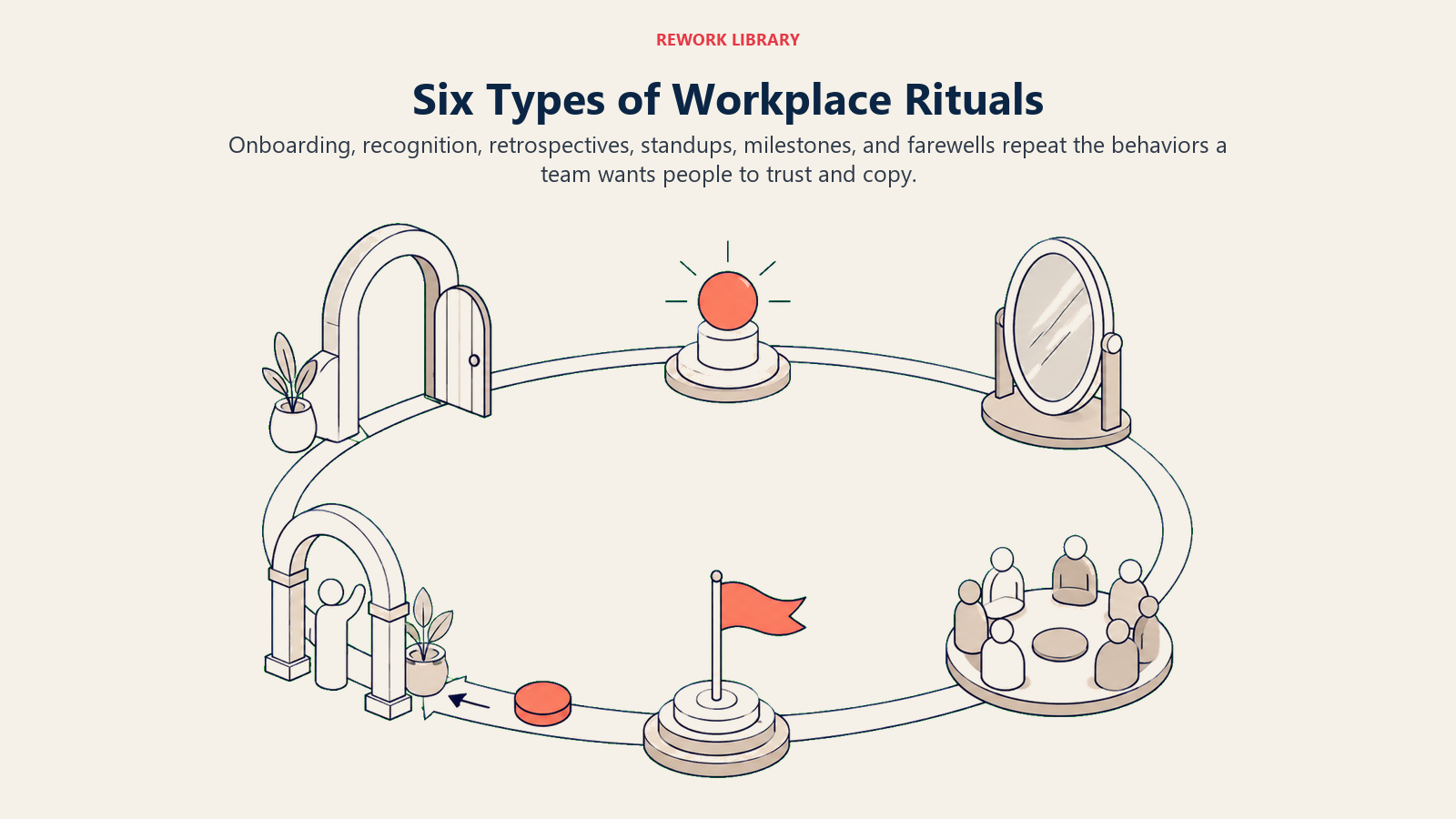
Onboarding Rituals
The first ritual a new hire experiences sets the tone for every one after it. A recurring team check-in they're included in from day one, a channel where wins get called out by name, a first-week lunch that isn't quietly skippable, these small repeated acts do more for early belonging than a single welcome event, because repetition is what makes a signal trustworthy. Onboarding for culture covers the deeper mechanics of why the first 90 days matter so much, and rituals are the concrete vehicle that theory rides in on.
Recognition Rituals
Recognition only works as a ritual if it's frequent and specific, not an annual awards ceremony that arrives once a year and forgets everything in between. A weekly shoutout in a public channel, a standing agenda item where a manager names one thing a teammate did well, a peer-nominated "assist of the week", these repeat often enough to actually shape behavior. Gallup's research above shows why the cadence matters as much as the gesture: recognition that shows up every seven days sustains engagement in a way an annual bonus announcement never can, because a ritual only teaches a lesson if people can predict it will happen again.
Retrospective Rituals
A retrospective, done at the end of a sprint, a project, or a quarter, is a ritual built around a specific belief: that naming what went wrong out loud, without blame, is safer and more useful than letting it fester unspoken. Teams that run retros well treat the format itself as sacred, no finger-pointing, one blameless round where everyone speaks, action items assigned before anyone leaves the room, because the format is what makes it safe to say "this didn't work" in front of the person responsible for it. That safety is the same currency covered in building a feedback culture: a retro is feedback culture with a fixed calendar slot.
Standup Rituals
A daily or weekly standup can be a ritual or just a status meeting wearing a ritual's clothes, and the difference shows up fast. A standup that's really a ritual gives every person a moment to speak and be heard, not just report a number to a manager who's really the only intended audience. Done as pure status reporting, it teaches people that the meeting exists for leadership's visibility, not the team's coordination, a distinction covered more fully in designing a better meeting culture. The ritual version and the status-theater version can look identical on a calendar invite and feel completely different in the room.
Milestone and Celebration Rituals
Shipping a big project, hitting a revenue number, a work anniversary, these moments either get marked or they slide past unnoticed, and which one happens is a culture choice, not an accident. A ritual doesn't need to be expensive to land, a team-wide message naming exactly what was hard about the win and who made it happen usually does more than an all-hands slide that lists a number without a story attached. What gets marked signals what the organization actually cares about, which ties directly into the link between culture and performance: teams that never pause to notice a win rarely sustain the effort required for the next one.
Farewell and Offboarding Rituals
The way a team handles someone leaving is one of the most-watched rituals in the entire employee lifecycle, because everyone still there is quietly asking "if I left, would it look like that." A farewell that includes a real goodbye message, credit for what the person built, and an open door for the future signals something very different from a name quietly vanishing off a Slack sidebar overnight. Gallup's exit-experience research above shows the stakes are real, not sentimental: a positive exit predicts whether someone will recommend the company to others, and that ripple effect touches employee retention for the people who stayed behind and watched how the departure was handled.
Why Rituals Beat a Values Poster
A values poster states a belief. A ritual enacts one, repeatedly, in front of witnesses, which is a fundamentally different kind of evidence. Anyone can print "we value candor" on a wall. Far fewer companies can point to a recurring retro where candor actually gets rewarded in the room, in front of the person it's about, every single sprint.
This is why how to define company values only gets a company halfway there. Naming a value is the easy half. The harder half is choosing a ritual that makes the value unavoidable to observe, something a new hire can watch happen and immediately understand what the company actually rewards, without anyone having to explain the poster to them first. A value with no ritual behind it is a claim. A value with a ritual behind it is a habit, and habits are what new hires actually copy.
There's a practical reason this works, beyond intuition. The Harvard Business School research cited above found that even an arbitrary, invented ritual, something with no inherent meaning at all, made a shared task feel more meaningful to the people performing it together. If a made-up ritual can do that, a ritual deliberately tied to a real value the company wants to reinforce does considerably more work, because it isn't just creating meaning out of nothing, it's pointing that meaning at something specific and true about how the team operates.
Designing Rituals Intentionally
Most rituals that work weren't the product of a single big decision, they were a small habit a team kept doing until other people started copying it without being told to. Designing one on purpose just means being deliberate about that starting point instead of hoping a good habit emerges by accident.
| Ritual type | What it's really reinforcing | Cadence that works | Signal if it's working |
|---|---|---|---|
| Onboarding ritual | New hires belong from day one | Every new hire, week one | New hire speaks up unprompted by week two |
| Recognition ritual | Good work gets noticed, not just paid | Weekly | People nominate peers without being asked |
| Retrospective | Naming problems is safe, not risky | End of each sprint or project | People raise their own mistakes first |
| Standup | Everyone's update matters, daily | Daily or a few times a week | People add context, not just a status line |
| Milestone celebration | Effort and wins get marked, not just numbers | At each real milestone, not calendar-driven | People tell the story unprompted afterward |
| Farewell ritual | Leaving well is normal, not shameful | Every departure | Alumni stay in touch or refer people back |
Start With the Belief, Not the Format
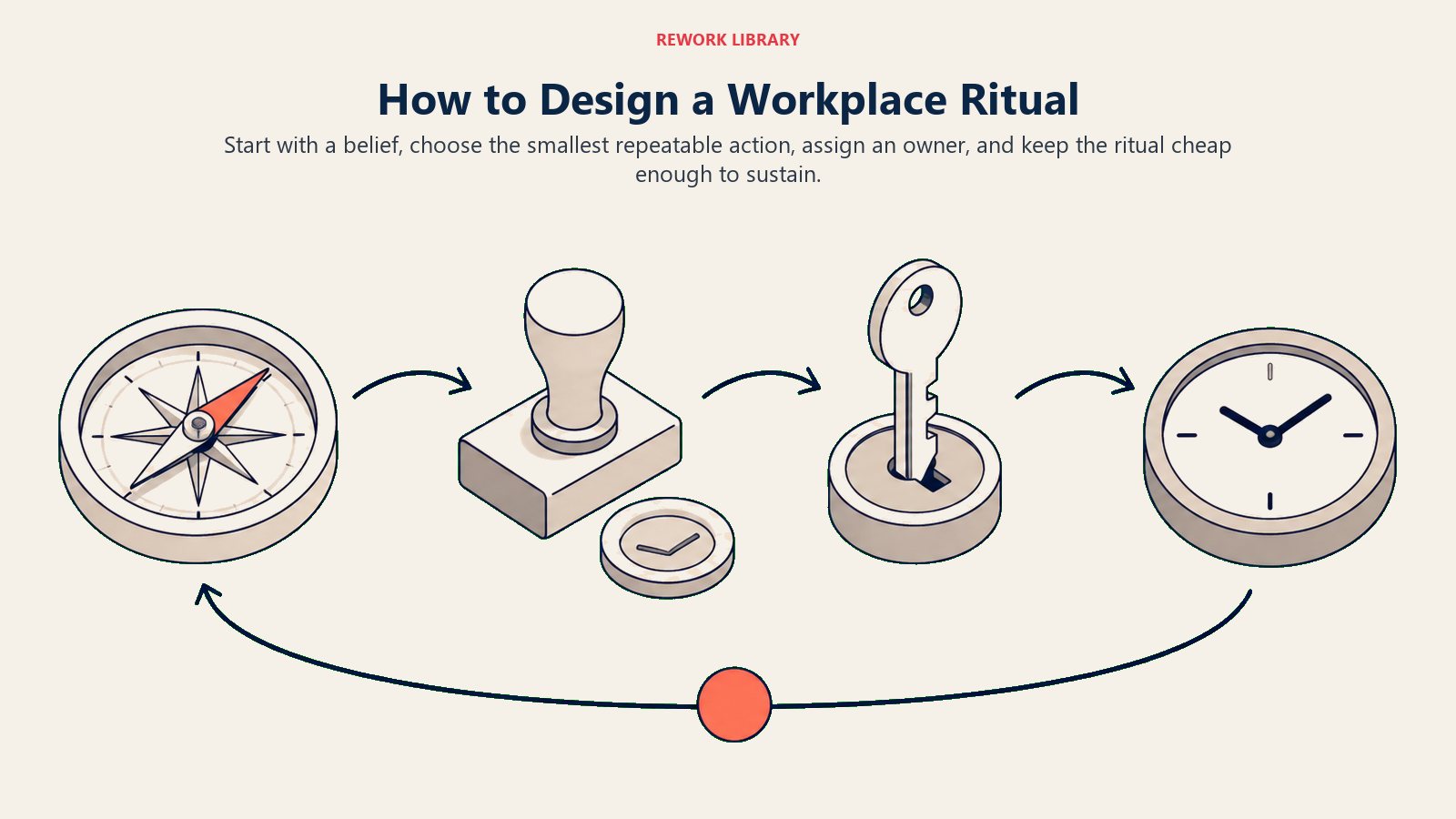
Pick the underlying belief first, then choose the smallest recurring action that makes it visible. If the belief is "everyone's voice counts in a decision," the ritual might be a round-robin at the start of every planning meeting, not a company-wide survey that runs once a year. The format should be the cheapest possible way to make the belief observable on a predictable schedule, not the most elaborate one that fits in a budget line.
Assign an Owner, or It Dies With Its Champion
A ritual with no named owner survives exactly as long as the person who started it stays enthusiastic, and quietly disappears the moment they get busy, change teams, or leave. Naming an owner, even an informal one, and rotating that ownership periodically, is what turns a founder's personal habit into an actual team institution that outlives any one person's attention.
Keep the Ritual Cheap to Repeat
The best rituals cost almost nothing to run every single time: a five-minute round-robin, a two-line shoutout post, a five-minute retro checkout question. A ritual that requires real planning, a big budget, or a special occasion to justify itself will happen a few times with real enthusiasm, then quietly slide to quarterly, then to "when we get around to it." Cheap and frequent beats expensive and rare almost every time culture is the actual goal.
Ritual Design for Remote and Hybrid Teams
Rituals do more work in a distributed team, not less, because remote and hybrid setups remove the incidental exposure an office used to provide for free: the hallway conversation, the shared lunch, the ambient sense of who's around and what they're working on. Without a deliberate ritual replacing that channel, distributed teams don't just lose a nice-to-have, they lose most of the informal signal that used to transmit culture without anyone trying.
The fix isn't recreating the office over video, which usually just produces exhausting, low-value calls nobody wants to attend. It's choosing rituals that work natively in an async or video-first format: a written-first weekly update that everyone reads and reacts to on their own time, a rotating "ask me anything" slot with a different teammate each week, a standing but genuinely optional coffee-chat pairing that resets every month so the same two people aren't stuck defaulting to it forever. Culture in remote and hybrid teams covers the broader mechanics of rebuilding what proximity used to do by accident, and rituals are the concrete unit that work gets built out of, one repeatable habit at a time rather than one big culture initiative.
The trap distributed teams fall into most often is importing an in-person ritual unchanged and wondering why it falls flat on video. A round-robin works beautifully on a call. A "walk around the room and share a win" ritual does not translate, because there's no room, and forcing the metaphor just makes remote attendees feel like they're watching something designed for people physically present somewhere else.
When Rituals Go Stale, or Turn Into Forced Fun
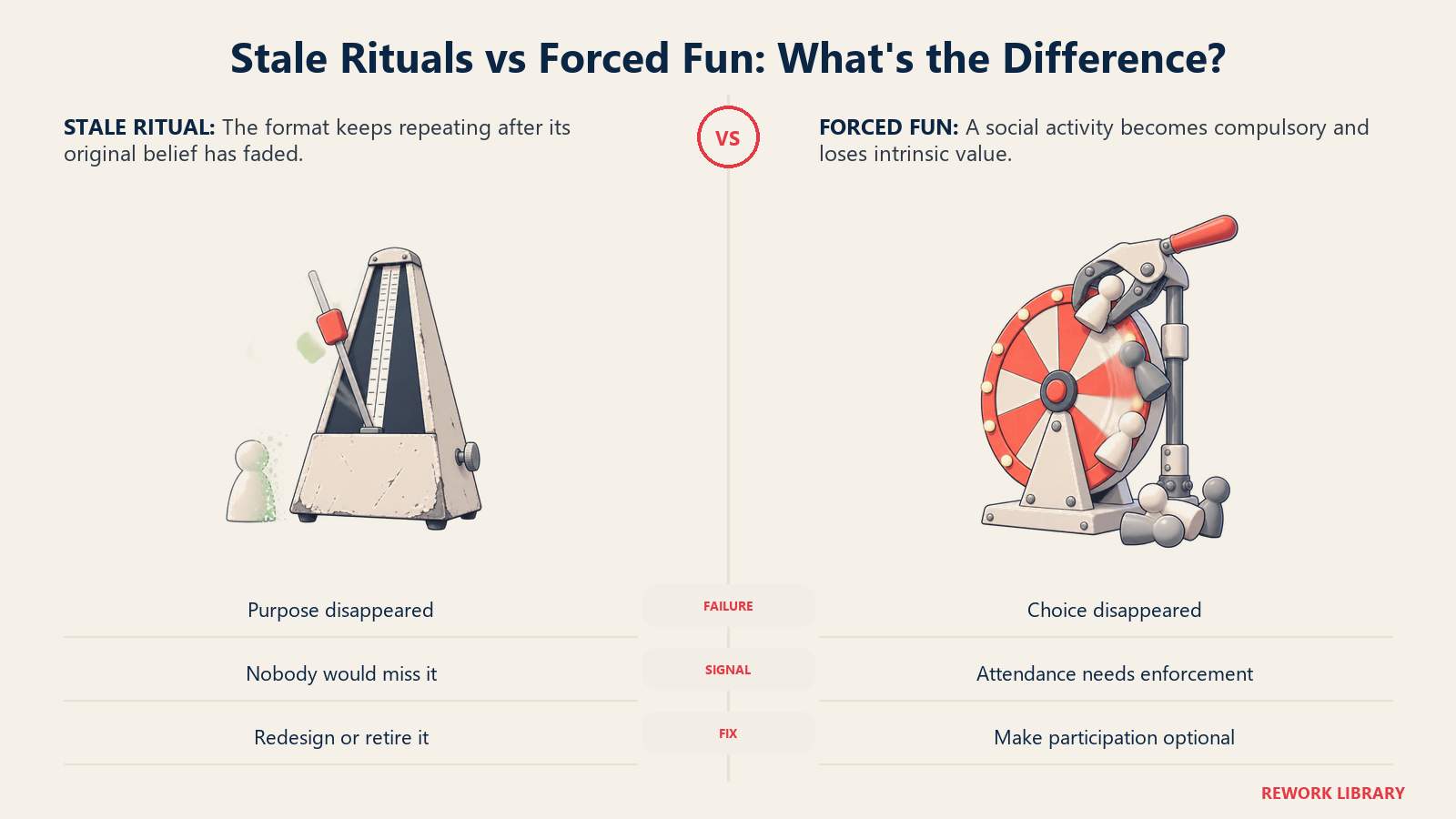
Every ritual has a shelf life, and pretending otherwise is how a good habit turns into an obligation nobody wants to defend out loud. Two failure modes show up constantly, and they're different problems with different fixes.
The Stale Ritual
A ritual goes stale when the format survives past the belief it was built to enact. The standup that used to surface real blockers now runs on autopilot, everyone reciting a status line nobody's actually listening to. The weekly shoutout channel still exists, but the same three people post in it out of habit while everyone else has quietly stopped reading. The tell is almost always the same: people keep attending or performing the ritual, but nobody would miss it if it vanished, and nobody can say what belief it's still reinforcing if you ask them directly.
The fix is rarely to kill the ritual outright, it's to check whether the underlying belief still matters and, if it does, redesign the format around it fresh. A stale standup might become a shorter async post plus a live discussion only when something's actually blocked. The belief, everyone's update matters, survives. The stale format doesn't have to.
When a Ritual Becomes Forced Fun
Forced fun is a different failure, and it's worth naming precisely because leaders often reach for more rituals as the fix for a culture problem that rituals can't solve. Research on mandatory team-building activities has found that removing choice from a supposedly fun activity removes the intrinsic motivation that made it enjoyable in the first place, and can trigger outright resistance, the psychological reactance people feel when a freedom, in this case the freedom to opt out, gets taken away. A "mandatory fun" happy hour, trivia night, or offsite doesn't read as a ritual to the people forced into it. It reads as one more task with a smile painted on it.
The signals are consistent: attendance requires enforcement rather than happening naturally, people show up but visibly disengage, and the ritual gets defended by leadership more energetically than it's ever requested by the team it's supposedly for. This is one of the quieter signs of a toxic culture, not because fun is bad, but because mandating it inverts the whole mechanism that makes a ritual work: real rituals earn participation because people believe in what they enact, not because attendance is tracked.
The honest fix is smaller than most leaders expect: make participation genuinely optional, let a ritual that nobody wants quietly die instead of propping it up, and take low uptake as real information about whether the underlying belief actually resonates, not a marketing problem to be solved with better invites.
Rituals in the Age of AI
A newer category of ritual is emerging now that some day-to-day collaborators are AI agents rather than people, and it's worth being precise about what's genuinely new here versus automation dressed up in ritual language.
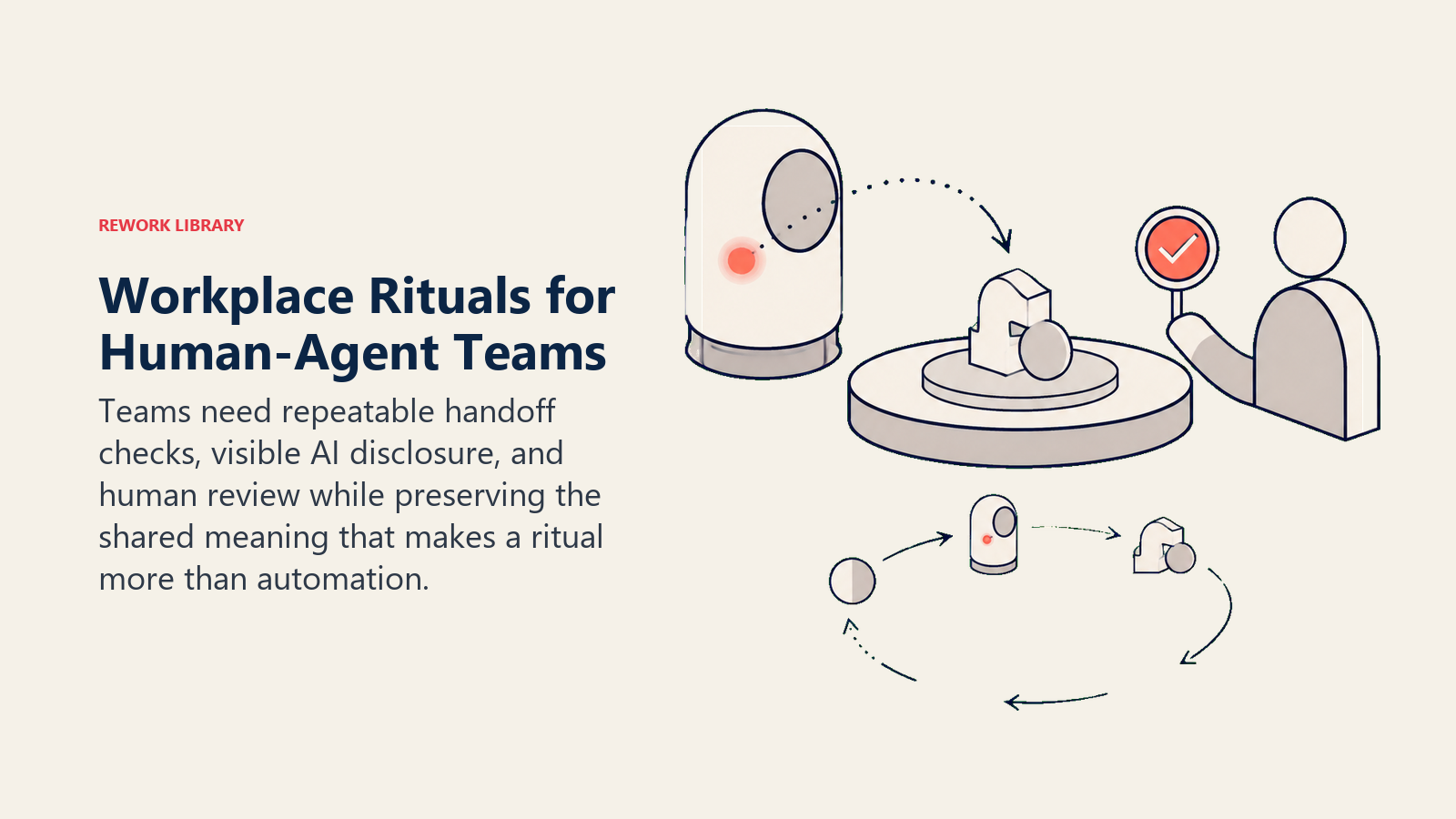
Agent-handoff rituals. When a task passes from a person to an agent, or an agent's output gets picked up by a person, teams are starting to build small, repeatable habits around that transition: a standard note explaining what the agent was asked to do and what it actually produced, a quick human check-in before an agent's output ships anywhere customer-facing. This is a genuinely new ritual category, distinct from ordinary automation, because it's really about trust and accountability, not just workflow. Human-agent teams and culture covers the broader dynamic this ritual is answering.
AI-in-the-room meeting norms. Whether a notetaker is transcribing a meeting, and who can see the transcript afterward, has quietly become a norm worth stating out loud rather than assuming. Naming that an AI tool is present, the same way you'd introduce a new person joining a call, is a small ritual with an outsized effect on whether people speak candidly. AI etiquette and workplace norms covers disclosure and attribution in more depth, and trust when your teammate is AI covers why that small act of naming matters more than it looks like it should.
What hasn't actually changed. An agent can post the weekly recognition message, generate the retro summary, or remind a team a standup is starting. None of that is the ritual itself, it's logistics support underneath one. The part a ritual actually does, signaling what a team believes and inviting people to enact that belief together, still requires people who mean it, showing up on a schedule they chose to keep.
Where Rework Fits
None of the rituals above require new software to start, they require a team willing to keep showing up for them. But a ritual with no home, a recognition habit that lives in one manager's head, a retro format nobody wrote down, tends to fade the moment that person gets busy or moves on. Teams running their work in Rework's Work Ops can build the recurring shoutout prompt, the retro template, and the standup structure directly into a recurring workflow, so the ritual survives past the founder or manager who started it, without turning into another mandatory event nobody asked for.
Where to Go Next
- What is business culture, the foundational definitions this article builds on
- How to define company values, the belief a ritual is built to make visible
- How to measure company culture, turning ritual participation into a real signal
- What is eNPS, one metric worth tracking alongside ritual health
Frequently Asked Questions about Workplace Rituals and Culture
What is a workplace ritual, exactly?
A workplace ritual is a repeated, deliberately designed behavior a team performs together on a predictable schedule, like a standup, a weekly shoutout, or an end-of-sprint retro, that carries meaning beyond its logistics. What separates it from a routine is that it enacts a belief the team holds, even when nobody states that belief out loud.
How is a ritual different from a company perk?
A perk is something people consume, like free snacks or a ping-pong table. A ritual involves people actively performing a shared action together on a repeating cadence, and that action points at something the group values. Perks don't require participation to exist; rituals stop existing the moment people stop showing up for them.
Why do rituals transmit culture better than a values statement or poster?
A poster states a belief once and hangs there passively. A ritual enacts that belief repeatedly, in front of witnesses, which makes it much harder to fake for long. New hires trust what they watch a team actually do far more than what they read on a wall, because repeated behavior is costlier to fake than a printed sentence.
What are the main types of workplace rituals?
The six worth designing on purpose are onboarding rituals, recognition rituals, retrospectives, standups, milestone and celebration rituals, and farewell or offboarding rituals. Most companies already have rough versions of all six; the difference is whether they were built intentionally around a real belief or accumulated by accident.
How do you design a ritual instead of letting one happen by accident?
Start with the belief you want to make visible, then pick the cheapest recurring action that demonstrates it consistently. Name an owner so it doesn't disappear when its original champion gets busy, and keep the format cheap enough to repeat weekly rather than needing a special occasion to justify itself.
When does a ritual turn into forced fun?
It happens when participation is mandated rather than earned, people attend but visibly disengage, and leadership defends the ritual more energetically than the team ever requested it. Research on mandatory team-building shows that removing the choice to opt out removes the intrinsic motivation that made the activity enjoyable in the first place.
How should rituals change for remote and hybrid teams?
Distributed teams need rituals even more than co-located ones, since they've lost the hallway conversations and incidental exposure that used to transmit culture for free. The fix is choosing formats that work natively async or on video, like a written weekly update or a rotating AMA slot, rather than forcing an in-person ritual like a "walk the room" activity onto a call where it doesn't translate.
How is AI changing workplace rituals?
A new category is emerging around agent handoffs, a standard note explaining what an agent was asked to do and what it produced before a person picks the work back up, and around naming when an AI notetaker is present in a meeting. Agents can support ritual logistics, like posting a reminder or drafting a summary, but the part that actually signals belief still needs people who mean it.
How do you tell if a ritual has gone stale?
The clearest sign is that people keep performing it, but nobody would miss it if it vanished, and nobody can say what belief it's still reinforcing if you ask directly. The fix is usually not killing it outright, it's checking whether the underlying belief still matters and rebuilding the format around it if it does.
A values poster is cheap to make and easy to ignore. A ritual costs almost nothing to run and is nearly impossible to fake for long, because it needs a team to keep showing up and meaning it, week after week. Build the six worth building on purpose, retire the ones that have gone stale, and never let "mandatory fun" replace the real thing. The rituals a team keeps without being told to are the most honest read of its culture you'll ever get.

Co-Founder, Rework.com
On this page
- What Counts as a Ritual (and What's Just a Perk)
- Rituals as the Visible Layer of Culture
- Key Facts
- The Six Types of Workplace Rituals Worth Designing
- Onboarding Rituals
- Recognition Rituals
- Retrospective Rituals
- Standup Rituals
- Milestone and Celebration Rituals
- Farewell and Offboarding Rituals
- Why Rituals Beat a Values Poster
- Designing Rituals Intentionally
- Start With the Belief, Not the Format
- Assign an Owner, or It Dies With Its Champion
- Keep the Ritual Cheap to Repeat
- Ritual Design for Remote and Hybrid Teams
- When Rituals Go Stale, or Turn Into Forced Fun
- The Stale Ritual
- When a Ritual Becomes Forced Fun
- Rituals in the Age of AI
- Where Rework Fits
- Where to Go Next