How to Design a Better Meeting Culture
Turn this article into takeaways for your work.


Each assistant summarizes the article only for you and suggests best practices for your work.
Meeting culture is the set of unwritten rules that governs how a company actually runs its meetings: who gets invited, who talks, who decides, and whether anyone's time is treated as a real cost. It is not a scheduling problem. It is company culture, compressed into an hour, with a start time.
That's why meeting culture is worth designing on purpose instead of letting it accumulate by default. Nobody decides "we will hold meetings with no agenda, let the loudest three people run the discussion, and invite eleven people to a decision that needs three." It happens gradually, one recurring invite at a time, until the calendar becomes a record of every deference and status habit the organization has never named out loud.
What Your Meetings Reveal About Your Culture
Walk into any company's all-hands, staff meeting, or weekly sync and you can read most of its real operating culture within twenty minutes, often more accurately than from a values deck. Three signals do most of the work.
Who talks tells you who has power. Not who has the title, who actually talks. In some rooms the most senior person speaks last on purpose, so nobody anchors to the boss's opinion first. In others, the senior person speaks first and everyone spends the rest of the meeting agreeing with varying enthusiasm. Airtime is one of the most honest proxies for authority a company has, and it rarely matches the org chart exactly.
Who decides tells you where authority actually sits. A meeting can look collaborative and still end with one person making the call regardless of what was said, or look hierarchical on paper and still end with the room quietly building consensus first. Consensus vs. top-down decision cultures covers this distinction in full, including why it's a separate axis from hierarchy itself.
How time gets treated tells you what the organization actually values. A culture that starts meetings on time, ends them early when the agenda is done, and protects people's calendars is telling every employee their hours matter. A culture that runs every meeting to its full scheduled length regardless of content, and treats a declined invite as minor insubordination, says something just as clearly, it just never puts it in a values statement.
None of this is really about meetings. It's culture, made visible in a format that repeats several times a day, which makes it one of the cheapest places to actually observe and change how a company operates.
Key Facts
- Executives report spending nearly 23 hours a week in meetings on average, up from less than 10 hours a week in the 1960s. Source: Harvard Business Review
- Poorly organized meetings were estimated to cost US organizations $399 billion in 2019, and professionals said they felt roughly two-thirds of the meetings they attended were unnecessary. Source: Doodle State of Meetings 2019
- Bain & Company found that a single weekly executive committee meeting at one large company consumed 300,000 person-hours a year once the preparatory meetings it triggered down the org chart were counted. Source: Harvard Business Review
- The average Microsoft Teams user saw a 252% increase in weekly meeting time and a 153% increase in the number of weekly meetings between February 2020 and 2022. Source: Microsoft Work Trend Index
- In a 2025 vendor survey by Fellow, an AI meeting-notes company, 75% of professionals said they currently use an AI notetaker in their work meetings, with privacy and security cited as the top reason among holdouts. Source: Fellow
The Dysfunctions That Make Meetings a Culture Problem
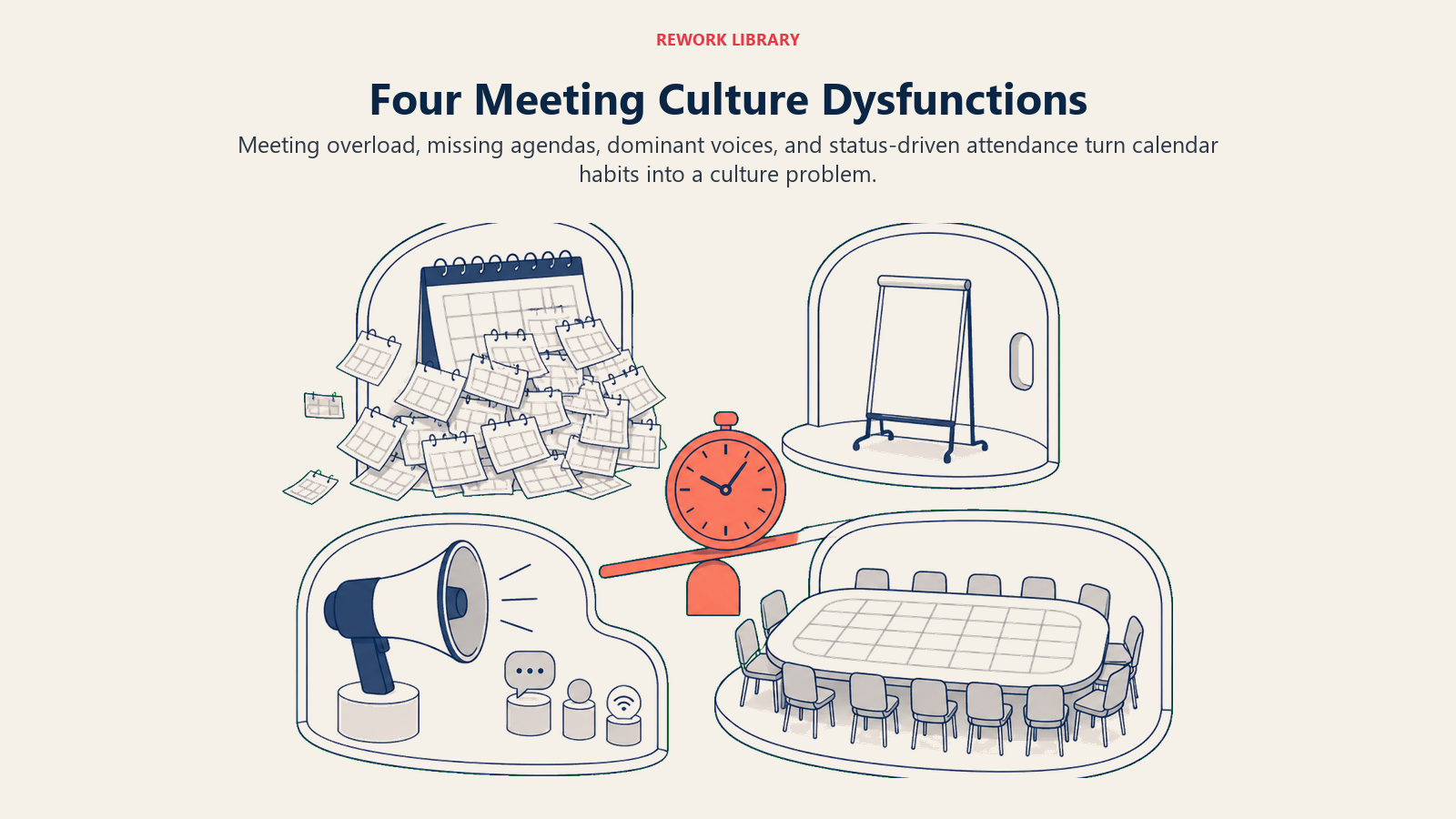
Most meeting complaints get filed under "too many meetings," which is real but incomplete. The deeper problems are structural, and they show up long before the calendar gets full.
Too Many Meetings, By Default
Meetings multiply because adding one is nearly free and removing one carries social cost. Nobody wants to cancel the standing sync a VP set up two years ago, even after the original reason evaporated. Left unmanaged, the calendar only grows, and the Bain research above shows exactly how one recurring meeting cascades into hundreds of thousands of hours once every layer below it holds its own prep meeting.
No Agenda, No Decision
A meeting without a written agenda is a meeting without an owner, and rarely produces a real decision. It produces a discussion that feels productive in the room and evaporates by morning, because nobody wrote down who does what by when. Recurring meetings are the worst offenders: the agenda that mattered in week one quietly stops getting updated, and by week twelve the meeting runs on inertia, not purpose.
Dominant Voices and Airtime Hierarchy
In an open-floor format, airtime goes to whoever is fastest, most senior, or least uncomfortable with silence, not necessarily whoever has the best information. Quieter processors, often more junior or working in a non-native language, need a beat of thinking time a fast-moving discussion rarely gives them. Why teams stay silent in meetings covers the full mechanics, including how to tell a dominant-voice problem apart from fear or format.
Meeting-as-Status
In some cultures, being invited to a meeting is itself the reward, a signal you matter enough to be in the room regardless of what you contribute once there. This balloons guest lists past anyone who actually needs to be present, because removing someone reads as demotion rather than a scheduling call. It ties closely to how hierarchical the underlying culture is; see hierarchical vs. egalitarian cultures for how that axis shapes who expects a seat at the table. Left unaddressed, it's one of the quieter signs of a toxic culture, rewarding proximity to power over useful contribution.
Designing a Better Meeting Culture
None of the fixes below require a company-wide mandate to start. They are habits a single team can adopt this week, and they compound once a few teams run them consistently enough that new hires copy them without being told to.
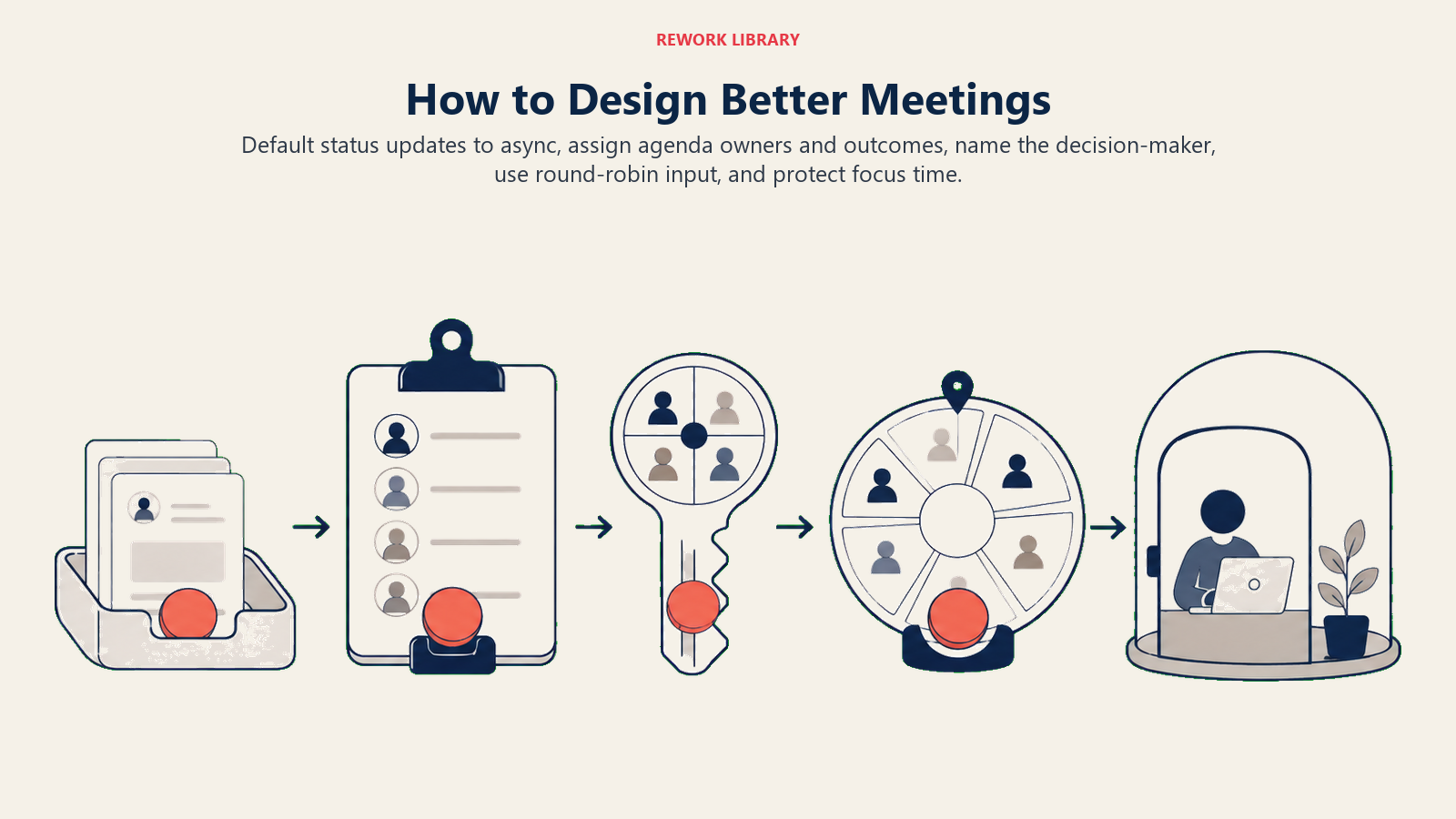
| Meeting need | Default format | Who's required |
|---|---|---|
| Status update, no decision needed | Async: written doc or recorded update | Owner posts, others read on their own time |
| Decision with 2-3 clear options | Short sync, 15-30 minutes | Decision-maker plus the people whose input actually changes the outcome |
| Complex, ambiguous decision | Sync with pre-read circulated 24 hours ahead | Decision-maker, key stakeholders, one note-taker |
| Brainstorm or open exploration | Sync, small group | 4-6 people, capped to keep airtime available for everyone |
| FYI or broadcast | Async: recording, memo, or channel post | No live attendance required |
Default to Async
The fastest way to shrink a meeting culture problem is to ask, honestly, whether a given meeting needs to be live at all. A status update nobody discusses in real time is a document wearing a calendar invite as a costume. Defaulting status updates, FYIs, and single-owner decisions to async formats, a shared doc, a short recording, a written proposal with a comment window, frees the remaining live time for discussions that genuinely need real-time back-and-forth.
Agendas With Owners and Outcomes
An agenda item is not a topic, it's a question with a name attached and a stated outcome: "Decide which vendor to use, owner: Priya, outcome: a pick by end of meeting" beats "Vendor discussion" every time. If an item can't be phrased that way, it usually isn't ready for a meeting yet, or doesn't need one.
Decide Who Decides, Before the Room
Most meeting frustration is really a decision-rights problem wearing a scheduling costume. Before the invite goes out, name who actually makes the call and who is there to inform it versus who is there to be informed after. A meeting where twelve people think they have a vote, and one person was always going to decide regardless, wastes eleven people's honesty along with their time.
Round-Robin for Inclusion
Open-floor discussion structurally favors fast talkers and senior voices. Going person by person, "what's your read on this?", asked directly to each attendee, removes the need to compete for airtime and signals that everyone's input is expected, not merely welcomed if they happen to jump in. It's one of the highest-leverage format changes for teams that go quiet under an open floor, and it costs nothing to try in your next sync.
Protect No-Meeting Blocks
A calendar with zero protected focus time has quietly decided coordination matters more than the work being coordinated. Blocking recurring no-meeting windows, a morning, a full day, whatever fits the team's rhythm, forces every meeting request to compete for a genuinely scarce slot instead of filling whatever gap is open. That scarcity alone kills a surprising share of meetings that would otherwise have survived on autopilot.
The Cross-Cultural Angle: Who Speaks First
Meeting format is never culturally neutral, even when it looks like a plain scheduling choice. The default Western meeting, open floor, whoever raises a hand first, assumes norms that do not hold everywhere.
In high power-distance cultures, waiting for the senior person to speak first, then calibrating your own view relative to theirs, is not passivity, it's the expected sequence, and skipping it can read as disrespect rather than confidence. In lower power-distance cultures, that same waiting can look like a lack of opinion. Neither read is wrong on its own terms; they're different rooms running different rules. Hierarchical vs. egalitarian cultures covers this axis in depth, and high-context vs. low-context cultures covers a related pattern: in high-context settings, much of a meeting's real signal is carried by what's implied and by who is in the room, not just by what gets said.
Decision style and hierarchy also get confused here, and it changes how you should design the meeting. A steeply hierarchical culture can still decide by consensus, quietly, before the meeting starts, the way many Japanese organizations build agreement through nemawashi ahead of a decision meeting that mostly ratifies what was already settled. A nearly flat culture can still decide top-down, fast, in the room, the reverse of what its flat org chart implies. A leader who assumes their home culture's meeting format is the neutral, correct one usually ends up quietly cutting off the exact voices whose disagreement would have caught a problem early, the pattern covered in why teams stay silent in meetings and psychological safety at work.
Meeting Culture in Remote and Hybrid Teams
Every dysfunction above gets amplified once a meeting moves to video. A co-located room gives a skilled facilitator small physical cues, a leaning-forward posture, a half-raised hand, that signal someone wants to speak before they've said a word. Video calls strip most of that out, and unmuting to interrupt carries a noticeably higher social cost than raising a hand across a table.
Hybrid meetings add a second layer: a room full of people present, plus a handful joining by video, rarely operates as one meeting. The people in the room read each other's body language and grab hallway time right after. Remote attendees get the transcript version, none of the ambient signal, and a harder time getting a word in. Left unmanaged, hybrid setups quietly reward physical presence with its own unearned airtime advantage. Culture in remote and hybrid teams covers the fuller set of rituals that rebuild trust once the office stops doing that work by accident, and the same discipline, written-first proposals, round-robin turns, a single source of truth for notes, fixes meeting culture specifically.
Meeting Culture in the Age of AI
AI notetakers moved from novelty to default fast enough that most teams adopted the habit before anyone wrote down the norms for it. That gap is worth closing, because an AI silently transcribing a sensitive conversation changes the room even when nobody says so out loud.
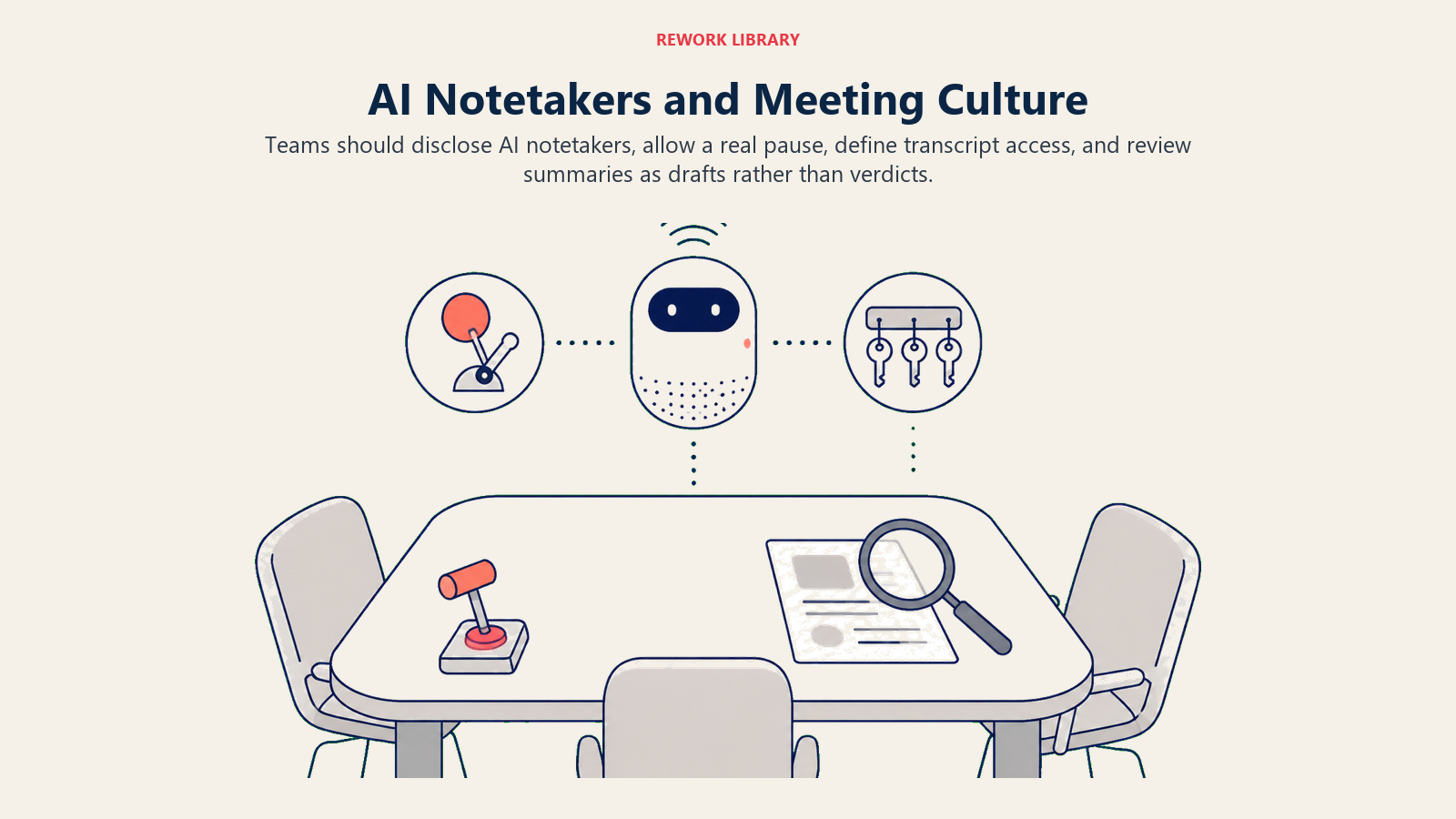
Say it's there, every time. A visible bot icon is not the same as informed consent. People change what they say, and what they admit to not knowing, when they believe a permanent, searchable transcript is being generated instead of a conversation that would otherwise be forgotten. Naming the notetaker out loud before a sensitive discussion, and giving people a real option to pause it, costs ten seconds and avoids a much larger trust problem later.
Ask who the AI is actually working for. A notetaker only the meeting organizer can access serves a different function than one the whole team can see and query. The first can quietly become a surveillance tool capturing every stumble for one person's later use. The second is closer to shared institutional memory. Which one you've built is a culture decision, not a settings toggle, worth naming explicitly rather than defaulting to whatever the vendor ships.
Treat the AI summary as a draft, not a verdict. An AI summary reflects what got said loudest and clearest, the same airtime bias this whole article is about, now automated and given a permanent record. A summary that faithfully captures the dominant voices and quietly drops the one hedge from the quietest person has not removed bias from your meeting culture, it has scaled it and timestamped it. This is one thread of what Deloitte calls AI cultural debt: erosion that accumulates when a tool gets adopted for convenience without anyone examining its effect on trust, including how human-agent teams build or lose trust between the people in the room and the tools working alongside them.
None of this argues against AI notetakers. It argues for treating who transcribes the room, who can see it, and what happens with its blind spots as a real meeting culture decision, made on purpose, the same way you'd decide who chairs the meeting.
Where Rework Fits
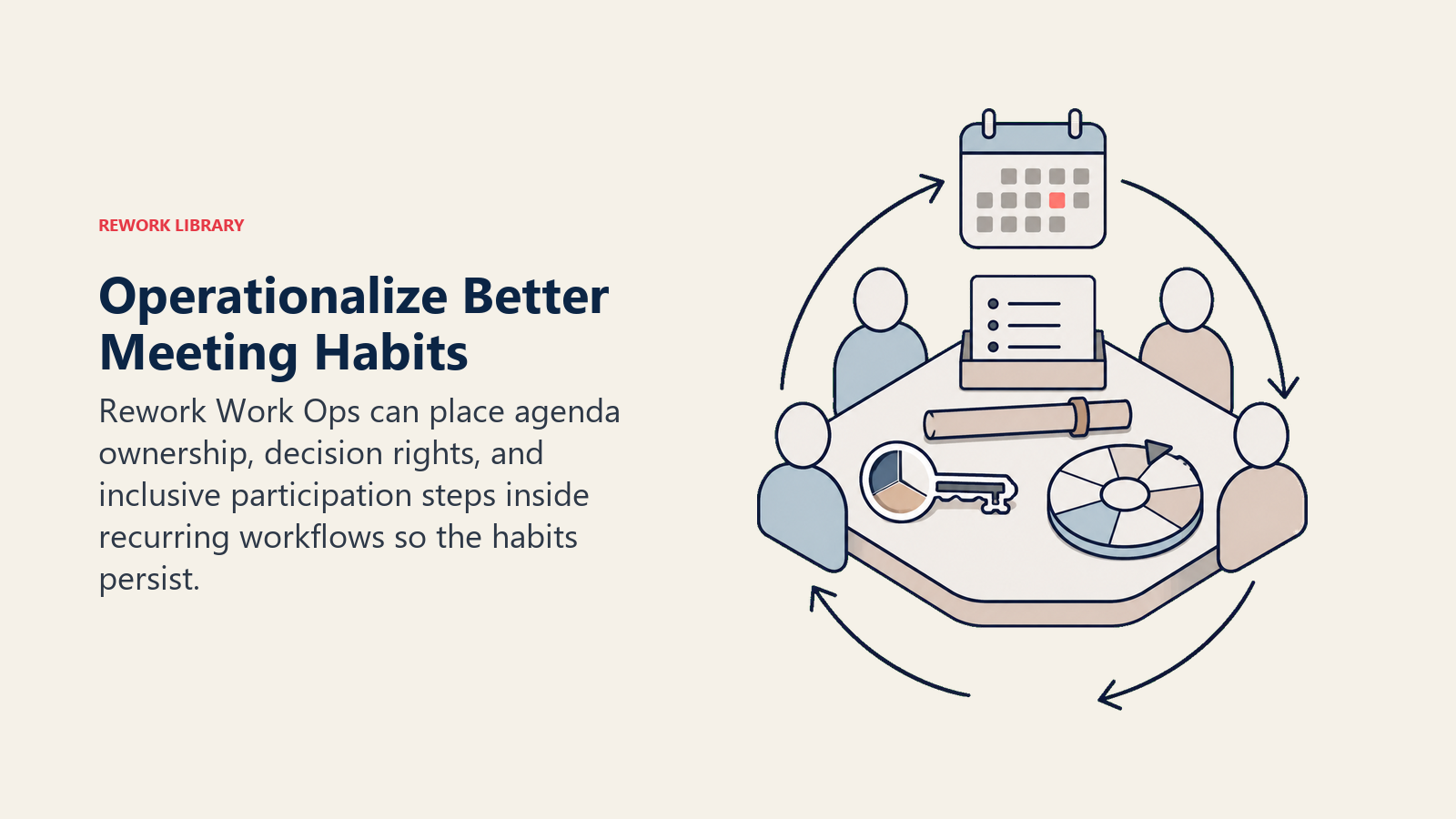
None of the redesign above requires new software, it requires a team willing to change the habit. But a round-robin, a no-meeting block, or a written-first proposal that lives only in one manager's head tends to fade within a quarter once that manager gets busy or moves on. Teams running their work in Rework's Work Ops can build the agenda-with-owner step, the decision-rights record, and the round-robin prompt directly into a recurring meeting workflow, so the habit survives past the first few meetings where it still feels new.
This discipline connects to building a feedback culture and building trust in the workplace. And if you want to check whether the redesign is actually working rather than just feeling better in the room, how to measure company culture covers the signals worth tracking beyond a post-meeting survey.
Frequently Asked Questions about Meeting Culture
What is meeting culture?
Meeting culture is the set of unwritten rules a company runs its meetings by: who gets invited, who talks, who actually decides, and whether time is treated as a real cost. It's one of the fastest ways to read an organization's real culture, often faster than a values statement.
Why do meetings reveal company culture better than other things?
Meetings repeat constantly and in front of witnesses, so patterns show up fast. Who talks first, who gets cut off, who the room defers to, and whether a meeting starts and ends on time all show the organization's actual hierarchy and priorities, regardless of what the stated values say.
How many meetings is too many?
There's no universal number, but a useful test is whether removing a given recurring meeting would actually be noticed. If nobody can say what decision it produced last time it ran, it has likely outlived its purpose.
What should a good meeting agenda actually include?
Each item should read as a question with an owner and a stated outcome, for example "decide which vendor to use, owner: Priya, outcome: a pick by end of meeting," rather than a vague topic like "vendor discussion." If it can't be phrased that specifically, it isn't ready for a meeting yet.
Do no-meeting blocks actually work?
Yes, mainly because they create real scarcity. When only a limited number of slots exist, every request has to justify taking one, which filters out meetings that were only ever filling open calendar space.
Should an AI notetaker join every meeting?
That's a culture decision, not a default setting. What matters is naming that it's there, giving people a real option to pause it for sensitive discussions, and being clear who can access the transcript afterward, since that shapes whether it's shared memory or one-sided surveillance.
Does remote work make meeting culture worse?
It amplifies whatever was already there. Video calls remove the small physical cues that help a facilitator draw quieter people in, and hybrid setups can create a proximity bias where people in the room get more airtime than remote attendees, even unintentionally.
What is round-robin and why does it help meeting culture?
Round-robin means going person by person and asking each attendee directly for their view, instead of leaving the floor open to whoever speaks first. It removes the need to compete for airtime and signals everyone's input is genuinely expected.
A company's meeting calendar is one of the most honest documents it has, because nobody edits it for how it looks to outsiders. Redesigning meeting culture isn't really about shorter meetings or fewer of them, though both usually follow. It's about deciding on purpose who talks, who decides, and whose time gets protected, instead of letting those answers accumulate by default until the calendar is just telling you who already has power.

Co-Founder, Rework.com
On this page
- What Your Meetings Reveal About Your Culture
- Key Facts
- The Dysfunctions That Make Meetings a Culture Problem
- Too Many Meetings, By Default
- No Agenda, No Decision
- Dominant Voices and Airtime Hierarchy
- Meeting-as-Status
- Designing a Better Meeting Culture
- Default to Async
- Agendas With Owners and Outcomes
- Decide Who Decides, Before the Room
- Round-Robin for Inclusion
- Protect No-Meeting Blocks
- The Cross-Cultural Angle: Who Speaks First
- Meeting Culture in Remote and Hybrid Teams
- Meeting Culture in the Age of AI
- Where Rework Fits