Schein's Three Levels of Organizational Culture Explained
Turn this article into takeaways for your work.


Each assistant summarizes the article only for you and suggests best practices for your work.
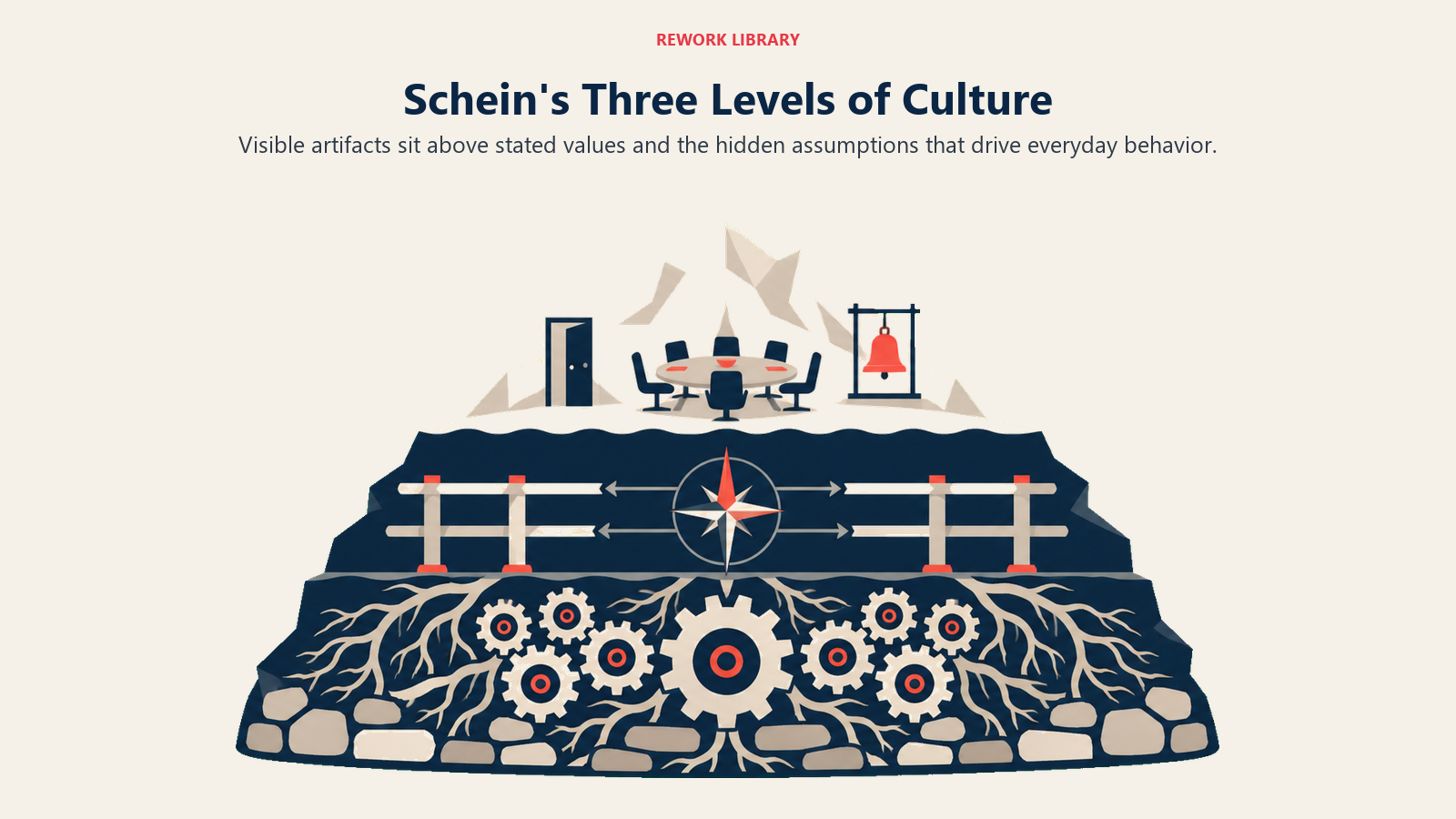
Edgar Schein's three levels of culture model explains organizational culture as three nested layers, from most visible to least: artifacts (what you can observe), espoused values (what the organization says it believes), and basic underlying assumptions (the unconscious beliefs that actually drive behavior). The deepest layer, not the visible one, is the real culture.
That ordering matters more than it looks. Most leaders trying to fix a culture problem start at the top, with a new values statement or a redesigned office, because that is the layer they can see and change quickly. Schein's whole point is that the top layer is the least reliable evidence of what a culture actually is, and the least effective place to intervene if you want behavior to change. If you have ever watched a company roll out a beautiful new mission statement and change nothing about how people actually treat each other six months later, you have watched this model fail in real time.
Where Schein's Model Comes From
Edgar Schein was an organizational psychologist at MIT Sloan who spent decades studying why culture change efforts succeed or collapse. He first laid out the three-level structure in a 1984 Sloan Management Review article, "Coming to a New Awareness of Organizational Culture," then expanded it into the book Organizational Culture and Leadership, first published in 1985 and now in its fifth edition.
The model held up because it answers a question that trips up almost every leader trying to change culture: why does a values initiative everyone nods along with in the all-hands meeting change nothing about how the team behaves the following Tuesday? Schein's answer is that values statements sit at a shallow layer of culture, while behavior is driven by a deeper layer no slide deck can touch. That is why the model is still the default framework taught in MBA programs and used by consultants running culture diagnostics, four decades after it was written.
The Three Levels at a Glance
Before going deep on each layer, it helps to see how they relate. Each level is more powerful and more invisible than the one above it.
| Level | Visibility | What it is | Business example |
|---|---|---|---|
| Artifacts | Fully visible | The observable stuff: behavior, language, symbols, physical space, processes | An open floor plan, a "no meetings before 10am" rule, a public leaderboard |
| Espoused values | Stated, not always practiced | What the organization says it believes and claims to stand for | "We value work-life balance" printed in the employee handbook |
| Basic underlying assumptions | Invisible, unconscious | The taken-for-granted beliefs that actually govern decisions | "The people who stay latest are the ones who get promoted" |
Notice the direction of the arrow. Artifacts are produced by espoused values, and espoused values are, in theory, supposed to reflect underlying assumptions. In practice, the arrow often runs backward: the real underlying assumption ("late nights signal commitment") produces behavior that quietly contradicts the espoused value ("we value work-life balance") while nobody updates the handbook.
Key Facts
- 82% of executives surveyed in Deloitte's 2016 Global Human Capital Trends report believe culture is a potential competitive advantage, but only 19% believe they have the "right culture," and just 28% believe they truly understand their own organization's culture. Source: Deloitte
- In a Strategy&/Katzenbach Center Global Culture Survey of senior executives, 84% said culture was critical to the success of a change management effort, and 64% said culture mattered more to performance than strategy or operating model. Source: PwC Strategy&
- Schein first introduced the three-level model in a 1984 Sloan Management Review article before expanding it into Organizational Culture and Leadership, a book still in active use and now in its fifth edition. Source: MIT Sloan Management Review
- 65% of organizations in Deloitte's 2026 Global Human Capital Trends research believe their culture needs to change significantly because of AI, and 34% say culture is currently blocking their AI transformation goals. Source: Deloitte
Level 1: Artifacts
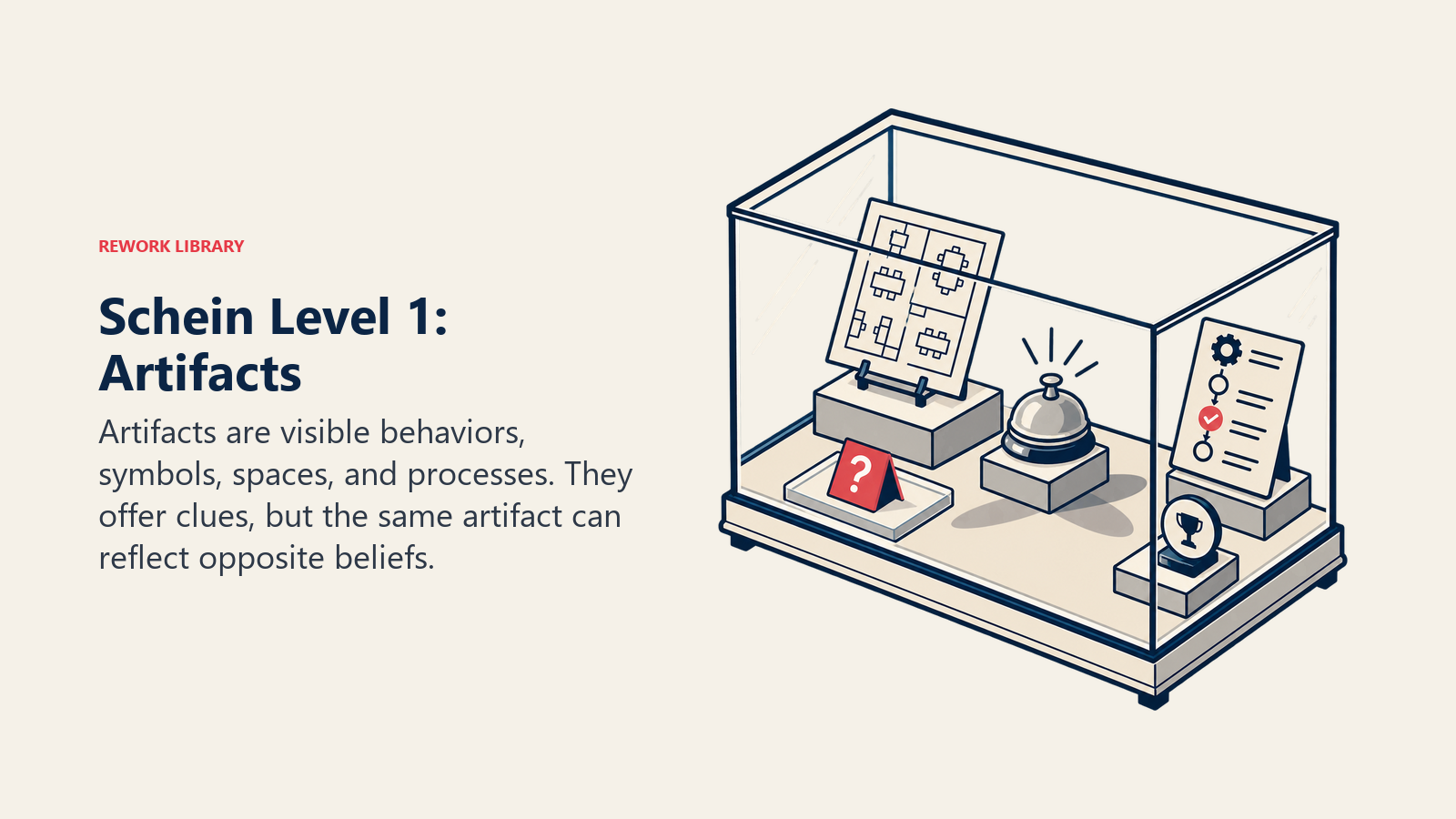
Artifacts are the layer of culture you can walk in and see on day one. Office layout, dress code, how meetings are run, what gets celebrated in the company Slack, the org chart, the tools everyone uses, the language people reach for ("we're a family here" versus "we're a team of professionals"). Artifacts include behavior itself, not just physical objects: how people talk to each other in a meeting is an artifact, and so is whether anyone interrupts the most senior person in the room.
Why Artifacts Are Easy to Copy and Easy to Miscopy
Because artifacts are visible, they are also the easiest layer to copy from another company, and the easiest layer to get wrong. A startup that installs a ping pong table because it read that Google has one is copying an artifact without understanding the underlying belief that artifact expressed (something about informal collaboration and status flattening). Copied artifacts without the belief behind them tend to feel hollow, and employees notice the hollowness fast.
| Common artifact | What it might signal | What it might actually be |
|---|---|---|
| Open floor plan | Collaboration, transparency | Cost-cutting on real estate |
| Unlimited vacation policy | Trust and flexibility | A policy nobody feels safe using |
| Public sales leaderboard | Healthy competition | A quiet driver of hoarding leads |
| No-email-after-hours rule | Respect for boundaries | A rule leadership itself ignores |
The lesson is not that artifacts are worthless. They are useful diagnostic clues. The lesson is that you cannot read a culture from its artifacts alone, because the same artifact can point to opposite underlying realities depending on the company.
Level 2: Espoused Values
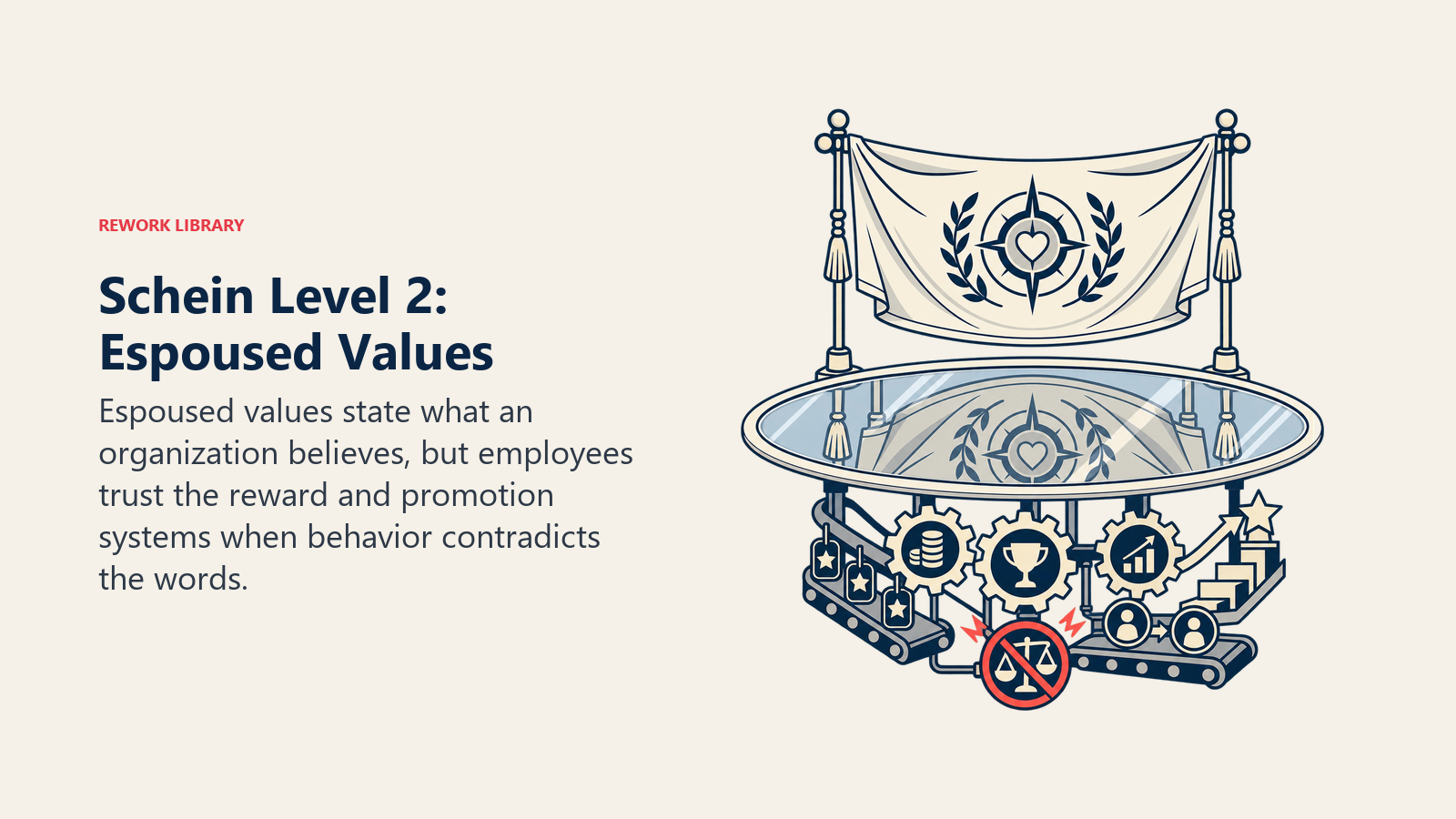
Espoused values are what an organization says it believes: statements like "customer obsession," "we win as a team," "integrity above all." These usually live in the careers page, the onboarding deck, the all-hands slide, and the framed poster in the lobby. Most organizations put the overwhelming majority of their culture effort into this layer, because it is the layer leadership has the most direct control over. Write the values, print them, talk about them in the town hall, and the espoused-values layer is done.
The Values-Behavior Gap
The problem is that espoused values describe aspiration, not necessarily behavior, and every employee eventually tests the gap between the two. A company that espouses "collaboration" but only measures and rewards individual output is running two different cultures at once: the one on the wall and the one in the performance review. Employees learn to trust the second one, because it is the one that determines their bonus.
This is also where most culture change initiatives get stuck. Refreshing the values statement, running a workshop, or renaming "excellence" to "impact" all happen at this layer, and all of them feel like progress because something visibly changed. But if the underlying assumptions and the systems that reinforce them (hiring, promotion, what gets tolerated from a high performer) stay the same, the new values statement becomes one more artifact contradicting the real culture, which is worse than changing nothing.
Level 3: Basic Underlying Assumptions
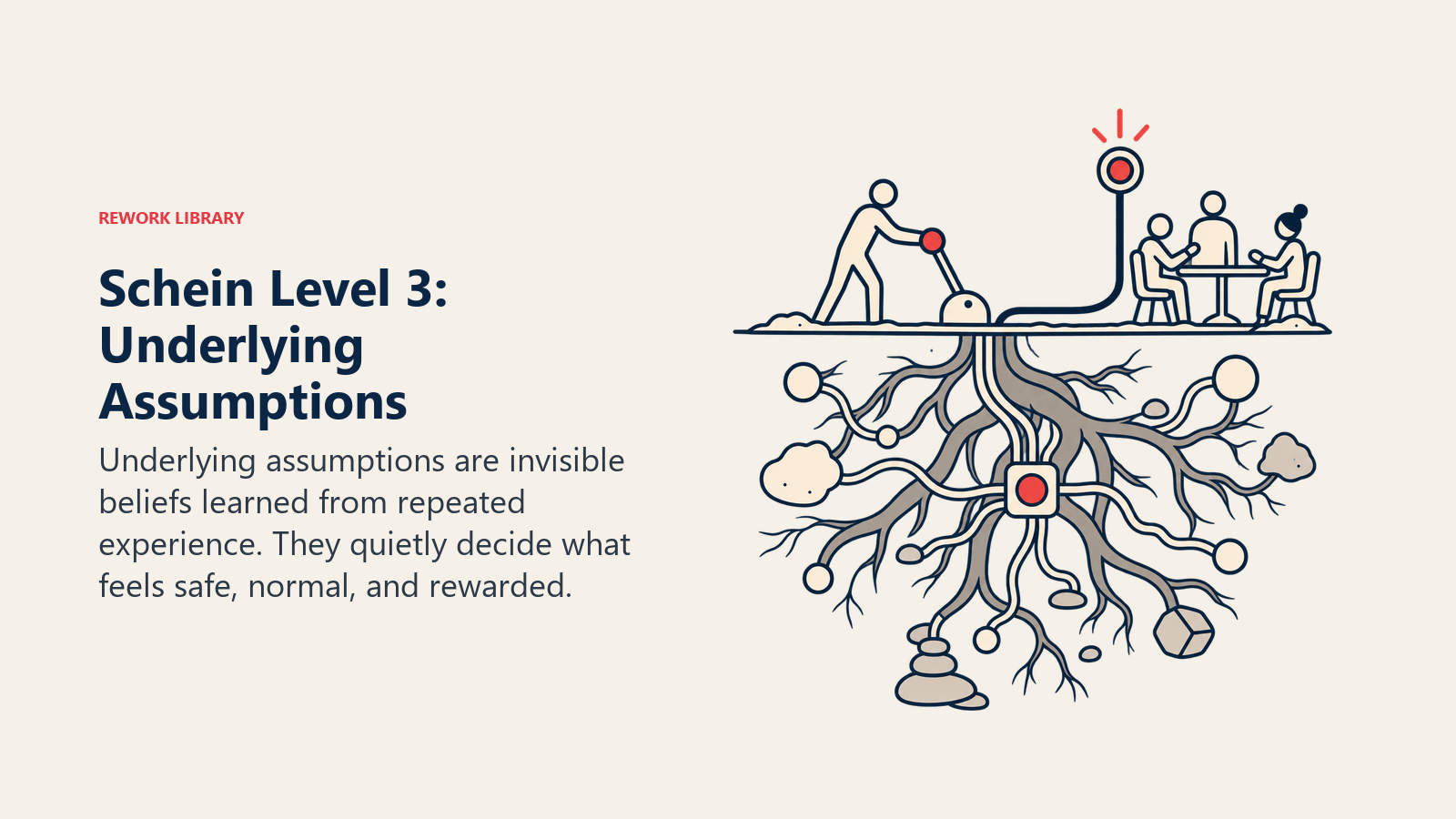
Basic underlying assumptions are the deepest layer: unconscious, taken-for-granted beliefs about how the world works that people are not even aware they hold, because the belief feels like a plain fact rather than an assumption that could be wrong. Examples: "conflict is dangerous, so smooth it over in the meeting and handle it in private later." "Customers do not really know what they want, so it is our job to decide for them." "Admitting a mistake in front of leadership ends careers, so bury it and fix it quietly." Nobody writes these down. Nobody discusses them in onboarding. New hires absorb them within a few months by watching what actually happens, not by being told.
Why This Layer Is Invisible to the People Inside It
Underlying assumptions are hard to see specifically because they work. They resolved some real problem so effectively, so repeatedly, that they stopped being treated as a choice and became treated as reality. A founding team that survived a near-death funding crisis by working around the clock may develop the unconscious assumption that "urgency and long hours are what save this company." Ten years later, with the company profitable and stable, that same assumption still runs the show, driving burnout leadership genuinely cannot see, because to them it is not a belief, it is just how serious companies operate.
This is the layer where why teams stay silent in meetings actually gets explained. A team's silence is rarely a personality trait. It is usually the visible behavior sitting on top of an underlying assumption, often something like "raising a concern in front of the group makes you the problem," that nobody stated out loud but everyone learned from watching what happened the one time someone tried.
How to Use the Model to Diagnose a Culture Problem
Schein's model is most useful as a diagnostic tool, not just a description. When something feels wrong in an organization, the model gives you a way to work downward from what you can see to the belief actually driving it.
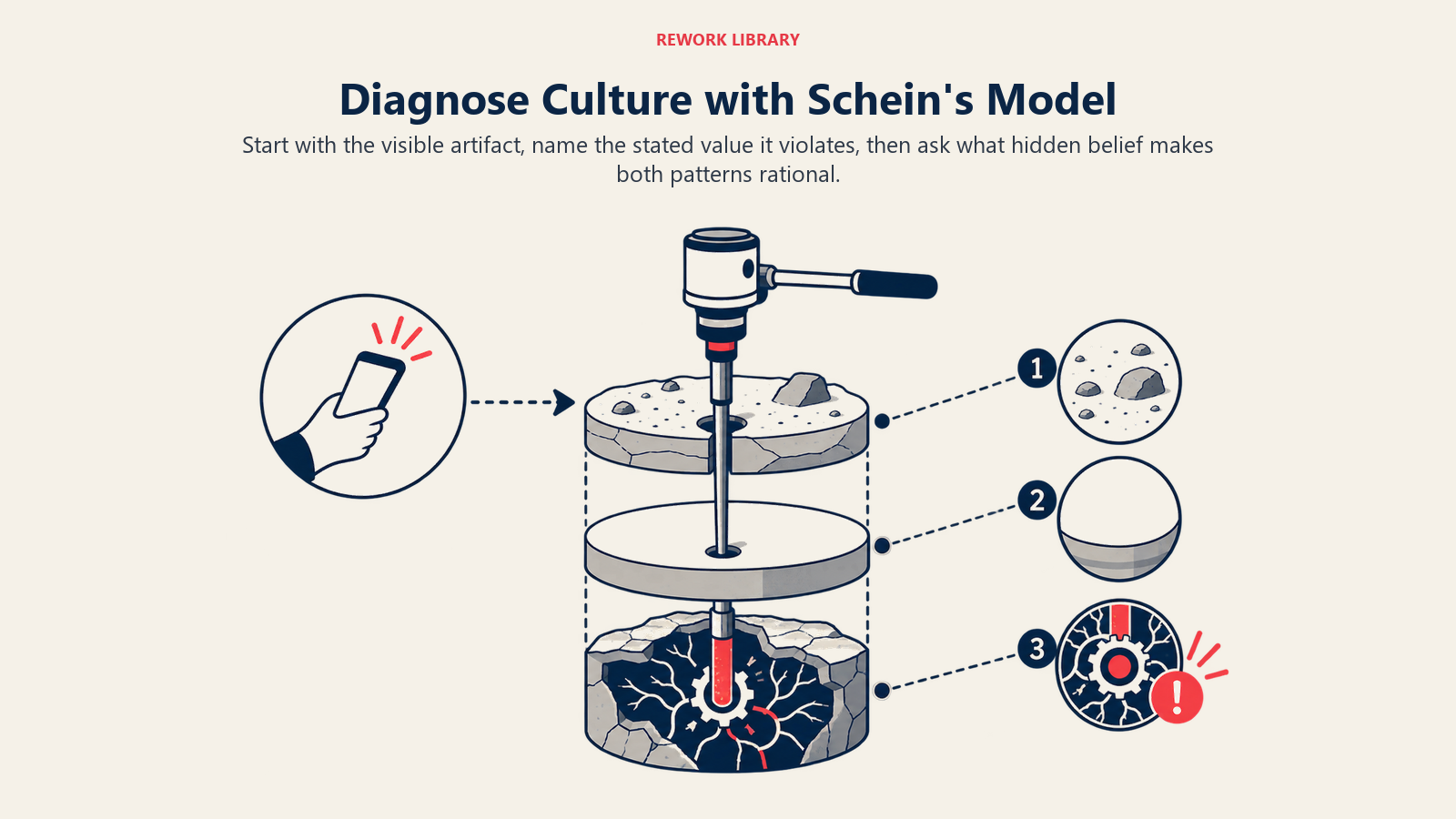
| What you observe (artifact) | Likely espoused value being violated | Question to surface the real assumption |
|---|---|---|
| Nobody speaks up in the leadership meeting | "We value open communication" | "What happened the last time someone disagreed with a senior leader here?" |
| Deadlines are always hit but quality quietly slips | "We value excellence" | "What actually gets someone in trouble here: missing a deadline, or shipping something flawed?" |
| High performers get away with bad behavior | "We have zero tolerance for disrespect" | "What would it take for this person to actually be held accountable?" |
| Every decision routes through one executive | "We trust our people" | "What does leadership believe happens if authority is delegated without close oversight?" |
The pattern across all four rows is the same: start with a visible artifact, name the espoused value it appears to violate, then ask a question aimed at the belief underneath both. That underlying belief, not the artifact and not the values poster, is what you are actually trying to change.
How to Use the Model to Change Culture
Diagnosis is only half the model. Schein's real argument is about where change efforts should aim, and it explains why so many of them fail despite genuine leadership intent.
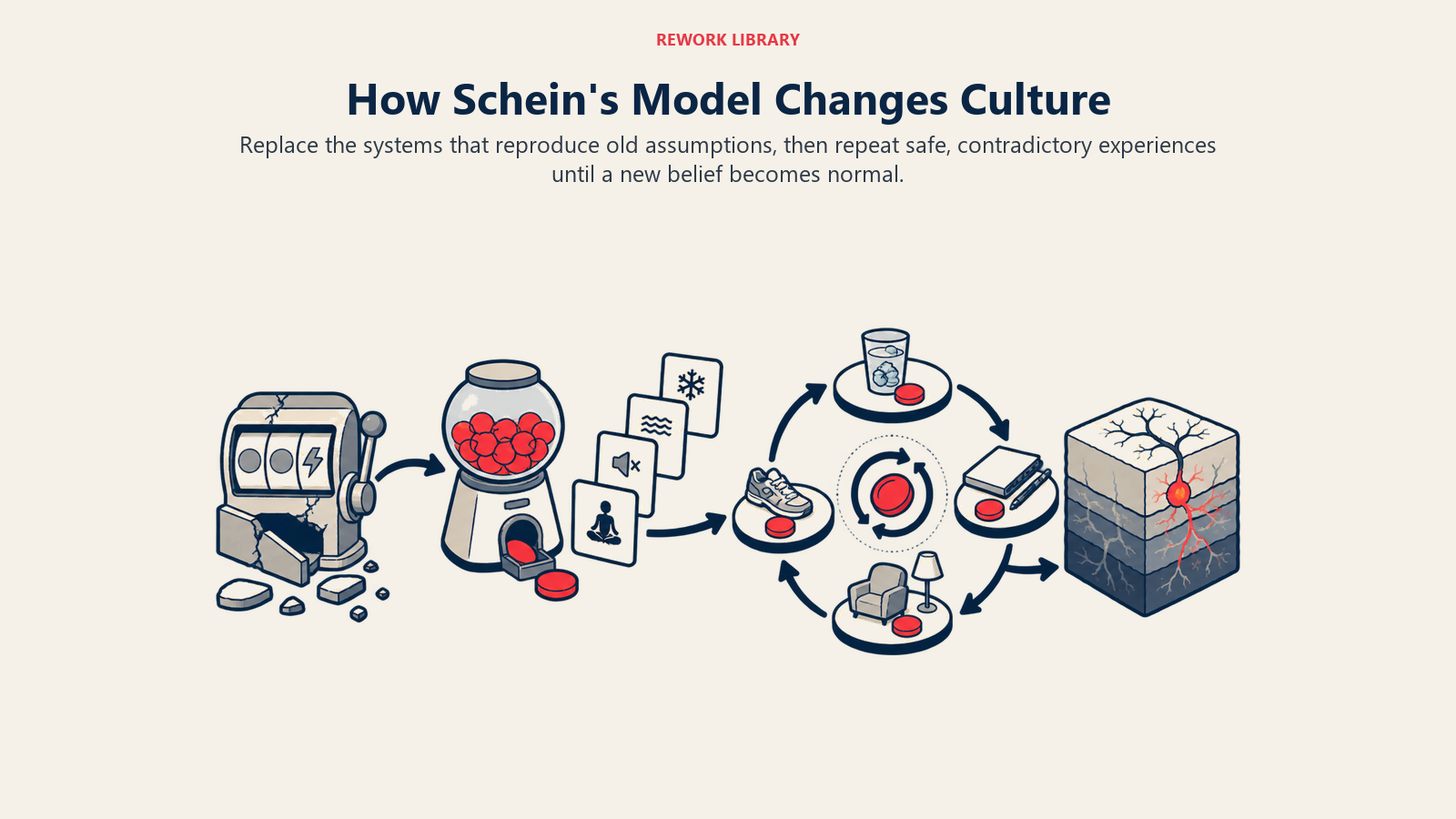
Artifact-level change is fast but shallow. Redesigning the office, rewriting the mission statement, or launching a new recognition program are all artifact or espoused-value changes. They are worth doing, but on their own they rarely move behavior, because the underlying assumption that produced the old behavior is still fully intact and will simply produce new artifacts that express the same belief.
Real change requires new experiences, not new statements. Schein argued that underlying assumptions only shift when people have a new, repeated experience that contradicts the old assumption and survives contact with reality. If the assumption is "raising bad news gets you punished," no memo will change it. What changes it is a leader visibly rewarding someone for surfacing a problem early, doing that consistently, and having the team watch nothing bad happen to that person, several times, before the old assumption loosens its grip. Culture architecture covers this system-by-system approach to redesigning hiring, promotion, and reward criteria so they produce those experiences instead of just new language.
Change the systems that manufacture the experience. Hiring criteria, promotion decisions, what gets measured, and what gets excused from a high performer are the actual levers, because they generate the repeated experiences employees learn from. Getting that redesign right is the difference between a values refresh and an actual shift in belief, and culture that scales covers keeping those systems intact as headcount grows and founders can no longer model every behavior personally.
Expect it to take longer than a campaign. Because you are waiting for disconfirming experiences to accumulate into a new assumption, real change at this level typically takes years of consistent, aligned systems, not a single initiative. Leaders who expect a quarter-long culture push to shift underlying assumptions are, without realizing it, aiming at the wrong layer of the model.
Limitations of Schein's Model
No framework this old survives without real limitations, and it is worth naming them rather than treating the model as gospel.
The three levels are cleaner in theory than in practice. Real organizations rarely sort neatly into three distinct layers; the boundary between an espoused value and a genuinely held assumption is often blurry, and reasonable observers can disagree which layer a given belief sits in. The model also says little about power: it treats culture as something that emerges collectively, but in most organizations a founder or CEO's personal assumptions get disproportionate weight in what becomes "the culture." It was also developed studying mostly large, established Western organizations, and applying it directly to a five-person startup or a culture shaped heavily by national context (see how business culture differs across the world and Hofstede's cultural dimensions) takes some adaptation. Used as a rigid checklist, it can also become an exercise that never touches the systems driving behavior, the exact failure mode it was written to warn against.
None of that makes the model wrong. It makes it a starting lens, not a finished answer, which is true of most frameworks this durable.
Schein's Model in the Age of AI
The three-level model turns out to be a useful lens for a newer problem: what Deloitte's 2026 research calls AI cultural debt, the misalignment and eroded trust that accumulates when AI gets rolled out fast without anyone touching the underlying beliefs about work. A company might adopt AI tools (the artifact) and even publish an AI usage policy (the espoused value), while an unstated underlying assumption, something like "using AI on your work is something to hide, not disclose," quietly governs what people actually do. That gap is exactly the pattern Schein described decades before AI was part of the conversation: new artifacts on top of an untouched assumption. AI cultural debt and what is AI-native culture go deeper on how that specific gap forms and what closes it, and trust built through consistent, safe experiences is exactly the mechanism that closes it, whether the new teammate is a person or an AI agent.
Why the Deepest Level Is the Real Culture
Come back to the original question: why does a new values statement so often change nothing? Because it operates at the layer people can see and control quickly, while behavior is governed by the layer nobody discusses out loud. Artifacts are the evidence. Espoused values are the intention. Underlying assumptions are the operating system, running quietly underneath both, and it is the only layer that actually determines what happens the next time someone has to make a judgment call with no policy covering the specific situation.
That is why "the deepest level is the real culture" is not a throwaway line. It is the entire practical payoff of Schein's model: if you want to know what a culture actually is, stop reading the posters and start asking what people believe will happen to them if they do the risky, honest thing. Whatever answer comes back, consistently, across enough people, is the culture. Everything else is decoration on top of it.
Where to Go Next
- What is business culture?, for the foundational definition and how Schein's model fits alongside the other core frameworks
- Culture architecture, for the full system-by-system playbook this article's change section only summarizes
- Why teams stay silent in meetings, for a real-world case of an underlying assumption producing a very visible artifact
- How business culture differs across the world, for how national culture shapes which assumptions take root in the first place
Schein's model has survived four decades of management fads because it makes an uncomfortable point that most frameworks avoid: the culture you can see is the least important part of the culture. If a diagnosis or a change effort never gets past artifacts and espoused values, it was never touching the real thing to begin with, no matter how good the new mission statement sounds in the town hall.

Co-Founder, Rework.com
On this page
- Where Schein's Model Comes From
- The Three Levels at a Glance
- Key Facts
- Level 1: Artifacts
- Why Artifacts Are Easy to Copy and Easy to Miscopy
- Level 2: Espoused Values
- The Values-Behavior Gap
- Level 3: Basic Underlying Assumptions
- Why This Layer Is Invisible to the People Inside It
- How to Use the Model to Diagnose a Culture Problem
- How to Use the Model to Change Culture
- Limitations of Schein's Model
- Schein's Model in the Age of AI
- Why the Deepest Level Is the Real Culture
- Where to Go Next