What is Business Culture? Types, Models, and Why It Matters
Turn this article into takeaways for your work.


Each assistant summarizes the article only for you and suggests best practices for your work.
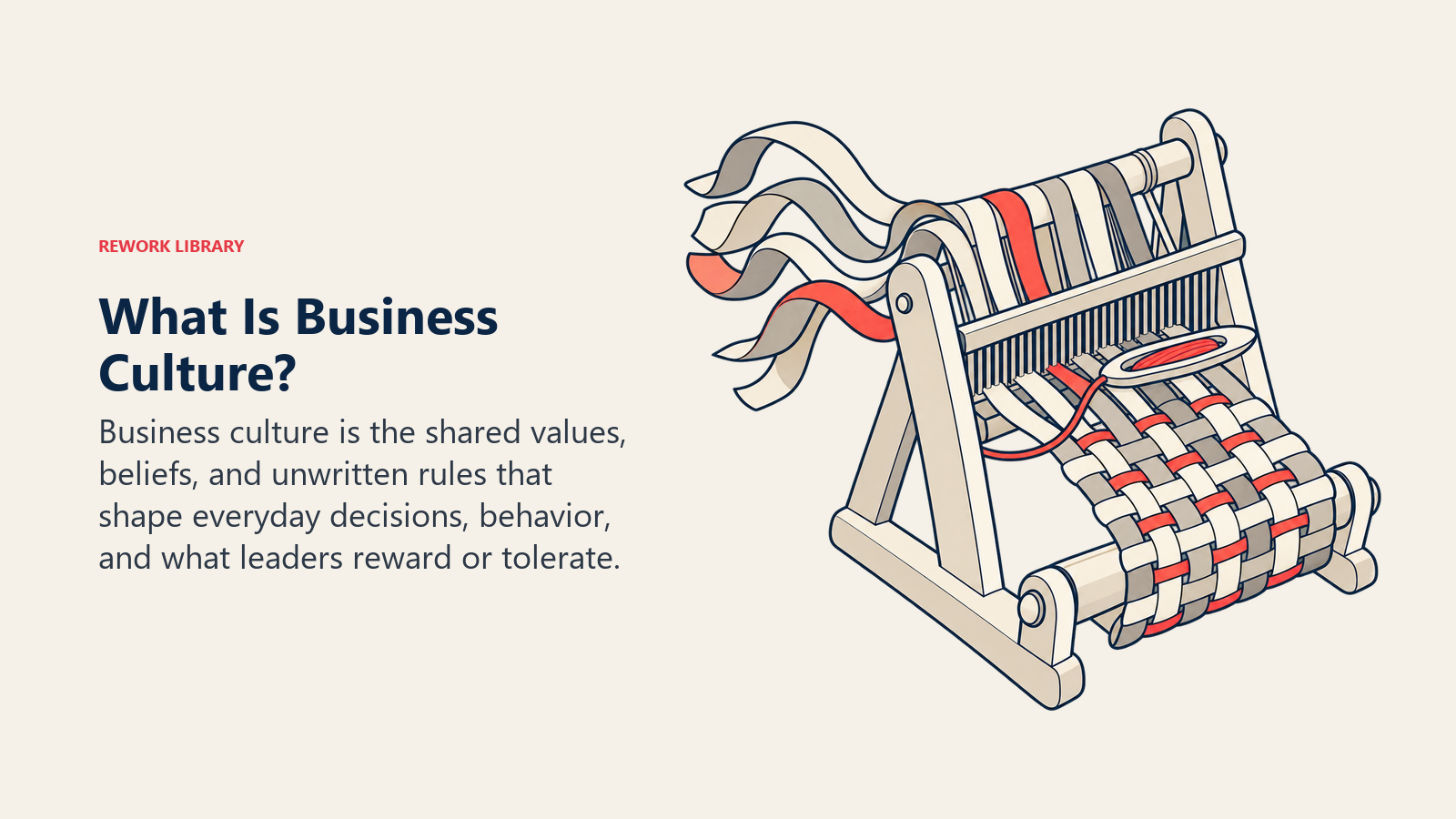
Business culture, also called organizational culture, is the shared set of values, beliefs, and unwritten rules that shape how people in a company actually work together: how decisions get made, how feedback lands, what gets rewarded, and what leaders tolerate when it is easier to look away.
That last part is the whole story. A careers page can say "we value transparency" all day long. The real culture shows up in what happens the first time a high performer hides a mistake, or a manager sits on bad news for a week, or someone gets promoted despite a trail of complaints about how they treat junior staff. Culture is not the poster on the wall. It is the pattern of behavior that repeats when nobody is grading the performance.
What Business Culture Actually Is
Every organization has a culture, whether or not anyone designed it. Left alone, culture forms the way sediment forms: early employees model certain behaviors, certain stories get retold, certain people get promoted, and certain problems get quietly tolerated. A few years in, those patterns have hardened into norms that new hires read and copy, often without anyone explaining them out loud.
That is the accidental version. The deliberate version treats culture as a system with levers: who gets hired, who gets promoted, what gets measured, what behavior gets a pass from a high performer, and which stories leadership tells about the company's own history. Pull those levers consistently and culture moves. Leave them alone and no amount of values workshops will change what people actually do on a Tuesday afternoon under deadline pressure.
Business culture is not the same thing as company personality or brand voice, though the three often get confused. A brand voice is how a company sounds to customers. Culture is how the company actually behaves toward its own people, which is a much harder thing to fake for long.
Business Culture vs. Climate vs. Values
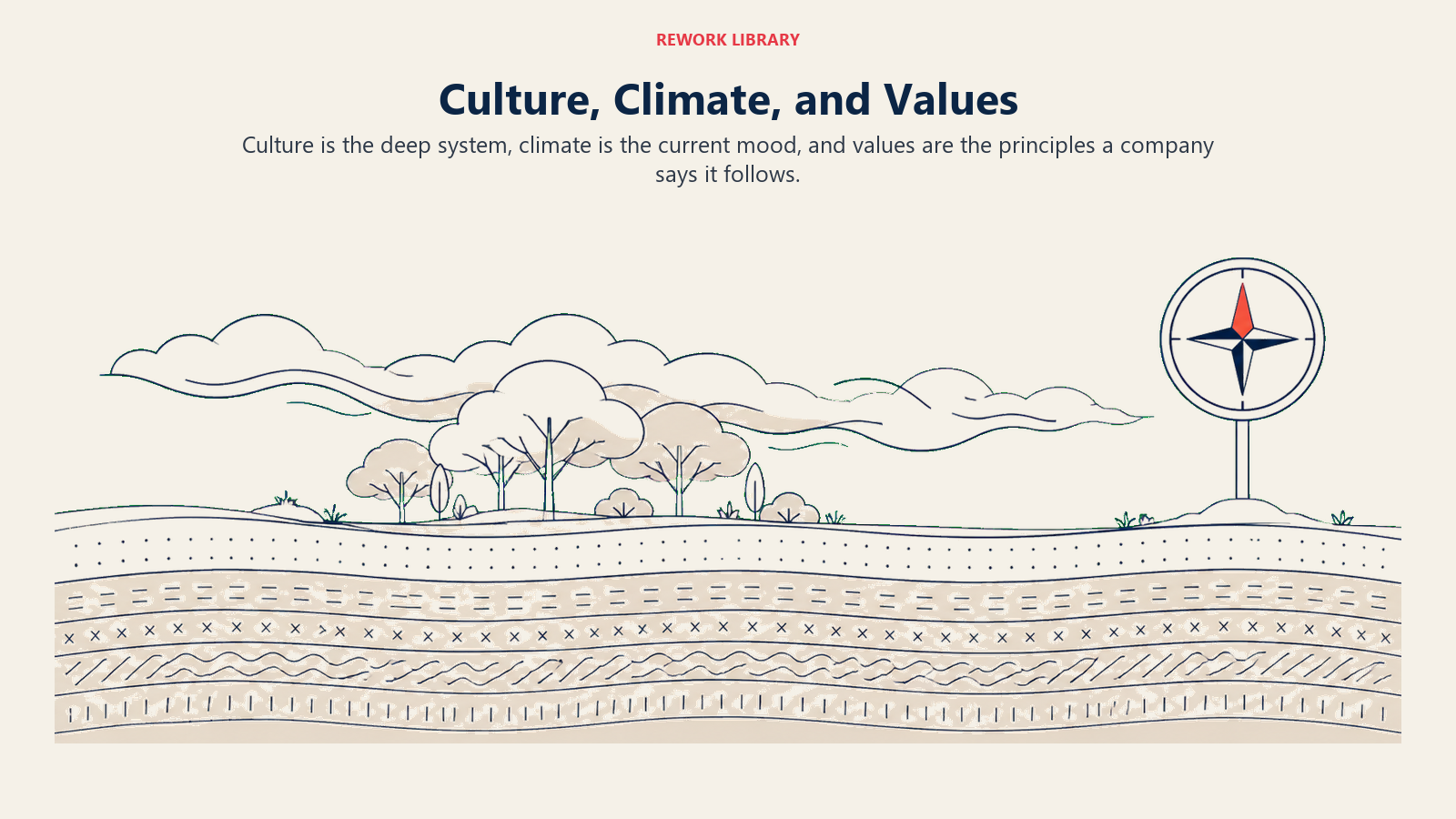
These three terms get used interchangeably, which causes real confusion when a leader tries to diagnose a problem. They are not the same thing, and mixing them up usually means fixing the wrong one.
| Term | What it actually measures | Example |
|---|---|---|
| Culture | The deep, slow-moving system of shared values, beliefs, and unwritten rules that shapes behavior over years | "Around here, nobody ships on a Friday, that's just how we operate" |
| Climate | The current, surface-level mood and perception of the work environment at a given moment | "Morale has been tense since the reorg" |
| Values | The explicit, stated principles an organization claims to hold | "Customer obsession" printed on the careers page or the all-hands slide |
Climate is the weather. Culture is the climate zone. A company can have a rough month (bad climate: layoffs just happened, everyone is on edge) without its underlying culture (how decisions get made, how feedback flows, what gets rewarded) actually changing. And a company can publish beautiful values that have almost no relationship to its real culture, which is exactly what an engagement survey usually exposes.
Key Facts
- Only 20% of U.S. employees strongly agree they feel connected to their organization's culture, even as most workers say culture shapes whether they stay. Source: Gallup
- Managers account for at least 70% of the variance in team engagement scores across business units, meaning culture at the team level usually comes down to who is managing it. Source: Gallup
- Companies in the top quartile of McKinsey's Organizational Health Index deliver total shareholder returns roughly three times higher than bottom-quartile companies. Source: McKinsey
- Employees at organizations with a strong sense of purpose are far more confident about growth: 82% versus 48% at organizations without one. Source: Deloitte Core Beliefs and Culture Survey
- 77% of adults say they would consider a company's culture before applying for a job, and 56% say culture matters more than salary for job satisfaction. Source: Glassdoor
- Workers who rate their culture as good or excellent are almost four times more likely to stay with their employer, and 83% say it motivates them to do high-quality work, versus 45% in poor cultures. Source: SHRM
- Google's two-year Project Aristotle study of more than 180 teams found psychological safety, the concept pioneered by Harvard's Amy Edmondson, was the top factor separating its highest-performing teams from the rest. Source: Google re:Work
The Three Levels of Culture
Organizational psychologist Edgar Schein's model is still the clearest way to understand why culture is so hard to see and even harder to change. He described culture as three nested layers, from most visible to least.
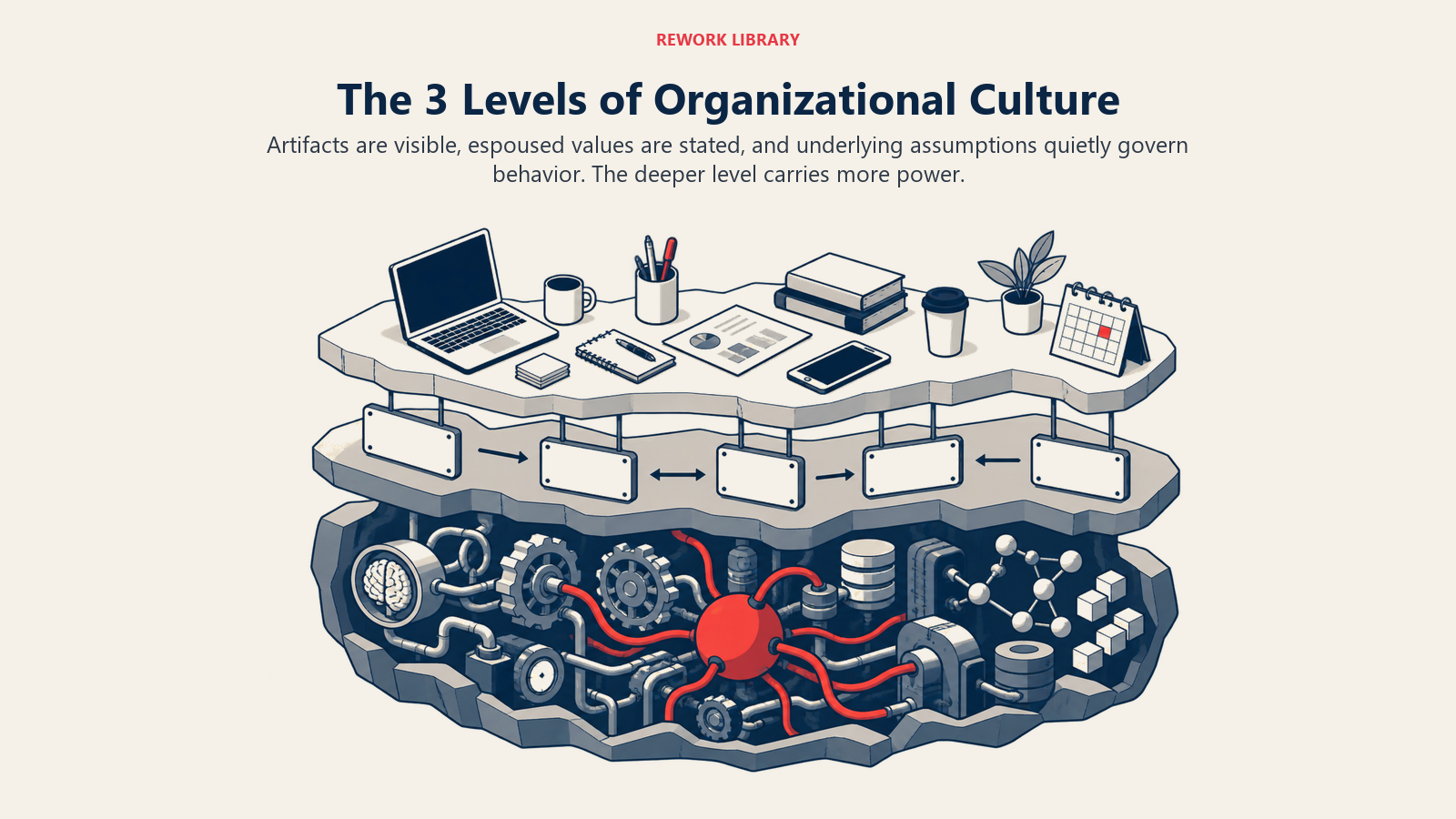
Artifacts. The stuff you can observe directly: the office layout, the meeting rituals, the language people use, how performance reviews are structured, which metrics sit on the dashboard everyone watches. Artifacts are easy to spot and easy to copy from another company, which is why they are also the least reliable signal of real culture. A beanbag chair and an open floor plan do not make a culture collaborative.
Espoused values. What the organization says it believes: innovation, integrity, customer focus, teamwork. Most companies spend most of their culture energy here, on the values statement, the onboarding deck, the all-hands talk. Espoused values matter, but they describe intention, not behavior, and every employee eventually notices the gap if one exists.
Underlying assumptions. The deepest layer: unconscious beliefs about how the world works that shape behavior without anyone discussing them out loud. "Customers cannot articulate what they actually want." "Managers cannot be trusted with ambiguous authority." "Conflict is dangerous, so smooth it over." These assumptions are usually invisible to the people who hold them, because they feel like plain facts rather than beliefs that could be wrong.
Most culture change efforts fail because they only touch artifacts and espoused values (a new mission statement, a new office) while leaving the underlying assumptions and the systems that reinforce them untouched.
Four Types of Organizational Culture
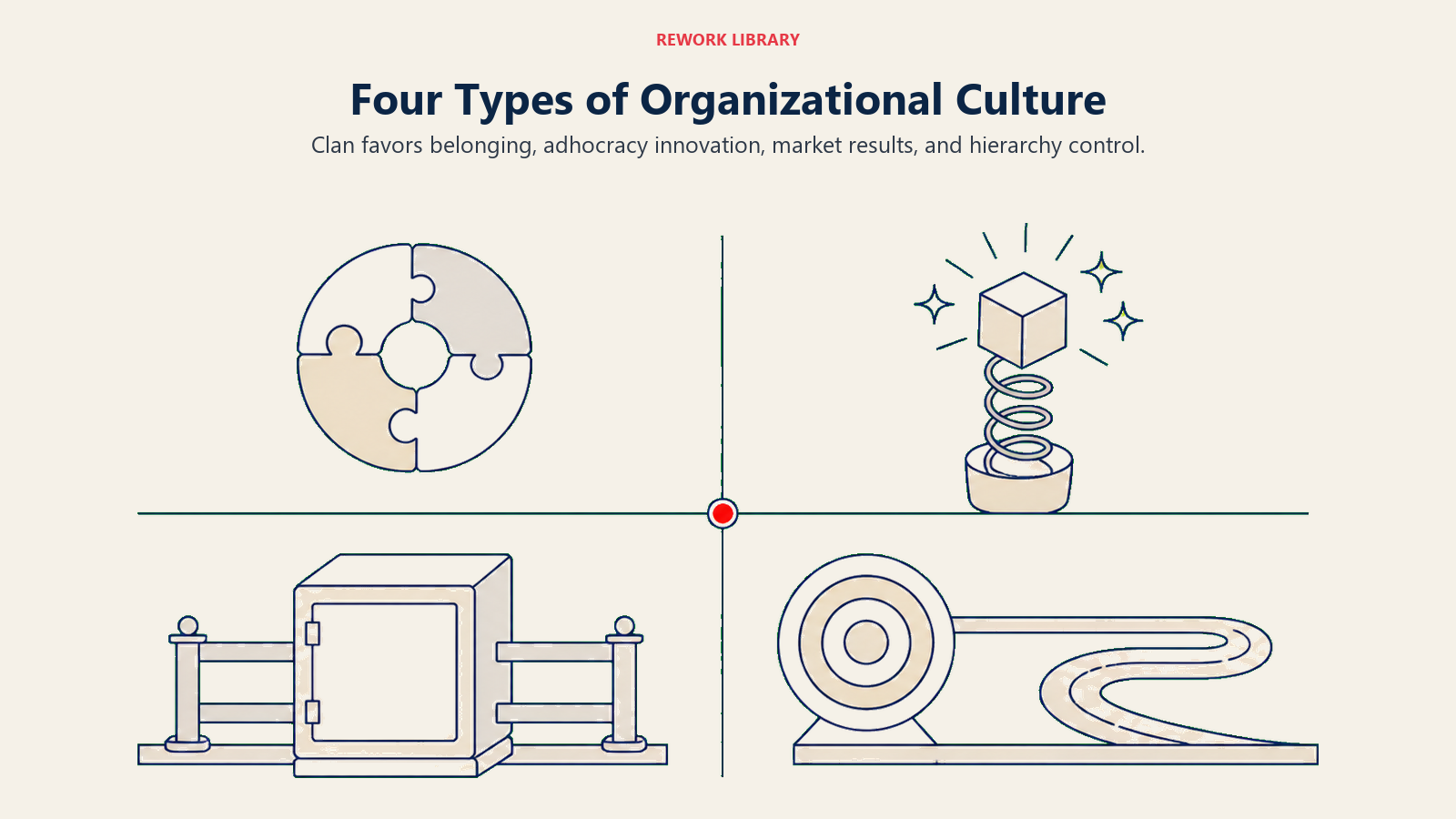
Different organizations need different cultures depending on their strategy, and there is no single "correct" culture to install. The Competing Values Framework, developed by researchers Kim Cameron and Robert Quinn, maps culture along two axes: flexibility versus stability, and internal focus versus external focus. That produces four recognizable types.
| Culture type | Core focus | What it looks like | Where it tends to fit |
|---|---|---|---|
| Clan | Internal, flexible: collaboration and belonging | Mentorship, teamwork, a family-like feel, consensus decisions | Early-stage teams, people-heavy service businesses |
| Adhocracy | External, flexible: innovation and risk-taking | Experimentation, fast iteration, tolerance for productive failure | Product-led startups, R&D, creative agencies |
| Market | External, stable: results and competition | Aggressive targets, clear accountability, customer and competitor focus | Sales-driven organizations, scaling companies chasing growth |
| Hierarchy | Internal, stable: process and control | Standardized procedures, clear reporting lines, predictability | Regulated industries, manufacturing, large operations teams |
Most real companies are a blend, with one type dominant and a secondary type showing up in specific functions. A fast-growing SaaS company might run an adhocracy culture in product and a market culture in sales, which is normal. The problems start when the dominant culture stops matching what the strategy actually requires, for example when a company that needs disciplined execution is still operating like an early-stage clan.
National vs. Company vs. Team Culture
Business culture operates at three layers at once, and leaders who only manage one of them get surprised by the other two.
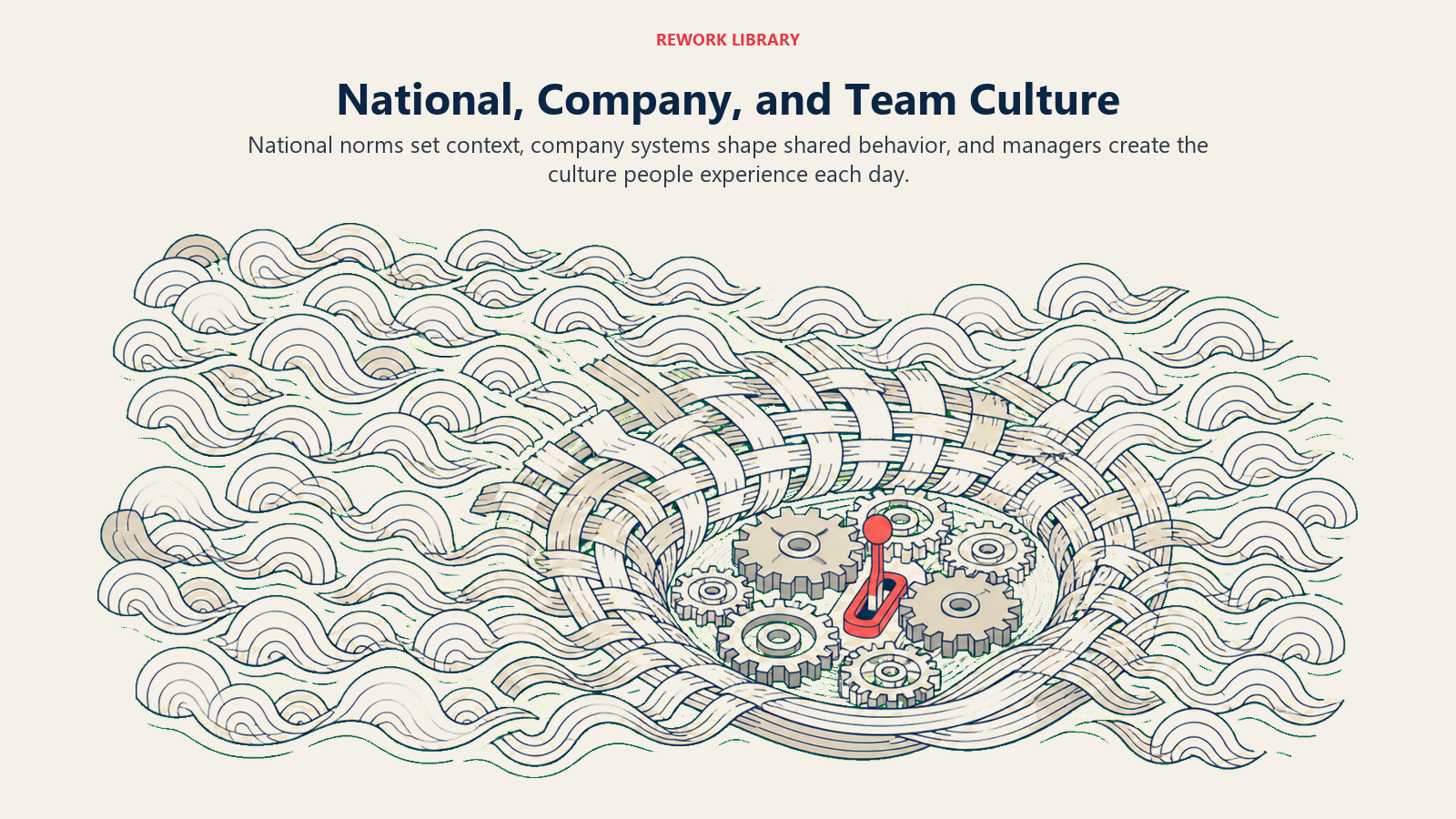
National culture is the broad, slow-changing set of norms a country's population tends to share around hierarchy, communication style, decision-making, and trust. It is shaped over generations, long before anyone joins a company. We break down how it varies by country, with Hofstede's research and a practical playbook for leading across it, in how business culture differs across the world and in Hofstede's cultural dimensions explained. Erin Meyer's work on reading these differences at the team level is covered in The Culture Map, explained.
Company culture is the narrower, chosen set of values and systems an organization deliberately builds on top of whatever national cultures its employees bring with them. A global company's culture has to work with national culture, not pretend it does not exist, adapting how values get communicated and reinforced in each country without abandoning the values themselves.
Team culture is the most local and often the most powerful layer, because it is shaped directly by a manager's daily behavior. Two teams inside the same company, with the same stated values and the same benefits, can feel completely different depending on who leads them. This is also where culture problems are easiest to spot early. When a team goes quiet in meetings and stops raising concerns, that is rarely a company-wide issue; it usually traces back to one manager's habits, a pattern we cover in why teams stay silent in meetings.
Why Business Culture Matters
Culture is not a soft topic that competes with strategy for attention. It is one of the clearest predictors of whether a strategy actually gets executed, because strategy gets carried out by people making thousands of small, unsupervised decisions every day, and culture is what governs those decisions when no policy covers the specific situation.
The performance link shows up most clearly in retention and execution quality. Workers who rate their culture as good or excellent are far more likely to stay and far more motivated to do quality work than workers in poor cultures, and companies with genuinely healthy organizations post materially stronger shareholder returns than their peers. On the flip side, weak culture shows up as quiet costs that rarely get attributed correctly: quiet quitting, slow decision-making because nobody trusts each other enough to move fast, avoidable turnover of exactly the people a company can least afford to lose, and a widening gap between what leadership announces and what the front line actually experiences.
Culture also compounds. A team that trusts its manager enough to surface bad news early catches problems while they are still small. A team that has learned silence is safer than speaking up will let the same problems grow until they become expensive, visible failures. That compounding effect is why culture, unlike a marketing campaign, gets more valuable or more costly the longer it runs unmanaged.
How Leaders Actually Shape Culture
Culture is not primarily a communication problem, so it does not get fixed with better communication. It is a systems problem: who gets hired, who gets promoted, what gets measured, what behavior gets excused from a high performer, and what leaders model when it would be easier not to.
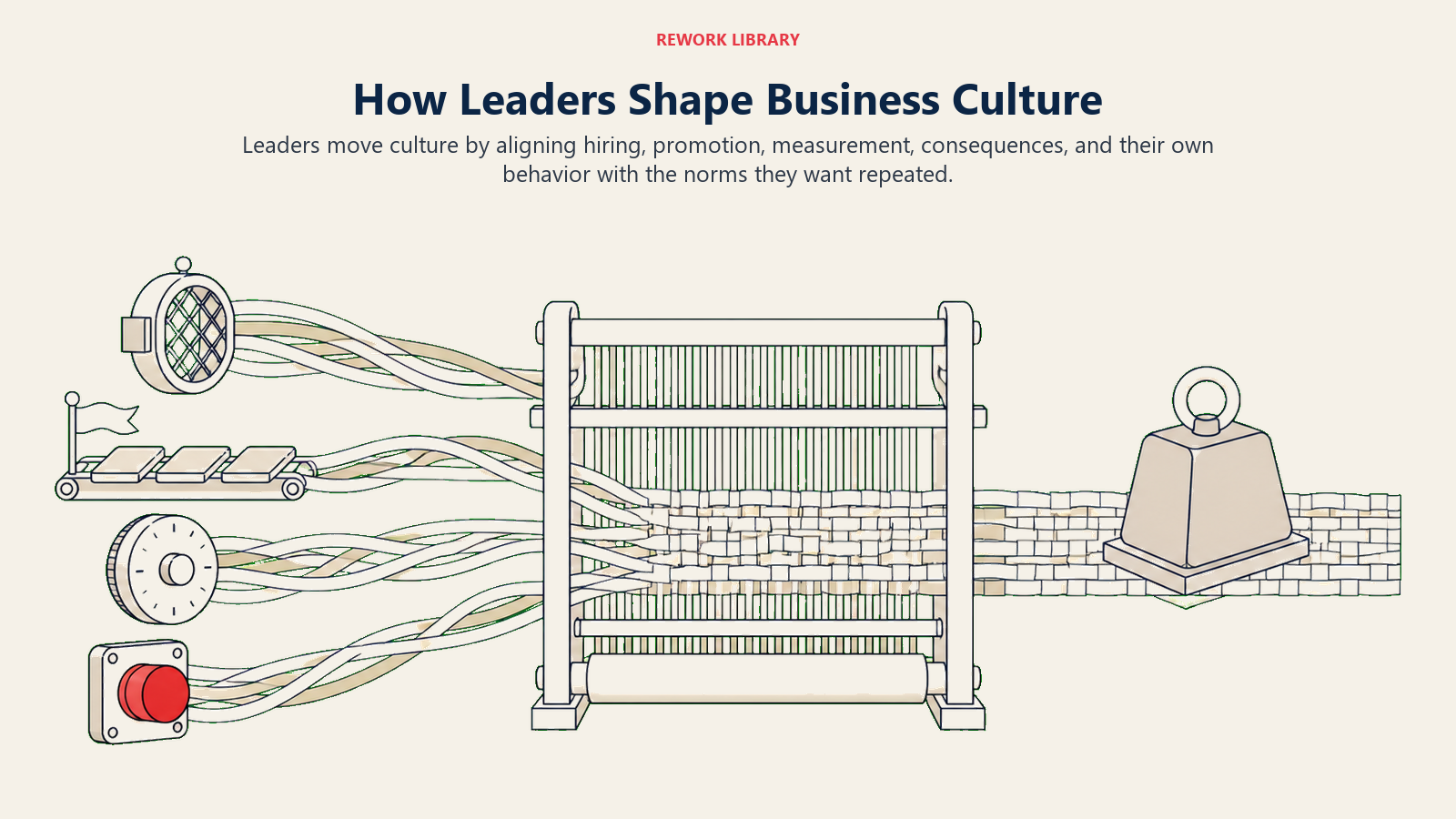
Diagnose the real culture before trying to change it. Look at what actually happens, not what the survey says people wish were true: who gets promoted and why, what a new hire learns in their first ninety days about how things really work, what gets tolerated from your best performer that would get anyone else fired.
Change the systems, not just the messaging. If the stated value is collaboration but performance reviews only reward individual output, the system wins every time. Fixing culture means fixing the performance criteria, the promotion process, and the recognition practices so they actually reinforce the behavior leadership says it wants. Culture architecture covers this system-by-system redesign process in depth, and succession planning covers how culture continuity depends on who gets developed into future leadership roles.
Model it visibly, especially under pressure. Leaders are the loudest cultural signal in any organization. When a leader's behavior under stress matches the stated values, that behavior becomes the credible template everyone copies. When it does not, the gap becomes the real lesson employees learn, no matter what the values deck says.
Protect psychological safety on purpose. Teams where people feel safe raising a concern, admitting a mistake, or challenging a decision consistently outperform teams where they do not, which is the core finding behind psychological safety and the specific behaviors that build talent density and psychological safety together. See what leadership actually means for how this connects to influence versus authority more broadly.
Tooling plays a smaller but real role here. Culture lives in decisions and systems more than in software, but the operational side of culture, consistent onboarding, visible recognition, and clean handoffs between HR and the rest of the business, is easier to run consistently when it is not scattered across five disconnected tools. That is the kind of unglamorous consistency Rework's People app (HRIS, time and attendance, and timesheets in one platform) is built to support, not a replacement for the harder leadership work above it.
Where to Go Next
This article is the foundation for the rest of this collection. From here:
- How business culture differs across the world, for the Hofstede-based map of national culture and a leader's playbook for global teams
- Hofstede's cultural dimensions explained, for the full six-dimension model behind that map
- The Culture Map, explained, for Erin Meyer's framework on reading communication and feedback differences across teams
- Why teams stay silent in meetings, for the specific, fixable pattern behind most "we have no problems" teams that actually do
Frequently Asked Questions about Business Culture
What is business culture in simple terms?
Business culture is the shared set of values, beliefs, and unwritten rules that shapes how people in a company actually behave: how decisions get made, how feedback is delivered, what gets rewarded, and what gets quietly tolerated. It is best understood as what the organization actually does, not what it says it values.
What is the difference between business culture and organizational culture?
There is no meaningful difference. "Business culture" and "organizational culture" describe the same thing, the shared behavioral norms of a company, and are used interchangeably across research and practice. Some writers use "corporate culture" as a third synonym for the same concept.
What are the three levels of organizational culture?
Edgar Schein's model describes three layers: artifacts (visible things like office layout and rituals), espoused values (what the organization says it believes), and underlying assumptions (the unconscious beliefs that actually drive behavior). Real culture change requires working at the underlying assumptions and enacted behavior layer, not just the visible artifacts.
What are the four types of organizational culture?
The Competing Values Framework, developed by Kim Cameron and Robert Quinn, identifies four types: clan (collaborative, internally focused), adhocracy (innovative, externally focused), market (results-driven, externally focused), and hierarchy (process-driven, internally focused). Most organizations blend a dominant type with a secondary one rather than fitting cleanly into a single quadrant.
How is company culture different from national culture?
National culture is the broad set of norms a country's population tends to share, shaped over generations before anyone joins a company. Company culture is the narrower, deliberately chosen set of values and systems an organization builds, which has to work alongside national culture rather than override it, especially for global teams.
Does business culture actually affect financial performance?
Yes. McKinsey's Organizational Health Index research finds that companies in the top quartile of organizational health deliver roughly three times the total shareholder returns of bottom-quartile companies, and research from SHRM and Gallup links strong culture directly to higher retention, motivation, and engagement, all of which show up in execution quality and cost.
Can culture be changed, or is it fixed once it forms?
Culture can be changed, but only by changing the systems that produce it (hiring, promotion, performance management, what gets tolerated from high performers), not by changing communication alone. Meaningful change at the level of enacted behavior typically takes years of consistent, aligned systems, not a single campaign or values refresh.
What is the fastest way to damage a strong culture?
Tolerating a clear violation of a stated value from a high performer, especially a visible one, does more damage to culture than almost anything else a leader can do. Every employee watches what happens in that moment and updates their understanding of what the organization actually rewards, regardless of what the values statement says.
Culture is not a slide in the onboarding deck. It is the accumulated result of every hiring decision, every promotion, every piece of feedback given or withheld, and every time leadership chose to look away instead of addressing a problem. The organizations with strong business culture did not get there by talking about culture more than everyone else. They got there by managing the systems that produce it with the same rigor they apply to the systems that produce revenue.

Co-Founder, Rework.com