How to Define Company Values That Actually Work
Turn this article into takeaways for your work.


Each assistant summarizes the article only for you and suggests best practices for your work.
To define company values that actually work, write down the specific, sometimes uncomfortable trade-offs your organization will consistently make, then build hiring, review, and promotion decisions around them. A values statement only counts as "real" once it changes what happens the next time someone violates it and a high performer is the one who did it.
Most companies never get past the first half of that sentence. They pick a handful of nice-sounding words, put them on a slide, and call the job done. Six months later nobody can name them, and the one person who quotes "integrity" in a meeting gets an awkward laugh instead of a nod. That gap between the words on the wall and what happens under pressure is why values work has a bad reputation among people who have sat through one too many offsite workshops.
This guide covers why most values statements fail, what a working one looks like, a step-by-step process for defining values that hold up under pressure, and how to embed them into hiring, reviews, and the decisions leadership makes when a value and a deadline collide.
Why Most Values Statements Fail
Three failure modes show up again and again, and they usually show up together.
They are generic. A 2019 MIT Sloan Management Review study of nearly 700 large companies found that 82% publish an official values statement, and the words repeat almost everywhere: "integrity" appeared in 298 of them, "respect" in 180, "innovation" in 152. Collaboration and customer focus showed up in roughly half. If a value could sit on a rival's careers page without anyone noticing the swap, it is not doing any work. It is decoration.
They are aspirational rather than descriptive. A values statement that describes the company leadership wishes it had, not the one that exists, sets up a credibility problem on day one. New hires read "we value transparency," then watch a reorg get announced with two days' notice and no explanation. The gap gets logged as evidence that the values page is theater.
They are never enforced. This is the failure mode that does the most damage, because employees notice it fastest. The same MIT Sloan research found essentially no correlation between the values a company publishes and how employees rate the actual culture: four of nine value categories studied, including collaboration and customer orientation, were negatively correlated with how well the company was said to live them. Publishing more of a value did not predict living it more, likely because a company reaches for a value publicly precisely where it is weakest.
The Quick Test
Before drafting anything, run each candidate value through one question: could a competitor put this word on their website tomorrow and would anyone notice a difference? If yes, it is not specific enough to guide a real decision. "Integrity" fails this test almost everywhere. "We ship on a Friday if it's ready, even if that means someone works the weekend" passes it, for better or worse, because it names an actual trade-off the company has chosen to make.
Key Facts
- Only 27% of U.S. employees strongly agree they believe in their organization's values, and just 23% strongly agree they can apply those values to their daily work. Source: Gallup
- 82% of large companies publish an official values statement, but "integrity," "respect," and "innovation" are so common (298, 180, and 152 companies respectively, out of roughly 700 studied) that they barely differentiate one culture from another, and the study found essentially no correlation between a company's stated values and how employees actually experienced its culture. Source: MIT Sloan Management Review
- A toxic culture is roughly 10 times more predictive of employee attrition than compensation, based on an analysis of 1.4 million Glassdoor reviews during the first wave of the Great Resignation. Source: MIT Sloan Management Review
- Companies rated good or excellent on culture see workers who are almost four times more likely to stay, a pattern directly tied to whether values are lived rather than just published. Source: SHRM
What Real Company Values Look Like
Real values share three traits that generic values statements almost never have.
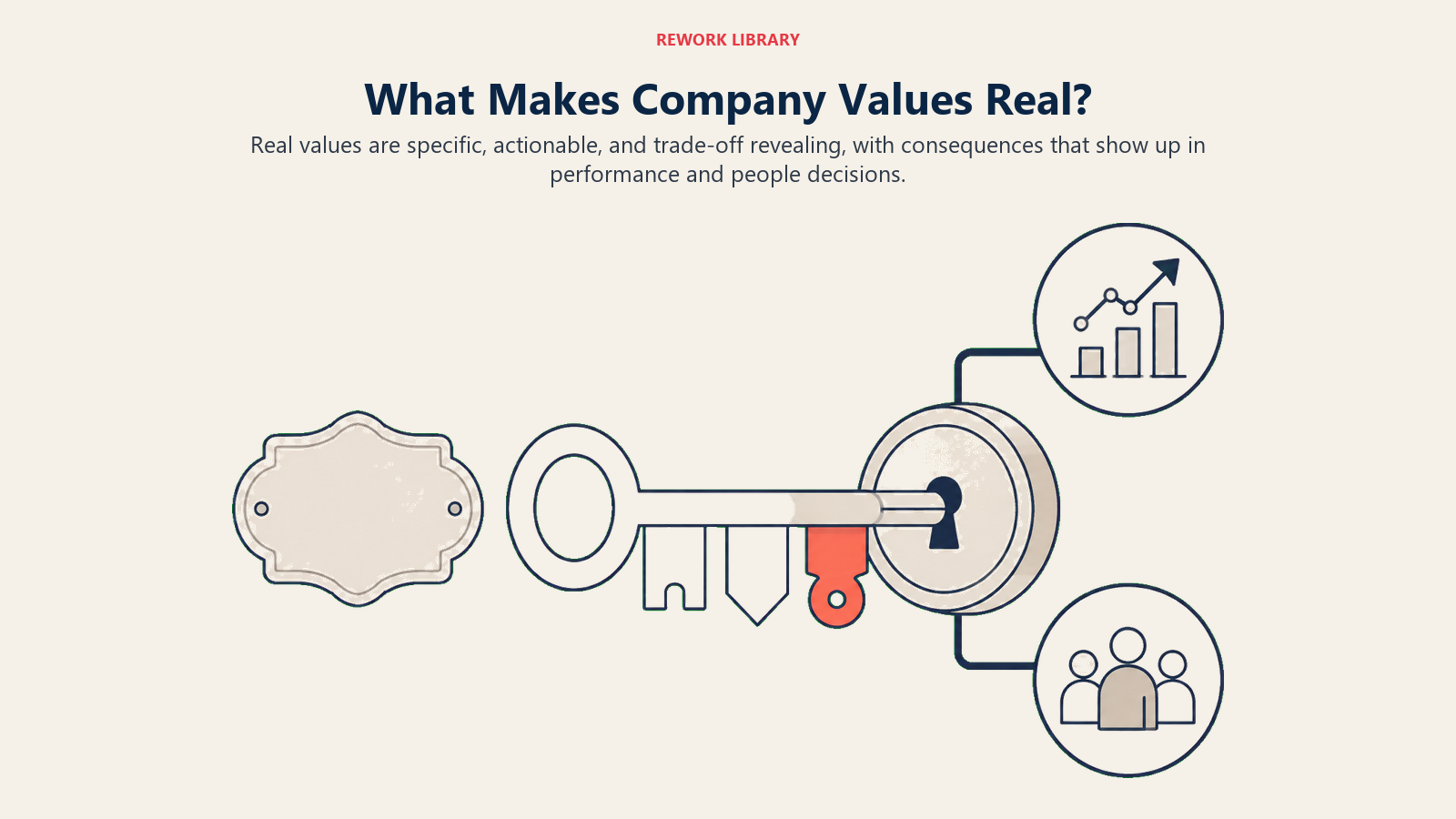
Specific. A real value names a concrete behavior or decision rule, not a virtue. "We default to the customer's account of what happened, not our own dashboard" is specific. "Customer-centric" is not, because two companies can both claim it while operating in opposite ways.
Actionable. An employee should be able to use the value to make an actual decision without asking a manager first. If a value cannot answer "what should I do right now," it is a slogan, not a value.
Trade-off revealing. The trait most companies skip, because it is the one that costs something. A real value names what the company gives up to hold it. "We move fast" is not a value until it is paired with what fast costs: fewer safety checks, more shipped bugs, less consensus before a decision. A value with no visible cost was never actually chosen. It was just agreed with.
The Netflix Example
Netflix's approach to values, first published in its 2009 culture memo and still the most cited example in this space, starts from a blunt premise in the words of co-founder Reed Hastings: real company values are the actual behaviors and skills a company rewards in employees, not the ones printed on a hallway poster. Netflix's current culture memo lists specific, judgeable behaviors like judgment, candor, courage, and selflessness rather than adjectives like "excellence," and says plainly that it is "easy to talk about values and harder to live them."
The trade-off shows up in how Netflix says it treats performance: the company has been open that it manages toward a "keeper test," which sets a much higher bar for who stays on a team than most organizations claim to run. Agree with that model or not, it demonstrates the underlying discipline: a real value comes with a real, sometimes uncomfortable consequence attached, not just a word on a slide.
| Generic value | What it actually says | Specific, decision-ready version |
|---|---|---|
| Integrity | Nothing a competitor could not also claim | "We tell the customer the real timeline, even when a shorter one would close the deal" |
| Excellence | An aspiration with no enforcement mechanism | "We do not ship a feature the on-call engineer would be uncomfortable supporting at 2am" |
| Customer-centric | A direction, not a rule | "Support tickets get a human reply within 4 business hours, no exceptions during a launch week" |
| Innovation | A word every startup pitch deck already uses | "Every team ships one experiment a quarter that might fail publicly" |
| Teamwork | Describes an intent, not a behavior | "We staff the unglamorous project before we staff the exciting one, on a rotation, no volunteering out" |
How to Define Company Values: A Step-by-Step Process
Skip the offsite whiteboard session that starts with "what words describe us?" That question produces adjectives. Start instead from evidence.
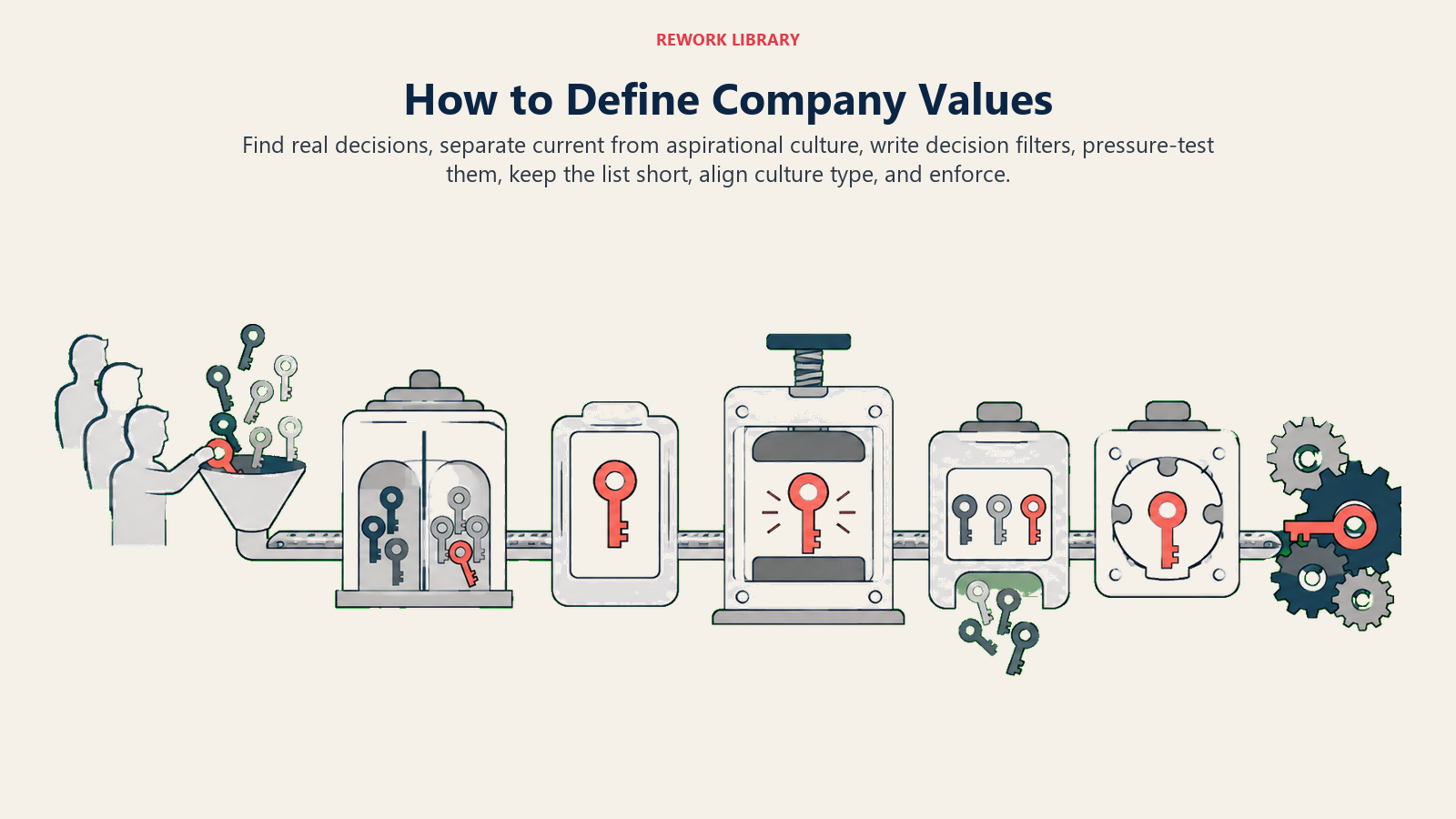
Step 1: Find the moments that already reveal your real culture
Look at the last four or five hard calls leadership actually made: a customer commitment kept or broken under pressure, a high performer who got a pass or did not, a deadline missed on purpose to protect quality, or the reverse. These moments already show what the organization values, whether anyone wrote it down or not, the same diagnostic instinct behind Schein's three levels of culture: the assumptions that actually drive behavior live below the espoused values and only surface in real decisions, not in workshops.
Step 2: Separate what you value from what you wish you valued
Every leadership team has a gap between the culture it has and the culture it wants. Both are worth naming, but only the first belongs in the values statement as written today. Aspirational culture belongs in a strategy document about where the company is headed, not in a document meant to describe what already governs decisions. Confusing the two is one of the most common ways culture, climate, and values get tangled together.
Step 3: Write each value as a decision filter, not an adjective
Rewrite each candidate value as a rule an employee could apply without asking permission. "We value transparency" becomes "any decision affecting more than one team gets posted in the open channel before it ships, not after." The second version is falsifiable: someone can point to a specific instance where it held or broke. The first cannot be checked against anything.
Step 4: Pressure-test with the high-performer question
For each value, ask: would we actually let this cost us our best salesperson, our fastest engineer, or our most senior manager if they violated it visibly? If the honest answer is no, the value is aspirational, and it should either get cut or get a genuine enforcement mechanism before it goes public. This single question filters out more fake values than any workshop exercise.
Step 5: Keep the list short enough to actually remember
Three to six values is the practical range. Beyond that, most employees cannot recall the full list, and a value nobody can name cannot guide a decision. If a draft list grows past six, look for values that are really the same idea worded twice, which happens more often than expected once trade-offs get made explicit.
Step 6: Decide which culture type the values need to reinforce
A values list is not one-size-fits-all. A regulated operations team leaning toward a hierarchy culture needs values that reward consistency and process discipline; a product team running more like an adhocracy needs values that reward fast, reversible bets. The Competing Values Framework is a useful check: values that fight the culture type a function actually needs get quietly ignored no matter how well they are worded.
Step 7: Publish, then commit to the harder half
Writing the values down is the easy 20% of the work. The other 80% is building the systems, described below, that make them true. Publish only once leadership has agreed to the enforcement side, because a values statement published without teeth is worse than no statement at all: it invites employees to measure the gap.
How to Embed Values So They Actually Stick
A values statement with no system behind it decays within a year. Four systems carry most of the weight: hiring, performance reviews, promotion and firing decisions, and recognition.
Hiring. Interview for the decision-rule version of each value, not the adjective. Ask candidates to describe a real moment where they had to choose between two things the company claims to value, speed versus quality for example, and listen for whether they can name what they gave up. A candidate who cannot describe a trade-off has probably not been tested against a real value before.
Performance reviews. If a value cannot appear as a line item that affects a rating, a bonus, or a promotion case, it is decorative, not embedded. This is where most values programs quietly die: the review template stays focused entirely on output metrics, and values become a paragraph nobody reads. Reviews are also where the pattern in how to build a feedback culture matters most, because a value only becomes real once managers name a violation directly instead of softening it into vague language.
Promotion and firing decisions. The highest-leverage moment for making values visible, and the one leadership is most tempted to skip when the person involved is valuable. Every employee watches what happens the first time a high performer is caught violating a stated value, and that moment teaches the organization more about its real values than a year of internal communications.
Recognition and rituals. Public recognition tied to a named value, not a generic "great job," reinforces the specific behavior rather than general effort. A shout-out that says "Maria pushed back on a deadline because it would have meant skipping the accessibility check we said we'd never skip" teaches the value far more effectively than a poster ever will.
Measuring whether this is working is covered in how to measure company culture, and the full system-by-system redesign is covered in culture architecture. Values and psychological safety reinforce each other too: a value like candor only survives if people trust that raising an uncomfortable point will not cost them, the core finding behind psychological safety at work.
Values vs. Behaviors: Why the Distinction Matters
A value is a stated principle. A behavior is the observable action that either honors or breaks it. The confusion between the two is where most values programs go wrong: leadership drafts values, publishes them, and stops, assuming behaviors will follow from the words alone.
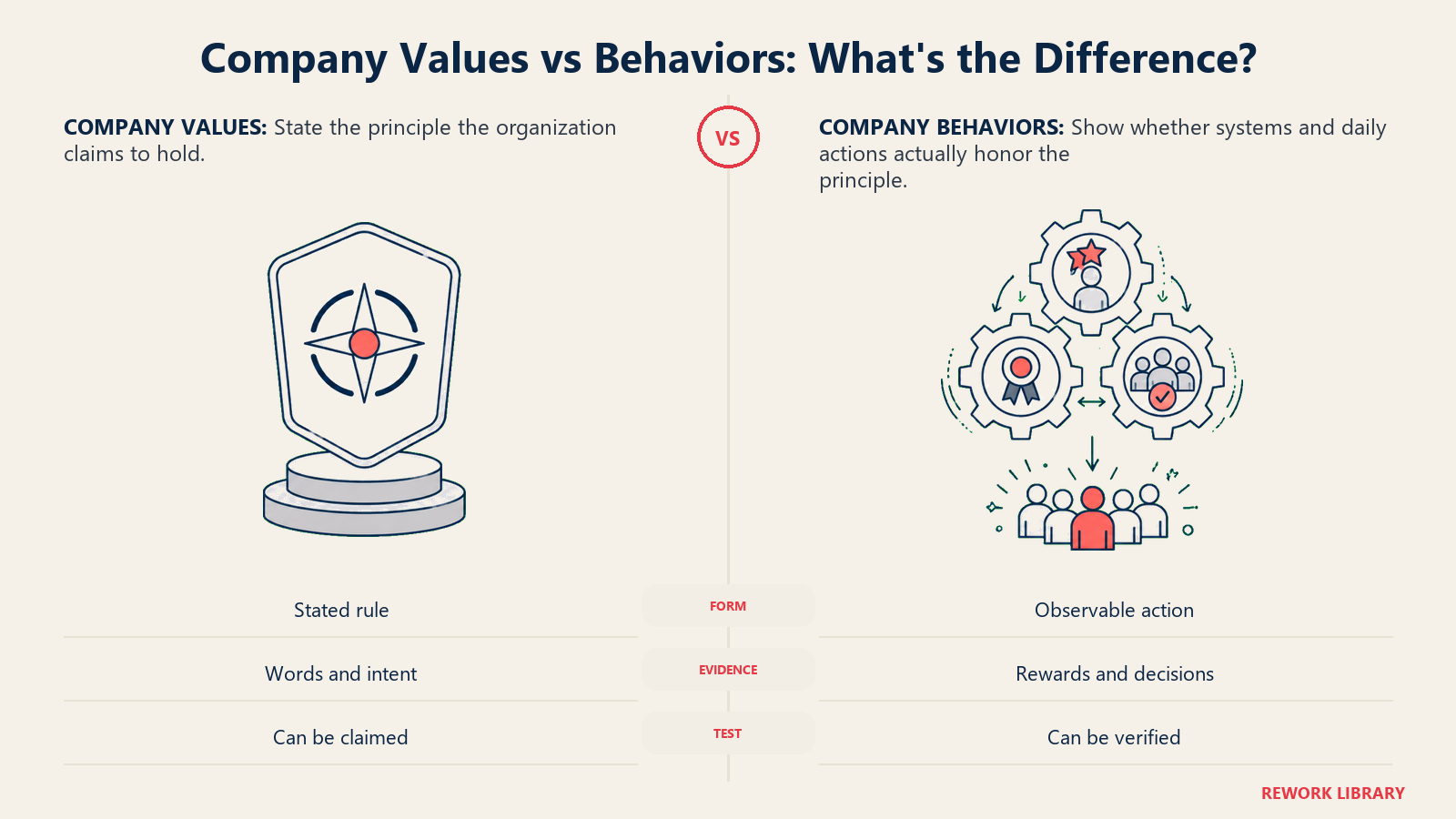
They will not, for the same reason a mission statement does not change a roadmap by itself. Behaviors change when the systems around them change: what gets measured, what gets rewarded, what gets tolerated from a high performer. A company can have a beautifully worded value and a workforce that has never once seen it enforced. In that case, the real value, in the Schein sense of the assumption that actually governs behavior, is whatever gets rewarded instead, which is why the link between culture and performance runs through enacted behavior, not the words in the document. Values also compound differently at each layer of the organization, worth reading alongside national vs. company vs. team culture: a manager's daily choices can uphold or quietly override a company-wide value long before anyone notices.
Defining Values in the Age of AI
One honest complication: some moments that used to reveal a company's real values, like how a manager handles a mistake or gives credit for hard work, now happen partly through an AI teammate instead of a person. If an agent drafts a decision or a piece of work under pressure, the same test applies: does it get checked with the rigor a human's work would get, or a quiet pass because reviewing it is slower than trusting it? That quiet pass is the same enforcement gap that used to expose a fake human values statement, and it exposes an AI-era one just as fast.
This does not require a separate values list for AI-assisted work, just the existing pressure-test question, "would this actually cost something to enforce," applied to a wider set of moments than before. The deeper shift in how culture works once AI does part of the job, including where credit, trust, and effort norms get renegotiated, is covered in what is AI-native culture.
Where to Go Next
- What is business culture? for the foundational models this guide builds on
- Schein's three levels of culture for why values on their own rarely predict behavior
- How to measure company culture for checking whether a values rollout is actually working
- Culture architecture for the full system-by-system redesign that makes values durable
Frequently Asked Questions about Defining Company Values
What are core company values?
Core company values are the small set of specific, decision-guiding principles an organization consistently enforces, not just states. A real one is specific enough to guide an actual decision and costly enough that upholding it sometimes means giving something up, like a deadline, a sale, or a high performer.
How many core values should a company have?
Most practitioners recommend three to six. Beyond that range, employees generally cannot recall the full list, and a value nobody can name cannot guide behavior. A shorter, genuinely enforced list beats a longer, aspirational one every time.
What is the difference between company values and company culture?
Values are the explicit principles a company states it holds. Culture is the actual, observed pattern of behavior, including the gap between what is stated and what is enforced. A company can publish values with almost no relationship to its real culture, which is exactly what employee surveys tend to expose.
Why do most company values statements fail?
They tend to be generic words like "integrity" or "excellence" that any competitor could also claim, aspirational rather than descriptive of what already happens, and never tied to hiring, review, or promotion decisions. Research from MIT Sloan Management Review found essentially no correlation between companies' stated values and how employees actually experienced the culture.
How do you know if a value is real or just aspirational?
Ask whether the company would let the value cost it something, specifically a high-performing employee's job or a big deal, if that person or deal clearly violated it. If the honest answer is no, the value is aspirational, not real, at least not yet.
How do you define values for a fast-growing startup?
Look at the trade-offs the founding team has already made under real pressure, not the ones they aspire to make later. A 20-person company's real values usually live in specific stories everyone already knows, like the time a launch got delayed to fix a bug nobody outside the company would have noticed. Write those down before growth erases why those calls were made.
Can AI-generated work reveal whether a company's values are real?
Yes, in the same way any new source of pressure does. If work produced with AI assistance gets a lighter review than human-produced work purely because checking it is inconvenient, that gap exposes the same kind of unenforced value that has always shown up when a company's stated principles meet a deadline.
A values statement is not the goal. The goal is a set of decision rules specific enough to use without asking permission, and costly enough that the organization feels it the day one gets enforced against someone it would rather protect. Most companies stop at the words. The ones whose culture holds up under pressure built the systems, in hiring, reviews, and the decisions nobody wants to make, that turned the words into something true.

Co-Founder, Rework.com
On this page
- Why Most Values Statements Fail
- The Quick Test
- Key Facts
- What Real Company Values Look Like
- The Netflix Example
- How to Define Company Values: A Step-by-Step Process
- Step 1: Find the moments that already reveal your real culture
- Step 2: Separate what you value from what you wish you valued
- Step 3: Write each value as a decision filter, not an adjective
- Step 4: Pressure-test with the high-performer question
- Step 5: Keep the list short enough to actually remember
- Step 6: Decide which culture type the values need to reinforce
- Step 7: Publish, then commit to the harder half
- How to Embed Values So They Actually Stick
- Values vs. Behaviors: Why the Distinction Matters
- Defining Values in the Age of AI
- Where to Go Next