Onboarding for Culture: How the First 90 Days Shape Belonging
Turn this article into takeaways for your work.


Each assistant summarizes the article only for you and suggests best practices for your work.
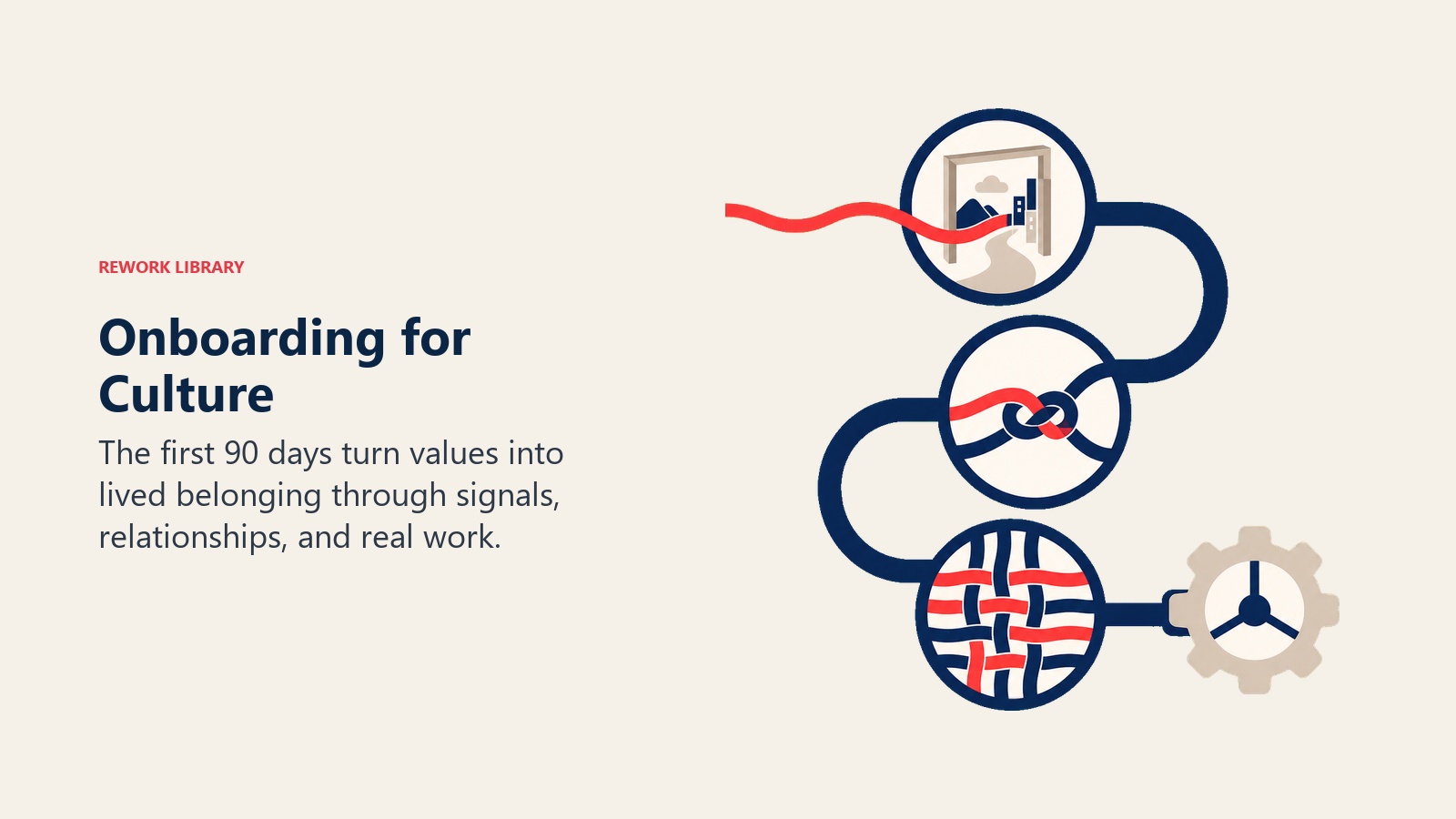
Culture onboarding is the practice of using a new hire's first days and weeks to transmit how the organization actually works, not just how to file expenses or set up a laptop. Done well, it turns the shared values and unwritten rules behind the culture into lived behavior a new hire can copy from day one. Done as paperwork, it leaves them to guess, and guessing is where belonging goes to die.
Most companies still treat onboarding as a logistics problem: forms, system access, a benefits walkthrough, maybe a slide with the mission statement on it. That gets someone set up to work. It does almost nothing to help them understand who to trust, what gets rewarded, and what gets quietly punished, and new hires answer those questions for themselves in the first couple of weeks either way.
This article covers why onboarding functions as culture transmission, what new hires pick up in week one, how to design culture-first onboarding, the gap remote and cross-cultural onboarding open up, how to measure whether it worked, and what changes once some teammates are AI agents.
What Culture Onboarding Actually Means
Orientation and culture onboarding get treated as the same thing, and that mix-up is most of the problem. Orientation is administrative: paperwork, tool access, the org chart. It answers "how do I do my job here." Culture onboarding answers a harder question: "how do people actually behave here, and what happens to the ones who don't."
You can run flawless orientation and still produce a new hire who feels like an outsider three months in, because nobody showed them how decisions get made or the unwritten rules around things like camera-on meetings or admitting you're stuck. Those are the layers Edgar Schein described as the three levels of culture: visible artifacts, stated values, and the underlying assumptions nobody says out loud. Orientation covers artifacts. Real onboarding has to reach the assumptions, or the new hire spends months learning them the hard way.
Culture Onboarding vs. a Values Deck
A values deck states what the company believes. Culture onboarding shows what it does. That gap is what a sharp new hire notices fastest, since they have no history yet to explain it away the way a veteran employee has learned to. Their first impression is the most honest read anyone will get on whether the culture is real.
Why Onboarding Is Culture Transmission, Not Paperwork
Every organization transmits culture to new hires whether or not anyone plans for it. The only real choice is whether that transmission is deliberate or accidental. Left accidental, a new hire pieces together "how things work here" from whatever lands in front of them: a slow reply, a meeting that ran long because nobody wanted to interrupt a senior person, a manager who canceled three 1:1s in a row. None of that is a formal lesson. All of it teaches something.
The Story New Hires Write in Week One
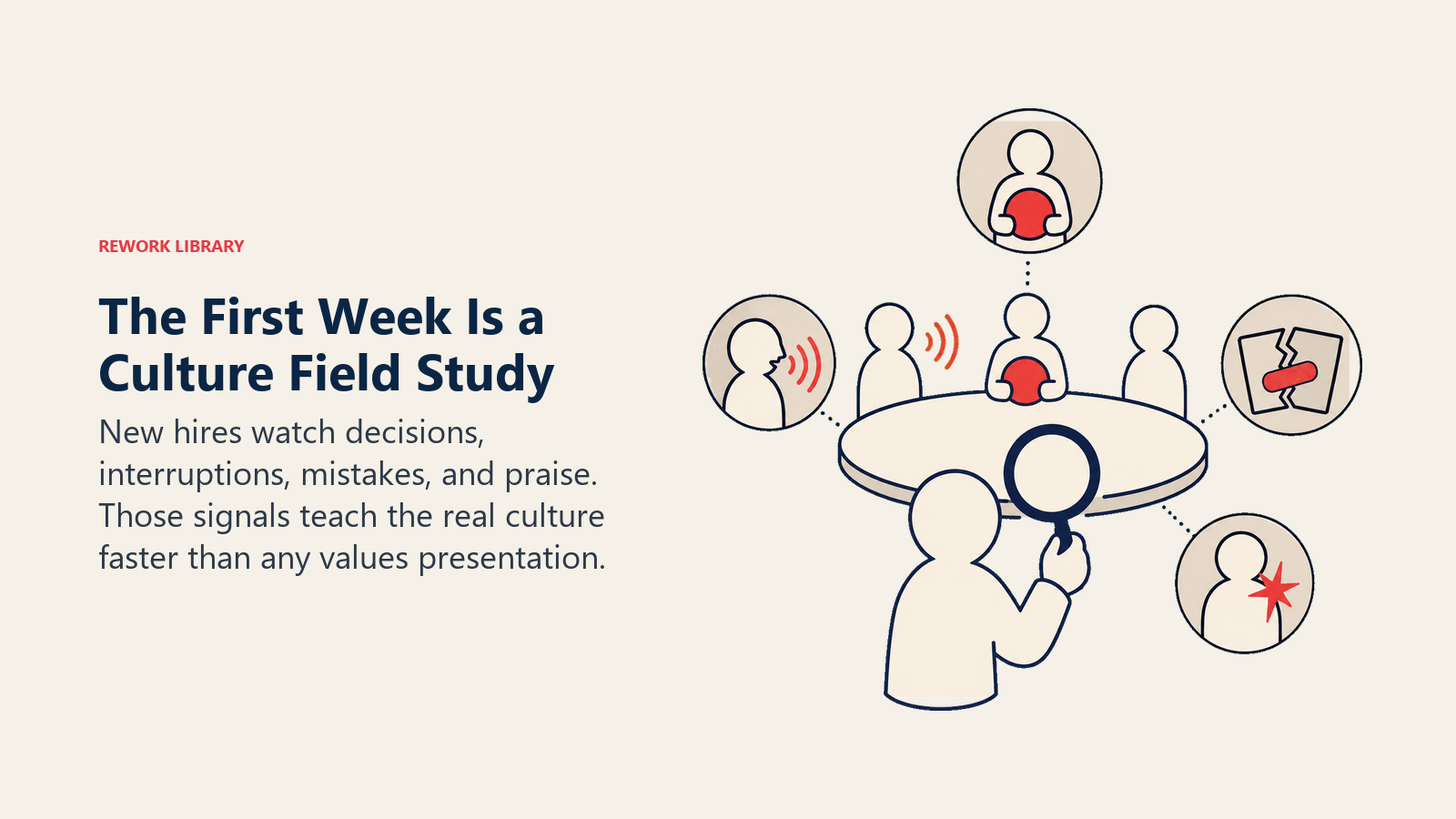
New hires arrive actively building a story about whether they made the right call in taking the job. Every small signal in the first two weeks feeds that story: whether their manager showed up to the first 1:1, whether the team included them in a lunch or a channel, whether a question got a patient answer or a sigh. By week three, most have already written a working draft of "what this place is really like," and that draft is hard to rewrite later. That is the mechanism behind culture onboarding: the highest-attention window a person will ever have in the organization, before they learn to tune out the signals the way tenured employees do.
Key Facts
- Only 12% of U.S. employees strongly agree their organization does a great job onboarding new employees. Source: Gallup
- New hires who complete a structured onboarding program are 58% more likely to still be with the company three years later. Source: SHRM (Wynhurst Group research)
- 86% of HR and business leaders believe a new hire's decision to stay long-term is effectively made within the first six months. Source: SHRM (Aberdeen Group research)
- Effective onboarding can lift new-hire performance by up to 11% and increase discretionary effort by more than 20%. Source: SHRM (Corporate Leadership Council data)
- Replacing an employee who leaves early can cost as much as two times their annual salary. Source: SHRM (BambooHR research)
- 46% of workers worry about missing out on coworker relationships because of hybrid work, a gap that hits hardest when a new hire has no relationship history to fall back on. Source: SurveyMonkey
What New Hires Actually Learn in the First Week
Ask a new hire what they learned in orientation and they'll describe the org chart and the benefits deadline. Ask what they learned about how the place really works, and you'll get a more honest list: who actually makes decisions versus whose name is on the slide, whether meetings start on time, and whether raising a concern gets a thoughtful answer or silence.
The Norms Nobody Puts in the Handbook
These norms never make it into a handbook, since they're too obvious to the people who already know them: which meetings are safe to skip, whether "we're flat" is true or every decision routes through one person, whether admitting "I don't know" reads as honesty or incompetence. A new hire absorbs the answers within days, just by watching what gets rewarded and ignored.
How New Hires Decode "How Things Really Work" Here
The decoding is fast and mostly nonverbal. New hires watch what a manager does under mild pressure more closely than what they say in a values talk, since behavior under pressure is harder to fake than a rehearsed line. They notice who gets interrupted in meetings, and whether a mistake in week two gets treated as normal ramp-up or a mark against them. Those moments confirm or quietly contradict whatever the deck claimed on day one, and contradictions get remembered far longer than the deck does.
Designing Culture-First Onboarding
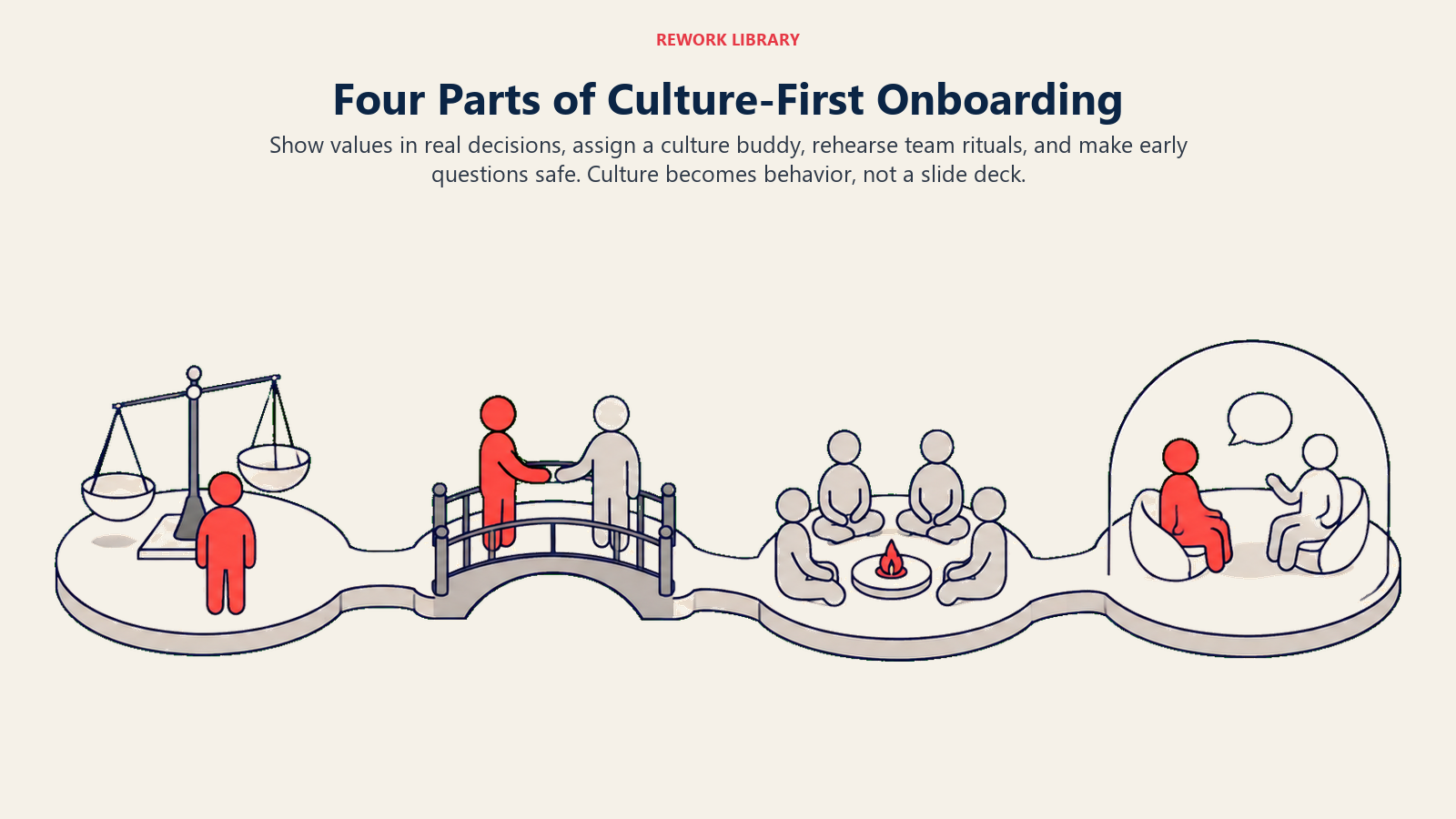
Since onboarding transmits culture whether you plan for it or not, the only real choice is designing that transmission deliberately, treating the first 90 days as a curriculum for the norms that matter, not just a checklist for system access.
Put Values in Action, Not on a Slide
Stating a value is cheap. Showing it in action is what makes it real. If the value is candor, put a manager in front of the new hire giving real, specific feedback in week one, so they see what candor sounds like instead of being told it exists. If the value is customer obsession, have the new hire sit in on a real customer call in week one instead of reading a case study about it. Values-in-action onboarding replaces the abstraction with a concrete memory the new hire can point back to later.
Buddy and Mentor Systems That Actually Transmit Culture
A buddy assigned on paper and never briefed does almost nothing. A buddy who actually transmits culture has one job: answer the questions a new hire is too embarrassed to ask their manager, like "is it actually okay to leave at 5:30" or "who really decides this." Those questions rarely get asked upward, but they get asked sideways constantly, which is why the buddy relationship carries more real culture information than most formal content combined. Pick buddies who model the behavior you want copied, not whoever has a free calendar slot.
Rituals That Signal Belonging Early
Small, repeatable rituals do more for early belonging than one big welcome event: a recurring team check-in the new hire speaks in from day one, a shared channel where wins get called out by name, a first-week lunch that isn't skippable because "everyone's busy." The ritual matters less than the signal underneath it, that they're already part of this, not an outsider earning a seat. That's how recognition reinforces culture and performance instead of leaving belonging to chance.
Building Psychological Safety From Day One
New hires are, by default, the least psychologically safe people on any team, with the least social capital and the most to lose by getting something visibly wrong. Waiting for them to "settle in" just extends that vulnerable period. The fix is direct: a manager who says, in week one, "you will get things wrong here, tell me when you're stuck," and then rewards the first time someone does exactly that. That moment, followed through on, does more to establish psychological safety than any values statement, because it's the first real test of whether the stated openness is genuine.
The Remote Onboarding Challenge
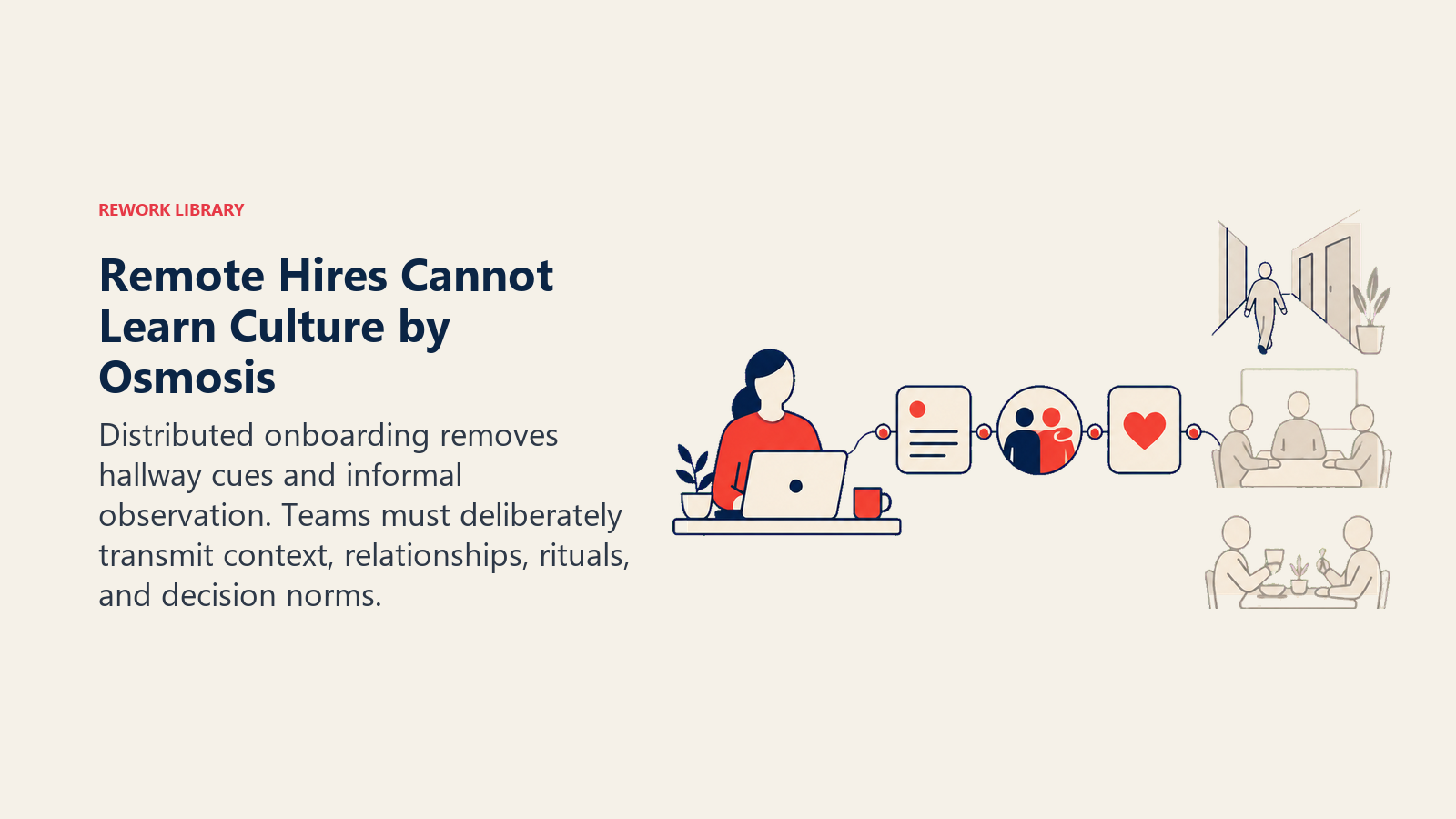
Remote and hybrid onboarding removes the channel most culture transmission used to travel through by accident: physical proximity. In an office, a new hire absorbs norms just by being near people, overhearing how a disagreement gets resolved, catching the tone of a hallway conversation after a hard meeting. None of that happens automatically over a laptop.
What Gets Lost Without a Hallway
The loss isn't information, it's incidental exposure. A remote new hire can read every document in the wiki and still miss the tone of how the team actually talks to each other, since tone rarely survives being written down. They don't overhear a manager handle a frustrated customer call, or catch the informal debrief after a rough meeting. Nearly half of workers already say hybrid work makes coworker relationships harder to build, and a brand-new remote hire starts from zero relationship history, which widens that gap.
How to Rebuild the Hallway on Purpose
Rebuilding that channel means making the incidental deliberate: standing, low-stakes video time with people outside the new hire's direct reporting line, and decisions narrated in writing the way they'd have been overheard in a hallway, why a call got made, not just what it was. Team-level culture is shaped most directly by a manager's daily behavior, a dynamic covered in team culture versus company and national culture, so remote managers carry more of this weight than they realize. A tight, transparent first 90 days can out-connect a mediocre in-office one, but it takes intention an office used to provide for free.
Cross-Cultural Onboarding Nuance
A culture onboarding program built around one country's defaults will misfire the moment it meets a new hire from a different one, usually as confusion rather than obvious conflict. A direct, "ask me anything" style reads as welcoming in a low power-distance culture and uncomfortably informal in a high power-distance culture, where a new hire may want more structure before feeling comfortable improvising.
Adjusting the Delivery Without Diluting the Culture
The fix isn't a different culture for every new hire, it's adjusting delivery while keeping the value constant. If candor is the value, a new hire from a high-context culture may need it delivered privately, framed around growth, before it reads as helpful rather than a public correction, while a low-context new hire may find an indirect version confusing and want it stated plainly. Neither changes what the company values, only how it lands, the same skill covered in how to manage a multicultural team. Skip this and some new hires quietly disengage over delivery, not the value itself.
Measuring Onboarding-Culture Fit
Most onboarding metrics measure logistics: forms completed, modules finished, time to system access. None of that tells you whether culture transmitted. Measuring fit means asking a harder question: does this new hire understand how things really work here, and do they feel like they belong yet.
Leading Indicators in the First 90 Days
A few signals surface fit before any formal review: whether a new hire has volunteered something unprompted in a meeting by week two, asked their buddy an "embarrassing" question instead of quietly guessing, or been included by name in something informal, not just a calendar invite. These are the same signals that show up when measuring company culture more broadly, just captured earlier and at a more personal scale.
Running a Real 90-Day Culture Check-In
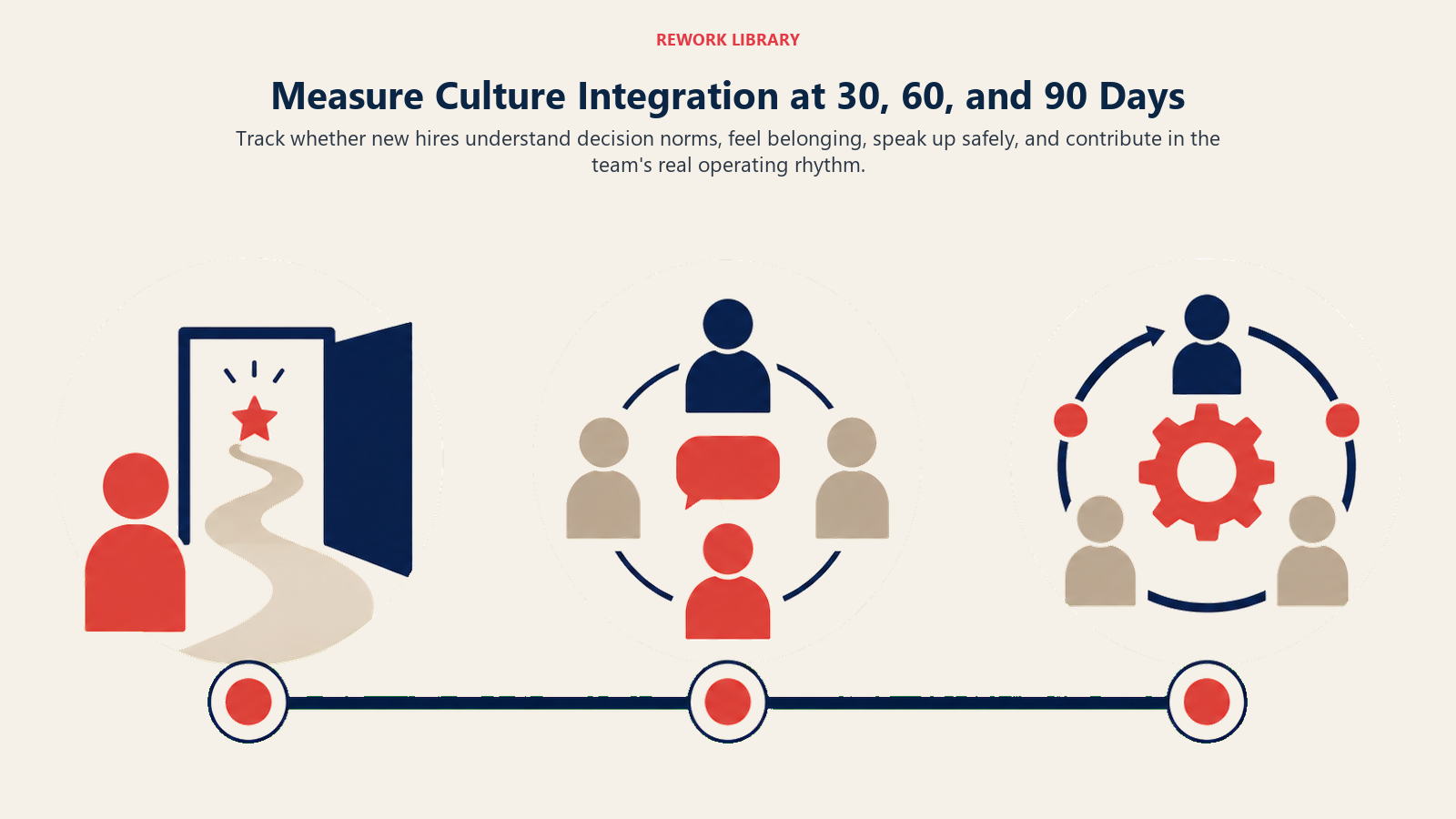
A structured 30-60-90 day check-in that only covers task performance misses the culture question. A version built for culture fit adds a short set of questions: what surprised you about how we work here, what's still unclear about how decisions get made, is there anything you've noticed that doesn't match what we told you before you joined. That last question matters most, since new hires only answer it honestly once they feel safe enough to, which makes the check-in itself a live test of whether the psychological safety work took. The operational side, consistent checklists, timely reminders, one record instead of five spreadsheets, is the unglamorous consistency Rework's People app is built to support, without pretending software can do the relationship-building above it.
Onboarding People Into Human-Agent Teams
A growing number of new hires now join teams where some day-to-day collaborators are AI agents, a shift covered more broadly in what AI-native culture actually means. Onboarding hasn't fully caught up, and it's worth being honest about what's genuinely new here versus automation wearing a new label.
Genuinely new: norms that didn't exist a few years ago, like when it's appropriate to hand a task to an agent, how to disclose AI-assisted work without it reading as evasive, and how much to trust an agent's output before treating it as done. Those are culture questions, not just tooling ones, and skipping them leaves new hires to guess at exactly the moment they're least equipped to.
Unchanged: agents handle onboarding logistics well, answering policy questions, nudging an incomplete task, walking someone through setup, the kind of scoped work covered in a build blueprint for an employee onboarding agent. What an agent can't do is the part that builds belonging: modeling how a disagreement gets resolved, noticing a new hire has gone quiet, making someone feel welcomed rather than processed. Treat agents as a logistics layer underneath onboarding, not a substitute for it.
Where to Go Next
- Schein's three levels of culture, why new hires read behavior faster than values statements
- Psychological safety at work, how to build the safety onboarding depends on
- How to manage a multicultural team, the broader playbook behind this article's cross-cultural section
- How to measure company culture, turning early signals into an ongoing system
Culture onboarding isn't a slide deck, and it isn't a checklist that ends when the laptop gets set up. It's the first, highest-attention test of whether the stated culture and the real one match. Get the first 90 days right and you don't just retain a new hire, you hand them the accurate version of "how things work here" they'll pass on to the next one.

Co-Founder, Rework.com
On this page
- What Culture Onboarding Actually Means
- Culture Onboarding vs. a Values Deck
- Why Onboarding Is Culture Transmission, Not Paperwork
- The Story New Hires Write in Week One
- Key Facts
- What New Hires Actually Learn in the First Week
- The Norms Nobody Puts in the Handbook
- How New Hires Decode "How Things Really Work" Here
- Designing Culture-First Onboarding
- Put Values in Action, Not on a Slide
- Buddy and Mentor Systems That Actually Transmit Culture
- Rituals That Signal Belonging Early
- Building Psychological Safety From Day One
- The Remote Onboarding Challenge
- What Gets Lost Without a Hallway
- How to Rebuild the Hallway on Purpose
- Cross-Cultural Onboarding Nuance
- Adjusting the Delivery Without Diluting the Culture
- Measuring Onboarding-Culture Fit
- Leading Indicators in the First 90 Days
- Running a Real 90-Day Culture Check-In
- Onboarding People Into Human-Agent Teams
- Where to Go Next